Applications of Quadratic Functions
5. Review and Problem Solving
Learning outcomes
- I can solve multi-step quadratic problems.
- I can choose appropriate mathematical methods.
- I can interpret solutions in context.
- I can communicate mathematical reasoning clearly.
- I can evaluate the reasonableness of my answers.
Review and Problem Solving: Quadratic Functions
Introduction
Quadratic functions are useful mathematical tools for solving problems involving patterns, graphs, equations, maximum and minimum values, and real-world situations.
In earlier topics, we explored how to recognise, graph, transform, and model quadratic functions. We also investigated projectile motion, optimisation, and quadratic regression.
This review brings these ideas together, focusing on multi-step problem solving.
Successful problem solving requires more than obtaining a numerical answer. It involves choosing an appropriate method, explaining the mathematical reasoning, interpreting results, and checking whether the answer is reasonable.


Reviewing Quadratic Functions
A quadratic function is a function that can be written as:
y = ax² + bx + c
where a, b, and c are constants and a ≠ 0.
The graph of a quadratic function is a parabola.
Important Characteristics
-
A positive a-value produces an upward-opening parabola.
-
A negative a-value produces a downward-opening parabola.
-
The vertex represents the maximum or minimum.
-
The axis of symmetry passes through the vertex.
-
A quadratic function can have zero, one, or two distinct real x-intercepts.
-
Quadratic functions can model many practical situations.
Example
Consider:
y = −2x² + 8x + 3
Since a = −2, the parabola opens downward.
Therefore, the function has a maximum value.
The Three Forms of Quadratic Functions
Quadratic functions can be expressed in three commonly used forms.
|
Form |
Equation |
Main advantage |
|---|---|---|
|
Standard |
y = ax² + bx + c |
Useful for identifying coefficients and applying the quadratic formula |
|
Vertex |
y = a(x − h)² + k |
Reveals the vertex and transformations |
|
Factored |
y = a(x − r₁)(x − r₂) |
Reveals the roots |
Example
Consider the function:
y = x² − 6x + 8
Standard form:
y = x² − 6x + 8
Factored form:
y = (x − 2)(x − 4)
Vertex form:
y = (x − 3)² − 1
All three equations represent the same parabola.
Important Observation
Choosing the most useful form can make a multi-step problem much easier.
Choosing the Appropriate Mathematical Method
Different quadratic problems require different approaches.
|
Problem |
Useful method |
|---|---|
|
Find x-intercepts |
Factoring, square roots, or quadratic formula |
|
Find the vertex |
Vertex form or x = −b/(2a) |
|
Identify transformations |
Vertex form |
|
Find a maximum or minimum |
Vertex |
|
Solve an equation that factors easily |
Factoring |
|
Solve an equation that does not factor easily |
Quadratic formula |
|
Determine the number of real roots |
Discriminant |
|
Model measured data |
Quadratic regression |
|
Interpret a real-world solution |
Apply context and domain restrictions |
Important Observation
A strong problem solver does not automatically use the same method for every problem.
The method should be selected based on the equation and what the question asks.
Solving Quadratic Equations by Factoring
Factoring is often the simplest method when a quadratic expression can be written as a product.
Worked Example
Solve:
x² − 7x + 12 = 0
Step 1: Find Two Numbers
We need two numbers that:
-
Multiply to 12.
-
Add to −7.
The numbers are −3 and −4.
Step 2: Factor
(x − 3)(x − 4) = 0
Step 3: Apply the Zero Product Property
x − 3 = 0
or
x − 4 = 0
Solutions
x = 3 or x = 4
Checking
For x = 3:
3² − 7(3) + 12 = 9 − 21 + 12 = 0
For x = 4:
4² − 7(4) + 12 = 16 − 28 + 12 = 0
Both solutions are correct.
Solving Quadratic Equations Using Square Roots
Square roots are particularly useful when the squared expression is isolated.
Worked Example
Solve:
3(x − 2)² = 27
Divide by 3:
(x − 2)² = 9
Take square roots:
x − 2 = ±3
Therefore:
x = 2 + 3
or
x = 2 − 3
Solutions
x = 5 or x = −1
Important Observation
Remember the positive and negative square roots when solving equations of this form.
Solving Using the Quadratic Formula
The quadratic formula can solve any quadratic equation written in standard form.
x = [−b ± √(b² − 4ac)]/(2a)
Worked Example
Solve:
2x² + 3x − 4 = 0
Identify:
a = 2
b = 3
c = −4
Substitute:
x = [−3 ± √(3² − 4(2)(−4))]/[2(2)]
x = [−3 ± √(9 + 32)]/4
x = [−3 ± √41]/4
Solutions
x = (−3 + √41)/4 ≈ 0.851
x = (−3 − √41)/4 ≈ −2.351
Important Observation
The quadratic formula is especially useful when factoring is difficult or impossible using simple integers.
Using the Discriminant
The discriminant is the expression:
D = b² − 4ac
It tells us how many distinct real solutions a quadratic equation has.
|
Discriminant |
Number of distinct real solutions |
|---|---|
|
D > 0 |
Two |
|
D = 0 |
One repeated root |
|
D < 0 |
None |
Worked Example
Determine the number of real solutions of:
x² − 4x + 7 = 0
a = 1
b = −4
c = 7
D = (−4)² − 4(1)(7)
D = 16 − 28
D = −12
Since the discriminant is negative, there are no real solutions.
Important Observation
The discriminant allows us to predict the number of real roots without calculating the roots themselves.
Finding the Vertex
The vertex is the turning point of a parabola.
For:
y = ax² + bx + c
the x-coordinate of the vertex is:
x = −b/(2a)
Worked Example
Find the vertex of:
y = −x² + 10x − 16
Step 1: Identify Coefficients
a = −1
b = 10
c = −16
Step 2: Find the x-Coordinate
x = −10/[2(−1)]
x = 5
Step 3: Find the y-Coordinate
y = −(5)² + 10(5) − 16
y = −25 + 50 − 16
y = 9
Final Answer
The vertex is:
(5, 9)
The maximum value is 9.
The axis of symmetry is x = 5.
Combining Transformations
Consider:
y = −2(x − 3)² + 4
Compared with the parent function y = x², the graph has undergone:
-
A horizontal translation 3 units right.
-
A vertical stretch by a factor of 2.
-
A reflection across the x-axis.
-
A vertical translation 4 units up.
Characteristics
-
Vertex: (3, 4)
-
Axis of symmetry: x = 3
-
Opens downward
-
Maximum value: 4
-
Range: y ≤ 4
Important Observation
Vertex form allows us to predict the graph before plotting points.
Visualising the Main Graph Characteristics
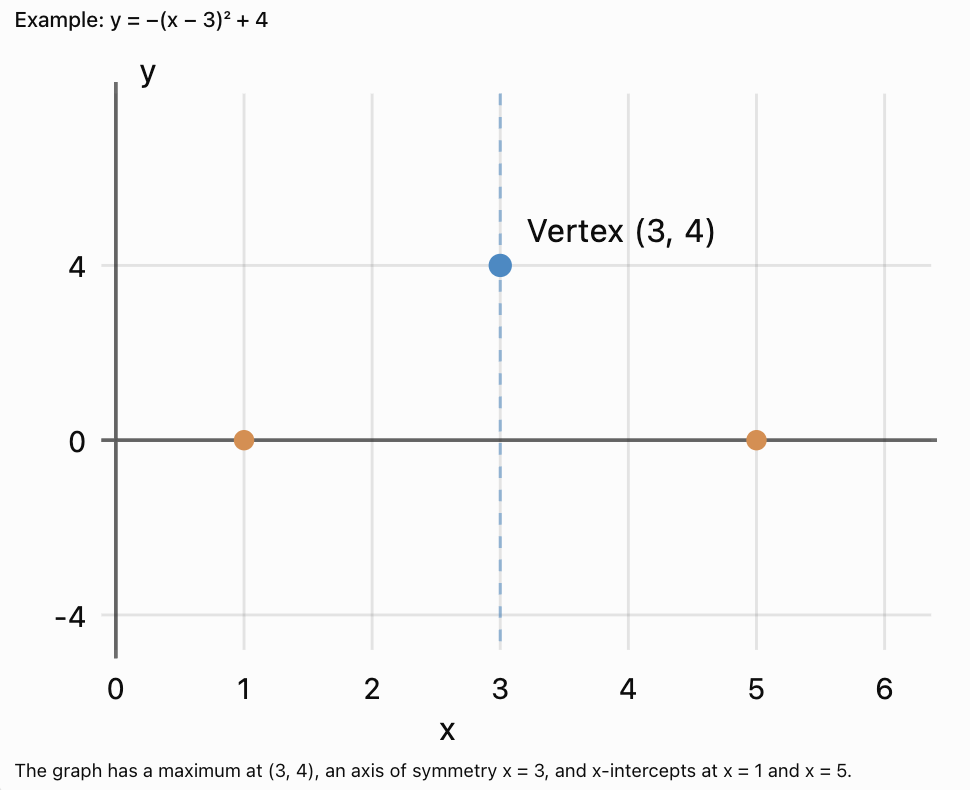
Multi-Step Problem: Rectangular Garden
A gardener has 48 metres of fencing and wants to create a rectangular garden.
Find the dimensions that produce the maximum area.

Step 1: Define Variables
Let:
w = width in metres
l = length in metres
A = area in square metres
Step 2: Write the Perimeter Equation
2w + 2l = 48
Divide by 2:
w + l = 24
Rearrange:
l = 24 − w
Step 3: Create the Area Function
A = lw
A = w(24 − w)
A(w) = −w² + 24w
Step 4: Find the Vertex
w = −24/[2(−1)]
w = 12 m
Step 5: Find the Length
l = 24 − 12
l = 12 m
Step 6: Calculate the Area
A = 12 × 12
A = 144 m²
Step 7: Interpret
The maximum garden area is 144 m², achieved with a square measuring 12 m by 12 m.
Step 8: Evaluate Reasonableness
Check the perimeter:
2(12) + 2(12) = 48 m
The dimensions satisfy the fencing restriction.
The answer is reasonable.
Multi-Step Problem: Projectile Motion
A ball is launched upward from a platform 5 metres high.
Its height is modelled by:
h(t) = −5t² + 25t + 5
where t is time in seconds and h is height in metres.
Find the maximum height and the time when the ball reaches the ground.

Finding Maximum Height
The vertex occurs at:
t = −b/(2a)
t = −25/[2(−5)]
t = 2.5 seconds
Substitute:
h(2.5) = −5(2.5)² + 25(2.5) + 5
h(2.5) = −31.25 + 62.5 + 5
Maximum height = 36.25 m
Finding Landing Time
Set height equal to zero:
0 = −5t² + 25t + 5
Divide by −5:
t² − 5t − 1 = 0
Use the quadratic formula:
t = [5 ± √(25 + 4)]/2
t = [5 ± √29]/2
The two solutions are approximately:
t ≈ 5.19
t ≈ −0.19
Reject the negative time because it occurs before launch.
Final Answer
The ball reaches a maximum height of 36.25 metres after 2.5 seconds.
It reaches the ground approximately 5.19 seconds after launch.
Evaluating Reasonableness
The ball begins 5 metres above ground level.
It rises to a maximum and then falls.
The landing time is greater than the time to maximum height, which is consistent with the situation.
Multi-Step Problem: Business Profit
A business models its profit using:
P(x) = −2x² + 40x − 100
where x is the number of products sold and P is profit in dollars.
Find the number of products that maximises profit and determine the maximum profit.
Step 1: Identify the Goal
We need to find the maximum profit.
Since a = −2, the parabola opens downward.
Step 2: Find the Vertex
x = −40/[2(−2)]
x = 10
Step 3: Calculate Profit
P(10) = −2(10)² + 40(10) − 100
P(10) = −200 + 400 − 100
P(10) = $100
Interpretation
The model predicts a maximum profit of $100 when 10 products are sold.
Reasonableness Check
The optimal quantity is a whole number.
It is also positive.
The answer is reasonable under the assumptions of the model.
Multi-Step Problem: Constructing a Quadratic Equation
A parabola has vertex (2, −3) and passes through (4, 5).
Find its equation.
Step 1: Choose Vertex Form
y = a(x − h)² + k
Since the vertex is (2, −3):
y = a(x − 2)² − 3
Step 2: Substitute the Known Point
Use (4, 5):
5 = a(4 − 2)² − 3
5 = 4a − 3
8 = 4a
a = 2
Step 3: Write the Equation
y = 2(x − 2)² − 3
Step 4: Check
Substitute x = 4:
y = 2(4 − 2)² − 3
y = 2(4) − 3
y = 5
The equation passes through the required point.
Multi-Step Problem: Solving a Quadratic Inequality
Solve:
x² − 5x + 6 < 0
Step 1: Factor
(x − 2)(x − 3) < 0
Step 2: Find the Roots
x = 2
x = 3
Step 3: Analyse the Graph
The parabola opens upward.
It is below the x-axis between its two roots.
Final Answer
2 < x < 3
Important Observation
Quadratic inequalities describe intervals where a function is positive, negative, or equal to zero.
Multi-Step Problem: Comparing Two Functions
Consider:
f(x) = x² − 4x + 3
g(x) = −x² + 6x − 5
Compare their vertices, directions of opening, and x-intercepts.
Function f(x)
Vertex:
x = −(−4)/[2(1)] = 2
f(2) = 4 − 8 + 3 = −1
Vertex:
(2, −1)
Factor:
f(x) = (x − 1)(x − 3)
Roots:
x = 1 and x = 3
Opens upward.
Function g(x)
Vertex:
x = −6/[2(−1)] = 3
g(3) = −9 + 18 − 5 = 4
Vertex:
(3, 4)
Factor:
g(x) = −(x − 1)(x − 5)
Roots:
x = 1 and x = 5
Opens downward.
Comparison
|
Property |
f(x) |
g(x) |
|---|---|---|
|
Vertex |
(2, −1) |
(3, 4) |
|
Opening |
Upward |
Downward |
|
Extremum |
Minimum −1 |
Maximum 4 |
|
x-intercepts |
1 and 3 |
1 and 5 |
|
Axis of symmetry |
x = 2 |
x = 3 |
Communicating Mathematical Reasoning Clearly
A correct answer should be supported by a logical explanation.
A Strong Mathematical Solution Includes
-
A clear statement of what is being found.
-
Appropriate variable definitions.
-
The relevant equation or formula.
-
Correct substitution and calculations.
-
Logical steps.
-
A final answer with units when needed.
-
An explanation of what the answer means.
-
A reasonableness check.
Example
Problem: Find the maximum value of y = −x² + 8x − 5.
A weak answer:
"11"
A stronger answer:
"The coefficient of x² is negative, so the parabola opens downward and has a maximum at its vertex. Using x = −b/(2a), the vertex occurs at x = 4. Substituting gives y = −16 + 32 − 5 = 11. Therefore, the maximum value is 11 when x = 4."
Important Observation
Clear reasoning demonstrates understanding and allows another person to follow and verify the solution.
Evaluating the Reasonableness of Answers
A mathematically correct calculation may still produce an unrealistic result.
Check the Sign
Can the quantity be negative?
For example, a negative garden width is impossible.
Check the Units
Does the answer have appropriate units?
Area should be measured in square units.
Check the Domain
Does the solution lie within the permitted range?
Check the Context
Does the answer make practical sense?
A business cannot normally sell 12.5 individual products.
Check by Substitution
Does the calculated value satisfy the original equation?
Check with a Graph
Does the solution agree with the graph's shape, intercepts, and vertex?
Check by Estimation
Is the answer close to what we would expect?
Important Observation
Reasonableness checks are an essential part of mathematical problem solving, not an optional final step.
A General Strategy for Multi-Step Problems
-
Understand: Identify what is given and what must be found.
-
Represent: Define variables and construct equations, tables, or diagrams.
-
Choose: Select an appropriate mathematical method.
-
Solve: Carry out calculations logically and accurately.
-
Interpret: Explain what the solutions mean in context.
-
Verify: Check calculations, constraints, units, and reasonableness.
-
Communicate: Present a clear final answer supported by reasoning.
Common Mistakes
-
Using the wrong method: Choose factoring, vertex calculations, square roots, or the quadratic formula based on the problem.
-
Forgetting to set the equation equal to zero: This is necessary when solving for roots.
-
Ignoring the negative square root: Square-root equations may have two solutions.
-
Making sign errors: Pay attention to negative coefficients.
-
Confusing the vertex coordinates: The x-coordinate gives the input; the y-coordinate gives the extremum.
-
Ignoring constraints: Not all mathematical solutions are physically possible.
-
Forgetting units: Always include units in contextual answers.
-
Failing to check solutions: Substitute answers back into the original equation.
-
Rounding too early: Keep exact values during calculations when practical.
-
Providing an answer without reasoning: Show enough steps to justify the result.
Key Terms
-
Quadratic Function: Function whose highest variable power is two.
-
Parabola: Graph of a quadratic function.
-
Standard Form: y = ax² + bx + c.
-
Vertex Form: y = a(x − h)² + k.
-
Factored Form: y = a(x − r₁)(x − r₂).
-
Vertex: Maximum or minimum point of a parabola.
-
Axis of Symmetry: Vertical line through the vertex.
-
Root: Value of x that makes a quadratic expression equal to zero.
-
x-Intercept: Point where a graph crosses or touches the x-axis.
-
Discriminant: Expression b² − 4ac.
-
Quadratic Formula: Formula used to solve quadratic equations.
-
Factoring: Rewriting an expression as a product.
-
Completing the Square: Method for rewriting a quadratic expression in vertex form.
-
Optimisation: Finding the best possible value under given conditions.
-
Maximum Value: Greatest output of a function.
-
Minimum Value: Smallest output of a function.
-
Constraint: Restriction on permitted values.
-
Domain: Set of permitted input values.
-
Range: Set of possible output values.
-
Mathematical Model: Mathematical representation of a real-world relationship.
-
Reasonableness Check: Evaluation of whether an answer is mathematically and contextually sensible.
-
Substitution: Replacing a variable with a value or expression.
-
Mathematical Reasoning: Logical explanation supporting a mathematical conclusion.
Key Takeaways
-
Quadratic functions can be written in standard, vertex, or factored form.
-
Different forms are useful for different problems.
-
Factoring is useful when the quadratic expression factors easily.
-
The quadratic formula works for any quadratic equation.
-
The discriminant identifies the number of distinct real roots.
-
The vertex provides the maximum or minimum of an unrestricted quadratic function.
-
Vertex form reveals transformations and the vertex.
-
Quadratic functions can model practical situations such as area, profit, and projectile motion.
-
Multi-step problems require logical organisation and appropriate method selection.
-
Solutions must be interpreted using the problem's context.
-
Constraints may eliminate some mathematical solutions.
-
Units should be included in practical answers.
-
Substitution and estimation help verify results.
-
Clear mathematical communication is an important problem-solving skill.
Check Your Understanding
Choosing Methods
-
Which method is often most efficient for solving x² − 9 = 0?
-
Which form is most useful for identifying the vertex directly?
-
Which method can solve a quadratic equation that does not factor easily?
-
What does the discriminant tell us?
-
Why is choosing an appropriate method important?
Solving Quadratic Equations
-
Solve x² − 5x + 6 = 0.
-
Solve x² − 16 = 0.
-
Solve 2x² − 8x = 0.
-
Find the discriminant of x² + 4x + 4 = 0.
-
Determine the number of distinct real solutions of x² + 2x + 5 = 0.
Vertex and Graphs
-
Find the vertex of y = x² − 6x + 8.
-
Find the maximum value of y = −x² + 8x − 3.
-
Determine the axis of symmetry of y = 2(x − 4)² + 1.
-
Describe the transformations in y = −3(x + 2)² + 5.
-
Find the x-intercepts of y = x² − 7x + 12.
Practical Problems
-
A rectangular garden has perimeter 32 m. What dimensions maximise its area?
-
Find the maximum area in Question 16.
-
A projectile follows h(t) = −5t² + 20t. Find its maximum height.
-
Explain why negative time solutions may be rejected in projectile problems.
-
Give two ways to check whether a quadratic solution is reasonable.
Answer Key
|
Question |
Answer |
|---|---|
|
1 |
Square roots or difference-of-squares factoring |
|
2 |
Vertex form |
|
3 |
Quadratic formula |
|
4 |
Number of distinct real roots |
|
5 |
It makes solving more efficient and reduces errors |
|
6 |
x = 2 or 3 |
|
7 |
x = −4 or 4 |
|
8 |
x = 0 or 4 |
|
9 |
0 |
|
10 |
No real solutions |
|
11 |
(3, −1) |
|
12 |
13 |
|
13 |
x = 4 |
|
14 |
Left 2, reflect, stretch by 3, up 5 |
|
15 |
x = 3 and x = 4 |
|
16 |
8 m by 8 m |
|
17 |
64 m² |
|
18 |
20 m |
|
19 |
They may represent times before launch |
|
20 |
Substitution, graphing, estimation, checking units or constraints |
Extended Challenge
-
Solve 3x² − 11x + 6 = 0.
-
Solve x² + 6x + 13 = 0 over the real numbers.
-
Find the vertex of y = −2x² + 12x − 7.
-
Rewrite y = x² − 10x + 21 in vertex form.
-
Determine the x-intercepts of y = 2x² − 8x + 6.
-
Solve the inequality x² − 4x − 5 ≤ 0.
-
A rectangle has perimeter 60 m. Find its maximum area.
-
A business has profit P(x) = −4x² + 80x − 200. Find the maximum profit.
-
A projectile follows h(t) = −5t² + 30t + 10. Find the maximum height and the time it occurs.
-
A parabola has vertex (−2, 5) and passes through (0, −3). Find its equation.
Final Investigation: Quadratic Problem-Solving Challenge
Complete the following investigation using a variety of mathematical methods.
Part A: Algebraic Skills
-
Solve x² − 9x + 20 = 0 by factoring.
-
Solve 2x² + 5x − 3 = 0 using the quadratic formula.
-
Find the discriminant of 3x² − 6x + 3 = 0.
-
Determine the vertex of y = x² − 8x + 10.
-
Rewrite y = x² + 4x − 5 in vertex form.
Part B: Graph Analysis
Consider:
f(x) = −2(x − 3)² + 8
-
Identify the vertex.
-
Determine the axis of symmetry.
-
Describe all transformations from y = x².
-
Determine the maximum value.
-
Find the x-intercepts.
Part C: Real-World Modelling
A rectangular garden has 40 metres of fencing.
-
Define suitable variables.
-
Write the perimeter equation.
-
Construct a quadratic area function.
-
Determine the dimensions that maximise area.
-
Calculate the maximum area.
Part D: Projectile Motion
A ball is launched from a height of 3 metres.
Its height is:
h(t) = −5t² + 20t + 3
-
Determine the initial height.
-
Find the time at maximum height.
-
Calculate the maximum height.
-
Determine when the ball reaches the ground, to two decimal places.
-
Evaluate whether the calculated answers are reasonable.
Selected Investigation Answers
Part A
-
x = 4 or 5
-
x = 0.5 or −3
-
D = 0
-
Vertex (4, −6)
-
y = (x + 2)² − 9
Part B
-
Vertex (3, 8)
-
x = 3
-
Right 3, vertical stretch 2, reflect across the x-axis, up 8
-
Maximum value = 8
-
x = 1 or 5
Part C
-
A(w) = −w² + 20w
-
10 m by 10 m
-
100 m²
Part D
-
3 m
-
2 s
-
23 m
-
Approximately 4.14 s
-
The ball begins 3 m above ground, rises to a maximum, and then reaches the ground after a positive amount of time. These results are consistent with the model.