Applications of Quadratic Functions
3. Optimisation Problems
Learning outcomes
- I can identify maximum and minimum values.
- I can solve optimisation problems using the vertex.
- I can interpret optimal solutions.
- I can model practical situations.
- I can explain why optimisation is useful.
Optimisation Problems
Introduction
In mathematics, optimisation means finding the best possible solution to a problem while satisfying certain conditions or restrictions.
Often, the goal is to find a maximum or minimum value.
For example:
-
What dimensions produce the largest possible garden?
-
How can a business maximise its profit?
-
What price produces the greatest revenue?
-
When does a projectile reach its maximum height?
-
How can a manufacturer minimise the amount of material used?
Many optimisation problems can be solved using quadratic functions because their graphs are parabolas with a single maximum or minimum point.
This point is called the vertex.
Understanding optimisation allows us to use mathematics to make efficient decisions, reduce costs, increase profits, and solve practical problems.


What Is Optimisation?
Optimisation is the process of finding the greatest or smallest possible value of a quantity.
There are two main types of optimisation.
Maximisation
Maximisation means finding the greatest possible value.
Examples include:
-
Maximum profit
-
Maximum revenue
-
Maximum area
-
Maximum height
-
Maximum efficiency
Minimisation
Minimisation means finding the smallest possible value.
Examples include:
-
Minimum cost
-
Minimum material usage
-
Minimum distance
-
Minimum energy consumption
-
Minimum production waste
Important Observation
An optimal solution is not simply a large or small number. It is the best value that satisfies the conditions of the problem.
Quadratic Functions and Optimisation
A quadratic function can be written in standard form:
y = ax² + bx + c
Its graph is a parabola.
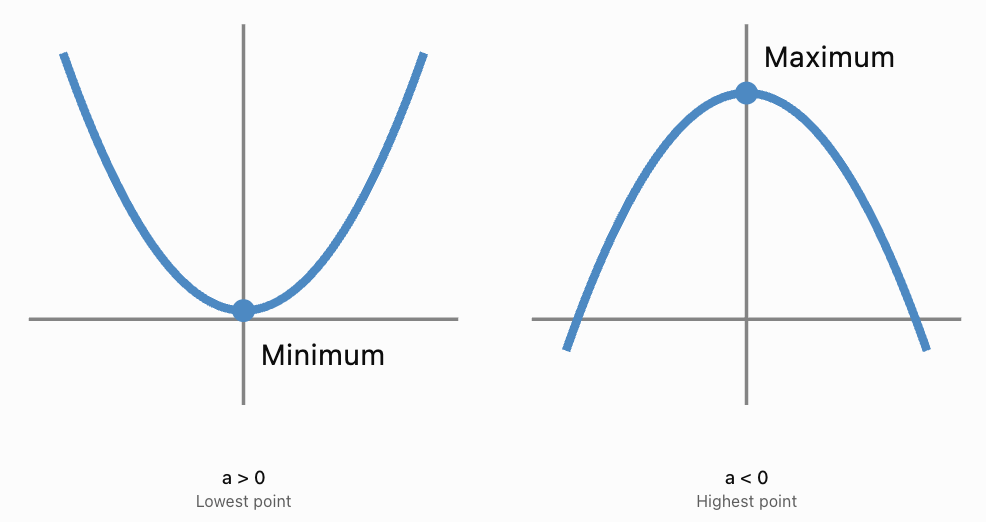
The sign of a determines whether the parabola has a maximum or minimum.
|
Coefficient |
Graph |
Vertex |
|---|---|---|
|
a > 0 |
Opens upward |
Minimum |
|
a < 0 |
Opens downward |
Maximum |
Example: Minimum
y = x² + 4
The graph opens upward.
The minimum value is 4.
Example: Maximum
y = −x² + 9
The graph opens downward.
The maximum value is 9.
Important Observation
For an unrestricted quadratic function, the vertex gives the global maximum or minimum. In practical optimisation problems, restrictions on the domain may change which value is optimal.
Understanding the Vertex
The vertex is the turning point of a parabola.
For an upward-opening parabola, the vertex is the lowest point.
For a downward-opening parabola, the vertex is the highest point.
The Coordinates of the Vertex
The vertex has coordinates:
(h, k)
where:
-
h is the input value that produces the optimum.
-
k is the maximum or minimum output.
Example
Consider:
P(x) = −2(x − 5)² + 100
The vertex is:
(5, 100)
If P represents profit, this means the maximum profit is 100 units when the input is 5.
Finding the Vertex from Standard Form
For:
y = ax² + bx + c
the x-coordinate of the vertex is:
x = −b/(2a)
Substitute this value into the equation to find the maximum or minimum output.
Worked Example
Find the maximum value of:
y = −2x² + 16x + 3
Step 1: Identify the Coefficients
a = −2
b = 16
c = 3
Step 2: Determine the Direction of Opening
Since a is negative, the parabola opens downward.
Therefore, the vertex is a maximum.
Step 3: Calculate the x-Coordinate
x = −16/[2(−2)]
x = −16/−4
x = 4
Step 4: Calculate the y-Coordinate
y = −2(4)² + 16(4) + 3
y = −32 + 64 + 3
y = 35
Final Answer
The maximum value is 35, occurring when x = 4.
The vertex is:
(4, 35)
Optimisation Using Vertex Form
Vertex form makes maximum and minimum values easier to identify.
y = a(x − h)² + k
The vertex is:
(h, k)
Example: Maximum
y = −3(x − 6)² + 80
The vertex is:
(6, 80)
The maximum value is:
80
This occurs when:
x = 6
Example: Minimum
y = 2(x + 4)² − 7
The vertex is:
(−4, −7)
The minimum value is:
−7
This occurs when:
x = −4
Important Observation
Vertex form is particularly useful in optimisation because the optimal input and output can be read directly from the equation.
Exploring Maximum and Minimum Values
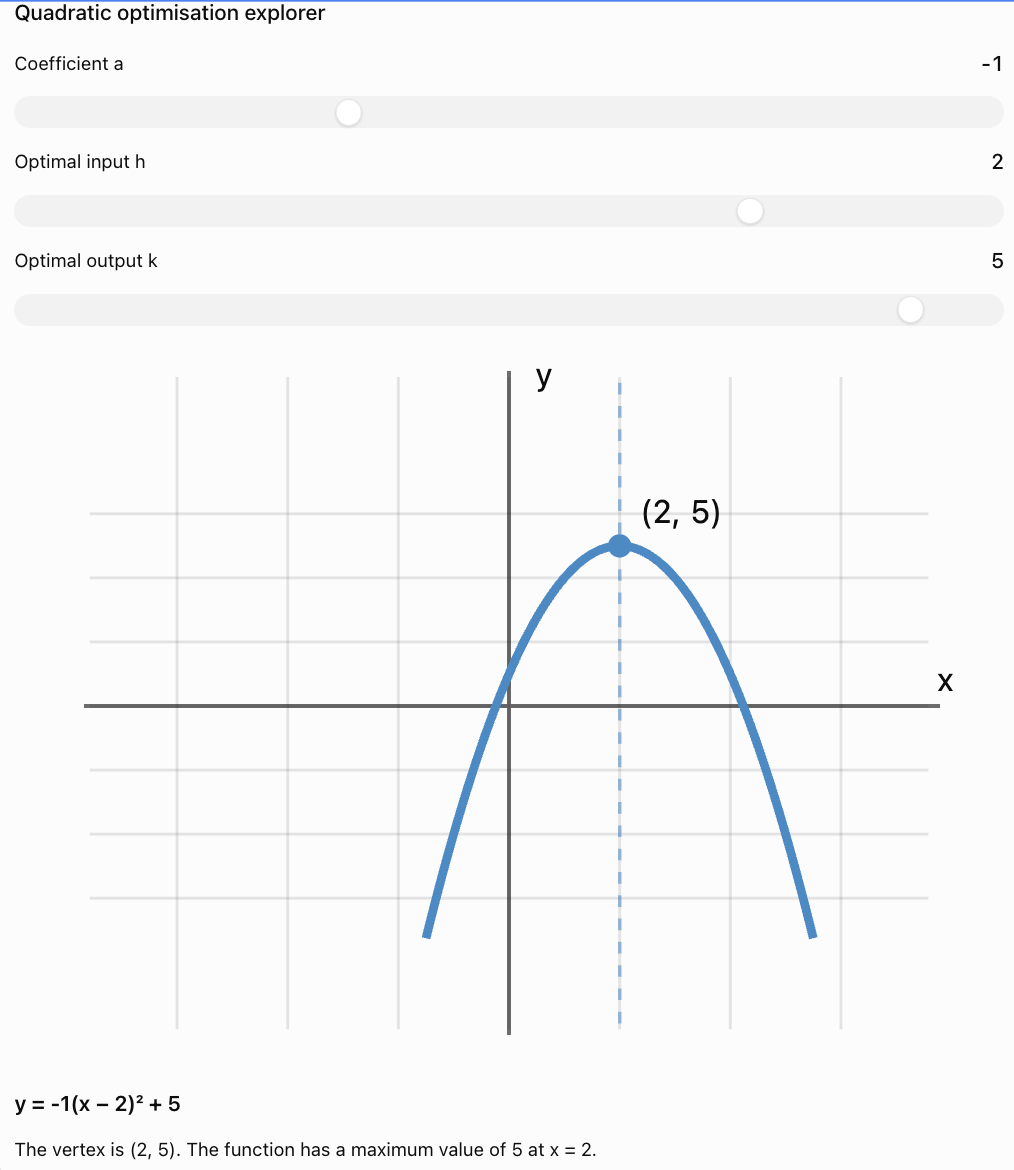
Change the coefficient and vertex position to investigate how the optimum changes.
Key Observation
The sign of a determines whether the vertex is a maximum or minimum.
The value h determines where the optimum occurs.
The value k determines the optimal output.
Optimising the Area of a Garden
One of the most common applications of quadratic optimisation is maximising area using a fixed amount of fencing.

Problem
A gardener has 40 metres of fencing to build a rectangular garden.
What dimensions will produce the largest possible area?
Step 1: Define Variables
Let:
w = width in metres
l = length in metres
A = area in square metres
Step 2: Write the Perimeter Equation
2w + 2l = 40
Divide by 2:
w + l = 20
Rearrange:
l = 20 − w
Step 3: Write the Area Equation
A = lw
Substitute:
A = w(20 − w)
Expand:
A(w) = −w² + 20w
Step 4: Find the Vertex
a = −1
b = 20
w = −20/[2(−1)]
w = 10 m
Step 5: Find the Length
l = 20 − 10
l = 10 m
Step 6: Calculate Maximum Area
A = 10 × 10
A = 100 m²
Final Answer
The maximum area is 100 m², achieved with a square garden measuring 10 m by 10 m.
Important Observation
When a rectangle has a fixed perimeter, the greatest area occurs when the rectangle is a square.
Optimising Area with Three Sides of Fencing
Sometimes a garden is built against a wall or river, so only three sides need fencing.
Problem
A farmer has 60 metres of fencing to enclose three sides of a rectangular field beside a straight wall.
Find the dimensions that maximise the area.
Step 1: Define Variables
Let:
w = width perpendicular to the wall
l = length parallel to the wall
Step 2: Write the Fencing Equation
2w + l = 60
Rearrange:
l = 60 − 2w
Step 3: Write the Area Equation
A = lw
A = w(60 − 2w)
A(w) = −2w² + 60w
Step 4: Find the Vertex
w = −60/[2(−2)]
w = 15 m
Step 5: Find the Length
l = 60 − 2(15)
l = 30 m
Step 6: Calculate the Maximum Area
A = 15 × 30
A = 450 m²
Final Answer
The maximum area is 450 m², with dimensions 15 m by 30 m.
Optimising Business Revenue
Businesses use optimisation to determine prices and quantities that produce the greatest revenue.
Problem
A company estimates that the selling price of a product is:
p = 80 − 2x
where:
-
p = price per item in dollars
-
x = number of items sold
Find the quantity that maximises revenue.
Step 1: Write the Revenue Equation
Revenue = price × quantity
R(x) = x(80 − 2x)
R(x) = −2x² + 80x
Step 2: Find the Vertex
a = −2
b = 80
x = −80/[2(−2)]
x = 20
Step 3: Calculate Maximum Revenue
R(20) = −2(20)² + 80(20)
R(20) = −800 + 1600
R(20) = $800
Step 4: Find the Selling Price
p = 80 − 2(20)
p = $40
Interpretation
The model predicts maximum revenue when the company sells 20 items at $40 each.
Important Distinction
Maximum revenue is not necessarily maximum profit.
Profit also depends on production and operating costs.
Optimising Business Profit
Profit is calculated using:
Profit = Revenue − Cost
Problem
A company's profit is modelled by:
P(x) = −3x² + 60x − 100
where x is the number of units produced, and P is measured in dollars.
Find the quantity that maximises profit.
Step 1: Identify Coefficients
a = −3
b = 60
c = −100
Step 2: Find the Optimal Quantity
x = −60/[2(−3)]
x = 10
Step 3: Calculate Maximum Profit
P(10) = −3(10)² + 60(10) − 100
P(10) = −300 + 600 − 100
P(10) = $200
Interpretation
The maximum predicted profit is $200 when 10 units are produced.
Important Observation
The vertex identifies the quantity that produces the greatest profit under the assumptions of the model.
Optimising Projectile Height
Projectile motion provides another important example of maximisation.

Problem
A ball is launched upward from ground level.
Its height is:
h(t) = −5t² + 30t
where:
-
h = height in metres
-
t = time in seconds
Find the maximum height.
Step 1: Identify Coefficients
a = −5
b = 30
Step 2: Find the Time at Maximum Height
t = −30/[2(−5)]
t = 3 seconds
Step 3: Calculate Maximum Height
h(3) = −5(3)² + 30(3)
h(3) = −45 + 90
h(3) = 45 m
Final Answer
The ball reaches a maximum height of 45 metres after 3 seconds.
Important Observation
The vertex provides both the optimal input and the maximum output.
Minimising Manufacturing Costs
Optimisation is also useful for reducing production costs.

Problem
A manufacturer's daily operating cost is modelled by:
C(x) = 2x² − 40x + 500
where x represents a production level in suitable units and C is measured in dollars.
Find the production level that minimises cost.
Step 1: Identify the Coefficients
a = 2
b = −40
c = 500
Step 2: Determine the Direction
Since a is positive, the parabola opens upward.
The vertex is a minimum.
Step 3: Find the Vertex
x = −(−40)/[2(2)]
x = 40/4
x = 10
Step 4: Calculate Minimum Cost
C(10) = 2(10)² − 40(10) + 500
C(10) = 200 − 400 + 500
C(10) = $300
Interpretation
According to the model, the minimum daily operating cost is $300 at a production level of 10 units.
Important Observation
The cost equation is a simplified model. Real manufacturing costs may not follow a quadratic relationship across all production levels.
Optimisation with Constraints
Real-world optimisation problems usually have restrictions.
These are called constraints.
Examples include:
-
A limited amount of fencing
-
A maximum budget
-
A minimum production quantity
-
A restricted amount of time
-
Available materials
-
Physical dimensions
Example
Suppose:
A(x) = −x² + 20x
The vertex occurs at:
x = 10
However, imagine the width must satisfy:
2 ≤ x ≤ 8
The vertex is outside the permitted domain.
Since the function is increasing throughout this interval, the maximum occurs at:
x = 8
Calculate:
A(8) = −8² + 20(8)
A(8) = −64 + 160
A(8) = 96
Important Observation
The vertex gives the optimum for an unrestricted quadratic function, but a restricted problem may have its optimum at a boundary.
Interpreting Optimal Solutions
Finding the vertex is only part of an optimisation problem.
The answer must also be interpreted.
Example
A revenue function has vertex:
(12.5, 312.5)
If x represents the number of products sold, then x = 12.5 is not a practical quantity.
We must compare nearby whole-number values.
For:
R(x) = −2x² + 50x
R(12) = $312
R(13) = $312
Interpretation
The best whole-number quantities are 12 or 13 items.
Both produce maximum revenue of $312.
Important Observation
An optimal mathematical answer may require adjustment to satisfy real-world restrictions.
Why Optimisation Is Useful
Optimisation is used in many areas of life.
Business and Economics
Companies use optimisation to:
-
Maximise profit
-
Minimise costs
-
Determine suitable prices
-
Allocate limited resources
Engineering
Engineers use optimisation to:
-
Reduce material usage
-
Improve structural designs
-
Minimise energy consumption
-
Improve efficiency
Agriculture
Farmers and gardeners use optimisation to:
-
Maximise planting area
-
Reduce fencing costs
-
Use available land efficiently
Sports and Physics
Optimisation can help analyse:
-
Maximum projectile height
-
Best launch conditions under specified constraints
-
Efficient movement and performance
Environmental Science
Optimisation may help:
-
Reduce waste
-
Improve resource allocation
-
Minimise energy use
-
Design efficient systems
A General Method for Solving Optimisation Problems
-
Understand the problem. Determine what must be maximised or minimised.
-
Define variables. Identify the independent and dependent quantities, including units.
-
Identify constraints. Determine any restrictions on the variables.
-
Create a quadratic model. Express the quantity to optimise as a function of one variable.
-
Find the vertex. Use vertex form or x = −b/(2a).
-
Check the domain. Compare the vertex with relevant endpoints or permitted integer values.
-
Interpret the result. Explain the optimal input and output in context.
-
Evaluate the model. Consider assumptions, accuracy, and whether the result is realistic.
Common Mistakes
Confusing the optimal input with the optimal output
The x-coordinate tells us where the optimum occurs. The y-coordinate tells us the maximum or minimum value.
Assuming every parabola has a maximum
Upward-opening parabolas have a minimum. Downward-opening parabolas have a maximum.
Forgetting to substitute the vertex x-coordinate
Finding x = −b/(2a) gives only the input. The output must also be calculated.
Ignoring constraints
A mathematically correct vertex may lie outside the permitted domain.
Using impossible dimensions
Lengths and widths must satisfy physical restrictions.
Confusing revenue and profit
Revenue is money received from sales. Profit is revenue minus costs.
Failing to define variables
Every variable should have a clear meaning and appropriate units.
Assuming decimal solutions are always practical
Whole-item quantities may require checking neighbouring integers.
Forgetting units
An area should be expressed in square units, not ordinary length units.
Assuming every real-world relationship is quadratic
Quadratic models are useful approximations in some situations but may not apply everywhere.
Key Terms
-
Optimisation: Finding the best possible solution under given conditions.
-
Maximisation: Finding the greatest possible value.
-
Minimisation: Finding the smallest possible value.
-
Optimal Solution: Best feasible value satisfying the constraints.
-
Objective Function: Function representing the quantity being maximised or minimised.
-
Constraint: Restriction on the values allowed in a problem.
-
Quadratic Function: Function whose highest variable power is two.
-
Parabola: Graph of a quadratic function.
-
Vertex: Maximum or minimum point of a parabola.
-
Maximum Value: Greatest output of a function over its domain.
-
Minimum Value: Smallest output of a function over its domain.
-
Vertex Form: Quadratic written as y = a(x − h)² + k.
-
Standard Form: Quadratic written as y = ax² + bx + c.
-
Axis of Symmetry: Vertical line passing through the vertex.
-
Independent Variable: Input variable.
-
Dependent Variable: Output variable.
-
Domain: Set of permitted input values.
-
Range: Set of possible output values.
-
Revenue: Total money received from sales.
-
Profit: Revenue minus costs.
-
Cost Function: Mathematical function describing expenses.
-
Area Function: Function describing how area depends on one or more dimensions.
-
Mathematical Model: Equation or representation describing a real-world situation.
-
Boundary Value: Value at an endpoint of a restricted domain.
-
Feasible Solution: Solution satisfying all constraints.
Key Takeaways
-
Optimisation involves finding maximum or minimum values.
-
Quadratic functions are useful for optimisation because their graphs have a single vertex.
-
An upward-opening parabola has a minimum.
-
A downward-opening parabola has a maximum.
-
The vertex gives the optimal input and output for an unrestricted quadratic function.
-
The vertex x-coordinate can be calculated using x = −b/(2a).
-
Vertex form makes maximum and minimum values easy to identify.
-
Practical optimisation problems require clearly defined variables.
-
Constraints must be considered before accepting a solution.
-
The optimum may occur at a boundary rather than at the vertex.
-
Mathematical solutions must be interpreted using appropriate units.
-
Optimisation is useful for maximising profit, revenue, area, and height.
-
Optimisation is also useful for minimising cost, waste, and resource consumption.
-
Real-world models should be evaluated for accuracy and realistic assumptions.
Check Your Understanding
Identifying Maximum and Minimum Values
-
What is optimisation?
-
What is the difference between maximisation and minimisation?
-
Does y = 3x² + 5 have a maximum or minimum?
-
Does y = −2x² + 8 have a maximum or minimum?
-
What point on a parabola represents the optimum?
Finding the Vertex
-
Find the vertex of y = −x² + 10x.
-
Determine the maximum value of the function in Question 6.
-
Find the minimum value of y = 2(x − 3)² + 4.
-
Find the vertex of y = x² − 8x + 10.
-
Explain why vertex form is useful for optimisation.
Practical Problems
-
A rectangular garden has perimeter 20 m. What dimensions maximise its area?
-
Find the maximum area of the garden in Question 11.
-
A revenue function is R(x) = −x² + 12x. Find the quantity that maximises revenue.
-
Find the maximum revenue in Question 13.
-
A projectile follows h(t) = −5t² + 20t. Find its maximum height.
Interpretation and Constraints
-
Why must constraints be considered in optimisation problems?
-
What is the difference between revenue and profit?
-
A quadratic model predicts an optimal production quantity of 8.5 items. What should be done?
-
Why might a mathematical optimum be unrealistic?
-
Give two real-world applications of optimisation.
Answer Key
|
Question |
Answer |
|---|---|
|
1 |
Finding the best possible value under given conditions |
|
2 |
Maximisation finds the greatest value; minimisation finds the smallest |
|
3 |
Minimum |
|
4 |
Maximum |
|
5 |
Vertex |
|
6 |
(5, 25) |
|
7 |
25 |
|
8 |
4 |
|
9 |
(4, −6) |
|
10 |
The optimal input and output can be read directly |
|
11 |
5 m by 5 m |
|
12 |
25 m² |
|
13 |
x = 6 |
|
14 |
36 |
|
15 |
20 m |
|
16 |
They restrict the feasible solutions |
|
17 |
Profit equals revenue minus costs |
|
18 |
Compare feasible whole-number quantities, such as 8 and 9 |
|
19 |
It may violate constraints or model assumptions |
|
20 |
Garden design, business profit, manufacturing costs, or projectile height |
Extended Challenge
-
Find the maximum value of y = −3x² + 24x − 10.
-
Find the minimum value of y = 4x² − 32x + 70.
-
A rectangle has perimeter 50 m. Determine the dimensions that maximise its area.
-
Find the maximum area of the rectangle in Question 3.
-
A farmer has 80 m of fencing for three sides of a rectangular field beside a river. Determine the optimal dimensions.
-
Find the maximum area of the field in Question 5.
-
A revenue model is R(x) = −4x² + 100x. Find the quantity that maximises revenue.
-
Determine the maximum revenue in Question 7 when only whole items can be sold.
-
A manufacturing cost model is C(x) = 3x² − 36x + 200. Find the minimum cost.
-
A projectile follows h(t) = −5t² + 40t + 2. Find its maximum height and the time at which it occurs.
Final Investigation: Designing an Optimal Garden
A school has 60 metres of fencing to construct a rectangular garden.
The school wants to maximise the planting area while using all the fencing.
Investigation Tasks
-
Define the width and length variables.
-
Write the perimeter equation.
-
Rearrange the equation to express length in terms of width.
-
Write the area equation.
-
Expand the area equation into standard quadratic form.
-
Identify the coefficients a, b, and c.
-
Explain why the graph opens downward.
-
Determine the vertex.
-
Interpret the vertex in the context of the garden.
-
Calculate the maximum area.
-
Determine the dimensions that produce the maximum area.
-
Create a table of values for several possible widths.
-
Graph the area function.
-
Identify the axis of symmetry.
-
Determine the physically meaningful domain.
-
Explain why negative widths are not acceptable.
-
Explain why a width greater than 30 m is impossible.
-
Compare the areas of gardens measuring 10 m by 20 m and 15 m by 15 m.
-
Explain why the optimal garden is a square.
-
Write a conclusion explaining how quadratic optimisation helps make efficient use of limited resources.
Investigation Check
The area equation is:
A(w) = −w² + 30w
The vertex is:
(15, 225)
Therefore:
-
Optimal width: 15 m
-
Optimal length: 15 m
-
Maximum area: 225 m²
The physically meaningful domain is:
0 < w < 30