Applications of Quadratic Functions
2. Projectile Motion
Learning outcomes
- I can recognise projectile motion as quadratic.
- I can interpret height-time graphs.
- I can determine maximum height.
- I can determine when an object reaches the ground.
- I can solve projectile problems using quadratic functions.
Projectile Motion
Introduction
When a ball is thrown, a basketball is shot toward a hoop, or a rocket launches into the air, the object follows a path influenced by gravity.
This type of motion is called projectile motion.
Projectile motion is an important application of quadratic functions because the height of an object changes with time according to a quadratic relationship, provided gravitational acceleration is constant and air resistance is negligible.
Quadratic models allow us to answer questions such as:
-
How high will the object travel?
-
How long will it take to reach its maximum height?
-
When will the object return to the ground?
-
What will its height be at a particular time?
-
How can a height-time graph help us predict its motion?


What Is Projectile Motion?
Projectile motion is the movement of an object that has been launched and then moves under the influence of gravity, assuming other forces such as air resistance can be ignored.
Examples include:
-
A basketball travelling toward a hoop.
-
A ball thrown vertically upward.
-
A football kicked through the air.
-
Water leaving a fountain.
-
A stone thrown from a cliff.
A projectile may move both horizontally and vertically.
Horizontal Motion
In ideal projectile motion, horizontal velocity remains constant because there is no horizontal acceleration.
Vertical Motion
Vertical velocity changes because gravity accelerates the object downward.
Near Earth's surface, gravitational acceleration is approximately:
g = 9.8 m/s²
For simpler calculations, we often use:
g ≈ 10 m/s²
Important Observation
Even when a projectile moves horizontally and vertically, its height as a function of time is quadratic.
Its trajectory through space is also parabolic under the same ideal assumptions, provided it has a nonzero horizontal velocity.
The Quadratic Model for Projectile Height
The vertical position of a projectile can be described using:
h(t) = −0.5gt² + v₀t + h₀
where:
-
h(t) = height at time t, in metres
-
t = time after launch, in seconds
-
g = gravitational acceleration, in m/s²
-
v₀ = initial vertical velocity, in m/s
-
h₀ = initial height, in metres
Using g ≈ 10 m/s²:
h(t) = −5t² + v₀t + h₀
This has the same structure as the standard quadratic function:
y = ax² + bx + c
|
Quadratic term |
Projectile interpretation |
|---|---|
|
a |
Half the vertical acceleration, −g/2 |
|
b |
Initial vertical velocity |
|
c |
Initial height |
|
x |
Time |
|
y |
Height |
Why Is the Coefficient of t² Negative?
Gravity accelerates the projectile downward.
Because upward is defined as positive, the vertical acceleration is negative.
Therefore, the height-time parabola opens downward.
Understanding the Shape of Projectile Motion
A typical projectile follows a curved path.

During its flight:
-
The projectile begins at its initial height.
-
If launched upward, it rises while slowing vertically.
-
It reaches a maximum height.
-
Its vertical velocity becomes zero momentarily.
-
It begins moving downward.
-
Its downward vertical speed increases as it falls.
Important Distinction
At the maximum height, the vertical velocity is zero, but the acceleration remains downward.
If the projectile has horizontal velocity, it is still moving horizontally at the highest point.
Interpreting Height-Time Graphs
A height-time graph shows how the vertical position of a projectile changes over time.
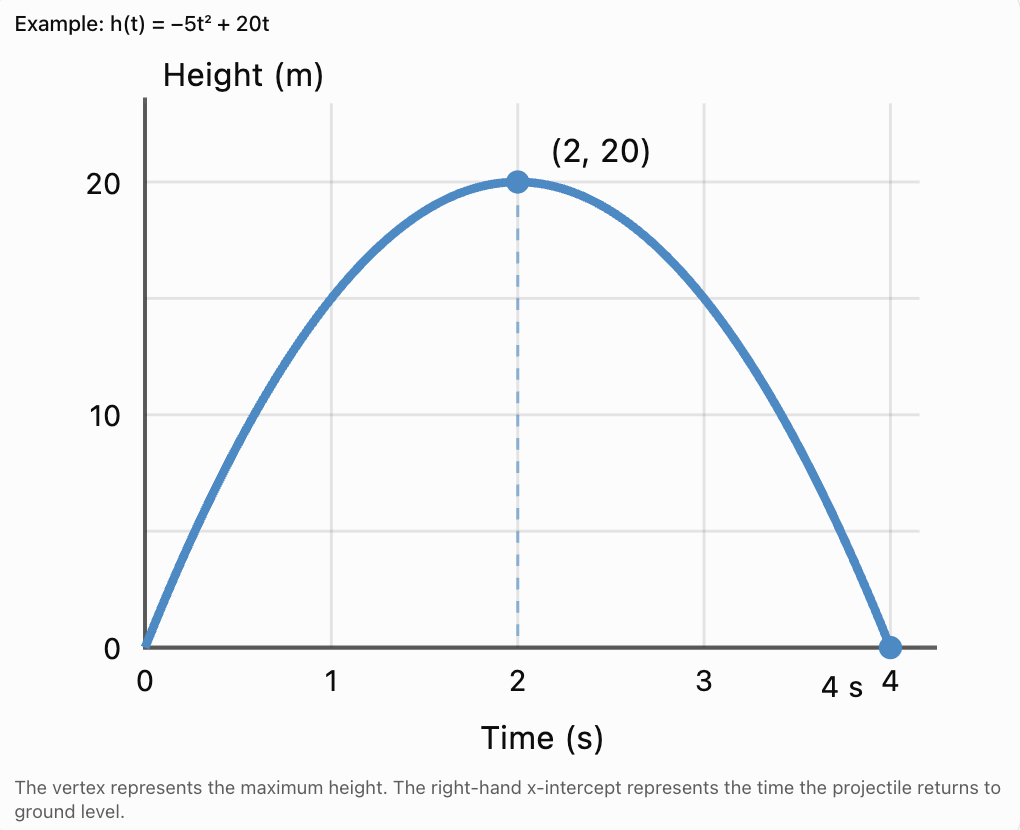
Important Features
The y-intercept: Represents the initial height.
The vertex: Represents the maximum height and the time it occurs.
The x-intercepts: Represent times when the height is zero.
The increasing section: Represents the projectile rising.
The decreasing section: Represents the projectile falling.
Important Observation
The horizontal axis represents time, not horizontal distance.
A height-time graph is different from a diagram showing the actual trajectory of the projectile through space.
Exploring Projectile Motion
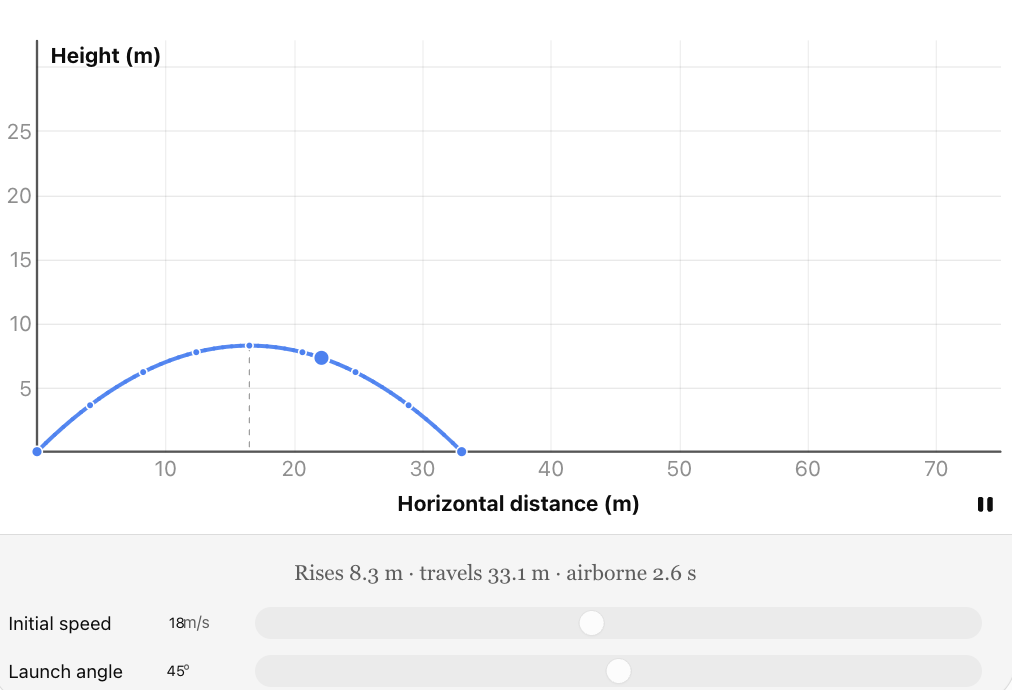
Explore how changing the launch speed and angle affects the projectile's maximum height, flight time, and horizontal range.
In this ideal model, the projectile launches and lands at the same height. The motion assumes constant gravity and negligible air resistance.
Calculating Height at a Particular Time
Consider a ball thrown upward from a height of 2 metres.
Its height is modelled by:
h(t) = −5t² + 20t + 2
Finding the Height After One Second
Substitute t = 1:
h(1) = −5(1)² + 20(1) + 2
h(1) = −5 + 20 + 2
h(1) = 17 m
Finding the Height After Three Seconds
Substitute t = 3:
h(3) = −5(3)² + 20(3) + 2
h(3) = −45 + 60 + 2
h(3) = 17 m
Why Are the Heights Equal?
The projectile is at the same height once while rising and once while falling.
These two times are symmetric around the time at which maximum height occurs.
Finding Maximum Height Using the Vertex
The maximum height of a projectile occurs at the vertex of its height-time parabola.
For:
h(t) = at² + bt + c
the time at the vertex is:
t = −b/(2a)
Worked Example
A ball is launched from ground level.
Its height is:
h(t) = −5t² + 30t
Step 1: Identify the Coefficients
a = −5
b = 30
c = 0
Step 2: Calculate the Time at Maximum Height
t = −30/[2(−5)]
t = −30/−10
t = 3 seconds
Step 3: Calculate Maximum Height
Substitute t = 3:
h(3) = −5(3)² + 30(3)
h(3) = −45 + 90
Maximum height = 45 m
Interpretation
The ball reaches a maximum height of 45 metres after 3 seconds.
Finding Maximum Height Using Vertex Form
Sometimes a projectile equation is already written in vertex form:
h(t) = a(t − p)² + q
For a downward-opening parabola:
-
p = time at maximum height
-
q = maximum height
Example
h(t) = −5(t − 4)² + 80
The vertex is:
(4, 80)
Therefore:
-
Time at maximum height = 4 seconds
-
Maximum height = 80 metres
Important Observation
Vertex form makes the maximum height immediately visible without additional calculations.
Finding When a Projectile Reaches the Ground
A projectile reaches ground level when its height is zero.
Therefore, set:
h(t) = 0
Then solve the quadratic equation.
Worked Example: Factoring
A ball is launched from the ground.
Its height is:
h(t) = −5t² + 20t
Set the height equal to zero:
0 = −5t² + 20t
Factor:
0 = −5t(t − 4)
Therefore:
t = 0 or t = 4
Interpretation
-
t = 0 seconds: The ball begins at ground level.
-
t = 4 seconds: The ball returns to ground level.
Flight time = 4 seconds
Important Observation
When a projectile launches from ground level and returns to the same height, the quadratic equation typically has two physically meaningful times: launch and landing.
Finding Landing Time Using the Quadratic Formula
Not every projectile equation can be factored easily.
In these cases, use the quadratic formula:
t = [−b ± √(b² − 4ac)]/(2a)
Worked Example
A ball is thrown upward from a platform 15 metres above the ground.
Its height is:
h(t) = −5t² + 20t + 15
Find when the ball reaches the ground.
Step 1: Set Height Equal to Zero
0 = −5t² + 20t + 15
Divide by −5:
t² − 4t − 3 = 0
Step 2: Identify the Coefficients
a = 1
b = −4
c = −3
Step 3: Substitute into the Formula
t = [4 ± √(16 + 12)]/2
t = [4 ± √28]/2
t = 2 ± √7
Step 4: Calculate Both Solutions
t ≈ −0.65 seconds
t ≈ 4.65 seconds
Step 5: Interpret
The negative time does not represent a time after launch.
Therefore:
The ball reaches the ground approximately 4.65 seconds after launch.
Important Observation
Mathematical solutions must be checked against the physical situation.
Negative times are generally excluded when time is measured from the instant of launch.
The Relationship Between Maximum Height and Flight Time
When a projectile launches and lands at the same height, its height-time graph is symmetric.
Suppose:
h(t) = −5t² + 40t
Finding Maximum Height
Time at vertex:
t = −40/[2(−5)]
t = 4 seconds
Maximum height:
h(4) = −5(4)² + 40(4)
h(4) = −80 + 160
Maximum height = 80 m
Finding Flight Time
Set h(t) = 0:
0 = −5t² + 40t
0 = −5t(t − 8)
t = 0 or t = 8
Flight time = 8 seconds
Relationship
Time to maximum height = 4 seconds
Total flight time = 8 seconds
Therefore:
Time to maximum height = half the total flight time
This relationship applies when the launch and landing heights are equal, under constant gravitational acceleration and negligible air resistance.
Projectile Motion from Different Starting Heights
Not all projectiles begin at ground level.

Example
A ball is thrown upward from a building 20 metres high.
Its height is:
h(t) = −5t² + 15t + 20
Initial Height
At t = 0:
h(0) = 20
The ball begins 20 metres above the ground.
Maximum Height
t = −15/[2(−5)]
t = 1.5 seconds
Substitute:
h(1.5) = −5(1.5)² + 15(1.5) + 20
h(1.5) = −11.25 + 22.5 + 20
Maximum height = 31.25 m
Landing Time
Set height equal to zero:
0 = −5t² + 15t + 20
Divide by −5:
t² − 3t − 4 = 0
Factor:
(t − 4)(t + 1) = 0
t = 4 or t = −1
The physically meaningful solution is:
t = 4 seconds
Important Observation
When the projectile starts above ground level, the time spent rising is generally not half the total time until it reaches the ground.
Comparing Two Projectile Models
Consider two projectiles:
Projectile A: h₁(t) = −5t² + 20t
Projectile B: h₂(t) = −5t² + 30t
Maximum Height of A
t = −20/[2(−5)] = 2 s
h₁(2) = −5(2)² + 20(2)
Maximum height = 20 m
Maximum Height of B
t = −30/[2(−5)] = 3 s
h₂(3) = −5(3)² + 30(3)
Maximum height = 45 m
Comparison
|
Property |
Projectile A |
Projectile B |
|---|---|---|
|
Initial height |
0 m |
0 m |
|
Initial vertical velocity |
20 m/s |
30 m/s |
|
Time to maximum height |
2 s |
3 s |
|
Maximum height |
20 m |
45 m |
|
Total flight time |
4 s |
6 s |
Interpretation
Projectile B has a greater initial upward velocity.
It rises higher and remains in the air longer.
Both experience the same downward acceleration in this model.
Understanding Vertical Velocity
The vertical velocity of a projectile changes continuously because of gravity.
For the height equation:
h(t) = −5t² + v₀t + h₀
the vertical velocity is:
v(t) = −10t + v₀
This equation describes how quickly the height changes.
Example
Consider:
h(t) = −5t² + 30t
The vertical velocity is:
v(t) = −10t + 30
At t = 0:
v(0) = 30 m/s
At t = 2:
v(2) = 10 m/s
At t = 3:
v(3) = 0 m/s
At t = 4:
v(4) = −10 m/s
Interpretation
-
Positive velocity: Moving upward.
-
Zero velocity: At maximum height.
-
Negative velocity: Moving downward.
Important Observation
The slope of the height-time graph represents vertical velocity.
The slope is positive while the projectile rises, zero at the vertex, and negative while it falls.
Predicting Projectile Motion from Graphs
A height-time graph can reveal information even when the equation is not given.
Example
Suppose a graph shows:
-
Initial height: 0 metres
-
Maximum height: 20 metres
-
Time at maximum height: 2 seconds
-
Landing time: 4 seconds
The vertex is:
(2, 20)
Use vertex form:
h(t) = a(t − 2)² + 20
Since the projectile begins at ground level:
0 = a(0 − 2)² + 20
0 = 4a + 20
a = −5
Therefore:
h(t) = −5(t − 2)² + 20
Expand:
h(t) = −5(t² − 4t + 4) + 20
h(t) = −5t² + 20t
Important Observation
A quadratic model can be constructed using the vertex and one additional point.
Limitations of Projectile Models
Quadratic projectile models are useful, but they rely on assumptions.
Air Resistance
Air resistance can change the motion, particularly for lightweight objects or objects moving at high speeds.
Constant Gravity
The model assumes gravitational acceleration remains approximately constant.
This is reasonable for many everyday situations near Earth's surface.
Wind
Wind can affect horizontal and vertical motion.
Object Shape
Different objects experience different aerodynamic forces.
Physical Domain
The model is usually meaningful only from launch until landing or another specified endpoint.
Important Observation
A quadratic equation may continue producing values after the projectile has reached the ground, but these values may not describe the actual physical motion.
Real-World Applications
Sports
Projectile models help analyse basketball shots, football kicks, and other ball trajectories.

Engineering
Engineers use projectile calculations to study the movement of objects and design controlled launching systems.
Water Fountains
Water jets can follow approximately parabolic paths when air resistance is small.

Space Science
Projectile motion provides an introduction to gravitational motion, although orbital motion requires more advanced models.
Common Mistakes
Confusing the trajectory with the height-time graph
A projectile's path through space is different from its graph of height against time.
Forgetting that gravity acts downward
The coefficient of t² is negative when upward is positive.
Confusing maximum height with time to maximum height
The vertex contains both values, but they have different units.
Failing to set height equal to zero
To find when a projectile reaches ground level, solve h(t) = 0.
Accepting negative time solutions
Negative times may be mathematically valid but are generally outside the physical domain after launch.
Assuming every projectile begins at ground level
The initial height may be greater than zero.
Assuming flight time is always twice the time to maximum height
This only applies when launch and landing heights are equal under ideal conditions.
Confusing velocity and acceleration
Vertical velocity is zero at maximum height, but acceleration is still downward.
Ignoring units
Time should be expressed in seconds, height in metres, and velocity in m/s.
Using the model beyond landing
The quadratic model may no longer represent the motion after the object strikes the ground.
Key Terms
-
Projectile Motion: Motion of an object launched and moving under gravity, neglecting other forces.
-
Projectile: An object moving through the air after being launched.
-
Trajectory: Path followed by a moving object.
-
Quadratic Function: Function whose highest variable power is two.
-
Parabola: Graph of a quadratic function.
-
Height-Time Graph: Graph showing how an object's height changes with time.
-
Vertex: Maximum or minimum point of a parabola.
-
Maximum Height: Greatest vertical position reached by a projectile.
-
Initial Height: Height of the projectile at launch.
-
Initial Vertical Velocity: Vertical component of velocity at launch.
-
Vertical Velocity: Rate at which an object's vertical position changes.
-
Acceleration: Rate of change of velocity.
-
Gravitational Acceleration: Downward acceleration caused by gravity.
-
Flight Time: Total time a projectile spends in flight.
-
x-Intercept: Point where the height-time graph reaches zero height.
-
y-Intercept: Initial height on a height-time graph.
-
Axis of Symmetry: Vertical line through the vertex of a parabola.
-
Standard Form: Quadratic written as y = ax² + bx + c.
-
Vertex Form: Quadratic written as y = a(x − h)² + k.
-
Quadratic Formula: Formula used to solve quadratic equations.
-
Physical Domain: Time interval over which the model represents the actual motion.
-
Air Resistance: Force opposing motion through air.
Key Takeaways
-
Projectile height can be modelled using a quadratic function under ideal conditions.
-
The height-time graph is a downward-opening parabola.
-
The initial height is represented by the constant term.
-
The initial vertical velocity is represented by the coefficient of t.
-
The coefficient of t² is related to gravitational acceleration.
-
The vertex represents the maximum height and the time it occurs.
-
The time at maximum height can be calculated using t = −b/(2a).
-
The maximum height is found by substituting the vertex time into the height equation.
-
A projectile reaches ground level when h(t) = 0.
-
Factoring and the quadratic formula can be used to calculate landing time.
-
Negative time solutions must be interpreted carefully.
-
If launch and landing heights are equal, the time to maximum height is half the total flight time.
-
The slope of a height-time graph represents vertical velocity.
-
Quadratic models have limitations and should only be used within appropriate physical conditions.
Check Your Understanding
Recognising Projectile Motion
-
Why is projectile height often modelled by a quadratic function?
-
What does the vertex of a height-time graph represent?
-
Why does a typical height-time parabola open downward?
-
What does the y-intercept represent?
-
What does an x-intercept represent?
Interpreting Equations
-
Identify the initial height in h(t) = −5t² + 20t + 3.
-
Identify the initial vertical velocity in the same equation.
-
Find the height at t = 2 seconds.
-
Determine the time at maximum height.
-
Calculate the maximum height.
Solving Projectile Problems
-
Find the landing time for h(t) = −5t² + 25t.
-
Find the maximum height of h(t) = −5t² + 40t.
-
Determine when h(t) = −5t² + 30t reaches maximum height.
-
Find the landing time for h(t) = −5t² + 15t + 20.
-
Explain why negative time solutions are usually rejected.
Analysis
-
Explain why vertical velocity is zero at maximum height.
-
Does gravitational acceleration become zero at maximum height?
-
Why might air resistance make a quadratic model inaccurate?
-
When is total flight time twice the time to maximum height?
-
Explain the difference between a trajectory diagram and a height-time graph.
Answer Key
|
Question |
Answer |
|---|---|
|
1 |
Constant gravitational acceleration produces a squared-time term |
|
2 |
Maximum height and the time it occurs |
|
3 |
Gravity acts downward |
|
4 |
Initial height |
|
5 |
A time when the projectile is at height zero |
|
6 |
3 m |
|
7 |
20 m/s |
|
8 |
23 m |
|
9 |
2 s |
|
10 |
23 m |
|
11 |
5 s after launch |
|
12 |
80 m |
|
13 |
3 s |
|
14 |
4 s after launch |
|
15 |
They occur before the chosen launch time |
|
16 |
The projectile changes from rising to falling |
|
17 |
No, acceleration remains downward |
|
18 |
It introduces additional forces |
|
19 |
When launch and landing heights are equal under ideal conditions |
|
20 |
A trajectory shows spatial motion; a height-time graph shows height against time |
Extended Challenge
-
A ball is launched from ground level with h(t) = −5t² + 35t. Find its maximum height.
-
Determine when the ball in Question 1 reaches maximum height.
-
Determine its total flight time.
-
A ball is launched from a 10 m platform with h(t) = −5t² + 20t + 10. Find its maximum height.
-
Determine when the ball in Question 4 reaches ground level, to two decimal places.
-
A projectile follows h(t) = −5(t − 3)² + 50. Identify the vertex and interpret it.
-
Determine the initial height of the projectile in Question 6.
-
Find the physically meaningful landing time for the projectile in Question 6.
-
A height-time graph has vertex (4, 80) and passes through (0, 0). Construct its quadratic equation.
-
Explain why the model in Question 9 is symmetric about t = 4.
Final Investigation: Designing a Projectile Model
A ball is launched upward from a platform 5 metres above the ground with an initial vertical velocity of 25 m/s.
Use gravitational acceleration g ≈ 10 m/s².
Investigation Tasks
-
Identify the independent variable.
-
Identify the dependent variable.
-
Write the general projectile height equation.
-
Substitute the initial height and velocity.
-
Write the quadratic model in standard form.
-
Determine the initial height from the equation.
-
Calculate the height after 1 second.
-
Calculate the height after 2 seconds.
-
Calculate the height after 3 seconds.
-
Determine the time at maximum height.
-
Calculate the maximum height.
-
Rewrite the equation in vertex form.
-
Construct a table of values from t = 0 to t = 5 seconds.
-
Graph the height-time relationship.
-
Identify the vertex.
-
Identify the axis of symmetry.
-
Solve the equation to determine when the ball reaches ground level.
-
Explain why one of the solutions must be rejected.
-
State two assumptions used in the model.
-
Write a conclusion explaining how quadratic functions can describe and predict projectile motion.
Investigation Check
The height equation is:
h(t) = −5t² + 25t + 5
The time at maximum height is:
t = 2.5 seconds
The maximum height is:
36.25 metres
The vertex form is:
h(t) = −5(t − 2.5)² + 36.25
The ball reaches the ground at approximately:
t = 5.19 seconds