Forms of Quadratic Equations
4. Converting Between Forms
Learning outcomes
- I can convert standard form to factored form when possible.
- I can convert between standard and vertex form.
- I can identify the advantages of each form.
- I can verify equivalent equations.
- I can choose the most useful form for a problem.
Converting Between Forms
Three Useful Forms of a Quadratic
A quadratic function can often be written in three different forms:
Standard form
y = ax² + bx + c
Vertex form
y = a(x − h)² + k
Factored form
y = a(x − r₁)(x − r₂)
These forms can describe the same parabola, but each makes different information easier to identify.
| Form | Most Useful Information |
|---|---|
| Standard | y-intercept and coefficients |
| Vertex | vertex, axis of symmetry, maximum/minimum |
| Factored | roots and x-intercepts |
Being able to convert between the forms allows us to choose the representation that is most useful for a particular problem.
Equivalent Quadratic Equations
Consider these equations:
y = x² − 6x + 5
y = (x − 1)(x − 5)
y = (x − 3)² − 4
Although they look different, they represent exactly the same quadratic function.
They therefore have:
- the same parabola
- the same vertex
- the same intercepts
- the same axis of symmetry
- the same value of y for every value of x
The only difference is the form in which the equation is written.
Standard Form
Standard form is:
y = ax² + bx + c
where a ≠ 0.
For example:
y = 2x² − 8x + 6
Standard form immediately shows:
a = 2
b = −8
c = 6
Since c = 6, the y-intercept is:
(0, 6)
The coefficient a also tells us that the parabola opens upward and is vertically stretched by a factor of 2.
Factored Form
Factored form is:
y = a(x − r₁)(x − r₂)
For example:
y = 2(x − 1)(x − 3)
The roots are immediately visible:
x = 1
and:
x = 3
Therefore, the x-intercepts are:
(1, 0) and (3, 0)
Vertex Form
Vertex form is:
y = a(x − h)² + k
For example:
y = 2(x − 2)² − 2
The vertex is immediately visible:
(2, −2)
and the axis of symmetry is:
x = 2
All three examples above represent the same function:
y = 2x² − 8x + 6
y = 2(x − 1)(x − 3)
y = 2(x − 2)² − 2
Standard Form to Factored Form
To convert standard form to factored form, we factor the quadratic expression.
Consider:
y = x² + 7x + 12
We need two numbers that:
- multiply to 12
- add to 7
Those numbers are:
3 and 4
Therefore:
y = (x + 3)(x + 4)
This is factored form.
The roots can now be identified immediately:
x = −3 and x = −4
Factoring When a = 1
For a quadratic:
x² + bx + c
look for two numbers that:
multiply to c
and:
add to b
Example:
y = x² − 8x + 15
We need two numbers that multiply to 15 and add to −8.
They are:
−3 and −5
Therefore:
y = (x − 3)(x − 5)
Another Factoring Example
Convert:
y = x² + 2x − 15
We need two numbers that:
multiply to −15
and add to 2.
The numbers are:
5 and −3
Therefore:
y = (x + 5)(x − 3)
The roots are:
x = −5 and x = 3
Factoring Out a Common Factor
Sometimes we should first factor out a common factor.
Consider:
y = 2x² − 10x + 12
Every term contains 2.
Factor it out:
y = 2(x² − 5x + 6)
Now factor the trinomial:
x² − 5x + 6
We need two numbers that multiply to 6 and add to −5.
They are:
−2 and −3
Therefore:
y = 2(x − 2)(x − 3)
Factoring When a Is Not 1
Consider:
y = 2x² + 7x + 3
We want to write it as:
y =
Since:
2x² = 2x × x
and:
3 = 3 × 1
try:
(2x + 1)(x + 3)
Check by expanding:
2x(x) = 2x²
2x(3) = 6x
1(x) = x
1(3) = 3
Combine:
2x² + 7x + 3
Therefore:
y = (2x + 1)(x + 3)
Not Every Quadratic Factors Easily
Consider:
y = x² + x + 1
There are no integers that multiply to 1 and add to 1.
Therefore, it cannot be factored into simple linear factors using integers.
Some quadratics:
- factor easily
- require irrational numbers
- require complex numbers
- have no real linear factors
So when we say convert to factored form when possible, we usually mean factor over the number system being used in the course.
Factored Form to Standard Form
To convert factored form to standard form, expand the factors.
Consider:
y = (x − 2)(x + 5)
Multiply:
y = x(x + 5) − 2(x + 5)
y = x² + 5x − 2x − 10
Combine like terms:
y = x² + 3x − 10
Expanding with a Leading Coefficient
Consider:
y = 3(x − 2)(x + 4)
First multiply the factors:
(x − 2)(x + 4)
= x² + 4x − 2x − 8
= x² + 2x − 8
Now multiply by 3:
y = 3x² + 6x − 24
This is standard form.
Standard Form to Vertex Form
To convert standard form to vertex form, we can use a process called completing the square.
Consider:
y = x² − 6x + 5
We want the form:
y = a(x − h)² + k
Start with:
y = x² − 6x + 5
Focus on:
x² − 6x
Take half of −6:
−3
Square it:
9
Add and subtract 9:
y = x² − 6x + 9 − 9 + 5
The first three terms form a perfect square:
x² − 6x + 9 = (x − 3)²
Therefore:
y = (x − 3)² − 9 + 5
So:
y = (x − 3)² − 4
The vertex is now immediately visible:
(3, −4)
Why Completing the Square Works
The expression:
x² + bx
can be turned into a perfect square by adding:
(b/2)²
For example:
x² + 8x
Half of 8 is:
4
Square 4:
16
Therefore:
x² + 8x + 16 = (x + 4)²
This idea is the basis of completing the square.
Another Standard-to-Vertex Example
Convert:
y = x² + 4x − 1
Take half of 4:
2
Square it:
4
Add and subtract 4:
y = x² + 4x + 4 − 4 − 1
Factor the perfect square:
y = (x + 2)² − 5
Therefore:
y = (x + 2)² − 5
Vertex:
(−2, −5)
When a Is Not 1
Consider:
y = 2x² − 8x + 3
First factor 2 from the x-terms:
y = 2(x² − 4x) + 3
Complete the square inside the brackets.
Half of −4 is:
−2
Square it:
4
So:
y = 2(x² − 4x + 4 − 4) + 3
Factor:
y = 2[(x − 2)² − 4] + 3
Distribute:
y = 2(x − 2)² − 8 + 3
Therefore:
y = 2(x − 2)² − 5
Vertex:
(2, −5)
A Faster Way to Find the Vertex
If the goal is simply to find the vertex rather than practise completing the square, start with:
y = ax² + bx + c
The x-coordinate of the vertex is:
x = −b/(2a)
Then substitute this value into the original equation to find y.
Example Using the Vertex Formula
Consider:
y = 2x² − 8x + 3
Here:
a = 2
b = −8
Find the x-coordinate:
x = −(−8)/(2 × 2)
x = 8/4
x = 2
Now substitute x = 2:
y = 2(2²) − 8(2) + 3
y = 8 − 16 + 3
y = −5
Therefore, the vertex is:
(2, −5)
So vertex form is:
y = 2(x − 2)² − 5
Vertex Form to Standard Form
To convert vertex form to standard form, expand the squared expression.
Consider:
y = (x − 4)² + 3
Expand:
(x − 4)² = x² − 8x + 16
Therefore:
y = x² − 8x + 16 + 3
y = x² − 8x + 19
Another Vertex-to-Standard Example
Convert:
y = −2(x + 3)² + 5
Expand:
(x + 3)² = x² + 6x + 9
Substitute:
y = −2(x² + 6x + 9) + 5
Distribute:
y = −2x² − 12x − 18 + 5
Therefore:
y = −2x² − 12x − 13
Factored Form to Vertex Form
There are several possible methods.
A useful method is:
- identify the roots
- find their midpoint
- use the midpoint as the x-coordinate of the vertex
- substitute to find the y-coordinate
- write vertex form
Consider:
y = (x − 2)(x − 8)
Roots:
2 and 8
Axis of symmetry:
x = (2 + 8)/2
x = 5
Find y when x = 5:
y = (5 − 2)(5 − 8)
y = 3(−3)
y = −9
Vertex:
(5, −9)
Since a = 1:
y = (x − 5)² − 9
Another Factored-to-Vertex Example
Consider:
y = −2(x − 1)(x − 5)
Roots:
1 and 5
Axis:
x = (1 + 5)/2
x = 3
Find y:
y = −2(3 − 1)(3 − 5)
y = −2(2)(−2)
y = 8
Vertex:
(3, 8)
Since a = −2:
y = −2(x − 3)² + 8
Vertex Form to Factored Form
To convert vertex form to factored form, we need to find the roots.
Consider:
y = (x − 3)² − 9
Set y = 0:
0 = (x − 3)² − 9
Add 9:
9 = (x − 3)²
Take square roots:
x − 3 = ±3
Therefore:
x = 6
or:
x = 0
The roots are 0 and 6.
Therefore, factored form is:
y = x(x − 6)
Another Vertex-to-Factored Example
Consider:
y = 2(x − 4)² − 18
Set y = 0:
0 = 2(x − 4)² − 18
18 = 2(x − 4)²
9 = (x − 4)²
x − 4 = ±3
Therefore:
x = 7
or:
x = 1
Since a = 2:
y = 2(x − 1)(x − 7)
When Real Factored Form Is Not Possible
Consider:
y = (x − 2)² + 4
Set y = 0:
0 = (x − 2)² + 4
−4 = (x − 2)²
A real number squared cannot equal −4.
Therefore, the quadratic has:
no real roots
and therefore cannot be written as a product of two real linear factors.
Its graph never reaches the x-axis.
Verifying Equivalent Equations
After converting between forms, it is useful to verify that the equations are equivalent.
There are several ways to do this.
Expand the equation
For example:
(x − 2)(x − 5)
expands to:
x² − 7x + 10
So the two forms are equivalent.
Substitute values
Choose an x-value and calculate y using both equations.
For example:
y = x² − 6x + 5
and:
y = (x − 1)(x − 5)
At x = 2:
Standard form:
y = 4 − 12 + 5
y = −3
Factored form:
y = (2 − 1)(2 − 5)
y = (1)(−3)
y = −3
Both produce the same result.
A Stronger Verification
Testing one x-value is a useful check, but it does not prove that two equations are equivalent.
To prove equivalence algebraically, transform one expression into the other.
For example:
(x − 1)(x − 5)
= x² − 5x − x + 5
= x² − 6x + 5
This confirms that the equations are identical for every x-value.
Comparing All Three Forms
Consider:
Standard
y = x² − 8x + 12
Factor:
Factored
y = (x − 2)(x − 6)
Complete the square:
Vertex
y = (x − 4)² − 4
These all represent the same parabola.
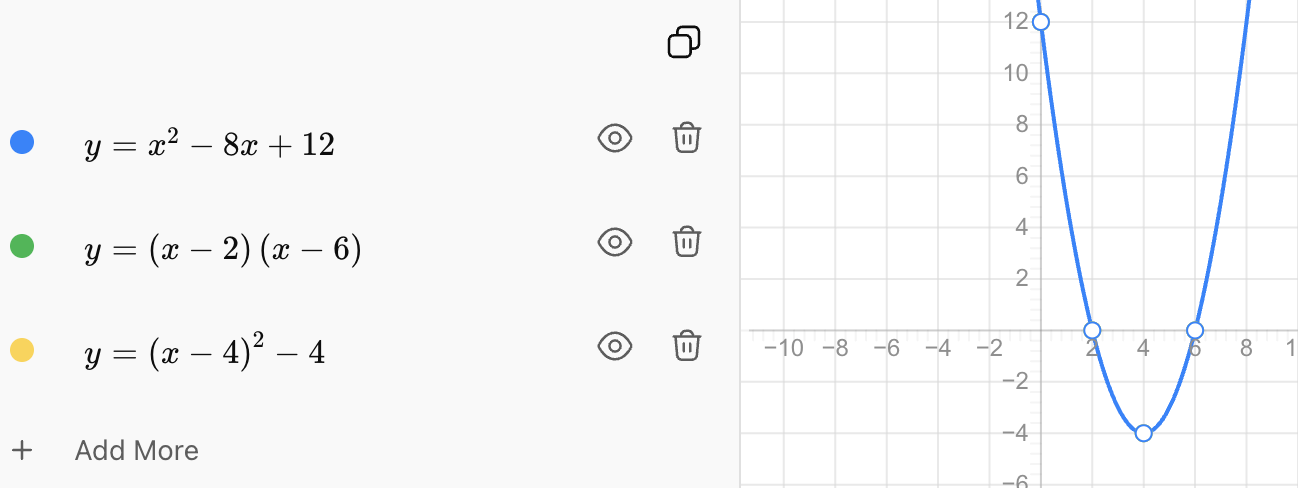
Because the equations are equivalent, the three graphs overlap exactly.
What Each Form Reveals
From:
y = x² − 8x + 12
we immediately see:
y-intercept = (0, 12)
From:
y = (x − 2)(x − 6)
we immediately see:
x-intercepts = (2, 0) and (6, 0)
From:
y = (x − 4)² − 4
we immediately see:
vertex = (4, −4)
and:
axis of symmetry = x = 4
The form changes, but the graph does not.
Advantages of Standard Form
y = ax² + bx + c
Standard form is useful when:
- identifying the y-intercept
- performing algebraic operations
- comparing coefficients
- using the quadratic formula
- finding the vertex using x = −b/(2a)
The y-intercept is simply:
(0, c)
Advantages of Vertex Form
y = a(x − h)² + k
Vertex form is useful when:
- identifying the vertex
- finding maximum or minimum values
- finding the axis of symmetry
- describing transformations
- sketching from transformations
- solving optimization problems
The vertex is:
(h, k)
Advantages of Factored Form
y = a(x − r₁)(x − r₂)
Factored form is useful when:
- identifying roots
- finding x-intercepts
- solving quadratic equations
- finding the axis of symmetry from the roots
- analyzing where a quadratic is positive or negative
The roots are:
r₁ and r₂
Choosing the Best Form
Suppose a question asks:
"When does the object hit the ground?"
This means:
height = 0
The roots are important.
Factored form is probably most useful.
Suppose a question asks:
"What is the maximum height?"
The vertex is important.
Vertex form is probably most useful.
Suppose a question asks:
"Where does the graph cross the y-axis?"
The y-intercept is important.
Standard form is probably most useful.
Example: Projectile Motion
Suppose the height of an object is:
h = −5t² + 30t
This is standard form.
Factor:
h = −5t(t − 6)
Now we can immediately identify when the object is at ground level:
t = 0
and:
t = 6
To find the maximum height, vertex form would be more useful.
Complete the square:
h = −5(t² − 6t)
h = −5[(t − 3)² − 9]
h = −5(t − 3)² + 45
Now we immediately see:
vertex = (3, 45)
Therefore:
maximum height = 45
at:
t = 3
The same quadratic in three forms reveals different information.
Moving Between Forms
A useful conversion map is:
Standard → Factored
Factor the quadratic.
Factored → Standard
Expand and combine like terms.
Standard → Vertex
Complete the square.
Vertex → Standard
Expand and simplify.
Factored → Vertex
Find the roots → find their midpoint → calculate the vertex → write vertex form.
Vertex → Factored
Set y = 0 → solve for the roots → write the factors.
Worked Example: All Three Forms
Start with:
y = 2x² − 12x + 10
Standard Form
Already given:
y = 2x² − 12x + 10
Convert to Factored Form
Factor out 2:
y = 2(x² − 6x + 5)
Factor:
y = 2(x − 1)(x − 5)
Roots:
1 and 5
Convert to Vertex Form
The axis lies halfway between the roots:
x = (1 + 5)/2
x = 3
Find y:
y = 2(3 − 1)(3 − 5)
y = 2(2)(−2)
y = −8
Vertex:
(3, −8)
Therefore:
y = 2(x − 3)² − 8
So the three equivalent forms are:
Standard: y = 2x² − 12x + 10
Factored: y = 2(x − 1)(x − 5)
Vertex: y = 2(x − 3)² − 8
Checking the Conversion
Expand the vertex form:
y = 2(x − 3)² − 8
y = 2(x² − 6x + 9) − 8
y = 2x² − 12x + 18 − 8
y = 2x² − 12x + 10
This matches the original standard form.
Now expand the factored form:
y = 2(x − 1)(x − 5)
y = 2(x² − 6x + 5)
y = 2x² − 12x + 10
All three are equivalent.
A Conversion Strategy
When faced with a quadratic problem, do not automatically convert the equation.
First ask:
What information do I need?
If you need the y-intercept, standard form may already be best.
If you need the roots, convert to factored form if possible.
If you need the vertex, vertex form may be best.
Choosing the right representation can greatly reduce the amount of work required.
Common Mistakes
Mistake: Changing forms changes the graph.
Equivalent forms represent exactly the same function and therefore the same graph.
Mistake: Factoring x² − 7x + 10 as (x + 2)(x + 5).
The correct factors are (x − 2)(x − 5).
Mistake: Forgetting the leading coefficient.
For example, 2x² − 10x + 12 becomes 2(x − 2)(x − 3), not simply (x − 2)(x − 3).
Mistake: Changing only part of an equation while completing the square.
Any quantity added must also be accounted for so that the function remains equivalent.
Mistake: Assuming every quadratic has a real factored form.
Some quadratics have no real roots.
Mistake: Using one substituted value as proof of equivalence.
It is a useful check, but algebraic expansion provides stronger verification.
Mistake: Converting equations unnecessarily.
Use the form that already reveals the information required.
Key Terms
Standard form — quadratic form y = ax² + bx + c.
Vertex form — quadratic form y = a(x − h)² + k.
Factored form — quadratic form y = a(x − r₁)(x − r₂).
Equivalent equations — equations representing the same function for every value of x.
Factor — expression multiplied by another expression to produce a product.
Root — x-value that makes the function equal to zero.
x-intercept — point where the graph meets the x-axis.
y-intercept — point where the graph meets the y-axis.
Vertex — maximum or minimum point of a parabola.
Axis of symmetry — vertical line passing through the vertex.
Completing the square — algebraic process used to create a perfect-square expression and convert a quadratic into vertex form.
Perfect-square trinomial — trinomial such as x² + 6x + 9 that can be written as the square of a binomial.
Key Takeaways
- Quadratic functions can be written in standard, vertex and factored forms.
- Equivalent forms describe exactly the same parabola.
- Standard form is y = ax² + bx + c.
- Vertex form is y = a(x − h)² + k.
- Factored form is y = a(x − r₁)(x − r₂).
- Standard form makes the y-intercept easy to identify.
- Vertex form makes the vertex and axis of symmetry easy to identify.
- Factored form makes the roots and x-intercepts easy to identify.
- Standard form can be converted to factored form by factoring when appropriate.
- Factored form can be converted to standard form by expanding.
- Standard form can be converted to vertex form by completing the square.
- Vertex form can be converted to standard form by expanding.
- The midpoint of the roots can help convert factored form to vertex form.
- Solving for the roots can help convert vertex form to factored form.
- Not every quadratic has real linear factors.
- Expanding expressions is a reliable way to verify that two forms are equivalent.
- The most useful quadratic form depends on the information required by the problem.
Check Your Understanding
- Convert y = x² + 7x + 12 to factored form.
- Convert y = x² − 9x + 20 to factored form.
- Convert y = 2x² − 10x + 12 to factored form.
- Expand y = (x − 3)(x + 5) into standard form.
- Expand y = 2(x − 1)(x − 6) into standard form.
- Convert y = x² − 6x + 2 into vertex form.
- Convert y = x² + 8x + 10 into vertex form.
- Convert y = 2x² − 8x + 1 into vertex form.
- Convert y = (x − 4)² − 9 into standard form.
- Convert y = −2(x + 3)² + 5 into standard form.
- Convert y = (x − 2)(x − 8) into vertex form.
- Convert y = (x − 3)² − 16 into factored form.
- Explain how you could verify that y = x² − 6x + 5 and y = (x − 1)(x − 5) are equivalent.
- Which form would you choose to find the x-intercepts of a quadratic? Explain.
- Which form would you choose to identify a maximum or minimum quickly? Explain.
- Write y = x² − 10x + 16 in standard, factored and vertex forms, and identify one advantage of each representation.