Forms of Quadratic Equations
3. Factored Form
Learning outcomes
- I can identify quadratic equations written in factored form.
- I can determine the x-intercepts from factored form.
- I can identify the axis of symmetry using the roots.
- I can sketch graphs from factored form.
- I can compare factored form with other forms.
Factored Form
What Is Factored Form?
A quadratic function can be written in factored form:
y = a(x − r₁)(x − r₂)
where:
- a affects the direction and vertical stretch or compression of the parabola
- r₁ is one root or x-intercept
- r₂ is the other root or x-intercept
Factored form is especially useful because the x-intercepts can usually be identified immediately.
For example:
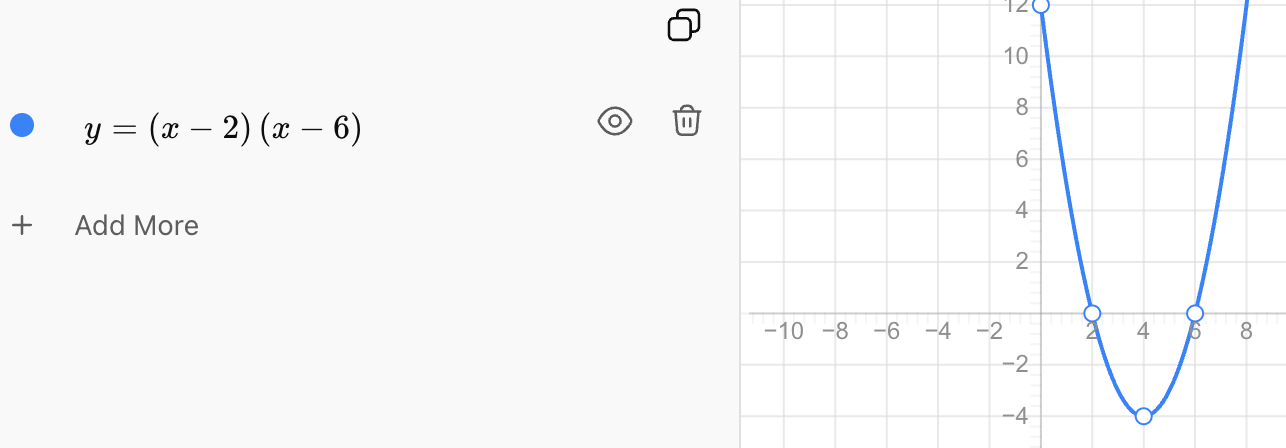
y = (x − 2)(x − 6)
has x-intercepts:
x = 2 and x = 6
or, as coordinate points:
(2, 0) and (6, 0)
Roots, Zeros and x-Intercepts
The terms roots, zeros, and x-intercepts are closely related.
A root or zero is an x-value that makes:
y = 0
An x-intercept is the corresponding point where the graph crosses or touches the x-axis.
For example:
y = (x − 3)(x + 5)
The roots are:
x = 3
and:
x = −5
The x-intercepts are:
(3, 0) and (−5, 0)
Finding the x-Intercepts
To find an x-intercept, set:
y = 0
Consider:
y = (x − 2)(x − 7)
Set y = 0:
0 = (x − 2)(x − 7)
For the product to equal zero, at least one factor must equal zero.
So:
x − 2 = 0
x = 2
or:
x − 7 = 0
x = 7
Therefore, the x-intercepts are:
(2, 0) and (7, 0)
The Zero Product Property
This method relies on the Zero Product Property.
If:
AB = 0
then:
A = 0 or B = 0
For a quadratic:
(x − r₁)(x − r₂) = 0
we can therefore write:
x − r₁ = 0
or:
x − r₂ = 0
giving:
x = r₁ or x = r₂
This is why factored form makes the roots so easy to identify.
Watch the Signs
As with vertex form, the signs can cause mistakes.
For:
(x − 4)
the root is:
x = 4
But for:
(x + 4)
the root is:
x = −4
because:
x + 4 = 0
x = −4
The sign of the root is therefore the opposite of the sign shown inside the factor.
Examples of Finding Roots
| Factored Form | Roots | x-Intercepts |
|---|---|---|
| y = (x − 2)(x − 5) | 2, 5 | (2, 0), (5, 0) |
| y = (x + 3)(x − 4) | −3, 4 | (−3, 0), (4, 0) |
| y = 2(x − 1)(x − 6) | 1, 6 | (1, 0), (6, 0) |
| y = −3(x + 5)(x + 2) | −5, −2 | (−5, 0), (−2, 0) |
| y = ½x(x − 8) | 0, 8 | (0, 0), (8, 0) |
Notice that a does not change the roots.
Axis of Symmetry from the Roots
A parabola is symmetrical.
If its roots are:
r₁ and r₂
the axis of symmetry lies exactly halfway between them.
Therefore:
x = (r₁ + r₂)/2
This is simply the average of the two roots.
Example: Finding the Axis of Symmetry
Consider:
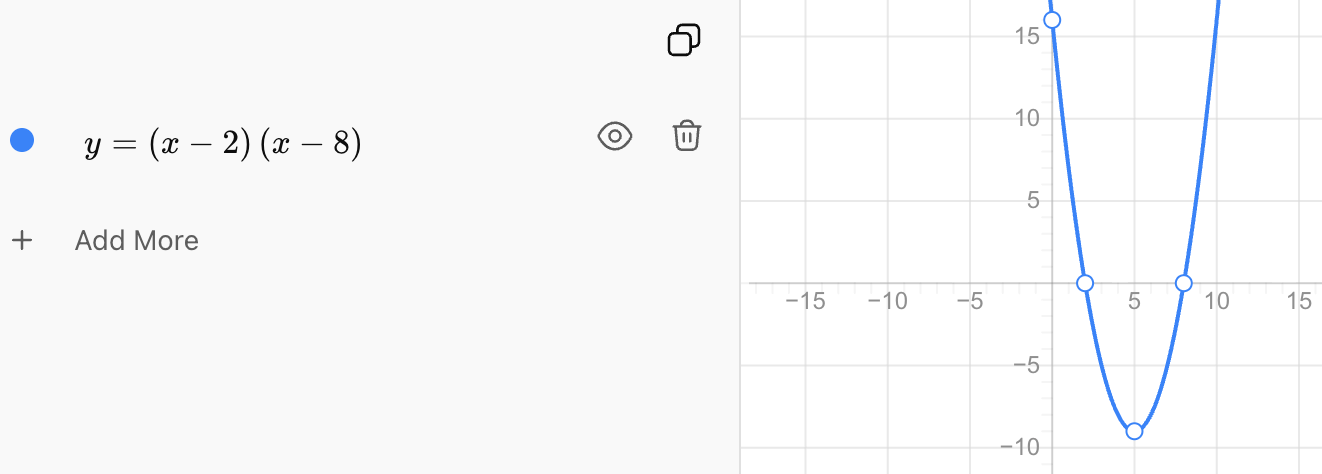
y = (x − 2)(x − 8)
The roots are:
r₁ = 2
r₂ = 8
Find their midpoint:
x = (2 + 8)/2
x = 10/2
x = 5
Therefore, the axis of symmetry is:
x = 5
Why the Axis Is Halfway Between the Roots
The two sides of a parabola are mirror images.
If the graph crosses the x-axis at:
(2, 0)
and:
(8, 0)
the axis of symmetry must be exactly halfway between those points.
The distance from 2 to 5 is 3.
The distance from 5 to 8 is also 3.
So:
x = 5
is the line of symmetry.
Finding the Vertex from Factored Form
Factored form does not show the vertex directly, but we can find it easily.
Consider:
y = (x − 2)(x − 8)
We already know the axis of symmetry:
x = 5
The vertex lies on this line.
Substitute x = 5:
y = (5 − 2)(5 − 8)
y = (3)(−3)
y = −9
Therefore:
vertex = (5, −9)
A Reliable Vertex Method
When given factored form:
y = a(x − r₁)(x − r₂)
Find the roots
r₁ and r₂
Find the axis of symmetry
x = (r₁ + r₂)/2
Substitute this x-value into the function
The resulting y-value gives the vertex.
This gives:
vertex = (x, y)
The Role of a
The value a has the same basic role in all forms of a quadratic.
If:
a > 0
the parabola opens upward.
If:
a < 0
the parabola opens downward.
Also:
- |a| > 1 → vertically stretched, appearing narrower
- |a| = 1 → basic width
- 0 < |a| < 1 → vertically compressed, appearing wider
Example with a Negative Value of a
Consider:
y = −2(x − 1)(x − 5)
Roots:
x = 1 and x = 5
Axis of symmetry:
x = (1 + 5)/2
x = 3
Find the vertex:
y = −2(3 − 1)(3 − 5)
y = −2(2)(−2)
y = 8
Therefore:
vertex = (3, 8)
Since:
a = −2
the parabola opens downward.
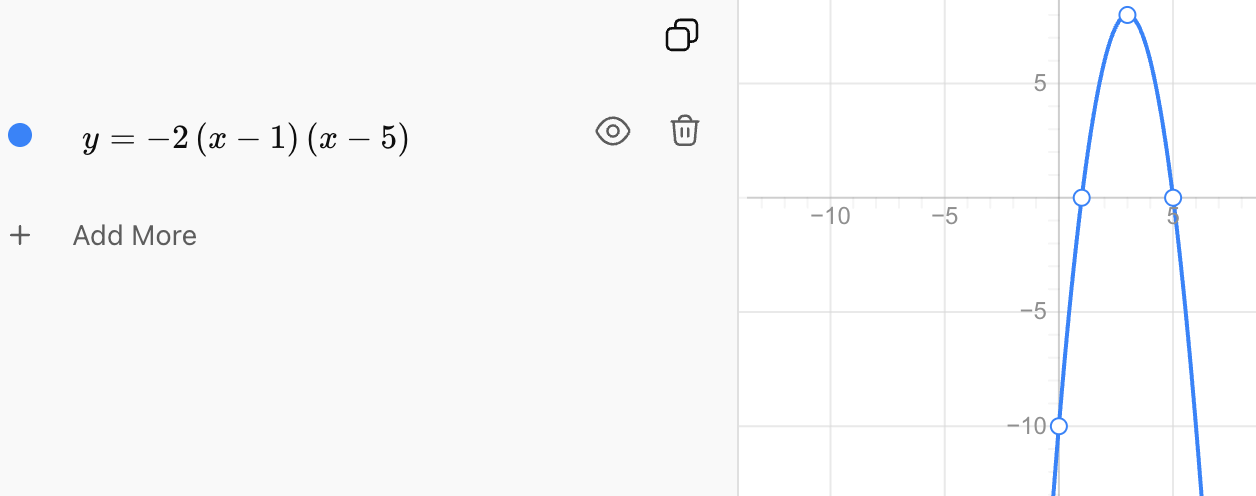
The vertex is therefore a maximum.
Finding the y-Intercept
Factored form also allows us to find the y-intercept.
At the y-intercept:
x = 0
Consider:
y = (x − 2)(x − 6)
Substitute x = 0:
y = (0 − 2)(0 − 6)
y = (−2)(−6)
y = 12
Therefore, the y-intercept is:
(0, 12)
The y-Intercept in General
For:
y = a(x − r₁)(x − r₂)
set x = 0:
y = a(−r₁)(−r₂)
Therefore:
y = ar₁r₂
So the y-intercept is:
(0, ar₁r₂)
This is useful when sketching.
Sketching from Factored Form
Factored form gives us several important features needed for a sketch.
Consider:
y = (x + 1)(x − 5)
Find the roots
x = −1
x = 5
So the x-intercepts are:
(−1, 0) and (5, 0)
Find the axis of symmetry
x = (−1 + 5)/2
x = 2
Find the vertex
Substitute x = 2:
y = (2 + 1)(2 − 5)
y = (3)(−3)
y = −9
Vertex:
(2, −9)
Determine direction
a = 1
Therefore, the parabola opens upward.
Find the y-intercept
Set x = 0:
y = (1)(−5)
y = −5
So:
y-intercept = (0, −5)
We now have enough information to sketch the graph accurately.
A Quick Sketching Strategy
When sketching from factored form, find these features:
- x-intercepts
- axis of symmetry
- vertex
- direction of opening
- y-intercept
Then draw a smooth symmetrical parabola through the important points.
Repeated Roots
Sometimes both factors are identical.
For example:
y = (x − 3)²
This can also be written:
y = (x − 3)(x − 3)
Both roots are:
x = 3
This is called a repeated root or double root.
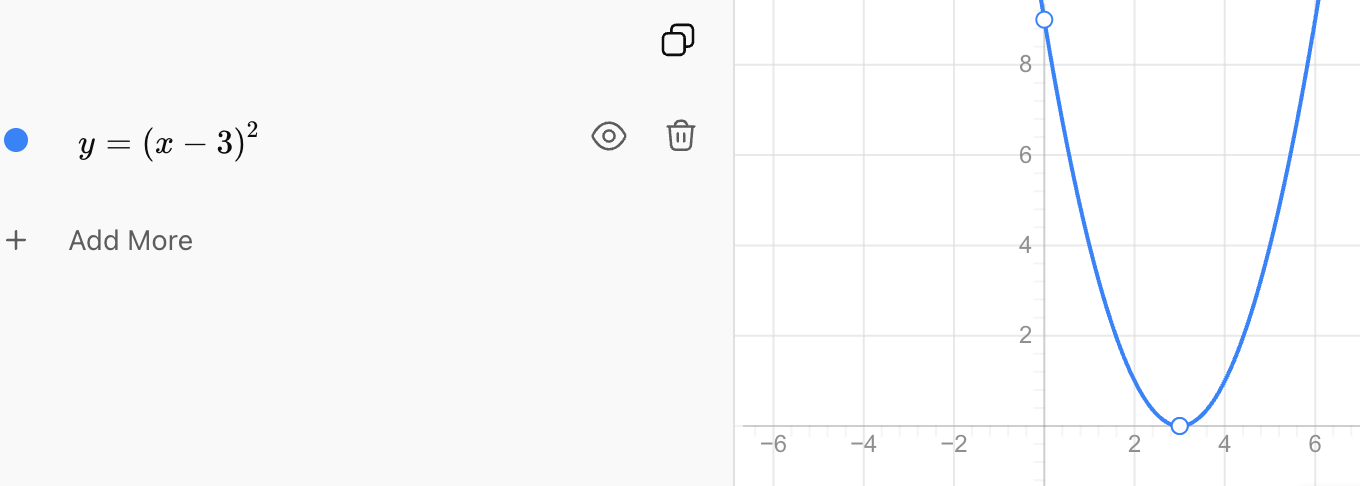
The parabola touches the x-axis at:
(3, 0)
but does not cross it.
The x-intercept is also the vertex.
Crossing vs Touching the x-Axis
If a quadratic has two different real roots, the graph usually crosses the x-axis twice.
For example:
y = (x − 2)(x − 6)
crosses at:
x = 2 and x = 6
If the quadratic has a repeated root, the graph touches the x-axis once.
For example:
y = (x − 4)²
touches at:
x = 4
This difference is important when interpreting quadratic graphs.
Factored Form and Standard Form
Standard form is:
y = ax² + bx + c
Factored form is:
y = a(x − r₁)(x − r₂)
The same quadratic can often be written in either form.
For example:
y = (x − 2)(x − 5)
Expand:
y = x² − 5x − 2x + 10
Therefore:
y = x² − 7x + 10
So:
y = (x − 2)(x − 5)
and:
y = x² − 7x + 10
represent the same parabola.
What Each Form Reveals
From:
y = (x − 2)(x − 5)
we can immediately identify:
roots = 2 and 5
From:
y = x² − 7x + 10
we can immediately identify:
y-intercept = 10
Different forms make different features easier to see.
Factored Form and Vertex Form
Vertex form is:
y = a(x − h)² + k
Factored form is:
y = a(x − r₁)(x − r₂)
Vertex form makes it easy to identify:
- vertex
- axis of symmetry
- maximum or minimum
- transformations
Factored form makes it easy to identify:
- roots
- x-intercepts
- axis of symmetry from the roots
Comparing the Three Main Forms
| Form | General Equation | Information Seen Most Easily |
|---|---|---|
| Standard | y = ax² + bx + c | y-intercept |
| Vertex | y = a(x − h)² + k | vertex and axis of symmetry |
| Factored | y = a(x − r₁)(x − r₂) | roots and x-intercepts |
The coefficient a can be identified directly in all three forms.
One Quadratic in Three Forms
Consider the quadratic:
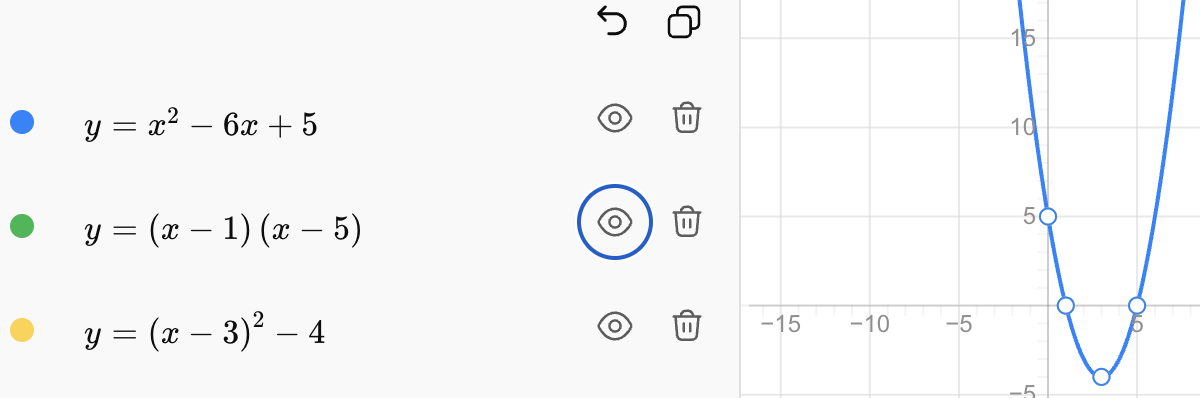
y = x² − 6x + 5
Standard Form
y = x² − 6x + 5
The y-intercept is immediately visible:
(0, 5)
Factored Form
Factor:
y = (x − 1)(x − 5)
The roots are immediately visible:
x = 1 and x = 5
Vertex Form
The same function can be written:
y = (x − 3)² − 4
The vertex is immediately visible:
(3, −4)
All three equations represent exactly the same parabola:
y = x² − 6x + 5
y = (x − 1)(x − 5)
y = (x − 3)² − 4