Fluid Flow and Bernoulli's Principle
3. Bernoulli's Principle
Learning outcomes
- I can state Bernoulli's Principle.
- I can explain the relationship between pressure and fluid speed.
- I can describe how energy is conserved in flowing fluids.
- I can apply Bernoulli's Principle to explain observed phenomena.
- I can solve simple problems involving pressure and fluid flow.
Why does pressure change when a fluid speeds up? Why can a narrow section of pipe have faster-moving fluid but lower static pressure? How can moving air help produce forces on wings, sails, and roofs?
These questions involve one of the most important ideas in fluid dynamics: Bernoulli's Principle.
In a simplified steady-flow situation:
Where a fluid moves faster, its static pressure tends to be lower, provided other relevant conditions such as height are accounted for.
Bernoulli's Principle is fundamentally an application of conservation of energy to a moving fluid.


From Continuity to Bernoulli
In the previous topic, we learned the continuity equation:
A₁v₁ = A₂v₂
For steady flow of an approximately incompressible fluid:
narrower section → greater fluid speed
But this raises another question:
What happens to the pressure when the fluid speeds up?
Bernoulli's equation helps answer this.
For a horizontal pipe under idealized conditions:
greater speed ↔ lower static pressure
and:
lower speed ↔ higher static pressure
This connection between speed and pressure is one of the central ideas of Bernoulli's Principle.
Bernoulli's Principle
A useful statement of Bernoulli's Principle is:
For steady flow of an ideal fluid along a streamline, the total mechanical energy per unit volume remains constant.
That energy can appear in three main forms:
- pressure energy
- kinetic energy
- gravitational potential energy
If one form increases, another must decrease if no external energy is added and losses are negligible.
Bernoulli's Equation
The mathematical form is:
P + ½ρv² + ρgh = constant
Between two positions:
P₁ + ½ρv₁² + ρgh₁ = P₂ + ½ρv₂² + ρgh₂
where:
- P = static pressure (Pa)
- ρ = fluid density (kg/m³)
- v = fluid speed (m/s)
- g = gravitational field strength (m/s² or N/kg)
- h = height (m)
Each term has units of:
Pa = J/m³
So each term represents energy per unit volume.
The Three Energy Terms
Pressure Term
P
This represents energy associated with the fluid's static pressure.
Kinetic Term
½ρv²
This represents kinetic energy per unit volume due to fluid motion.
Faster fluid has a larger kinetic term.
Gravitational Term
ρgh
This represents gravitational potential energy per unit volume.
Fluid at greater height has a larger gravitational term.
So Bernoulli's equation can be summarized as:
pressure energy + kinetic energy + gravitational potential energy = constant
under the ideal conditions assumed.
A Horizontal Pipe
Suppose a pipe remains at the same height.
Then:
h₁ = h₂
so the gravitational terms cancel.
Bernoulli's equation becomes:
P₁ + ½ρv₁² = P₂ + ½ρv₂²
Now the relationship becomes easier to see.
If:
v₂ > v₁
then:
½ρv₂² > ½ρv₁²
So the kinetic term has increased.
For the total to remain constant:
P₂ < P₁
Therefore:
In this ideal horizontal-flow case, faster-moving fluid has lower static pressure.


Continuity + Bernoulli
These two principles work together.
Continuity tells us:
narrower pipe → greater speed
for the same steady incompressible flow rate.
Bernoulli tells us:
In an ideal horizontal system:
greater speed → lower static pressure
Therefore:
wide section → slower fluid → higher static pressure
narrow section → faster fluid → lower static pressure
       WIDE                 NARROW                WIDE

   slower flow            faster flow          slower flow
   higher static P        lower static P        higher static P

 ┌──────────────┐        ┌───────┐        ┌──────────────┐
 │ →   →   →    │────────│→→→→→→→│────────│ →   →   →    │
 └──────────────┘        └───────┘        └──────────────┘
This combination is extremely useful in fluid dynamics.
The Venturi Effect
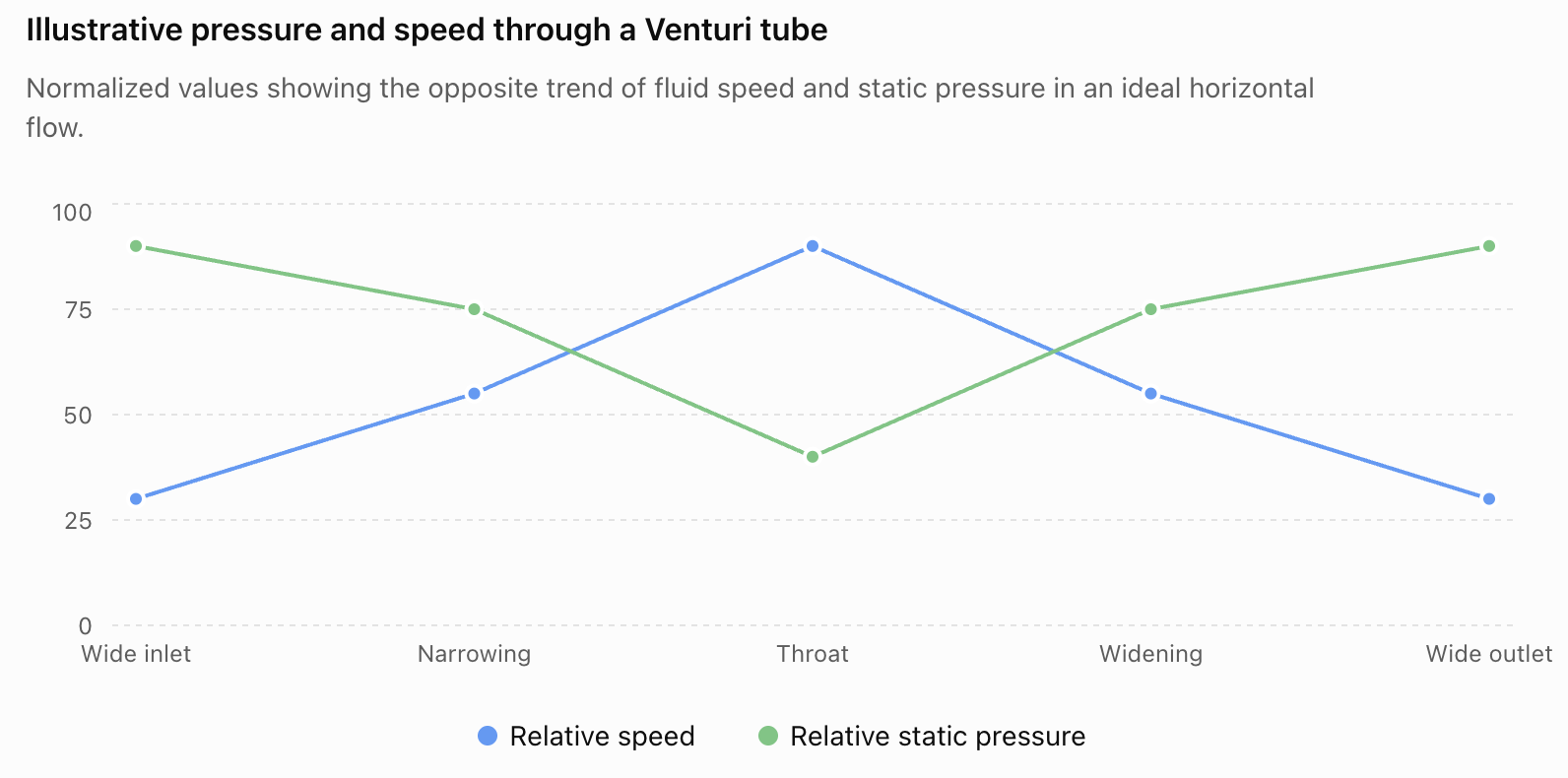
A tube that narrows and then widens again can demonstrate Bernoulli's Principle.
This is often called a Venturi tube.


At the narrow region, called the throat:
- cross-sectional area decreases
- fluid velocity increases
- static pressure decreases
This pressure difference can be measured.
Venturi devices can therefore be used to determine fluid flow rate.
Why Doesn't the Narrow Section Have Higher Pressure?
This is a common source of confusion.
It is tempting to think:
"The fluid is squeezed into a smaller space, so its pressure must increase."
But in a flowing system, the fluid must accelerate as it enters the narrow section.
Energy is required to increase its kinetic energy.
Under ideal horizontal conditions, that energy comes partly from the pressure term.
Therefore:
pressure energy decreases → kinetic energy increases
So the narrow section can have lower static pressure, not higher static pressure.
Pressure and Speed
Consider an ideal horizontal flow.
If fluid speed increases:
kinetic energy per unit volume increases
Since:
P + ½ρv² = constant
the static pressure must decrease.
If fluid speed decreases:
kinetic energy per unit volume decreases
and static pressure can increase.
This is an example of energy transformation rather than energy disappearing.
Worked Example 1: Pressure Change
Water flows through a horizontal pipe.
At Point 1:
v₁ = 2 m/s
P₁ = 120 000 Pa
At Point 2:
v₂ = 6 m/s
Use:
ρ = 1000 kg/m³
Find P₂.
For a horizontal pipe:
P₁ + ½ρv₁² = P₂ + ½ρv₂²
Substitute:
120 000 + ½(1000)(2²) = P₂ + ½(1000)(6²)
Calculate the kinetic terms:
½(1000)(4) = 2000 Pa
½(1000)(36) = 18 000 Pa
Therefore:
120 000 + 2000 = P₂ + 18 000
122 000 = P₂ + 18 000
So:
P₂ = 104 000 Pa
Answer
P₂ = 104 000 Pa
The fluid moves faster at Point 2, so its static pressure is lower.
Checking the Answer
Before accepting a calculation, always ask:
Does the answer make physical sense?
The water sped up:
2 m/s → 6 m/s
Therefore, in the ideal horizontal case, static pressure should decrease.
Our answer shows:
120 000 Pa → 104 000 Pa
So the result is reasonable.
Worked Example 2: Finding Fluid Speed
Water flows through a horizontal pipe.
At Point 1:
P₁ = 150 000 Pa
v₁ = 3 m/s
At Point 2:
P₂ = 142 000 Pa
Use:
ρ = 1000 kg/m³
Find v₂.
Start with:
P₁ + ½ρv₁² = P₂ + ½ρv₂²
Substitute:
150 000 + ½(1000)(3²) = 142 000 + ½(1000)v₂²
150 000 + 4500 = 142 000 + 500v₂²
154 500 = 142 000 + 500v₂²
12 500 = 500v₂²
v₂² = 25
Therefore:
v₂ = 5 m/s
Answer
The fluid speed at Point 2 is:
5 m/s
Again, the lower-pressure location has the greater fluid speed.
What Happens When Height Changes?
Bernoulli's Principle also includes gravitational potential energy.
Consider fluid moving upward through a pipe.


The full equation is:
P + ½ρv² + ρgh = constant
If the fluid moves upward:
h increases
so gravitational potential energy increases.
If the speed remains approximately constant, this increase can come from a decrease in pressure.
Therefore:
greater height can mean lower pressure
even when fluid speed does not change.
This is why we must be careful with the simplified statement:
"faster fluid has lower pressure."
Height also matters.
Worked Example 3: Changing Height
Water flows through a pipe of constant diameter.
Point 2 is 5 m higher than Point 1.
Assume the water speed is the same at both points.
At Point 1:
P₁ = 200 000 Pa
Use:
ρ = 1000 kg/m³
g = 10 N/kg
Because the speeds are equal, the kinetic terms cancel.
Bernoulli's equation becomes:
P₁ + ρgh₁ = P₂ + ρgh₂
Take:
h₁ = 0 m
and:
h₂ = 5 m
Then:
200 000 = P₂ + (1000)(10)(5)
200 000 = P₂ + 50 000
Therefore:
P₂ = 150 000 Pa
Answer
The pressure at the higher point is:
150 000 Pa
Some pressure energy has been converted into gravitational potential energy.
Energy Conservation
Bernoulli's equation is really an energy equation.
Imagine a small amount of fluid moving through a system.
Its energy can shift between:
pressure ↔ motion ↔ height
but under ideal conditions the total remains constant.
For example:
pressure energy decreases → kinetic energy increases
or:
pressure energy decreases → gravitational potential energy increases
This is the same conservation principle encountered throughout physics:
Energy can be transferred or transformed, but it is not created or destroyed.
A Useful Energy Picture
Imagine three "accounts" containing the fluid's mechanical energy:
| Energy Form | Bernoulli Term | Increased By |
|---|---|---|
| Pressure | P | Greater static pressure |
| Kinetic | ½ρv² | Greater fluid speed |
| Gravitational | ρgh | Greater height |
If one account gains energy, another must lose energy when the total remains constant.
This is a useful way to think about Bernoulli problems.
Visualizing Pressure and Velocity
Consider an illustrative horizontal Venturi tube where fluid speed increases as the tube narrows.