3. Bernoulli's Principle

Learning outcomes
  • I can state Bernoulli's Principle.
  • I can explain the relationship between pressure and fluid speed.
  • I can describe how energy is conserved in flowing fluids.
  • I can apply Bernoulli's Principle to explain observed phenomena.
  • I can solve simple problems involving pressure and fluid flow.

Why does pressure change when a fluid speeds up? Why can a narrow section of pipe have faster-moving fluid but lower static pressure? How can moving air help produce forces on wings, sails, and roofs?

These questions involve one of the most important ideas in fluid dynamics: Bernoulli's Principle.

In a simplified steady-flow situation:

Where a fluid moves faster, its static pressure tends to be lower, provided other relevant conditions such as height are accounted for.

Bernoulli's Principle is fundamentally an application of conservation of energy to a moving fluid.

https://images.openai.com/static-rsc-4/suKNPlZJ4PPaqrmXOwXsl0jxPRnH0AMFfZBCukThEh43w1Bw0Y3aUyn7yIHSaakJcB9CTkWvnng8x9nAfRmx7zXN5FAklDFUceSc65phGI2bMlsQmCQnNeb113PnWYcfiiSIabcyn7aZeCpjCQw3MN2DG7fXD3YrERiAL6ILxTPcHgmcHpg2j7tUEtEp1HeY?purpose=fullsize
https://images.openai.com/static-rsc-4/VBCYX1NSreq2bMDMmM3_5hc6eGT-yJ0kRVx6U1gLVWZ4UC8GoMn8W0jyk70VXPAuWkNCPXwBe3_NyIDs0GJgQcy5AMZ2Xg0x__LzKSsFEoU_SSO-ZI5FR301sCWCP7gxDTDHE0kQ4MmX2clRdotwFn6rnS2rlYlay8iie5DV634nr8PCaoiXbrp4IjmfQApW?purpose=fullsize
https://images.openai.com/static-rsc-4/aEzEavK2OU29So5oNXciEJ6g90jhNG0N9ycKenv7dgJsqCsjWuQpaNbEHV0VSSuov6b8K4KWRS8xyWE4dSAC7UnfuZAnU3MKu9UYWsog7fQXmtGYdfGfDz6mLbqnMQpSfXQkn-ZOf1uV3DKjDyxdbkVEAdqWxG7o0PUMZ_g08n-Hc6XWvZwhuKgBN9KmFtdY?purpose=fullsize
6

From Continuity to Bernoulli

In the previous topic, we learned the continuity equation:

A₁v₁ = A₂v₂

For steady flow of an approximately incompressible fluid:

narrower section → greater fluid speed

But this raises another question:

What happens to the pressure when the fluid speeds up?

Bernoulli's equation helps answer this.

For a horizontal pipe under idealized conditions:

greater speed ↔ lower static pressure

and:

lower speed ↔ higher static pressure

This connection between speed and pressure is one of the central ideas of Bernoulli's Principle.


Bernoulli's Principle

A useful statement of Bernoulli's Principle is:

For steady flow of an ideal fluid along a streamline, the total mechanical energy per unit volume remains constant.

That energy can appear in three main forms:

  • pressure energy
  • kinetic energy
  • gravitational potential energy

If one form increases, another must decrease if no external energy is added and losses are negligible.


Bernoulli's Equation

The mathematical form is:

P + ½ρv² + ρgh = constant

Between two positions:

P₁ + ½ρv₁² + ρgh₁ = P₂ + ½ρv₂² + ρgh₂

where:

  • P = static pressure (Pa)
  • ρ = fluid density (kg/m³)
  • v = fluid speed (m/s)
  • g = gravitational field strength (m/s² or N/kg)
  • h = height (m)

Each term has units of:

Pa = J/m³

So each term represents energy per unit volume.


The Three Energy Terms

Pressure Term

P

This represents energy associated with the fluid's static pressure.

Kinetic Term

½ρv²

This represents kinetic energy per unit volume due to fluid motion.

Faster fluid has a larger kinetic term.

Gravitational Term

ρgh

This represents gravitational potential energy per unit volume.

Fluid at greater height has a larger gravitational term.

So Bernoulli's equation can be summarized as:

pressure energy + kinetic energy + gravitational potential energy = constant

under the ideal conditions assumed.


A Horizontal Pipe

Suppose a pipe remains at the same height.

Then:

h₁ = h₂

so the gravitational terms cancel.

Bernoulli's equation becomes:

P₁ + ½ρv₁² = P₂ + ½ρv₂²

Now the relationship becomes easier to see.

If:

v₂ > v₁

then:

½ρv₂² > ½ρv₁²

So the kinetic term has increased.

For the total to remain constant:

P₂ < P₁

Therefore:

In this ideal horizontal-flow case, faster-moving fluid has lower static pressure.

https://images.openai.com/static-rsc-4/m7Hr-KftcekWb0UlLwyjLu8klHkMtBLy0KAZm7BFkToEM-fRqjPC2VnAXJGbCwGAz2zGSfsEK7uYl3rTIufUtxODmWyh28F2cdGJY5wxEtbOEOl0IZn39DeCDTpJnLbuEvVNOBelInk4osHNmH2RisHPamRKDcJ30cGSSsHbfZxvMLcUBtgdKyNGrqo_fcOJ?purpose=fullsize
https://images.openai.com/static-rsc-4/V5oDac722S7BYbVG28xZ-jKQuyzmxs7Us4bD-_EIHVIRF_veoxkiCJRlRXKWPBDWaBVInl48JmUNdwfKx7JaupjsiMJOhGjN5fuGWKkhHscvxqfT9xKXgudGiTDwKN_QdJLg2Gy0l5fptWWfR9bhkzo5jJZFiu8nrI71cg_mEbvBkOVB363miijs-BJ7NKSV?purpose=fullsize
https://images.openai.com/static-rsc-4/uprfpXheIeLcfQsME_3h_6yo-vjJg-48sM1-yVD2J7X_NmFhzKn0DRiuODHKCbs9EywWvIdxWGTuIG84JN9BrY7Gj0EoEMsjiHxc9iBwdnGhGJYd-TaM8J9uP_Yx6la5nwoMOLn0kNfH7krY3Fpt8vd_tVNWEDTnTYVb-JjpPTJvCL71-UAUNQsPAy1Kyvr-?purpose=fullsize
6

Continuity + Bernoulli

These two principles work together.

Continuity tells us:

narrower pipe → greater speed

for the same steady incompressible flow rate.

Bernoulli tells us:

In an ideal horizontal system:

greater speed → lower static pressure

Therefore:

wide section → slower fluid → higher static pressure

narrow section → faster fluid → lower static pressure

 
       WIDE                 NARROW                WIDE

   slower flow            faster flow          slower flow
   higher static P        lower static P        higher static P

 ┌──────────────┐        ┌───────┐        ┌──────────────┐
 │ →   →   →    │────────│→→→→→→→│────────│ →   →   →    │
 └──────────────┘        └───────┘        └──────────────┘
 

This combination is extremely useful in fluid dynamics.


The Venturi Effect

A tube that narrows and then widens again can demonstrate Bernoulli's Principle.

This is often called a Venturi tube.

https://images.openai.com/static-rsc-4/V4Tp4HCNG31FnBM-_TL0qG14lsGxOD1UYcVyxCXAyFsosiD9uQMBtfjS1El3iT-mnXSMVzVD5uDacTp3pLShDkBn6UT_C9S43v7JCcRcXTOWscqEvAmizZsZZMZ833iY0dsNOKYEQcSbS2Uf_CV6UOx46PG7DV3fZWTa1BxeCTJCe32Vq_r3EqD7IKojMkCC?purpose=fullsize
https://images.openai.com/static-rsc-4/VBCYX1NSreq2bMDMmM3_5hc6eGT-yJ0kRVx6U1gLVWZ4UC8GoMn8W0jyk70VXPAuWkNCPXwBe3_NyIDs0GJgQcy5AMZ2Xg0x__LzKSsFEoU_SSO-ZI5FR301sCWCP7gxDTDHE0kQ4MmX2clRdotwFn6rnS2rlYlay8iie5DV634nr8PCaoiXbrp4IjmfQApW?purpose=fullsize
https://images.openai.com/static-rsc-4/dXCTpQmMIxdd6XprqqkTWBk7g53ThZC71PdJEmk4RuACb0TUE5AvGedmAjLpLTzvMg5Va34g3lQWyuEYcbLjQjWcyWbrS63JqG5VhvRhTsZSKVsEqwfliOt3i8q9TNkVcybMbZ1POvNUChGhdfBh8LHjRxPEhb7nLn96lGpUL-DCtylsAcjpiCYbUoQvoUhp?purpose=fullsize
5

At the narrow region, called the throat:

  • cross-sectional area decreases
  • fluid velocity increases
  • static pressure decreases

This pressure difference can be measured.

Venturi devices can therefore be used to determine fluid flow rate.


Why Doesn't the Narrow Section Have Higher Pressure?

This is a common source of confusion.

It is tempting to think:

"The fluid is squeezed into a smaller space, so its pressure must increase."

But in a flowing system, the fluid must accelerate as it enters the narrow section.

Energy is required to increase its kinetic energy.

Under ideal horizontal conditions, that energy comes partly from the pressure term.

Therefore:

pressure energy decreases → kinetic energy increases

So the narrow section can have lower static pressure, not higher static pressure.


Pressure and Speed

Consider an ideal horizontal flow.

If fluid speed increases:

kinetic energy per unit volume increases

Since:

P + ½ρv² = constant

the static pressure must decrease.

If fluid speed decreases:

kinetic energy per unit volume decreases

and static pressure can increase.

This is an example of energy transformation rather than energy disappearing.


Worked Example 1: Pressure Change

Water flows through a horizontal pipe.

At Point 1:

v₁ = 2 m/s

P₁ = 120 000 Pa

At Point 2:

v₂ = 6 m/s

Use:

ρ = 1000 kg/m³

Find P₂.

For a horizontal pipe:

P₁ + ½ρv₁² = P₂ + ½ρv₂²

Substitute:

120 000 + ½(1000)(2²) = P₂ + ½(1000)(6²)

Calculate the kinetic terms:

½(1000)(4) = 2000 Pa

½(1000)(36) = 18 000 Pa

Therefore:

120 000 + 2000 = P₂ + 18 000

122 000 = P₂ + 18 000

So:

P₂ = 104 000 Pa

Answer

P₂ = 104 000 Pa

The fluid moves faster at Point 2, so its static pressure is lower.


Checking the Answer

Before accepting a calculation, always ask:

Does the answer make physical sense?

The water sped up:

2 m/s → 6 m/s

Therefore, in the ideal horizontal case, static pressure should decrease.

Our answer shows:

120 000 Pa → 104 000 Pa

So the result is reasonable.


Worked Example 2: Finding Fluid Speed

Water flows through a horizontal pipe.

At Point 1:

P₁ = 150 000 Pa

v₁ = 3 m/s

At Point 2:

P₂ = 142 000 Pa

Use:

ρ = 1000 kg/m³

Find v₂.

Start with:

P₁ + ½ρv₁² = P₂ + ½ρv₂²

Substitute:

150 000 + ½(1000)(3²) = 142 000 + ½(1000)v₂²

150 000 + 4500 = 142 000 + 500v₂²

154 500 = 142 000 + 500v₂²

12 500 = 500v₂²

v₂² = 25

Therefore:

v₂ = 5 m/s

Answer

The fluid speed at Point 2 is:

5 m/s

Again, the lower-pressure location has the greater fluid speed.


What Happens When Height Changes?

Bernoulli's Principle also includes gravitational potential energy.

Consider fluid moving upward through a pipe.

https://images.openai.com/static-rsc-4/E4gNwF0aZuDJDVqdBlzuSPBK8ZBsNqj5nH3vUvZhd1wPVZgCVvVfdPSww_-WRQ2jV4ZrqQRQ3iuqQZmtTIEFRN4vKfrl-qVX0IlxEm90tlU51WUsva99CNldoxCzxzaA817mDBjWSF7F6zNJ2rqPJ8ORm2tY4-C2usThDtrToPfdSzw5boD6XYVV8cw_tVHO?purpose=fullsize
https://images.openai.com/static-rsc-4/9nCEzHXmPd1mfBG2C-aGDO9UDDp7A_c-dAj8ysq0vhymwTSSP1VrGqMObO2sMA_BebN35_LM6ALVcdGxLJ1vcMJH2dkBep-l3JZL7HhdiIo0uJiCOFAZN_FIfGhmUaQiyYiJWXACUjOuF4hTEEEmhUoGjMIJ8UKT1ff6H_arNjAbeJ6cymVNdt80TPG4McJS?purpose=fullsize
https://images.openai.com/static-rsc-4/6hCg134W60LRT6y6IyNyhCUwBKPBJqPkfu_DxoEHZ0htENuCCbaRqPjejsedMGuau_MAL83rWINV8i01tqRFUwNIOffGBjsSefx1pMonkvsnMA2miDFChQaiBkVqibg8BYls7Mt4GTAr87kugF3Td8hte286bAQAP-d142a_u0AlQIK-6gsIc-bSNmZN65m6?purpose=fullsize
5

The full equation is:

P + ½ρv² + ρgh = constant

If the fluid moves upward:

h increases

so gravitational potential energy increases.

If the speed remains approximately constant, this increase can come from a decrease in pressure.

Therefore:

greater height can mean lower pressure

even when fluid speed does not change.

This is why we must be careful with the simplified statement:

"faster fluid has lower pressure."

Height also matters.


Worked Example 3: Changing Height

Water flows through a pipe of constant diameter.

Point 2 is 5 m higher than Point 1.

Assume the water speed is the same at both points.

At Point 1:

P₁ = 200 000 Pa

Use:

ρ = 1000 kg/m³

g = 10 N/kg

Because the speeds are equal, the kinetic terms cancel.

Bernoulli's equation becomes:

P₁ + ρgh₁ = P₂ + ρgh₂

Take:

h₁ = 0 m

and:

h₂ = 5 m

Then:

200 000 = P₂ + (1000)(10)(5)

200 000 = P₂ + 50 000

Therefore:

P₂ = 150 000 Pa

Answer

The pressure at the higher point is:

150 000 Pa

Some pressure energy has been converted into gravitational potential energy.


Energy Conservation

Bernoulli's equation is really an energy equation.

Imagine a small amount of fluid moving through a system.

Its energy can shift between:

pressure ↔ motion ↔ height

but under ideal conditions the total remains constant.

For example:

pressure energy decreases → kinetic energy increases

or:

pressure energy decreases → gravitational potential energy increases

This is the same conservation principle encountered throughout physics:

Energy can be transferred or transformed, but it is not created or destroyed.


A Useful Energy Picture

Imagine three "accounts" containing the fluid's mechanical energy:

Energy Form Bernoulli Term Increased By
Pressure P Greater static pressure
Kinetic ½ρv² Greater fluid speed
Gravitational ρgh Greater height

If one account gains energy, another must lose energy when the total remains constant.

This is a useful way to think about Bernoulli problems.


Visualizing Pressure and Velocity

Consider an illustrative horizontal Venturi tube where fluid speed increases as the tube narrows.
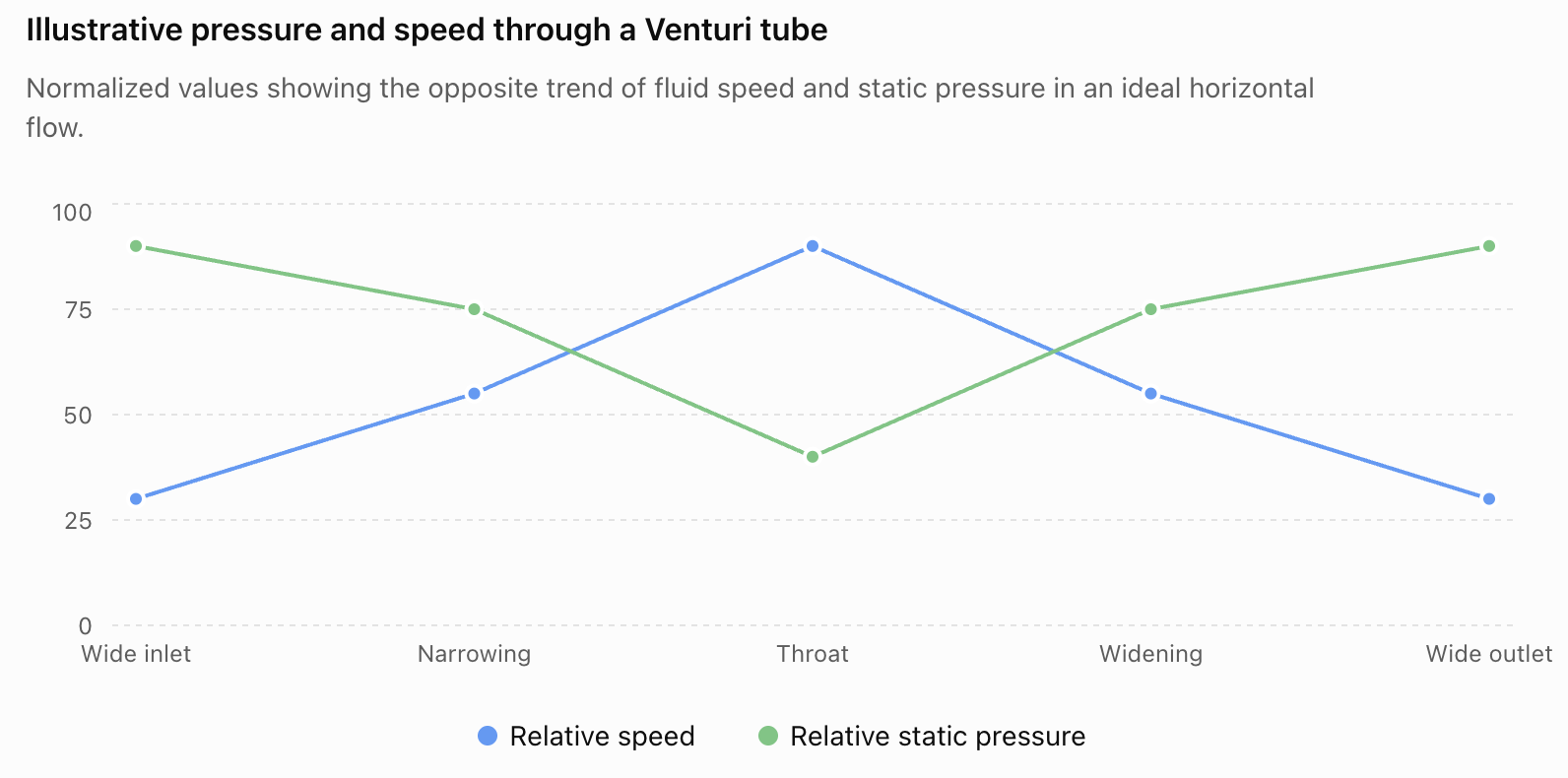
The values above are illustrative rather than measured data, but they show the key relationship:

speed rises → static pressure falls

and when the pipe widens again:

speed falls → static pressure can recover


Bernoulli and Airflow

Bernoulli's Principle applies to gases as well as liquids when the assumptions are appropriate.

Air moving around objects can therefore show pressure differences associated with differences in flow speed.

Applications include:

  • aircraft wings
  • sails
  • roofs
  • spray devices
  • Venturi meters
  • carburetors
  • laboratory aspirators
https://images.openai.com/static-rsc-4/4v7eDY9Nmej2eApXxa0g5xyUydftxBTPZaas8Ul74k7gFvuW3eLNKP3a33S4X3nV-ijYpBfWJuhLAhEimjgT-W0B4QFTA76ofuImrNnQ1Ubyd6kZfzPUZHL3eMX8rknz5pb-X61E2ktYtGC-6F2lYRhbJPRXEVPqyF98DN0KBTcj9glTvLSMsXdMeGUHMTNz?purpose=fullsize
https://images.openai.com/static-rsc-4/3e2IkzLnkkEGygiEIv7iOT-I7Jv8rf-EH3HyriEDuFPOqa2FyWYeJHlG7Qvps0Dw0xLPo7mVhFXQQO5GGiSfY7atcN4eelN-oQhAEuBRcPQdgj6qySZCNoZbO7Z9y79VXxgn7D2KG6L4fBZS9q4Viluf7koVfDLql2ClFQYbT0jDQmyDrrJomalDebs-ISHQ?purpose=fullsize
https://images.openai.com/static-rsc-4/2-sevnK2V7Ay9Ho6duAtzSApCnmZ6mnaSHorQLE8AioIdB6Gl7s360RuGvk8hDg1VQaOHLzNTaaCV--Nt3jHX69hhNuNlPg1ygJE8xeNHHZY8dTkxpFH09l8xsG6Ykf1HUirtA4gO2s7KfzbrroWSApIYV1Z7uYzCd1ZAncOsEUZO_KwEDS4MxZcCTJRcd1D?purpose=fullsize
6

Aircraft Wings

Aircraft wings provide an important application of fluid dynamics, but they require a careful explanation.

Air moving around a wing creates a pressure distribution over its surfaces.

The pressure is typically lower over much of the upper surface than over the lower surface, producing part of the upward aerodynamic force called lift.

https://images.openai.com/static-rsc-4/IfyjilRgNhFQtSCYXIsdN_Z3wYyxc95Vh2-NW_AhWEgP_5XWM132CTORWaV1WcnvHuAfYjV6Q0Vq9re73cLjoLHQ6GRUbAwT8hwaOJ6GG6DZzQcVig3LeTWHDBulf-0gdI80UqCvIh6VJFX9Nohg3Z-H5oJRTwrtFShCE8CXUY1xlXn-_kV9FtbhxCPUJn3c?purpose=fullsize
https://images.openai.com/static-rsc-4/XkKVQH78m-HoGnrhiwIWcw9hAOQB9ZbDadcZ11U6QvjkJHns0G5kqx9dlQExuyjZCCQarvT1UkuGUMNVyqpwZI19sQ53Kxyll8CVFQcz394uqbVNiQtN_wWAJmwPHlZiTdygSb5GwuJEsyLu95_vjEbpLsCKIh0fXUK_qR_p0cnnbvK4FTM-jdCkI9pYKWe0?purpose=fullsize
https://images.openai.com/static-rsc-4/NkRQjr3YVxXbIy9MO2w1TxKzc5-fQxImRl1LZCdWg1D3lCEpGazWwhp8B0ujD8lXA52QzWoQoCSyz_NAmclzUAWdwytKcCIJJIQWOJfFPRuOKqR7ak_yPB_0Jm9_h2KAZ3-dK_3bkdwEbGtbpHBGht2wQRvkjqoTANYndYwuq2l5Lnjg-YXuGDpZMk3YnWby?purpose=fullsize
6

Bernoulli's equation can help relate regions of different airflow speed to pressure differences.

However, it is incomplete to say:

"Planes fly only because air moves faster over the top."

Lift also involves:

  • wing shape
  • angle of attack
  • airflow deflection
  • circulation
  • pressure distribution

Bernoulli's Principle and Newton's laws are consistent descriptions of the same fluid behaviour, not competing explanations.


An Important Wing Misconception

You may have heard this explanation:

"Air travelling over the top of a wing must meet the air travelling underneath at the back."

This is called the equal-transit-time explanation, and it is incorrect.

Air particles separated at the front of the wing do not have to arrive at the trailing edge at the same time.

A better explanation considers the complete airflow and resulting pressure distribution around the wing.

This distinction is important when using Bernoulli's Principle correctly.


Spray Bottles and Atomizers

Some spray devices use fast-moving air to help draw liquid into an airflow.

https://images.openai.com/static-rsc-4/nvbo4jTM9M0sVflaNmFmfW4C5nE3pK8lyyyPgIO-mjAZ1vOxQLkbaQRPUEhUdED1a2KUNW1Wbun4B1KzpxJ6oMM_YgTaXVrEtLslB6O1WsKRKy9ptwm0nb9EN2ITGNKXy1AzWfrrml5RbGB62WxhQyMkrXLj2HFublmifxsNRxT5PehyLrt_nkdFdXNA4LP2?purpose=fullsize
https://images.openai.com/static-rsc-4/dbPi83t7QVsgZVJjdiX1Pw5vAkX6tIqeXbaJoEdAIu-drz_roQO4-DZgU-PKD_NWtGmHdvN74SSTpkrdHtBmjEJxh-_fibf1zTURrlCSm1YSTjU4vG0QvCb-Zj_OsmK9QH5f6Fc0ylsS5evI2Ffsh0HVFRlVBzm-HcN5dKUY3UIXDgJMFSKt--rVCUtZ3f8V?purpose=fullsize
https://images.openai.com/static-rsc-4/Ck_qNYbmAr_pW9sVgSSy-AUmv3a_uxB-8PaA9PzdSn7yaVLBqdXbeQ9mzuzPWy_tdEZtF5akUhGdG_4dQkD9mTNSyCbJZOY-EPxPRq6Qx11hbhAIApFZuHMXVCviq21YJan1wyLuWKE_l-_-q-pMu_cxfXem4dtCe15LAe5G047VOanzgCpr3w_QxkUB4bsh?purpose=fullsize
5

Fast air moving past the top of a tube can be associated with lower static pressure.

If the pressure acting on the liquid elsewhere is greater, the pressure difference can help push liquid upward.

The moving air then breaks the liquid into small droplets.

This principle has been used in:

  • perfume atomizers
  • paint sprayers
  • laboratory equipment
  • some fuel-delivery systems

Chimneys

Moving air across the top of a chimney can influence the pressure near its opening.

A pressure difference can help encourage gases to move upward through the chimney.

https://images.openai.com/static-rsc-4/AI9UrDTk8yy7_MUQ8v_AE9zgiBJFkco6ZS-AgFbcAky2w6n5zmjvvl6DwRratYUswdLVCSxEncbKXZ9IlkutedXXQWd2y_hAgyJOHVFz5MyPqLADiKXXzaVWPTiHkaZdw4JkUQoaiOa1WMbZ-Y1kXP3ZY823K8ux44dffcIFVlIuFv5qpIAdngxnzZhMFQty?purpose=fullsize
https://images.openai.com/static-rsc-4/K2u7XerR2T0YCvZn32CuKul80-PXw0lYWmmO417QwpqCjYyKwVG5ByZTFtZsyL7-KT95uyyOoD9reCxaTybW2SJUfKkgNWqJBbd9bTi0PMZRMx9tfB8lEn4Mw6XzfZqbs4tq6qJ51BW-cMDYybJN0c15tuKqXSTB-WJtj0kVQd8AVVerMvCeJpz5wvUFmfPE?purpose=fullsize
https://images.openai.com/static-rsc-4/ztybAhcyC0NjtyNhT_Q5xhordslEKQQqiW2wYXlo5U_rcYE-7fRWPpqAxnJRin9zoC08tkhWk1KdOgbkYaUwZZRPnCqFuCRfNakNq5jAeTIsCKPEHMW0DOX_Tsq5Cnr9sNVaUzr8IaUIWPXBRlBW09E1dGLgdVCLfellHYsWgW_QEawLlrDk-kopeqCzl150?purpose=fullsize

However, chimney draft is also strongly affected by buoyancy because hot gases inside the chimney are usually less dense than cooler outside air.

This is a good example where several fluid principles operate together.


Strong Winds and Roofs

Fast-moving wind around a building can create pressure differences across surfaces.

https://images.openai.com/static-rsc-4/wyAIUYHaM6b0c_INmssafFXOQLssxshYqgHgpwNdq4F__JFWeti64nIQUy0NxIuwIWJWPq00N-bUHYyQX7FtDVNe5mElLTjZTaoKfq4TPUjLFeSdZx0x3OSxzqDyj1V_xUVl7CQfj0T5Squi9tlUDNY40V-OhZCBrkaXWlLEMTB4IIeMq9bSXbi61DGN747a?purpose=fullsize
https://images.openai.com/static-rsc-4/QkltsQSvZw6g63Kiv-LwP0rsnvMMhcOh3YOovlsK1vX0kfIQSIcAXzoZQgwBBHb-WWCBltTO7Yu782h7vvXyCQkQ3HWG4XoJs_EfWeqv_JtU-zMlPS43eqkDJ15f7I9-ExtGmR8WIw5AH2bD5NwrW4BTocs1ib-naM1-MTRnLExjUb2ERCUPTwWcWsKUXk3W?purpose=fullsize
https://images.openai.com/static-rsc-4/nKjhX0JitIYQfeSazkweOTX3X4ddeOYdrHTfN4SkBKOX21K_OVFlzmDIYrEYuBxw8cIpnBPOZCPepIVvlSeCucQLx9jTSVXuJNM_ssyE5wrFTjxENytsGTi04hioOCdYwVJVLzv0xIad2Aq2rLGIkNqYxELNwowjVAETqjKCNZlW8w_CXmbtnSzECE_sjkTU?purpose=fullsize
6

These pressure differences can contribute to forces on roofs.

However, real wind flow around buildings is turbulent and complex.

Engineers therefore do not rely on a simple Bernoulli statement alone. They consider:

  • external pressure
  • internal pressure
  • turbulence
  • building geometry
  • wind direction
  • structural strength

This is an important example of applying a scientific model while recognizing its limitations.


Sailing

Sails interact with moving air and can create pressure differences across their surfaces.

https://images.openai.com/static-rsc-4/3e2IkzLnkkEGygiEIv7iOT-I7Jv8rf-EH3HyriEDuFPOqa2FyWYeJHlG7Qvps0Dw0xLPo7mVhFXQQO5GGiSfY7atcN4eelN-oQhAEuBRcPQdgj6qySZCNoZbO7Z9y79VXxgn7D2KG6L4fBZS9q4Viluf7koVfDLql2ClFQYbT0jDQmyDrrJomalDebs-ISHQ?purpose=fullsize
https://images.openai.com/static-rsc-4/ujmgI6d0zcQKKSCPBq2-1S2ALWkqzk53dlY-5cIl_8L_BCBC39Mo3X4k9pAuDVU_v1muwNVA9Mw0tjYe2Sk0fERqpVIJHUsHwCD8JPjJq5ECStDorvaUZ6gK3RbCPocb6D6ig5WtvZc_rQQwbwmQhNWvZGVENck1uXg_ZiEh4Tc2JxIFhdr7kPN4SpJ39f2y?purpose=fullsize
https://images.openai.com/static-rsc-4/otkHywqj6HDT03I9KLyDm9-kH2yOwgn_YWQUsfF4yKfZltrX2WHGJoJZjDVCpsqmcSw1i19NXx0P4wfrfKw4oR7Ublk1JEBsU7hBxNQfYth-MsUqP00wKFgCfUqFA4OSXmX1VM9ScRLu-0RHEFO1zJg6MYLIpXD0lcPZklTNjyXg-ozRfHrDDXqf_m6kEqE2?purpose=fullsize
6

The resulting aerodynamic force can be resolved into components that help move the boat.

As with aircraft wings, the complete explanation involves:

  • pressure distribution
  • airflow deflection
  • sail shape
  • angle to the wind

Bernoulli's equation can help describe the relationship between airflow speed and pressure in suitable parts of the flow.


Pitot Tubes

Aircraft and other systems can measure fluid speed using differences in pressure.

One device is a Pitot tube.

https://images.openai.com/static-rsc-4/eMkyUoXMyAlXTBcI61PgfnGKlAnkTxOTwEpKVvV8qeSBCG9Q1IKbXQalMSAChulzsqaSliDMXsi-_P-TK4kAbhTPMWODYz9AmAI8vRF7k8J5F1AGf9eJ1xctU_a2XZT1bFLQhywVj37xiEqj_lMz4woMFej4hS25a1-6P2L1Rct8jswY0scNLNoMmcUx3wO9?purpose=fullsize
https://images.openai.com/static-rsc-4/h-k_IxIKcr6Fdv9-NlRJWnlLz267U4IzT3ou4IJ_nECLHUjnOMk8FynmDvwDsfFdIAG_LJEhuqhL7HYKJPALRxrcjtoWqsv-Eg0nDKsJmEatlfZAjclgEx40_Xof5brP99XCPlZEHEOvzHzYcP1PxD_J_gOUrVnXLGZRUiBgmF2JnL1unY66-9GuMc1_eqiw?purpose=fullsize
https://images.openai.com/static-rsc-4/lXdnMv6qKhaZBItYS80nKlL-cqHqG31s4T1HSxIefqdWOBdNLIrCdnx9NhtvxmfEGImcXZR10S8CNFY91Q-ytqW_UoRRt35mP4USvjyBMmcbsmS5beqyffJKJNcJgW-bihX2y5fysCCLLmtICq59gv6xHZv1y9PwDiVa6RHxEF1hpkfC856dCrzFvEHXsgEZ?purpose=fullsize
4

A Pitot-static system compares:

  • static pressure
  • stagnation pressure

The pressure difference can be related to fluid speed using Bernoulli's equation.

This allows aircraft instruments to determine airspeed.


Worked Example 4: Using Pressure Difference

Air moves through a horizontal system.

At Point 1:

v₁ = 10 m/s

At Point 2:

v₂ = 20 m/s

Use an air density of:

ρ = 1.2 kg/m³

Calculate:

P₁ − P₂

Start with:

P₁ + ½ρv₁² = P₂ + ½ρv₂²

Rearrange:

P₁ − P₂ = ½ρ(v₂² − v₁²)

Substitute:

P₁ − P₂ = ½(1.2)(20² − 10²)

P₁ − P₂ = 0.6(400 − 100)

P₁ − P₂ = 0.6 × 300

P₁ − P₂ = 180 Pa

Answer

P₁ is 180 Pa greater than P₂.

The faster-moving air at Point 2 has the lower static pressure in this idealized horizontal example.


Combining Continuity and Bernoulli

Some problems require both equations.

Suppose water moves through a horizontal pipe:

A₁ = 0.040 m²

v₁ = 2 m/s

The pipe narrows to:

A₂ = 0.020 m²

and:

P₁ = 130 000 Pa

Use:

ρ = 1000 kg/m³

Find v₂ and P₂.

Step 1: Use Continuity

A₁v₁ = A₂v₂

0.040 × 2 = 0.020 × v₂

v₂ = 4 m/s

Step 2: Use Bernoulli

Because the pipe is horizontal:

P₁ + ½ρv₁² = P₂ + ½ρv₂²

Substitute:

130 000 + ½(1000)(2²) = P₂ + ½(1000)(4²)

130 000 + 2000 = P₂ + 8000

Therefore:

P₂ = 124 000 Pa

Answer

v₂ = 4 m/s

P₂ = 124 000 Pa

So:

area decreases → velocity increases → static pressure decreases


A Problem-Solving Strategy

When solving Bernoulli problems:

Step 1: Draw or examine the system

Identify Points 1 and 2.

Step 2: Record the known quantities

Look for:

  • P₁ and P₂
  • v₁ and v₂
  • h₁ and h₂
  • ρ

Step 3: Ask whether continuity is needed

If pipe areas are given, you may first need:

A₁v₁ = A₂v₂

Step 4: Write Bernoulli's equation

P₁ + ½ρv₁² + ρgh₁ = P₂ + ½ρv₂² + ρgh₂

Step 5: Cancel equal terms

If the pipe is horizontal:

h₁ = h₂

so the gravitational terms cancel.

Step 6: Solve

Substitute carefully and include units.

Step 7: Check your reasoning

Ask:

  • Did the fluid speed increase?
  • Should the static pressure therefore be lower in this ideal horizontal case?
  • Did the fluid move higher?
  • Should gravitational potential energy have increased?

A physical check is often as important as the arithmetic.


When Does Bernoulli's Equation Work Best?

The simple Bernoulli equation assumes an idealized situation.

It works best when the flow is approximately:

  • steady
  • incompressible
  • low in viscosity
  • considered along a streamline
  • free from significant energy additions or losses between the selected points

Real fluids experience:

  • friction
  • turbulence
  • viscosity
  • pumps
  • turbines
  • heat transfer

These can change the fluid's mechanical energy.

Engineers therefore use extended forms of the energy equation for complex real systems.


Real Pipes Lose Energy

Imagine water travelling through a long pipe.

Friction between the moving fluid and pipe walls causes mechanical energy to be dissipated, mainly into internal energy.

Therefore, real systems often experience pressure loss.

https://images.openai.com/static-rsc-4/O-TDHP8KQ7FgK2IYm44NEi4L9JoAlpUR0tQoeyy-5-sT4KVOrxvQTcAm8Zmn9LH7nFXAHqzJs10Uhn4os7W8Ns3BCaEIE34yHnL0-mx5ImRiE2X4s-gpsdNgk_-pJsOcOq2YvoJyHfsO_bL2MBgzNlHP1WhGsxxSpcQktVufR6Koq8buk3QCnK-x8iOu-nvP?purpose=fullsize
https://images.openai.com/static-rsc-4/qF8ta-VCRV-w24Cwbdml9brgunPO9YXRWe3KKS_w-0fHzgMG1ITEW0uHxBA2OLzUGdYb2JNZkGTluibJPKESAxnEz-7OacnJ5dLalaNRIJCK0xkx8PJ4duD2aErO7-pHvZKhRuDArPDWIlOZUOvDfCg3N9Prfvf5mys_qfwkAcKAIHiOGiymYZWyokcz8PNQ?purpose=fullsize
https://images.openai.com/static-rsc-4/1oek8q_IZm32fMNjCYqMxz0epVeal7eqjkcnwT_PxlvtYes7lE3fQf1vFMu6V5-jz4mmK9Pprdw-_X3X_lYuDQ88CBCvf70h4VNZ1pzpdmeBChCajQeYXlnALwBVzhcaOSog7Dv1skiJ-fovTtz0O61RG3vqRPcysm-VXVyiCimywbomKFjILN2hH1NCq6xG?purpose=fullsize
4

Factors affecting pressure losses include:

  • pipe length
  • pipe diameter
  • fluid viscosity
  • surface roughness
  • flow speed
  • bends
  • valves
  • turbulence

So real systems may not behave exactly like the ideal Bernoulli model.


Pumps Add Energy

A pump can add mechanical energy to a fluid.

https://images.openai.com/static-rsc-4/qNHLQSqHnLr4UhYHzUVoQB9ydah6lodFbEPWv9nkiLpi_ZMXprMXU3kg_F7Gk2nHDU0UxqMAlHgvfHqND3HG0LSodbUzkOHOwJbJ-ETKyVsjlLrcUeXiDSi108ROrnd15jv3WG4nmMXe5MlUGMVyAv5YY_Plql5pIOFJdRQw3oF6tbsh6VYK6a1_WhcUR-Fu?purpose=fullsize
https://images.openai.com/static-rsc-4/s3t1ra80sd2PLd6jPqwjjEeuRx-yOiXhkhrfTVXupv2yDqvBp-PYlRuJbqhyq2QPn2zYrNtLIawCZmxB7jycALw14s7_W5KQeuI7Os4sC52NPQe_uak54t-Ou-_bGeH4KKLw7Tz13-6NdvTZ9kQhbU3OS5kG6H0uwtWxJb4KGCluPI0kVxEH62y4ifkLpjxl?purpose=fullsize
https://images.openai.com/static-rsc-4/HNMV0vFb_HR9VZxCtwn3uqZItla9S7xqAzU-vGmiDBg376dwMQ9RZ1TsiM8VWRHwxjTaqD_MnR1xYs0903oirxjNnDYL3SWboT482uNqOkHqb48f8vuTgUG4I3o16EWvK8rKEgK0ag_9ccRHuSrne4RE4KaZS5tEY9lSrTPEEh5Jp0Hg84oSrh97J7YGso5b?purpose=fullsize

For example, a pump can:

  • increase pressure
  • increase flow rate
  • move water to greater height

In such systems, the simple Bernoulli equation between points on opposite sides of the pump must be modified to include the energy supplied by the pump.


Bernoulli in Engineering

Bernoulli's Principle is important in many fields.

Civil Engineering

Used when analysing:

  • water distribution
  • pipelines
  • dams
  • drainage systems

Mechanical Engineering

Used in:

  • pumps
  • turbines
  • nozzles
  • Venturi meters

Aerospace Engineering

Used in understanding:

  • airflow
  • pressure measurements
  • wings
  • aircraft instruments

Marine Engineering

Used in:

  • propellers
  • hull flows
  • underwater systems

Biomedical Engineering

Fluid-dynamics principles help scientists understand:

  • blood flow
  • pressure differences
  • medical flow devices

Bernoulli's Principle is therefore not just a classroom idea—it is one part of the foundation of fluid engineering.


Common Mistakes

Mistake 1: "Fast fluid always has low pressure."

This is too general.

The simple inverse relationship is most useful when comparing appropriate points in the same flow, especially at similar heights under ideal conditions.

Pressure also depends on height, energy losses, pumps and other factors.


Mistake 2: "Narrow pipes have higher pressure because the fluid is squeezed."

For steady ideal horizontal flow, the fluid accelerates through the narrower section.

Its kinetic energy increases, while its static pressure decreases.


Mistake 3: Confusing pressure with kinetic energy

Pressure and fluid speed represent different forms of mechanical energy in Bernoulli's equation.

Greater speed does not mean greater static pressure.


Mistake 4: Forgetting height

Bernoulli's equation contains:

ρgh

If height changes significantly, it cannot simply be ignored.


Mistake 5: Forgetting to square velocity

The kinetic term is:

½ρv²

not:

½ρv

A small increase in velocity can therefore cause a relatively large change in the kinetic term.


Mistake 6: Assuming Bernoulli creates energy

Bernoulli's Principle does not create extra pressure or speed.

It describes how mechanical energy is transferred between different forms.


Mistake 7: Using the "equal transit time" explanation for wings

Air travelling over and under a wing does not have to reconnect at the trailing edge at the same time.

Aircraft lift requires a more complete explanation involving the entire airflow and pressure distribution.


Mistake 8: Ignoring friction in real systems

The simple Bernoulli equation describes an idealized flow.

Real pipes lose mechanical energy because of friction, turbulence and other effects.


Mistake 9: Thinking Bernoulli and Newton give competing explanations

They are compatible.

Pressure differences and changes in fluid momentum are connected aspects of the same physical process.


Check Your Understanding

1. Recall

State Bernoulli's Principle in your own words.

2. Energy

Name the three energy terms represented in:

P + ½ρv² + ρgh = constant

3. Predict

Water moves through a horizontal pipe from a wide section into a narrow section.

Predict what happens to:

a. fluid velocity

b. static pressure

Explain your reasoning.

4. Explain

Why does static pressure decrease when fluid speeds up in an ideal horizontal flow?

Use the idea of conservation of energy.

5. Calculate

Water flows through a horizontal pipe.

At Point 1:

P₁ = 160 000 Pa

v₁ = 2 m/s

At Point 2:

v₂ = 4 m/s

Use:

ρ = 1000 kg/m³

Calculate P₂.

6. Height

Water moves upward through a constant-diameter pipe.

Its speed remains approximately constant.

Explain what happens to its pressure as its height increases.

7. Apply

Explain how a Venturi tube uses differences in:

  • cross-sectional area
  • velocity
  • pressure

8. Airflow

Explain how Bernoulli's Principle can help describe pressure differences around an aircraft wing. Why is Bernoulli alone not a complete explanation of lift?

9. Combine Principles

Water flows through a horizontal pipe.

At Section 1:

A₁ = 0.060 m²

v₁ = 2 m/s

P₁ = 150 000 Pa

At Section 2:

A₂ = 0.030 m²

Use:

ρ = 1000 kg/m³

First calculate v₂ using continuity.

Then calculate P₂ using Bernoulli's equation.

10. Challenge

A student says:

"Bernoulli's Principle means that whenever something moves faster through a fluid, the pressure everywhere around it must decrease."

Explain why this statement is too simplistic.

Include at least three conditions or factors that must be considered.


Key Terms

  • Bernoulli's Principle – conservation of mechanical energy applied to suitable fluid flow
  • Bernoulli's equation – relationship between pressure, velocity and height in ideal fluid flow
  • Static pressure – pressure associated with the local thermodynamic state of the fluid, distinct from the kinetic contribution of bulk motion
  • Dynamic pressure – quantity ½ρv² associated with fluid motion
  • Pressure energy – mechanical energy associated with fluid pressure
  • Kinetic energy – energy associated with motion
  • Gravitational potential energy – energy associated with height
  • Venturi effect – pressure change associated with fluid acceleration through a constriction
  • Venturi tube – device containing a narrowed section used to produce measurable pressure differences
  • Streamline – path representing the direction of fluid flow
  • Steady flow – flow whose conditions at a particular point do not change significantly with time
  • Incompressible fluid – fluid whose density remains approximately constant
  • Pressure loss – reduction in mechanical pressure associated with friction and other losses
  • Pitot tube – device that uses pressure measurements to determine fluid speed

Key Takeaways

  • Bernoulli's Principle is an application of conservation of mechanical energy to fluid flow.
  • Bernoulli's equation is:

P + ½ρv² + ρgh = constant

  • The three terms represent pressure, kinetic, and gravitational contributions to mechanical energy per unit volume.
  • In an ideal horizontal flow, greater fluid speed is associated with lower static pressure.
  • Continuity explains why fluid speeds up when a pipe narrows.
  • Bernoulli explains how this change in speed is related to pressure.
  • Together:

narrower area → greater velocity → lower static pressure

for an ideal horizontal flow.

  • If fluid moves to greater height, some mechanical energy may be transferred into gravitational potential energy.
  • Bernoulli's Principle helps explain and analyze Venturi tubes, nozzles, pressure measurements, airflow, spray systems, and many engineering systems.
  • Aircraft lift should not be explained using the incorrect equal-transit-time idea; the full airflow and pressure distribution must be considered.
  • Real fluids experience viscosity, friction and turbulence, so real systems may lose mechanical energy.
  • Pumps can add mechanical energy to flowing fluids.
  • Bernoulli's equation is a model with assumptions, so it should be applied only when those assumptions are reasonable.