Buoyancy and Archimedes' Principle
5. Applications of Buoyancy
Learning outcomes
- I can identify examples of buoyancy in nature and technology.
- I can explain how buoyancy affects aquatic organisms.
- I can describe the role of buoyancy in hot-air balloons.
- I can explain how buoyancy is used in rescue and safety equipment.
- I can evaluate the importance of buoyancy in modern engineering.
Buoyancy is not limited to ships and submarines. It affects organisms living in oceans, divers exploring underwater environments, balloons travelling through the atmosphere, rescue equipment designed to save lives, and enormous engineering structures floating at sea.
The same principle connects all of these examples:
A fluid exerts an upward buoyant force on an object immersed in it.
According to Archimedes' Principle, the size of this force equals the weight of the fluid displaced by the object.
Because both liquids and gases are fluids, buoyancy occurs in water and air.


Buoyancy Is Everywhere
Some obvious examples of buoyancy include:
- ships floating on oceans
- submarines controlling their depth
- fish remaining at particular depths
- life jackets keeping people afloat
- hot-air balloons rising
- helium balloons floating through air
- floating docks
- rescue buoys
- offshore platforms
- scuba divers controlling their depth
Although these examples look very different, they all involve the relationship between:
weight ↓
and
buoyant force ↑
If the forces are balanced:
Fᵦ = W
there is no net vertical force.
If buoyant force is greater than weight, the object tends to accelerate upward.
If weight is greater, the object tends to accelerate downward.
Buoyancy in Aquatic Organisms
Animals living in water constantly experience buoyant force.
Without buoyancy, aquatic organisms would need to use much more energy simply to prevent themselves from sinking.


Buoyancy helps aquatic organisms:
- maintain their position in the water
- move vertically
- conserve energy
- remain near food sources
- avoid predators
- reach suitable temperatures or light levels
Different organisms have evolved different ways of controlling or using buoyancy.
Fish and Swim Bladders
Many bony fish have an internal gas-filled organ called a swim bladder.
The swim bladder helps the fish control its buoyancy.


Changing the amount of gas in the swim bladder changes the fish's effective volume and average density.
If the swim bladder expands:
volume increases
while mass changes relatively little.
Therefore:
average density decreases
and buoyancy increases.
If the amount of gas decreases:
volume decreases
and the fish becomes less buoyant.
This allows many fish to maintain depth without constantly swimming upward.
Why Neutral Buoyancy Helps Fish
Imagine a fish that had to continuously swim upward just to prevent itself from sinking.
That would require a constant supply of energy.
Instead, many fish can approach neutral buoyancy.
At neutral buoyancy:
Buoyant force ≈ Weight
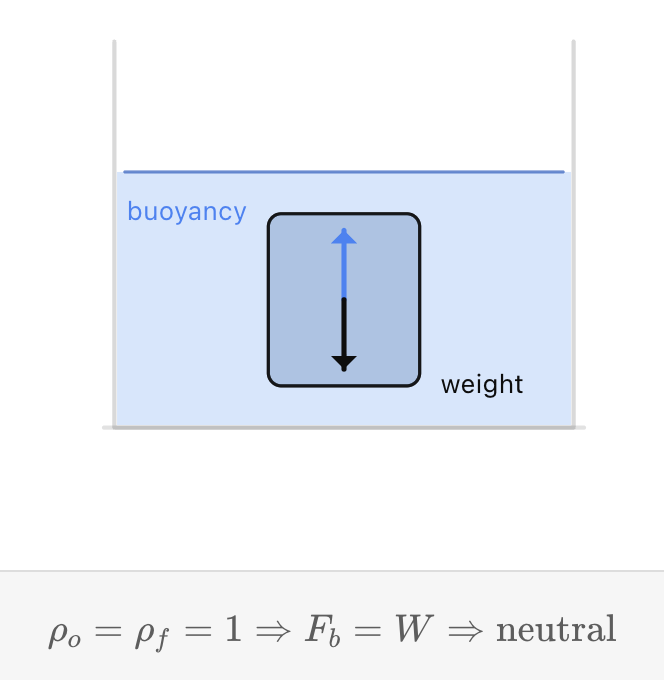
The fish can then remain at approximately the same depth with much less effort.
This is an important biological advantage because organisms need to conserve energy for:
- finding food
- escaping predators
- reproduction
- growth
- migration
Not All Fish Have Swim Bladders
Sharks do not have the gas-filled swim bladders found in many bony fish.
Instead, sharks use several adaptations that help with buoyancy.


These include:
- large livers containing low-density oils
- relatively lightweight skeletons made from cartilage
- body and fin shapes that can generate hydrodynamic lift while swimming
Many sharks are still denser than seawater and therefore rely partly on forward movement to help maintain depth.
This shows that organisms can solve the same physical problem using different biological adaptations.
Jellyfish and Buoyancy
Jellyfish have bodies composed largely of water.
Their average density is therefore very close to that of the surrounding seawater.


This allows them to remain suspended relatively easily.
They still swim and are moved by currents, but they do not require heavy structures to support their bodies against gravity in the same way that land animals do.
Buoyancy therefore influences not only movement but also body structure.
Buoyancy and Large Marine Animals
Water provides buoyant support to large animals such as whales.


A whale still has enormous weight, but the surrounding water produces a large buoyant force.
This helps support its body.
On land, that buoyant support is largely absent, which is one reason extremely large aquatic animals are poorly adapted to supporting their own bodies out of water.
Buoyancy in Plants and Seeds
Buoyancy can also help plants.
Some fruits and seeds can float, allowing water to transport them to new locations.
Coconuts are a well-known example.


Air spaces and low-density tissues can help these structures float.
This allows rivers, currents, and oceans to contribute to seed dispersal.
Buoyancy therefore has ecological importance as well as mechanical importance.
Buoyancy in Air
Air is a gas.
Gases are fluids.
Therefore, objects surrounded by air also experience buoyant force.
Usually this force is small compared with an object's weight, so we do not notice it.
But for very large, low-density objects such as balloons, the buoyant force can become important.
Hot-Air Balloons
A hot-air balloon provides one of the clearest examples of buoyancy in a gas.


The balloon's large envelope contains heated air.
The surrounding atmosphere produces a buoyant force equal to the weight of the outside air displaced by the balloon.
The key is density.
Heating air causes it to expand.
The same amount of air occupies a greater volume, so its density decreases.
Therefore:
hot air is less dense than cooler surrounding air
How a Hot-Air Balloon Rises
Consider the entire balloon system:
- envelope
- basket
- passengers
- equipment
- heated air
The balloon displaces a large volume of surrounding air.
If the buoyant force becomes greater than the total weight:
Fᵦ > W
there is a net upward force.
The balloon accelerates upward.
The basic sequence is:
burner heats air → air density decreases → average density of balloon system decreases → upward buoyancy can exceed weight → balloon rises
Maintaining Altitude
A balloon does not need to rise continuously.
To maintain approximately constant altitude, the pilot can manage the temperature of the air so that the upward and downward forces are approximately balanced:
Buoyant force ≈ Weight
If the air inside cools, its density increases and the available lift decreases.
The balloon may begin descending.
The burner can then heat the air again.


Pilots therefore control vertical motion partly by controlling the temperature and density of the air inside the envelope.
Hot-Air Balloon vs Helium Balloon
Both use buoyancy, but they reduce average density differently.
| Hot-Air Balloon | Helium Balloon |
|---|---|
| Contains heated air | Contains helium |
| Heating reduces air density | Helium is naturally less dense than air |
| Burner controls lift | Gas quantity and ballast can affect lift |
| Air cools over time | Helium does not require heating |
Both work because the balloon system can have a sufficiently low average density compared with the surrounding atmosphere.


Buoyancy and Life Jackets
One of the most important safety applications of buoyancy is the life jacket, or personal flotation device.
A life jacket contains material that has a low density.
This may include:
- closed-cell foam
- inflatable air chambers
- combinations of buoyant materials


The life jacket adds significant volume without adding much mass.
This lowers the average density of the:
person + life jacket system
and allows the system to displace more water.
The resulting buoyant force helps support the person at the surface.
Why Life Jackets Are Effective
Imagine a person who has difficulty keeping their head above water.
Adding a life jacket:
increases volume substantially
but:
increases mass only slightly
This allows more water to be displaced.
According to Archimedes' Principle:
more displaced water → greater available buoyant force
A properly designed flotation device can also position buoyancy around the body in ways that help keep the wearer in a safer orientation.
Life Rings and Rescue Buoys
A life ring uses the same basic principle.


The ring has:
- relatively low mass
- relatively large volume
- low average density
When placed in water, it floats.
A person holding onto the ring increases the total weight, causing the ring to sit deeper.
As it sits deeper:
more water is displaced → buoyant force increases
This helps support the combined person-and-ring system.
Rescue Boats and Life Rafts
Emergency life rafts are designed to provide large amounts of buoyancy while remaining relatively lightweight.
Inflatable rafts use air-filled chambers.


Inflation dramatically increases the raft's volume without greatly increasing its mass.
This creates a low average density and allows the raft to displace enough water to support several people.
Engineers must also consider:
- stability
- puncture resistance
- visibility
- durability
- rapid deployment
- capacity
- survival in waves
Buoyancy alone is necessary, but it is not the only engineering requirement.
Buoyancy Compensators for Divers
Scuba divers use a buoyancy control device, often called a BCD.
The diver can add or release air from the device.


Adding air increases the volume of the diver-system.
This increases the volume of water displaced.
The buoyant force increases.
Releasing air decreases the displaced volume and reduces buoyancy.
A diver can therefore adjust between:
- positive buoyancy
- approximately neutral buoyancy
- negative buoyancy
This is essentially a small-scale controllable buoyancy system.
Floating Docks and Pontoons
Many docks are supported by floating structures called pontoons.
A pontoon contains a large volume of air or low-density material.


As people or equipment are added:
weight increases
The pontoon sinks slightly deeper.
This displaces more water.
The buoyant force increases until it again balances the total weight.
The same principle allows floating bridges and work platforms to support substantial loads.
Offshore Platforms
Some offshore engineering structures are designed to float rather than rest directly on the ocean floor.
Examples include certain:
- oil and gas platforms
- floating wind turbine platforms
- research platforms
- floating production systems


These structures can be enormous.
Engineers must manage:
- buoyancy
- stability
- ballast
- waves
- wind
- currents
- structural strength
- anchoring or mooring
Buoyancy makes it possible to support massive structures without constructing foundations all the way to the seabed.
Floating Bridges
Some bridges are supported by large floating pontoons rather than conventional piers extending to the bottom.


Large pontoons displace enough water to support:
- the bridge structure
- vehicles
- people
- additional loads
As traffic adds weight, the pontoons sit slightly lower and displace more water.
Engineers must ensure that the bridge remains stable under changing loads, waves, and weather conditions.
Underwater Robots
Buoyancy is also important for underwater robots.
These include:
- remotely operated vehicles (ROVs)
- autonomous underwater vehicles (AUVs)
- scientific instruments
- underwater drones


Engineers may design these vehicles to have nearly neutral buoyancy.
Why?
If:
Buoyant force ≈ Weight
the motors do not need to continuously fight a large upward or downward force.
This can reduce energy consumption and make depth control easier.
Buoyancy and Marine Engineering
Ships, submarines, floating platforms, rescue vessels, underwater robots, and offshore structures all depend on careful control of buoyancy.
But simply producing enough buoyant force is not sufficient.
Engineers must also consider stability.
An object might float but still tip over.


Engineers therefore consider:
- centre of gravity
- centre of buoyancy
- hull shape
- mass distribution
- ballast
- waves and currents
A successful floating structure must be both buoyant and stable.
Buoyancy and Engineering Efficiency
Buoyancy can reduce the energy required to support objects.
Consider an underwater robot.
If the robot is strongly negatively buoyant, its motors must continuously produce upward thrust to prevent it from sinking.
If it is strongly positively buoyant, its motors must continuously push downward.
But if it is nearly neutrally buoyant:
Buoyant force ≈ Weight
very little continuous vertical thrust may be required.
This can:
- conserve battery power
- increase operating time
- improve control
- reduce motor size requirements
This makes buoyancy an important part of energy-efficient engineering design.
Worked Example 1: Rescue Float
A rescue float and person have a combined weight of:
850 N
When floating calmly at rest, what buoyant force must the water provide?
For a floating system:
Fᵦ = W
Therefore:
Fᵦ = 850 N
Answer
The water provides a buoyant force of:
850 N upward
Worked Example 2: Underwater Robot
An underwater robot has:
Weight = 620 N
Buoyant force = 600 N
Calculate the net vertical force.
Net force = 620 − 600
Net force = 20 N downward
Therefore, ignoring other forces, the robot tends to accelerate downward.
Engineers could add buoyant material or increase displaced volume to bring the robot closer to neutral buoyancy.
Worked Example 3: Life Raft
A life raft and its passengers have a total mass of:
600 kg
Use:
g = 10 N/kg
Calculate the required buoyant force while floating at rest.
First:
W = mg
W = 600 × 10
W = 6000 N
Since the raft is floating:
Fᵦ = W
Therefore:
Fᵦ = 6000 N
According to Archimedes' Principle, the raft must displace water weighing:
6000 N.
Worked Example 4: Displaced Water
A floating rescue platform displaces:
350 kg of water
Using:
g = 10 N/kg
calculate the buoyant force.
According to Archimedes' Principle:
Fᵦ = weight of displaced water
Fᵦ = mg
Fᵦ = 350 × 10
Fᵦ = 3500 N
Answer
The buoyant force is:
3500 N upward
If the platform is floating at rest, the total weight of the platform and its load is also approximately 3500 N.
Evaluating Buoyancy in Engineering
When evaluating a buoyancy-based technology, asking only "Does it float?" is not enough.
Engineers must consider several requirements.
Buoyancy
Can the system produce enough buoyant force?
Stability
Will it remain in the correct orientation?
Strength
Can it withstand water pressure, waves, impacts, or loads?
Control
Can its buoyancy be adjusted if necessary?
Safety
What happens if part of the system fails?
Efficiency
Does the design minimize unnecessary energy use?
Capacity
Can it support the required people, cargo, or equipment?
Durability
Can it survive repeated use and environmental exposure?
A successful design usually involves a balance between several competing requirements.
Example Evaluation: Life Jacket
Consider a life jacket.
Advantages
- provides additional buoyancy
- requires little or no external energy
- lightweight
- relatively simple
- can help keep a person at the surface
- portable
Limitations
- must fit correctly
- has a limited buoyancy rating
- inflatable designs may depend on successful inflation
- damaged equipment may provide less protection
- flotation does not remove all hazards associated with cold water, waves, currents, or injury
The engineering goal is therefore not simply to make something that floats, but to make a device that provides reliable, practical and appropriate flotation.
Example Evaluation: Hot-Air Balloon
Advantages
- uses buoyancy rather than wings for lift
- can remain airborne at relatively low speeds
- vertical movement can be influenced by heating the air
Limitations
- requires fuel to heat the air
- movement depends strongly on atmospheric conditions
- direct horizontal steering is limited compared with powered aircraft
- lift depends on atmospheric density and temperature differences
The same scientific principle can therefore be useful while also creating engineering limitations.
Why Buoyancy Matters in Modern Engineering
Buoyancy allows engineers to use the surrounding fluid itself to help support enormous loads.
Consider a large floating structure.
Without buoyancy, the structure might need a solid support extending all the way to the seabed.
With buoyancy:
displaced water provides the supporting force
This makes possible technologies such as:
- massive ships
- floating docks
- offshore platforms
- floating wind systems
- underwater vehicles
- rescue equipment
Buoyancy can therefore reduce structural requirements, improve mobility, and allow technology to operate in environments that would otherwise be extremely difficult to access.
Connecting the Applications
| Application | How Buoyancy Is Used |
|---|---|
| Fish | Helps maintain depth and reduce energy use |
| Sharks | Low-density oils and hydrodynamic lift assist depth control |
| Jellyfish | Density close to water helps them remain suspended |
| Hot-air balloon | Displaced atmospheric air produces upward force |
| Helium balloon | Low-density gas allows the system to rise |
| Life jacket | Adds volume with little mass |
| Life raft | Air-filled chambers provide large displacement |
| Scuba diver | Adjustable air volume controls buoyancy |
| Floating dock | Pontoons displace water to support loads |
| Offshore platform | Large floating structures support equipment |
| Underwater robot | Neutral buoyancy can reduce energy consumption |
| Ship | Hull displaces enough water to support the vessel |
| Submarine | Ballast allows controlled changes in buoyancy |
Common Mistakes
Mistake 1: Thinking buoyancy only occurs in water
Buoyancy occurs in all fluids.
Air is a fluid, which is why hot-air and helium balloons experience buoyant force.
Mistake 2: Saying a hot-air balloon rises because "heat rises"
The more precise explanation is that heating the air inside the balloon reduces its density. The surrounding denser air produces buoyant force on the balloon system.
Mistake 3: Thinking life jackets make people lighter
A life jacket does not significantly reduce a person's mass.
Instead, it adds volume with relatively little mass, increasing displacement and available buoyant force.
Mistake 4: Thinking neutral buoyancy means no forces act
Weight and buoyant force still act.
At neutral buoyancy:
Fᵦ ≈ W
The forces approximately balance.
Mistake 5: Thinking all fish use swim bladders
Many bony fish use swim bladders, but sharks and some other fish use different adaptations.
Mistake 6: Thinking anything that floats is automatically safe
A floating object can still be:
- unstable
- overloaded
- easily overturned
- structurally weak
Engineering must consider stability, strength, capacity, and safety, not buoyancy alone.
Mistake 7: Thinking more buoyancy is always better
Too much positive buoyancy can also be undesirable.
A scuba diver or underwater robot needs controlled buoyancy, not simply the greatest possible upward force.
Often the goal is neutral buoyancy.
Mistake 8: Confusing buoyancy with propulsion
Buoyancy provides a vertical force resulting from displaced fluid.
Propellers, fins, motors, or engines may provide additional forces used to move or steer an object.
The two concepts are related but not the same.
Check Your Understanding
1. Recall
Give four examples of buoyancy being used in nature or technology.
2. Aquatic Organisms
Explain how a swim bladder can help a fish maintain its depth without continuously swimming upward.
3. Compare
How does a shark's method of controlling its position in water differ from that of many bony fish?
4. Hot-Air Balloons
Explain why heating the air inside a hot-air balloon can cause the balloon to rise.
Your answer should use the terms:
density, buoyant force, and weight.
5. Safety Equipment
Explain why a life jacket can help a person float even though it adds some additional mass.
6. Calculate
A person and flotation device have a combined weight of 720 N and are floating at rest.
What buoyant force does the water exert?
7. Underwater Engineering
An underwater robot has:
Weight = 450 N
Buoyant force = 450 N
Describe its buoyancy condition and explain one engineering advantage of this condition.
8. Apply
A life raft is loaded with additional passengers.
Explain what happens to:
a. its weight
b. its position in the water
c. the amount of water displaced
d. the buoyant force
9. Evaluate
Why is it not enough for an engineer designing a floating rescue platform simply to make sure that it floats?
Give at least three other factors that should be considered.
10. Challenge
An engineer is designing a battery-powered underwater research robot.
Explain why designing the robot to be almost neutrally buoyant could increase the amount of time it can operate before its battery needs recharging.
Key Terms
- Buoyancy – tendency of an object to rise or remain supported in a fluid
- Buoyant force – upward force exerted by a fluid on an immersed object
- Archimedes' Principle – buoyant force equals the weight of displaced fluid
- Neutral buoyancy – condition in which buoyant force approximately balances weight while submerged
- Positive buoyancy – condition in which an object tends to rise
- Negative buoyancy – condition in which an object tends to sink
- Swim bladder – gas-filled organ that helps many fish regulate buoyancy
- Average density – total mass divided by total volume
- Personal flotation device (PFD) – equipment designed to provide additional flotation
- Buoyancy control device (BCD) – adjustable flotation equipment commonly used by scuba divers
- Pontoon – floating structure that provides buoyant support
- Displacement – fluid pushed aside by an immersed object
- Stability – ability of an object to maintain or return toward a suitable orientation
- Ballast – mass used to help control buoyancy or stability
Key Takeaways
- Buoyancy has important applications in nature, transportation, aviation, rescue, marine science, and engineering.
- Aquatic organisms use several adaptations to control or take advantage of buoyancy.
- Many bony fish use swim bladders to help regulate their average density and depth.
- Hot-air balloons experience buoyancy because they displace surrounding air, and heating their internal air reduces its density.
- Life jackets and life rafts add large volume with relatively little mass, helping increase displacement and buoyant support.
- Scuba divers use adjustable air volume to control their buoyancy.
- Floating docks, bridges, offshore platforms, and other structures use displaced water to support large loads.
- Underwater robots can use neutral buoyancy to reduce the energy required for depth control.
- Buoyancy alone does not guarantee a successful design; engineers must also consider stability, strength, control, capacity, efficiency, reliability, and safety.
- Understanding buoyancy allows engineers to use fluids themselves as part of the supporting system, making many modern technologies possible.