Buoyancy and Archimedes' Principle
4. Ships and Submarines
Learning outcomes
- I can explain how large ships float despite being made of metal.
- I can describe how submarines control their depth.
- I can explain the role of ballast tanks in submarines.
- I can apply buoyancy principles to marine transportation.
- I can evaluate engineering solutions used in ship and submarine design.
A small solid piece of steel sinks in water, yet a cargo ship made from thousands of tonnes of steel can cross an ocean without sinking. A submarine can use many of the same principles but can deliberately float, sink, rise, or remain underwater at a chosen depth.
Both technologies depend on the same fundamental ideas:
density, displacement, buoyant force, weight, and Archimedes' Principle.
The difference is how engineers control these factors.


The Puzzle of the Steel Ship
Steel is much denser than water.
The density of steel is roughly:
7800 kg/m³
while freshwater has a density of about:
1000 kg/m³
A solid block of steel therefore sinks in water.
So why doesn't a steel ship sink?
The answer is that a ship is not a solid block of steel.
Its hull encloses a huge volume containing air.
When we consider the entire ship—including its hollow spaces—the ship's average density can be less than the density of the water in which it floats.
Average Density
The average density of an object depends on its total mass and total volume:
Average density = total mass ÷ total volume
A ship may have an enormous mass, but it also occupies an enormous volume.
Much of that volume contains air.


Consider two objects made from the same amount of metal.
Solid metal block
Small volume + large mass → high average density → sinks.
Hollow metal boat
Large volume + same mass → lower average density → can float.
This is why changing the shape of a material can completely change its floating behaviour.
A Simple Demonstration
Imagine a sheet of aluminium foil.
If you squeeze it into a compact ball and place it in water, it may sink or sit very low in the water.
Now take an identical sheet and shape it into a wide boat.
The mass has not changed.
But the boat shape encloses air and occupies a much larger volume.


The boat can now displace a much greater volume of water before becoming submerged.
This allows the buoyant force to become large enough to balance its weight.
Archimedes' Principle and Ships
According to Archimedes' Principle:
Buoyant force = weight of displaced fluid
As a ship enters the water, its hull pushes water aside.
The farther the ship sinks:
more water displaced → greater buoyant force
Eventually:
Buoyant force = Weight of ship
At that point, the forces are balanced and the ship floats.
             ↑
        Buoyant force
             │
        ┌─────────┐
      __│  SHIP   │__
~~~~~/~~└─────────┘~~\~~~~~
             │
           Weight
             ↓
The water does not need to be able to "hold up steel."
It needs to provide enough buoyant force to support the entire ship.
Displacement
A ship's displacement is closely related to the amount of water it pushes aside.
For a floating ship:
Weight of ship = Weight of displaced water
Suppose a ship has a total mass of:
20 000 000 kg
Then, while floating, it must displace water with approximately the same mass:
20 000 000 kg of water
That is why very large ships require enormous hull volumes.


Worked Example: Ship Displacement
A small vessel has a total mass of:
80 000 kg
Use:
g = 10 N/kg
Step 1: Calculate the ship's weight
W = mg
W = 80 000 × 10
W = 800 000 N
Because the vessel is floating:
Buoyant force = Weight
Therefore:
Fᵦ = 800 000 N
According to Archimedes' Principle, the displaced water must also weigh:
800 000 N
Its mass is therefore:
80 000 kg
Answer
The vessel must displace 80 000 kg of water.
Why Hull Shape Matters
The hull is one of the most important parts of ship design.
A hull must allow the ship to displace enough water while also providing:
- stability
- cargo space
- structural strength
- efficient movement through water
- sufficient freeboard
- protection from waves


A very wide hull may provide excellent stability and displacement but create greater water resistance.
A narrow hull may move efficiently through water but provide less cargo space or stability.
Ship design therefore involves engineering trade-offs.
There is rarely one perfect design for every purpose.
What Happens When Cargo Is Added?
Suppose containers are loaded onto a cargo ship.
The ship's:
mass increases
Therefore:
weight increases
But a floating ship requires:
Buoyant force = Weight
So the buoyant force must also increase.
How?
The ship sinks slightly deeper into the water.
This causes:
greater submerged volume → more water displaced → greater buoyant force


Eventually the increased buoyant force balances the new weight.
The ship then floats at a new, lower position.
Why Ships Cannot Be Loaded Indefinitely
Adding cargo causes a ship to sit lower and lower in the water.
Eventually, too much of the hull may become submerged.
This creates serious risks.
Waves may more easily wash over the deck, stability can be affected, and the vessel may no longer have a sufficient safety margin.
Ships therefore have load lines showing safe loading limits.


The well-known Plimsoll mark helps indicate how deeply a ship may safely sit in different conditions.
Freshwater and Seawater
Seawater is denser than freshwater.
Suppose the same ship moves from the ocean into a freshwater river.
Its mass and weight remain approximately the same.
Therefore, it still requires the same buoyant force.
But freshwater is less dense.
To obtain the required buoyant force:
more freshwater must be displaced
Therefore, the ship sits slightly lower in freshwater.
In denser seawater, the ship floats slightly higher.
This is another reason ship loading limits must account for the type of water in which the vessel operates.
Stability Is Different from Floating
A ship can have enough buoyancy to float and still be unstable.
Buoyancy answers:
Will the ship remain supported by the water?
Stability answers:
Will the ship remain upright or return upright after being tilted?


Engineers must carefully control:
- centre of gravity
- distribution of cargo
- hull shape
- ballast
- centre of buoyancy
For example, placing too much heavy cargo high above the waterline can make a ship less stable.
Ballast in Ships
Ships sometimes carry ballast to improve their stability and control how they sit in the water.
Modern ships often use water stored in ballast tanks.
When a ship carries little cargo, ballast water can add mass low in the vessel.
This can help:
- improve stability
- maintain suitable draft
- keep the propeller properly submerged
- improve handling
When cargo is added, some ballast water may be removed.
So ballast allows engineers and crews to control the ship's mass distribution and position in the water.
Submarines
A surface ship is designed mainly to remain floating at the surface.
A submarine must do much more.
It needs to:
- float at the surface
- descend below the surface
- control its depth
- remain at approximately constant depth
- rise again


To accomplish this, submarines control the relationship between:
weight and buoyant force
A major part of this control comes from ballast tanks.
Ballast Tanks
Ballast tanks are spaces that can contain either water or air.
They allow a submarine to change its overall mass and average density.
A simplified ballast system works like this:
At the surface
The main ballast tanks contain mostly air.
The submarine's overall average density is low enough for it to float.
To dive
Flood valves allow seawater to enter the ballast tanks.
The water replaces air that is vented from the tanks.
The submarine's mass increases.
Its average density increases.
To surface
Compressed air is introduced into the ballast tanks.
The compressed air pushes water out.
The submarine's mass decreases.
Its average density decreases.


How a Submarine Dives
Consider a submarine initially floating at the surface.
At first:
Buoyant force = Weight
Water is then allowed into its ballast tanks.
This increases the submarine's mass.
Therefore:
Weight increases
The submarine can become negatively buoyant:
Weight > Buoyant force
There is now a net downward force.
The submarine begins to descend.
       ↑
  Buoyant force
    [SUB]
       ↓↓↓
     Weight

Net force: downward
In real submarines, diving and depth control also involve control surfaces and propulsion, so ballast is only part of the system.
How a Submarine Rises
To surface, compressed air can force water from the main ballast tanks.
This decreases the submarine's mass.
Its weight decreases.
If:
Buoyant force > Weight
the net force is upward.
The submarine rises toward the surface.
      ↑↑↑
  Buoyant force
    [SUB]
       ↓
     Weight

Net force: upward
Once at the surface, the submarine can establish positive buoyancy so that it remains safely afloat.
Neutral Buoyancy
A submarine often needs to remain at approximately the same depth rather than continuously sinking or rising.
This requires approximately:
Buoyant force = Weight
This condition is called neutral buoyancy.
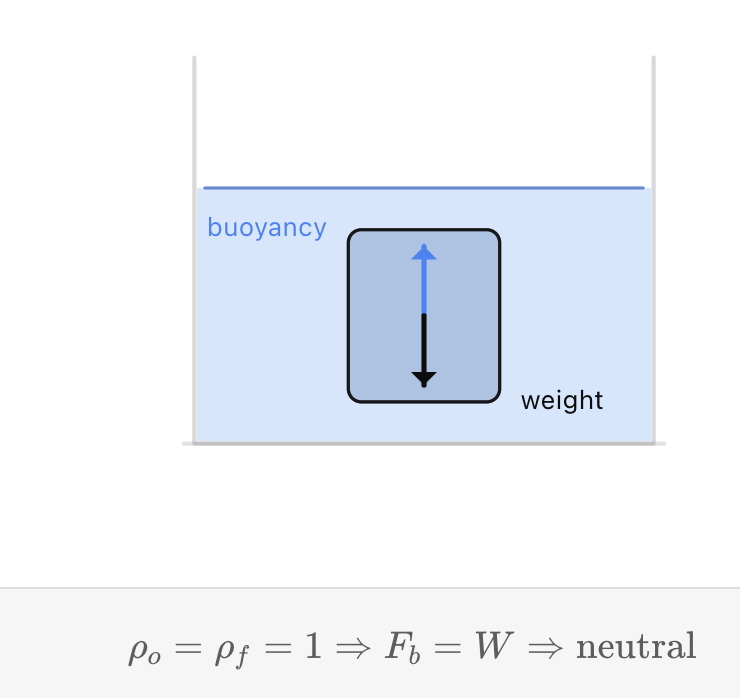
A neutrally buoyant submarine has no net vertical force from weight and buoyancy alone.
However, submarines moving through water also experience hydrodynamic forces, so actual depth control is more complicated than simply balancing these two forces.
Main Ballast Tanks vs Trim Tanks
Not all ballast tanks perform exactly the same job.
Main Ballast Tanks
These are mainly used to make large changes between:
- surfaced operation
- submerged operation
Flooding them helps the submarine dive.
Blowing water from them helps the submarine surface.
Trim or Variable Ballast Tanks
Smaller adjustments can be made using additional tanks.
These help control:
- exact buoyancy
- balance
- trim
- depth


Trim describes the submarine's balance from front to back.
If too much mass is concentrated toward the bow, for example, the submarine may tend to tilt nose-down.
Diving Planes and Control Surfaces
Submarines also use control surfaces sometimes called diving planes or hydroplanes.
These work somewhat like underwater wings.
As the submarine moves forward, water flowing over these surfaces can produce forces that help control depth and angle.


This means submarine depth control involves two different ideas:
Buoyancy control – adjusting mass and ballast.
Hydrodynamic control – using water flow over control surfaces while moving.
This gives submarines much finer control than ballast tanks alone could provide.
A Useful Comparison
| Situation | Weight vs Buoyant Force | Result |
|---|---|---|
| Ship floating | Fᵦ = W | Remains at surface |
| Submarine positively buoyant | Fᵦ > W | Tends to rise |
| Submarine negatively buoyant | Fᵦ < W | Tends to sink |
| Submarine neutrally buoyant | Fᵦ = W | Can remain submerged |
| Overloaded vessel | Weight becomes too large for safe displacement | Sits dangerously low |
Pressure Is Another Major Challenge
Buoyancy is not the only challenge faced by submarines.
Water pressure increases with depth:
p = ρgh
The deeper a submarine travels, the greater the pressure of the surrounding water.


Inside the submarine, the crew compartment remains at a much lower pressure than the surrounding deep water.
Therefore, the hull must withstand a large pressure difference.
This is why submarine design requires extremely strong structures.
The Pressure Hull
Submarines typically have a strong internal structure called a pressure hull.
Its purpose is to withstand the external water pressure and maintain a safe internal environment.
Rounded and cylindrical shapes are useful because they distribute external pressure more effectively than large flat surfaces.
Engineers must consider:
- material strength
- hull thickness
- shape
- operating depth
- fatigue
- corrosion
- safety factors


Increasing hull strength can allow greater operating depths, but it may also increase:
- mass
- construction difficulty
- cost
Again, engineering involves trade-offs.
Streamlined Shapes
Ships and submarines must move through water.
Water produces drag, which opposes motion.
Engineers therefore use streamlined shapes to reduce resistance.


Reducing drag can:
- reduce fuel or energy use
- increase speed
- improve range
- reduce the power required from engines
However, the ideal shape for reducing drag may not be the ideal shape for carrying cargo or withstanding pressure.
Designers must balance several requirements.
Cargo Ships: An Engineering Compromise
A cargo ship must satisfy many requirements at the same time.
It should:
- carry a large amount of cargo
- remain stable
- displace enough water to float
- resist waves
- move efficiently
- withstand corrosion
- remain structurally strong
- provide sufficient freeboard
- operate economically


A very wide vessel may provide excellent cargo capacity and stability but create more drag.
A very narrow vessel may move efficiently but provide less cargo space.
The final design is therefore a compromise between competing requirements.
Submarines: An Even More Complex Compromise
Submarines face additional engineering challenges.
They must:
- withstand enormous external pressure
- control buoyancy
- control trim
- move efficiently underwater
- carry sufficient air, energy, equipment, and supplies
- remain stable
- control depth accurately
A design change that improves one feature can create problems elsewhere.
For example:
Thicker pressure hull → greater strength
but also:
Thicker pressure hull → greater mass
Greater mass then affects:
- buoyancy
- required displacement
- propulsion
- energy consumption
Engineering therefore involves evaluating the whole system.
Worked Example: Loading a Vessel
A vessel initially has a mass of:
500 000 kg
Cargo with a mass of:
100 000 kg
is added.
The new mass is:
600 000 kg
Using:
g = 10 N/kg
the new weight is:
W = 600 000 × 10
W = 6 000 000 N
Because the vessel floats:
Buoyant force = 6 000 000 N
Therefore, the vessel must now displace water weighing:
6 000 000 N
Adding the cargo forces the vessel to sit lower so that it can displace enough additional water.
Worked Example: Submarine Forces
A submerged submarine has:
Weight = 9 500 000 N
Buoyant force = 9 300 000 N
Calculate the net vertical force.
Net force = 9 500 000 − 9 300 000
Net force = 200 000 N downward
Therefore, ignoring other vertical forces, the submarine has a net downward force and will accelerate downward.
To establish neutral buoyancy, the submarine would need to adjust its mass or buoyancy until:
Buoyant force = Weight
Marine Transportation and Density
Density affects many aspects of marine transportation.
Ships may move through:
- seawater
- freshwater rivers
- estuaries
- ports with changing salinity
Because these waters can have different densities, the same ship may float at slightly different depths.
A ship moving from seawater into less-dense freshwater tends to sit lower.
A ship moving into denser water tends to sit higher.
Engineers and crews therefore need to consider water density when determining safe loading.
Evaluating Ship Engineering Solutions
When evaluating a ship design, we should not simply ask:
"Does it float?"
A useful engineering evaluation considers several factors.
Buoyancy
Can the hull displace enough water to support the vessel and cargo?
Stability
Will the vessel remain upright?
Strength
Can the hull withstand waves, cargo loads, and repeated stresses?
Efficiency
Does the hull reduce unnecessary drag?
Capacity
Can the ship carry enough passengers or cargo?
Safety
Does the ship maintain sufficient freeboard and reserve buoyancy?
Environmental Impact
How much energy does the vessel use, and what effects might its operation have on the environment?
Evaluating Submarine Engineering Solutions
For submarines, engineers must also consider:
Pressure resistance
Can the pressure hull withstand the intended operating depth?
Buoyancy control
Can ballast systems reliably control ascent and descent?
Trim
Can mass be distributed so the submarine remains properly balanced?
Hydrodynamics
Can the submarine move efficiently through water?
Reliability
Can critical systems continue functioning safely?
Mass
Can sufficient strength be achieved without making the submarine unnecessarily heavy?
The best engineering solution is therefore rarely the one that maximizes only one property.
Common Mistakes
Mistake 1: "Ships float because steel floats."
Steel itself is denser than water.
Ships float because their hollow shape gives the entire vessel a lower average density and allows it to displace enough water.
Mistake 2: "Ships float because they are lighter than water."
A large ship can weigh thousands or even hundreds of thousands of tonnes.
The important comparison is not simply total mass.
The ship floats because the buoyant force produced by displaced water can balance its weight.
Mistake 3: "Ballast tanks make a submarine smaller."
Ballast tanks mainly change the submarine's mass and average density by taking in or expelling water.
They do not significantly change the submarine's external hull volume.
Mistake 4: "A submarine dives because it loses buoyant force."
In a simplified model, flooding ballast tanks mainly increases the submarine's mass and weight while its external displaced volume changes very little.
The balance between weight and buoyancy changes.
Mistake 5: "A submarine uses ballast tanks alone to control depth."
Ballast is essential, but moving submarines also use control surfaces and propulsion to control their depth and orientation.
Mistake 6: "Neutral buoyancy means there are no forces."
Weight and buoyant force still act.
For neutral buoyancy:
Buoyant force = Weight
The forces balance.
Mistake 7: "If a ship floats, it is automatically stable."
Floating and stability are different.
A vessel can have sufficient buoyancy but still be poorly balanced and at risk of capsizing.
Mistake 8: "A submarine can simply be made extremely thick to survive any depth."
Increasing hull thickness can improve strength, but it also increases mass, cost, and engineering difficulty.
Submarine design requires compromises between many factors.
Check Your Understanding
1. Explain
Why does a solid steel block sink while a hollow steel ship can float?
2. Archimedes' Principle
A ship has a total mass of 2 000 000 kg.
What mass of water must it displace while floating at rest?
3. Cargo
Explain why a cargo ship sits lower in the water after containers are loaded onto it.
4. Freshwater vs Seawater
A ship travels from the ocean into a freshwater river.
Will it normally sit higher or lower in the water?
Explain why.
5. Submarine Ballast
Describe what happens inside the main ballast tanks when a submarine:
a. prepares to dive
b. surfaces
6. Forces
A submarine has:
Weight = 4.8 × 10⁶ N
Buoyant force = 5.0 × 10⁶ N
Calculate the net vertical force and predict the submarine's tendency of motion, ignoring other vertical forces.
7. Neutral Buoyancy
Explain what neutral buoyancy means and why it is useful to a submarine.
8. Engineering Challenge
A designer proposes making a submarine pressure hull much thicker so that it can travel deeper.
Explain:
- one advantage of this change
- two possible disadvantages
9. Evaluate
Why must ship engineers consider stability as well as buoyancy?
10. Challenge
A submarine's external volume remains approximately constant as its ballast tanks fill with seawater.
Explain why taking in ballast water can cause the submarine to descend even though the volume of water displaced by its outer hull changes very little.
Key Terms
- Hull – main body of a ship or submarine
- Average density – total mass divided by total volume
- Displacement – amount of fluid pushed aside by an object
- Buoyant force – upward force exerted by a fluid
- Archimedes' Principle – buoyant force equals the weight of displaced fluid
- Ballast – material or water used to control mass, stability, or buoyancy
- Ballast tank – tank that can take in or expel water to help control buoyancy
- Neutral buoyancy – condition in which buoyant force and weight are balanced while submerged
- Positive buoyancy – condition in which an object tends to rise
- Negative buoyancy – condition in which an object tends to sink
- Trim – balance of a vessel from front to back
- Draft – vertical distance between the waterline and the lowest part of a vessel's hull
- Freeboard – distance between the waterline and the upper edge of the vessel's hull or deck
- Pressure hull – strong submarine structure designed to withstand external water pressure
- Hydrodynamics – study of fluids in motion and their interactions with objects
Key Takeaways
- A large metal ship can float because its hollow hull gives the entire vessel a relatively low average density.
- A floating ship displaces enough water for the buoyant force to equal its weight.
- Adding cargo increases a ship's weight, causing it to sit deeper and displace more water.
- Ships generally float higher in denser seawater and lower in less-dense freshwater.
- Floating and stability are different engineering problems; a vessel must have sufficient buoyancy and stability.
- Submarines use ballast tanks to change their mass and average density.
- Taking water into ballast tanks increases mass and helps a submarine descend.
- Expelling ballast water reduces mass and helps a submarine rise.
- Neutral buoyancy occurs when buoyant force and weight are approximately equal.
- Submarines also use control surfaces and propulsion for precise depth control.
- Submarine pressure hulls must withstand increasing water pressure at greater depths.
- Ship and submarine design requires engineers to balance buoyancy, stability, strength, drag, capacity, safety, mass, and efficiency rather than optimizing only one feature.