2. Archimedes' Principle

Learning outcomes
  • I can state Archimedes' Principle.
  • I can explain the relationship between displaced fluid and buoyant force.
  • I can calculate buoyant force using displaced fluid data.
  • I can apply Archimedes' Principle to real-world situations.
  • I can explain how Archimedes' discovery changed our understanding of floating.

Why can a steel ship float? Why does an object seem lighter underwater? How can we predict whether an object will float or sink?

More than 2,000 years ago, the Greek mathematician and scientist Archimedes described the relationship between an object, the fluid it displaces, and the upward buoyant force acting on it.

His principle remains fundamental to the design of ships, submarines, floating platforms, hydrometers, and many other technologies.

https://images.openai.com/static-rsc-4/l_qawkJP6SfRpuPsBdnMjvGfs5SExvbXWUaL-y2-wdvgMuDWcmFulWyQWDD6rt5FJmaljooi6Pe-O9EDuTef4R6FK7zjHUSXog47U1V7kHEoif0JINEPbiPiZqDjrfLOLMaq9ffDU71YI5HueScNFJ4dIaQEQdFPzdRJhT6kgGEBLK3mBGTHN8J2cDb5cdrk?purpose=fullsize
https://images.openai.com/static-rsc-4/wCVTYnQ0xooLBvM75-zy2DnwncNucOBwnPA7IE0YCPzZLj_LylkDlycl3Wlfy0mYOITY3SrlRVIIRCxiAwLen53xrul_uwfNg8t2HTwS4q9vySjlkWDVCtiRtlHCMQrmaR7QWuNPrz-dyGvn5rKOtmTMar5s023MqycM0N__spFl7nsn1npNRHM9smT78_TU?purpose=fullsize
https://images.openai.com/static-rsc-4/pDiVqOBI8GX9CN3_4F8LufHp3mvIPEOMG4ZaAupdczobYLsBE0_F_xm9dhxhyoiXwBezF_MqnosoeThb46yKlKH1isJrlE2293iSeaXXkpzcQF8DsbPn1lSb_tYdOTOzsD9tqu0MoEpfZ2rkKDBbalyu9_fvO1gL67-xGdV4rSPC_1osTMJd6ncyzrnyigHZ?purpose=fullsize
6

What Is Archimedes' Principle?

Archimedes' Principle states that an object partly or completely immersed in a fluid experiences a buoyant force equal to the weight of the fluid it displaces.

In simpler words:

Buoyant force = weight of displaced fluid

This gives us a powerful way to determine the buoyant force on an object.

Instead of measuring the forces acting on every surface of the object, we can determine how much fluid it displaces.


What Does "Displaced Fluid" Mean?

When an object is placed into a fluid, the object occupies space that was previously occupied by the fluid.

The fluid that has been pushed out of this space is called the displaced fluid.

https://images.openai.com/static-rsc-4/T8Vu2h8xIIJfYZPX8MUWCLetDl0Bzy6gxTM45IYKGwBAFGI4FtZ-252ma5Z031DfjNOCCOlY7bqv3KQBqrWprx3XoI9FK-eBLYO05W0YnHIXoUFTfx3g9uBb6ygHguKUWK31PUDAMUSYf4uiXwuNgEcrCmlFztuzjXxZkPn7otU6LlR85EU1nwMdVbK-5yO_?purpose=fullsize
https://images.openai.com/static-rsc-4/F_Wdz0D60xMwU02qKgfNAsnojHDXviVNY-aO8eqUJlcajpqfQTbhvielwVpD7cUjWSTsSCypPmxSpiv1WpgWYwec_uAR8q386NxO9YPssRKRHChXRcisiJStX3-ebzxt7NauGi5doTzbh15YcgCr6azEt8cJkrnJo7QqfY3UXy2xCgoA4vfsLBxuAzlAcYg1?purpose=fullsize
https://images.openai.com/static-rsc-4/pYmmaF2X5-TruR73ODamHhkfSy753JAxg-QOINwpC-BmtkAMrVUHbxHuh9Ieh567XwVX9dt0jiiLSOZjrKsTpjJGSKoCNfHCppA-rLx1pCegLIBlDrSB7DTVy_MN5-EICFcGtyDx7XPVlpRXnUso_Xys1z4R5UpWzEuuD5XSIetKydaGUJW04v5mru7o-Ek0?purpose=fullsize
5

Imagine placing a rock into a container filled completely to the top with water.

Some water spills out.

The volume of water pushed aside corresponds to the volume of the part of the rock that is underwater.

If the rock is completely submerged:

Volume of displaced water = Volume of rock

If only part of an object is underwater:

Volume of displaced water = Volume of submerged part

This distinction becomes especially important when studying floating objects.


From Displaced Fluid to Buoyant Force

Archimedes' Principle tells us:

Buoyant force = weight of displaced fluid

Weight is calculated using:

W = mg

Therefore:

Buoyant force = mass of displaced fluid × gravitational field strength

or:

Fᵦ = mfluid × g

where:

  • Fᵦ = buoyant force (N)
  • mfluid = mass of displaced fluid (kg)
  • g = gravitational field strength (N/kg)

This gives us our first useful method for calculating buoyant force.


Worked Example 1: Using the Mass of Displaced Water

An object displaces 3.0 kg of water.

Calculate the buoyant force.

Use:

g = 10 N/kg

According to Archimedes' Principle:

Fᵦ = weight of displaced water

So:

Fᵦ = mg

Fᵦ = 3.0 × 10

Fᵦ = 30 N

Answer

The buoyant force is:

30 N upward

Notice that we did not need to know the mass of the object.

We needed the mass of the displaced fluid.


Using Volume and Density

Sometimes we are given the volume of displaced fluid rather than its mass.

Remember the density equation:

ρ = m/V

Rearranging:

m = ρV

The weight of the displaced fluid is therefore:

W = ρVg

Since buoyant force equals the weight of displaced fluid:

Fᵦ = ρVg

where:

  • Fᵦ = buoyant force (N)
  • ρ = density of the fluid (kg/m³)
  • V = volume of displaced fluid (m³)
  • g = gravitational field strength (N/kg)

This equation connects several of the ideas we have studied:

density + displacement + gravity → buoyant force


Worked Example 2: Using Displaced Volume

A completely submerged object displaces:

0.004 m³ of freshwater

Calculate the buoyant force.

Use:

ρwater = 1000 kg/m³

g = 10 N/kg

Start with:

Fᵦ = ρVg

Substitute:

Fᵦ = 1000 × 0.004 × 10

First:

1000 × 0.004 = 4 kg

So the object displaces 4 kg of water.

Then:

Fᵦ = 4 × 10

Fᵦ = 40 N

Answer

The buoyant force is:

40 N upward


Why Does This Principle Work?

Archimedes' Principle is closely connected to fluid pressure.

Recall:

Pressure increases with depth.

Imagine a block completely submerged in water.

https://images.openai.com/static-rsc-4/pZhodpo6a3hjuuOxO9spScMsRN9S82DUj8AfkqCL-iZTwnLDx3Ewak_ZnPqjsPah1gwReDtb4Vt0Cpsnh4A-_HBuWM06pxn4fgFNg5JS35LmBi0gzaAcByNtHbzQXCOgp614w6HXRDDdCBup6juJCF1sv3zsjz-HS9qSFNVa-rSFQrm6qxdocO67ksk6H1nq?purpose=fullsize
https://images.openai.com/static-rsc-4/JX5Ks34WtaIcUICUdi1lx-9CFT-1Kfq-MDqKUdPlzjM_THFqEBCrk0TEh-m0532DOVnpGd1wI3H9prMDHyOD-zR4hg-XFoJNptrHu19yeYLYreKMFVhcAVeO1B00lQu8c6cZztLOJOBu6t6GaRBBZ3YQtxQ5hu8-ND6URqNCdV7HtUXsVPuGwkGckRNlZDv_?purpose=fullsize
https://images.openai.com/static-rsc-4/Giubt2IUekI8f2ri06_2To_4fFU0XGGiWrZAwgM15uv_6DHpuUVuargVSLzM-3664oEaK8tEWsMvblryCYgcOU1QYXwyXBVD_PCOu_rn7fb-mQjviVasAFkWy_c203BqLxNTe7VnqLqLlmRGOVlt9J9NCu3e4eMcy8uyWeHij-og9d2oYFY_dgIgrRh5Tqcq?purpose=fullsize
4

The bottom of the block is deeper than the top.

Therefore:

Pressure at bottom > Pressure at top

The water produces:

  • a downward force on the top
  • an upward force on the bottom
  • sideways forces that largely balance

Because the upward force is greater than the downward force, there is a net upward force.

That force is the buoyant force.

Archimedes' Principle gives us a convenient way to calculate that force without calculating all the individual pressure forces.


More Displaced Fluid Means More Buoyant Force

Consider two completely submerged objects in the same water.

Object A displaces:

1 kg of water

Object B displaces:

4 kg of water

Object A experiences:

Fᵦ = 1 × 10 = 10 N

Object B experiences:

Fᵦ = 4 × 10 = 40 N

Therefore:

more displaced fluid → greater buoyant force

For the same fluid and gravitational field:

Buoyant force ∝ displaced volume


Comparing Displaced Volume and Buoyant Force

Consider completely submerged objects in freshwater.

Using ρ = 1000 kg/m³ and g = 10 N/kg:
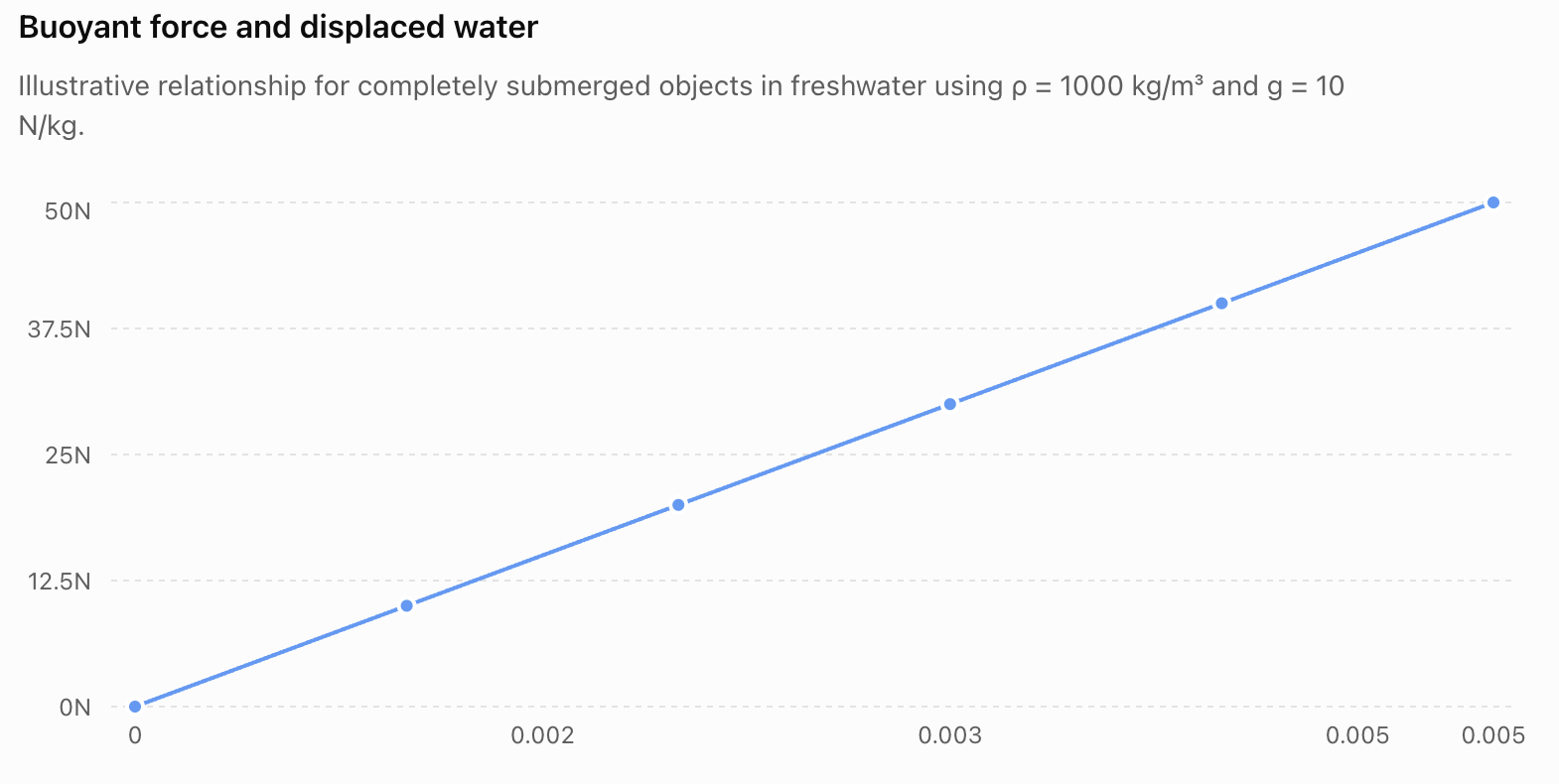
The straight-line relationship shows that doubling the displaced volume doubles the buoyant force, provided fluid density and gravity remain constant.


Worked Example 3: A Completely Submerged Block

A block has a volume of:

0.006 m³

It is completely submerged in freshwater.

Calculate the buoyant force.

Use:

ρ = 1000 kg/m³

g = 10 N/kg

Because the object is completely submerged:

Volume displaced = Volume of object

Therefore:

V = 0.006 m³

Now:

Fᵦ = ρVg

Fᵦ = 1000 × 0.006 × 10

Fᵦ = 60 N

Answer

The buoyant force is:

60 N upward


Does the Mass of the Object Matter?

Not directly when calculating buoyant force from displacement.

Imagine two objects with identical volumes:

  • one made from aluminium
  • one made from lead

Both are completely submerged in the same water.

https://images.openai.com/static-rsc-4/6hAu6JzRslBLv_-MOMojaleAej_qQZt1TXidg2aClN7lDjYogfu7j6WSSEWz2sGtV9U3kgfLK24mAZ9mo9gxgz0MbcPm6I3_w4-4yPVyeB4P_MG91olXrQ1-_b9WZrldMwMBxhV3bE1J3BvKnLwYjBmFEI-v94v_UgVqX1fcqX0BSDmbRW0eKoYVO9VYO9E-?purpose=fullsize
https://images.openai.com/static-rsc-4/-pWaInwMyfoAZqlllR4XVvBKR9UAQZbki4D0JXEaOKGN8TXrf0jRhiokkrt8nj-JvvWCJfl1sgn-Ulb-GLGs-y0cPvRj-Hjvy0Jd-g_n1nHOSmLVtFgAyTFwXoh9y78k1Xtg6z9mtF3sqRNGcJarNdEHJbJmd0XZnTFSw19HBbMlBdmJS7j7f-Zq1sw8_nLM?purpose=fullsize
https://images.openai.com/static-rsc-4/LMR5TOGPH79tTgmYYYS_2lMbJYEiWlc9IlQoh7xaXl_Q-BWmN1q45IFz_Wv05xO6OpM1shX0MVlVHGttnBsMExeSvrByTIVQnTSNWXu0awKJiU3MGCgdySlbZjewh-VIJXKxz31zckb7wwv3EBItBmodpXfvpaOpE1HHTlyzb30koH476ASm_WQp08h0loZ5?purpose=fullsize
6

Because their volumes are identical, they displace the same amount of water.

Therefore:

same displaced volume + same fluid → same buoyant force

The lead object has greater mass and therefore greater weight, but that does not mean it experiences a greater buoyant force.

This distinction is very important:

Object mass affects weight.

Displaced fluid determines buoyant force.


Floating Objects and Archimedes' Principle

A floating object is only partly submerged.

As the object enters the water, it begins displacing water.

The deeper it sinks:

more water is displaced → buoyant force increases

Eventually, the buoyant force becomes equal to the object's weight.

At that point:

Buoyant force = Weight of object

But Archimedes' Principle also tells us:

Buoyant force = Weight of displaced fluid

Therefore, for an object floating at rest:

Weight of object = Weight of displaced fluid

This is one of the most important conclusions from Archimedes' Principle.


Example: A Floating Boat

Suppose a small boat and its passengers have a total mass of:

500 kg

Their weight is:

W = mg

W = 500 × 10

W = 5000 N

Because the boat is floating at rest:

Buoyant force = 5000 N

Therefore, according to Archimedes' Principle, the boat must displace water weighing:

5000 N

In freshwater, that corresponds to a mass of:

500 kg of displaced water

So a floating 500 kg boat must displace approximately 500 kg of water.


What Happens When Cargo Is Added?

Suppose another 200 kg of cargo is loaded onto the boat.

The total mass becomes:

700 kg

The total weight becomes:

700 × 10 = 7000 N

To remain floating:

Buoyant force must increase to 7000 N

How does this happen?

The boat sinks slightly deeper.

https://images.openai.com/static-rsc-4/E2rHLJOu6g2DwB_MriM_UhwUJH72cvJA2qu5Le-K4UNeKqcTEMVOA3JfKh8QZc1betK8YvB_T0J6tsDnRruvQiNDmln3EoE235mjm54u71WDNVOB5GLjosLvJI4um_jkGk3fSmPCOiduVVExCj1nxNt1sR6I-jzHm_FptGIq3d2k1TPB4g_oAOyxynP1ZkDO?purpose=fullsize
https://images.openai.com/static-rsc-4/ART06fNY8VzDa6xTWLO3Rsrpaeu8n33z8YcMcZhOF_pzA2RGjYVabXwFK6ca2HLWMb2YLnrOcc3bXvqo6Om9do0H2wLk-HMTQsl3zxXhLJ_vjnfVBEggc1ZOmamW1ms_O70nojVC4ySOrGKRrYGnY5DBfwbtkmA3oHp5WRIKvKBYXocSoVedx-7IWlMTFFrr?purpose=fullsize
https://images.openai.com/static-rsc-4/uEpenzn4M-eTNCcEM9RvlnZnP3zkV8Sw4h_bBULdHHoIOHPTfCC1-pEaq0uFhE6tm2vUaxiJovMQbrLY0O1lDke5nEbcEYcHznEJ6AOg50Z1Wpe0lMOSI1fIlHnnWt8Dkn0N6gdw_In_R5fTShDhFmJB1uwVrHg3LGZx0kBMmMI7T8JGG0UNe0fgWLs8LNxz?purpose=fullsize
5

As it sinks deeper:

more water is displaced

Therefore:

weight of displaced water increases

and:

buoyant force increases

Eventually:

Buoyant force = 7000 N

and the boat reaches a new floating position.


Why Can a Steel Ship Float?

A solid block of steel usually sinks in water because steel is much denser than water.

Yet huge ships made largely from steel can float.

The key is the ship's shape.

https://images.openai.com/static-rsc-4/6bb4qboat6xTH7dyJlmWuY9JN81IRlno_VOJP--4HkPsrBWuis8tk9dSo0VRsHVwZQJbrpOICJLy_d1xE-hgTfU2csyqJvXw-W01jPzvMt3U28e2wHT05O30cXrX_QSbrHiRJcBt2bLHwk2c8TH0rc9njh2eEXdyvsCulKBAfb06HjpLfi5p9iP9TlcDo4op?purpose=fullsize
https://images.openai.com/static-rsc-4/ART06fNY8VzDa6xTWLO3Rsrpaeu8n33z8YcMcZhOF_pzA2RGjYVabXwFK6ca2HLWMb2YLnrOcc3bXvqo6Om9do0H2wLk-HMTQsl3zxXhLJ_vjnfVBEggc1ZOmamW1ms_O70nojVC4ySOrGKRrYGnY5DBfwbtkmA3oHp5WRIKvKBYXocSoVedx-7IWlMTFFrr?purpose=fullsize
https://images.openai.com/static-rsc-4/VKygmwS2AQyMoz7H67ANs06huJnYHSCMBOR6jf0CWUwsnoYzxbhZOtnC0V5pNFDAsUdaRReZxR6rL0aov5sbfZ136hiGNsG_OFxmw6arw07-UlysFT-e4yrvoxFevpLLqGfNLiE_8zAZML5D_RUjxt9zB35z0pgN4hbJKjKCgnO64G3-jUzdC467PzdeaepN?purpose=fullsize
5

A ship has a large hollow hull containing air.

This gives the ship a very large total volume.

As the ship settles into the water, its hull displaces more and more water.

Eventually:

Weight of displaced water = Weight of ship

At that point:

Buoyant force = Weight

and the ship floats.

The steel itself has not become less dense. Instead, the average density of the entire ship, including its air-filled spaces, is low enough for the ship to float while displacing sufficient water.


Freshwater vs Saltwater

Fluid density affects buoyant force.

The equation:

Fᵦ = ρVg

shows that increasing fluid density increases buoyant force for the same displaced volume.

Saltwater is denser than freshwater.

Therefore, the same submerged volume produces a greater buoyant force in saltwater.

https://images.openai.com/static-rsc-4/5IfnWBs1Hu6FgFTVbpXWqNrXtw3X08BPONJ0_vs8hx_u_o8ScmA8qlji4k0hmdCqCVMH0H3Pl4-16XqRYmSl5ltojtJ0orYnzSmHGl6VjeMiRmRYDPR4viVsOUotGPXu5jGR3rATEjLRfNAV9ML3nO_Fc44zr1OvA3UVVooeDOrOtT55uiVU1TWlcgWdT5Tk?purpose=fullsize
https://images.openai.com/static-rsc-4/qM4gk7kWRUQjwMTx6VAWsOjP68rex23JlhvP-Gn-woQQQ-a6g2pYSOU9plqxo69mA7Zq6aIen94iz0hr-Lh3_3bZk9t477E4KU-xBQKQ8ekwMbkUEBZL6eoZH70rzcp6AHacjmmy3rkC14hvH8q5Hc-IjW62G7tLWUDQqDRCUv5wNtY-LV9B_t6VyaZz1Nmh?purpose=fullsize
https://images.openai.com/static-rsc-4/2GkobsDL71EAFhao2gCwoeMpz4ZnP-xZjIVcynlbrYcU8xzo_aRJzMcwA-nCKs0_NAVd7cEXG_Di4YUCVV5xfJEUKco4WVU2UE5I83S1lxyRwSW21Roaj3Q_sfJOKtQFYnYIlIiP3fH2A6fkC0nPIrElljXQrePzsCEG8vmh4tSbuyIfp_YdBO6VSdYoear5?purpose=fullsize
5

This has an interesting consequence for ships.

A ship needs a certain buoyant force to balance its weight.

In denser seawater, it needs to displace a smaller volume of water to produce that force.

Therefore, a ship normally floats slightly higher in seawater than in freshwater.


Worked Example 4: Comparing Two Fluids

An object displaces:

0.002 m³

of fluid.

Compare the buoyant force in:

Fluid A: ρ = 800 kg/m³

Fluid B: ρ = 1200 kg/m³

Use:

g = 10 N/kg

Fluid A

Fᵦ = 800 × 0.002 × 10

Fᵦ = 16 N

Fluid B

Fᵦ = 1200 × 0.002 × 10

Fᵦ = 24 N

Comparison

The same displaced volume produces:

16 N in Fluid A

and:

24 N in Fluid B

The denser fluid produces the greater buoyant force.


Finding Displaced Volume

We can rearrange the buoyant-force equation.

Starting with:

Fᵦ = ρVg

To find displaced volume:

V = Fᵦ ÷ (ρg)


Worked Example 5: How Much Water Must Be Displaced?

A floating object weighs 250 N.

What volume of freshwater must it displace?

Use:

ρ = 1000 kg/m³

g = 10 N/kg

Because the object is floating:

Fᵦ = Weight

Therefore:

Fᵦ = 250 N

Now:

V = Fᵦ ÷ (ρg)

V = 250 ÷ (1000 × 10)

V = 0.025 m³

Answer

The object must displace:

0.025 m³ of freshwater


Measuring Buoyant Force Experimentally

Archimedes' Principle can be tested using a spring balance and an overflow container.

https://images.openai.com/static-rsc-4/vPxpdNhnIRJHT3TkZioS3QqWlXEaPfDEOyNMDPTMITMMD7BG9eO5TQZJRkrd9wb2FcbHFGh8j9G_3jj8YuvTGPjsdKKBz3S6FoXChDk1utxOayMvSH83URPOEiGYdP4AQUVcEUqYy8hz_nN03ZAjQAZ_E6x_7KF1c64Ysh7RRyH192rc90sh6EJ6UGb9D16O?purpose=fullsize
https://images.openai.com/static-rsc-4/VUNOdcVf090jo4DLD_OE1jF6FcNNVSet63Nd7zsO-9KuzI6CYx5a5-SgG6EE6VcI21Bm-nLRKBqjTzEEPuC0cukleH_77NoNtUUrul4is4o5nTZq7M0P9CwJU1M0ipOdbTIl77qFOHspv1FGZPMdGueptgGR5U_g_SiR8uGpdEzdkQtISaOHjccDdxloBj9D?purpose=fullsize
https://images.openai.com/static-rsc-4/6_uehXFW8kkscuxfalXnSCkWqlIpVb4SQfv3JHycQDmlB1VnjS2xCZNVHjQTGRkmzUrswGuDt3EXX3icpAmsLFqB1W548D35KAsLXu7h8nkLycjT1KN44fIlpfA2AH4NGLr8Hx_xToiJR8fvU380bskoR97c2Bi0r5II1ETfKW-IJp-QaJ-Co9iigva8iU52?purpose=fullsize

Step 1

Measure the object's weight in air.

Suppose:

Weight in air = 12 N

Step 2

Lower the object completely into water without letting it touch the container.

Suppose:

Apparent weight = 8 N

Step 3

Calculate the buoyant force:

Fᵦ = actual weight − apparent weight

Fᵦ = 12 − 8

Fᵦ = 4 N

Step 4

Collect the displaced water.

If the displaced water weighs 4 N, then:

Buoyant force = weight of displaced water

The experiment supports Archimedes' Principle.


Apparent Weight

Objects appear lighter underwater because the fluid exerts an upward buoyant force.

Therefore:

Apparent weight = Actual weight − Buoyant force

For example:

Actual weight = 70 N

Buoyant force = 25 N

Then:

Apparent weight = 70 − 25

Apparent weight = 45 N

The object's actual gravitational weight has not changed significantly.

The difference occurs because the water provides an additional upward force.


Submarines and Archimedes' Principle

Submarines use Archimedes' Principle to control their vertical motion.

https://images.openai.com/static-rsc-4/kNaDcIg7P-vYDQqHEVVneInV66fvSLSQCS48SN-2hi6JteSMvCUkTFriEV7xRb0Smj7GTK2TQYTU9oWK4CtMsMKfuOnBCP6jeU6dy7GK9hkZT2AYbBscXKROwwloYVCOxl4iL_5oOuAiSx8PPu08mgZptc4zVs6IcVFb_lRZKNIfQF1NQudavjkngTT2MfGo?purpose=fullsize
https://images.openai.com/static-rsc-4/oSXGwSKLu0KciEIU3xMUyiUGXGC-eOQMafOkPmpXks-qAzrOUqv2Ckp1z02-x38hDcP3FzZRlgjIc7WzaezOuQE5lmOYBhODOank-scRBeJdM0yNTXOQRgQXR1zcIRBbYHtFrfBByzw1G_bVsqxcV4-OjSQrlL2JTYiWKwWE7KD3T7Pgk_GPONmMhQgnJbcH?purpose=fullsize
https://images.openai.com/static-rsc-4/rmWliOZToZGgMYaHOO4N9tfrxnuofsJ1HAHnSiG79TJG4ilfJ3YX11Om9KPkZa1iip3M0SoBtLlWitZnCZFygaggBtu0S2zUAOHQfjmEG_rOsm8nHc5O4sNRAJjwy3kmtuLHUuBbIRsEqtoofr9nQ_BX8EgSHqwYrtideD0CC5NXPM33QkwK3Yl_7eMwImDW?purpose=fullsize
5

A submerged submarine displaces a large volume of water.

That displaced water produces a buoyant force.

The submarine adjusts its weight using ballast tanks.

To descend

Water enters the ballast tanks.

Mass increases → weight increases

If:

Weight > Buoyant force

the submarine accelerates downward.

To rise

Water is forced out of the ballast tanks.

Mass decreases → weight decreases

If:

Buoyant force > Weight

the submarine accelerates upward.

Neutral buoyancy

If:

Buoyant force = Weight

the submarine can remain at approximately the same depth.


Hydrometers

A hydrometer is an instrument used to measure the density of liquids.

It floats vertically in the liquid.

https://images.openai.com/static-rsc-4/qUJNkhSOnGa0lpftcLOGTYLq5YdYmI2u8mV5rMAki6K2VJvLtuLoJQINgDmbIQd3Fw60Uf6XUYEG5O-5NnHgpAwEPxab2uwefKxrUbm4IaZFfxbFanxB-vYxHDcqPFzclJbDCSc9zIM5KMdCNUSnq3U8o_6IfksXqTAqp6xog-puv6cBX5JQXH_nR_8YJ3Xg?purpose=fullsize
https://images.openai.com/static-rsc-4/Ml4p1AgAHeM3L76k0tKuBh7ifSyVsdev3QhfDe_qyv7UsNXZDMtCzlhy5sTxx8Jfep43vVsVGB6CBJLJO5KEtJz-L9VMI0CJBzcel3-GxTe_DRYJFW8q4Xz0n2rqulQuplqXQ455rcilLgw6TzX_l_i5VO1SYyEwcdS8v1DB5bjFNbA4ZhEBEybl5uWSV9IZ?purpose=fullsize
https://images.openai.com/static-rsc-4/EbzcWZYyC0q5zhKAf7Fr1JFDN5H_0rWMcDzN9E5ClmAHSXKb0XbV6-0VPrhzh8T7Azltla-zV5phhxaDUewUovOm8VRG7Uo2q6kHRFb_cKPJVQSvp4ko09HVj1ibK2VW7SBvwH-Q8KeJnclGkGZCwh8T0_1KX-S8cek-hSHMCYtOX-c5YkUk_h1IKG-eF7G_?purpose=fullsize
6

In a less-dense liquid, the hydrometer must sink farther before it displaces enough liquid to balance its weight.

In a denser liquid, it does not need to sink as far.

Therefore:

denser liquid → hydrometer floats higher

less-dense liquid → hydrometer sinks deeper

Hydrometers are an excellent practical application of Archimedes' Principle.


The Famous Story of Archimedes

Archimedes lived in the Greek city of Syracuse during the third century BCE.

A famous story says that King Hiero II asked Archimedes to determine whether a crown was made from pure gold without damaging it.

According to the traditional account, Archimedes realized while entering a bath that an immersed object displaced water.

https://images.openai.com/static-rsc-4/9cZ9CnUuXm_ZRSQ67hZZb97-cFep4xYlUrIyZ1_Ft1O-KSz8hiF2jb0Uvrq6zy0cBeyCjzlMpjMMMcj8vKU3u1qEEFrADhngzi9M6ZLJ_OsYLXhmcTzvdURCGMwWz2oopisn9cO9TFN9bJxDfeeHn17szBlkSPl6hdCW4NieLDc5MdZXZ893HlH7tVR-ejq1?purpose=fullsize
https://images.openai.com/static-rsc-4/UKXg6o6zBd3wxa2B9bCRNFMS-O_otfMuyGy6x4k4Fi4eJjprsroHjVSo8H1d8kL1UiKyMZGveEu-ZmEAdfIStYMj-vvh1lVpphMQuNultNhOaNuMyTFncSFwhlyi_RU3foYFDu8_nUXz5jexZwHLO-CFeO7fBR6IsSchLNd2kq3QwkVTtcn-84hm2UIxiDPJ?purpose=fullsize
https://images.openai.com/static-rsc-4/Q3Cs-dPZ_QWX8HUtNl-AChZe9f4FkCk2Cs_qBsPvr1J1_rvHTVWKPSkcx3lPfNwPn6yPXNFN7C3zBPZF07ThwbCTxZM_VKQs3NvD7Ubj3kh2PMNndbluwQ85xAVo2WZ8CSE-62hxslCCE97AOaCDYjDRbDyCe0zYvFGmupLqjzm6pvWgkR50s8z2E59d-AxN?purpose=fullsize

The story is often associated with Archimedes shouting:

"Eureka!"

meaning approximately "I have found it!"

The familiar bath-and-crown story was recorded long after Archimedes lived, so its exact historical details are uncertain.

The scientific idea, however, is extremely important: measurements involving displacement and buoyancy can provide information about an object's volume and density.


How Archimedes Changed Our Understanding of Floating

Before a mathematical understanding of buoyancy, floating and sinking could be observed but were harder to predict quantitatively.

Archimedes connected three important ideas:

the immersed object

the fluid it displaces

the upward force produced by the fluid

His principle showed that buoyancy could be measured and calculated.

Instead of simply saying that water "holds something up," we can predict the upward force from the amount and density of displaced fluid.

This provided a foundation for understanding:

  • floating ships
  • submerged objects
  • apparent weight
  • fluid density
  • ship loading
  • submarine buoyancy
  • hydrometers
  • marine engineering

Archimedes' work helped turn observations about floating into a quantitative scientific principle.


Does Greater Depth Increase Buoyant Force?

This is an important connection to our previous topic.

Suppose a rigid object is completely submerged in freshwater.

Moving it deeper increases the pressure around it.

However, for water treated as approximately incompressible, the object's volume does not change and the water's density remains approximately constant.

Therefore:

Fᵦ = ρVg

does not change significantly.

https://images.openai.com/static-rsc-4/vzWazcCr2gySlvtLjg33QPy-sPMFCQGTzeQPe1rJ8ai8rxkOMBCJRIV3WViM29YjXvnQ3Ft8imO0RGHnep3l7MBo2yJkl_U4qbR55nuLyNjZbjWNCvT7crNkX-J9WThReWBls8alecSc43BT8Py0HeyNG-gGDqY6zl9GrFJ7mj2X4lSMeZ8fWw5vSPJsbjYw?purpose=fullsize
https://images.openai.com/static-rsc-4/GiLAGTNkj6y97PeEEAk1efWffF-5bB04hQQDZYUomCmNUCs41cGeto9JLOPVH1jyazdMGVMyz1Bbiv29cHQxXRhVdupMX7jc6Qj7Lc5etM8uVk6Jv9HcXHLpiDdRS5EgUtFVpde2XmxkrWoBF35k35aviWwmoT6oFdv30FgKuCt7-pwxtZi6dS-vrMwIkBiP?purpose=fullsize
https://images.openai.com/static-rsc-4/pUoJsLrNiBWmLD5xymP6u1WSJPrhs_xEWl2IN_4rgczcCC_D_z6U38ZorWCJdO5WyzxEHgw6gszPh4DdBblE8_gMBWne-FyVMNgpBiA9qCXoV1H99CMBPLKK5v2DTdgl7Cjx2MCK3TGX9WGVcxobyStpDmOIE5aa-WkZ-Jwj2zFLgsMIRJ3lm7O4k3nUYlwC?purpose=fullsize

The absolute pressure is greater at the greater depth, but the difference in pressure between the top and bottom remains appropriate to produce the same buoyant force.

So:

Greater pressure does not automatically mean greater buoyant force.


A Problem-Solving Strategy

When solving Archimedes' Principle problems, follow these steps.

Step 1: Identify what has been displaced

Is the object:

  • partly submerged?
  • completely submerged?
  • floating?

Step 2: Find the displaced fluid data

Look for:

  • displaced mass
  • displaced volume
  • fluid density

Step 3: Choose the relationship

If displaced mass is known:

Fᵦ = mg

If displaced volume and fluid density are known:

Fᵦ = ρVg

If the object is floating at rest:

Fᵦ = Weight of object

Step 4: Check units

Use:

  • mass in kg
  • volume in m³
  • density in kg/m³
  • force in N

Step 5: Ask whether the answer makes sense

A larger displaced volume should generally produce a larger buoyant force in the same fluid.


Unit Conversion: A Common Challenge

Buoyancy problems often give volume in cm³, but the equation may require m³.

Remember:

1 m³ = 1 000 000 cm³

Therefore:

1000 cm³ = 0.001 m³

Also:

1 litre = 0.001 m³

and:

1 m³ = 1000 litres


Worked Example 6: Volume Conversion

A completely submerged object displaces:

2500 cm³ of water

Convert to cubic metres:

2500 cm³ = 0.0025 m³

Now calculate buoyant force:

Fᵦ = ρVg

Fᵦ = 1000 × 0.0025 × 10

Fᵦ = 25 N

Answer

The buoyant force is:

25 N upward


Common Mistakes

Mistake 1: Using the object's mass instead of the displaced fluid's mass

Archimedes' Principle states:

Buoyant force = weight of displaced fluid

It does not say buoyant force always equals the object's weight.

That is only true when an object is floating at rest or otherwise vertically balanced.


Mistake 2: Assuming a completely submerged object always floats

A completely submerged object still experiences buoyant force.

But if:

Weight > Buoyant force

the object sinks.


Mistake 3: Using the whole object's volume when it is only partly submerged

For a floating object:

Displaced volume = submerged volume

not necessarily the object's total volume.


Mistake 4: Thinking heavier objects automatically experience greater buoyant force

For completely submerged objects:

buoyant force depends on displaced volume and fluid density

not directly on the object's mass.


Mistake 5: Forgetting fluid density

The same displaced volume can produce different buoyant forces in different fluids.

Denser fluid → greater buoyant force


Mistake 6: Forgetting to convert volume units

Do not substitute cm³ directly into an equation expecting m³.

For example:

2000 cm³ = 0.002 m³

not 2 m³.


Mistake 7: Thinking floating objects experience no forces

A floating object still experiences:

  • weight downward
  • buoyant force upward

When floating at rest, these forces are balanced.


Mistake 8: Thinking Archimedes' Principle applies only to water

It applies to fluids, including liquids and gases.

A helium balloon experiences buoyancy because it displaces air.


Check Your Understanding

1. Recall

State Archimedes' Principle in your own words.

2. Explain

What does it mean when we say that an object displaces water?

3. Calculate

An object displaces 2.5 kg of water.

Using g = 10 N/kg, calculate the buoyant force.

4. Calculate

An object completely submerged in freshwater displaces:

0.008 m³

Calculate the buoyant force.

Use:

ρ = 1000 kg/m³

g = 10 N/kg

5. Compare

Two equal-volume objects are completely submerged:

  • Object A is in freshwater.
  • Object B is in denser saltwater.

Which object experiences the greater buoyant force? Explain.

6. Apply

A floating boat and its cargo have a total weight of 15 000 N.

What is:

a. the buoyant force?

b. the weight of water displaced?

Explain your reasoning.

7. Apparent Weight

A rock weighs 60 N in air and 42 N when completely submerged in water.

Calculate the buoyant force.

8. Challenge

A floating object has a mass of 300 kg.

Using:

ρwater = 1000 kg/m³

g = 10 N/kg

calculate:

a. the object's weight

b. the buoyant force

c. the volume of water that must be displaced


Key Terms

  • Archimedes' Principle – an immersed object experiences a buoyant force equal to the weight of the fluid it displaces
  • Buoyant force – upward force exerted by a fluid on an immersed object
  • Displacement – movement of fluid caused by an object occupying space within it
  • Displaced fluid – fluid pushed aside by an immersed object
  • Immersed – partly or completely surrounded by a fluid
  • Apparent weight – measured weight when a buoyant force acts on an object
  • Fluid density – mass per unit volume of a fluid
  • Neutral buoyancy – condition in which buoyant force balances weight while an object is within a fluid
  • Hydrometer – instrument that uses floating behaviour to measure liquid density
  • Overflow can – apparatus used to collect fluid displaced by an object

Key Takeaways

  • Archimedes' Principle states that the buoyant force on an immersed object equals the weight of the fluid displaced.
  • More displaced fluid generally means a greater buoyant force.
  • Buoyant force can be calculated from the mass of displaced fluid using Fᵦ = mg.
  • If displaced volume is known, buoyant force can be calculated using Fᵦ = ρVg.
  • A completely submerged object displaces a volume of fluid equal to its own volume.
  • A partly submerged object displaces only the volume of its submerged portion.
  • A floating object at rest displaces a weight of fluid equal to its own weight.
  • Denser fluids produce greater buoyant forces for the same displaced volume.
  • Ships float by displacing enough water for the buoyant force to balance their weight.
  • Submarines control their motion by changing the relationship between weight and buoyant force.
  • Archimedes' Principle turned floating and sinking into phenomena that could be measured, calculated, and predicted, forming an important foundation of fluid mechanics and marine engineering.