Pressure in Fluids
2. Pressure in Liquids
Learning outcomes
- I can explain why pressure increases with depth in a liquid.
- I can identify factors that affect liquid pressure.
- I can use the fluid pressure equation to solve problems.
- I can interpret pressure-depth graphs.
- I can apply liquid pressure concepts to underwater environments.
If you have ever dived to the bottom of a swimming pool, you may have noticed increasing pressure in your ears as you went deeper. This happens because liquid pressure increases with depth.
The deeper you travel below the surface, the more liquid there is above you. That liquid has weight, and its weight produces pressure.
This principle is important in swimming and diving, but it also affects submarines, dams, underwater pipelines, deep-sea animals, and ocean exploration.


What Is Liquid Pressure?
Liquids exert pressure on objects that are in contact with them.
Unlike a solid object resting on a table, a liquid does not exert force in only one direction. At a particular point in a stationary liquid, pressure acts in all directions.
This means that water pushes:
- downward on the bottom of a container
- sideways against the walls
- against objects submerged in the water
- against swimmers and divers
The pressure produced by the liquid itself is called hydrostatic pressure.
Why Does Pressure Increase with Depth?
Imagine standing at the bottom of a shallow swimming pool.
There is a column of water above you. The water has mass, so gravity pulls it downward. The weight of this water contributes to the pressure at your depth.
Now imagine moving to the bottom of a much deeper pool.
There is now a taller column of water above you.


A taller column of water means:
more water above you → greater weight of water → greater pressure
Therefore:
As depth increases, liquid pressure increases.
This is why a diver experiences greater pressure at 20 m below the surface than at 5 m below the surface.
Factors Affecting Liquid Pressure
For a liquid at rest, the pressure caused by the liquid depends mainly on three factors:
1. Depth
Greater depth produces greater pressure.
Greater depth → greater liquid pressure
2. Density of the Liquid
A denser liquid has more mass in the same volume.
Therefore, at the same depth:
Greater density → greater liquid pressure
For example, seawater is slightly denser than freshwater, so at the same depth it produces slightly greater pressure.
3. Gravitational Field Strength
Stronger gravity increases the weight of the liquid.
Therefore:
Greater gravitational field strength → greater liquid pressure
These three factors appear in the fluid-pressure equation.
The Fluid Pressure Equation
The pressure caused by a column of liquid can be calculated using:
p = ρgh
where:
p = pressure caused by the liquid (Pa)
ρ = density of the liquid (kg/m³)
g = gravitational field strength (N/kg)
h = depth below the surface (m)
The Greek letter ρ, pronounced rho, represents density.
For water, we usually use:
ρ ≈ 1000 kg/m³
Near Earth's surface:
g ≈ 9.8 N/kg
In many school calculations, this may be rounded to:
g ≈ 10 N/kg
Understanding the Equation
The equation
p = ρgh
shows us directly what affects liquid pressure.
If h increases, pressure increases.
If ρ increases, pressure increases.
If g increases, pressure increases.
Pressure is therefore directly proportional to all three quantities.
For example, if depth doubles while density and gravity remain constant:
pressure doubles.
If depth triples:
pressure triples.
Worked Example 1: Pressure in Water
A swimmer is 3.0 m below the surface of freshwater.
Calculate the pressure caused by the water.
Use:
ρ = 1000 kg/m³
g = 10 N/kg
h = 3.0 m
Start with:
p = ρgh
Substitute:
p = 1000 × 10 × 3
p = 30 000 Pa
Therefore, the water produces a pressure of:
30 000 Pa
or:
30 kPa
because:
1000 Pa = 1 kPa
Worked Example 2: Going Deeper
A diver moves from a depth of 4 m to a depth of 12 m.
Using freshwater and g = 10 N/kg, compare the liquid pressure.
At 4 m:
p = 1000 × 10 × 4
p = 40 000 Pa
At 12 m:
p = 1000 × 10 × 12
p = 120 000 Pa
The diver is now three times as deep.
The pressure caused by the water is also three times as large.
This demonstrates the direct relationship between pressure and depth.
Comparing Different Liquids
Density also matters.
Suppose two containers are filled to the same depth:
- Container A contains water.
- Container B contains a denser liquid.


At the same depth, the denser liquid produces greater pressure.
Consider water and a liquid with density 1200 kg/m³ at a depth of 2 m.
Water
p = 1000 × 10 × 2
p = 20 000 Pa
Denser liquid
p = 1200 × 10 × 2
p = 24 000 Pa
The denser liquid produces greater pressure even though the depth is identical.
Worked Example 3: Finding Depth
The equation can also be rearranged.
Suppose the pressure caused by water is 50 000 Pa.
At what depth does this occur?
Use:
ρ = 1000 kg/m³
g = 10 N/kg
Starting with:
p = ρgh
Rearrange:
h = p ÷ (ρg)
Substitute:
h = 50 000 ÷ (1000 × 10)
h = 5 m
Therefore, the depth is:
5 m
Pressure-Depth Graphs
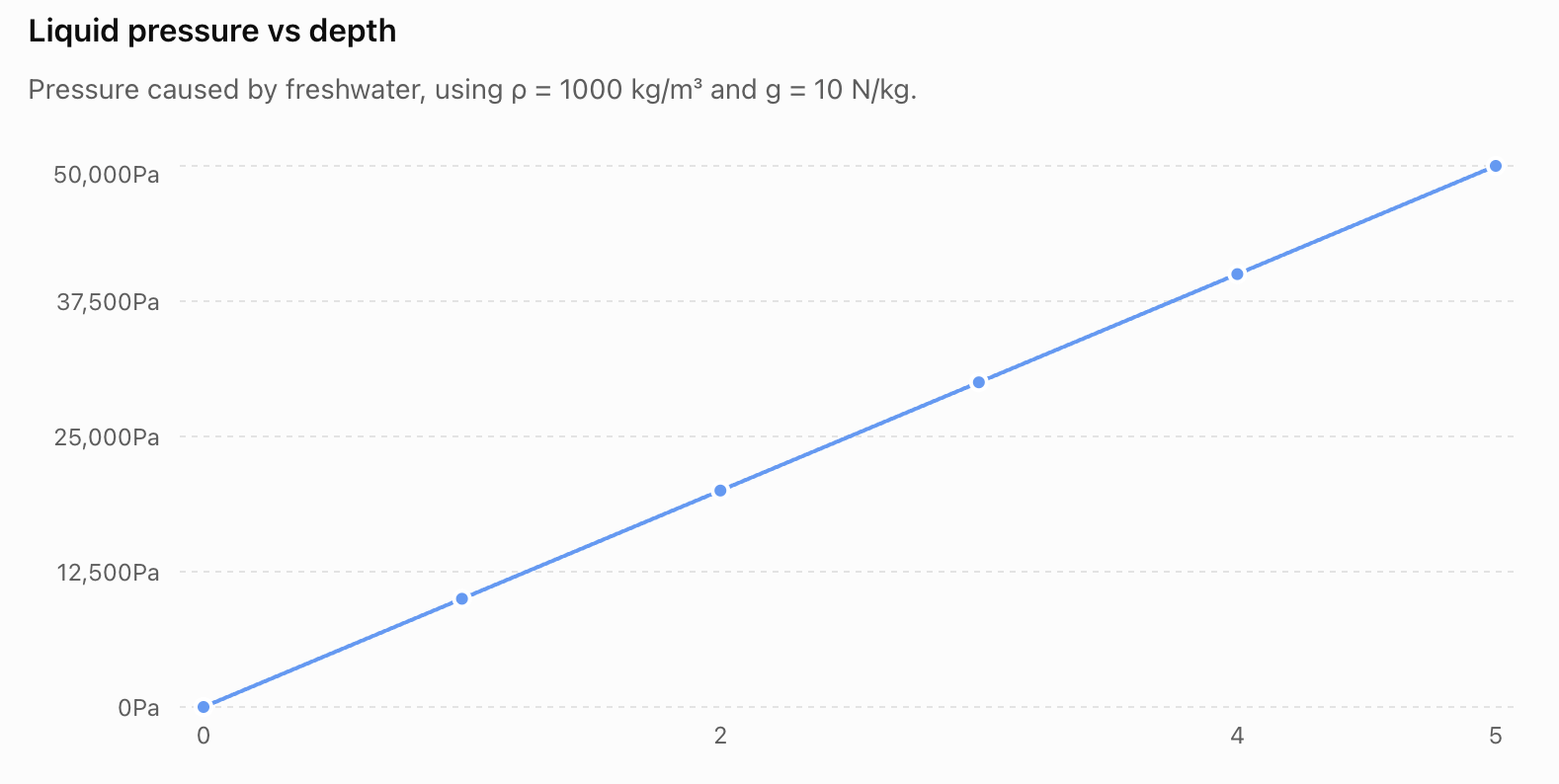
Because liquid pressure increases directly with depth, a graph of pressure caused by the liquid against depth produces a straight line.
Here is an example for freshwater using g = 10 N/kg.