2. Pressure in Liquids

Learning outcomes
  • I can explain why pressure increases with depth in a liquid.
  • I can identify factors that affect liquid pressure.
  • I can use the fluid pressure equation to solve problems.
  • I can interpret pressure-depth graphs.
  • I can apply liquid pressure concepts to underwater environments.

If you have ever dived to the bottom of a swimming pool, you may have noticed increasing pressure in your ears as you went deeper. This happens because liquid pressure increases with depth.

The deeper you travel below the surface, the more liquid there is above you. That liquid has weight, and its weight produces pressure.

This principle is important in swimming and diving, but it also affects submarines, dams, underwater pipelines, deep-sea animals, and ocean exploration.

https://images.openai.com/static-rsc-4/eWUw4PWuXsNwGpyyYKoPzjByQYnIXSUjQtP0gFVf1ZtdOksHrwdnAjgM-xsxF7Brf6jRjSZwN9yF3m-iFRzX-2KCWpOhVKOfCUTIGE5gpdAGIhm3hMC-18VkECsMTX5mpfv1Y8xIi9OB-LavQrJuhnPabPqkEWxAHAg9gU57umOn3Ep8cAFj8FXXUb5a0yp1?purpose=fullsize
https://images.openai.com/static-rsc-4/kgDKTl20hIvDCQwFIwzQ6a2M0XtOrzY1iJpjmJaMDN3DdUtvCS2Of4QkfsXjLaRhKmnipt9pZ5uUn7Mjoi_Ms-_O8nD589RPjCpvZn_66AmvXZJtW_8ILVM9FppsYB0k2GSh_M1xHbx0WIN3rH93rFrinv7UKRPWk148pR4ILVGOCE5Zh1EK-vWq-_d_MnXh?purpose=fullsize
https://images.openai.com/static-rsc-4/L8CqTuEuS0LWi_8iydHWMOqneuJejO6ipabB7jaTVQ-C5dWuC5UIGZZQlqKkJsZalkAt0Q-TzHYs9hH1VesPSn0mnHuf4MGtj3fsfruAOwflpE63LF3CHwKNBu7fzNKVtttRslihAYcL2CI9yLurCXdnIpH4QLgT3Qf2YyhzUwV7QJfjJUwS2pDmwTFzYd1Y?purpose=fullsize
7

What Is Liquid Pressure?

Liquids exert pressure on objects that are in contact with them.

Unlike a solid object resting on a table, a liquid does not exert force in only one direction. At a particular point in a stationary liquid, pressure acts in all directions.

This means that water pushes:

  • downward on the bottom of a container
  • sideways against the walls
  • against objects submerged in the water
  • against swimmers and divers

The pressure produced by the liquid itself is called hydrostatic pressure.


Why Does Pressure Increase with Depth?

Imagine standing at the bottom of a shallow swimming pool.

There is a column of water above you. The water has mass, so gravity pulls it downward. The weight of this water contributes to the pressure at your depth.

Now imagine moving to the bottom of a much deeper pool.

There is now a taller column of water above you.

https://images.openai.com/static-rsc-4/28QLJzTbVSor0VAuNew_llL2b6nHHRpSG_40VMENAz1xlCrY0mnMrqI1gd5JvYbbYrPd2eDwopnjacP5QA_vGwJPZveC5W2CD4qJP8CK7QnBZKn-iftXsjip3N2lDU792igQTN4pcsnXULqjiaQFujwPg_hjKVKWi-UpSI2dH-tW6qIbx4XRw1BahKeWkkPq?purpose=fullsize
https://images.openai.com/static-rsc-4/_ozNMv746bAONv3GsiStMwI-y_DyKIOXSGQ8fstzUG1IJzsR3v6EU_OpzSSMyxA3oSqVdp6n5SqLw33DVBNWpHo6BfUMfnlMbpmofyR0QjMt7MqvQ3QE48vKMebgLq0tajrRsAzTQHIdgs01gRJnTwrLAWkLA6JoAOSwFSraHTTr9Nt0MKdYlbWslo11zMSH?purpose=fullsize
https://images.openai.com/static-rsc-4/ek-AM00vLh8hl1DsGYDG_E0wIZXK6ufinKn_hsrGiRqEoJnXLy6jJxC-3hkQMU9-bkec3Ng3w_ImyFq2TJBUu0tskFmLshuYvzeO7PF3XcKFwMas-LEnjh44F4i_dW2BAnfZdhDTu56OCeDnsHiTMqCdaT84P4eWePw29nhNy9WcPU1V-TzkyxqFIMd32gBm?purpose=fullsize
6

A taller column of water means:

more water above you → greater weight of water → greater pressure

Therefore:

As depth increases, liquid pressure increases.

This is why a diver experiences greater pressure at 20 m below the surface than at 5 m below the surface.


Factors Affecting Liquid Pressure

For a liquid at rest, the pressure caused by the liquid depends mainly on three factors:

1. Depth

Greater depth produces greater pressure.

Greater depth → greater liquid pressure

2. Density of the Liquid

A denser liquid has more mass in the same volume.

Therefore, at the same depth:

Greater density → greater liquid pressure

For example, seawater is slightly denser than freshwater, so at the same depth it produces slightly greater pressure.

3. Gravitational Field Strength

Stronger gravity increases the weight of the liquid.

Therefore:

Greater gravitational field strength → greater liquid pressure

These three factors appear in the fluid-pressure equation.


The Fluid Pressure Equation

The pressure caused by a column of liquid can be calculated using:

p = ρgh

where:

p = pressure caused by the liquid (Pa)
ρ = density of the liquid (kg/m³)
g = gravitational field strength (N/kg)
h = depth below the surface (m)

The Greek letter ρ, pronounced rho, represents density.

For water, we usually use:

ρ ≈ 1000 kg/m³

Near Earth's surface:

g ≈ 9.8 N/kg

In many school calculations, this may be rounded to:

g ≈ 10 N/kg


Understanding the Equation

The equation

p = ρgh

shows us directly what affects liquid pressure.

If h increases, pressure increases.

If ρ increases, pressure increases.

If g increases, pressure increases.

Pressure is therefore directly proportional to all three quantities.

For example, if depth doubles while density and gravity remain constant:

pressure doubles.

If depth triples:

pressure triples.


Worked Example 1: Pressure in Water

A swimmer is 3.0 m below the surface of freshwater.

Calculate the pressure caused by the water.

Use:

ρ = 1000 kg/m³

g = 10 N/kg

h = 3.0 m

Start with:

p = ρgh

Substitute:

p = 1000 × 10 × 3

p = 30 000 Pa

Therefore, the water produces a pressure of:

30 000 Pa

or:

30 kPa

because:

1000 Pa = 1 kPa


Worked Example 2: Going Deeper

A diver moves from a depth of 4 m to a depth of 12 m.

Using freshwater and g = 10 N/kg, compare the liquid pressure.

At 4 m:

p = 1000 × 10 × 4

p = 40 000 Pa

At 12 m:

p = 1000 × 10 × 12

p = 120 000 Pa

The diver is now three times as deep.

The pressure caused by the water is also three times as large.

This demonstrates the direct relationship between pressure and depth.


Comparing Different Liquids

Density also matters.

Suppose two containers are filled to the same depth:

  • Container A contains water.
  • Container B contains a denser liquid.
https://images.openai.com/static-rsc-4/TQSMOPau7RT9CSJu-CKaOO-1dvdYkg1RAVHqKlO_VCkD8BQuwTdrYOt5gfGdmahw98TFWv_4WgL4AxDvXIcnHH-kHjTuWFAG75mXW9kITQSYUrKNA7kE5Q6FXJ3glz8J-IsQEb1VcguHGKhhalzN6wvLXSHHjx8Mv_Dww6NhmrjRDbaozpeJIwXd9YUmsRgj?purpose=fullsize
https://images.openai.com/static-rsc-4/ScQz8d_DRXLENzlmmBseBFp7lM_o7zTFug5nOnrPPNhu_WQfuTIoJKJhyzXRjzYQ4RKxyTqlUMYUF8kyiRvOp2wnkyWHP44DmlzxQI4Pb8LyeOwAglkNXAch24hPQ4AMBrYE_x3ykvnR3ox5SawWl64WkAKEQGXtCd9y2YE-wmqO2EmGRWbYzBTVfJRpnHd7?purpose=fullsize
https://images.openai.com/static-rsc-4/phgiYfTtXZuvlgdvnBhmIgM5kH6i7UaRDo1xEftrhZjC1lNlRKeWj3XwHup0QyaXgfCga698rqDcQk0gkzuGbGfLKD1pr91IifzCRT1tzUtw3qHrjLUj7TqK48yAZnanGqhnNm8yWHO0WcI2hUqZ6J7W6XU_-PJITF1i8DzQ4KAHiomqgg7pGb1PjAsruUfL?purpose=fullsize
5

At the same depth, the denser liquid produces greater pressure.

Consider water and a liquid with density 1200 kg/m³ at a depth of 2 m.

Water

p = 1000 × 10 × 2

p = 20 000 Pa

Denser liquid

p = 1200 × 10 × 2

p = 24 000 Pa

The denser liquid produces greater pressure even though the depth is identical.


Worked Example 3: Finding Depth

The equation can also be rearranged.

Suppose the pressure caused by water is 50 000 Pa.

At what depth does this occur?

Use:

ρ = 1000 kg/m³

g = 10 N/kg

Starting with:

p = ρgh

Rearrange:

h = p ÷ (ρg)

Substitute:

h = 50 000 ÷ (1000 × 10)

h = 5 m

Therefore, the depth is:

5 m


Pressure-Depth Graphs

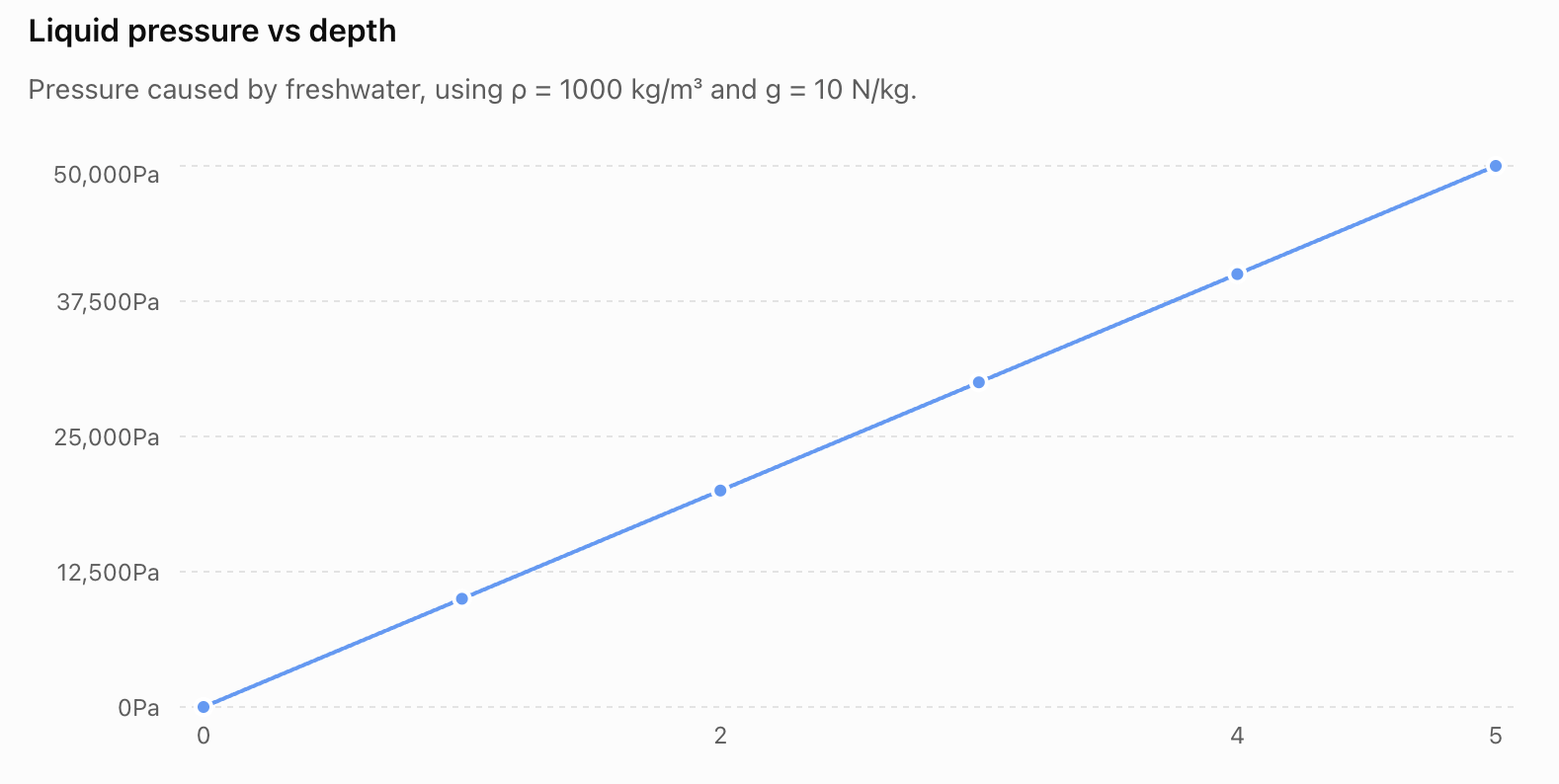
Because liquid pressure increases directly with depth, a graph of pressure caused by the liquid against depth produces a straight line.

Here is an example for freshwater using g = 10 N/kg.
Notice that:

  • At 0 m, the pressure caused by the water is 0 Pa.
  • At 1 m, it is 10 000 Pa.
  • At 2 m, it is 20 000 Pa.
  • At 5 m, it is 50 000 Pa.

Every additional metre adds the same amount of pressure.

This creates a straight-line relationship.


Interpreting the Gradient

The steepness, or gradient, of a pressure-depth graph tells us how quickly pressure increases with depth.

From:

p = ρgh

we can see that the gradient depends on:

ρg

Therefore, if two liquids are on the same planet:

denser liquid → steeper pressure-depth graph

A less-dense liquid produces a less-steep graph.

This means you can sometimes compare the densities of liquids simply by comparing their pressure-depth graphs.


Gauge Pressure and Total Pressure

There is an important distinction when discussing pressure underwater.

The equation:

p = ρgh

calculates the pressure caused by the liquid column.

But a swimmer in an open swimming pool also has atmospheric pressure acting on the surface of the water.

Therefore, the total pressure is:

total pressure = atmospheric pressure + liquid pressure

At Earth's surface, atmospheric pressure is approximately:

101 000 Pa

or about:

101 kPa

So if water contributes another 50 000 Pa:

Total pressure ≈ 101 000 + 50 000

Total pressure ≈ 151 000 Pa

The pressure calculated using ρgh alone is sometimes called gauge pressure or hydrostatic pressure.

This distinction becomes especially important when discussing diving.


Pressure Underwater

Water is much denser than air, so pressure changes much more rapidly with depth in water than it does with height in the atmosphere.

This is why divers quickly notice pressure changes.

https://images.openai.com/static-rsc-4/EzM-882e4PdYov2HzEigxLqs1D57xL3cAqIqIvuwJgw3reIgYOtRguY-6UHkdHCMtP4DLs3iTADtsxYl8cycSnLMWCga1EFUDHALwEGH_6YPPtKDSaDrwtRcaUBLu3Vu3g2tgkpROq_eze7aKctonbr00Zco7FyVV-gJVv5bxpaHMoiYF2HIQfHZy69GgbJQ?purpose=fullsize
https://images.openai.com/static-rsc-4/OorohcxNXmXdkDdGTT82Vdt-9y_LbZD0RD_zN64qjDOpqRLVo8QYHGv5raohFIC0IRCiEl3V3ljiMoqATmdaG_XpXSDDjdH6XkCPsjyTLyCWu734aZCHGtQjSydmVenYuBjCW3TN18mCDTQB_uUQYMZiazim9kFYHPcYzMT5BkAFDE1u6p3jwTQaTyjLwRVu?purpose=fullsize
https://images.openai.com/static-rsc-4/eWUw4PWuXsNwGpyyYKoPzjByQYnIXSUjQtP0gFVf1ZtdOksHrwdnAjgM-xsxF7Brf6jRjSZwN9yF3m-iFRzX-2KCWpOhVKOfCUTIGE5gpdAGIhm3hMC-18VkECsMTX5mpfv1Y8xIi9OB-LavQrJuhnPabPqkEWxAHAg9gU57umOn3Ep8cAFj8FXXUb5a0yp1?purpose=fullsize
5

As a diver descends:

depth increases → water pressure increases

The increasing external pressure affects air spaces in the body, particularly:

  • ears
  • sinuses
  • lungs
  • diving equipment

Divers therefore need to manage pressure changes carefully.


A Useful Diving Approximation

In seawater, pressure increases by approximately one atmosphere for every 10 m of depth.

At the surface:

≈ 1 atmosphere

At 10 m:

≈ 2 atmospheres total

At 20 m:

≈ 3 atmospheres total

At 30 m:

≈ 4 atmospheres total

The extra pressure comes from the increasing column of water above the diver.

This is an approximation, but it is useful for understanding how rapidly pressure increases underwater.


Submarines and Deep-Sea Vehicles

Submarines must be designed to withstand large external pressures.

The deeper a submarine travels, the greater the pressure exerted by the surrounding water.

https://images.openai.com/static-rsc-4/0aUAa2DfBdnXTqubwfYpZnd4UVFMZjrVuweKELWl_BwdyhKiBp0VyKu07GWSKwfO33bECGGF-PeysHyO9cNlNazkt3_ym3tYe2UbcxtSwZZjz_gYOK1x_m886dNIBOiSdGBR_I38zaUyXaleKBdCZLw7E8twBN10xFLd2cFGxwUmlFaLqcI6s5_3LbFS3Qnd?purpose=fullsize
https://images.openai.com/static-rsc-4/IX9x2WuKIS_DjfyNsRnC20iBrEr2LMwirM8Obd2CyD6_FMa475Lgxe53ENdbBzW8_f5vEtVZGfS-We7hE-AYnuwF-VinF02lZPlk0WTjoMYKRsFTjWhpUDMAlIssk48wk3exeYkPp5gH9RujY2gPtiP3e17RbNswwKa9C7LqiGdGnytjz6QPF_h5_5_zWjMz?purpose=fullsize
https://images.openai.com/static-rsc-4/pErw8Msqu70rqb-lu1NP6-LniLb1mQz7hDjQiJwTOuOcMaANYR1EjTVtFZu80xuB3DQPLlntrqdgNW7NRXg-bcWWwaICiiuulUfgur_oIlQ6wWdqZ5iT---Ci6-LrhTHdP7G_tE_f_r5ZnddGbfasiLvVZJcsOjBDIUNe9bCjbPHzp0a7B34nxA0pu3vXWjD?purpose=fullsize
5

A submarine therefore requires a strong pressure hull.

Engineers must consider:

  • maximum operating depth
  • water density
  • hull material
  • hull thickness
  • hull shape
  • safety margins

Deep-sea research vehicles face even greater engineering challenges because they may descend thousands of metres below the surface.


Why Deep-Sea Submersibles Are Often Rounded

Many deep-sea vessels use spherical or nearly spherical pressure chambers.

Why?

External water pressure acts from all directions.

https://images.openai.com/static-rsc-4/7jEzGqyZEmM_oItG5S4Yra4caL4R7_6cBxz836IPpzgRkjWfPlu_1W348cRS8L5GHaWKK59f3GHVY9CvHcNYqn2eTT4uCB_tHworzzTZf2pvWqxILuLRGXnNCFXjthnKzc6cLIXNMsZgMNF4OFv9TWpGMTowBCQaQBNwepPYdnpsKH-KrTP445Do6aHeB18k?purpose=fullsize
https://images.openai.com/static-rsc-4/LoGurt8XafgRvuwHaFIEuaU2a7wxkeOhQ-5mSLjmN2jdP2dvALAJF0m7YE6pdX1ByKMGxsSmjPfSChPZg7mQS02t1cMIWgUnhT2F-qBQhIpmvIElwTBs9jZ3rK0GiZyEnaAm4WiAickiy-jEvYQhhUrkBjvN6PSGAS2diWnQK7iSITNhqydxu6SU_BY3bj6Y?purpose=fullsize
https://images.openai.com/static-rsc-4/TADMPZe1wn5KJDEzVpCpVnu8xQmqAA6yjBVX2N_XsWTMUYP_rJ__J6UkCQbP5BhWb9vp28ODEr_el9QMDu-rkibeiccLwr0cgNWplVjluyBlC3LV5Uqqk_3Lzs-nlHP85_9LhHln8osparZbzL5VBqrDk1jIn6WbuUUGVjmuZ5H-S4gb8bWu8J403u4fz5xu?purpose=fullsize
6

A rounded structure distributes the external forces more evenly than many flat-sided structures.

This helps the vessel resist deformation or collapse under enormous pressure.


Dams and Liquid Pressure

Dams provide another important application.

Water pressure increases with depth, so the bottom of a dam experiences greater pressure than the top.

https://images.openai.com/static-rsc-4/AVVEAopfdvbo3lCuuKP6NoAFx9cdTcH8Q1CT2G10tFRKWFhCfrzNZbOEanVOH_OMcy43N8AQ9IagMMDAXOcr6hbh1OaRtAc5Ih97bugiS8wUjIH_L7LpRDKsYoSWkHpwV-JwogSNre5BloVu1Qm8SVXfElnWRD-R2xeF10PNIbEUxzHMHJQUPC_9WuzMkx45?purpose=fullsize
https://images.openai.com/static-rsc-4/6NmO1ZExY3jogGgxUv6aEEOzR9SowxGHLbWBm9gdZgsqSm8suCxGcqjz7W4SLmG41y-lTy6vHM3_MJursKMrnUsShGZoP1nUC4LpkV2fDCwBQTQnyfV1FsUI53QNRMQCRj29jqM6N9Y0u897pcao4uGJ2by3RAN1wUinDi6IZlpy22xhEiQtNYoU4fagUuRc?purpose=fullsize
https://images.openai.com/static-rsc-4/VxrBqF0UvZl6SCFzZ5yyCODrenkDe-GHbChyFC-HioxTL9cDwdlXPZTukEaCmOfctX4qNJi_RQg-xjS57cOgGbG28qKhwfZforgLqQtiulif6jYoHsbooz6042nH1nehZljsYSdrdvmSTtUAwK5hu5iiiG1JZpfPTmMaWW20QLNdJrCnthyU6w5Ty6J3Frk8?purpose=fullsize
4

For this reason, many dams are:

thinner near the top

and

much thicker near the bottom

The structure must withstand the greater forces produced by the higher water pressure at greater depths.


Pressure Acts Sideways Too

A common misconception is that liquid pressure acts only downward because gravity pulls the water downward.

In reality, a stationary liquid exerts pressure in every direction.

A simple experiment demonstrates this.

Imagine a bottle containing water with holes at different heights.

https://images.openai.com/static-rsc-4/v1RsYKN9j9uq4Hp1IDBOohckuCTs60-kbM3TdKVQfSuTycLfBKdrFEJtLhppwkQN_0OAN2SxCm0CyEozrbHJ88AhqNkEEbIaUGQ2RZJEcShq1jl3mYuEimCzBaURUmCDHT3_wmBFhUP4O3ZZmRiBPrKlvJai1t0eMVlf0FD5cH4osipg8ICthUzG2L5zoYVR?purpose=fullsize
https://images.openai.com/static-rsc-4/O9SPeFgbYkdiJbcfB7GlZpHh1ztxoB2H3uDFpOKnEv-QeAbZY286RY5z1iAaZqdfgj66pdefLVIhdZnJLExQqZ56zgxB7HaLB_cdMsaIhm6ALorz5SPNhCg9lHHSwDGNyuja_og3u44dpmVgVzuVa0iCcMd_FRpt0qbLs18ODhYoISxUZHliwuBM4lFwXsST?purpose=fullsize
https://images.openai.com/static-rsc-4/hzcRgmFH4xYYJaH7unHN9OTGN0_RYP9E-L0MGB_y63RUwgXfSQjnu9Nt2bOQHctHFVOaTB6QT3C7FGozQFy5BYYQSiAFBq3Mf_MDXxGsCMSUZbn0IhzX5EBA2SxO5I2SEQuPdV_qGrTWFcIMqdUcpwNV66pKOlNdJMMAwpCWhoGrgTXVwUW0J6-6Ch_mxQPN?purpose=fullsize
4

Water shoots sideways from each hole.

The water from the lowest hole usually travels farthest because the pressure is greatest there.

This demonstrates two important ideas:

  • liquid pressure acts sideways
  • liquid pressure increases with depth

Does Container Shape Affect Pressure?

Suppose several containers have very different shapes but contain the same liquid to the same depth.

At the same depth, the pressure is the same.

https://images.openai.com/static-rsc-4/eE1zdo3DtHG8RHAaqp9Ai5udEwp9Vx_tBMXTSEOrhxgpcam_MooaU8tNLVouz1CUf4NcCBgjj7BHaaOHkw8ehqS_6sN9-8x_Pw8m78CMCndwVSjJ9RvahOB42SFZbwEEDuwwMbUcCvSMd2qlhSwEMY76PGgRINPH_9CwiKFmT3S97fkWKRaKb_KY3MVZb-CX?purpose=fullsize
https://images.openai.com/static-rsc-4/FvEkJg30dvSfWEJzfvdBx1TgTAWc99_NKWa3gq_10zjp2Pm5A7DluCMHBxcFwSU1DL3vMAQ3Q342lmnwyS5JgqgCY9JvkheQ3eIRq2YOlKanvRT7xsLb4TFSEaMZJMO7G_6_ntFrw_aGttoXbHXjI207zeSuimLy9JxLQsP2W1x77016GMOtvIrPNk0dCHd7?purpose=fullsize
https://images.openai.com/static-rsc-4/cp7qm9hIVHjqlctdlDxwQ1s1HRgtxoXAbkfQVQB5VI4r3N2qGC4QJjpomvEW9wqvE3v-CAd2AvIXCBOWAvx1ByFyqTTPLSjECFQ8LGZWeN303txOl7E36hAL3wuuawPDceC9Gha1nqUj5FglizNP1FnRTQbR6xpTB2El4hkrQla3YwWGzgh7a6Yhc2IX1RE0?purpose=fullsize
5

Why?

Look again at:

p = ρgh

Container shape does not appear in the equation.

Neither does the total volume of liquid.

Pressure at a particular depth depends on:

  • density
  • gravitational field strength
  • depth

It does not directly depend on the shape of the container.


Same Depth, Same Pressure

Another important rule is:

Points at the same depth in the same connected liquid have the same pressure.

For example, imagine three points located 2 m below the surface of the same swimming pool.

Even if they are in different horizontal positions, they experience approximately the same liquid pressure.

Their depth is the same.

Their liquid density is the same.

Gravity is the same.

Therefore:

p = ρgh

gives the same pressure.


Common Mistakes

Mistake 1: Thinking pressure depends only on depth

Depth is important, but density and gravitational field strength also affect liquid pressure.

Remember:

p = ρgh


Mistake 2: Using centimetres instead of metres

If a question gives:

50 cm

convert it first:

50 cm = 0.50 m

Then use the equation.


Mistake 3: Using density in g/cm³

The standard equation normally requires density in:

kg/m³

For example:

1.0 g/cm³ = 1000 kg/m³


Mistake 4: Adding atmospheric pressure when the question only asks for liquid pressure

If the question asks for the pressure caused by the water, use:

p = ρgh

If it asks for total or absolute pressure, atmospheric pressure may also need to be included.

Read the wording carefully.


Mistake 5: Thinking a wider container produces greater pressure

A wide container may contain more water, but pressure at a particular depth does not depend directly on the width or total volume.

At the same depth:

same liquid + same gravity → same pressure


Mistake 6: Thinking pressure acts only downward

Liquid pressure acts in all directions.

This is why water pushes against the sides of containers and against every surface of a submerged object.


Mistake 7: Confusing pressure with force

Pressure and force are related, but they are not the same quantity.

Force is measured in newtons (N).

Pressure is measured in pascals (Pa).

A pressure acting over a surface can produce a force, but pressure itself is not a force.


Check Your Understanding

1. Recall

What happens to liquid pressure as depth increases?

2. Explain

Why is the pressure greater at the bottom of a swimming pool than near the surface?

3. Calculate

Calculate the pressure caused by freshwater at a depth of 6 m.

Use:

ρ = 1000 kg/m³

g = 10 N/kg

4. Compare

Two divers are underwater.

  • Diver A is at 5 m.
  • Diver B is at 15 m.

Which diver experiences the greater pressure caused by the water? How many times greater is it?

5. Apply

Liquid X has a density of 800 kg/m³.

Liquid Y has a density of 1200 kg/m³.

Both are measured at a depth of 4 m.

Which liquid produces greater pressure? Explain without calculating first.

6. Interpret a Graph

A pressure-depth graph is a straight line through the origin.

What does this tell you about the relationship between pressure and depth?

7. Engineering

Why are many dams thicker at the bottom than at the top?

8. Challenge

Two containers have completely different shapes. Both contain freshwater to a depth of 3 m.

Is the pressure at the bottom necessarily different?

Explain your answer using the fluid-pressure equation.


Key Terms

  • Pressure – force acting per unit area
  • Liquid pressure – pressure exerted by a liquid
  • Hydrostatic pressure – pressure produced by a stationary liquid
  • Depth – vertical distance below the surface of a liquid
  • Density – mass per unit volume
  • Pascal (Pa) – SI unit of pressure
  • Atmospheric pressure – pressure produced by Earth's atmosphere
  • Gauge pressure – pressure measured relative to atmospheric pressure
  • Absolute pressure – total pressure including atmospheric pressure
  • Pressure hull – strong structure designed to withstand a pressure difference
  • Gradient – steepness of a graph

Key Takeaways

  • Liquid pressure increases with depth because deeper points have a greater weight of liquid above them.
  • Liquid pressure depends on depth, liquid density, and gravitational field strength.
  • The fluid-pressure equation is p = ρgh.
  • A denser liquid produces greater pressure at the same depth.
  • A pressure-depth graph is a straight line when density and gravity remain constant.
  • A steeper pressure-depth graph represents a greater value of ρg.
  • Liquid pressure acts in all directions, not just downward.
  • At the same depth in the same connected liquid, pressure is the same.
  • Container shape does not directly determine pressure at a given depth.
  • ρgh gives the pressure produced by the liquid; total pressure may also include atmospheric pressure.
  • Increasing underwater pressure is important in the design of dams, submarines, diving equipment, and deep-sea vehicles.