1. The Cell Cycle

Learning outcomes
  • I can describe the stages of the cell cycle.
  • I can explain the purpose of the cell cycle in living organisms.
  • I can identify the events that occur before, during, and after cell division.
  • I can explain why DNA must be replicated before cell division.
  • I can relate the cell cycle to growth and repair.

The Cell Cycle

Living organisms grow, replace damaged cells, and maintain tissues by producing new cells. New cells do not simply appear. They are produced when existing cells go through an organized series of events called the cell cycle.

During the cell cycle, a cell:

  • grows
  • carries out its normal functions
  • copies its DNA
  • prepares for division
  • divides its nucleus
  • divides into two new cells

The two cells produced are called daughter cells.

https://images.openai.com/static-rsc-4/Yu353kTO2WCWMsDu3uN1XrfXe2YCaNyLNDywGtn8hRQRMhb4O22dM7j24Rp0hf3sJVFdU8CnBn0L_zrs1yJb9N6lOEUb3KVuFinOJNPg1kxlU643CvRaI8XDaAwCJFcklEiHwEWFNWkcHpeYTJ19i1TJvh41AJXN6CEZQwT-8uvYqHza-UNgKw0H3PaMRl_0?purpose=fullsize
 
https://images.openai.com/static-rsc-4/n9y_bO5fc0998_XeJeFsZ2ridWlhh6Ghrqf_KhaYAYVtuH96Z09WUwdOzzT1bEJ_FLGxqgVDIRT8xOA0ou3CS7m36zcVI_ECv9BKU9S5BOPK5j1jrFmkGALxUhzgHpm763iHvvvzLA1l3yS_XSPHR5FIM9ZCOmzbfaBX-wUyoz6jfB5AJv1YEixldPce75f0?purpose=fullsize
 
https://images.openai.com/static-rsc-4/cml_xko85XZgpXUSlyTLY7fQFf9AQkSh_1H4lSJAs64x94Cd200T0o5DabEKgbBCY0CtSsB_b8j9FkwfPGr5PJZiiIL_qxgQhq0TtUdfjYLiojYmzTaykIy34N6h7DlSRcngSqfbTCo_hMubCxX9ObnNe8E2V7M8L8t-wGWKw2nXoeSPk-E7AF_vyIfaY7qt?purpose=fullsize
 
5

What Is the Cell Cycle?

The cell cycle is the series of stages that a cell passes through as it grows and divides.

A simplified cell cycle can be divided into three major parts:

Interphase → Mitosis → Cytokinesis

During interphase, the cell grows, performs its normal activities, copies its DNA, and prepares for division.

During mitosis, the copied chromosomes are separated into two nuclei.

During cytokinesis, the cytoplasm and cell membrane divide, producing two daughter cells.

The cycle can then begin again.


Why Do Cells Divide?

Cell division is necessary for several important biological processes.

These include:

  • growth
  • development
  • repair
  • replacement of old cells
  • replacement of damaged cells
  • asexual reproduction in some organisms

A multicellular organism begins as a single cell.

Repeated cell division increases the number of cells:

1 → 2 → 4 → 8 → 16 → 32 → ...

Eventually, millions or even trillions of cells can form.


The Main Stages of the Cell Cycle

The cell cycle can be summarized as:

Before cell division

Interphase

The cell grows, carries out normal activities, replicates its DNA, and prepares for division.

During nuclear division

Mitosis

The chromosomes are separated so that two nuclei form.

After nuclear division

Cytokinesis

The cytoplasm divides and two daughter cells are produced.

This process can be followed visually below.
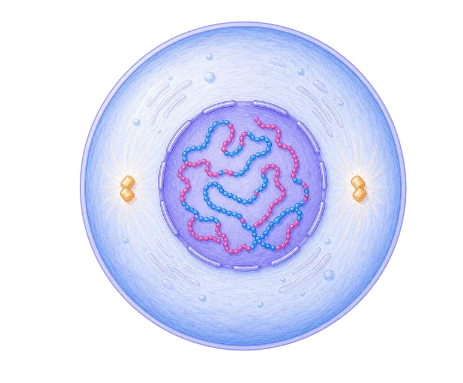
Interphase
 
DNA has been copied before mitosis, but it still remains uncondensed inside one nucleus.
 
 
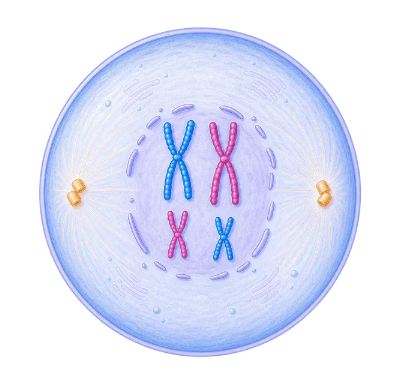
Prophase
Chromosomes condense and the spindle starts to form.
 
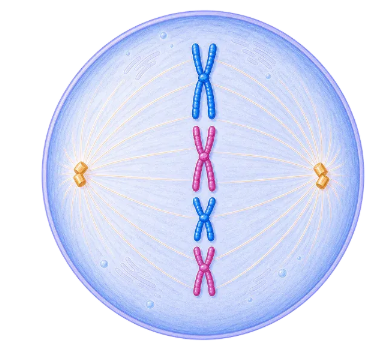
Metaphase
Duplicated chromosomes line up across the middle.
 
 
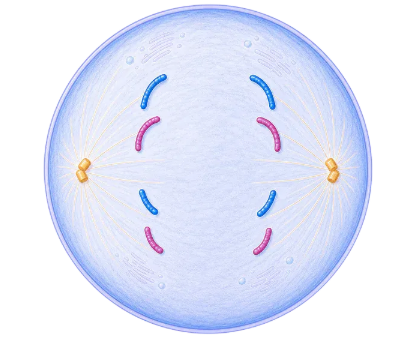
Anaphase
Sister chromatids move toward opposite sides.
 
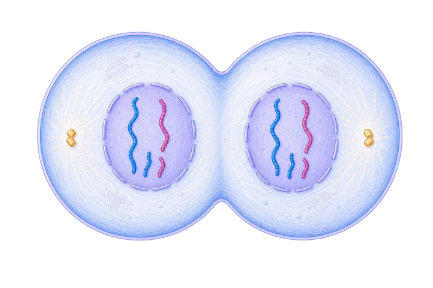
Telophase + Cytokinesis
Two identical daughter cells finish forming as new nuclei reappear around decondensing DNA.
 

Interphase

Cells spend much of the cell cycle in interphase.

Interphase is sometimes incorrectly described as a "resting stage."

The cell is not resting.

During interphase, it is extremely active.

The cell may:

  • grow
  • produce proteins
  • make new organelles
  • carry out its normal functions
  • replicate its DNA
  • prepare for division
https://images.openai.com/static-rsc-4/JX84EOYLu-SiLBkF5zXhCsUpd7UJq-sjRWYGj3BBWKcfRq2YqL6CeF28QNXMoQBXific-VSYxxlizJ7IeyZFwYx3UfrEhqd-go45Q6ZPEBFYVW_GJUqjfIiDmyqQMAKLwZKIOlQ7P03oxV9GBZd_vLg7dVGYE7iuZfn3sFK8xRSl17jWoA1d3CIQucPgwCoV?purpose=fullsize
 
https://images.openai.com/static-rsc-4/HLjAiYcXXa0slVzTbHMpkol_o9q5R2ibpud2TSEpDT9Qt5rOfI6k_3X7LolKnJxJIPsiluiRO6s-aKrAoJoflI8rFRHctKD9jAgI3bnM0JUVZ6FdwJqJaoRuJ78tVn38iBxtaBX--Devna39vSkyaoSwV0upQIKICJn8RoH8pttqA9BnMaOy3_0e5ia9CFxI?purpose=fullsize
 
https://images.openai.com/static-rsc-4/fO8eGCdpns6NaYRUXUW6SaZ8L2KoO-q8Uf__3-DGWbd9mb0SgBeRHg0XaW0ub5NF3UUu9FGpyHJP3Oet_X7Hbo2C3ddfEPKZFB5A_OjQukuLkEpdFo9umwuOKqmUh4gCYyYUD9Z06q1teV4oMCCWL-o_BAImhro3r962xVgxhtZeU1BfZZqu2HsaeyE5Bm3E?purpose=fullsize
 
6

The Three Parts of Interphase

Interphase can be divided into three stages:

G1 → S → G2

G1 Phase

During G1, the cell:

  • grows
  • carries out normal functions
  • produces proteins
  • increases the number of some organelles

The letter G stands for gap, although this is a period of considerable cell activity.

S Phase

During the S phase, the cell replicates its DNA.

S stands for synthesis.

Each chromosome is copied so that there will be enough genetic information for both daughter cells.

G2 Phase

During G2, the cell:

  • continues growing
  • produces molecules needed for division
  • checks and prepares its DNA
  • prepares the structures required for mitosis

After G2, the cell can enter mitosis.


DNA Replication

Before a cell divides, its DNA must be copied.

This process is called DNA replication.

DNA contains the genetic instructions needed for the cell to function.

If a cell divided without copying its DNA first, the daughter cells would not receive complete sets of genetic information.

Therefore:

DNA replication must occur before mitosis.

https://images.openai.com/static-rsc-4/bSED3kdrJ6PDvqKvmFst_ehF7_YM4_CERA_4xR7K0D2QyN3yFRlqPiPlb59ANwx9v6Su6FAqEyft2ZemCiIzaBNpNCQPWerN3HUlFHEHbuMr2Fo3w5kaWiorPvD-st1ZXmfDpq74oQ5j_PZTWX1sL7St5uS4aKx755MNLuUcSKmD4nn0gXo00XltONPhtSGH?purpose=fullsize
 
https://images.openai.com/static-rsc-4/mnhtNZFgxtVny0sb8gpi0lyvKmZvi8asl6VucUw6G_PeTtEhHvM50NcPOpLPlTCc8RCalH-2o35cgmKVUaeBS7CSfNQBdVCeb5A_pe6tdBHPZO_9U0A5PrYMZYwu03Uy7Nz83IlX01rDHhvYXj2IPuPhzIguSn4jPzikT4x1iE_jlMEU9hWBcN7IZQsGJs9v?purpose=fullsize
 
https://images.openai.com/static-rsc-4/JxYB3Ur6ia6dd6BoPvPIaNDANGPylFKD5NxuU5DpfvgxnAW2M5WCGP59Y8oT35YXmjsDrA1fwOimKMLnCQPQxWDeFRj-YiuxgJOBPV3BDDMqTk42HeAb98CMSIzLLHp1xmFfPbXcfB0YVLRiBM0QZYJ1DfYlb0veOPdyYY36GGmJHtAvU6un2Kn3DtqbD_BW?purpose=fullsize
 
6

Why Must DNA Be Replicated?

Imagine a cell contains one complete set of genetic instructions.

If it simply divided those instructions between two daughter cells without copying them, each cell would receive only part of the information.

Instead, the cell first produces a copy.

This creates two complete sets of DNA.

During mitosis, the copied chromosomes are separated.

As a result, each daughter cell receives a complete set of genetic information.


Chromosomes Before Cell Division

DNA is organized into structures called chromosomes.

Before DNA replication, each chromosome consists of one DNA molecule.

After replication, the chromosome consists of two identical copies called sister chromatids.

The sister chromatids are joined at a region called the centromere.

A replicated chromosome is often drawn as an X-shaped structure.

However, chromosomes do not remain X-shaped throughout the entire cell cycle. This shape becomes particularly visible when chromosomes condense during cell division.


Mitosis

Mitosis is the division of the nucleus that produces two genetically identical nuclei.

Mitosis ensures that each daughter cell receives the same number and types of chromosomes as the original cell.

Mitosis is commonly divided into four main stages:

Prophase → Metaphase → Anaphase → Telophase

A useful memory aid is:

P → M → A → T

https://images.openai.com/static-rsc-4/hym4cEEF4TPSXRJqFhXpNtIzawT_8H_DNdkbhN162Zx4Ex8iGk1wzRfHzZmYG7eiRGn3G6hIwLLjK6AQPc8JMgXZQRK2GG2tiQwiViY-FS0BlCVG1Wy0Iy-bxJrctmM7cmHzCQVS87tZDHUGZH40jVYU3jxAMNtebs4o7n45jaMk8SYn4t0Fe49Rald2r5vV?purpose=fullsize
 
https://images.openai.com/static-rsc-4/sdS35Lg8JBb_C-Ei9NgiKBV_FDH4W-oFzntUtlI9acgwx5-nYeQtqwKvcF9BBpblhazd1ucamrO5Xb4S61yiw7cGO11jZHK35xzGv25_m4BvrfVsGhdT4ZwwPNmUa8gEDqBO7iD50ol0RUoSlqA4rqgUfTCFYAbluBXjlEAEhrFHpUbJ5CJDIoPNGOqG_5ZB?purpose=fullsize
 
https://images.openai.com/static-rsc-4/No83DDUXq8RbAibEuwnuzl-g7eIpyGYOrdtAyt6KMun_f-RFLpdQacMGbrkyoAFEIXVVWrL62SlnOWd-Dafvh3s6deYCRTDabgATVqFnMeP1xJfTk6b3gI8pdUwumkn3J24z1LouWBQKkBI7MLcMJSTm_uioXsIzexa8tVp86E0ACR4E132I-IPejQ7SFPRM?purpose=fullsize
 
5

Prophase

During prophase:

  • chromosomes condense and become more visible
  • each replicated chromosome consists of two sister chromatids
  • the nuclear envelope begins to break down
  • spindle fibres begin to form

The chromosomes become compact, making them easier to move without becoming tangled.


Metaphase

During metaphase:

  • chromosomes move toward the middle of the cell
  • chromosomes line up around the cell's equator
  • spindle fibres attach to the chromosomes

The alignment helps ensure that the chromosome copies can be separated accurately.

A useful clue for identifying metaphase is:

chromosomes lined up across the middle


Anaphase

During anaphase:

  • sister chromatids separate
  • spindle fibres pull them toward opposite ends of the cell

Once the sister chromatids separate, each becomes an individual chromosome.

A useful clue for identifying anaphase is:

chromosomes moving apart


Telophase

During telophase:

  • chromosomes reach opposite ends of the cell
  • chromosomes begin to uncoil
  • new nuclear envelopes form
  • two nuclei are produced

Mitosis is now nearly complete.

The cell has divided its genetic material into two nuclei.


Identifying Mitosis Under a Microscope

Scientists can observe dividing cells using microscopes.

Growing regions of plants, such as onion root tips, are particularly useful because many cells are actively dividing.

https://images.openai.com/static-rsc-4/Hfw5FPk6VKym3nPgrF985MQZD4AvXMcjCD0KWrWbGpl4p_EPfjf5PUMN9Rnfu9nnthsfz26XVK122_3Wqx1jya8U8K3lNbtg4MjYgX2zCmOStsKb1tX-xq_9S5mPAzHkspoJXPTQWq1gFweDXVU0a297aC6JL2Z8krabMXKR3eRlt3EnRSPBZxb7m3RaIqd3?purpose=fullsize
 
https://images.openai.com/static-rsc-4/gw8pgYAAwugW2b6tUrvZLzmlq96DFMM0AivSOKYcot_f8jhpvYu613kVHdN7O3xt401cViG2ps-Ur8ZAO3WkpDwJXa2udsgEjAcAqNUXWWxDC73RJFiilvlNhytc519iVJxaht3-mRyCMm9_8KmN0StcLpUTjzNZNNOqlTRmDZoOqWuI7QitCk__pFSUvUxv?purpose=fullsize
 
https://images.openai.com/static-rsc-4/peY4Q2lyhA14eD0BMrokeap8YtHAIUHkh14z3qC9mdgUYUkQ8bFdzM1RY8BWIvx89v2Fi4HpSJ_M_tIsD0iZ3UgOrfckbfyFyfvmHQkX0XIo5Pwn1Dq__AAItz8BL9G6mFtYUS7s3PIVqEpTiA54aEs2quD71bicEDL0tllQCHImY_20PE7sGIZzb1ZMGbSZ?purpose=fullsize
 
5

When examining cells, look for:

  • visible condensed chromosomes
  • chromosomes lined up in the centre
  • chromosomes separating
  • two nuclei beginning to form

Many cells will appear to be in interphase because cells generally spend much more time in interphase than in mitosis.


Cytokinesis

After the nucleus has divided, the cell itself must divide.

This process is called cytokinesis.

During cytokinesis:

  • the cytoplasm divides
  • the cell separates
  • two daughter cells form

Cytokinesis occurs differently in animal and plant cells.


Cytokinesis in Animal Cells

Animal cells do not have rigid cell walls.

During cytokinesis, the cell membrane pinches inward.

A groove forms around the middle of the cell.

This is called a cleavage furrow.

The membrane continues pinching until two separate daughter cells form.

https://images.openai.com/static-rsc-4/dxRc1mUOPWWSqew8DOX436GgKYnVLTxBEuiaAa5M5ac8UVJkcRFQRS8r1Oaf6i5ziLRCatPGN9lb1s2ruWOS5kNAbsrr2-aaSaMRp4EGoi30tPS95Y9V3l_QxJm35SJVaNQuMufJMOF3GI3THnFA2ClqCqDa3cEdnaNJypaOvW4ZY2aL5wZ7gbOLKjBqknOp?purpose=fullsize
 
https://images.openai.com/static-rsc-4/35phO7X-C0yAF_Ew8tO8xvrXJoyg1fQNnosDZcfTPLlGiNyp2xZ5aUQpAQLiIMj-3qO3Cw-LyhQP4XXU-GOurbxtsDxQwX0QcBqyRkzkms5s8c749yJiNkHs2YIspwreK6aNs3c8CT04Es2sup_LuRPE1dfMLUbI7UWpqm6F2EqPFXPCsWQ0h2FqdBWhO5Xp?purpose=fullsize
 
https://images.openai.com/static-rsc-4/Hf-2rM0Aub5Rqep3zfHQIT3EwTpuENE9463Un6oamI4Rnb-vW9aKWnIRM69QJmu-JAW4peYg5bzPAS7-7WQrHYIAcjD0w6zCebmXJxw4LKwQmBH1q5i5ub6nOCRReBeObkF5BpVP3CMNbwYRrUvDAaBktPGeOpWbKyzlzZ_Tv1OZfgwBbpAZIqbQujdo2t5l?purpose=fullsize
 
4

Cytokinesis in Plant Cells

Plant cells have rigid cell walls, so they cannot simply pinch inward.

Instead, a structure called a cell plate forms between the two new nuclei.

The cell plate develops into new membranes and a new cell wall.

This separates the original cell into two daughter cells.

Therefore:

Animal cells → cleavage furrow

Plant cells → cell plate


The Complete Cell Cycle

The overall sequence is:

G1 → S → G2 → Mitosis → Cytokinesis

The major events are:

Stage Major Event
G1 Cell grows and performs normal functions
S DNA is replicated
G2 Cell prepares for division
Prophase Chromosomes condense
Metaphase   Chromosomes line up
Anaphase Sister chromatids separate
Telophase Two nuclei form
Cytokinesis Cell divides into two

What Are Daughter Cells?

The cells produced by cell division are called daughter cells.

For normal mitotic division, the daughter cells are genetically very similar to each other and to the parent cell.

They receive:

  • a complete set of chromosomes
  • cytoplasm
  • cell membranes
  • cellular structures

After division, the daughter cells may grow and eventually enter another cell cycle.


The Cell Cycle and Growth

Multicellular organisms grow mainly by increasing their number of cells, rather than simply making individual cells larger and larger.

Imagine a fertilized egg.

It begins as one cell.

That cell divides:

1 cell → 2 cells

The cells divide again:

2 → 4

Then:

4 → 8

Repeated cell cycles eventually produce the enormous number of cells making up an organism.

https://images.openai.com/static-rsc-4/8s2Ltek7Q3j-ao3ZaIHyNgJ1vv-hc2fBgUEDCAsDMfG8l8QXc6FSJNEsS-85PnLXjA4Z6xdZgmcAEnmfrz811zG-UaEO5VlrwWq8KKuhJ0lAUseBMIk3gKo0Su1YWc0DcU8ry3e7zdgv5-vUQ4-TmqoMLJKATFCm7SYnSQTCK2kS79t3sH-RfkcMfcnWIITQ?purpose=fullsize
 
https://images.openai.com/static-rsc-4/azQ2tOBL8HeFu4LLFuSTxYpI_PCL8gWG6-GkNlmoL1YwlfkpQn94D_9H1CqHBoXLAdDaQ-ji_aC7vMN87ncQgM8Fe5RFyCMDrLmVfJPPQ7ZS9ild5qliS74U2rns8aq2ZHMh-kbyLhYoxnvi2qDf5IUtu05gMWgnSbcYQL_GCxVydoeEhsrlbDqtvBQirL-l?purpose=fullsize
 
https://images.openai.com/static-rsc-4/KnkFc8xQ4_9FaizXBPwox6VSGcMIsOvnH8Ej8Oua_-vACg7sml8GBED0udhF6InVlXiRrG83fb2Pp7u6lao5088zVhEg-ohjJDm5-LceVk3dTOZOrIIFc65TeL6gOSrvd4YhMc4I8H9am1BQC0QOhQRARlqfAWfJfkgbiFJEZTBh85jgYlDzl4DWvQZBVH5y?purpose=fullsize
 
5

Cell division therefore plays a major role in:

  • embryonic development
  • childhood growth
  • tissue development
  • growth throughout an organism's life

The Cell Cycle and Repair

Cells can become damaged through:

  • injury
  • friction
  • chemicals
  • heat
  • radiation
  • normal wear and tear

Damaged or lost cells often need to be replaced.

Cells near the damaged area can undergo the cell cycle and produce new cells.

For example, if you cut your skin, cells around the wound divide and help replace damaged tissue.

https://images.openai.com/static-rsc-4/jPq4V_NtRIhFZIlh4V8zmT-mTbGI0iMpSy1ITqQo9xCbcvJWhi0SA9R-q2zRAQudlpfz79hwRmgDAgkK54oBXYkRxrBKx-aRfu1uI0glpc3VaQn4-d9U-_JQuTs2nKv1-rmfVvJ_4tVIPVdunEHGoE66WywL0T2MM8la-MJzTBjFAWlqTyA9B4mCB85QmPLY?purpose=fullsize
 
https://images.openai.com/static-rsc-4/6si-PKZE7OqrauPkOVXZN5amvyodpTanK3xjnwAxV_ugci3kE-7ru5tx5qrTaXfpYTxKfA53qQ-gaZikHbK5ruXZXp1mbuh7WbZiF3GBqf_mLpCosFhWpNBvdqQUNww8mGNZRYQ2o2DD2BLQiiSlcaiXW8-bc5dxOY8u1KVL8doisbcQ5hHHeJVNBdWkH9f9?purpose=fullsize
 
https://images.openai.com/static-rsc-4/To2vzjiykgGqWWB1qdsTrE7yBqM_6dZlmsOu2ftS0MuRkW3RzqNN9DLC-P8thqLq6T-ZsBRPvRTVmuBPszC2K6skiwKefJ3Bsfz-A9TOoeJo0hP-_wKaIP9HoKTLG8ol4s6QlL9v020lIAZBaUloF7bdrWgWtympIBDHs8vEeYloKuod5hGycI1m8u133Daj?purpose=fullsize
 
5

This is why cell division is essential for tissue repair.


Replacing Old Cells

Many cells do not survive for the entire lifetime of an organism.

They must constantly be replaced.

Examples include cells associated with:

  • skin
  • digestive tract lining
  • blood production

Cells in different tissues divide at different rates.

Some tissues undergo frequent cell division because cells are regularly lost or damaged.

Other specialized cells divide much less frequently.


Cell Division and Surface Area

Cell division also helps cells remain small.

As a cell grows, its volume increases faster than its surface area.

This reduces its surface area-to-volume ratio.

Eventually, exchange across the membrane may become less efficient relative to the needs of the cell.

Cell division produces two smaller cells.

These smaller cells have higher surface area-to-volume ratios, making exchange more efficient.

This connects the cell cycle to the concept of surface area and exchange.


Controlling the Cell Cycle

Cells do not normally divide continuously without control.

The cell cycle contains checkpoints.

At these checkpoints, the cell can assess whether conditions are suitable for continuing.

Checks may include:

  • Is the cell large enough?
  • Has the DNA been copied correctly?
  • Is the DNA damaged?
  • Are the chromosomes correctly attached before separation?

If serious problems are detected, the cell cycle may stop.

This helps prevent damaged cells from dividing.


What Happens When Cell-Cycle Control Fails?

Normally, cell division is carefully controlled.

Sometimes mutations affect genes involved in controlling the cell cycle.

A cell may then begin dividing when it should not.

Repeated uncontrolled cell division can produce a mass of cells called a tumour.

Some tumours can develop into cancer.

This is one reason why regulation of the cell cycle is extremely important.


Worked Example: Why Copy DNA?

A cell is preparing to divide into two daughter cells.

Why must it replicate its DNA first?

The cell needs to produce two complete copies of its genetic information.

During mitosis, one complete set can then be distributed to each new nucleus.

Therefore:

DNA replication ensures that each daughter cell receives a complete set of genetic information.


Worked Example: Identifying a Stage

A microscope image shows chromosomes lined up across the middle of a cell.

Which stage is occurring?

The key clue is:

chromosomes lined up in the middle

Therefore, the cell is in:

metaphase


Worked Example: Identifying Anaphase

A student observes two groups of chromosomes moving toward opposite ends of a cell.

This indicates:

anaphase

because sister chromatids have separated and are being pulled toward opposite poles.


Worked Example: Growth

A student says:

"A child grows mainly because every cell becomes much larger."

This is incomplete.

Although cells can grow, multicellular organisms increase in size largely by producing more cells through cell division.

Therefore, repeated cell cycles contribute directly to growth.


Worked Example: Repair

A person scratches their skin and damages some surface cells.

Cells near the damaged area enter the cell cycle.

They:

  • grow
  • replicate their DNA
  • undergo mitosis
  • complete cytokinesis

The new cells replace damaged cells.

Therefore, the cell cycle contributes to tissue repair.


Before, During and After Cell Division

A useful way to organize the cell cycle is:

Before division

The cell:

  • grows
  • carries out normal functions
  • replicates DNA
  • prepares for division

During nuclear division

The cell:

  • condenses chromosomes
  • lines them up
  • separates chromosome copies
  • forms two nuclei

After nuclear division

The cell:

  • divides its cytoplasm
  • forms two daughter cells
  • begins growth again

Mitosis Is Not the Entire Cell Cycle

One common mistake is using mitosis and cell cycle as if they mean the same thing.

They do not.

The cell cycle includes:

Interphase + Mitosis + Cytokinesis

Mitosis is only the stage in which the nucleus divides.

In fact, cells generally spend much more time in interphase than they do undergoing mitosis.


Common Misconceptions

Interphase is a resting stage.

Incorrect. Cells are highly active during interphase. They grow, perform normal functions and replicate their DNA.

Mitosis is the entire cell cycle.

Incorrect. Mitosis is only one part of the cell cycle.

DNA is copied during mitosis.

DNA is replicated before mitosis, during the S phase of interphase.

Chromosomes are always X-shaped.

No. The familiar X shape represents a replicated and condensed chromosome consisting of two sister chromatids.

Cell division is only needed for growth.

It is also important for tissue repair, cell replacement and asexual reproduction in some organisms.

Mitosis produces four cells.

Normal mitotic cell division produces two daughter cells.

Plant and animal cells complete cytokinesis in exactly the same way.

Animal cells form a cleavage furrow, while plant cells form a cell plate.


Did You Know?

Different cells in your body move through the cell cycle at very different rates.

Cells in tissues that experience frequent wear, such as the lining of the digestive system, must be replaced regularly.

Other highly specialized cells may remain outside the active cell cycle for very long periods.

This means cell division is carefully matched to the needs of each tissue.

https://images.openai.com/static-rsc-4/madAkY7gM398fJcLiOBEJhmwY3SYdLHwx-o-ulUYkBDTrdruKD0jDf_mmbOsa5hgLKH5EfD3CnPBZJlN8BDyhVyTWTF0qO1BeWsuyB6xs8prhn9ahbADy4G909d_q7erxX8Mr4us1gqy6xtlCkZkkVdJVPuAuJFxkMTiskvITGASonApGHUsMga779g3TtVh?purpose=fullsize
 
https://images.openai.com/static-rsc-4/Whi0SGr2ONEuq-imJO3JTLw2uVDzvGdHqqSEhpYU7Se7QgOYO-CwPJkCHYGBJKncIMUfza8kgrAZ0t8gLp3c7jL7h0oun3eikLHTU7pmd-8Zd657Wnz54rr1zuL1yorlECb8nscczL0VJ-j1Szyo0bMZBYPS_WwNnb8jk-yCSlEpeVFg6k7EwVMCsECXIkAH?purpose=fullsize
 
https://images.openai.com/static-rsc-4/4WwcHLxSQS3bG93Keg2IwnlEWrM1N0ZnwUs1ypB-2SGWUce70rw4BT6-9pIBm0zuG8bf3ZdiulDmLdYJp3Da7UD-CyqmOsAmLE0dejU3-Oa9vUxMU9aK8e06uTsZD1cl06uHzppSCgjd2i4H4m3fzQslYlgNy1567uE362VqsJGEdc0usmIxdf-XHhl0-MLJ?purpose=fullsize
 
6

Key Terms

Cell cycle – The series of stages through which a cell grows, copies its DNA and divides.

Interphase – The part of the cell cycle during which the cell grows, functions, replicates its DNA and prepares for division.

G1 phase – A stage of interphase involving cell growth and normal activity.

S phase – The stage during which DNA replication occurs.

G2 phase – The stage during which the cell prepares for division.

DNA replication – The process of copying DNA before cell division.

Chromosome – A structure containing DNA and associated proteins.

Sister chromatids – Identical copies of a replicated chromosome.

Centromere – The region where sister chromatids are joined.

Mitosis – Division of the nucleus to produce two genetically similar nuclei.

Cytokinesis – Division of the cytoplasm to produce two daughter cells.

Daughter cells – Cells produced by cell division.

Cell plate – A structure that forms between new plant cells during cytokinesis.

Cleavage furrow – The inward pinching of an animal cell membrane during cytokinesis.

Key Takeaways

  • The cell cycle is the sequence of events through which cells grow and divide.
  • The main parts are interphase, mitosis and cytokinesis.
  • During G1, the cell grows and carries out normal functions.
  • During the S phase, DNA is replicated.
  • During G2, the cell prepares for division.
  • DNA must be copied before division so each daughter cell receives a complete set of genetic information.
  • Mitosis can be divided into prophase, metaphase, anaphase and telophase.
  • During mitosis, replicated chromosomes are separated into two nuclei.
  • During cytokinesis, the cytoplasm divides.
  • Mitotic cell division normally produces two genetically similar daughter cells.
  • Animal cells divide using a cleavage furrow, while plant cells form a cell plate.
  • The cell cycle allows multicellular organisms to grow by increasing their number of cells.
  • Cell division also replaces old or damaged cells and allows tissue repair.
  • Cell-cycle checkpoints help ensure that cells divide correctly.
  • Loss of normal cell-cycle control can lead to uncontrolled cell division and tumour formation.