Equations of Motion
3. Solving Kinematics Problems
Learning outcomes
- I can identify known and unknown variables in a motion problem.
- I can organize information using diagrams, tables, or variable lists.
- I can select and apply appropriate equations to solve problems.
- I can show complete and logical solutions using correct units.
- I can evaluate whether an answer is reasonable.
What is a kinematics problem?
Kinematics is the study of motion without focusing on the forces that cause it.
A kinematics problem may ask you to determine:
- An object’s displacement.
- Its initial or final velocity.
- Its acceleration.
- The time taken.
- Where or when two objects meet.
- The distance travelled during a journey.
- The maximum height of a moving object.
Solving these problems requires more than inserting numbers into an equation. You must first understand the motion, organize the information and choose a mathematical model that fits the situation.
A reliable problem-solving method
A complete solution can be organized into five stages:
- Represent the motion.
- Organize the information.
- Select an appropriate equation.
- Solve carefully.
- Evaluate the result.
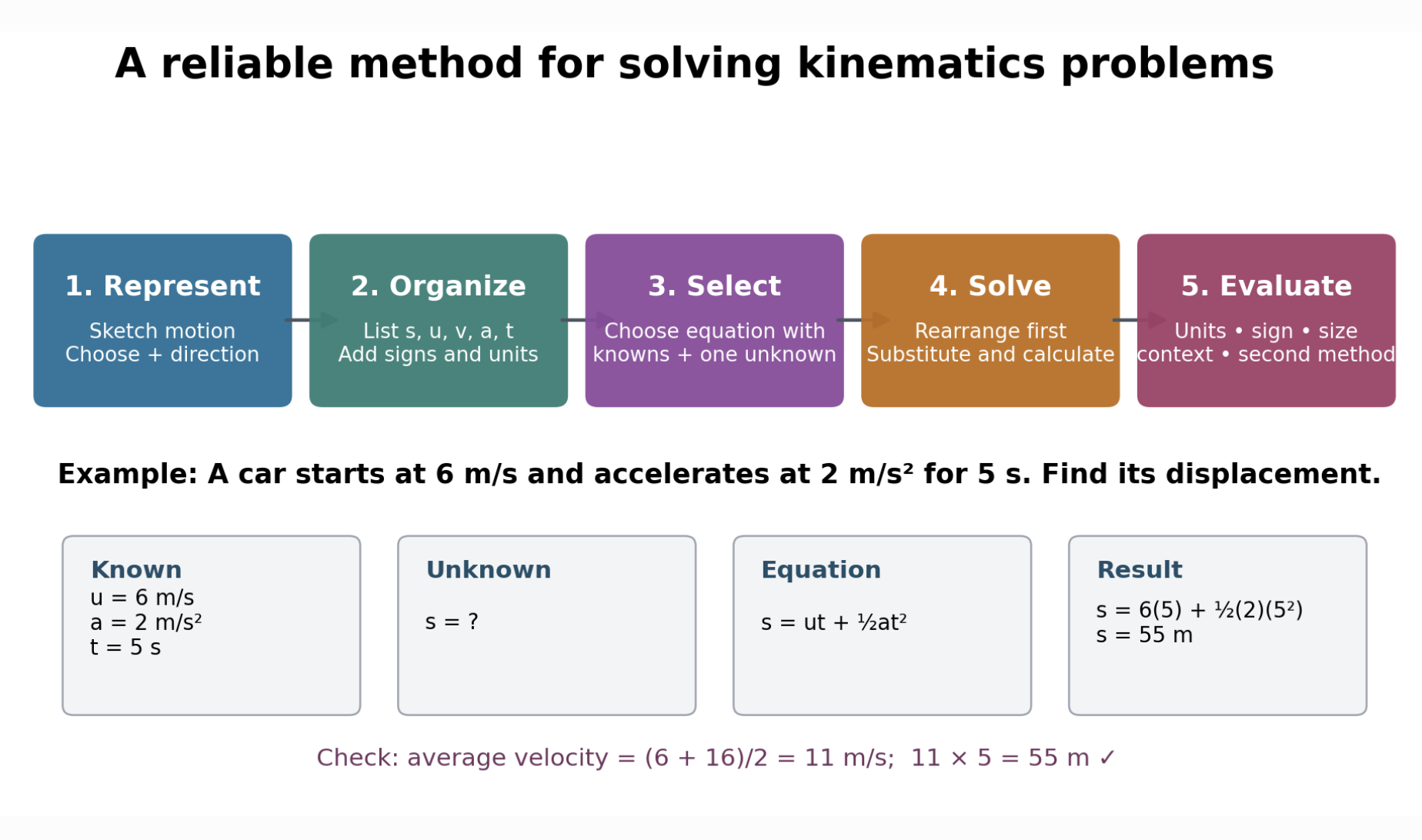
This method makes each decision visible. It also makes errors easier to find and correct.
Reading a motion problem carefully
Begin by identifying words and phrases that communicate mathematical information.
| Phrase in the problem | Mathematical meaning |
|---|---|
| Starts from rest | u = 0 |
| Comes to rest or stops | v = 0 |
| Constant velocity | a = 0 |
| Uniform acceleration | a is constant |
| Falls freely | a = g downward |
| Returns to its starting point | Total displacement = 0 |
| Moves east, right or upwards | Often chosen as positive |
| Moves west, left or downwards | Often represented as negative |
| Maximum height | Vertical velocity is momentarily zero |
| Ignore air resistance | Gravity is the only significant acceleration |
Do not assume information that the problem does not provide. For example, “a car moves at 20 m/s” does not mean it started from rest.
Identifying the variables
For uniformly accelerated motion, organize information using the five SUVAT variables.
| Symbol | Quantity | SI unit |
|---|---|---|
| s | Displacement | m |
| u | Initial velocity | m/s |
| v | Final velocity | m/s |
| a | Acceleration | m/s² |
| t | Time | s |
For constant-velocity motion, the main relationship is:
s = vt
or, when an initial position is included:
x = x₀ + vt
Before choosing an equation, write down each known value and the required unknown.
For example:
A car starts at 6 m/s and accelerates at 2 m/s² for 5 seconds. Find its displacement.
Known:
u = 6 m/s
a = 2 m/s²
t = 5 s
Unknown:
s = ?
The unused variable is v, so an equation that does not contain v is convenient.
Drawing a motion diagram
A simple diagram can clarify:
- The direction of motion.
- The chosen positive direction.
- The starting and finishing positions.
- Whether the object reverses direction.
- Whether several objects are involved.
- Whether the journey contains multiple stages.
A diagram does not need to be artistic. A line, arrows and labels are often sufficient.
For example:
Start: x = 0 m →→→ Finish: x = 80 m
Positive direction: →
A vertical-motion diagram might show:
- The release point.
- The highest point.
- The ground.
- The upward positive direction.
- The downward acceleration due to gravity.


A photograph or sequence can help visualize the situation, but the mathematical diagram should isolate only the positions, directions and quantities needed for the calculation.
Choosing a positive direction
Velocity, acceleration and displacement are vectors. Their signs depend on the chosen coordinate system.
For horizontal motion, you might choose:
- Right or east as positive.
- Left or west as negative.
For vertical motion, you might choose:
- Upwards as positive and gravity negative.
- Downwards as positive and gravity positive.
Either choice works if it is used consistently.
Suppose east is positive:
- A velocity of 12 m/s east is +12 m/s.
- A displacement of 30 m west is −30 m.
- An acceleration acting west is negative.
The sign belongs with the numerical value when it is listed. Do not wait until the end to decide which values should be negative.
Selecting an equation
The equations of uniformly accelerated motion are:
v = u + at
s = [(u + v)/2]t
s = ut + ½at²
v² = u² + 2as
s = vt − ½at²
Each equation omits one SUVAT variable.
| Equation | Variable not included |
|---|---|
| v = u + at | s |
| s = [(u + v)/2]t | a |
| s = ut + ½at² | v |
| v² = u² + 2as | t |
| s = vt − ½at² | u |
Choose the equation containing the known quantities and the one unknown you need.
Do not select an equation simply because it looks familiar. Match its variables to the information in the problem.
Worked example: finding displacement
A car has an initial velocity of 6 m/s and accelerates uniformly at 2 m/s² for 5 seconds. Calculate its displacement.
Known:
u = 6 m/s
a = 2 m/s²
t = 5 s
s = ?
The final velocity is not known or required. Choose:
s = ut + ½at²
Substitute:
s = 6(5) + ½(2)(5²)
s = 30 + 25
s = 55 m
Checking with a second method
First calculate the final velocity:
v = u + at
v = 6 + 2(5)
v = 16 m/s
Because acceleration is constant:
Average velocity = (u + v)/2
Average velocity = (6 + 16)/2
Average velocity = 11 m/s
Therefore:
s = 11 × 5
s = 55 m
Both methods produce the same answer.
Rearranging before substituting
When possible, rearrange an equation symbolically before inserting numbers. This keeps the logic clear and reduces calculator errors.
Worked example
A cyclist increases velocity from 4 m/s to 16 m/s over a displacement of 60 m. Calculate the constant acceleration.
Known:
u = 4 m/s
v = 16 m/s
s = 60 m
a = ?
Time is not given, so choose:
v² = u² + 2as
Rearrange for a:
v² − u² = 2as
a = (v² − u²)/(2s)
Substitute:
a = (16² − 4²)/(2 × 60)
a = (256 − 16)/120
a = 240/120
a = 2 m/s²
Showing a complete solution
A complete kinematics solution should include:
- The known variables.
- The unknown variable.
- A direction convention where needed.
- The equation used.
- Any rearrangement.
- Substitution with values.
- The calculated result.
- Correct units.
- Direction or physical interpretation where appropriate.
Writing only a calculator result makes it difficult to check the reasoning.
A clear solution might look like this:
Known: u = 4 m/s, v = 16 m/s, s = 60 m
Required: a
Equation: v² = u² + 2as
Rearrange: a = (v² − u²)/(2s)
Substitute: a = (16² − 4²)/(2 × 60)
Result: a = 2 m/s²
Worked example: uniform deceleration
A train moving at 30 m/s slows uniformly to 12 m/s in 9 seconds. Calculate its acceleration and displacement.
Choose the original direction of travel as positive.
Known:
u = 30 m/s
v = 12 m/s
t = 9 s
Calculate acceleration
Use:
v = u + at
Rearrange:
a = (v − u)/t
Substitute:
a = (12 − 30)/9
a = −18/9
a = −2 m/s²
The negative sign shows that the acceleration acts opposite to the train’s positive velocity.
Calculate displacement
Use:
s = [(u + v)/2]t
s = (30 + 12)/2
s = 21 × 9
s = 189 m
The train continues moving forwards while slowing down.


A train’s real acceleration may change during braking. A constant-acceleration model approximates the motion over an interval in which the velocity decreases at a steady rate.
Worked example: starting from rest
A runner starts from rest and accelerates uniformly at 1.2 m/s² for 6 seconds. Calculate the final velocity and displacement.
“Starts from rest” means:
u = 0 m/s
Final velocity
v = u + at
v = 0 + 1.2(6)
v = 7.2 m/s
Displacement
s = ut + ½at²
s = 0 + ½(1.2)(6²)
s = 0.6(36)
s = 21.6 m
A common error is to use the final velocity for the entire six seconds:
7.2 × 6 = 43.2 m
This is incorrect because the runner did not travel at 7.2 m/s for the whole interval. The runner began at rest and gradually reached that velocity.
Worked example: finding time
A motorcycle accelerates uniformly from 8 m/s to 24 m/s at 4 m/s². Calculate the time taken.
Known:
u = 8 m/s
v = 24 m/s
a = 4 m/s²
t = ?
Use:
v = u + at
Rearrange:
t = (v − u)/a
Substitute:
t = (24 − 8)/4
t = 16/4
t = 4 s
Check:
The motorcycle gains 4 m/s each second. A gain of 16 m/s should therefore take four seconds.
Problems involving constant velocity
Not every kinematics problem requires the uniformly accelerated motion equations.
If velocity is constant:
a = 0
Use:
s = vt
Worked example
A boat travels north at a constant velocity of 7.5 m/s for 40 seconds. Find its displacement.
s = vt
s = 7.5 × 40
s = 300 m north
Using s = ut + ½at² would also work if u = 7.5 m/s and a = 0, but the simpler constant-velocity equation is more efficient.
Problems involving free fall
Near Earth’s surface, free-falling objects have an approximately constant downward acceleration:
g = 9.8 m/s²
Air resistance is ignored in basic free-fall problems.
Worked example: dropping an object
A ball is dropped from a bridge and falls for 2.5 seconds. Calculate its downward displacement. Ignore air resistance.
Choose downward as positive.
Known:
u = 0 m/s
a = +9.8 m/s²
t = 2.5 s
s = ?
Use:
s = ut + ½at²
s = 0 + ½(9.8)(2.5²)
s = 4.9(6.25)
s = 30.6 m downward
The ball falls approximately 30.6 m.
Worked example: throwing an object upwards
A ball is thrown vertically upwards at 24 m/s. Calculate the time required to reach its highest point. Ignore air resistance.
Choose upwards as positive:
u = +24 m/s
v = 0 m/s
a = −9.8 m/s²
t = ?
At maximum height, the ball’s velocity is momentarily zero.
Use:
v = u + at
0 = 24 − 9.8t
9.8t = 24
t = 24/9.8
t ≈ 2.45 s
The ball reaches its highest point after approximately 2.45 seconds.
Its acceleration remains −9.8 m/s² at the highest point.
Problems with more than one solution
A quadratic equation may produce two possible times.
For example, a ball is thrown upwards from the ground with:
s = 20t − 5t²
Find when it is 15 m above the ground:
15 = 20t − 5t²
Rearrange:
5t² − 20t + 15 = 0
Divide by 5:
t² − 4t + 3 = 0
Factorize:
(t − 1)(t − 3) = 0
Therefore:
t = 1 s or t = 3 s
Both answers are reasonable:
- The ball passes 15 m while rising at 1 second.
- It passes 15 m again while falling at 3 seconds.
A complete solution interprets why two answers occur.
Problems involving two objects
When two objects meet, their positions are equal at the same time.
Worked example
Two cyclists move along the same straight road.
- Cyclist A starts at x = 0 m and moves at 6 m/s.
- Cyclist B starts 40 m ahead and moves in the same direction at 4 m/s.
Write their position equations:
xₐ = 6t
xᵦ = 40 + 4t
At the meeting point:
xₐ = xᵦ
Therefore:
6t = 40 + 4t
2t = 40
t = 20 s
Find the meeting position:
x = 6(20)
x = 120 m
Cyclist A catches Cyclist B after 20 seconds, 120 m from A’s starting point.
Multi-stage motion problems
Many real journeys contain several stages.
A car might:
- Accelerate from rest.
- Travel at constant velocity.
- Decelerate to a stop.
Treat each stage separately because the motion conditions change.
For each stage:
- List a new set of variables.
- Use the final velocity of one stage as the initial velocity of the next.
- Calculate the stage displacement.
- Add signed displacements for total displacement.
- Add distance magnitudes for total distance.
- Add all stage times for total time.
Worked example
A car:
- Accelerates from rest at 2 m/s² for 5 seconds.
- Travels at constant velocity for 8 seconds.
- Decelerates uniformly to rest in 4 seconds.
Stage 1: accelerating
u = 0 m/s
a = 2 m/s²
t = 5 s
Final velocity:
v = u + at
v = 0 + 2(5)
v = 10 m/s
Displacement:
s₁ = ut + ½at²
s₁ = 0 + ½(2)(5²)
s₁ = 25 m
Stage 2: constant velocity
v = 10 m/s
t = 8 s
s₂ = vt
s₂ = 10(8)
s₂ = 80 m
Stage 3: decelerating
u = 10 m/s
v = 0 m/s
t = 4 s
s₃ = [(u + v)/2]t
s₃ = (10 + 0)/2
s₃ = 20 m
Entire journey
Total displacement:
s = 25 + 80 + 20
s = 125 m
Total time:
t = 5 + 8 + 4
t = 17 s
Average velocity:
v_avg = 125/17
v_avg ≈ 7.35 m/s
Using graphs to check a solution
Motion graphs provide an independent way to check calculations.
Position–time graph
- Gradient gives velocity.
- A straight line represents constant velocity.
- A curve represents changing velocity.
- A horizontal tangent represents zero instantaneous velocity.
Velocity–time graph
- Vertical coordinate gives velocity.
- Gradient gives acceleration.
- Signed area gives displacement.
- A horizontal line represents zero acceleration.
Acceleration–time graph
- Vertical coordinate gives acceleration.
- Signed area gives change in velocity.
- A horizontal line represents constant acceleration.
For the multi-stage car journey, a velocity–time graph would rise from 0 to 10 m/s, remain horizontal, and then fall to zero. Its total area would be 125 m.
Converting units before calculating
Measurements must use compatible units.
Useful conversions include:
1 km = 1000 m
1 h = 3600 s
1 m/s = 3.6 km/h
To convert km/h to m/s, divide by 3.6.
To convert m/s to km/h, multiply by 3.6.
Worked example
A car travelling at 72 km/h accelerates uniformly to 30 m/s in 5 seconds. Find its acceleration.
Convert the initial velocity:
u = 72/3.6
u = 20 m/s
Now use:
a = (v − u)/t
a = (30 − 20)/5
a = 2 m/s²
Using 72 and 30 directly would mix incompatible units.
Significant figures and precision
A final answer should usually reflect the precision of the data.
For example, if a distance is given as 25 m and a time as 3.2 s:
v = 25/3.2
v = 7.8125 m/s
A suitable reported answer is:
v ≈ 7.8 m/s
Do not round intermediate values too early. Keep extra calculator digits during the calculation and round the final result.
When a problem states that g = 9.8 m/s², answers generally should not imply greater precision than that value supports.
Evaluating whether an answer is reasonable
Check the units
Each calculated quantity requires an appropriate unit:
- Displacement: m.
- Velocity: m/s.
- Acceleration: m/s².
- Time: s.
For example, using s = ut + ½at²:
ut has units (m/s)(s) = m
at² has units (m/s²)(s²) = m
Both terms have displacement units.
Check the sign
A negative answer may describe direction rather than an error.
Ask:
- Which direction was chosen as positive?
- Does the sign match the motion?
- Did the object reverse direction?
- Does the question ask for a vector or a magnitude?
Check the size
Estimate before or after calculating.
A person walking for 10 seconds at about 1.5 m/s should travel roughly 15 m. An answer of 1500 m would be unreasonable.
Check against limiting cases
If acceleration is zero, the accelerated-motion equations should reduce to constant-velocity relationships.
If time is zero:
- Displacement should be zero.
- Final velocity should equal initial velocity.
Use a second method
Possible checks include:
- Using a different kinematic equation.
- Finding the area under a velocity–time graph.
- Substituting the result back into the original equation.
- Comparing it with a simple estimate.
Check the physical context
Ask whether the answer describes something possible within the model.
For example:
- A negative time may lie outside the interval being studied.
- A vehicle’s calculated speed might be unrealistically high.
- A height below ground may be outside the intended model.
- Two mathematical solutions may describe the upward and downward parts of a flight.
Diagnosing common errors
Using the wrong initial velocity
The initial velocity belongs to the beginning of the chosen interval. In a multi-stage problem, it may not be the velocity at the start of the entire journey.
Confusing final velocity with average velocity
For constant acceleration:
Average velocity = (u + v)/2
The final velocity should not be multiplied by the entire time unless velocity was constant at that value.
Ignoring direction
Substituting every value as positive can produce an incorrect result in braking, vertical-motion and reversal problems.
Mixing distance and displacement
Distance is the total path length. Displacement depends only on initial and final positions.
Mixing units
Kilometres, metres, hours and seconds must be converted into a compatible system before substitution.
Applying SUVAT across changing acceleration
If acceleration changes between stages, solve each constant-acceleration interval separately.
Rounding too early
Premature rounding can noticeably change a final answer, especially in multi-step calculations.
Did you know?
A good diagram can prevent errors before any algebra begins.
Representing the origin, positive direction and starting position helps determine the correct signs. In multi-object problems, separate position equations make it clear that the objects meet when their positions become equal.
Professional scientists and engineers use diagrams and variable definitions for the same reason: they make the model and assumptions visible.
Key terms
- Kinematics: The study of motion without considering its causes.
- Known variable: A quantity whose value is provided or can be inferred.
- Unknown variable: The quantity that must be calculated.
- SUVAT variables: Displacement, initial velocity, final velocity, acceleration and time.
- Sign convention: A consistent choice of positive and negative directions.
- Motion diagram: A simplified representation of positions, directions and motion.
- Uniform acceleration: Acceleration that remains constant.
- Free fall: Motion under the influence of gravity alone.
- Multi-stage motion: A journey divided into intervals with different motion conditions.
- Physical solution: A mathematical result that fits the stated situation.
- Dimensional check: A comparison of units used to test whether an equation or answer is consistent.
- Reasonableness check: An evaluation of whether an answer’s sign, size, units and meaning are plausible.
Key takeaways
- Read the problem carefully and translate words into variables.
- Sketch the motion and choose a positive direction.
- List known and unknown quantities with signs and units.
- Select an equation containing the known variables and required unknown.
- Rearrange before substituting when practical.
- Show the equation, substitution, calculation, unit and interpretation.
- Treat multi-stage journeys one interval at a time.
- Interpret multiple or negative solutions using the physical context.
- Check answers using units, estimates, graphs or a second method.