Equations of Motion
2. Uniformly Accelerated Motion
Learning outcomes
- I can describe uniformly accelerated motion as motion with constant acceleration.
- I can identify the variables used in the equations of motion.
- I can apply the kinematic equations to uniformly accelerated motion.
- I can calculate displacement, velocity, acceleration, or time using the appropriate equation.
- I can interpret the physical meaning of solutions to kinematics problems.
What is uniformly accelerated motion?
Uniformly accelerated motion is motion in which acceleration remains constant.
Constant acceleration means that velocity changes by equal amounts during equal time intervals.
For example, if an object has an acceleration of 3 m/s², its velocity changes by 3 m/s every second:
| Time (s) | Velocity (m/s) |
|---|---|
| 0 | 2 |
| 1 | 5 |
| 2 | 8 |
| 3 | 11 |
| 4 | 14 |
The velocity increases by 3 m/s during every one-second interval. Therefore, the acceleration is constant at 3 m/s².
Uniform acceleration does not mean constant velocity. The velocity is changing, but it changes at a constant rate.
Positive and negative acceleration
The sign of acceleration describes its direction relative to a chosen positive direction.
- Positive acceleration acts in the positive direction.
- Negative acceleration acts in the negative direction.
- Zero acceleration means velocity is constant.
Negative acceleration does not always mean that an object is slowing down.
| Velocity | Acceleration | Effect on speed |
|---|---|---|
| Positive | Positive | Speed increases |
| Positive | Negative | Speed decreases |
| Negative | Positive | Speed decreases |
| Negative | Negative | Speed increases |
An object speeds up when velocity and acceleration have the same direction. It slows down when velocity and acceleration have opposite directions.
The five kinematic variables
The equations for uniformly accelerated motion use five main variables. They are often called the SUVAT variables.
| Symbol | Quantity | SI unit |
|---|---|---|
| s | Displacement | metre, m |
| u | Initial velocity | metre per second, m/s |
| v | Final velocity | metre per second, m/s |
| a | Constant acceleration | metre per second squared, m/s² |
| t | Time interval | second, s |
In some resources, displacement may be written as Δx instead of s. These symbols represent the same type of quantity: the change in position.
Be careful with u and v:
- u is the velocity at the beginning of the chosen interval.
- v is the velocity at the end of the chosen interval.
These letters do not represent directions by themselves. Direction is communicated through positive and negative signs.
The equations of uniformly accelerated motion
The standard equations are:
v = u + at
s = [(u + v)/2]t
s = ut + ½at²
v² = u² + 2as
s = vt − ½at²
Each equation assumes:
- Acceleration is constant.
- Motion is along a straight line or treated one dimension at a time.
- All values refer to the same time interval.
- A consistent positive direction is used.
These equations are not suitable for an interval in which acceleration changes.
Understanding where the equations come from
The equations are connected to the definitions of acceleration and displacement.
Velocity equation
For constant acceleration:
a = (v − u)/t
Multiply by t:
at = v − u
Rearrange:
v = u + at
This equation shows that the final velocity equals the initial velocity plus the change in velocity.
Average velocity equation
When acceleration is constant, velocity changes linearly from u to v. The average velocity is:
Average velocity = (u + v)/2
Displacement equals average velocity multiplied by time:
s = [(u + v)/2]t
This simple average applies because acceleration is constant.
Displacement equation
Substitute v = u + at into the average-velocity equation:
s = [(u + u + at)/2]t
s = [(2u + at)/2]t
Therefore:
s = ut + ½at²
The term ut represents the displacement the object would cover at its initial velocity. The term ½at² represents the additional displacement caused by acceleration.
Uniform acceleration on motion graphs
On a velocity–time graph, constant acceleration appears as a straight line because its gradient remains constant.
The gradient gives acceleration:
a = Δv/Δt
The area under the velocity–time graph gives displacement.
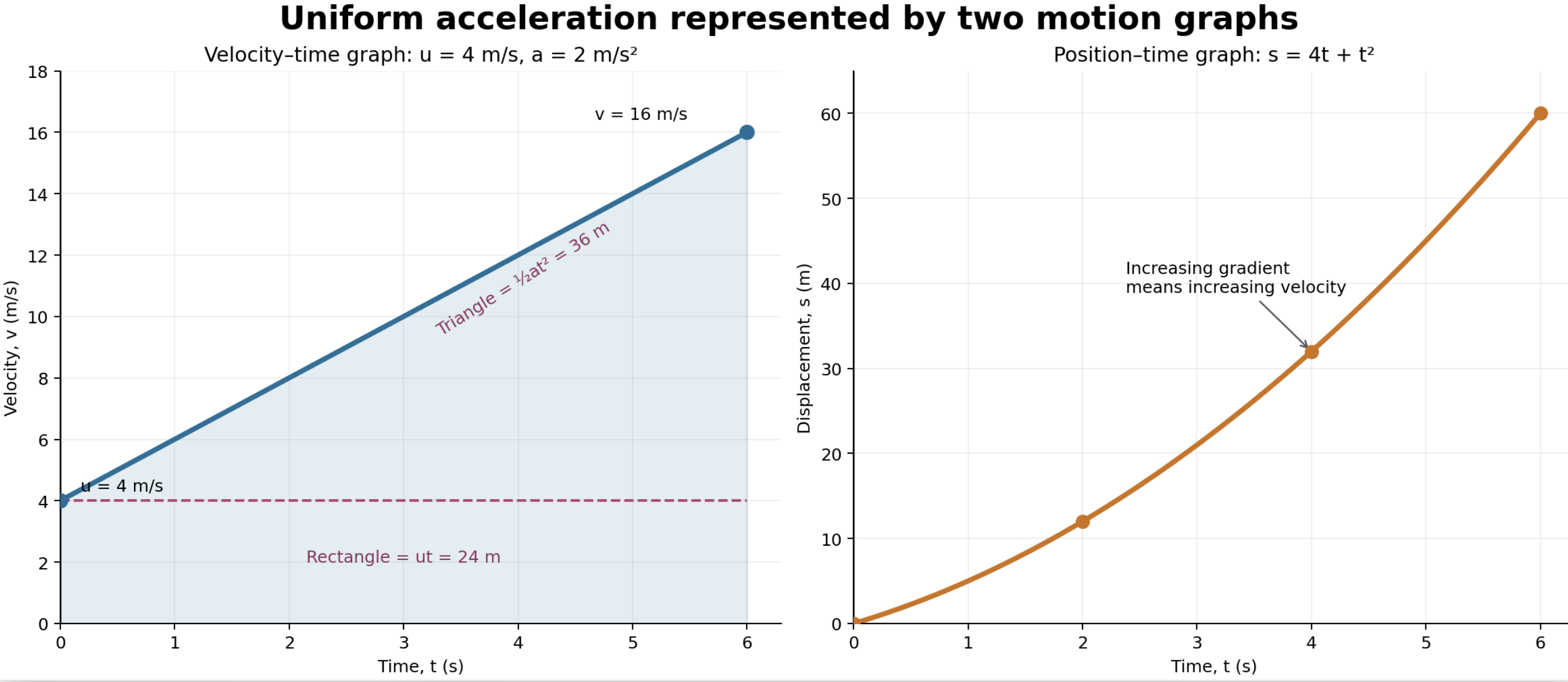
In this example:
u = 4 m/s
a = 2 m/s²
t = 6 s
The final velocity is:
v = u + at
v = 4 + 2(6)
v = 16 m/s
The displacement is the area under the velocity–time graph.
Rectangle:
ut = 4 × 6
ut = 24 m
Triangle:
½at² = ½ × 2 × 6²
½at² = 36 m
Total displacement:
s = 24 + 36
s = 60 m
The position–time graph curves upwards because its gradient, which represents velocity, continually increases.
Choosing the appropriate equation
A useful strategy is to identify the known variables and the unknown variable before selecting an equation.
| Equation | Variable absent |
|---|---|
| v = u + at | s |
| s = [(u + v)/2]t | a |
| s = ut + ½at² | v |
| v² = u² + 2as | t |
| s = vt − ½at² | u |
Choose an equation that contains:
- The quantity you need to find.
- The quantities you already know.
- As few additional unknowns as possible.
For example, if you know u, a and t and need v, use:
v = u + at
If you know u, v and a and need s, use:
v² = u² + 2as
This equation is especially useful when time is not known.
A reliable problem-solving method
Use the following method for each problem:
- Draw a simple diagram where useful.
- Choose a positive direction.
- List the known variables with signs and units.
- Identify the unknown variable.
- Select an equation containing those variables.
- Rearrange the equation if necessary.
- Substitute the values.
- Calculate and include the correct unit.
- Interpret the sign and physical meaning.
- Check whether the answer is reasonable.
Writing the variables first reduces the chance of choosing an unsuitable equation.
Worked example: finding final velocity
A car has an initial velocity of 8 m/s and accelerates uniformly at 3 m/s² for 5 seconds. Calculate its final velocity.
Known values:
u = 8 m/s
a = 3 m/s²
t = 5 s
v = ?
Choose:
v = u + at
Substitute:
v = 8 + 3(5)
v = 8 + 15
v = 23 m/s
The car’s velocity increases by 15 m/s during the five seconds, giving a final velocity of 23 m/s.


A straight test track provides a useful setting for one-dimensional acceleration problems. A real vehicle’s acceleration may vary, so the uniform model applies only over an interval where constant acceleration is a reasonable approximation.
Worked example: finding displacement
A cyclist travels at an initial velocity of 4 m/s and accelerates uniformly at 1.5 m/s² for 8 seconds. Calculate the displacement.
Known values:
u = 4 m/s
a = 1.5 m/s²
t = 8 s
s = ?
The final velocity is not required, so use:
s = ut + ½at²
Substitute:
s = 4(8) + ½(1.5)(8²)
s = 32 + 0.75(64)
s = 32 + 48
s = 80 m
The cyclist moves 80 m in the positive direction.
Worked example: finding acceleration
A train increases its velocity from 10 m/s to 22 m/s in 8 seconds. Calculate its acceleration.
Known values:
u = 10 m/s
v = 22 m/s
t = 8 s
a = ?
Use:
v = u + at
Rearrange:
a = (v − u)/t
Substitute:
a = (22 − 10)/8
a = 12/8
a = 1.5 m/s²
The train’s velocity increases by 1.5 m/s every second.
Worked example: finding time
A skateboarder accelerates uniformly from 3 m/s to 11 m/s at 2 m/s². Calculate the time taken.
Known values:
u = 3 m/s
v = 11 m/s
a = 2 m/s²
t = ?
Use:
v = u + at
Rearrange:
t = (v − u)/a
Substitute:
t = (11 − 3)/2
t = 8/2
t = 4 s
Worked example: when time is not known
A motorcycle moving at 12 m/s accelerates uniformly at 4 m/s² over a displacement of 40 m. Calculate its final velocity.
Known values:
u = 12 m/s
a = 4 m/s²
s = 40 m
v = ?
Time is not known, so use:
v² = u² + 2as
Substitute:
v² = 12² + 2(4)(40)
v² = 144 + 320
v² = 464
v = √464
v ≈ 21.5 m/s
Mathematically, taking a square root can produce positive and negative roots. In this situation, the motorcycle continues in the chosen positive direction, so the positive root is physically appropriate.
Worked example: uniform deceleration
A car travelling at 24 m/s brakes uniformly and stops in 6 seconds. Calculate its acceleration and braking displacement.
Choose the original direction of travel as positive.
Known values:
u = 24 m/s
v = 0 m/s
t = 6 s
Find the acceleration
Use:
v = u + at
Rearrange:
a = (v − u)/t
a = (0 − 24)/6
a = −4 m/s²
The negative sign shows that acceleration acts opposite to the original motion.
Find the braking displacement
Use average velocity:
s = [(u + v)/2]t
s = (24 + 0)/2
s = 12 × 6
s = 72 m
The car travels 72 m while braking.


Braking can often be approximated as uniform deceleration in introductory problems. Road conditions, tyres and braking systems cause real acceleration to vary.
Starting from rest
If an object begins from rest:
u = 0
The equations simplify.
Final velocity:
v = at
Displacement:
s = ½at²
Velocity and displacement:
v² = 2as
“Starts from rest” is important information and should immediately be recorded as u = 0.
Worked example
A trolley starts from rest and accelerates uniformly at 2.5 m/s² for 4 seconds.
Final velocity:
v = at
v = 2.5(4)
v = 10 m/s
Displacement:
s = ½at²
s = ½(2.5)(4²)
s = 1.25(16)
s = 20 m
Coming to rest
If an object stops at the end of an interval:
v = 0
“Comes to rest,” “stops,” and “reaches zero velocity” all indicate v = 0.
This does not mean that acceleration is zero during the stopping interval. A non-zero acceleration is required to change the velocity.
At the exact moment an object reaches zero velocity, it may still have non-zero acceleration.
Free fall as uniform acceleration
Near Earth’s surface, an object in free fall has an approximately constant downward acceleration:
g ≈ 9.8 m/s²
For simpler calculations, g may be rounded to 10 m/s².
An object is in free fall when gravity is the only significant force acting on it. Air resistance is ignored.


In a stroboscopic image, the increasing gaps between successive positions of a falling object show that its speed is increasing.
Choosing signs in vertical motion
If upward is chosen as positive:
a = −9.8 m/s²
If downward is chosen as positive:
a = +9.8 m/s²
Either choice works if it is used consistently.
Worked example: dropping an object
A stone is dropped from rest and falls for 3 seconds. Ignore air resistance and use g = 9.8 m/s². Choose downward as positive.
Known values:
u = 0 m/s
a = +9.8 m/s²
t = 3 s
Final velocity
v = u + at
v = 0 + 9.8(3)
v = 29.4 m/s downward
Displacement
s = ut + ½at²
s = 0 + ½(9.8)(3²)
s = 4.9(9)
s = 44.1 m downward
The velocity and displacement are both positive because downward was selected as the positive direction.
Worked example: throwing an object upwards
A ball is thrown vertically upwards at 19.6 m/s. Ignore air resistance. Find the time taken to reach its highest point.
Choose upward as positive.
Known values:
u = +19.6 m/s
v = 0 m/s at the highest point
a = −9.8 m/s²
t = ?
Use:
v = u + at
0 = 19.6 − 9.8t
9.8t = 19.6
t = 2.0 s
The ball takes 2.0 seconds to reach its highest point.
At that point:
- Its instantaneous velocity is zero.
- Its acceleration is still −9.8 m/s².
- It is about to begin moving downwards.
Finding maximum height
Using the same upward-thrown ball:
u = 19.6 m/s
v = 0 m/s
a = −9.8 m/s²
Time is not required, so use:
v² = u² + 2as
0² = 19.6² + 2(−9.8)s
0 = 384.16 − 19.6s
19.6s = 384.16
s = 19.6 m
The ball rises 19.6 m above its release point.
Problems with two possible times
Some displacement problems produce a quadratic equation and two mathematical solutions.
Worked example
A ball is thrown upwards from ground level at 20 m/s. Its height is modelled using g = 10 m/s²:
s = ut + ½at²
s = 20t − 5t²
Find when the ball is 15 m above the ground:
15 = 20t − 5t²
Rearrange:
5t² − 20t + 15 = 0
Divide by 5:
t² − 4t + 3 = 0
Factorize:
(t − 1)(t − 3) = 0
Therefore:
t = 1 s or t = 3 s
Both solutions are physically meaningful:
- At 1 second, the ball passes 15 m while rising.
- At 3 seconds, it passes 15 m again while falling.
A complete answer must interpret both solutions.
Interpreting negative time solutions
A quadratic equation may also produce a negative time.
Suppose a problem asks what happens after t = 0. A solution such as t = −2 s refers to a time before the chosen starting moment and is normally rejected for that context.
Do not reject a solution simply because it is negative. First identify what the sign represents:
- Negative time may lie outside the modelled interval.
- Negative velocity may indicate direction.
- Negative displacement may indicate a final position in the negative direction.
- Negative acceleration may indicate acceleration in the negative direction.
Interpret each sign using the problem’s coordinate system.
Multi-stage motion
A single kinematic equation applies only while acceleration is constant.
If acceleration changes, divide the journey into stages.
For example, a car may:
- Accelerate at 2 m/s² for 5 seconds.
- Travel at constant velocity for 10 seconds.
- Decelerate at −4 m/s² until stopping.
For each stage:
- The final velocity of one stage becomes the initial velocity of the next.
- Calculate the displacement separately.
- Add displacements algebraically to find total displacement.
- Add distance magnitudes when total distance is required.
- Add the stage times to find total time.
Do not apply one constant-acceleration equation across the whole journey unless acceleration is constant throughout it.
Dimensional checks
Units can help verify an equation.
For:
s = ut + ½at²
The term ut has units:
(m/s)(s) = m
The term at² has units:
(m/s²)(s²) = m
Both terms have units of displacement, so they can be added.
For:
v² = u² + 2as
Each term has units:
m²/s²
A proposed equation such as v = u + as would be invalid because u and as have different units.
Checking whether an answer is reasonable
Check the direction
Does the sign match the direction described in the problem?
Check the size
An object accelerating at 2 m/s² for 3 seconds changes velocity by 6 m/s. A calculated change of 60 m/s probably contains an error.
Check the limiting case
If a = 0:
v = u + at becomes v = u
s = ut + ½at² becomes s = ut
The equations reduce correctly to constant-velocity motion.
Substitute into another equation
If enough information is available, verify the result using a second kinematic equation.
Compare with a graph
Uniform acceleration should produce:
- A straight velocity–time graph.
- A horizontal acceleration–time graph.
- A curved position–time graph.
Common misconceptions
- “Uniform acceleration means constant velocity.” It means velocity changes at a constant rate.
- “Negative acceleration always means slowing down.” Compare the directions of velocity and acceleration.
- “The final velocity is always greater than the initial velocity.” It may be smaller or have the opposite sign.
- “An object at rest has no acceleration.” It may have zero velocity at one instant while still accelerating.
- “Every answer from a quadratic equation is physically meaningful.” Check the time interval and context.
- “The equations work for any changing motion.” They require constant acceleration.
- “Displacement and distance are interchangeable.” Displacement includes direction and can be negative.
- “A negative result must be wrong.” It often communicates direction.
Did you know?
The equation:
s = ut + ½at²
shows that displacement depends on the square of time when acceleration is constant.
For an object starting from rest, doubling the time makes the displacement four times as large:
s = ½a(2t)²
s = 4(½at²)
This is why the gaps between successive positions of a freely falling object become increasingly large.
Key terms
- Uniformly accelerated motion: Motion with constant acceleration.
- Initial velocity: Velocity at the beginning of an interval, represented by u.
- Final velocity: Velocity at the end of an interval, represented by v.
- Displacement: Change in position, represented by s or Δx.
- Acceleration: Rate of change of velocity, represented by a.
- Time interval: Elapsed time during the motion, represented by t.
- SUVAT equations: Equations connecting displacement, initial velocity, final velocity, acceleration and time.
- Free fall: Motion in which gravity is the only significant force.
- Average velocity: Total displacement divided by total time.
- Sign convention: A consistent choice of positive and negative directions.
- Physical solution: A mathematical answer that fits the conditions of the situation.
Key takeaways
- Uniform acceleration means acceleration remains constant.
- List the SUVAT variables before selecting an equation.
- Choose the equation that contains the known values and required unknown.
- Use positive and negative signs consistently to represent direction.
- Uniform acceleration produces a straight velocity–time graph.
- The area under a velocity–time graph gives displacement.
- Free fall is approximately uniform acceleration when air resistance is ignored.
- Divide changing motion into stages when acceleration is not constant.
- Interpret every solution using its sign, units and physical context.