Atomic Energy Levels and Transitions
2. Emission Spectra
Learning Outcomes
- I can explain how emission spectra are produced.
- I can identify the characteristics of line spectra.
- I can describe the hydrogen emission spectrum.
- I can explain why different elements have unique spectra.
- I can use spectra to identify elements.
- Bohr’s model of the atom
- Energy level diagrams
Quantization of Atomic Energy Levels ⚛️🔢
The concept of quantized energy levels is a fundamental principle of quantum mechanics. It explains why electrons in an atom can only occupy specific energy states and why atoms emit or absorb discrete spectral lines. Let’s explore this in depth! 🔍✨
1. What Does "Quantization" Mean? 📌
🔹 In classical physics, energy is continuous—an object can have any amount of energy.
🔹 In quantum mechanics, atomic energy levels are discrete (quantized)—electrons cannot exist between energy levels.
📌 Key Concept:
- Electrons in atoms can only occupy specific energy states ().
- They cannot have energy values in between these states.
- Electrons move between these levels by absorbing or emitting photons of exact energy.
🔹 Analogy: Imagine climbing a ladder. You can stand on specific steps, but you cannot hover between them—this is how electron energy levels work! 🔢
2. The Energy Levels of Hydrogen ⚛️
The allowed energy levels of a hydrogen atom are given by the Bohr Model equation:
where:
✅
= Energy of the electron in level
(electron volts, eV).
✅
= Principal quantum number (
).
✅
eV = Energy required to ionize hydrogen (ground state energy).
📌 Key Observations:
- The ground state () has the lowest energy ( eV).
- Higher energy levels () are less negative, meaning electrons are less bound to the nucleus.
- Energy gaps get smaller as increases.
🔹 Example: An electron in hydrogen can move from
to
, but it cannot exist at
!
3. Electron Transitions & Photon Emission 🌈
1️⃣ Absorption: Moving to a Higher Level 📥
- Electrons absorb energy (photon) to jump to a higher energy level.
- The photon must have exactly the right energy ().
- Example: An electron in hydrogen absorbs a 10.2 eV photon to jump from to.
2️⃣ Emission: Falling to a Lower Level 📤
- Electrons release energy as photons when they move to lower energy levels.
- The emitted photon’s energy matches the difference between energy levels.
- Example: A hydrogen electron drops from to, emitting a red photon (656 nm, Balmer series).
📌 Key Insight:
- Different elements have unique energy levels, leading to distinct atomic spectra.
4. Quantum Mechanics & Energy Quantization 🔬
1️⃣ The Bohr Model ⚛️
- Proposed by Niels Bohr, this model introduced quantized orbits.
- Explained hydrogen’s emission spectrum but failed for multi-electron atoms.
2️⃣ The Quantum Mechanical Model 🌌
- Modern quantum theory describes electrons as wavefunctions (not orbits).
- Energy levels are quantized due to the wave nature of electrons (Schrödinger Equation).
- Electrons exist in orbitals (probability regions) rather than fixed paths.
📌 Key Takeaway: Quantization arises because electron waves must fit perfectly within orbitals—just like a guitar string only vibrates at certain frequencies! 🎸
5. Real-World Applications 🌍
✅ Astronomy 🔭 – Identifying elements in stars using spectral lines.
✅ Lasers & LEDs 💡 – Controlled photon emissions power modern technology.
✅ Quantum Computing 🖥️ – Uses quantized energy levels for data processing.
✅ Medical Imaging 🏥 – MRI scans rely on atomic energy transitions.
📊 Understanding quantized energy levels helps us explore the universe and develop cutting-edge technology! 🚀✨
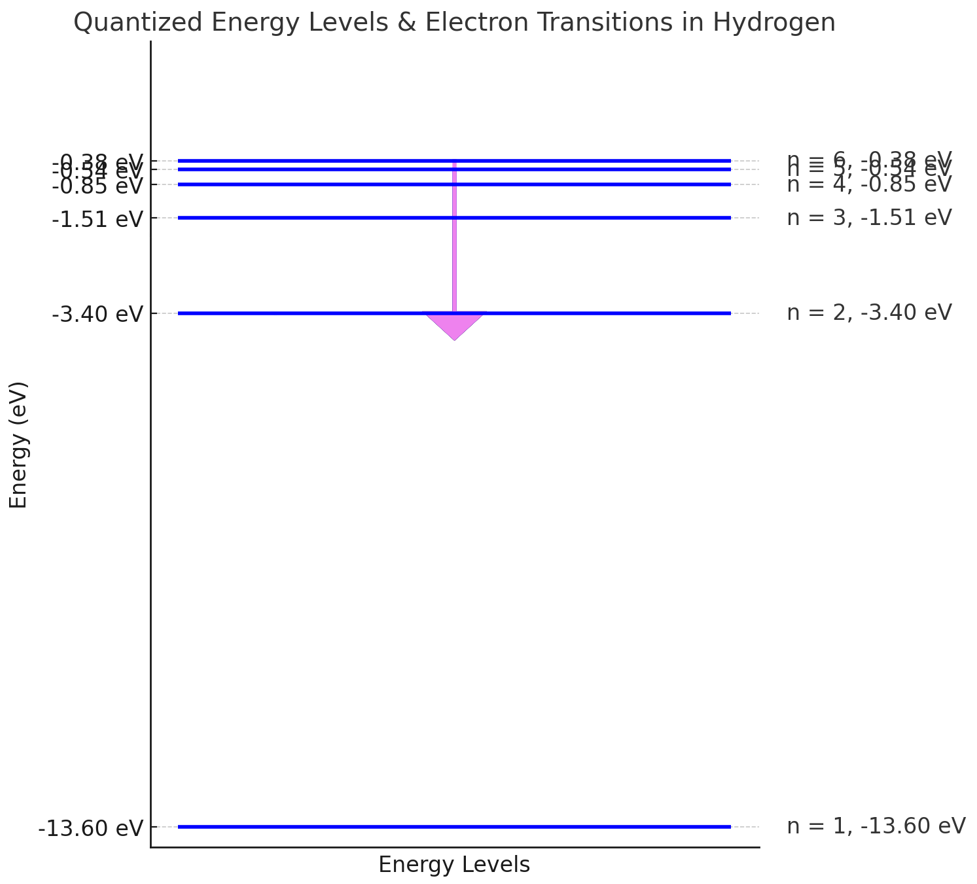
Visual Representation of Quantized Energy Levels & Electron Transitions ⚛️🌈
This diagram shows the discrete (quantized) energy levels of the hydrogen atom and how electrons transition between them. Let’s analyze it! 🔍✨
1. Understanding the Diagram 📊
🔹 Blue horizontal lines represent energy levels where electrons can exist:
- (Ground State): eV (Lowest energy, most stable).
- (Excited States): Higher energy, less stable.
🔹 Colored arrows show electron transitions:
- Electrons fall from higher levels (n = 3,4,5,6) to → Balmer series (visible spectrum).
- Different transitions emit different colors of light (red, green, blue, violet).
📌 Key Concept:
- Larger jumps = More energy emitted (shorter wavelength, higher frequency).
- Smaller jumps = Less energy emitted (longer wavelength, lower frequency).
2. Key Takeaways About Energy Quantization 📌
✅ Electrons can only occupy specific energy levels (no in-between states).
✅ Absorbing a photon moves an electron up; emitting a photon moves it down.
✅ Each transition corresponds to a specific photon energy (color of light).
3. Real-World Applications 🌍
✅ Astronomy 🔭 – Identifying star compositions from spectral lines.
✅ Quantum Mechanics ⚛️ – Explains why atoms absorb/emit specific energies.
✅ Lasers & Electronics 💡 – Utilize electron transitions for light emission.
📊 Understanding quantized energy levels allows us to explore the universe and power modern technology! 🚀✨
Activities:
- Problem-solving on energy level transitions
- Diagramming the energy levels of hydrogen
Assessment:
- Short quiz on Bohr’s model and quantization
Quantization of Atomic Energy Levels
The concept of energy quantization in atoms stems from the understanding that electrons cannot occupy arbitrary energy states but are instead restricted to specific, discrete energy levels. This idea was first proposed by Niels Bohr in 1913 as part of his atomic model, which addressed limitations in classical physics. Bohr suggested that electrons orbit the nucleus in distinct energy states and can only transition between these levels by absorbing or emitting a quantum of energy, typically in the form of a photon.
Discrete Energy Levels
In an atom, the energy of an electron depends on its distance from the nucleus. The closer an electron is to the nucleus, the lower its energy due to the attractive electrostatic force between the negatively charged electron and the positively charged nucleus. Bohr’s model introduced the idea that only certain orbits, corresponding to specific energy levels, are allowed. These energy levels are quantized, meaning that their values are discrete rather than continuous.
For the hydrogen atom, the energy of each level is given by the formula:
where
is the principal quantum number (an integer:
). The negative sign indicates that the electron is bound to the nucleus, with lower values of
corresponding to more tightly bound states.
Absorption and Emission of Photons
When an electron transitions from one energy level to another, it must absorb or emit energy equal to the difference between the two levels. If the electron jumps to a higher energy level, it absorbs a photon, and if it falls to a lower level, it emits a photon. The energy of the photon is given by:
This principle explains the discrete spectral lines observed in atomic emission and absorption spectra, such as the Balmer series for hydrogen. Each line corresponds to a specific electron transition between quantized energy levels.
Quantum Mechanics and Wave Functions
The development of quantum mechanics further refined the understanding of atomic energy levels. Instead of classical orbits, electrons are described by wave functions, which represent the probability of finding an electron in a given region of space. The solutions to the Schrödinger equation for an atom reveal that only certain energy states are allowed, corresponding to specific wave functions. These states are characterized by quantum numbers, which determine properties like energy, angular momentum, and spin.
Sublevels and Orbitals
In multi-electron atoms, energy levels are divided into sublevels (or subshells), which are further split into orbitals. The principal quantum number
defines the main energy level, while the azimuthal quantum number
defines the sublevel (e.g.,
,
,
,
). Each sublevel has a unique shape and can hold a specific number of electrons. These sublevels introduce additional complexity but still adhere to the principle of quantization.
Pauli Exclusion Principle and Electron Configuration
The Pauli exclusion principle states that no two electrons in an atom can have the same set of quantum numbers. This principle helps explain how electrons fill energy levels and sublevels in a specific order, following the Aufbau principle. The quantized nature of these levels ensures that each element has a unique electron configuration, which determines its chemical and physical properties.
Applications of Quantization
The quantization of energy levels has profound implications for fields such as spectroscopy, quantum chemistry, and laser technology. By analyzing the spectral lines emitted or absorbed by atoms, scientists can identify elements, measure temperatures, and study the composition of distant stars. Additionally, the principles of energy quantization underlie technologies like LEDs and quantum computing.
Conclusion
The quantization of atomic energy levels provides a foundational framework for modern atomic theory and quantum mechanics. It explains the discrete nature of atomic spectra, governs electron behavior in atoms, and underpins much of our understanding of matter at the microscopic level. This concept not only resolved the shortcomings of classical physics but also paved the way for groundbreaking advancements in science and technology.