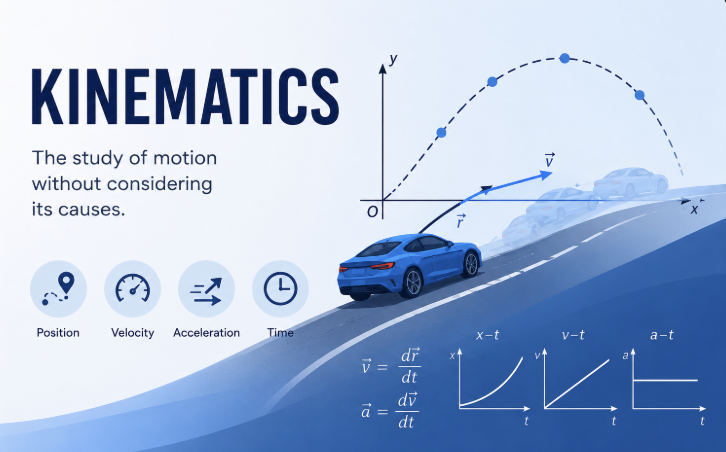
Motion is one of the most fundamental concepts in physics. From a runner sprinting down a track to a spacecraft traveling through the Solar System, kinematics provides the tools needed to describe and analyze how objects move. In this course, students will explore the physics of motion by investigating distance, displacement, speed, velocity, acceleration, motion graphs, equations of motion, and projectile motion. By learning how to describe motion mathematically and visually, students will develop a deeper understanding of the physical world and the principles that govern movement.
The course begins by examining how motion is described using reference frames, distance, displacement, speed, and velocity. Students then explore acceleration and learn how changes in velocity affect motion. Building on these concepts, they will analyze and interpret motion graphs, using graphical techniques to understand the behavior of moving objects. The course then introduces the equations of motion, allowing students to solve increasingly complex kinematics problems involving constant velocity and constant acceleration. Finally, students will apply their knowledge to two-dimensional motion, including vectors, free fall, and projectile motion.
Throughout the course, students will investigate real-world examples drawn from transportation, sports, engineering, and space exploration. Emphasis is placed on problem-solving, graphical analysis, and the application of mathematical models to physical situations. By the end of the course, students will be able to describe, predict, and analyze motion using the same tools employed by physicists, engineers, and scientists.
Main Topics
- Describing Motion
Learn how reference frames, distance, displacement, speed, and velocity are used to describe the movement of objects. - Acceleration
Explore how velocity changes over time and investigate the causes and effects of acceleration and deceleration. - Motion Graphs
Interpret and analyze distance-time and velocity-time graphs to reveal patterns and relationships in motion. - Equations of Motion
Apply mathematical models to solve problems involving constant velocity and uniformly accelerated motion. - Two-Dimensional Motion
Investigate vectors, free fall, projectile motion, and the motion of objects moving through two dimensions.
Perfect for: High school physics students, IB Physics learners, AP Physics students, homeschoolers, and anyone seeking a strong foundation in the physics of motion.
- Giáo viên: Mr. Young