Two-Dimensional Motion
1. Vectors in Motion
Learning outcomes
- I can distinguish between scalar and vector quantities.
- I can represent vectors using magnitude and direction.
- I can add and subtract vectors graphically.
- I can resolve vectors into horizontal and vertical components.
- I can apply vector concepts to displacement, velocity, and acceleration.
Scalars and vectors
Physical quantities can be classified as scalars or vectors.
A scalar quantity has magnitude only.
A vector quantity has both magnitude and direction.
Magnitude describes the size or amount of a quantity. For example, a velocity might have a magnitude of 12 m/s.
| Scalar quantities | Vector quantities |
|---|---|
| Distance | Displacement |
| Speed | Velocity |
| Time | Acceleration |
| Mass | Force |
| Temperature | Momentum |
| Energy | Weight |
A scalar can usually be described with a number and a unit:
Speed = 12 m/s
A vector also requires direction:
Velocity = 12 m/s east
Direction is essential. Two objects travelling at 12 m/s in opposite directions have equal speeds but different velocities.
Distance and displacement
Distance is the total length of the path travelled. It is a scalar.
Displacement is the change in position from the starting point to the finishing point. It is a vector.
Imagine a student walking:
- 5 m east.
- Then 2 m west.
Total distance:
d = 5 + 2
d = 7 m
Taking east as positive, displacement is:
s = +5 − 2
s = +3 m
The student’s displacement is 3 m east.
Distance depends on the complete path. Displacement depends only on the initial and final positions.


A winding route may have a large distance but a much smaller displacement between its starting and finishing points.
Speed and velocity
Speed describes how quickly distance is travelled:
Average speed = total distance/total time
Velocity describes how quickly displacement changes:
Average velocity = displacement/time
Speed is scalar. Velocity is vector.
Worked example
A runner completes one 400 m lap in 80 seconds and finishes at the starting line.
Average speed:
Average speed = 400/80
Average speed = 5 m/s
The runner’s displacement is zero, so:
Average velocity = 0/80
Average velocity = 0 m/s
The runner was moving throughout the lap, but the average velocity is zero because the final position equals the initial position.
Representing a vector
A vector can be represented using an arrow.
The arrow shows:
- Length: The vector’s magnitude according to a chosen scale.
- Arrowhead: The vector’s direction.
- Orientation: The line along which the vector acts.
For example, a scale diagram might use:
1 cm represents 5 m/s
A velocity of 15 m/s east would be drawn as a 3 cm arrow pointing east.
A velocity of 10 m/s north would be drawn as a 2 cm arrow pointing north.
The scale must be stated so that the vector’s magnitude can be recovered from the diagram.
Describing vector directions
Vectors can be described using compass directions:
- North.
- South.
- East.
- West.
- Northeast and other combinations.
They can also be described using angles:
- 30° north of east.
- 20° west of north.
- A bearing of 065°.
- 40° above the horizontal.
30° north of east means begin facing east and rotate 30° towards north.
30° east of north means begin facing north and rotate 30° towards east.
These descriptions are not equivalent.
Vector notation
Vectors may be written using:
- A bold symbol, such as v.
- A symbol with an arrow above it.
- Component notation, such as ⟨vₓ, vᵧ⟩.
The magnitude of a vector may be written as:
|v|
For example, if:
v = ⟨6, 8⟩ m/s
then its magnitude is:
|v| = √(6² + 8²)
|v| = √100
|v| = 10 m/s
The vector and its magnitude are different:
- v includes direction.
- |v| is a non-negative scalar.
Adding vectors
When several vectors act in sequence, they can be combined to find a resultant vector.
The resultant has the same overall effect as the original vectors together.
For displacement:
Resultant displacement = displacement₁ + displacement₂ + …
For velocity:
Resultant velocity = velocity₁ + velocity₂ + …
Vector addition must account for direction.
Head-to-tail addition
To add vectors graphically:
- Choose and state a scale.
- Draw the first vector accurately.
- Place the tail of the second vector at the head of the first.
- Continue this process for any additional vectors.
- Draw the resultant from the tail of the first vector to the head of the final vector.
- Measure the resultant’s length and direction.
The vectors can be added in either order without changing the resultant:
A + B = B + A
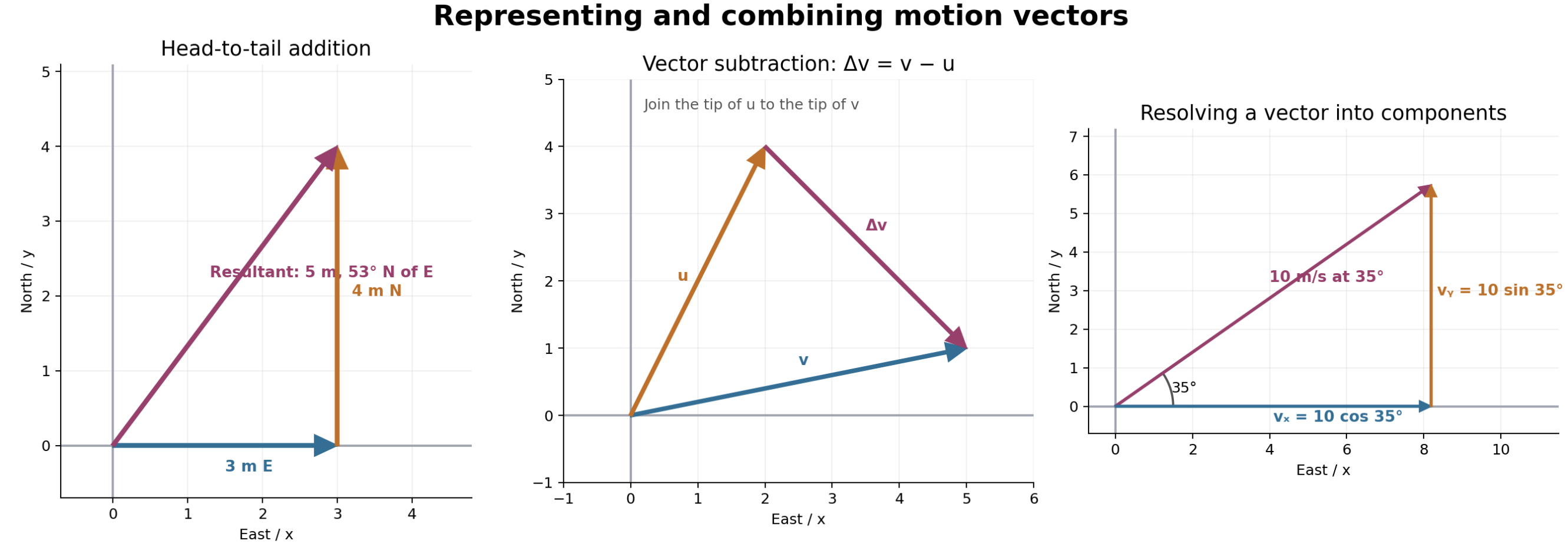
The first diagram shows a 3 m eastward displacement followed by a 4 m northward displacement. The resultant is the diagonal vector from the starting point to the finishing point.
Worked example: perpendicular displacements
A person walks 3 m east and then 4 m north.
These displacements form a right-angled triangle.
Use the Pythagorean theorem to find the resultant magnitude:
R² = 3² + 4²
R² = 9 + 16
R = 5 m
Find the angle measured north of east:
tan θ = opposite/adjacent
tan θ = 4/3
θ = tan⁻¹(4/3)
θ ≈ 53°
The resultant displacement is:
5 m at 53° north of east
The total distance travelled is 7 m, while the displacement magnitude is 5 m.
Adding vectors in the same dimension
Vectors acting along one straight line can be added using positive and negative signs.
Choose right as positive.
Worked example
A trolley moves:
- 12 m right.
- Then 5 m left.
- Then 3 m right.
Write the displacements with signs:
s₁ = +12 m
s₂ = −5 m
s₃ = +3 m
Add them:
s = 12 − 5 + 3
s = +10 m
The resultant displacement is 10 m to the right.
The total distance is:
d = 12 + 5 + 3
d = 20 m
Adding non-perpendicular vectors graphically
When vectors are not perpendicular, they can still be added using a scale diagram.
For example, to add:
- 8 m east.
- 6 m at 40° north of east.
Draw the first vector, then place the second vector head-to-tail at the correct angle. Draw and measure the resultant.
The accuracy depends on:
- The size of the scale drawing.
- Accurate angle measurement.
- Thin, precise lines.
- Careful measurement of the resultant.
A large scale usually produces a more accurate answer.
For exact results, vectors can be resolved into components and added algebraically.
Subtracting vectors
Vector subtraction can be rewritten as addition of the opposite vector:
A − B = A + (−B)
The vector −B has the same magnitude as B but points in the opposite direction.
To subtract graphically:
- Draw vector A.
- Reverse vector B to obtain −B.
- Add A and −B using the head-to-tail method.
If vectors A and B are drawn from the same origin, A − B is the vector from the head of B to the head of A.
Change in velocity
Acceleration depends on the change in velocity:
a = Δv/Δt
The change in velocity is:
Δv = v − u
Because velocity is a vector, this subtraction must account for direction.
Worked example: straight-line velocity change
A car’s velocity changes from +5 m/s to +17 m/s in 4 seconds.
Δv = v − u
Δv = 17 − 5
Δv = +12 m/s
a = 12/4
a = +3 m/s²
Worked example: reversing direction
A ball’s velocity changes from +6 m/s to −4 m/s in 2 seconds.
Δv = v − u
Δv = −4 − (+6)
Δv = −10 m/s
a = −10/2
a = −5 m/s²
The velocity did not change by only 2 m/s. The object passed through zero velocity and reversed direction.
Direction changes create acceleration
An object can accelerate even when its speed remains constant.
Suppose a car travels around a circular track at a constant speed. Its direction changes continuously, so its velocity changes continuously.
Therefore, the car accelerates even though its speedometer reading may remain constant.


In circular motion, instantaneous velocity is tangent to the path, while acceleration points towards the centre of the circle.
Resolving vectors into components
To resolve a vector means to separate it into perpendicular components.
In two-dimensional motion, these are usually:
- A horizontal component.
- A vertical component.
The components combine to produce the original vector.
For a vector V making an angle θ above the positive horizontal:
Vₓ = V cos θ
Vᵧ = V sin θ
These equations apply when θ is measured from the horizontal.
If the angle is measured from the vertical, the sine and cosine relationships exchange roles. A diagram helps prevent mistakes.
Worked example: resolving velocity
An object moves at 10 m/s at 35° above the horizontal.
Horizontal component:
vₓ = v cos θ
vₓ = 10 cos 35°
vₓ ≈ 8.19 m/s
Vertical component:
vᵧ = v sin θ
vᵧ = 10 sin 35°
vᵧ ≈ 5.74 m/s
The velocity can be written in component form:
v = ⟨8.19, 5.74⟩ m/s
These components act together. They do not represent two separate velocities occurring at different times.
Reconstructing a vector from components
If the components are known, use the Pythagorean theorem to find the magnitude:
V = √(Vₓ² + Vᵧ²)
Find its direction using:
tan θ = Vᵧ/Vₓ
Therefore:
θ = tan⁻¹(Vᵧ/Vₓ)
Worked example
A drone’s velocity components are:
vₓ = 12 m/s east
vᵧ = 5 m/s north
Magnitude:
v = √(12² + 5²)
v = √169
v = 13 m/s
Direction:
θ = tan⁻¹(5/12)
θ ≈ 22.6°
The drone’s velocity is:
13 m/s at 22.6° north of east
Always check the signs of the components to determine the correct quadrant.
Signs and quadrants
If east and north are positive:
| Direction | Horizontal component | Vertical component |
|---|---|---|
| Northeast | Positive | Positive |
| Northwest | Negative | Positive |
| Southwest | Negative | Negative |
| Southeast | Positive | Negative |
A calculator’s inverse tangent may return an angle that does not identify the correct quadrant. Inspect the component signs and describe the direction clearly.
For example:
vₓ = −6 m/s
vᵧ = +8 m/s
The vector points northwest.
Its magnitude is:
v = √[(−6)² + 8²]
v = 10 m/s
The reference angle is:
θ = tan⁻¹(8/6)
θ ≈ 53°
A clear direction is:
53° north of west
Adding vectors using components
Component addition is often more accurate than a scale drawing.
To add several vectors:
- Resolve each vector into horizontal and vertical components.
- Add all horizontal components.
- Add all vertical components.
- Reconstruct the resultant magnitude and direction.
Rₓ = Aₓ + Bₓ + …
Rᵧ = Aᵧ + Bᵧ + …
Then:
R = √(Rₓ² + Rᵧ²)
Worked example: adding angled displacements
A hiker walks:
- 6.0 km east.
- Then 4.0 km at 30° north of east.
Resolve the second displacement:
Bₓ = 4.0 cos 30°
Bₓ ≈ 3.46 km
Bᵧ = 4.0 sin 30°
Bᵧ = 2.00 km
Add components:
Rₓ = 6.0 + 3.46
Rₓ = 9.46 km
Rᵧ = 0 + 2.00
Rᵧ = 2.00 km
Magnitude:
R = √(9.46² + 2.00²)
R ≈ 9.67 km
Direction:
θ = tan⁻¹(2.00/9.46)
θ ≈ 11.9°
The resultant displacement is approximately:
9.67 km at 11.9° north of east
Vectors in projectile motion
Projectile motion can be analyzed by separating the velocity into horizontal and vertical components.
If air resistance is ignored:
- Horizontal acceleration is zero.
- Horizontal velocity remains constant.
- Vertical acceleration is caused by gravity.
- Horizontal and vertical motion occur during the same time interval.


The horizontal and vertical components change differently during flight, but together they produce the projectile’s curved path.
Worked example: initial projectile components
A ball is kicked at 20 m/s at 40° above the horizontal.
Horizontal component:
uₓ = 20 cos 40°
uₓ ≈ 15.3 m/s
Vertical component:
uᵧ = 20 sin 40°
uᵧ ≈ 12.9 m/s
Ignoring air resistance:
- The horizontal velocity remains approximately 15.3 m/s.
- The vertical velocity decreases as gravity acts downwards.
- At the highest point, vertical velocity is zero.
- The ball still has horizontal velocity at the highest point.
The total velocity is not zero at the top of the trajectory.
Relative velocity
Relative velocity describes the velocity of one object as observed from another moving object.
For objects A and B:
vₐ relative to B = vₐ − vᵦ
Worked example: vehicles moving in the same direction
Car A travels east at 25 m/s. Car B travels east at 18 m/s.
Velocity of A relative to B:
vₐᵦ = 25 − 18
vₐᵦ = 7 m/s east
A passenger in B sees A move forwards at 7 m/s.
Worked example: vehicles moving in opposite directions
Car A travels east at +25 m/s. Car B travels west at −18 m/s.
Velocity of A relative to B:
vₐᵦ = 25 − (−18)
vₐᵦ = 43 m/s east
Their separation changes at 43 m/s.
Relative velocity with wind and water
A boat’s velocity relative to the water combines with the water’s velocity relative to the ground.
Boat velocity relative to ground = boat velocity relative to water + water velocity relative to ground
The same principle applies to aircraft and wind.


Pilots and boat operators must account for the motion of the air or water to reach the intended destination.
Worked example: boat crossing a river
A boat moves north through the water at 4 m/s. The river current flows east at 3 m/s.
The velocity components relative to the ground are:
vₓ = 3 m/s east
vᵧ = 4 m/s north
Magnitude:
v = √(3² + 4²)
v = 5 m/s
Direction:
θ = tan⁻¹(3/4)
θ ≈ 36.9° east of north
The boat’s ground velocity is 5 m/s at 36.9° east of north.
If the river is 80 m wide, the crossing time depends on the northward component:
t = 80/4
t = 20 s
During that time, the current carries the boat east:
sₓ = 3(20)
sₓ = 60 m
The total speed of 5 m/s should not be used to calculate the crossing time because only the northward component carries the boat across the river.
Acceleration as a vector
Acceleration describes the change in the velocity vector:
a = Δv/Δt
Because velocity has magnitude and direction, acceleration may result from:
- A change in speed.
- A change in direction.
- Changes in both speed and direction.
Acceleration can also be resolved into components:
a = ⟨aₓ, aᵧ⟩
For projectile motion without air resistance:
aₓ = 0
aᵧ = −g, if upward is positive
For circular motion, acceleration points towards the centre of the path.
Multiplying vectors by time
For constant velocity:
s = vt
Multiplying a velocity vector by a positive time interval produces a displacement vector in the same direction.
For example:
v = ⟨4, 3⟩ m/s
t = 5 s
Then:
s = ⟨4, 3⟩(5)
s = ⟨20, 15⟩ m
The displacement magnitude is:
|s| = √(20² + 15²)
|s| = 25 m
Its direction is:
θ = tan⁻¹(15/20)
θ ≈ 36.9° north of east
Vector diagrams and scale
A high-quality vector diagram should include:
- A stated scale.
- Clearly labelled vectors.
- Arrowheads showing direction.
- Accurate angles.
- Suitable units.
- The resultant beginning and ending at the correct points.
When solving graphically, do not calculate the resultant by adding the arrow lengths unless the vectors point along the same line in the same direction.
A graphical answer is usually approximate. Component calculations can produce a more precise result.
Common misconceptions
- “A vector is any quantity with a positive or negative sign.” A vector has both magnitude and direction.
- “Distance and displacement are always equal.” They are equal only for suitable one-direction paths.
- “Speed and velocity are interchangeable.” Velocity includes direction.
- “Vectors are added by adding their magnitudes.” Direction must be considered.
- “The resultant is drawn by joining the two arrowheads.” For head-to-tail addition, it runs from the first tail to the final head.
- “Sine always gives the vertical component.” This depends on where the angle is measured.
- “At the top of a projectile’s path, velocity is zero.” Only its vertical velocity is zero if horizontal motion continues.
- “Constant speed means zero acceleration.” A changing direction produces acceleration.
- “A negative vector has a negative magnitude.” Magnitude is non-negative; the sign indicates direction along an axis.
Did you know?
Air-traffic controllers use vector calculations to separate an aircraft’s motion through the air from the motion of the surrounding air mass.
An aircraft may point in one direction while travelling over the ground in another direction because crosswind changes its resultant velocity.
Key terms
- Scalar: A quantity with magnitude only.
- Vector: A quantity with magnitude and direction.
- Magnitude: The size of a scalar or vector quantity.
- Direction: The orientation in which a vector acts.
- Resultant vector: A single vector with the same effect as two or more combined vectors.
- Component: Part of a vector acting along a selected axis.
- Head-to-tail method: A graphical method of adding vectors sequentially.
- Resolution: The process of separating a vector into perpendicular components.
- Relative velocity: The velocity of one object measured from the viewpoint of another.
- Displacement: Change in position, including direction.
- Projectile: An object moving under gravity after being launched.
- Trajectory: The path followed by a moving object.
Key takeaways
- Scalars have magnitude; vectors have magnitude and direction.
- Distance and speed are scalars, while displacement, velocity and acceleration are vectors.
- Represent a vector with a scaled arrow.
- Add vectors using the head-to-tail method or components.
- Subtract a vector by adding its opposite.
- Use cosine and sine to find components when the angle is measured from the horizontal.
- Add horizontal components separately from vertical components.
- Reconstruct magnitude using the Pythagorean theorem.
- Changes in speed or direction both produce acceleration.
- Vector methods are essential for projectiles, navigation and relative motion.