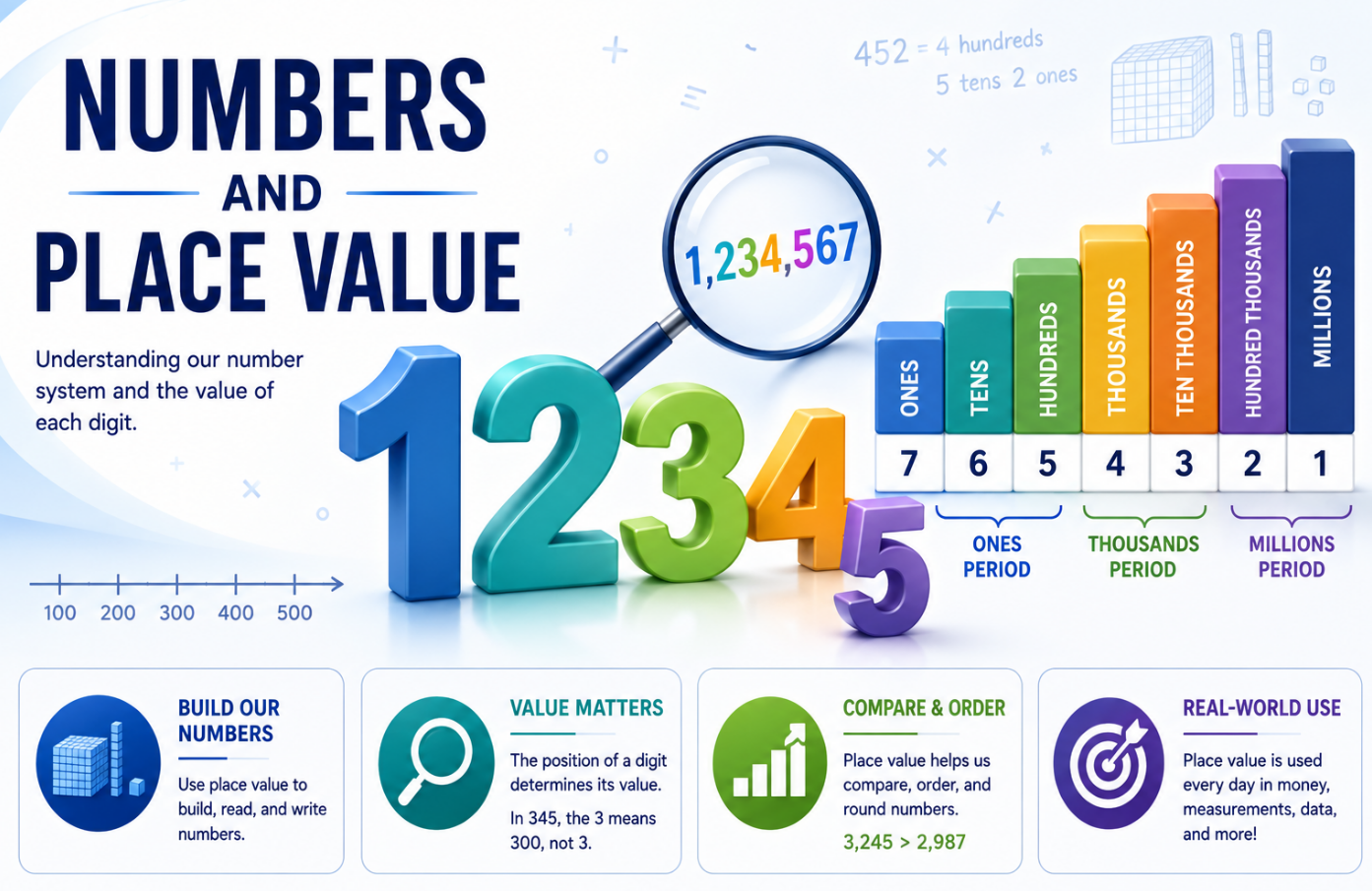
Numbers are the foundation of mathematics. Whether measuring distance, calculating money, interpreting scientific data, or solving complex problems, every mathematical concept begins with an understanding of numbers and how they are represented. In this course, students will develop a strong foundation in number sense by exploring place value, whole numbers, decimals, integers, and scientific notation. Through hands-on examples and real-world applications, students will learn how our number system works and how numbers can be used to describe and understand the world around us.
The course begins by introducing the structure of the base-ten number system and the importance of place value. Students will learn to read, write, compare, order, and round numbers while developing a deeper understanding of how the value of a digit depends on its position. They will then explore whole number operations and strategies for efficient calculation. Building on these skills, students will extend their understanding to decimals and learn how place value continues beyond the decimal point.
As the course progresses, students will investigate positive and negative numbers, factors and multiples, prime numbers, and important number relationships. Finally, they will explore powers of ten and scientific notation, allowing them to work confidently with extremely large and extremely small numbers commonly encountered in science, engineering, and technology.
Throughout the course, students will strengthen their number sense, improve their estimation skills, and develop confidence in working with numerical information. These skills provide the foundation for future learning in fractions, algebra, geometry, statistics, and advanced mathematics.
Main Topics
Unit 1: Understanding Our Number System
Explore place value, number representations, rounding, estimation, and patterns within the base-ten system.
Unit 2: Whole Numbers and Operations
Develop fluency with whole number calculations, mental math strategies, multiplication, division, and number properties.
Unit 3: Decimals and Place Value Extensions
Extend place value concepts beyond whole numbers and apply decimal operations in real-world contexts.
Unit 4: Integers and Number Relationships
Investigate positive and negative numbers, factors, multiples, divisibility, prime numbers, and number structures.
Unit 5: Scientific Notation and Number Sense
Learn to work with very large and very small numbers using powers of ten and scientific notation.
Perfect For
- Upper elementary and middle school students building strong mathematical foundations
- Students preparing for pre-algebra and algebra courses
- Homeschool learners seeking a structured introduction to number concepts
- Anyone looking to strengthen their number sense and confidence with mathematics
By the End of This Course
Students will be able to:
- Understand and apply place value concepts confidently.
- Read, write, compare, and order numbers of various types.
- Perform calculations with whole numbers and decimals.
- Use factors, multiples, and prime factorization to solve problems.
- Work with positive and negative numbers.
- Represent very large and very small quantities using scientific notation.
- Apply number sense and estimation strategies to real-world situations.
This course provides the essential numerical foundation upon which all future mathematics is built, helping students become confident, flexible, and accurate problem solvers.
- Enseignant: Mr. Young