Acids, Bases, and Equilibrium Systems
1. Strong and Weak Acids
Learning outcomes
- I can distinguish between strong and weak acids.
- I can explain acid strength in terms of ionization.
- I can compare pH and acid strength.
- I can identify examples of strong and weak acids.
- I can explain equilibrium in weak acid systems.
Strong and Weak Acids
Acids do not all behave in exactly the same way when dissolved in water. Some acids ionize almost completely, while others ionize only partially.
This difference allows acids to be classified as strong acids or weak acids.
The central idea is:
Strong acid → nearly complete ionization in water
Weak acid → partial ionization in water
Acid strength describes the extent of ionization, not simply how concentrated the acid solution is.
What Does It Mean for an Acid to Ionize?
An acid can donate a proton, H⁺, when dissolved in water.
More accurately, the proton is transferred to a water molecule, producing a hydronium ion, H₃O⁺.
For a general acid HA:
HA + H₂O → H₃O⁺ + A⁻
where:
- HA is the acid
- H₂O accepts the proton
- H₃O⁺ is the hydronium ion
- A⁻ is the conjugate base
The amount of HA that ionizes determines whether the acid is considered strong or weak.
Strong Acids
A strong acid ionizes almost completely in water.
This means that nearly all of the dissolved acid molecules donate protons to water molecules.
For example, hydrochloric acid is a strong acid:
HCl + H₂O → H₃O⁺ + Cl⁻
In a typical dilute aqueous solution, very little un-ionized HCl remains.
Therefore, the solution contains large numbers of:
- H₃O⁺ ions
- Cl⁻ ions
relative to the initial amount of HCl.
Examples of Strong Acids
Common strong acids include:
- hydrochloric acid, HCl
- nitric acid, HNO₃
- sulfuric acid, H₂SO₄, for its first ionization
- hydrobromic acid, HBr
- hydroiodic acid, HI
- perchloric acid, HClO₄
At introductory level, hydrochloric acid and nitric acid are particularly useful examples.
Weak Acids
A weak acid ionizes only partially in water.
For a weak acid HA:
HA + H₂O ⇌ H₃O⁺ + A⁻
Notice the reversible arrow.
Only a fraction of the acid molecules ionize.
The solution therefore contains:
- many un-ionized HA molecules
- some H₃O⁺ ions
- some A⁻ ions
A dynamic equilibrium becomes established between the ionized and un-ionized forms.
Examples of Weak Acids
Common weak acids include:
- ethanoic acid, CH₃COOH
- carbonic acid, H₂CO₃
- hydrofluoric acid, HF
- phosphoric acid, H₃PO₄
- methanoic acid, HCOOH
Many naturally occurring organic acids are also weak acids.
Examples include acids found in:
- vinegar
- citrus fruits
- fermented foods
- biological systems
Ethanoic Acid
Ethanoic acid is a useful example of a weak acid.
Its ionization can be represented as:
CH₃COOH + H₂O ⇌ H₃O⁺ + CH₃COO⁻
Only part of the ethanoic acid ionizes.
At equilibrium, the solution contains mostly un-ionized CH₃COOH molecules together with smaller amounts of H₃O⁺ and CH₃COO⁻.
This is fundamentally different from the behaviour of a strong acid such as HCl.
Strong Acid Versus Weak Acid
| Property | Strong Acid | Weak Acid |
|---|---|---|
| Ionization | Nearly complete | Partial |
| Equilibrium | Strongly favours ions | Significant un-ionized acid remains |
| H₃O⁺ at equal concentration | Generally higher | Generally lower |
| pH at equal concentration | Generally lower | Generally higher |
| Typical equation arrow | → | ⇌ |
| Example | HCl | CH₃COOH |
The most important difference is:
the extent of ionization.
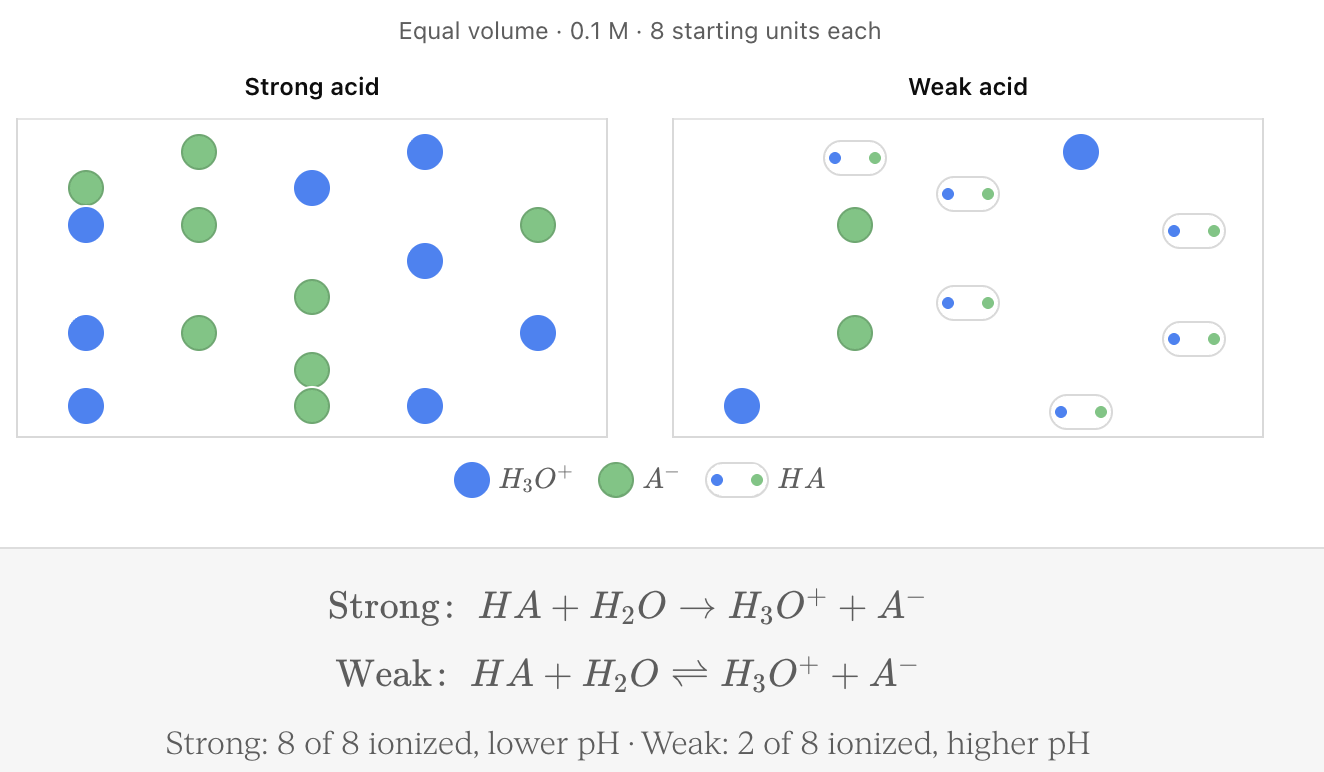
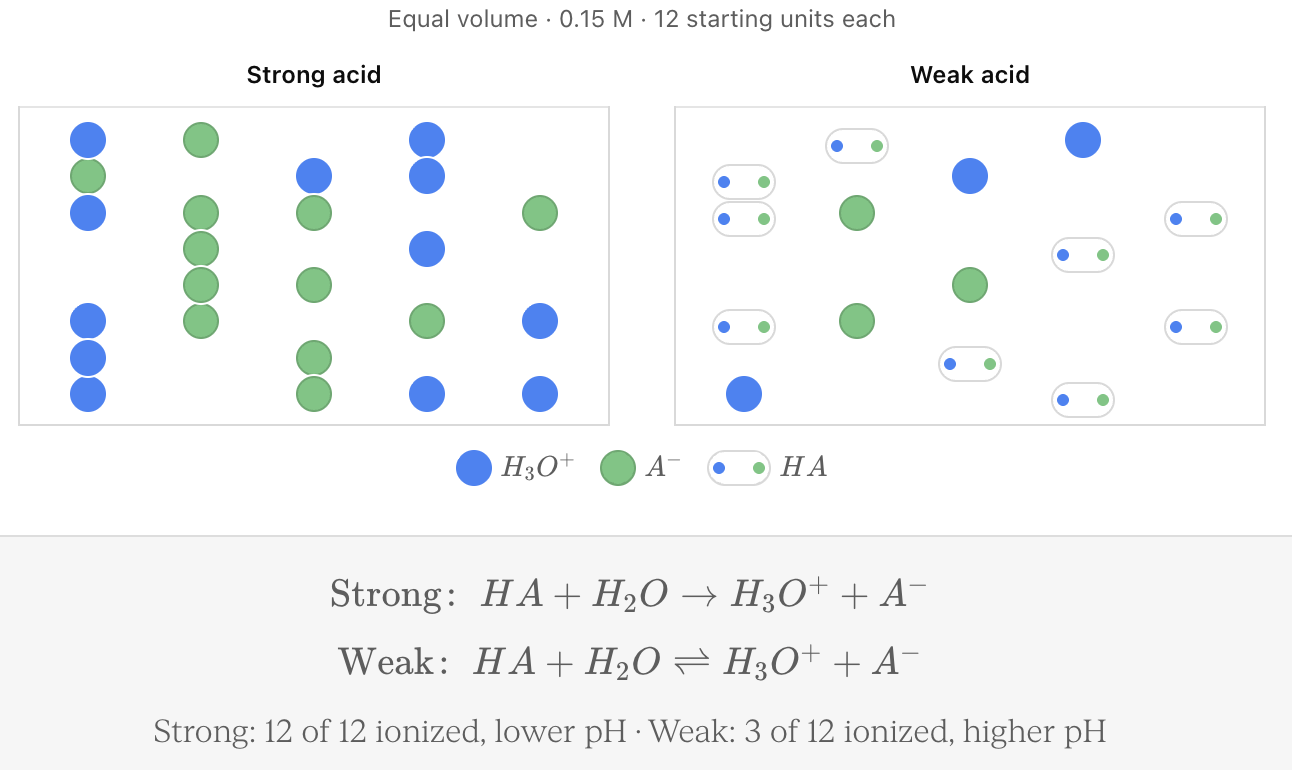
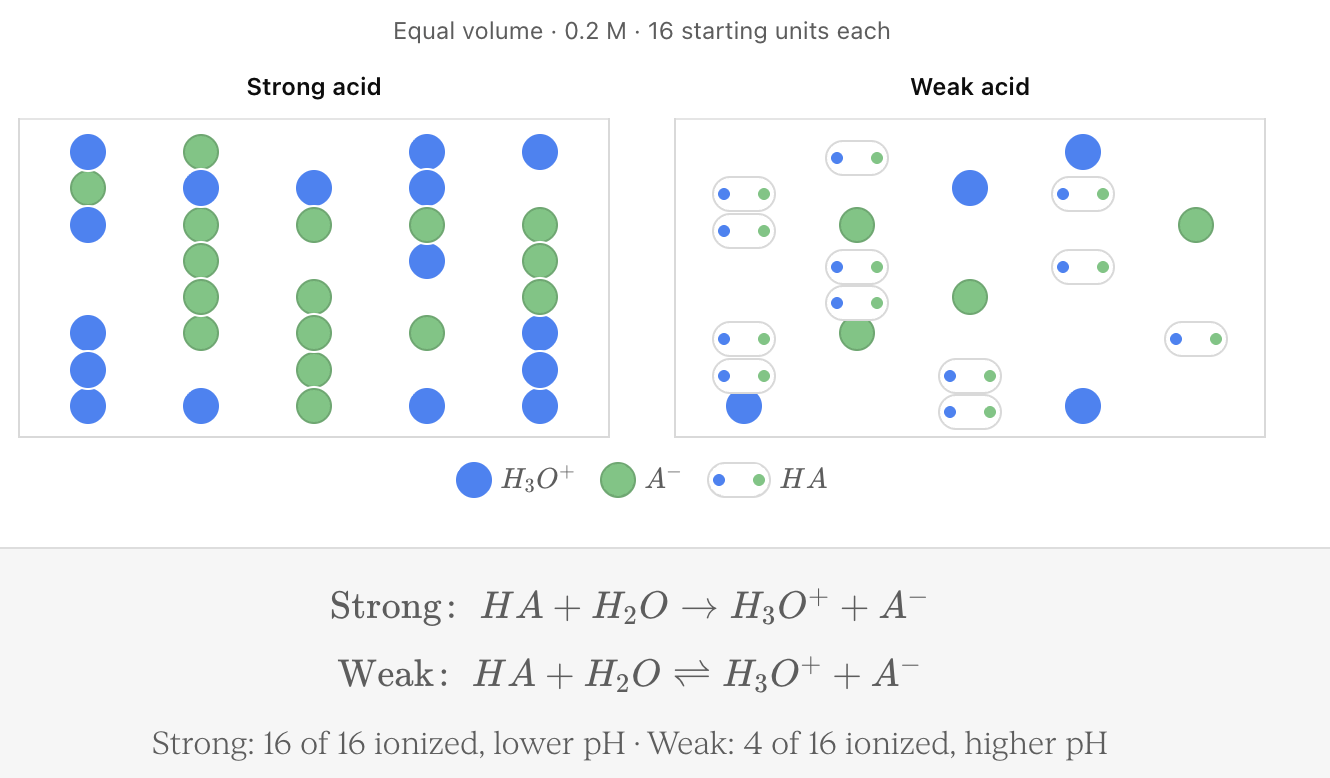
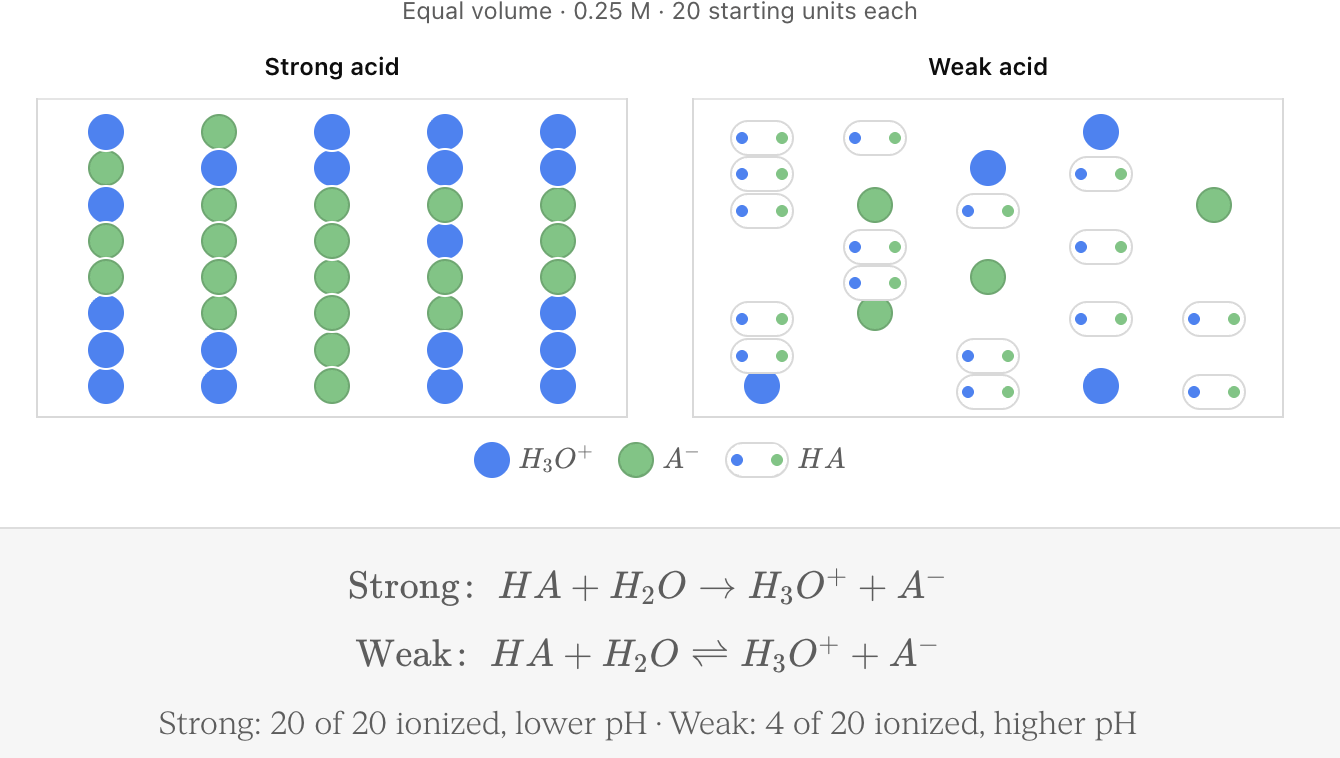
Particle-Level Comparison
Imagine two solutions containing the same initial concentration of acid.
Strong acid
Almost every HA particle has ionized:
H₃O⁺ A⁻ H₃O⁺ A⁻ H₃O⁺ A⁻
Very little HA remains.
Weak acid
Only some HA particles have ionized:
HA HA H₃O⁺ A⁻ HA HA HA
Many acid molecules remain intact.
This particle-level difference explains many of the observable differences between strong and weak acids.
Acid Strength and pH
pH is related to the concentration of hydronium ions in a solution.
More H₃O⁺ generally means:
lower pH
Less H₃O⁺ generally means:
higher pH
If we compare equal concentrations of a strong monoprotic acid and a weak monoprotic acid:
strong acid → more complete ionization → more H₃O⁺ → lower pH
weak acid → partial ionization → less H₃O⁺ → higher pH
Example: Equal Concentrations
Suppose we compare:
0.10 mol/L HCl
and:
0.10 mol/L CH₃COOH
HCl ionizes essentially completely:
HCl + H₂O → H₃O⁺ + Cl⁻
Ethanoic acid ionizes only partially:
CH₃COOH + H₂O ⇌ H₃O⁺ + CH₃COO⁻
Therefore, the HCl solution has a greater H₃O⁺ concentration and a lower pH.
Strength Is Not the Same as Concentration
This distinction is extremely important.
Strength describes:
how extensively the acid ionizes
Concentration describes:
how much acid is present per unit volume
Therefore:
strong ≠ concentrated
and:
weak ≠ dilute
A strong acid can be dilute.
A weak acid can be concentrated.
Strong but Dilute
Imagine a small amount of HCl dissolved in a large volume of water.
The HCl still ionizes almost completely.
Therefore, it remains a:
strong acid
However, because relatively little acid is present per unit volume, the solution is:
dilute
So a solution can be:
strong and dilute
Weak but Concentrated
Imagine a large amount of ethanoic acid dissolved in a relatively small volume.
Ethanoic acid still ionizes only partially.
Therefore, it remains:
weak
But because a large amount is present per unit volume, the solution may be:
concentrated
So a solution can be:
weak and concentrated
Strength and Concentration Describe Different Things
| Term | Meaning |
|---|---|
| Strong | Acid ionizes almost completely |
| Weak | Acid ionizes partially |
| Concentrated | Large amount of acid per unit volume |
| Dilute | Small amount of acid per unit volume |
These terms should never be used interchangeably.
Can a Weak Acid Have a Lower pH Than a Strong Acid?
Yes.
This can happen if the weak acid solution is much more concentrated.
For example, comparing:
very dilute strong acid
with:
much more concentrated weak acid
may result in the concentrated weak acid having the lower pH.
Therefore, you cannot determine acid strength from pH alone unless concentration and other relevant conditions are also considered.
This is an important point:
pH depends on both acid strength and concentration.
Weak Acids and Dynamic Equilibrium
Weak acids provide an important application of equilibrium.
Consider:
HA + H₂O ⇌ H₃O⁺ + A⁻
Initially, HA molecules begin donating protons to water.
The forward reaction produces:
- H₃O⁺
- A⁻
As these products accumulate, the reverse reaction becomes increasingly important.
Eventually:
forward rate = reverse rate
A dynamic equilibrium is established.
What Happens at Weak-Acid Equilibrium?
At equilibrium:
- acid molecules continue to ionize
- ions continue to recombine
- both reactions continue
- forward and reverse rates are equal
- concentrations remain constant
The reaction has not stopped.
This is the same principle of dynamic equilibrium studied in other reversible reactions.
Why Weak Acids Use a Reversible Arrow
For a weak acid:
HA + H₂O ⇌ H₃O⁺ + A⁻
the reversible arrow indicates that significant amounts of both ionized and un-ionized forms are present.
For a strong acid, introductory equations often use:
→
because ionization is essentially complete in dilute aqueous solution.
Equilibrium Position and Acid Strength
Consider:
HA + H₂O ⇌ H₃O⁺ + A⁻
For a relatively weak acid, the equilibrium lies mainly toward:
HA + H₂O
For a stronger acid, proton transfer is more favourable and the equilibrium lies further toward:
H₃O⁺ + A⁻
Therefore:
greater ionization → stronger acid
less ionization → weaker acid
The Acid Ionization Constant
The strength of a weak acid can be described quantitatively using the acid ionization constant, Ka.
For:
HA + H₂O ⇌ H₃O⁺ + A⁻
the simplified equilibrium expression is:
Ka = [H₃O⁺][A⁻] / [HA]
Water is not included in this simplified expression because its concentration is effectively constant in dilute aqueous solutions.
What Does Ka Tell Us?
Ka indicates how strongly the equilibrium favours ionization.
Larger Ka
More ionization occurs.
Therefore:
larger Ka → stronger acid
Smaller Ka
Less ionization occurs.
Therefore:
smaller Ka → weaker acid
For weak acids:
acid strength ↑ → Ka ↑
Comparing Two Weak Acids
Suppose:
Acid A: Ka = 1.0 × 10⁻³
Acid B: Ka = 1.0 × 10⁻⁶
Acid A has the larger Ka.
Therefore:
Acid A is stronger than Acid B.
Its equilibrium lies further toward the ionized products.
Ka and Equilibrium Position
For:
HA + H₂O ⇌ H₃O⁺ + A⁻
a relatively large Ka indicates that the equilibrium contains relatively more:
- H₃O⁺
- A⁻
A relatively small Ka indicates that the equilibrium contains relatively more:
- HA
Thus Ka connects the concepts of:
acid strength + ionization + equilibrium
Percentage Ionization
Another way of describing weak-acid behaviour is percentage ionization.
Percentage ionization tells us what fraction of the original acid molecules have ionized.
For example, suppose 1000 HA molecules are initially present and 50 ionize.
Percentage ionization:
50 / 1000 × 100% = 5%
This means:
95% remain un-ionized
and:
5% have ionized
The acid is therefore only partially ionized.
Strong Acid Example
Suppose 1000 HCl particles are placed into water.
Conceptually, almost all transfer their protons to water.
The solution therefore contains approximately:
1000 H₃O⁺ ions
and:
1000 Cl⁻ ions
with essentially no molecular HCl remaining in the simple introductory model.
Weak Acid Example
Suppose 1000 HA molecules are placed into water.
Imagine only 40 ionize.
The solution would contain approximately:
- 960 HA molecules
- 40 H₃O⁺ ions
- 40 A⁻ ions
This illustrates why the weak acid produces a lower H₃O⁺ concentration than an equally concentrated strong monoprotic acid.
Electrical Conductivity
Acid solutions conduct electricity because they contain mobile ions.
At equal concentrations:
strong acid → more ions → generally greater electrical conductivity
weak acid → fewer ions → generally lower electrical conductivity
This provides experimental evidence for differences in ionization.
A conductivity probe can therefore help compare acid solutions.
Reaction Rate with Metals
Acids can react with certain metals.
A simplified reaction is:
acid + metal → salt + hydrogen
For acids at the same concentration under otherwise similar conditions, a strong acid often provides a greater initial H₃O⁺ concentration than a weak acid.
This can result in a faster initial reaction.
However, reaction rate depends on several factors, so acid strength should not be determined from reaction rate alone.
Reaction with Carbonates
Acids react with carbonates to produce:
salt + water + carbon dioxide
For example:
2HCl + CaCO₃ → CaCl₂ + H₂O + CO₂
Visible bubbling occurs because carbon dioxide gas is produced.
Both strong and weak acids can react with carbonates.
Therefore:
"weak acid" does not mean "does not react."
Weak Does Not Mean Harmless
The words strong and weak describe ionization.
They do not directly describe:
- concentration
- corrosiveness
- toxicity
- overall hazard
A concentrated weak acid may still be hazardous.
A dilute strong acid may present less risk than a concentrated solution under some circumstances.
Chemical safety should therefore be based on the actual substance, concentration, exposure route, and hazard information—not simply the labels "strong" and "weak."
Acid Strength and the Conjugate Base
When an acid donates H⁺, it forms its conjugate base.
For:
HA ⇌ H⁺ + A⁻
HA is the acid.
A⁻ is its conjugate base.
In general:
stronger acid → weaker conjugate base
weaker acid → stronger conjugate base
This relationship helps explain acid-base equilibria.
Example: Ethanoic Acid
Ethanoic acid donates a proton:
CH₃COOH ⇌ H⁺ + CH₃COO⁻
CH₃COOH is the acid.
CH₃COO⁻ is the conjugate base.
In water, a more complete representation is:
CH₃COOH + H₂O ⇌ H₃O⁺ + CH₃COO⁻
Because ethanoic acid is weak, significant amounts of CH₃COOH remain un-ionized.
Example: Hydrofluoric Acid
Hydrofluoric acid, HF, is a weak acid despite containing hydrogen and a halogen.
Its equilibrium can be represented as:
HF + H₂O ⇌ H₃O⁺ + F⁻
Only partial ionization occurs.
This is a useful reminder that you cannot determine acid strength simply by looking for an H at the beginning of a formula.
Comparing HCl and HF
HCl:
HCl + H₂O → H₃O⁺ + Cl⁻
HF:
HF + H₂O ⇌ H₃O⁺ + F⁻
HCl ionizes essentially completely in dilute aqueous solution.
HF ionizes only partially.
Therefore:
HCl is stronger than HF.
Strong and Weak Are Relative Ideas
Within the category of weak acids, some acids are stronger than others.
For example:
Acid A
might ionize more extensively than:
Acid B
even though both are classified as weak acids.
Ka allows us to make more precise comparisons.
So acids are not simply divided into two perfectly separate behaviours. Acid strength can be considered along a spectrum.
Worked Example: Identifying a Strong Acid
A solution contains almost entirely H₃O⁺ and A⁻ ions, with very little un-ionized HA.
What does this suggest?
Step 1
Look at the extent of ionization.
Almost all HA has ionized.
Step 2
Classify the acid.
Strong acid
The evidence is the nearly complete ionization.
Worked Example: Identifying a Weak Acid
A solution contains:
- many HA molecules
- some H₃O⁺ ions
- some A⁻ ions
What does this suggest?
A significant amount of HA remains un-ionized.
Therefore:
partial ionization has occurred
and the acid is:
weak
Worked Example: Comparing pH
Two solutions have equal concentrations:
0.10 mol/L HCl
and:
0.10 mol/L weak acid HA
Which should have the lower pH?
HCl ionizes essentially completely.
HA ionizes only partially.
Therefore HCl produces the greater H₃O⁺ concentration.
So:
HCl has the lower pH.
Worked Example: Strength Versus Concentration
Student A says:
"This acid has a low concentration, so it must be weak."
This is incorrect.
Concentration tells us how much acid is present per unit volume.
Strength tells us how extensively the acid ionizes.
A dilute HCl solution is still a solution of a strong acid.
Worked Example: Using Ka
Three weak acids have the following Ka values:
Acid X: 4.0 × 10⁻³
Acid Y: 2.0 × 10⁻⁵
Acid Z: 7.0 × 10⁻⁸
The strongest acid has the largest Ka.
Therefore:
X is strongest
followed by:
Y
and then:
Z
So:
X > Y > Z in acid strength
Worked Example: Equilibrium Interpretation
Consider:
HA + H₂O ⇌ H₃O⁺ + A⁻
Suppose the equilibrium lies strongly to the left.
This means the equilibrium mixture contains relatively large amounts of HA and relatively small amounts of H₃O⁺ and A⁻.
Therefore, HA ionizes only slightly.
It is a:
weak acid
Strong Acids and Equilibrium
All acid-base proton transfers can be considered in terms of equilibrium.
For a strong acid in water, however, the equilibrium lies so strongly toward ionized products that introductory chemistry normally represents the reaction with a one-way arrow:
HCl + H₂O → H₃O⁺ + Cl⁻
For weak acids, both directions are significant:
CH₃COOH + H₂O ⇌ H₃O⁺ + CH₃COO⁻
This distinction connects acid strength directly to equilibrium position.
Common Mistakes
Strong Means Concentrated
Incorrect.
Strength = extent of ionization
Concentration = amount per volume
Weak Means Dilute
Incorrect.
A weak acid can be highly concentrated.
Weak Means Safe
Incorrect.
Weak describes ionization, not hazard.
Strong Acids Have More Hydrogen Atoms
Incorrect.
Acid strength is determined by proton-donation behaviour, not simply the number of H atoms in the formula.
Low pH Always Means Strong Acid
Not necessarily.
pH depends on both:
- acid strength
- concentration
A concentrated weak acid can have a lower pH than a sufficiently dilute strong acid.
Weak Acids Do Not Ionize
Incorrect.
Weak acids partially ionize.
Equilibrium Means the Reaction Stops
Incorrect.
In a weak-acid equilibrium:
forward rate = reverse rate
Both reactions continue.
Strong Acids Do Not Have Equilibrium
Acid-base reactions are equilibrium processes, but for a strong acid in water the equilibrium lies overwhelmingly toward ionized products.
Larger Ka Means Weaker Acid
Incorrect.
larger Ka → greater ionization → stronger acid
Weak Acids Do Not React with Metals or Carbonates
Incorrect.
Weak acids can still participate in normal acid reactions.
Check Your Understanding
- What is meant by a strong acid?
- What is meant by a weak acid?
- What does ionization mean?
- What ion is responsible for acidic behaviour in aqueous solution?
- Why is H₃O⁺ often more accurate than writing H⁺ by itself in water?
- Give two examples of strong acids.
- Give two examples of weak acids.
- Write an equation representing HCl ionization in water.
- Write a reversible equation for the ionization of a weak acid HA.
- Why is a reversible arrow used for weak acids?
- Compare the particles present in equal-concentration strong- and weak-acid solutions.
- Why does an equally concentrated strong acid generally have a lower pH than a weak acid?
- Explain the difference between acid strength and acid concentration.
- Can a strong acid be dilute? Explain.
- Can a weak acid be concentrated? Explain.
- Can a concentrated weak acid sometimes have a lower pH than a very dilute strong acid?
- What happens at dynamic equilibrium in a weak-acid solution?
- Does ionization stop when equilibrium is reached?
- What does Ka measure?
- What does a relatively large Ka indicate?
- What does a relatively small Ka indicate?
- Which is stronger: an acid with Ka = 1 × 10⁻² or one with Ka = 1 × 10⁻⁶?
- What is percentage ionization?
- Why do strong-acid solutions generally conduct electricity well?
- Does "weak acid" mean "safe acid"?
- Identify the conjugate base of HA.
- Identify the conjugate base of CH₃COOH.
- Explain why HCl is stronger than HF in water.
- A particle diagram contains mostly HA molecules and only a few H₃O⁺ and A⁻ ions. What does this tell you about the acid?
- Explain how acid strength is connected to equilibrium position.
Key Terms
Acid — Substance that can donate a proton, H⁺, in a Brønsted-Lowry acid-base reaction.
Strong acid — Acid that ionizes essentially completely in water.
Weak acid — Acid that ionizes only partially in water.
Ionization — Formation of ions when a molecular substance reacts with or dissolves in a solvent.
Hydronium ion (H₃O⁺) — Ion formed when a water molecule accepts a proton.
Conjugate base — Species remaining after an acid has donated a proton.
Acid strength — Measure of the tendency of an acid to donate protons or ionize.
Concentration — Amount of dissolved substance per unit volume of solution.
Dilute solution — Solution containing a relatively small amount of solute per unit volume.
Concentrated solution — Solution containing a relatively large amount of solute per unit volume.
Dynamic equilibrium — State in which forward and reverse reactions continue at equal rates.
Equilibrium position — Relative amounts of reactants and products present at equilibrium.
Acid ionization constant (Ka) — Equilibrium constant describing ionization of a weak acid.
Percentage ionization — Percentage of the initial acid that has ionized.
pH — Measure related to hydronium-ion concentration in an aqueous solution.
Key Takeaways
- Strong and weak acids differ primarily in their extent of ionization.
- Strong acids ionize essentially completely in water.
- Weak acids ionize only partially.
- Hydrochloric acid and nitric acid are common strong acids.
- Ethanoic acid, carbonic acid, and hydrofluoric acid are weak acids.
- Strong-acid ionization is often represented using →.
- Weak-acid ionization is represented using ⇌.
- Weak acids establish a dynamic equilibrium between ionized and un-ionized forms.
- At equilibrium, ionization and recombination continue at equal rates.
- Equal concentrations of strong and weak monoprotic acids generally produce different H₃O⁺ concentrations.
- The strong acid generally produces more H₃O⁺ and therefore has the lower pH.
- Strength and concentration are different properties.
- A strong acid can be dilute.
- A weak acid can be concentrated.
- pH alone does not always identify whether an acid is strong or weak.
- pH depends on both acid strength and concentration.
- Ka measures weak-acid ionization equilibrium.
- Larger Ka → stronger acid.
- Smaller Ka → weaker acid.
- Weak acids still react and can still be hazardous.
- Stronger acids generally have weaker conjugate bases.
- Acid strength can be understood as an application of chemical equilibrium.
The most important distinction is:
STRONG ACID
nearly complete ionization
↓
WEAK ACID
partial ionization and equilibrium
while:
CONCENTRATED / DILUTE
describes how much acid is present, not how strongly it ionizes.