Rote
5. Review of Newtonian Mechanics
Review of Newtonian Mechanics
From net force and acceleration to torque and angular dynamics
Newton’s laws explain how forces affect motion. For a rigid body, forces can change the motion of its center of mass and also change its rotation. We therefore need both net force and net torque.
Learning targets
- I can apply Newton’s three laws of motion.
- I can calculate net force and linear acceleration.
- I can distinguish mass from weight.
- I can explain torque and the role of the lever arm.
- I can connect translational and rotational dynamics.
1. Newton’s laws
First law: An object remains at rest or moves at constant velocity when net external force is zero. Second law: net external force equals mass times acceleration, ΣF = ma. Third law: interacting objects exert equal-magnitude, opposite-direction forces on each other.
Third-law pairs act on different objects, so they do not cancel in a free-body diagram for one object.
A 6 kg cart is pushed right with 30 N while friction acts left with 12 N.
Net force = 30 − 12 = 18 N right.
a = Fnet/m = 18/6 = 3.0 m/s² right.
2. Forces and free-body diagrams
A free-body diagram shows the external forces acting on one chosen object. Typical forces include weight (mg), normal reaction, friction, tension, and applied pushes or pulls.
Choose positive directions and add force components algebraically. A body at rest is not necessarily force-free: its forces may balance.
Mass measures inertia and is expressed in kilograms. Weight is the gravitational force W = mg, measured in newtons. A 10 kg object near Earth has weight ≈ 98 N when g = 9.8 N/kg.
3. Torque: the turning effect of a force
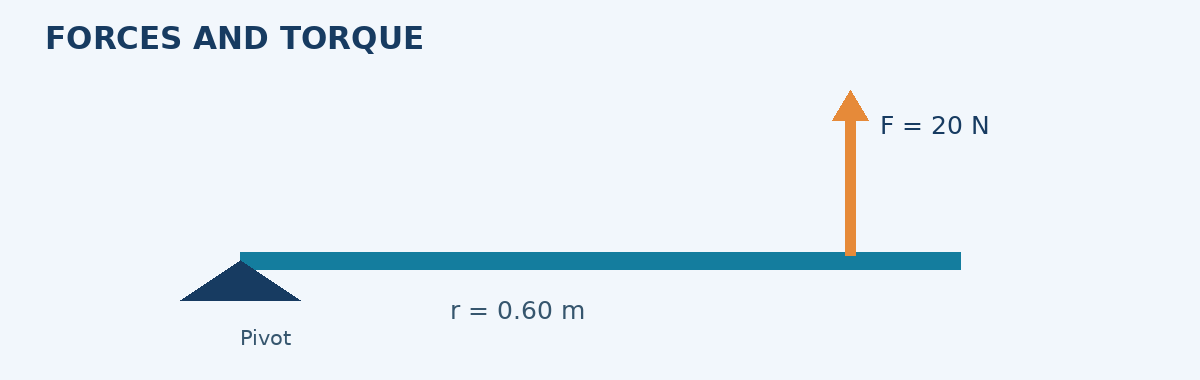
A force can cause rotation when its line of action does not pass through the axis. Torque magnitude is τ = rF sin φ, where r is the distance from pivot to application point and φ is the angle between r and the force.
The perpendicular lever arm is d = r sin φ, so τ = Fd. Torque is measured in newton metres (N·m).
A 20 N force acts perpendicular to a door 0.60 m from the hinge.
τ = rF sin 90° = 0.60 × 20 = 12 N·m.
If the same force acts 0.30 m from the hinge, torque falls to 6 N·m.
The same force is more effective when applied farther from the pivot, provided the angle is unchanged.
4. Rotational form of Newton’s second law
For rotation about a fixed axis, net external torque equals moment of inertia times angular acceleration: Στ = Iα. The moment of inertia I measures resistance to changes in angular velocity and depends on how mass is distributed relative to the axis.
Mass is the translational analogue of moment of inertia; force is the translational analogue of torque; linear acceleration corresponds to angular acceleration.
| Translation | Rotation |
|---|---|
| ΣF = ma | Στ = Iα |
| Mass m (kg) | Moment of inertia I (kg·m²) |
| Velocity v (m/s) | Angular velocity ω (rad/s) |
| Acceleration a (m/s²) | Angular acceleration α (rad/s²) |
A wheel has I = 2.5 kg·m² and experiences net torque 10 N·m.
α = Στ/I = 10/2.5 = 4 rad/s².
5. Equilibrium and motion
A rigid body in static equilibrium has both zero net force and zero net torque: ΣF = 0 and Στ = 0. Zero net force alone is not enough: a pair of equal and opposite forces can produce a turning couple.
A wrench, bicycle pedal, seesaw, and door handle all demonstrate how lever arm and force direction determine turning effect.
Common mistakes
- Thinking a force is required to maintain constant velocity.
- Using one applied force instead of the net force in F = ma.
- Confusing mass (kg) and weight (N).
- Canceling third-law pairs that act on different objects.
- Assuming zero net force always implies zero torque.
Key terms
- Net force: vector sum of external forces
- Inertia: resistance to a change in motion
- Weight: gravitational force mg
- Torque: turning effect of a force about an axis
- Lever arm: perpendicular distance from axis to force line of action
- Moment of inertia: rotational inertia determined by mass distribution
Check your understanding — fully worked answers
- A 4 kg object experiences net force 20 N. Find acceleration.
Worked answer: a = 20/4 = 5 m/s².
- Find the weight of a 3 kg object at g = 9.8 N/kg.
Worked answer: W = mg = 3 × 9.8 = 29.4 N.
- A 15 N force acts perpendicularly 0.40 m from a pivot. Find torque.
Worked answer: τ = rF = 0.40 × 15 = 6.0 N·m.
- A disk with I = 3 kg·m² has net torque 12 N·m. Find α.
Worked answer: α = τ/I = 12/3 = 4 rad/s².
- Can an object have zero net force but rotate with angular acceleration?
Worked answer: Yes. A couple can exert zero net force but nonzero net torque.
Key takeaways
- Newton’s laws apply to translational motion and underpin rotational mechanics.
- Net force changes center-of-mass motion; net torque changes rotation.
- For static equilibrium both net force and net torque must be zero.