Rote
| サイト: | Young Education |
| コース: | Rigid Body Mechanics |
| ブック: | Rote |
| 印刷者: | Gwestai |
| 日付: | 2026年 11月 9日(月曜日) 16:34 |
1. What Is a Rigid Body?
What Is a Rigid Body?
Why physicists sometimes pretend that objects never bend
A rigid body is an idealized object whose shape and size do not change. Distances between any two points in the body remain constant, even as it moves or rotates. Real objects can deform; the model is useful when that deformation is negligible.
Learning targets
- Define a rigid body and explain the assumptions of rigid body mechanics.
- Distinguish between particle models and rigid body models.
- Identify examples of rigid bodies in everyday life.
- Explain why rigid body approximations are useful in physics.
- Recognize situations where objects cannot be treated as rigid bodies.
1. What makes a body rigid?
Imagine marking two points, A and B, on a bicycle wheel. As the wheel turns, the points move through space, but the distance AB stays the same. This is the defining assumption of the rigid-body model.
Rigid body: a model in which the distance between every pair of material points stays constant over time. A rigid body can translate, rotate, or do both.
The model does not mean that the object cannot move. It means that it does not stretch, compress, bend, or change shape within the accuracy required by the problem.
2. Particle model versus rigid-body model
A particle model represents an object as a single point. It is useful when only the overall position or motion matters and the object’s size and rotation can be ignored.
A rigid-body model retains the object’s size, shape, and orientation. It is necessary when rotation, torque, or the location of forces matters.
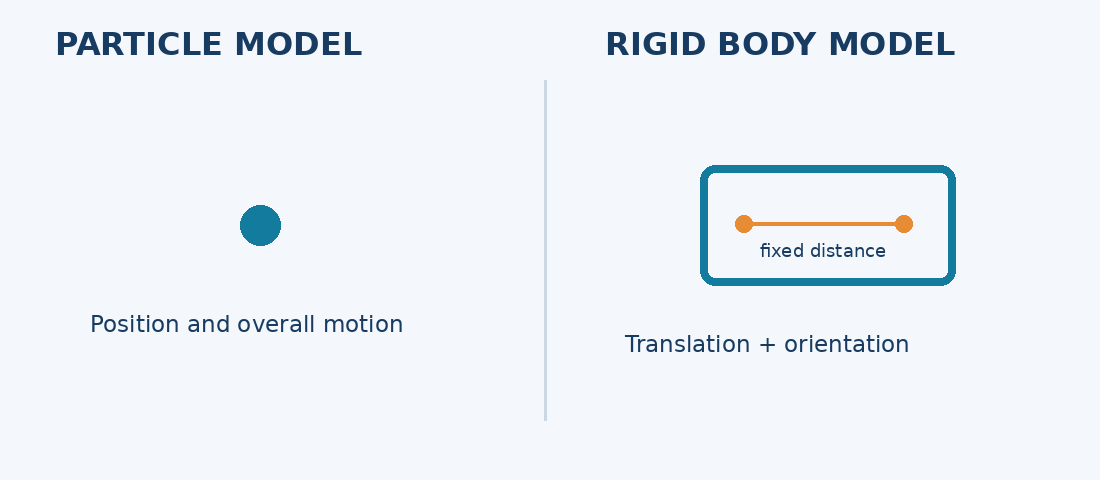
| Question | Particle | Rigid body |
|---|---|---|
| Does shape matter? | No | Yes |
| Can we study rotation? | Not about its own size | Yes |
| Typical example | A spacecraft traveling between planets | A wheel spinning on an axle |
3. Where do we use the approximation?
Many solid objects are approximately rigid during ordinary motion: a door swinging on hinges, a spinning flywheel, a bicycle wheel, or a moving vehicle body. The approximation works because the change in shape is small compared with the motion being studied.
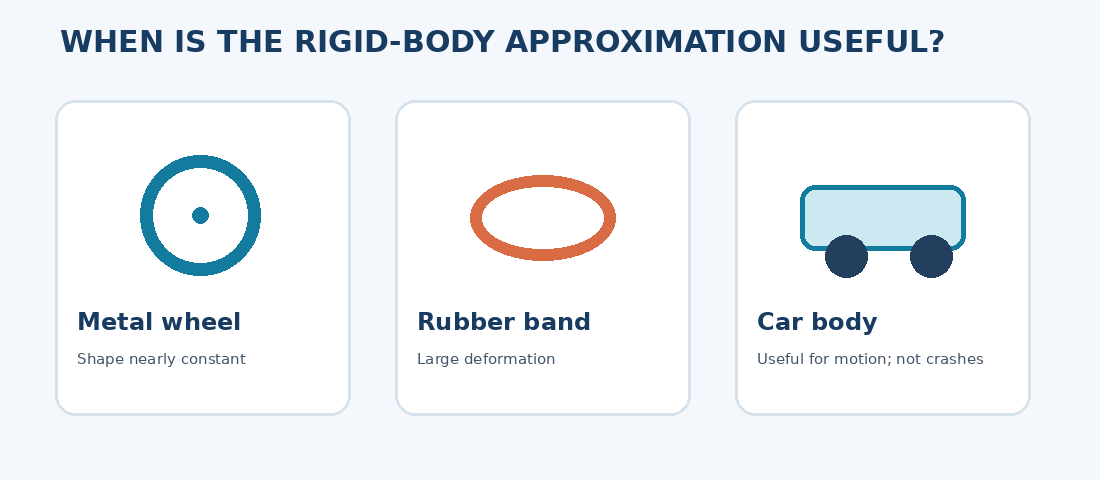
To predict how a door rotates around its hinges, we usually treat it as rigid. Every point on the door turns through the same angle, although points farther from the hinges travel a greater distance.
4. When does the model fail?
A rubber band stretching, a diving board bending, a spring compressing, or a car crumpling in a collision cannot be treated as rigid when the deformation itself is important.
Even a steel beam bends slightly under load. Whether that matters depends on the question. For calculating the beam’s overall movement, a rigid model may be adequate; for determining stress or deflection, it is not.
“Metal objects are rigid, and rubber objects are not.” Not necessarily. Rigidity is an approximation for a particular problem, not a permanent label for a material.
5. Worked examples
Problem: A satellite travels around Earth. We want to calculate its orbital period. Must we model its size and rotation?
Reasoning: If the satellite is very small compared with the orbit and its orientation does not affect the calculation, treat it as a particle.
Answer: The particle model is sufficient.
Problem: Two points on a wheel are 0.20 m and 0.40 m from its center. The wheel rotates through 1.5 radians. Find the distance each point travels.
Equation: s = rθ (θ in radians)
Inner point: s = 0.20 × 1.5 = 0.30 m
Outer point: s = 0.40 × 1.5 = 0.60 m
Interpretation: Both points rotate through the same angle, but the outer point travels twice as far.
6. Check your understanding — with answers
- What remains unchanged in a rigid body?
Answer: The distance between every pair of points in the body.
- Why is a particle model unsuitable for a spinning door?
Answer: A single point cannot describe the door’s size, orientation, or rotation about its hinges.
- Can a car be modeled as rigid during a crash? Explain.
Answer: Not when we are studying deformation or impact damage, because the car body changes shape.
- Two points on a rigid wheel rotate through 2 radians. One is 0.5 m from the axis. How far does it move?
Answer: s = rθ = 0.5 × 2 = 1.0 m.
- Why do physicists use idealized models?
Answer: They simplify a problem while retaining the features needed to answer the question accurately.
Common mistakes
- Confusing rigid with stationary: a rigid body may move and rotate.
- Assuming real objects are perfectly rigid: all real materials deform to some extent.
- Using a particle model when torque, orientation, or rotation is central to the question.
- Forgetting that points at different radii travel different distances during the same rotation.
Key terms
- Rigid body: idealized object with fixed distances between all points.
- Particle model: object represented by a single point.
- Translation: motion in which all points undergo the same displacement.
- Rotation: change in orientation around an axis.
- Deformation: change in shape or dimensions.
- Approximation: simplified description valid under stated conditions.
Key takeaways
A rigid body can move and rotate, but it does not change shape in the model. Choose a particle model when size and orientation do not matter; choose a rigid-body model when rotation or force location matters. If deformation is significant, neither idealization may be sufficient.
2. What Is a Rigid Body
What Is a Rigid Body?
A useful model for objects that move without changing shape
A rigid body is an idealization: the distance between any two material points stays constant. The object may move or rotate, but it does not stretch, bend, or change shape in the model. Real objects are never perfectly rigid; we use this approximation when deformation is too small to affect the answer.
Learning targets
- I can define a rigid body and explain its assumptions.
- I can distinguish particle and rigid-body models.
- I can identify examples of approximately rigid objects.
- I can explain why rigid-body approximations simplify physics.
- I can recognize situations in which deformation matters.
1. Defining a rigid body
Imagine marking points A and B on a solid wheel. As the wheel turns, both points move, yet their separation AB remains constant. This fixed-distance condition defines a rigid body. It implies that the body maintains its size and shape.
Rigidity does not mean stationary. A rigid body may translate, rotate about a fixed axis, or undergo a combination of both. The model ignores internal deformation, not motion.
2. Particle model versus rigid-body model
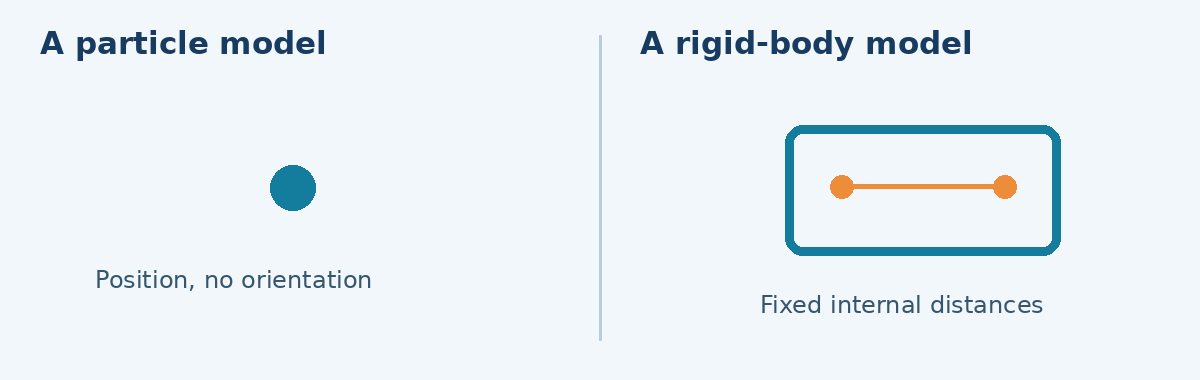
A particle model treats an object as a point with mass. It is appropriate when size, shape, and orientation do not influence the calculation. A rigid-body model retains geometry, orientation, and the positions where forces act.
| Feature | Particle model | Rigid-body model |
|---|---|---|
| Shape and size | Ignored | Retained |
| Rotation about own axis | Not described | Described |
| Useful for | Orbital trajectory | Door, gear, wheel |
A satellite moving around Earth can often be treated as a particle when calculating orbital period. A door opening on hinges needs a rigid-body model because its orientation and the location of applied force matter.
3. Everyday examples
- Door: rotates around hinges while keeping approximately the same shape.
- Bicycle wheel: rotates while distances between points on its rim remain approximately fixed.
- Wrench: transmits a turning effect from the hand to a nut.
- Book sliding across a table: approximately translates without changing shape.
- Seesaw: rotates around its pivot; the positions of the children determine torque.
Whether an object is approximately rigid depends on the question. A steel beam may be treated as rigid for its overall motion but not when calculating its bending.
4. Why the approximation is useful
Modeling every tiny deformation requires complicated material properties and internal forces. Treating an object as rigid lets us focus on its translation, rotation, net force, and torque. This simplification is accurate when changes in shape are negligible compared with the distances or angles we study.
A wheel rotates through 1.5 radians. Two marked points lie 0.20 m and 0.40 m from the axis. Find each point’s arc length.
Use s = rθ, with θ in radians.
Inner point: s = 0.20 × 1.5 = 0.30 m.
Outer point: s = 0.40 × 1.5 = 0.60 m.
Both points have the same angular displacement, but the point farther from the axis travels twice as far.
5. When a rigid-body model fails
A rubber band stretches, a spring compresses, a diving board bends, and a vehicle crumples during a collision. If deformation is central to the question, a rigid-body model leaves out the very behavior we need to explain.
Ask: “Would ignoring the change in shape materially change my answer?” If yes, use a deformable-body model instead.
Common mistakes
- Rigid means motionless — false; rigid bodies can translate and rotate.
- Metal is always rigid — false; metals deform under sufficient load.
- A rigid body is the same as a particle — false; a rigid body has size and orientation.
- A force’s point of application never matters — false; it changes torque.
Key terms
- Rigid body: idealized object with fixed internal distances
- Particle model: object represented by one point
- Translation: motion with equal displacement of all points
- Rotation: change in orientation about an axis
- Deformation: change in shape or dimensions
Check your understanding — fully worked answers
- What property defines a rigid body?
Worked answer: The distance between every pair of points stays constant.
- Can a rigid body rotate?
Worked answer: Yes. Rigidity concerns shape, not whether the object moves.
- Why is a particle model insufficient for a door opening?
Worked answer: It cannot represent orientation or torque about the hinges.
- A point at radius 0.30 m rotates by 2 rad. Find its arc length.
Worked answer: s = rθ = 0.30 × 2 = 0.60 m.
- Is a car rigid during a crash?
Worked answer: Not for studying impact deformation, because its body changes shape.
Key takeaways
- Rigid-body mechanics is an approximation, not a claim that materials never deform.
- Particle models ignore size; rigid-body models retain shape and orientation.
- Choose the simplest model that keeps the features relevant to the question.
3. Translational vs Rotational Motion
Translational vs Rotational Motion
How position, velocity and acceleration describe different kinds of movement
Translation changes an object’s position; rotation changes its orientation. A rolling wheel does both. Linear quantities describe distances and speeds in metres, while angular quantities describe angles and rates of turning in radians.
Learning targets
- I can distinguish translational and rotational motion.
- I can describe linear and angular displacement.
- I can compare linear and angular velocity and acceleration.
- I can relate linear and angular quantities mathematically.
- I can identify combined motion in everyday systems.
1. Translation: movement without turning
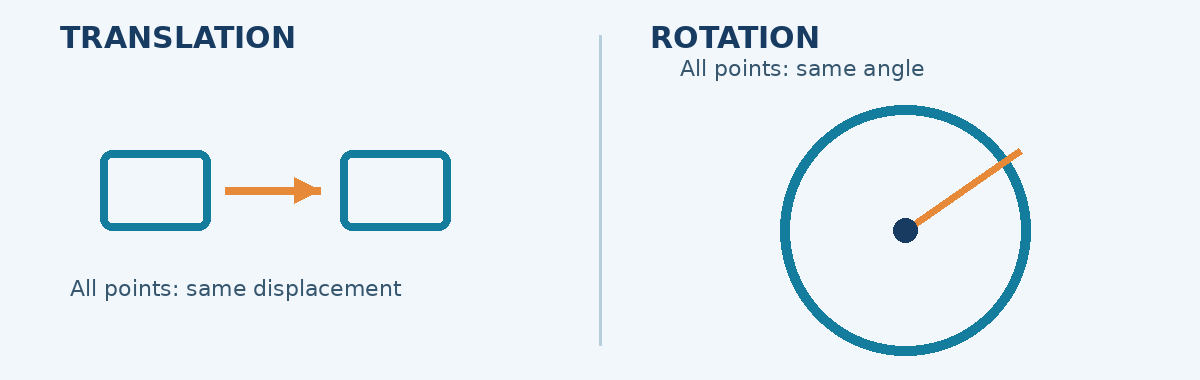
In pure translation, every point of a rigid body experiences the same displacement over a given interval. The path may be straight or curved, but the body does not change its orientation.
Linear displacement: Δx = xf − xi (m). Average velocity: v = Δx/Δt (m/s). Average acceleration: a = Δv/Δt (m/s²).
A box moves from x = 2 m to x = 14 m in 4 s.
Displacement = 14 − 2 = 12 m.
Average velocity = 12/4 = 3 m/s in the positive x-direction.
2. Rotation: changing orientation
In pure rotation about a fixed axis, every point turns through the same angle, although points at different distances from the axis travel different arc lengths.
Angular displacement: Δθ (radians). Average angular velocity: ω = Δθ/Δt (rad/s). Average angular acceleration: α = Δω/Δt (rad/s²).
One complete revolution equals 2π radians or 360°. Counterclockwise is often defined as positive, but the sign convention must be stated.
3. Connecting linear and angular quantities
s = rθ (arc length), v = rω (tangential speed), at = rα (tangential acceleration). These use radians and a radius measured from the rotation axis.
At a fixed angular speed, doubling the radius doubles tangential speed. Every point on the same rigid wheel shares ω but not v.
A wheel of radius 0.35 m turns at ω = 8 rad/s.
Tangential speed at the rim: v = rω = 0.35 × 8 = 2.8 m/s.
At radius 0.175 m: v = 0.175 × 8 = 1.4 m/s.
4. Angular acceleration and circular motion
If angular velocity changes, the body has angular acceleration. Even if angular speed is constant, a point moving in a circle has centripetal acceleration because its velocity direction changes.
Tangential acceleration: at = rα. Centripetal acceleration: ac = v²/r = rω², directed toward the axis.
A fan speeds up uniformly from 2 rad/s to 14 rad/s in 3 s.
α = (14 − 2)/3 = 4 rad/s².
At r = 0.25 m, at = rα = 0.25 × 4 = 1.0 m/s².
5. Combined motion: rolling
A rolling wheel translates as its center moves forward and rotates about its center. For rolling without slipping, the center’s speed satisfies vcenter = Rω.
This relationship is used in vehicle wheels, conveyor rollers, gears, and bicycle motion. It fails for a wheel skidding across the ground.
A car tire may rotate quickly while the car travels slowly on ice. In that case the tire is slipping, so v = Rω does not describe the vehicle speed.
Common mistakes
- Assuming all movement is translation.
- Calling rotation motion only when an object changes location.
- Confusing radians with degrees in s = rθ.
- Assuming all points on a rotating body have equal tangential speed.
- Using v = Rω for a slipping wheel without checking the assumption.
Key terms
- Displacement: change in position
- Angular displacement: change in orientation measured in radians
- Angular velocity: rate of angular displacement
- Angular acceleration: rate of change of angular velocity
- Tangential speed: linear speed along a circular path
- Rolling without slipping: rolling motion where v of center equals Rω
Check your understanding — fully worked answers
- How many radians are in half a revolution?
Worked answer: π radians.
- A disk rotates 6 rad in 2 s. Find average angular velocity.
Worked answer: ω = Δθ/Δt = 6/2 = 3 rad/s.
- Find rim speed for r = 0.50 m and ω = 10 rad/s.
Worked answer: v = rω = 0.50 × 10 = 5.0 m/s.
- Why is a point on a spinning wheel accelerating at constant angular speed?
Worked answer: Its velocity direction changes continuously, producing centripetal acceleration.
- A wheel of radius 0.40 m rolls without slipping at 2 m/s. Find ω.
Worked answer: ω = v/R = 2/0.40 = 5 rad/s.
Key takeaways
- Translation and rotation describe different aspects of motion.
- Points on a rigid body share angular speed but have different tangential speeds if radii differ.
- Use s = rθ, v = rω, aₜ = rα with angles in radians.
4. Reference Frames and Coordinate Systems
Reference Frames and Coordinate Systems
Choosing an observer, an origin and axes before describing motion
Motion is always described relative to a chosen reference frame. Coordinate systems provide a language for position and orientation. The same motion may look different from different observers, even though the physical event is the same.
Learning targets
- I can define a reference frame and explain relative motion.
- I can use Cartesian coordinates to locate objects.
- I can interpret polar coordinates and angular position.
- I can select appropriate axes and rotational origins.
- I can explain how descriptions differ between observers.
1. Reference frames and observers
A reference frame specifies the observer, the reference object or origin, the directions of the axes, and a clock. A passenger sitting on a moving bus is stationary relative to the bus but moving relative to the road.
A bus travels east at 15 m/s. A passenger walks toward the front at 1.5 m/s relative to the bus.
Relative to the road, passenger velocity = 15 + 1.5 = 16.5 m/s east.
If the passenger walks toward the rear at 1.5 m/s, road velocity = 15 − 1.5 = 13.5 m/s east.
These simple velocity additions assume ordinary non-relativistic speeds and reference frames moving at constant velocity relative to each other.
2. Cartesian coordinates
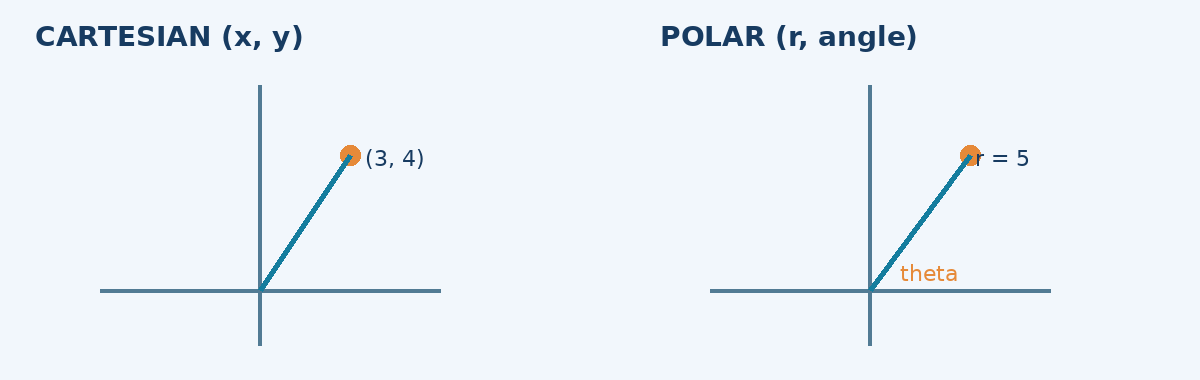
In a Cartesian system, an object’s position is described by (x, y) in a plane, or (x, y, z) in three dimensions. The origin is the point (0, 0), and axes must have specified directions and units.
For a position change from (2, 1) m to (5, 5) m, the displacement vector is (3, 4) m. Its magnitude is √(3² + 4²) = 5 m.
There is no rule that the x-axis must be horizontal or that the origin must be at the center of the room. Choose axes that simplify the problem.
3. Polar coordinates
Polar coordinates describe position using a distance r from an origin and an angle θ measured from a chosen reference direction. They are especially convenient for circular motion.
x = r cos θ and y = r sin θ. Conversely, r = √(x² + y²), while θ is found from the correct quadrant of (x, y).
A point is 5 m from the origin at θ = 53.13° above the positive x-axis.
x = 5 cos 53.13° ≈ 3.0 m.
y = 5 sin 53.13° ≈ 4.0 m.
The Cartesian coordinates are approximately (3, 4) m.
4. Rotational axes and signs
A rotation axis need not pass through the object’s center. A door rotates around its hinges; a wheel around its axle; a seesaw around its support. Radius is measured perpendicular to the chosen axis, not simply from the center of the object.
In two-dimensional problems, counterclockwise is usually positive and clockwise negative. State the convention, especially when comparing angular displacement or torque.
A wheel turns 90° clockwise, then 180° counterclockwise. Take counterclockwise as positive.
Δθ = −90° + 180° = +90° = π/2 rad.
5. Choosing the most useful description
Cartesian coordinates work well for straight-line movement and forces along perpendicular directions. Polar coordinates simplify circular trajectories, angular displacement, and rotation about a fixed point.
For a wheel moving down a road, describe the center with Cartesian coordinates and the wheel’s orientation with angular position θ. This combination handles translation and rotation without confusion.
Navigation systems use a reference frame tied to Earth, while a robot arm often uses a coordinate system attached to its joints. Engineers must transform between these systems to describe the same motion.
Common mistakes
- Describing motion without stating a reference frame.
- Assuming the origin has to be at the geometric center.
- Measuring radius from the wrong point instead of the rotation axis.
- Ignoring angle quadrants when converting polar coordinates.
- Treating clockwise as intrinsically positive or negative.
Key terms
- Reference frame: observer and coordinate system used to describe motion
- Origin: zero point of a coordinate system
- Cartesian coordinates: position given by perpendicular coordinates
- Polar coordinates: position given by radius and angle
- Relative velocity: velocity measured with respect to another frame
- Rotation axis: line about which an object rotates
Check your understanding — fully worked answers
- A passenger sits on a moving train. Are they moving?
Worked answer: They are stationary relative to the train but moving relative to the ground.
- Find the magnitude of displacement from (1, 2) m to (4, 6) m.
Worked answer: Δr = (3, 4) m; magnitude = √(9 + 16) = 5 m.
- Convert r = 10 m, θ = 30° to Cartesian coordinates.
Worked answer: x = 10 cos 30° ≈ 8.66 m; y = 10 sin 30° = 5.0 m.
- A wheel turns 270° clockwise. Express Δθ in radians with CCW positive.
Worked answer: Δθ = −270° × π/180° = −3π/2 rad.
- Where is the rotation axis of a hinged door?
Worked answer: Along the hinge line, not through the door’s geometric center.
Key takeaways
- State the observer, origin, axes, and sign convention before calculating.
- Different frames can give different velocities without contradiction.
- Cartesian coordinates suit linear motion; polar coordinates suit circular motion.
5. Review of Newtonian Mechanics
Review of Newtonian Mechanics
From net force and acceleration to torque and angular dynamics
Newton’s laws explain how forces affect motion. For a rigid body, forces can change the motion of its center of mass and also change its rotation. We therefore need both net force and net torque.
Learning targets
- I can apply Newton’s three laws of motion.
- I can calculate net force and linear acceleration.
- I can distinguish mass from weight.
- I can explain torque and the role of the lever arm.
- I can connect translational and rotational dynamics.
1. Newton’s laws
First law: An object remains at rest or moves at constant velocity when net external force is zero. Second law: net external force equals mass times acceleration, ΣF = ma. Third law: interacting objects exert equal-magnitude, opposite-direction forces on each other.
Third-law pairs act on different objects, so they do not cancel in a free-body diagram for one object.
A 6 kg cart is pushed right with 30 N while friction acts left with 12 N.
Net force = 30 − 12 = 18 N right.
a = Fnet/m = 18/6 = 3.0 m/s² right.
2. Forces and free-body diagrams
A free-body diagram shows the external forces acting on one chosen object. Typical forces include weight (mg), normal reaction, friction, tension, and applied pushes or pulls.
Choose positive directions and add force components algebraically. A body at rest is not necessarily force-free: its forces may balance.
Mass measures inertia and is expressed in kilograms. Weight is the gravitational force W = mg, measured in newtons. A 10 kg object near Earth has weight ≈ 98 N when g = 9.8 N/kg.
3. Torque: the turning effect of a force
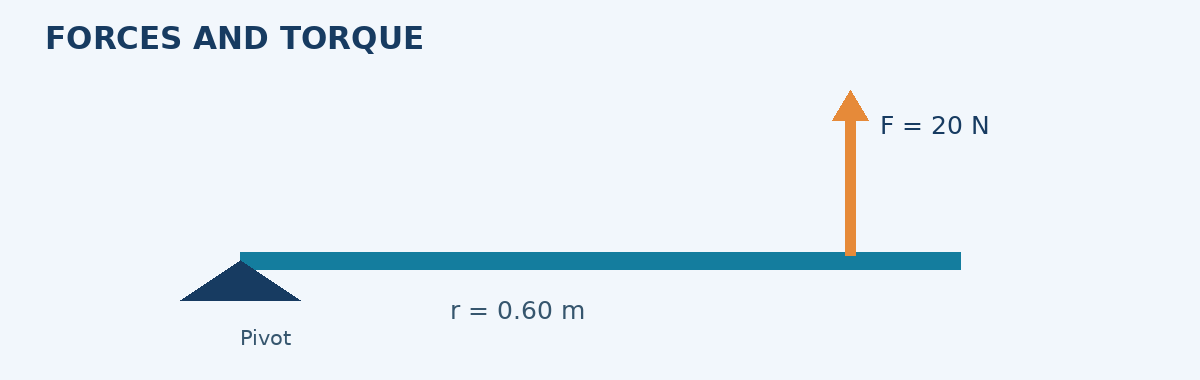
A force can cause rotation when its line of action does not pass through the axis. Torque magnitude is τ = rF sin φ, where r is the distance from pivot to application point and φ is the angle between r and the force.
The perpendicular lever arm is d = r sin φ, so τ = Fd. Torque is measured in newton metres (N·m).
A 20 N force acts perpendicular to a door 0.60 m from the hinge.
τ = rF sin 90° = 0.60 × 20 = 12 N·m.
If the same force acts 0.30 m from the hinge, torque falls to 6 N·m.
The same force is more effective when applied farther from the pivot, provided the angle is unchanged.
4. Rotational form of Newton’s second law
For rotation about a fixed axis, net external torque equals moment of inertia times angular acceleration: Στ = Iα. The moment of inertia I measures resistance to changes in angular velocity and depends on how mass is distributed relative to the axis.
Mass is the translational analogue of moment of inertia; force is the translational analogue of torque; linear acceleration corresponds to angular acceleration.
| Translation | Rotation |
|---|---|
| ΣF = ma | Στ = Iα |
| Mass m (kg) | Moment of inertia I (kg·m²) |
| Velocity v (m/s) | Angular velocity ω (rad/s) |
| Acceleration a (m/s²) | Angular acceleration α (rad/s²) |
A wheel has I = 2.5 kg·m² and experiences net torque 10 N·m.
α = Στ/I = 10/2.5 = 4 rad/s².
5. Equilibrium and motion
A rigid body in static equilibrium has both zero net force and zero net torque: ΣF = 0 and Στ = 0. Zero net force alone is not enough: a pair of equal and opposite forces can produce a turning couple.
A wrench, bicycle pedal, seesaw, and door handle all demonstrate how lever arm and force direction determine turning effect.
Common mistakes
- Thinking a force is required to maintain constant velocity.
- Using one applied force instead of the net force in F = ma.
- Confusing mass (kg) and weight (N).
- Canceling third-law pairs that act on different objects.
- Assuming zero net force always implies zero torque.
Key terms
- Net force: vector sum of external forces
- Inertia: resistance to a change in motion
- Weight: gravitational force mg
- Torque: turning effect of a force about an axis
- Lever arm: perpendicular distance from axis to force line of action
- Moment of inertia: rotational inertia determined by mass distribution
Check your understanding — fully worked answers
- A 4 kg object experiences net force 20 N. Find acceleration.
Worked answer: a = 20/4 = 5 m/s².
- Find the weight of a 3 kg object at g = 9.8 N/kg.
Worked answer: W = mg = 3 × 9.8 = 29.4 N.
- A 15 N force acts perpendicularly 0.40 m from a pivot. Find torque.
Worked answer: τ = rF = 0.40 × 15 = 6.0 N·m.
- A disk with I = 3 kg·m² has net torque 12 N·m. Find α.
Worked answer: α = τ/I = 12/3 = 4 rad/s².
- Can an object have zero net force but rotate with angular acceleration?
Worked answer: Yes. A couple can exert zero net force but nonzero net torque.
Key takeaways
- Newton’s laws apply to translational motion and underpin rotational mechanics.
- Net force changes center-of-mass motion; net torque changes rotation.
- For static equilibrium both net force and net torque must be zero.
6. Applications of Rigid Body Mechanics
Applications of Rigid Body Mechanics
Putting motion, forces, torque and equilibrium together
Rigid-body mechanics connects the ideas from the previous chapters. Engineers and scientists use it to predict how doors, wheels, tools, beams, robotic arms, and vehicles move or balance under forces.
Learning targets
- I can identify rigid-body mechanics in everyday systems.
- I can combine translational and rotational descriptions.
- I can calculate torque and use equilibrium conditions.
- I can interpret the role of moment of inertia and center of mass.
- I can evaluate the limits of simplified physical models.
1. Doors, wrenches and levers
For a hinged door, the turning effect depends on the force, the perpendicular distance from the hinge, and the angle of the push. The same principle makes a long wrench more effective than a short one.
A mechanic applies 80 N perpendicular to a wrench 0.25 m long.
τ = rF = 0.25 × 80 = 20 N·m.
If the wrench is lengthened to 0.40 m and the force remains perpendicular, τ = 0.40 × 80 = 32 N·m.
Increasing the lever arm increases torque without increasing force.
2. Balancing a seesaw
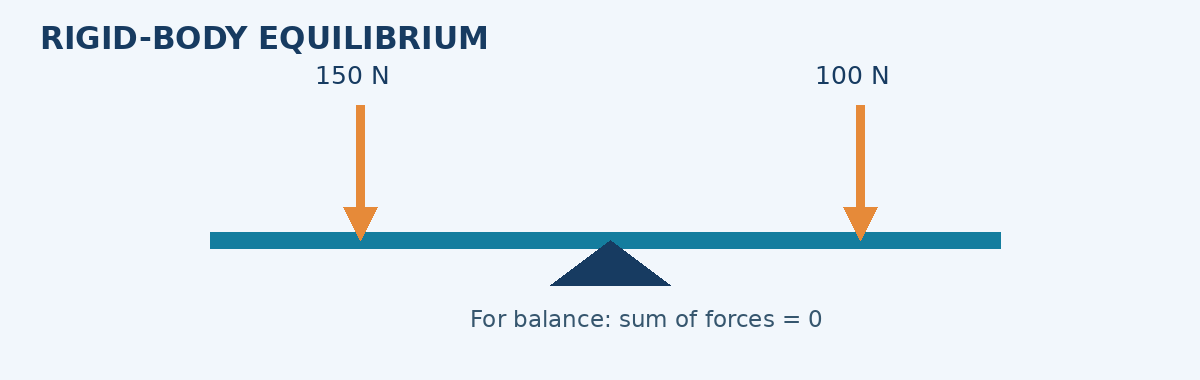
In static equilibrium, clockwise and counterclockwise torques balance around the pivot, and the net force is zero. Choosing the pivot as the torque origin often eliminates the unknown support force from the torque equation.
A child weighing 300 N sits 2.0 m to the left of the pivot. Where should a 400 N child sit on the right to balance?
Set magnitudes of torques equal: 300 × 2.0 = 400 × d.
d = 600/400 = 1.5 m to the right.
The heavier child sits closer to the pivot.
Balancing torque does not automatically establish all equilibrium conditions. For a complete free-body analysis, check the vertical and horizontal forces too.
3. Rolling wheels and vehicle motion
A vehicle wheel combines translation of its center with rotation about the axle. For rolling without slipping, v = Rω. A larger wheel has a lower angular speed at the same road speed.
A bicycle travels at 6 m/s with wheel radius 0.30 m. Assume rolling without slipping.
ω = v/R = 6/0.30 = 20 rad/s.
Revolutions per second = ω/(2π) = 20/(2π) ≈ 3.18 rev/s.
Braking forces create torques on the wheel. Tire-road friction also affects the wheel’s rotation and the vehicle’s translation. If the wheel skids, the rolling condition is invalid.
4. Center of mass and stability
The center of mass is the mass-weighted average position of a body. In a uniform gravitational field, weight can be treated as acting through this point for torque calculations.
An object is less likely to tip when the vertical line through its center of mass stays within its support base. Lowering the center of mass and widening the base generally improve stability.
A 2 kg mass is at x = 0 m and a 4 kg mass at x = 3 m. Neglect the rod’s mass.
xcm = (m₁x₁ + m₂x₂)/(m₁ + m₂).
xcm = (2 × 0 + 4 × 3)/(2 + 4) = 2.0 m.
The center of mass lies closer to the heavier mass.
5. Rotating machinery and moment of inertia
Moment of inertia depends on how mass is distributed relative to the axis. For the same mass and radius, a thin hoop has I = MR² while a uniform solid disk has I = ½MR² about their central axes. The hoop is harder to angularly accelerate with the same torque.
A solid disk and thin hoop each have mass 2 kg and radius 0.50 m.
Disk: I = ½MR² = 0.5 × 2 × 0.50² = 0.25 kg·m².
Hoop: I = MR² = 2 × 0.50² = 0.50 kg·m².
With the same net torque, the disk has twice the angular acceleration.
6. Engineering decisions and model limits
Rigid-body analysis is useful for robotic arms, gear trains, cranes, sports equipment, structures, and mechanisms. Engineers also need to know when bending, vibrations, fatigue, friction, or collisions make the rigid approximation inadequate.
A 0.75 m door is pushed with 24 N perpendicular to its surface. First calculate the torque. Then explain what happens if the force is applied halfway to the hinge, and why pushing along the door instead of perpendicular to it is ineffective.
Solution: τ = 0.75 × 24 = 18 N·m. At half the radius, τ = 0.375 × 24 = 9 N·m. Pushing along the door toward the hinge gives φ ≈ 0°, so sin φ ≈ 0 and torque is approximately zero.
Common mistakes
- Assuming torque depends only on force magnitude.
- Forgetting that static equilibrium requires both force and torque balance.
- Using v = Rω when a wheel is skidding.
- Assuming objects with equal mass have equal moment of inertia.
- Ignoring deformation when analyzing collisions or bending.
Key terms
- Equilibrium: state of zero net force and zero net torque
- Center of mass: mass-weighted average position
- Support base: region over which an object is supported
- Moment of inertia: rotational resistance related to mass distribution
- Rolling without slipping: motion where v of center equals Rω
- Couple: pair of forces producing pure torque
Check your understanding — fully worked answers
- A 50 N force acts perpendicularly 0.20 m from a hinge. Find torque.
Worked answer: τ = 50 × 0.20 = 10 N·m.
- A 200 N load is 1.5 m left of a pivot. Where must a 300 N load be placed right of the pivot to balance?
Worked answer: 200 × 1.5 = 300d; d = 1.0 m.
- A wheel radius 0.25 m rolls at 5 m/s. Find ω.
Worked answer: ω = v/R = 5/0.25 = 20 rad/s.
- Two equal masses lie at x = 0 and x = 4 m. Find center of mass.
Worked answer: xcm = (m×0 + m×4)/(2m) = 2 m.
- Why might a rigid-body model fail for a crash test?
Worked answer: The vehicle deforms significantly; deformation and energy absorption are central to the result.
Key takeaways
- Rigid-body mechanics applies to tools, vehicles, machines and structures.
- Torque depends on force, lever arm and angle.
- Stability, rolling and angular acceleration require careful modeling assumptions.