Rote
1. What Is a Rigid Body?
What Is a Rigid Body?
Why physicists sometimes pretend that objects never bend
A rigid body is an idealized object whose shape and size do not change. Distances between any two points in the body remain constant, even as it moves or rotates. Real objects can deform; the model is useful when that deformation is negligible.
Learning targets
- Define a rigid body and explain the assumptions of rigid body mechanics.
- Distinguish between particle models and rigid body models.
- Identify examples of rigid bodies in everyday life.
- Explain why rigid body approximations are useful in physics.
- Recognize situations where objects cannot be treated as rigid bodies.
1. What makes a body rigid?
Imagine marking two points, A and B, on a bicycle wheel. As the wheel turns, the points move through space, but the distance AB stays the same. This is the defining assumption of the rigid-body model.
Rigid body: a model in which the distance between every pair of material points stays constant over time. A rigid body can translate, rotate, or do both.
The model does not mean that the object cannot move. It means that it does not stretch, compress, bend, or change shape within the accuracy required by the problem.
2. Particle model versus rigid-body model
A particle model represents an object as a single point. It is useful when only the overall position or motion matters and the object’s size and rotation can be ignored.
A rigid-body model retains the object’s size, shape, and orientation. It is necessary when rotation, torque, or the location of forces matters.
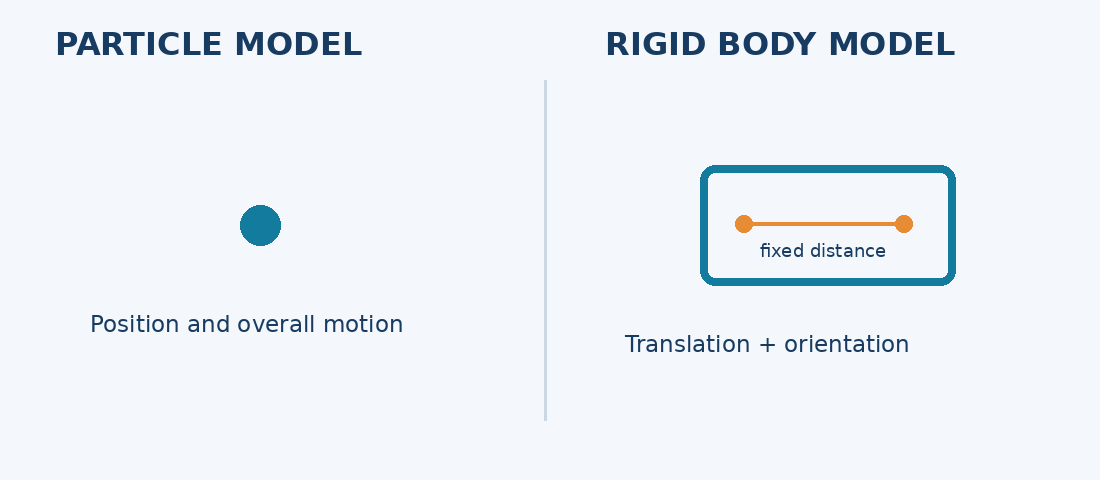
| Question | Particle | Rigid body |
|---|---|---|
| Does shape matter? | No | Yes |
| Can we study rotation? | Not about its own size | Yes |
| Typical example | A spacecraft traveling between planets | A wheel spinning on an axle |
3. Where do we use the approximation?
Many solid objects are approximately rigid during ordinary motion: a door swinging on hinges, a spinning flywheel, a bicycle wheel, or a moving vehicle body. The approximation works because the change in shape is small compared with the motion being studied.
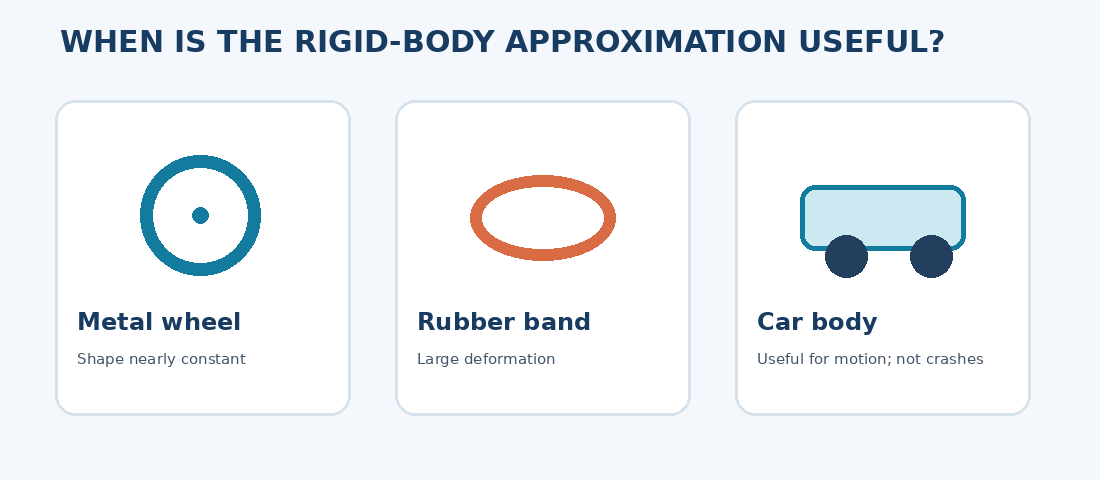
To predict how a door rotates around its hinges, we usually treat it as rigid. Every point on the door turns through the same angle, although points farther from the hinges travel a greater distance.
4. When does the model fail?
A rubber band stretching, a diving board bending, a spring compressing, or a car crumpling in a collision cannot be treated as rigid when the deformation itself is important.
Even a steel beam bends slightly under load. Whether that matters depends on the question. For calculating the beam’s overall movement, a rigid model may be adequate; for determining stress or deflection, it is not.
“Metal objects are rigid, and rubber objects are not.” Not necessarily. Rigidity is an approximation for a particular problem, not a permanent label for a material.
5. Worked examples
Problem: A satellite travels around Earth. We want to calculate its orbital period. Must we model its size and rotation?
Reasoning: If the satellite is very small compared with the orbit and its orientation does not affect the calculation, treat it as a particle.
Answer: The particle model is sufficient.
Problem: Two points on a wheel are 0.20 m and 0.40 m from its center. The wheel rotates through 1.5 radians. Find the distance each point travels.
Equation: s = rθ (θ in radians)
Inner point: s = 0.20 × 1.5 = 0.30 m
Outer point: s = 0.40 × 1.5 = 0.60 m
Interpretation: Both points rotate through the same angle, but the outer point travels twice as far.
6. Check your understanding — with answers
- What remains unchanged in a rigid body?
Answer: The distance between every pair of points in the body.
- Why is a particle model unsuitable for a spinning door?
Answer: A single point cannot describe the door’s size, orientation, or rotation about its hinges.
- Can a car be modeled as rigid during a crash? Explain.
Answer: Not when we are studying deformation or impact damage, because the car body changes shape.
- Two points on a rigid wheel rotate through 2 radians. One is 0.5 m from the axis. How far does it move?
Answer: s = rθ = 0.5 × 2 = 1.0 m.
- Why do physicists use idealized models?
Answer: They simplify a problem while retaining the features needed to answer the question accurately.
Common mistakes
- Confusing rigid with stationary: a rigid body may move and rotate.
- Assuming real objects are perfectly rigid: all real materials deform to some extent.
- Using a particle model when torque, orientation, or rotation is central to the question.
- Forgetting that points at different radii travel different distances during the same rotation.
Key terms
- Rigid body: idealized object with fixed distances between all points.
- Particle model: object represented by a single point.
- Translation: motion in which all points undergo the same displacement.
- Rotation: change in orientation around an axis.
- Deformation: change in shape or dimensions.
- Approximation: simplified description valid under stated conditions.
Key takeaways
A rigid body can move and rotate, but it does not change shape in the model. Choose a particle model when size and orientation do not matter; choose a rigid-body model when rotation or force location matters. If deformation is significant, neither idealization may be sufficient.