Introduction to Matrices
1. Matrix Fundamentals
Learning outcomes
- I can define matrices and their dimensions.
- I can identify different types of matrices.
- I can represent data using matrices.
- I can interpret matrix notation.
- I can recognise practical uses of matrices.
Matrix Fundamentals
Introduction to Matrices
Matrices are mathematical structures used to organise, represent, and analyse information.
A matrix is a rectangular arrangement of numbers, variables, or mathematical expressions organised into rows and columns.
Matrices are particularly useful when working with large amounts of data, solving systems of equations, representing geometric transformations, and modelling relationships between quantities.
They are widely used in mathematics, engineering, computer science, economics, physics, statistics, and artificial intelligence.
For example, a school might record the test scores of several students across different subjects. Instead of writing each score separately, the information can be organised into a matrix.
Consider the following scores:
|
Student |
Mathematics |
Science |
English |
|---|---|---|---|
|
Alice |
85 |
90 |
78 |
|
Ben |
72 |
88 |
81 |
|
Chloe |
94 |
91 |
89 |
These scores can be represented by the matrix:
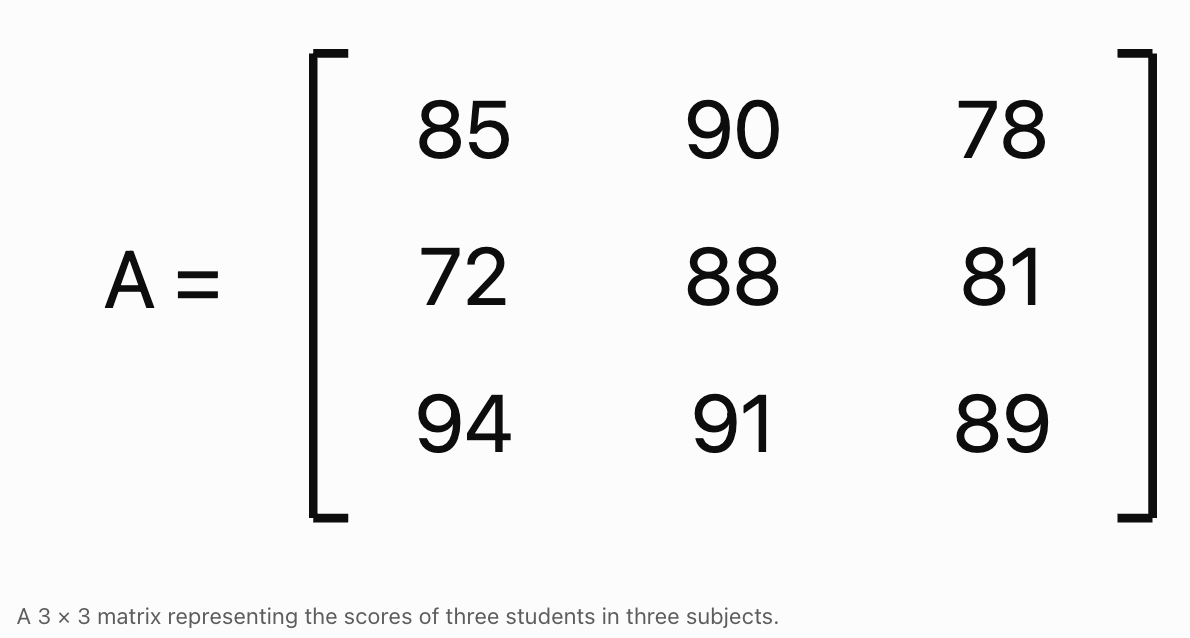
Each row represents one student.
Each column represents one subject.
Matrices allow this information to be stored and manipulated systematically.
Rows and Columns
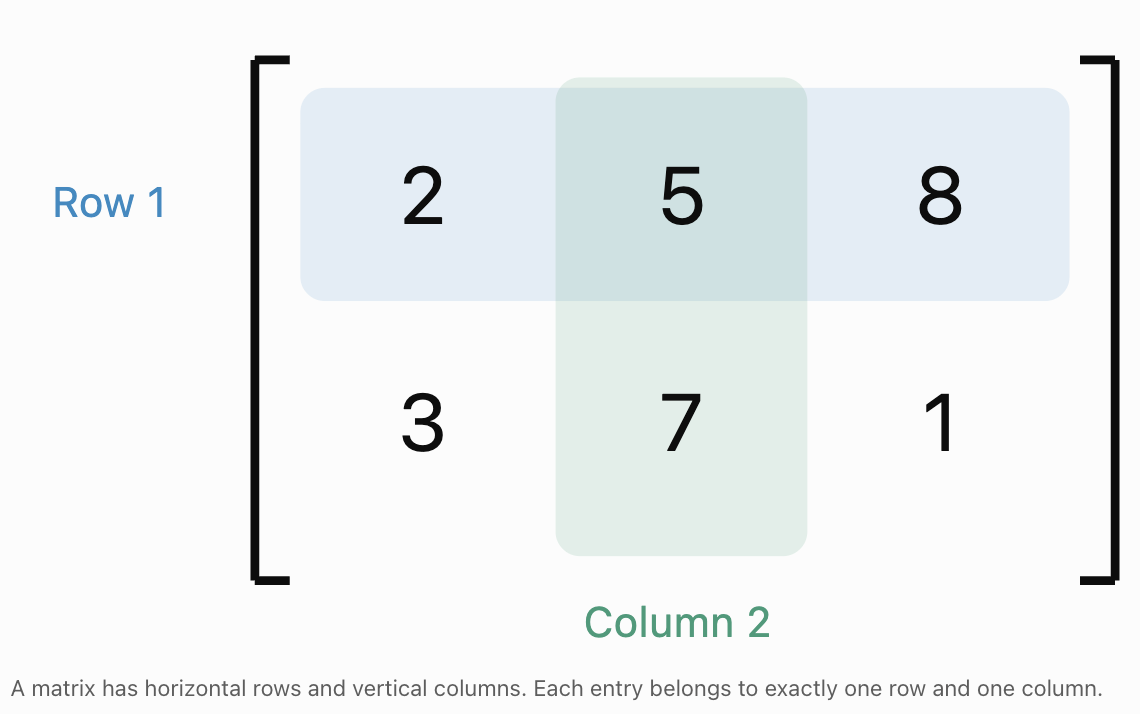
A matrix consists of horizontal rows and vertical columns.
-
A row is a horizontal arrangement of entries.
-
A column is a vertical arrangement of entries.
-
An element or entry is an individual value in a matrix.
Consider:
A = [[2, 5, 8], [3, 7, 1]]
The outer brackets enclose the matrix. Each inner bracket represents a row.
Identifying the Rows
Row 1:
[2, 5, 8]
Row 2:
[3, 7, 1]
Identifying the Columns
Column 1 contains 2 and 3.
Column 2 contains 5 and 7.
Column 3 contains 8 and 1.
Important Observation
The arrangement of values matters.
Changing the order of rows or columns may change the meaning of the data.
For example, swapping two student rows would change which student each set of scores represents.
Dimensions of a Matrix
The dimensions or order of a matrix describe its number of rows and columns.
The standard notation is:
m × n
where:
-
m = number of rows.
-
n = number of columns.
The number of rows is always written first.
Examples
|
Matrix |
Rows |
Columns |
Dimensions |
|---|---|---|---|
|
[[2, 4], [6, 8]] |
2 |
2 |
2 × 2 |
|
[[1, 3, 5]] |
1 |
3 |
1 × 3 |
|
[[4], [7], [9]] |
3 |
1 |
3 × 1 |
|
[[1, 2, 3], [4, 5, 6]] |
2 |
3 |
2 × 3 |
|
[[2, 0], [1, 4], [3, 5]] |
3 |
2 |
3 × 2 |
Worked Example: Determining Matrix Dimensions
Consider:
A = [[3, 7, 2, 5], [1, 4, 8, 6], [9, 0, 3, 2]]
Step 1: Count the rows
There are three rows.
Step 2: Count the columns
There are four columns.
Final Answer
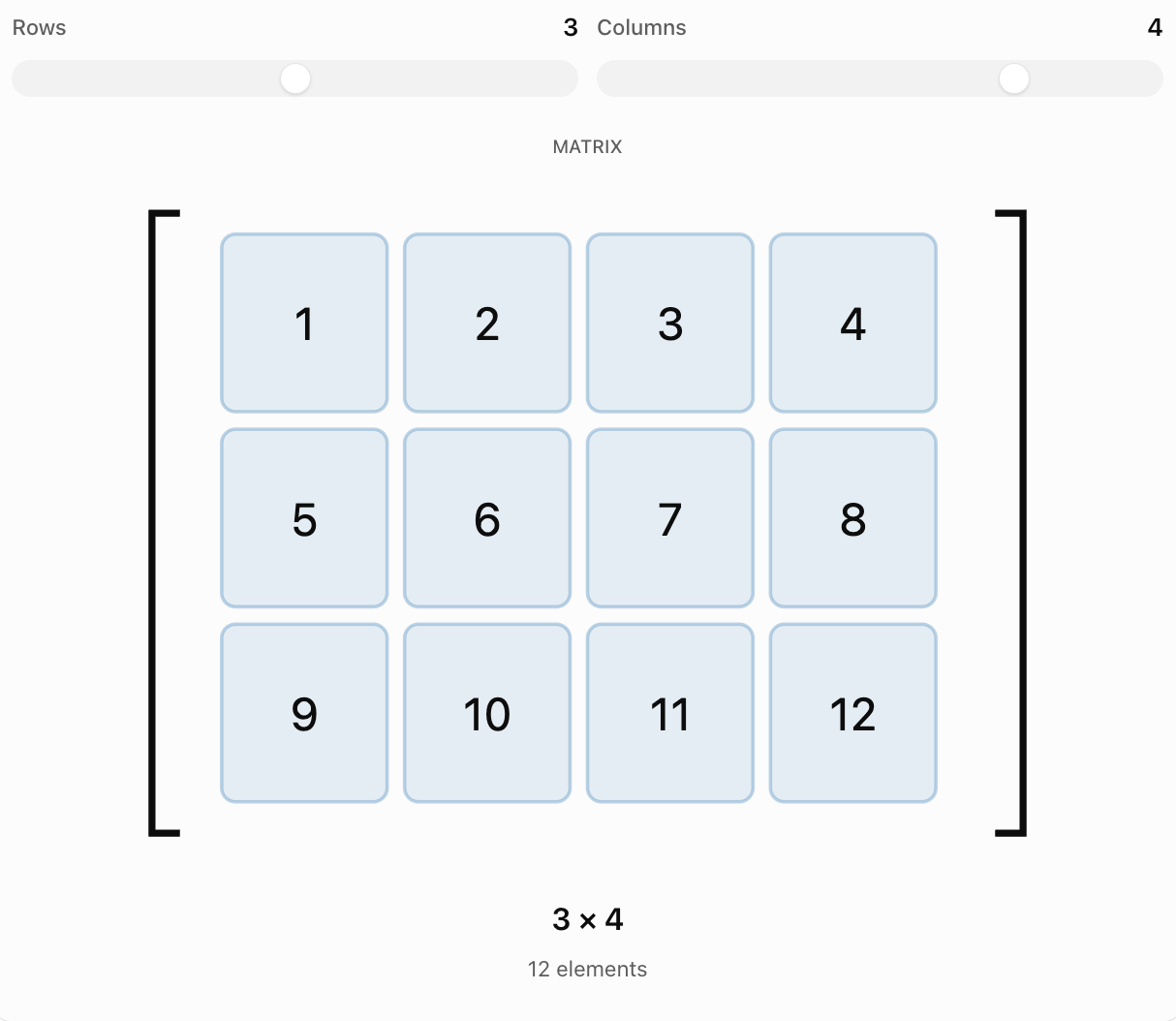
A is a 3 × 4 matrix.
Number of Elements
A matrix with dimensions m × n contains:
Number of elements = m × n
For a 3 × 4 matrix:
3 × 4 = 12
Therefore, matrix A contains 12 elements.
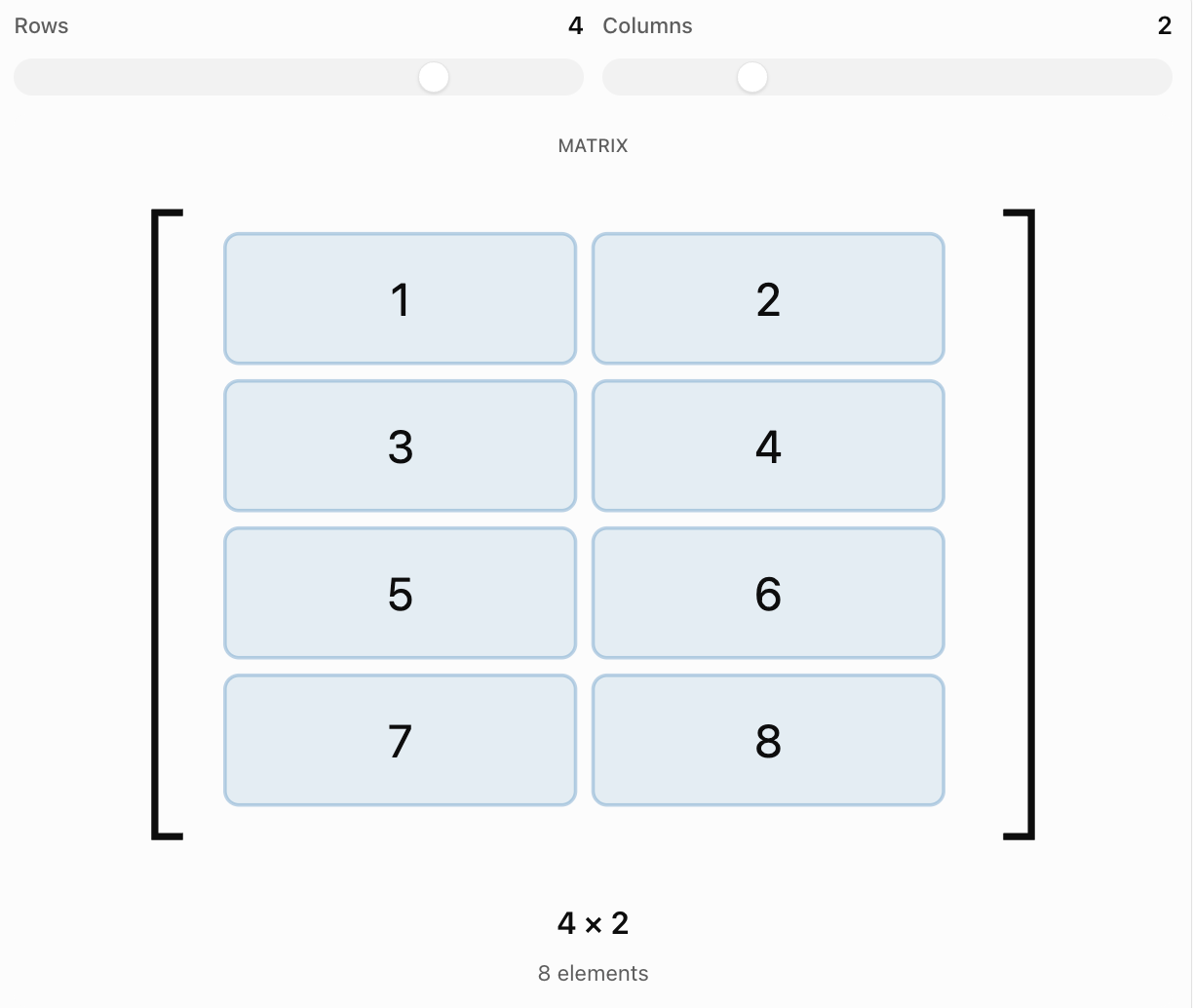
Explore Matrix Dimensions
Change the number of rows and columns to see how the dimensions and total number of elements change.
Matrix Notation
Matrices are usually represented by capital letters:
A, B, C, M, X
Individual entries are represented by lowercase letters with subscripts.
For a matrix A, an entry is written:
aᵢⱼ
where:
-
i identifies the row.
-
j identifies the column.
The first subscript always refers to the row.
The second subscript refers to the column.
For example:
a₂₃
means the element in row 2, column 3.
Worked Example: Reading Matrix Entries
Consider:
A = [[4, 7, 2], [9, 1, 5], [6, 8, 3]]
Find:
-
a₁₂
-
a₂₃
-
a₃₁
-
a₃₃
Step 1: Find a₁₂
Row 1, column 2 contains 7.
a₁₂ = 7
Step 2: Find a₂₃
Row 2, column 3 contains 5.
a₂₃ = 5
Step 3: Find a₃₁
Row 3, column 1 contains 6.
a₃₁ = 6
Step 4: Find a₃₃
Row 3, column 3 contains 3.
a₃₃ = 3
Important Principle
Matrix subscripts are read row first, column second.
General Matrix Representation
A matrix with m rows and n columns can be written:
A = [aᵢⱼ], where i = 1, 2, ..., m and j = 1, 2, ..., n.
For a 2 × 3 matrix:
A = [[a₁₁, a₁₂, a₁₃], [a₂₁, a₂₂, a₂₃]]
The entries may be:
-
Numbers.
-
Variables.
-
Algebraic expressions.
-
Measurements.
-
Data values.
Example: A Matrix Containing Variables
B = [[x, 2y], [3x, y + 1]]
This is a 2 × 2 matrix.
If x = 2 and y = 3:
B = [[2, 6], [6, 4]]
Matrices do not need to contain only fixed numerical values.
Types of Matrices
Matrices can be classified according to their dimensions and the arrangement of their entries.
Row Matrix
A row matrix contains exactly one row.
Example:
A = [[3, 5, 7, 9]]
Dimensions:
1 × 4
Row matrices are useful for representing a single set of related values.
For example, one student's scores across four subjects.
Column Matrix
A column matrix contains exactly one column.
Example:
B = [[2], [4], [6]]
Dimensions:
3 × 1
Column matrices are commonly used to represent vectors.
For example, the three-dimensional position vector (2, 4, 6) can be represented as a column matrix.
Rectangular Matrix
A rectangular matrix has a different number of rows and columns.
Example:
C = [[1, 2, 3], [4, 5, 6]]
Dimensions:
2 × 3
Rectangular matrices are frequently used to organise data tables.
Square Matrix
A square matrix has the same number of rows and columns.
Example:
D = [[2, 5], [7, 3]]
Dimensions:
2 × 2
Another example:
E = [[1, 2, 3], [4, 5, 6], [7, 8, 9]]
Dimensions:
3 × 3
Square matrices are particularly important in systems of equations, transformations, and advanced matrix operations.
Zero Matrix
A zero matrix contains only zeros.
Example:
O = [[0, 0, 0], [0, 0, 0]]
Dimensions:
2 × 3
Another example:
O = [[0, 0], [0, 0]]
Dimensions:
2 × 2
Important Properties
-
Every entry is zero.
-
Zero matrices can have different dimensions.
-
A zero matrix does not have to be square.
The zero matrix plays a role similar to the number zero in ordinary arithmetic.
For matrix addition, it acts as an additive identity when its dimensions match those of the other matrix.
Identity Matrix
An identity matrix is a square matrix with:
-
Ones along the main diagonal.
-
Zeros everywhere else.
The main diagonal extends from the upper-left corner to the lower-right corner.
Identity Matrix of Order 2
I₂ = [[1, 0], [0, 1]]
Identity Matrix of Order 3
I₃ = [[1, 0, 0], [0, 1, 0], [0, 0, 1]]
Important Property
When a matrix A is multiplied by a compatible identity matrix, A remains unchanged.
For a 2 × 2 matrix:
AI₂ = I₂A = A
This is similar to multiplying a number by 1.
Why Identity Matrices Matter
Identity matrices are used in:
-
Matrix multiplication.
-
Matrix inverses.
-
Coordinate transformations.
-
Systems of linear equations.
-
Computer graphics.
Diagonal Matrix
A diagonal matrix is a square matrix in which all entries outside the main diagonal are zero.
Example:
D = [[4, 0, 0], [0, 7, 0], [0, 0, 2]]
The diagonal entries are:
4, 7, 2
A diagonal matrix may contain zeros on its main diagonal.
Important Observation
Every identity matrix is a diagonal matrix.
However, not every diagonal matrix is an identity matrix.
Scalar Matrix
A scalar matrix is a diagonal matrix in which every entry on the main diagonal has the same value.
Example:
S = [[5, 0, 0], [0, 5, 0], [0, 0, 5]]
This can also be written:
S = 5I₃
A scalar matrix is useful for representing uniform scaling.
For example, multiplying coordinate vectors by 5 enlarges them by a factor of 5 relative to the origin.
Upper and Lower Triangular Matrices
Triangular matrices are square matrices with zeros on one side of the main diagonal.
Upper Triangular Matrix
All entries below the main diagonal are zero.
U = [[2, 4, 6], [0, 3, 5], [0, 0, 7]]
Lower Triangular Matrix
All entries above the main diagonal are zero.
L = [[2, 0, 0], [4, 3, 0], [6, 5, 7]]
Triangular matrices are important in numerical methods and solving systems of linear equations.
Symmetric Matrix
A symmetric matrix is a square matrix whose entries are mirrored across the main diagonal.
Example:
A = [[2, 5, 7], [5, 3, 4], [7, 4, 6]]
Notice:
a₁₂ = a₂₁ = 5
a₁₃ = a₃₁ = 7
a₂₃ = a₃₂ = 4
A symmetric matrix satisfies:
Aᵀ = A
where Aᵀ represents the transpose of A.
Symmetric matrices appear in statistics, physics, optimisation, and engineering.
Comparing Matrix Types
|
Matrix type |
Main characteristic |
Example |
|---|---|---|
|
Row |
One row |
[[2, 4, 6]] |
|
Column |
One column |
[[2], [4], [6]] |
|
Rectangular |
Different numbers of rows and columns |
[[1, 2, 3], [4, 5, 6]] |
|
Square |
Equal numbers of rows and columns |
[[1, 2], [3, 4]] |
|
Zero |
All entries are zero |
[[0, 0], [0, 0]] |
|
Identity |
Ones on main diagonal, zeros elsewhere |
[[1, 0], [0, 1]] |
|
Diagonal |
Zeros outside main diagonal |
[[3, 0], [0, 7]] |
|
Scalar |
Equal diagonal entries, zeros elsewhere |
[[5, 0], [0, 5]] |
|
Upper triangular |
Zeros below main diagonal |
[[2, 3], [0, 4]] |
|
Lower triangular |
Zeros above main diagonal |
[[2, 0], [3, 4]] |
|
Symmetric |
Mirrored across main diagonal |
[[2, 5], [5, 3]] |
A matrix may belong to more than one category.
For example, an identity matrix is also square, diagonal, scalar, upper triangular, lower triangular, and symmetric.
Representing Data Using Matrices
One of the most common applications of matrices is organising data.
Rows and columns allow related values to be stored in a consistent structure.
Example: School Attendance
A school records the number of students present in three classes over four days.
|
Class |
Monday |
Tuesday |
Wednesday |
Thursday |
|---|---|---|---|---|
|
Class A |
24 |
23 |
25 |
24 |
|
Class B |
21 |
22 |
20 |
23 |
|
Class C |
26 |
25 |
24 |
26 |
The data can be represented as:
A = [[24, 23, 25, 24], [21, 22, 20, 23], [26, 25, 24, 26]]
Interpretation
-
The matrix has three rows.
-
The matrix has four columns.
-
Its dimensions are 3 × 4.
-
Each row represents a class.
-
Each column represents a day.
Worked Example: Reading Attendance Data
What does a₂₃ represent?
Row 2 corresponds to Class B.
Column 3 corresponds to Wednesday.
Therefore:
a₂₃ = 20
This means 20 students were present in Class B on Wednesday.
Why Matrix Labels Matter
The numbers alone do not explain what they represent.
A matrix becomes meaningful when the rows, columns, and units are clearly identified.
Worked Example: Organising Sales Data
A company sells three products in two stores.
The number of products sold during one week is:
|
Store |
Product A |
Product B |
Product C |
|---|---|---|---|
|
Store 1 |
40 |
25 |
30 |
|
Store 2 |
35 |
45 |
20 |
Represent this information as a matrix.
Step 1: Identify the rows
There are two stores.
Therefore, the matrix needs two rows.
Step 2: Identify the columns
There are three products.
Therefore, the matrix needs three columns.
Step 3: Write the matrix
S = [[40, 25, 30], [35, 45, 20]]
Final Answer
The sales matrix has dimensions:
2 × 3
Interpreting Entries
s₁₂ = 25 means Store 1 sold 25 units of Product B.
s₂₃ = 20 means Store 2 sold 20 units of Product C.
Extending the Example
The total number of products sold by Store 1 is:
40 + 25 + 30 = 95
The total number of products sold by Store 2 is:
35 + 45 + 20 = 100
Matrices make it easier to organise information for later calculations.
Representing Images Using Matrices
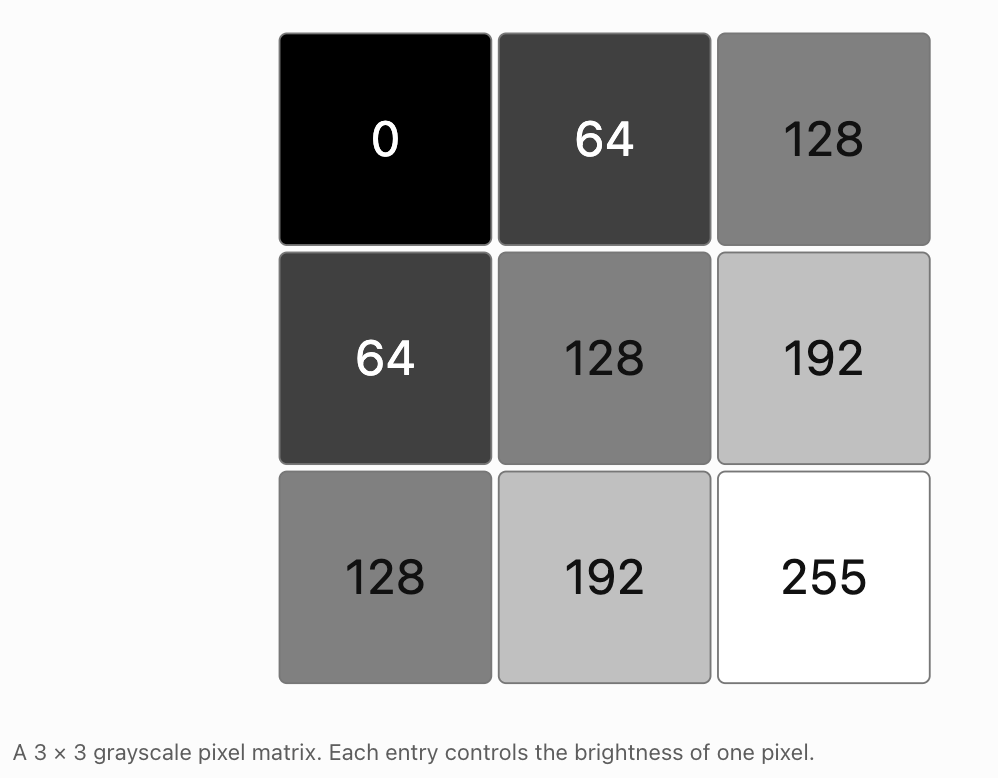
Digital images can be represented using matrices.
Each pixel has a numerical value describing its colour or brightness.
For a grayscale image:
-
0 commonly represents black.
-
255 commonly represents white.
-
Intermediate values represent shades of gray.
Consider:
P = [[0, 64, 128], [64, 128, 192], [128, 192, 255]]
This matrix represents a simple 3 × 3 grayscale image.
Interpretation
-
The top-left pixel has brightness 0.
-
The centre pixel has brightness 128.
-
The bottom-right pixel has brightness 255.
Colour Images
Colour images often use separate matrices for red, green, and blue intensity values.
This is the basis of the RGB colour model.
Practical Uses
Image matrices are used in:
-
Photography.
-
Medical imaging.
-
Computer vision.
-
Video processing.
-
Facial recognition systems.
-
Satellite imagery.
-
Artificial intelligence.


Representing Systems of Equations
Matrices provide an organised way to represent systems of linear equations.
Consider:
2x + 3y = 7
4x − y = 5
The coefficients can be arranged into the matrix:
A = [[2, 3], [4, −1]]
The variables can be represented as a column matrix:
X = [[x], [y]]
The constants can be represented as:
B = [[7], [5]]
The system can then be written:
AX = B
This is called the matrix form of a system of linear equations.
Why This Is Useful
Matrix methods allow large systems of equations to be solved systematically.
They are especially useful when systems contain many variables and equations.
For example, engineers may use matrices to solve systems describing forces, electrical circuits, or structural stresses.
Matrices in Geometric Transformations
Matrices can describe geometric transformations such as:
-
Rotations.
-
Reflections.
-
Dilations.
-
Combinations of transformations.
Example: Rotation Matrix
A 90° counterclockwise rotation about the origin can be represented by:
R = [[0, −1], [1, 0]]
This matrix transforms points according to:
(x, y) → (−y, x)
For example:
P = (3, 2)
After rotation:
P′ = (−2, 3)
Example: Dilation Matrix
A dilation with scale factor 2 can be represented by:
D = [[2, 0], [0, 2]]
This produces:
(x, y) → (2x, 2y)
For example:
P = (3, 2)
After dilation:
P′ = (6, 4)

Important Observation
Matrix transformations are fundamental in computer graphics and engineering design.
They allow geometric objects to be transformed efficiently using mathematical operations.
Matrices in Economics and Business
Businesses use matrices to organise and analyse numerical information.
Examples include:
-
Sales figures.
-
Production quantities.
-
Inventory levels.
-
Employee schedules.
-
Transportation costs.
-
Financial models.
Worked Example: Production Data
A factory produces three products during two shifts.
|
Shift |
Product A |
Product B |
Product C |
|---|---|---|---|
|
Morning |
120 |
90 |
60 |
|
Evening |
100 |
110 |
80 |
The production matrix is:
P = [[120, 90, 60], [100, 110, 80]]
Questions
How many units of Product B are produced during the evening shift?
p₂₂ = 110
How many units of Product C are produced during the morning shift?
p₁₃ = 60
What are the dimensions of P?
2 × 3
Interpretation
The matrix provides a compact representation of production data.
It can later be used to calculate totals, costs, revenue, and resource requirements.
Matrices in Science and Engineering
Matrices are used extensively in scientific and engineering calculations.
Physics
Matrices can represent:
-
Rotations.
-
Coordinate transformations.
-
Systems of forces.
-
Electrical circuits.
-
Quantum mechanical operations.
Engineering
Matrices are used to model:
-
Structural forces.
-
Mechanical systems.
-
Electrical networks.
-
Robotics.
-
Control systems.
-
Three-dimensional transformations.
Chemistry
Matrices can help organise:
-
Chemical reaction coefficients.
-
Stoichiometric relationships.
-
Experimental measurements.
-
Reaction networks.
Biology
Matrices are used in:
-
Population models.
-
Genetics.
-
Ecological interactions.
-
Biological networks.
-
Medical imaging.


Matrices in Networks
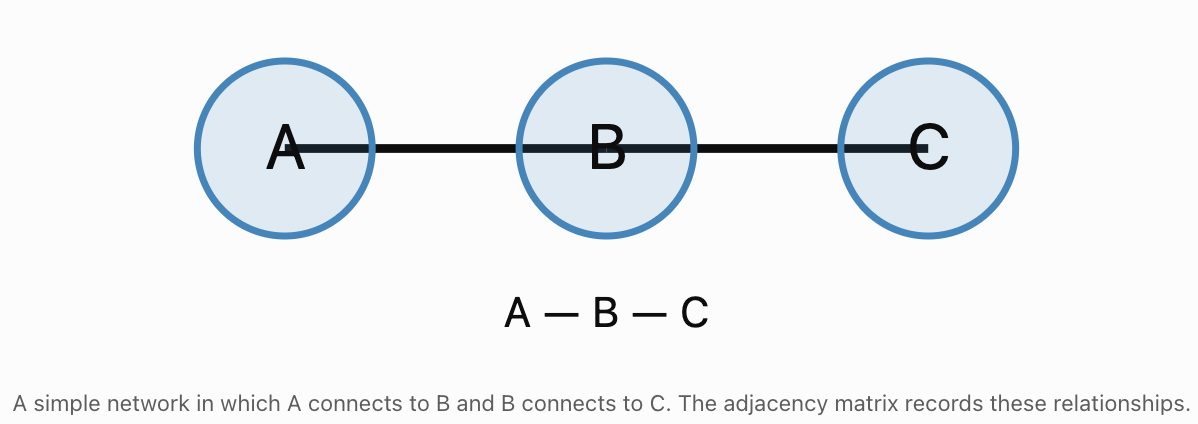
Matrices can represent relationships between connected objects.
For example, consider three cities:
A, B, and C.
Suppose:
-
A is connected to B.
-
B is connected to C.
-
A is not directly connected to C.
This information can be represented using an adjacency matrix.
M = [[0, 1, 0], [1, 0, 1], [0, 1, 0]]
Here:
-
1 indicates a direct connection.
-
0 indicates no direct connection.
The diagonal entries are zero because the model does not include connections from a city to itself.
Interpreting the Matrix
m₁₂ = 1 means A is directly connected to B.
m₁₃ = 0 means A is not directly connected to C.
m₂₃ = 1 means B is directly connected to C.
Practical Uses
Adjacency matrices are used in:
-
Transportation networks.
-
Computer networks.
-
Social networks.
-
Communication systems.
-
Graph theory.
-
Route planning.
Matrices in Artificial Intelligence
Modern artificial intelligence relies heavily on matrices.
Data, model parameters, and calculations are often represented using arrays of numbers.
For example, a simple dataset containing four observations and three measured features can be represented by a 4 × 3 matrix.
X = [[2, 5, 1], [3, 4, 2], [6, 7, 3], [5, 8, 4]]
Each row represents one observation.
Each column represents one feature.
Why Matrices Are Useful in AI
Matrices allow computers to perform many calculations efficiently.
They are used in:
-
Machine learning.
-
Neural networks.
-
Image recognition.
-
Language processing.
-
Recommendation systems.
-
Data classification.

Important Observation
The mathematical operations performed on matrices allow AI systems to process large quantities of information.
Understanding matrix fundamentals is an important foundation for studying machine learning and advanced computing.
Matrix Equality
Two matrices are equal when:
-
They have the same dimensions.
-
Their corresponding entries are equal.
Consider:
A = [[2, 5], [7, 3]]
B = [[2, 5], [7, 3]]
Since every corresponding entry is equal:
A = B
However:
C = [[2, 7], [5, 3]]
Although C contains the same four numbers, they are arranged differently.
Therefore:
A ≠ C
Worked Example: Finding Unknown Entries
Suppose:
A = [[x, 4], [7, y]]
and:
B = [[3, 4], [7, 9]]
If A = B, find x and y.
Corresponding entries must be equal.
Therefore:
x = 3
y = 9
Final Answer
x = 3 and y = 9
The Transpose of a Matrix
The transpose of a matrix is obtained by interchanging its rows and columns.
The transpose of A is written:
Aᵀ
For example:
A = [[1, 2, 3], [4, 5, 6]]
The rows of A become the columns of Aᵀ.
Therefore:
Aᵀ = [[1, 4], [2, 5], [3, 6]]
Dimensions
Original matrix:
2 × 3
Transpose:
3 × 2
Important Principle
If A has dimensions m × n, then Aᵀ has dimensions n × m.
Practical Uses
Transposes are useful in:
-
Data analysis.
-
Matrix multiplication.
-
Statistics.
-
Engineering.
-
Machine learning.
Matrix Notation in Mathematical Models
Matrices can represent mathematical relationships in a compact form.
For example, consider the equations:
x + 2y = 8
3x + 4y = 18
The coefficient matrix is:
A = [[1, 2], [3, 4]]
The variable matrix is:
X = [[x], [y]]
The constant matrix is:
B = [[8], [18]]
The system is written:
AX = B
Interpretation
The matrix A stores the coefficients.
The matrix X stores the unknown variables.
The matrix B stores the constants.
This notation becomes especially valuable when working with larger systems.
Common Mistakes
Confusing rows and columns
Rows are horizontal, while columns are vertical.
Writing dimensions in the wrong order
Matrix dimensions are written rows × columns, not columns × rows.
Misreading matrix subscripts
The first subscript indicates the row, and the second indicates the column.
Assuming all matrices are square
Matrices can have different numbers of rows and columns.
Assuming a zero matrix must be square
Zero matrices can have any dimensions.
Confusing a zero matrix with an identity matrix
A zero matrix contains only zeros, while an identity matrix contains ones along the main diagonal.
Assuming all diagonal matrices are identity matrices
Diagonal matrices may have values other than 1 on the main diagonal.
Confusing row matrices and column matrices
A row matrix has one row, while a column matrix has one column.
Ignoring the order of entries
The positions of entries are important.
Assuming matrices with the same values are equal
Corresponding entries must appear in the same positions.
Forgetting that matrices may contain variables
Matrix entries can be numbers, variables, or expressions.
Misinterpreting matrix data
Rows and columns must be associated with their correct labels.
Confusing matrix dimensions with the number of elements
A 3 × 4 matrix has dimensions 3 × 4 but contains 12 elements.
Confusing a matrix with its transpose
Transposition interchanges rows and columns.
Assuming matrix notation is only used in mathematics
Matrices are widely used in science, engineering, economics, computing, and data analysis.
Key Terms
-
Matrix: A rectangular arrangement of numbers, variables, or expressions organised into rows and columns.
-
Row: A horizontal arrangement of entries in a matrix.
-
Column: A vertical arrangement of entries in a matrix.
-
Element: An individual value or expression within a matrix.
-
Entry: Another name for a matrix element.
-
Dimensions: The number of rows and columns in a matrix.
-
Order of a Matrix: Another term for its dimensions.
-
m × n Matrix: A matrix with m rows and n columns.
-
Matrix Notation: The mathematical symbols used to represent matrices and their entries.
-
Subscript: A small index identifying the position of an entry.
-
Row Matrix: A matrix containing exactly one row.
-
Column Matrix: A matrix containing exactly one column.
-
Rectangular Matrix: A matrix with different numbers of rows and columns.
-
Square Matrix: A matrix with equal numbers of rows and columns.
-
Zero Matrix: A matrix in which every entry is zero.
-
Identity Matrix: A square matrix with ones on the main diagonal and zeros elsewhere.
-
Diagonal Matrix: A square matrix with zeros outside the main diagonal.
-
Scalar Matrix: A diagonal matrix with equal diagonal entries.
-
Upper Triangular Matrix: A square matrix with zeros below the main diagonal.
-
Lower Triangular Matrix: A square matrix with zeros above the main diagonal.
-
Symmetric Matrix: A square matrix equal to its transpose.
-
Main Diagonal: The entries extending from the upper-left corner to the lower-right corner of a matrix.
-
Transpose: A matrix obtained by interchanging rows and columns.
-
Matrix Equality: A relationship in which matrices have identical dimensions and corresponding entries.
-
Coefficient Matrix: A matrix containing the coefficients of variables in a system of equations.
-
Column Vector: A vector represented as a matrix with one column.
-
Transformation Matrix: A matrix used to represent a geometric transformation.
-
Adjacency Matrix: A matrix describing connections between objects in a network.
-
Data Matrix: A matrix used to organise observations or measurements.
-
Pixel Matrix: A matrix representing image brightness or colour information.
-
Matrix Multiplication: An operation combining matrices according to row-and-column calculations.
-
Linear System: A collection of linear equations involving common variables.
-
Mathematical Model: A mathematical representation of a real-world situation.
-
RGB Colour Model: A system representing colours using red, green, and blue intensity values.
-
Machine Learning: A field of computing that develops systems capable of learning patterns from data.
Key Takeaways
-
A matrix is a rectangular arrangement of entries organised into rows and columns.
-
Matrix dimensions are written as rows × columns.
-
An m × n matrix contains m rows and n columns.
-
The total number of entries in a matrix is m × n.
-
Matrix entries are identified using row and column subscripts.
-
The notation aᵢⱼ represents the entry in row i, column j.
-
Matrices may contain numbers, variables, or expressions.
-
Row matrices contain one row.
-
Column matrices contain one column.
-
Rectangular matrices have different numbers of rows and columns.
-
Square matrices have equal numbers of rows and columns.
-
Zero matrices contain only zeros.
-
Identity matrices contain ones on the main diagonal and zeros elsewhere.
-
Diagonal matrices contain zeros outside the main diagonal.
-
Scalar matrices have equal diagonal entries.
-
Triangular matrices contain zeros above or below the main diagonal.
-
Symmetric matrices are mirrored across the main diagonal.
-
Two matrices are equal only when their dimensions and corresponding entries match.
-
Transposing a matrix interchanges its rows and columns.
-
Matrices can organise and represent data efficiently.
-
Matrices are used to represent systems of equations and geometric transformations.
-
Matrices are important in science, engineering, economics, statistics, computer graphics, and artificial intelligence.
-
Understanding matrix structure, notation, dimensions, and types provides the foundation for more advanced matrix operations and applications.
Check Your Understanding
Recall and Understanding
-
Define a matrix and explain the difference between a row and a column.
-
What are the dimensions of a matrix containing four rows and three columns?
-
Explain the meaning of the notation a₂₃.
-
Describe the difference between a row matrix and a column matrix.
-
Explain how an identity matrix differs from a zero matrix.
Application
6. Determine the dimensions and number of elements in:
A = [[2, 4, 6], [1, 3, 5], [7, 8, 9], [0, 2, 4]]
7. Given:
B = [[5, 8, 2], [3, 7, 9], [4, 1, 6]]
Find b₁₃, b₂₂, b₃₁, and b₃₃.
8. Write a 2 × 3 matrix representing the following sales data:
Store A sold 12 books, 8 pens, and 5 notebooks.
Store B sold 9 books, 15 pens, and 7 notebooks.
-
Write the 3 × 3 identity matrix.
-
Find the transpose of:
C = [[1, 4, 7], [2, 5, 8]]
Analysis and Challenge
11. Classify the following matrix as many ways as possible:
D = [[4, 0, 0], [0, 4, 0], [0, 0, 4]]
12. Determine whether the following matrices are equal:
A = [[2, 5], [7, 3]]
B = [[2, 7], [5, 3]]
Explain your reasoning.
13. If:
A = [[x, 3], [5, y]]
and:
B = [[7, 3], [5, 2]]
find x and y, given that A = B.
14. A digital grayscale image is represented by a 5 × 8 matrix. How many pixels does it contain? Explain what each entry represents.
15. Three towns are connected as follows: A is connected to B, A is connected to C, and B is not directly connected to C. Construct a 3 × 3 adjacency matrix for this undirected network, assuming no town is connected to itself.
Final Summary
Matrices are mathematical structures used to organise information into rows and columns.
Their dimensions describe the number of rows and columns, while matrix notation allows individual entries to be identified precisely.
Different matrix types have special properties. Row matrices, column matrices, square matrices, zero matrices, identity matrices, diagonal matrices, triangular matrices, and symmetric matrices each play important roles in mathematics.
Matrices are especially valuable because they provide a compact and systematic way to represent information.
They are used to organise data, describe systems of equations, represent geometric transformations, model networks, and perform calculations in science, engineering, economics, and computer science.
Understanding matrix fundamentals prepares students for more advanced topics such as matrix addition, scalar multiplication, matrix multiplication, determinants, inverses, systems of linear equations, and transformations.
The central principle is that matrices provide an organised mathematical language for representing and analysing relationships between quantities, making them essential tools in both pure mathematics and real-world applications.