Advanced Vector Geometry
4. Vector Transformations
Learning outcomes
- I can apply translations using vectors.
- I can describe geometric transformations with vectors.
- I can combine multiple transformations.
- I can analyse geometric movement.
- I can model transformations mathematically.
Vector Transformations
Introduction to Vector Transformations
Geometric transformations describe how points, lines, shapes, and objects move or change position in space.
A transformation may move an object without changing its shape, rotate it around a point, reflect it across a line, or change its size.
Vectors provide a mathematical way to describe these transformations precisely.
For example, instead of saying that a triangle moves four units to the right and three units upward, we can describe the movement using the translation vector:
v = (4, 3)
Vector transformations are useful in geometry, physics, engineering, computer graphics, animation, robotics, and navigation.
They allow us to:
-
Describe the movement of geometric figures.
-
Calculate the new coordinates of transformed points.
-
Combine multiple transformations.
-
Determine the overall effect of a sequence of movements.
-
Model geometric changes using vectors and matrices.
-
Analyse whether lengths, angles, and orientations are preserved.
The central idea is that transformations can be represented using mathematical rules that map original points to new positions.
Understanding Geometric Transformations
A geometric transformation is a rule that maps each point of a figure to another point.
The original figure is called the preimage.
The resulting figure is called the image.
For example, if point A is transformed into point A′, we write:
A → A′
The prime symbol (′) indicates the transformed point.
A transformation can be represented using coordinate rules.
For example:
(x, y) → (x + 3, y − 2)
This means every point moves:
-
3 units to the right.
-
2 units downward.
Common Types of Transformations
|
Transformation |
Description |
Effect |
|---|---|---|
|
Translation |
Slides a figure |
Changes position |
|
Reflection |
Flips a figure across a line |
Reverses orientation |
|
Rotation |
Turns a figure around a point |
Changes direction |
|
Dilation |
Enlarges or reduces a figure |
Changes size |
|
Combination |
Applies multiple transformations |
Depends on the operations |
Translations, reflections, and rotations are rigid transformations, also called isometries.
They preserve distances and angles.
Dilations generally change lengths but preserve angles and proportional relationships.


Translations Using Vectors
A translation moves every point of a figure by the same distance in the same direction.
The translation vector describes this movement.
For a two-dimensional translation:
v = (a, b)
the transformation rule is:
(x, y) → (x + a, y + b)
where:
-
a is the horizontal displacement.
-
b is the vertical displacement.
Interpreting Translation Vectors
|
Translation vector |
Movement |
|---|---|
|
(4, 0) |
4 units right |
|
(−3, 0) |
3 units left |
|
(0, 5) |
5 units up |
|
(0, −2) |
2 units down |
|
(3, 4) |
3 right, 4 up |
|
(−2, −5) |
2 left, 5 down |
A positive x-component moves a point right.
A negative x-component moves a point left.
A positive y-component moves a point up.
A negative y-component moves a point down.
Worked Example: Translating a Point
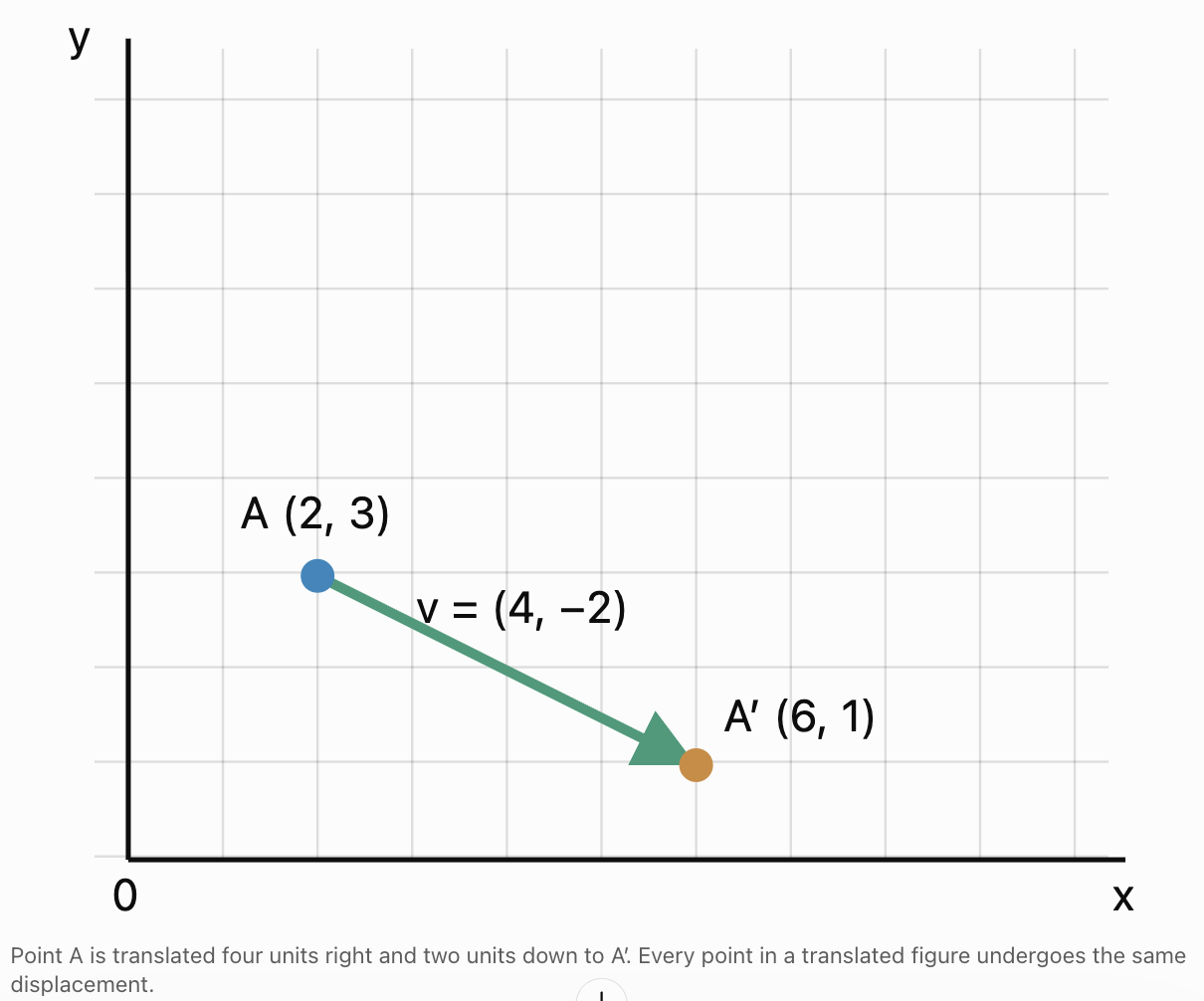
Point A has coordinates:
A = (2, 3)
Translate A using:
v = (4, −2)
Step 1: Write the translation rule
A′ = A + v
Step 2: Substitute
A′ = (2, 3) + (4, −2)
Step 3: Add corresponding components
A′ = (2 + 4, 3 − 2)
Final Answer
A′ = (6, 1)
The point moves four units right and two units down.
Translating Geometric Figures
When a figure is translated, every vertex moves according to the same translation vector.
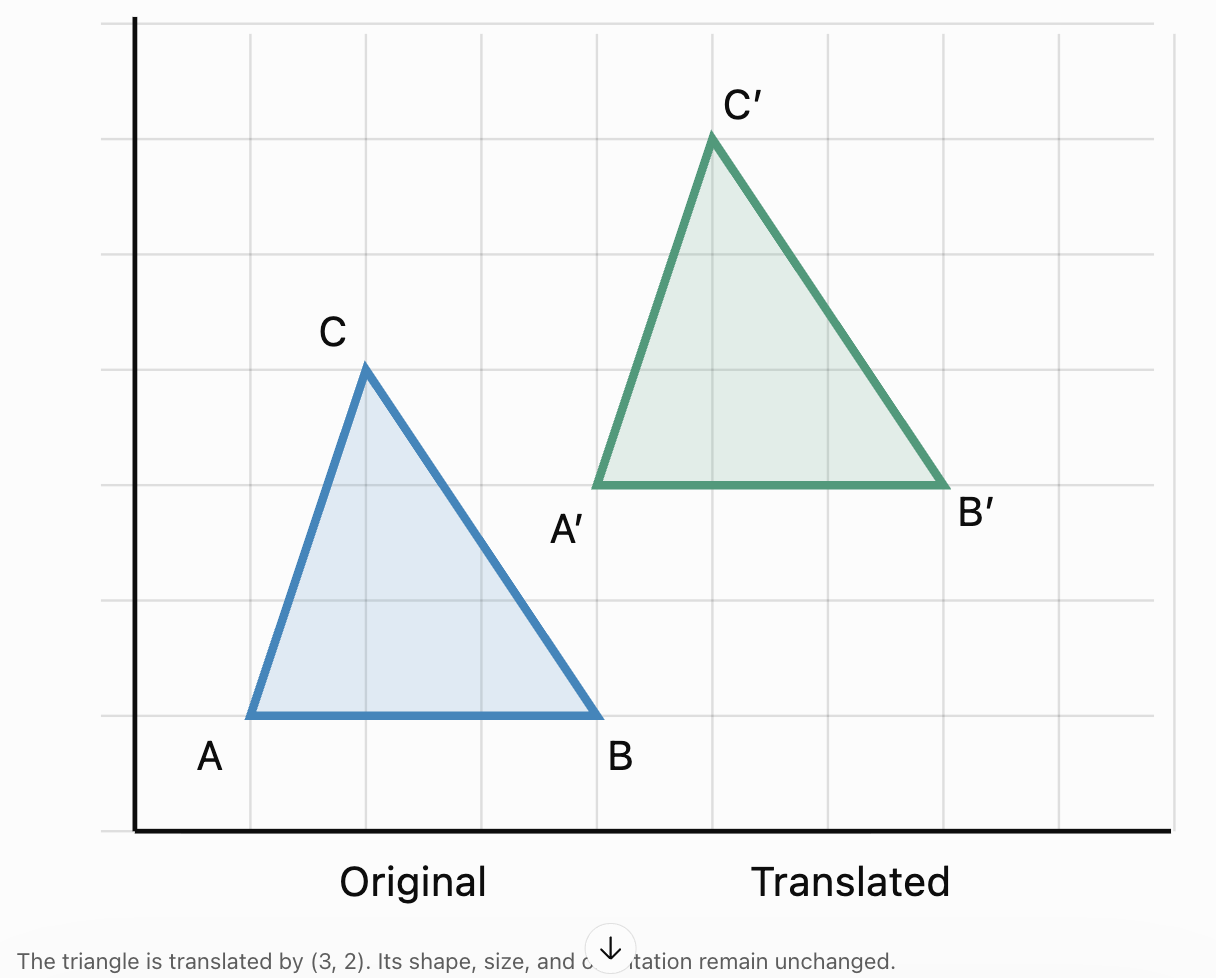
Worked Example: Translating a Triangle
A triangle has vertices:
A = (1, 1)
B = (4, 1)
C = (2, 4)
Translate the triangle using:
v = (3, 2)
Step 1: Translate A
A′ = (1 + 3, 1 + 2)
A′ = (4, 3)
Step 2: Translate B
B′ = (4 + 3, 1 + 2)
B′ = (7, 3)
Step 3: Translate C
C′ = (2 + 3, 4 + 2)
C′ = (5, 6)
Final Answer
The transformed triangle has vertices:
A′ = (4, 3)
B′ = (7, 3)
C′ = (5, 6)
Important Observation
A translation preserves:
-
Side lengths.
-
Angle measurements.
-
Area.
-
Perimeter.
-
Parallel relationships.
-
Orientation.
The image and preimage are congruent.
Finding a Translation Vector
Sometimes the original and transformed points are given, and the translation vector must be determined.
If:
A = (x₁, y₁)
A′ = (x₂, y₂)
then:
v = A′ − A
Therefore:
v = (x₂ − x₁, y₂ − y₁)
Worked Example
Point P = (−2, 5) is translated to:
P′ = (4, 1)
Find the translation vector.
Step 1: Subtract the original coordinates
v = P′ − P
Step 2: Substitute
v = (4 − (−2), 1 − 5)
Step 3: Simplify
v = (6, −4)
Interpretation
The point moves:
-
6 units right.
-
4 units down.
Verification
(−2, 5) + (6, −4) = (4, 1)
The translation is correct.
Magnitude and Direction of a Translation
A translation vector describes both distance and direction.
For:
v = (a, b)
the magnitude is:
|v| = √(a² + b²)
This gives the straight-line distance through which each point moves.
Worked Example
A figure is translated by:
v = (6, 8)
Calculate the distance moved.
Step 1: Apply the magnitude formula
|v| = √(6² + 8²)
Step 2: Simplify
|v| = √(36 + 64)
|v| = √100
Final Answer
|v| = 10 units
Although the figure moves six units horizontally and eight units vertically, the straight-line displacement is ten units.
Finding the Direction
For a nonzero vector:
v = (a, b)
the direction angle measured counterclockwise from the positive x-axis can be calculated using the vector's components.
When a > 0:
tan θ = b/a
For vectors in other quadrants, the signs of both components must be considered to select the correct angle.
For v = (6, 8):
tan θ = 8/6
θ ≈ 53.1°
Therefore, the translation is directed approximately 53.1° above the positive x-axis.
Combining Multiple Translations
Multiple translations can be combined by adding their translation vectors.
Suppose a figure is translated by:
v₁ = (a, b)
followed by:
v₂ = (c, d)
The combined translation is:
v_total = v₁ + v₂
Therefore:
v_total = (a + c, b + d)
Worked Example
A point undergoes two translations:
First:
v₁ = (4, 3)
Then:
v₂ = (−2, 5)
Find the combined translation.
Step 1: Add the vectors
v_total = (4, 3) + (−2, 5)
Step 2: Combine components
v_total = (4 − 2, 3 + 5)
Final Answer
v_total = (2, 8)
The overall movement is two units right and eight units up.
Worked Example: Three Successive Translations
A robot moves according to:
v₁ = (5, 2)
v₂ = (−3, 4)
v₃ = (1, −6)
Find the total displacement.
Step 1: Add all vectors
v_total = v₁ + v₂ + v₃
Step 2: Substitute
v_total = (5, 2) + (−3, 4) + (1, −6)
Step 3: Combine x-components
5 − 3 + 1 = 3
Step 4: Combine y-components
2 + 4 − 6 = 0
Final Answer
v_total = (3, 0)
The robot finishes three units to the right of its starting position.
Important Principle
The order of pure translations does not affect the final result because vector addition is commutative.
v₁ + v₂ = v₂ + v₁
This is not generally true when translations are combined with rotations or reflections.
Inverse Translations
An inverse transformation reverses the effect of the original transformation.
If a translation is:
v = (a, b)
then the inverse translation is:
−v = (−a, −b)
Worked Example
A point is translated by:
v = (7, −4)
Find the inverse translation.
Solution
−v = (−7, 4)
The inverse moves the point seven units left and four units up.
Verification
v + (−v) = (7, −4) + (−7, 4)
= (0, 0)
The combined transformation produces no net displacement.
Identity Transformation
A transformation that leaves every point unchanged is called the identity transformation.
For translations, the identity vector is:
(0, 0)
Reflections Using Coordinate Rules
A reflection flips a figure across a line called the line of reflection.
Unlike a translation, a reflection changes the orientation of a figure.
Common coordinate rules include:
|
Reflection |
Coordinate rule |
|---|---|
|
Across x-axis |
(x, y) → (x, −y) |
|
Across y-axis |
(x, y) → (−x, y) |
|
Across y = x |
(x, y) → (y, x) |
|
Across y = −x |
(x, y) → (−y, −x) |
|
Across x = a |
(x, y) → (2a − x, y) |
|
Across y = b |
(x, y) → (x, 2b − y) |
Worked Example: Reflection Across the y-Axis
Reflect:
P = (4, −3)
across the y-axis.
Step 1: Apply the reflection rule
(x, y) → (−x, y)
Step 2: Substitute
(4, −3) → (−4, −3)
Final Answer
P′ = (−4, −3)
The x-coordinate changes sign, while the y-coordinate remains unchanged.

Rotations Using Coordinate Rules
A rotation turns a figure around a fixed point.
For rotations about the origin, common rules are:
|
Rotation |
Coordinate rule |
|---|---|
|
90° counterclockwise |
(x, y) → (−y, x) |
|
180° |
(x, y) → (−x, −y) |
|
270° counterclockwise |
(x, y) → (y, −x) |
|
90° clockwise |
(x, y) → (y, −x) |
Worked Example: 90° Counterclockwise Rotation
Rotate:
P = (3, 2)
90° counterclockwise about the origin.
Step 1: Apply the rule
(x, y) → (−y, x)
Step 2: Substitute
(3, 2) → (−2, 3)
Final Answer
P′ = (−2, 3)
Important Observation
Rotations preserve:
-
Distance.
-
Angle measurements.
-
Area.
-
Shape.
-
Orientation.
They change the position and direction of the figure.

Dilations and Scale Transformations
A dilation changes the size of a figure using a scale factor.
For a dilation centred at the origin:
(x, y) → (kx, ky)
where k is the scale factor.
Interpreting the Scale Factor
-
k > 1 produces an enlargement.
-
0 < k < 1 produces a reduction.
-
k = 1 leaves the figure unchanged.
-
k < 0 also reverses the direction of position vectors through the centre, in addition to scaling their lengths.
Worked Example
Dilate:
P = (2, 3)
using scale factor:
k = 2
Step 1: Apply the dilation rule
P′ = (2x, 2y)
Step 2: Substitute
P′ = (2(2), 2(3))
Final Answer
P′ = (4, 6)
The point's distance from the origin doubles.
Effect on Geometric Properties
For a dilation with scale factor k:
-
Lengths are multiplied by |k|.
-
Areas are multiplied by k².
-
Angles remain unchanged.
-
The image and preimage are similar.
Combining Different Transformations
A sequence of transformations is called a composition of transformations.
For example, a figure might be:
-
Translated.
-
Rotated.
-
Reflected.
The final image depends on the order in which these operations are applied.
Worked Example: Translation Followed by Rotation
Point P has coordinates:
P = (2, 1)
First translate by:
v = (3, 2)
Then rotate 90° counterclockwise about the origin.
Step 1: Apply the translation
P′ = (2 + 3, 1 + 2)
P′ = (5, 3)
Step 2: Apply the rotation
The rotation rule is:
(x, y) → (−y, x)
Therefore:
(5, 3) → (−3, 5)
Final Answer
P″ = (−3, 5)
Reversing the Order
Now rotate P first, then apply the same translation.
Step 1: Rotate P
P = (2, 1)
After a 90° counterclockwise rotation:
P′ = (−1, 2)
Step 2: Translate
P″ = (−1 + 3, 2 + 2)
P″ = (2, 4)
Comparison
|
Order |
Final coordinates |
|---|---|
|
Translation, then rotation |
(−3, 5) |
|
Rotation, then translation |
(2, 4) |
The results are different.
Important Principle
The order of transformations matters when combining different types of transformations.
Translations and rotations are not generally commutative.
Describing Transformations with Matrices
Matrices provide a systematic way to represent geometric transformations.
A two-dimensional point can be written as a column vector:
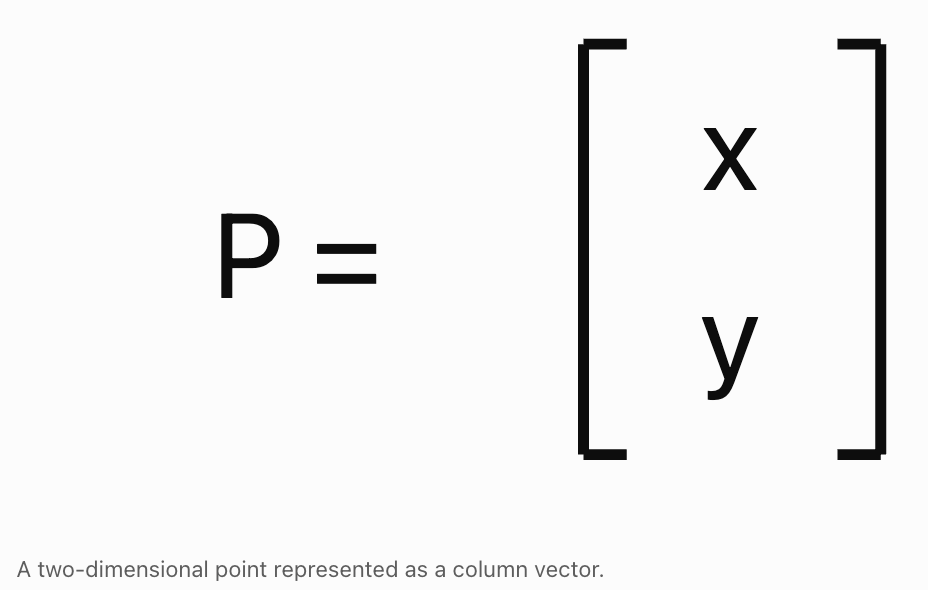
A linear transformation can be represented by a matrix M:
P′ = MP
For example, a 90° counterclockwise rotation uses:
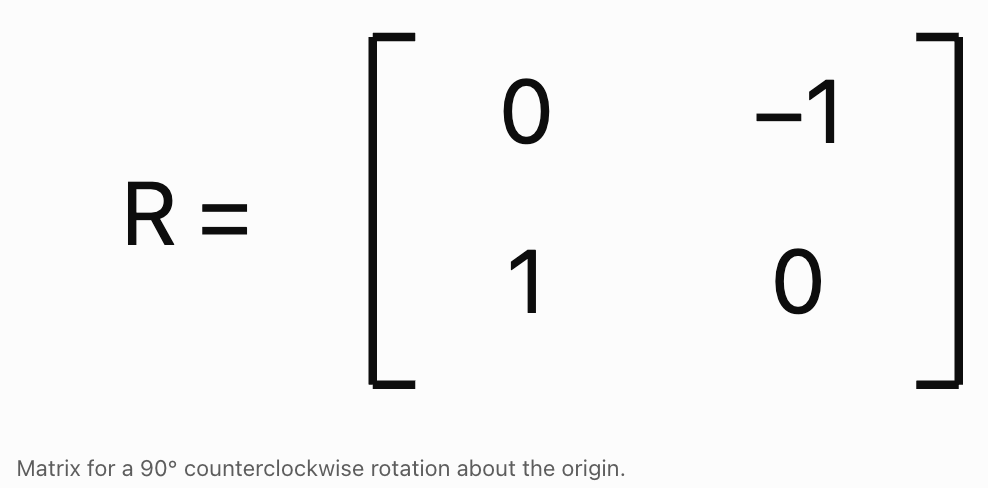
Multiplying the rotation matrix by the point vector produces:
(x, y) → (−y, x)
Common Transformation Matrices
|
Transformation |
Matrix rows |
|---|---|
|
Reflection across x-axis |
(1, 0), (0, −1) |
|
Reflection across y-axis |
(−1, 0), (0, 1) |
|
Rotation 90° counterclockwise |
(0, −1), (1, 0) |
|
Rotation 180° |
(−1, 0), (0, −1) |
|
Dilation by k |
(k, 0), (0, k) |
Each pair in the table represents one row of a 2 × 2 matrix.
General Rotation Matrix
For a counterclockwise rotation through angle θ:
R = [[cos θ, −sin θ], [sin θ, cos θ]]
Applying the matrix gives:
x′ = x cos θ − y sin θ
y′ = x sin θ + y cos θ
Worked Example: Rotation Through 30°
Rotate:
P = (4, 0)
30° counterclockwise about the origin.
Step 1: Apply the formulas
x′ = 4 cos 30° − 0 sin 30°
y′ = 4 sin 30° + 0 cos 30°
Step 2: Evaluate
x′ = 4(√3/2) = 2√3
y′ = 4(1/2) = 2
Final Answer
P′ = (2√3, 2)
Approximately:
P′ ≈ (3.46, 2)
Why Translations Are Different from Linear Matrix Transformations
A translation adds a vector to a point:
P′ = P + v
A rotation or reflection about the origin can be represented using a 2 × 2 matrix:
P′ = MP
A nonzero translation cannot be represented by multiplying ordinary two-dimensional position vectors by a 2 × 2 matrix alone.
This is because every linear transformation sends the origin to the origin, while a nonzero translation moves it.
However, translations and linear transformations can be combined using:
P′ = MP + v
This is called an affine transformation.
Example
A point is rotated 90° counterclockwise and then translated by (3, 2).
The transformation is:
P′ = RP + (3, 2)
For:
P = (2, 1)
First rotate:
RP = (−1, 2)
Then translate:
P′ = (−1, 2) + (3, 2)
P′ = (2, 4)
This mathematical form is widely used in computer graphics and robotics.
Homogeneous Coordinates
In computer graphics, translations can be included in matrix multiplication by using homogeneous coordinates.
A two-dimensional point:
P = (x, y)
is represented as:
P = (x, y, 1)
A translation by (a, b) can then be represented using the matrix:
T = [[1, 0, a], [0, 1, b], [0, 0, 1]]
Multiplying T by the homogeneous point vector gives:
(x, y, 1) → (x + a, y + b, 1)
Why This Matters
Homogeneous coordinates allow translations, rotations, reflections, and dilations to be combined into matrix operations.
This makes complex transformation sequences easier to calculate and implement in computer systems.
Vector Transformations in Three Dimensions
Translations can also be performed in three-dimensional space.
For a point:
P = (x, y, z)
and translation vector:
v = (a, b, c)
the transformation is:
(x, y, z) → (x + a, y + b, z + c)
Worked Example
A point has coordinates:
P = (2, −1, 4)
Translate it by:
v = (3, 5, −2)
Step 1: Add corresponding components
P′ = (2 + 3, −1 + 5, 4 − 2)
Final Answer
P′ = (5, 4, 2)
Finding the Magnitude of a Three-Dimensional Translation
The magnitude of:
v = (a, b, c)
is:
|v| = √(a² + b² + c²)
For:
v = (3, 5, −2)
|v| = √(3² + 5² + (−2)²)
|v| = √(9 + 25 + 4)
|v| = √38 ≈ 6.16 units

Transformations of Lines and Planes
Vectors can describe transformations of entire geometric objects, not just individual points.
Translating a Line
Suppose a line has vector equation:
r = a + td
Translate every point by vector v.
The transformed line is:
r′ = (a + v) + td
The direction vector remains unchanged.
Worked Example
Original line:
r = (1, 2, 3) + t(2, 1, −1)
Translation:
v = (4, −2, 5)
Step 1: Translate the known point
a′ = (1, 2, 3) + (4, −2, 5)
a′ = (5, 0, 8)
Step 2: Keep the direction vector
d = (2, 1, −1)
Final Answer
r′ = (5, 0, 8) + t(2, 1, −1)
The translated line is parallel to the original line.
Translating a Plane
Consider a plane:
n · r = d
where n is the plane's normal vector.
After translation by v, its equation becomes:
n · r′ = d + n · v
The normal vector does not change.
Worked Example
Original plane:
2x + y − z = 5
Translation:
v = (3, 1, 2)
The normal vector is:
n = (2, 1, −1)
Calculate:
n · v = (2)(3) + (1)(1) + (−1)(2)
n · v = 6 + 1 − 2
n · v = 5
Therefore, the translated plane is:
2x + y − z = 10
The plane's orientation remains unchanged.
Analysing Geometric Movement
Vector transformations allow us to compare displacement, distance travelled, and final position.
These quantities are related but are not identical.
Displacement
Displacement describes the change in position from start to finish.
Displacement = final position − initial position
Distance Travelled
Distance travelled is the total length of the actual path.
For several straight-line movements:
Total distance = |v₁| + |v₂| + ...
Worked Example
A person walks:
-
6 m east.
-
8 m north.
Represent the movements as:
v₁ = (6, 0)
v₂ = (0, 8)
Step 1: Calculate the displacement
v_total = (6, 0) + (0, 8)
v_total = (6, 8)
Step 2: Calculate displacement magnitude
|v_total| = √(6² + 8²)
|v_total| = 10 m
Step 3: Calculate distance travelled
Distance = 6 + 8
Distance = 14 m
Final Answers
Displacement = 10 m northeast
Distance travelled = 14 m
The distance travelled is greater because the actual path is not a straight line between the starting and ending positions.
Real-World Application: Navigation
Navigation systems use vectors to represent movement and calculate final positions.
A vehicle or aircraft may undergo a series of displacements.
The overall displacement is found by adding the movement vectors.
Worked Example
A drone begins at:
P = (10, 20, 5)
Its movements are:
v₁ = (4, 3, 2)
v₂ = (−1, 5, −1)
v₃ = (2, −4, 3)
Find the final position.

Step 1: Calculate total displacement
v_total = (4, 3, 2) + (−1, 5, −1) + (2, −4, 3)
Step 2: Combine components
x-component:
4 − 1 + 2 = 5
y-component:
3 + 5 − 4 = 4
z-component:
2 − 1 + 3 = 4
Therefore:
v_total = (5, 4, 4)
Step 3: Calculate final position
P′ = (10, 20, 5) + (5, 4, 4)
Final Answer
P′ = (15, 24, 9)
The drone finishes at coordinates (15, 24, 9).
Real-World Application: Computer Graphics and Animation
Computer graphics systems use transformations to move, rotate, resize, and orient objects.
For example, a video game character may:
-
Translate across a scene.
-
Rotate to face a target.
-
Scale during an animation.
-
Reflect in a mirror.
-
Move through a three-dimensional environment.


Why Vector Transformations Are Useful
A three-dimensional object may contain thousands of vertices.
Instead of manually recalculating each vertex, software applies the same transformation rule to every vertex.
For example:
P′ = MP + v
can represent a rotation, scaling operation, or reflection followed by a translation.
Complex animations can be produced by combining many such transformations.
Real-World Application: Robotics
Robotic arms move through a sequence of rotations and translations.
Each joint changes the position and orientation of the components attached to it.

Example
A robotic tool begins at:
P = (2, 3)
It undergoes:
-
A translation of (4, 0).
-
A 90° counterclockwise rotation about the origin.
-
A translation of (0, −2).
Find the final position.
Step 1: First translation
P′ = (2 + 4, 3 + 0)
P′ = (6, 3)
Step 2: Rotation
(6, 3) → (−3, 6)
Step 3: Second translation
P‴ = (−3, 6) + (0, −2)
Final Answer
P‴ = (−3, 4)
The order of operations is essential.
Real-World Application: Physics
In physics, vector transformations can describe changes in position and coordinate orientation.
For example:
-
Displacement vectors describe movement.
-
Rotation matrices describe changes in direction.
-
Coordinate transformations allow the same motion to be analysed from different reference frames.
-
Three-dimensional transformations help describe rigid-body motion.
Example: Changing Coordinate Orientation
Suppose a velocity vector is:
v = (5, 0)
If the coordinate axes are rotated 90° counterclockwise while the physical velocity remains unchanged, the velocity's components in the new coordinate system become:
v_new = (0, −5)
This is different from actively rotating the velocity vector itself 90° counterclockwise in a fixed coordinate system, which would give:
v_rotated = (0, 5)
Important Distinction
An active transformation changes the geometric object or vector.
A passive transformation changes the coordinate system used to describe it.
This distinction becomes important in advanced physics, engineering, and robotics.
Multi-Step Transformation Problems
Worked Example: Translation, Reflection, and Rotation
A point begins at:
P = (3, 1)
It undergoes:
-
Translation by (−2, 4).
-
Reflection across the y-axis.
-
Rotation by 90° clockwise about the origin.
Find the final coordinates.
Step 1: Translate
P′ = (3 − 2, 1 + 4)
P′ = (1, 5)
Step 2: Reflect Across the y-Axis
Rule:
(x, y) → (−x, y)
Therefore:
P″ = (−1, 5)
Step 3: Rotate 90° Clockwise
Rule:
(x, y) → (y, −x)
Therefore:
P‴ = (5, 1)
Final Answer
P‴ = (5, 1)
Verification
Each transformation has been applied in the stated order.
Reversing the order could produce a different final point.
Worked Example: Transforming a Triangle
A triangle has vertices:
A = (1, 1)
B = (4, 1)
C = (2, 3)
The triangle is:
-
Translated by (2, 1).
-
Rotated 180° about the origin.
Find the final coordinates.
Step 1: Translate Each Vertex
A′ = (3, 2)
B′ = (6, 2)
C′ = (4, 4)
Step 2: Apply the 180° Rotation
Rule:
(x, y) → (−x, −y)
Therefore:
A″ = (−3, −2)
B″ = (−6, −2)
C″ = (−4, −4)
Final Answer
The transformed triangle has vertices:
A″ = (−3, −2)
B″ = (−6, −2)
C″ = (−4, −4)
Geometric Interpretation
Both translations and rotations are rigid transformations.
Therefore, the final triangle is congruent to the original triangle.
Its side lengths, angles, perimeter, and area remain unchanged.
Analysing Transformation Properties
Different transformations preserve different geometric properties.
|
Property |
Translation |
Rotation |
Reflection |
Dilation |
|---|---|---|---|---|
|
Shape |
Preserved |
Preserved |
Preserved |
Preserved |
|
Side lengths |
Preserved |
Preserved |
Preserved |
Scaled |
|
Angles |
Preserved |
Preserved |
Preserved |
Preserved |
|
Area |
Preserved |
Preserved |
Preserved |
Scaled by k² |
|
Orientation |
Preserved |
Preserved |
Reversed |
Preserved if k > 0 |
|
Parallelism |
Preserved |
Preserved |
Preserved |
Preserved |
Orientation
Orientation describes the ordering of points around a figure.
For example, a triangle's vertices may be arranged clockwise or counterclockwise.
Translations and rotations preserve this ordering.
Reflections reverse it.
A dilation with a negative scale factor centred at a point corresponds to a positive dilation combined with a 180° rotation, so it preserves orientation in two dimensions.
Choosing the Correct Transformation Method
|
Problem |
Recommended method |
|---|---|
|
Translate a point |
Add the translation vector |
|
Translate a figure |
Add the vector to every vertex |
|
Find a translation vector |
Subtract original coordinates from image coordinates |
|
Combine translations |
Add the translation vectors |
|
Reverse a translation |
Use the negative vector |
|
Calculate displacement |
Final position − initial position |
|
Calculate movement distance |
Find the magnitude of the displacement vector |
|
Reflect across an axis |
Apply the coordinate reflection rule |
|
Rotate around the origin |
Apply a coordinate rule or rotation matrix |
|
Dilate from the origin |
Multiply coordinates by the scale factor |
|
Combine transformations |
Apply each transformation in the correct order |
|
Transform a line |
Translate a known point; preserve its direction |
|
Transform a plane by translation |
Adjust its constant using the normal vector |
|
Model complex movement |
Use affine transformations or homogeneous coordinates |
General Problem-Solving Strategy
-
Identify the original point or figure.
-
Determine the type of transformation.
-
Write the transformation rule.
-
Apply the rule to each relevant point.
-
If several transformations are involved, follow the stated order.
-
Calculate the final coordinates.
-
Check whether the expected geometric properties are preserved.
-
Interpret the movement in the original context.
-
Verify the result using an inverse transformation or coordinate substitution when appropriate.
Common Mistakes
Confusing a point with a translation vector
A point represents a location, while a translation vector represents movement.
Subtracting instead of adding during translation
Translations are performed by adding the translation vector to the point coordinates.
Ignoring negative components
Negative components indicate movement left or downward in the standard coordinate system.
Translating only one vertex of a figure
Every vertex must undergo the same translation.
Confusing distance travelled with displacement
Displacement is the net change in position, while distance travelled measures the total path length.
Adding vector magnitudes instead of vector components
The combined translation is found by adding corresponding components.
Using the wrong reflection rule
Different reflection lines require different coordinate rules.
Confusing clockwise and counterclockwise rotations
A 90° clockwise rotation differs from a 90° counterclockwise rotation.
Forgetting the centre of rotation
Rotation rules depend on the centre of rotation.
Assuming transformation order never matters
Pure translations commute, but combinations of different transformations generally do not.
Confusing congruence and similarity
Rigid transformations preserve size and shape, while dilations preserve shape but generally change size.
Using an incorrect scale factor
A dilation by k multiplies coordinates relative to its centre by k.
Assuming a 2 × 2 matrix can represent every translation
Nonzero translations require vector addition or an augmented matrix representation.
Applying matrix transformations in the wrong order
Matrix multiplication is generally not commutative.
Confusing active and passive transformations
Moving a vector and changing the coordinate system are different operations.
Failing to check geometric properties
Translations and rotations should preserve lengths and angles.
Rounding intermediate calculations too early
Keep exact values whenever possible and round only the final result.
Key Terms
-
Vector: A quantity with magnitude and direction.
-
Position Vector: A vector describing the location of a point relative to the origin.
-
Translation: A transformation that moves every point by the same displacement.
-
Translation Vector: A vector describing the distance and direction of a translation.
-
Geometric Transformation: A rule mapping points of a figure to new positions.
-
Preimage: The original figure before a transformation.
-
Image: The figure produced by a transformation.
-
Coordinate Rule: A mathematical rule describing how coordinates change.
-
Rigid Transformation: A transformation preserving distances and angles.
-
Isometry: Another name for a distance-preserving transformation.
-
Reflection: A transformation that flips a figure across a line.
-
Line of Reflection: The line across which a figure is reflected.
-
Rotation: A transformation that turns a figure around a fixed point.
-
Centre of Rotation: The fixed point around which a rotation occurs.
-
Angle of Rotation: The angle through which a figure is rotated.
-
Dilation: A transformation that changes the size of a figure using a scale factor.
-
Scale Factor: A number determining the enlargement or reduction of a figure.
-
Composition of Transformations: A sequence of two or more transformations.
-
Inverse Transformation: A transformation that reverses another transformation.
-
Identity Transformation: A transformation that leaves every point unchanged.
-
Displacement: The change in position from an initial point to a final point.
-
Distance Travelled: The total length of the path followed.
-
Magnitude: The length or size of a vector.
-
Direction Angle: An angle describing the direction of a vector relative to a reference axis.
-
Matrix: A rectangular arrangement of numbers used in mathematical operations.
-
Transformation Matrix: A matrix representing a geometric transformation.
-
Linear Transformation: A transformation preserving vector addition and scalar multiplication.
-
Affine Transformation: A transformation combining a linear transformation with a translation.
-
Homogeneous Coordinates: An extended coordinate system allowing translations to be represented using matrices.
-
Commutative Property: A property stating that changing the order of operations does not change the result.
-
Congruence: A relationship between figures with the same shape and size.
-
Similarity: A relationship between figures with the same shape and proportional dimensions.
-
Orientation: The clockwise or counterclockwise ordering of points in a figure.
-
Active Transformation: A transformation that changes the position or orientation of an object.
-
Passive Transformation: A change in the coordinate system used to describe an object.
-
Three-Dimensional Translation: A movement described by changes in x-, y-, and z-coordinates.
-
Geometric Modelling: Using mathematical representations to describe shapes, positions, and movement.
Key Takeaways
-
Vector transformations provide a mathematical method for describing geometric movement.
-
A translation moves every point of a figure by the same vector.
-
In two dimensions, a translation by (a, b) follows the rule (x, y) → (x + a, y + b).
-
In three dimensions, a translation by (a, b, c) follows the rule (x, y, z) → (x + a, y + b, z + c).
-
A translation vector can be found by subtracting the original coordinates from the transformed coordinates.
-
The magnitude of a translation vector gives the straight-line displacement distance.
-
Multiple translations can be combined by adding their vectors.
-
The order of pure translations does not affect the final result.
-
An inverse translation uses the negative of the original translation vector.
-
Reflections reverse orientation while preserving distances and angles.
-
Rotations preserve distances, angles, and orientation.
-
Dilations change size according to a scale factor.
-
Different transformation types can be combined into a composition.
-
The order of transformations generally matters.
-
Matrices provide a systematic way to represent rotations, reflections, and dilations.
-
Affine transformations combine matrix operations with vector translations.
-
Homogeneous coordinates allow translations to be represented through matrix multiplication.
-
Translations can be applied to points, figures, lines, and planes.
-
Vector addition allows us to analyse total displacement from several movements.
-
Displacement and distance travelled are different quantities.
-
Vector transformations are widely used in navigation, robotics, physics, animation, and computer graphics.
-
The central skill is applying vector rules to describe, combine, analyse, and model geometric transformations in two and three dimensions.
Check Your Understanding
Recall and Understanding
-
Define a translation and explain how a vector describes its movement.
-
Explain the difference between a preimage and an image.
-
State the coordinate rule for a translation by vector (a, b).
-
Explain why the order of two translations does not affect the final result.
-
Describe the difference between a rigid transformation and a dilation.
Application
-
Translate P = (3, −2) by vector v = (5, 4). Find P′.
-
A triangle has vertices A = (1, 2), B = (4, 2), and C = (2, 5). Translate it by (−3, 1).
-
Point P = (−4, 6) is translated to P′ = (2, 1). Find the translation vector.
-
Combine the translations v₁ = (4, 3), v₂ = (−2, 5), and v₃ = (1, −4).
-
Rotate P = (5, 2) by 90° counterclockwise about the origin.
Analysis and Challenge
-
Point P = (2, 3) is translated by (4, −1), then reflected across the y-axis. Find its final coordinates.
-
Point P = (3, −1) is rotated 180° about the origin and then translated by (2, 5). Find its final coordinates.
-
A robot begins at (5, 2, 1) and moves by vectors (3, 4, 2), (−2, 1, −3), and (4, −5, 1). Find its final position and the magnitude of its total displacement.
-
A line has equation r = (1, 2, 3) + t(2, −1, 4). Translate it by vector (3, 5, −2). Write the new line equation.
-
A plane has equation 2x − y + 3z = 7. Translate it by vector (1, 2, −1). Determine the equation of the translated plane.
Final Summary
Vector transformations provide a systematic mathematical framework for describing how geometric objects move and change in space.
Translations are represented by adding displacement vectors to points. Multiple translations can be combined through vector addition, and inverse translations reverse the original movement.
Reflections, rotations, and dilations can be described using coordinate rules and matrices.
More complex transformations can be modelled using affine transformations, which combine linear transformations with translations.
The order of operations is important when several different transformations are applied.
Vector transformations are useful for describing geometric movement, analysing displacement, modelling rigid-body motion, and performing calculations in computer graphics, engineering, robotics, and navigation.
The central principle is that geometric transformations can be represented using mathematical operations on vectors and coordinates, allowing us to describe movement precisely, combine transformations, and predict the resulting position and orientation of objects.