Advanced Vector Geometry
1. Dot Product
Learning outcomes
- I can calculate the dot product of two vectors.
- I can determine the angle between vectors.
- I can identify perpendicular vectors.
- I can solve projection problems.
- I can interpret the geometric meaning of the dot product.
Dot Product
Introduction to the Dot Product
Vectors are mathematical quantities that have both magnitude and direction. They are used to represent displacement, velocity, acceleration, force, and many other physical quantities.
When working with vectors, we often need to determine how two vectors are related. For example:
-
Do two forces act in the same direction?
-
Are two directions perpendicular?
-
What angle separates two vectors?
-
How much of one vector acts in the direction of another?
-
How much work is performed by a force acting at an angle?
The dot product, also called the scalar product, is a mathematical operation that helps answer these questions.
Unlike vector addition, which produces another vector, the dot product produces a single number called a scalar.
The dot product connects the components of vectors with their magnitudes and the angle between them. This makes it useful in geometry, physics, engineering, navigation, and computer graphics.
Understanding the Dot Product
The dot product of two vectors A and B is written:
A · B
The dot symbol indicates the dot product operation.
The result is a scalar, not a vector.
For example:
A · B = 12
This means the dot product of vectors A and B is 12.
What Does the Dot Product Tell Us?
The dot product measures how strongly two vectors point in the same direction, taking their magnitudes into account.
-
A positive dot product indicates that the angle between the nonzero vectors is acute.
-
A zero dot product indicates that two nonzero vectors are perpendicular.
-
A negative dot product indicates that the angle between the nonzero vectors is obtuse.
The magnitude of the result also depends on the lengths of the vectors.
A larger positive dot product does not necessarily mean a smaller angle unless the vector magnitudes are held constant.
Calculating the Dot Product Using Components
Vectors can be represented using horizontal and vertical components.
In two dimensions:
A = (Aₓ, Aᵧ)
B = (Bₓ, Bᵧ)
The dot product is calculated by multiplying corresponding components and adding the results.
A · B = AₓBₓ + AᵧBᵧ
Worked Example: Two-Dimensional Dot Product
Given:
A = (3, 4)
B = (2, 5)
Calculate A · B.
Step 1: Write the formula
A · B = AₓBₓ + AᵧBᵧ
Step 2: Substitute the components
A · B = (3)(2) + (4)(5)
Step 3: Multiply
A · B = 6 + 20
Step 4: Add
A · B = 26
The dot product is 26.
Because the result is positive, the angle between the vectors is acute.
Worked Example: Negative Components
Given:
A = (−2, 5)
B = (4, −3)
Calculate A · B.
A · B = (−2)(4) + (5)(−3)
A · B = −8 − 15
A · B = −23
The negative result indicates that the angle between the vectors is greater than 90°.
Worked Example: Zero Dot Product
Given:
A = (3, 4)
B = (−4, 3)
Calculate A · B.
A · B = (3)(−4) + (4)(3)
A · B = −12 + 12
A · B = 0
Since both vectors are nonzero, they are perpendicular.
Dot Product in Three Dimensions
The dot product can also be calculated for three-dimensional vectors.
Given:
A = (Aₓ, Aᵧ, Aᵤ)
B = (Bₓ, Bᵧ, Bᵤ)
where the third components represent the z-direction, the formula is:
A · B = AₓBₓ + AᵧBᵧ + AᵤBᵤ
More conventionally, writing the components as (Aₓ, Aᵧ, A_z) and (Bₓ, Bᵧ, B_z):
A · B = AₓBₓ + AᵧBᵧ + A_zB_z
Worked Example: Three-Dimensional Dot Product
Given:
A = (2, −1, 3)
B = (4, 5, −2)
Calculate A · B.
Step 1: Write the formula
A · B = AₓBₓ + AᵧBᵧ + A_zB_z
Step 2: Substitute
A · B = (2)(4) + (−1)(5) + (3)(−2)
Step 3: Multiply
A · B = 8 − 5 − 6
Step 4: Add
A · B = −3
The dot product is −3.
The vectors form an obtuse angle.
Important Observation
The same principle applies in two, three, or more dimensions:
Multiply corresponding components and add the products.
The Geometric Definition of the Dot Product
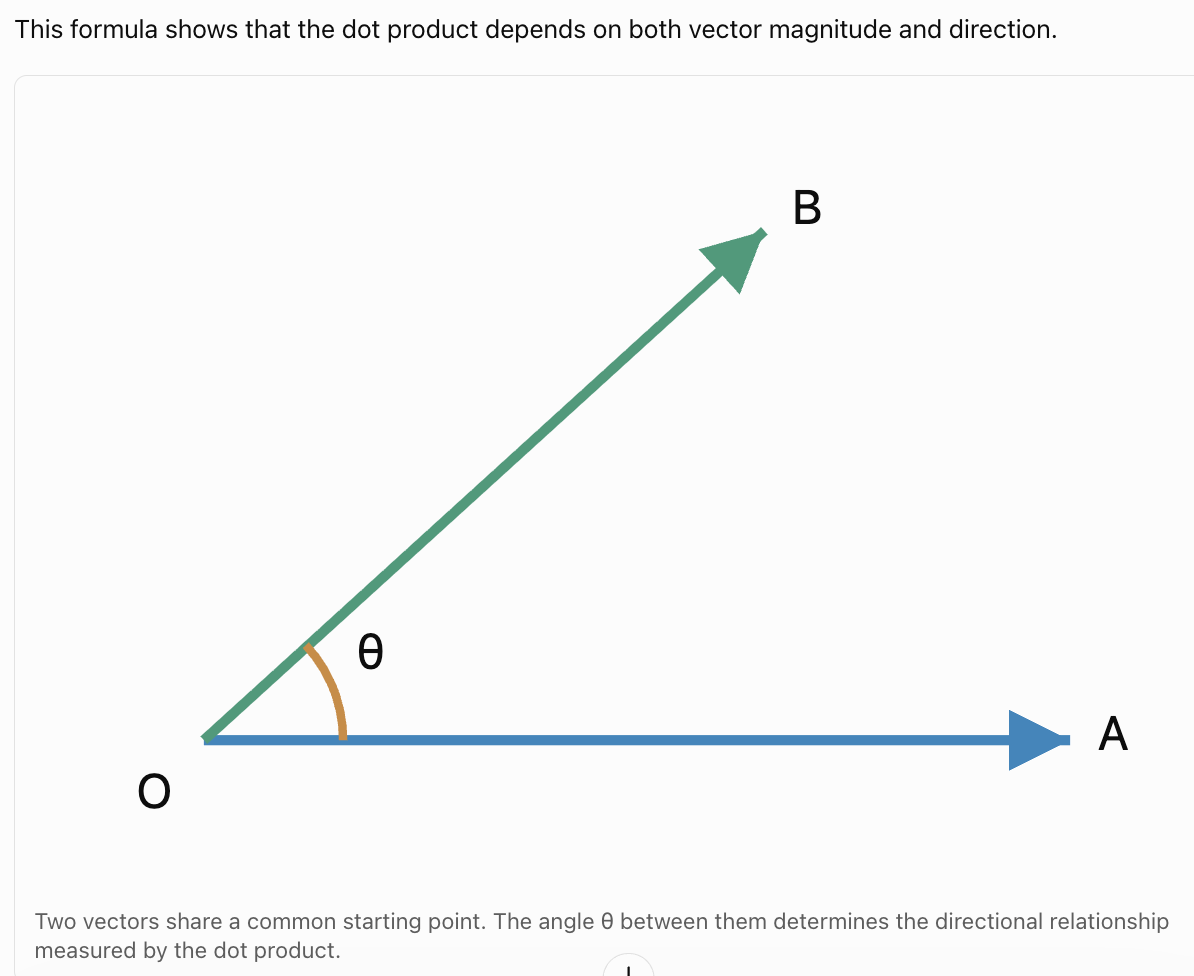
The dot product can also be calculated using the magnitudes of two vectors and the angle between them.
The geometric formula is:
A · B = |A||B| cos θ
where:
-
A · B is the dot product.
-
|A| is the magnitude of vector A.
-
|B| is the magnitude of vector B.
-
θ is the angle between the vectors.
-
cos θ is the cosine of the angle.
The angle θ is normally taken between 0° and 180°.
How the Angle Affects the Dot Product
The cosine function determines whether the dot product is positive, zero, or negative.
|
Angle θ |
cos θ |
Dot product |
|---|---|---|
|
0° |
1 |
Positive maximum for fixed magnitudes |
|
30° |
≈ 0.866 |
Positive |
|
60° |
0.5 |
Positive |
|
90° |
0 |
Zero |
|
120° |
−0.5 |
Negative |
|
150° |
≈ −0.866 |
Negative |
|
180° |
−1 |
Negative minimum for fixed magnitudes |
Vectors Pointing in the Same Direction
When θ = 0°:
cos 0° = 1
Therefore:
A · B = |A||B|
The dot product is as large as possible for the given magnitudes.
Perpendicular Vectors
When θ = 90°:
cos 90° = 0
Therefore:
A · B = 0
The dot product is zero.
Vectors Pointing in Opposite Directions
When θ = 180°:
cos 180° = −1
Therefore:
A · B = −|A||B|
The dot product is as negative as possible for the given magnitudes.
Calculating the Dot Product from Magnitudes and Angles
Worked Example: Acute Angle
Two vectors have magnitudes:
|A| = 6
|B| = 8
The angle between them is 60°.
Calculate the dot product.
Step 1: Write the formula
A · B = |A||B| cos θ
Step 2: Substitute
A · B = (6)(8) cos 60°
Step 3: Evaluate the cosine
cos 60° = 0.5
Step 4: Calculate
A · B = 48(0.5)
A · B = 24
Worked Example: Obtuse Angle
Two vectors have magnitudes:
|A| = 5
|B| = 10
The angle between them is 120°.
A · B = (5)(10) cos 120°
Since:
cos 120° = −0.5
A · B = 50(−0.5)
A · B = −25
The negative result is consistent with the obtuse angle.
Calculating Vector Magnitudes
To determine the angle between vectors, we must often calculate their magnitudes first.
For a two-dimensional vector:
A = (Aₓ, Aᵧ)
its magnitude is:
|A| = √(Aₓ² + Aᵧ²)
For a three-dimensional vector:
A = (Aₓ, Aᵧ, A_z)
its magnitude is:
|A| = √(Aₓ² + Aᵧ² + A_z²)
Worked Example
Find the magnitude of:
A = (6, 8)
|A| = √(6² + 8²)
|A| = √(36 + 64)
|A| = √100
|A| = 10
Three-Dimensional Example
Find the magnitude of:
B = (2, −3, 6)
|B| = √(2² + (−3)² + 6²)
|B| = √(4 + 9 + 36)
|B| = √49
|B| = 7
Finding the Angle Between Two Vectors
The geometric dot product formula can be rearranged to determine the angle between vectors.
Starting with:
A · B = |A||B| cos θ
Divide by the product of the magnitudes:
cos θ = (A · B)/(|A||B|)
Take the inverse cosine:
θ = cos⁻¹[(A · B)/(|A||B|)]
This formula applies when both vectors are nonzero.
Worked Example: Finding an Acute Angle
Given:
A = (1, 2)
B = (3, 1)
Find the angle between the vectors.
Step 1: Calculate the dot product
A · B = (1)(3) + (2)(1)
A · B = 3 + 2
A · B = 5
Step 2: Find the magnitude of A
|A| = √(1² + 2²)
|A| = √5
Step 3: Find the magnitude of B
|B| = √(3² + 1²)
|B| = √10
Step 4: Substitute
cos θ = 5/(√5 × √10)
cos θ = 5/√50
cos θ ≈ 0.7071
Step 5: Take the inverse cosine
θ = cos⁻¹(0.7071)
θ = 45°
Interpretation
The vectors form an angle of 45°.
Since the dot product is positive, an acute angle is expected.
Worked Example: Finding an Obtuse Angle
Given:
A = (2, 1)
B = (−3, 2)
Find the angle between the vectors.
Step 1: Calculate the dot product
A · B = (2)(−3) + (1)(2)
A · B = −6 + 2
A · B = −4
Step 2: Calculate the magnitudes
|A| = √(2² + 1²) = √5
|B| = √((−3)² + 2²) = √13
Step 3: Substitute
cos θ = −4/(√5 × √13)
cos θ = −4/√65
cos θ ≈ −0.4961
Step 4: Calculate the angle
θ = cos⁻¹(−0.4961)
θ ≈ 119.7°
Reasonableness Check
The dot product is negative.
Therefore, the angle should be greater than 90°.
The calculated angle of approximately 119.7° is reasonable.
Identifying Perpendicular Vectors
Two vectors are perpendicular when they meet at an angle of 90°.
For two nonzero vectors:
A · B = 0 if and only if A and B are perpendicular.
This is one of the most useful applications of the dot product.
Worked Example: Testing Perpendicularity
Given:
A = (4, 3)
B = (−3, 4)
Determine whether the vectors are perpendicular.
Step 1: Calculate the dot product
A · B = (4)(−3) + (3)(4)
A · B = −12 + 12
A · B = 0
Step 2: Interpret
Both vectors are nonzero, and their dot product is zero.
Therefore:
A and B are perpendicular.
Worked Example: Vectors That Are Not Perpendicular
Given:
A = (5, 2)
B = (3, −4)
A · B = (5)(3) + (2)(−4)
A · B = 15 − 8
A · B = 7
Since the dot product is not zero, the vectors are not perpendicular.
Finding an Unknown Component
The perpendicularity condition can be used to solve algebraic problems.
Worked Example
Given:
A = (3, 4)
B = (x, 6)
Find x if the vectors are perpendicular.
Step 1: Apply the perpendicularity condition
A · B = 0
Step 2: Substitute
3x + 4(6) = 0
Step 3: Simplify
3x + 24 = 0
Step 4: Solve
3x = −24
x = −8
Verification
B = (−8, 6)
A · B = (3)(−8) + (4)(6)
A · B = −24 + 24
A · B = 0
The vectors are perpendicular.
Orthogonal Vectors
Vectors with a dot product of zero are called orthogonal vectors.
For nonzero vectors, orthogonal means perpendicular.
The term orthogonal is particularly common in linear algebra and higher-dimensional vector spaces.
Example
A = (1, 0, 0)
B = (0, 1, 0)
A · B = (1)(0) + (0)(1) + (0)(0)
A · B = 0
The vectors are orthogonal.
The Zero Vector
The zero vector has all components equal to zero.
For example:
O = (0, 0)
Its dot product with every vector is zero.
However, the zero vector has no defined direction, so an angle between the zero vector and another vector is undefined.
This is why angle calculations require nonzero vectors.
Understanding Vector Projection
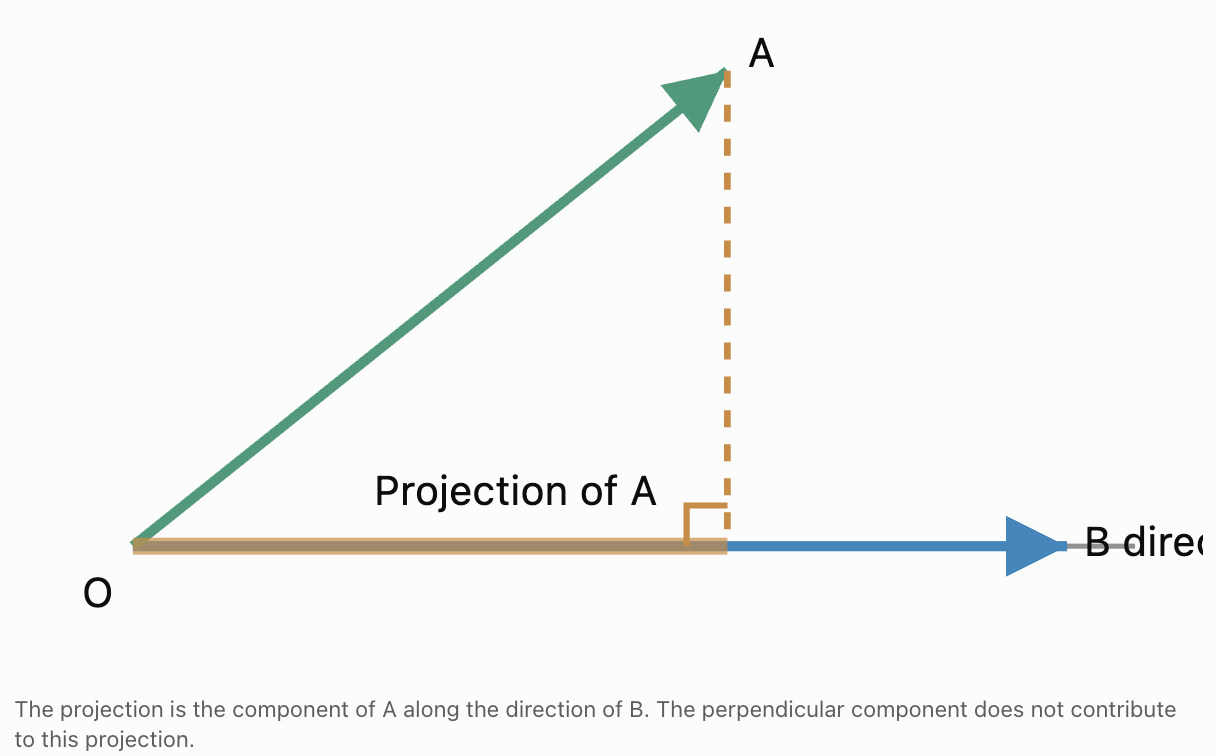
A vector projection describes the part of one vector that acts along the direction of another vector.
Imagine shining a light perpendicular to a line. The shadow of a vector onto that line represents its projection.
Projection is useful when a vector must be separated into components acting along particular directions.
Examples include:
- Finding the component of a force along a slope.
- Determining motion in a particular direction.
- Calculating work done by a force.
- Analysing velocities.
- Resolving vectors in engineering.
Scalar Projection
The scalar projection of A onto B gives the signed length of the component of A in the direction of B.
The formula is:
Scalar projection of A onto B = (A · B)/|B|
It can also be written as:
|A| cos θ
The scalar projection may be positive, negative, or zero.
Worked Example
Given:
A = (6, 8)
B = (1, 0)
Find the scalar projection of A onto B.
Step 1: Calculate the dot product
A · B = (6)(1) + (8)(0)
A · B = 6
Step 2: Calculate the magnitude of B
|B| = √(1² + 0²)
|B| = 1
Step 3: Apply the formula
Scalar projection = 6/1
Scalar projection = 6
Interpretation
The component of A in the positive horizontal direction is 6 units.
Vector Projection
The vector projection gives both the magnitude and direction of the component.
The formula for the projection of A onto nonzero B is:
proj_B(A) = [(A · B)/|B|²]B
Since:
|B|² = B · B
the formula may also be written:
proj_B(A) = [(A · B)/(B · B)]B
Worked Example: Vector Projection
Given:
A = (4, 3)
B = (2, 0)
Find the projection of A onto B.
Step 1: Calculate the dot product
A · B = (4)(2) + (3)(0)
A · B = 8
Step 2: Calculate |B|²
|B|² = 2² + 0²
|B|² = 4
Step 3: Apply the formula
proj_B(A) = (8/4)(2, 0)
Step 4: Simplify
proj_B(A) = 2(2, 0)
proj_B(A) = (4, 0)
Interpretation
The projection of A onto B is the horizontal component of A.
The original vector is:
A = (4, 3)
Its horizontal projection is:
(4, 0)
The remaining perpendicular component is:
(0, 3)
Worked Example: Projection onto a Diagonal Vector
Given:
A = (3, 4)
B = (1, 1)
Find the vector projection of A onto B.
Step 1: Calculate A · B
A · B = (3)(1) + (4)(1)
A · B = 7
Step 2: Calculate |B|²
|B|² = 1² + 1²
|B|² = 2
Step 3: Apply the formula
proj_B(A) = (7/2)(1, 1)
Step 4: Multiply
proj_B(A) = (3.5, 3.5)
Verification
The remaining component is:
A − proj_B(A)
= (3, 4) − (3.5, 3.5)
= (−0.5, 0.5)
Check whether this component is perpendicular to B:
(−0.5, 0.5) · (1, 1)
= −0.5 + 0.5
= 0
Therefore, the remaining component is perpendicular to B, confirming that the projection is correct.
Decomposing a Vector into Parallel and Perpendicular Components
Any vector A can be separated into:
-
A component parallel to a nonzero vector B.
-
A component perpendicular to B.
The parallel component is:
A_parallel = proj_B(A)
The perpendicular component is:
A_perpendicular = A − proj_B(A)
Therefore:
A = A_parallel + A_perpendicular
Worked Example
Given:
A = (5, 4)
B = (3, 0)
Find the parallel and perpendicular components of A relative to B.
Step 1: Calculate the dot product
A · B = (5)(3) + (4)(0)
A · B = 15
Step 2: Calculate |B|²
|B|² = 3² = 9
Step 3: Find the parallel component
A_parallel = (15/9)(3, 0)
A_parallel = (5, 0)
Step 4: Find the perpendicular component
A_perpendicular = (5, 4) − (5, 0)
A_perpendicular = (0, 4)
Final Answer
Parallel component = (5, 0)
Perpendicular component = (0, 4)
Verification
(5, 0) + (0, 4) = (5, 4)
The original vector has been reconstructed.
Properties of the Dot Product
The dot product has several important algebraic properties.
Commutative Property
A · B = B · A
The order of the vectors does not change the result.
Example:
A = (2, 3)
B = (4, 5)
A · B = 2(4) + 3(5) = 23
B · A = 4(2) + 5(3) = 23
Both results are equal.
Distributive Property
A · (B + C) = A · B + A · C
This allows dot products to be expanded across vector addition.
Scalar Multiplication
(kA) · B = k(A · B)
where k is a scalar.
Dot Product of a Vector with Itself
A · A = |A|²
For example:
A = (3, 4)
A · A = 3² + 4²
A · A = 25
Therefore:
|A| = √25 = 5
Non-Negativity
For every vector A:
A · A ≥ 0
The result equals zero only when A is the zero vector.
Important Observation
Although the dot product is commutative, vector projection is generally not.
In general:
proj_B(A) ≠ proj_A(B)
The direction of projection matters.
The Dot Product and the Law of Cosines
The dot product is closely related to the Law of Cosines.
For vectors A and B:
|A − B|² = (A − B) · (A − B)
Expanding:
|A − B|² = A · A − 2(A · B) + B · B
Since:
A · A = |A|²
B · B = |B|²
and:
A · B = |A||B| cos θ
we obtain:
|A − B|² = |A|² + |B|² − 2|A||B| cos θ
This is the vector form of the Law of Cosines.
Why This Matters
The Law of Cosines generalises the Pythagorean Theorem.
When θ = 90°:
cos 90° = 0
Therefore:
|A − B|² = |A|² + |B|²
This is the Pythagorean relationship.
The dot product therefore connects vector geometry, trigonometry, and triangle geometry.
Real-World Application: Work Done by a Force
In physics, work is the energy transferred when a force causes displacement.
When the force and displacement are vectors, work is calculated using the dot product.
W = F · s
or:
W = |F||s| cos θ
where:
-
W is work done, measured in joules (J).
-
F is the force vector, measured in newtons (N).
-
s is the displacement vector, measured in metres (m).
-
θ is the angle between force and displacement.
Worked Example: Pulling an Object
A person pulls a box with a force of 50 N at an angle of 30° above the horizontal.
The box moves 8 m horizontally.
Calculate the work done by the pulling force.

Step 1: Identify the Values
|F| = 50 N
|s| = 8 m
θ = 30°
Step 2: Apply the Formula
W = |F||s| cos θ
Step 3: Substitute
W = (50)(8) cos 30°
Step 4: Calculate
W = 400(0.8660)
W ≈ 346.4 J
Interpretation
The pulling force performs approximately 346.4 J of work.
Only the component of the force parallel to the displacement contributes to the work.
The upward component does not contribute to the work in this example because the displacement is horizontal.
Positive, Negative, and Zero Work
The sign of the dot product has a direct physical interpretation.
Positive Work
When the force acts partly in the direction of displacement:
W > 0
The force transfers energy to the object through mechanical work.
Negative Work
When the force acts partly opposite the displacement:
W < 0
For example, friction often performs negative work on a sliding object.
Zero Work
When the force is perpendicular to displacement:
W = 0
For example, the normal force does zero work on an object moving horizontally across a level surface when the normal force is vertical.
Real-World Application: Motion Along a Slope
Vector projection can determine the component of a force acting along an inclined surface.
For an object on a slope inclined at angle θ above the horizontal, the component of its weight parallel to the slope has magnitude:
F_parallel = mg sin θ
The component perpendicular to the slope has magnitude:
F_perpendicular = mg cos θ
These formulas can be derived by projecting the weight vector onto directions parallel and perpendicular to the slope.
Worked Example
A 10 kg object rests on a slope inclined at 30°.
Find the magnitude of the component of gravitational force acting down the slope.
Take:
g = 9.8 m/s²
Step 1: Calculate the Weight
F = mg
F = 10(9.8)
F = 98 N
Step 2: Calculate the Parallel Component
F_parallel = 98 sin 30°
Step 3: Evaluate
sin 30° = 0.5
F_parallel = 98(0.5)
F_parallel = 49 N
Interpretation
The component of gravitational force acting down the slope is 49 N.
The remaining component acts perpendicular to the slope.

Real-World Application: Computer Graphics
Dot products are used in computer graphics to calculate how brightly a surface is illuminated.
A surface receives more direct illumination when its outward normal vector points toward a light source.
The brightness calculation often depends on:
N · L
where:
-
N is a unit vector perpendicular to the surface.
-
L is a unit vector pointing toward the light source.
When both are unit vectors:
N · L = cos θ
Interpretation
-
If N · L = 1, the light points directly along the surface normal.
-
If N · L = 0, the light direction is perpendicular to the normal.
-
If N · L is negative, the light is directed toward the back side of the surface.
In a simple diffuse-lighting model, the illuminated front-facing contribution is proportional to:
max(0, N · L)
This is one reason the dot product is fundamental to three-dimensional graphics and game development.

Real-World Application: Navigation
Dot products can determine whether movement is aligned with a desired direction.
Worked Example
A vehicle has velocity:
v = (12, 5) m/s
The desired direction is represented by:
d = (1, 0)
Calculate the component of velocity in the desired direction.
Step 1: Calculate the Dot Product
v · d = (12)(1) + (5)(0)
v · d = 12
Step 2: Calculate the Magnitude of d
|d| = 1
Step 3: Find the Scalar Projection
Scalar projection = 12/1
Scalar projection = 12 m/s
Interpretation
The vehicle's velocity component in the positive horizontal direction is 12 m/s.
Its total speed is:
|v| = √(12² + 5²)
|v| = √169
|v| = 13 m/s
Therefore, the vehicle travels at 13 m/s overall, but only 12 m/s of that velocity is in the specified horizontal direction.
Choosing the Correct Dot Product Method
Different problems require different forms of the dot product.
| Problem | Method | |---|---| | Calculate a dot product from components | A · B = AₓBₓ + AᵧBᵧ | | Calculate a dot product from magnitudes and angle | A · B = |A||B| cos θ | | Find the angle between nonzero vectors | θ = cos⁻¹[(A · B)/(|A||B|)] | | Test perpendicularity of nonzero vectors | Check whether A · B = 0 | | Find scalar projection onto B | (A · B)/|B| | | Find vector projection onto B | [(A · B)/|B|²]B | | Calculate work done | W = F · s |
Problem-Solving Strategy
-
Identify the vectors and their components.
-
Determine whether magnitudes or angles are given.
-
Decide whether the problem requires a scalar, an angle, or a vector projection.
-
Select the appropriate formula.
-
Substitute carefully, paying attention to negative components.
-
Calculate the result.
-
Check the sign and magnitude for reasonableness.
-
Interpret the result in the original context.
Common Mistakes
Confusing the dot product with vector multiplication
The dot product produces a scalar, not another vector.
Adding corresponding components instead of multiplying them
The dot product requires multiplication of corresponding components followed by addition.
Ignoring negative signs
Negative components can change the sign of the dot product.
Using the wrong angle
The angle must be the angle between the vectors when they are placed tail-to-tail.
Confusing sine and cosine
The geometric dot product formula uses cosine.
Forgetting vector magnitudes when finding angles
The angle formula requires division by the product of both magnitudes.
Using the inverse cosine incorrectly
The inverse cosine function must be used to find an angle from its cosine.
Using radians when degrees are expected
Check the calculator's angle mode.
Assuming a zero dot product always gives a 90° angle
The angle interpretation requires both vectors to be nonzero.
Confusing scalar and vector projection
Scalar projection produces a signed number; vector projection produces a vector.
Using |A|² instead of |B|² in the projection formula
When projecting A onto B, the denominator is |B|².
Assuming projection is commutative
Projecting A onto B is generally different from projecting B onto A.
Ignoring the physical meaning of a negative dot product
In applications such as work, a negative value indicates that the force has a component opposite the displacement.
Rounding intermediate calculations too early
Keep exact values where possible and round only at the final step.
Key Terms
-
Vector: A quantity with magnitude and direction.
-
Scalar: A quantity described by magnitude alone.
-
Dot Product: An operation combining two vectors to produce a scalar.
-
Scalar Product: Another name for the dot product.
-
Vector Component: The amount of a vector acting along a coordinate direction.
-
Magnitude: The length or size of a vector.
-
Direction: The orientation in which a vector points.
-
Angle Between Vectors: The angle formed when two nonzero vectors are placed tail-to-tail.
-
Cosine: A trigonometric function used to relate vector directions.
-
Inverse Cosine: A function used to determine an angle from its cosine value.
-
Perpendicular Vectors: Nonzero vectors forming a 90° angle.
-
Orthogonal Vectors: Vectors whose dot product equals zero.
-
Zero Vector: A vector whose components are all zero.
-
Unit Vector: A vector with magnitude 1.
-
Projection: The component of one vector acting along the direction of another.
-
Scalar Projection: The signed length of a vector's projection onto a specified direction.
-
Vector Projection: A vector representing the component of one vector along another.
-
Parallel Component: The part of a vector acting along a specified direction.
-
Perpendicular Component: The part of a vector acting at 90° to a specified direction.
-
Commutative Property: A property stating that changing the order of two quantities does not change the result.
-
Distributive Property: A property allowing an operation to be distributed across addition.
-
Law of Cosines: A theorem relating the side lengths of a triangle to the cosine of an included angle.
-
Work Done: Energy transferred when a force acts through a displacement.
-
Displacement: A vector describing a change in position.
-
Force: A vector quantity that can change an object's motion.
-
Velocity: A vector describing the rate of change of position.
-
Normal Vector: A vector perpendicular to a surface.
-
Directional Alignment: The extent to which two vectors point in similar directions.
-
Vector Decomposition: Separating a vector into components along specified directions.
Key Takeaways
-
The dot product combines two vectors to produce a scalar.
-
The dot product can be calculated using vector components.
-
In two dimensions, A · B = AₓBₓ + AᵧBᵧ.
-
In three dimensions, A · B = AₓBₓ + AᵧBᵧ + A_zB_z.
-
The geometric formula is A · B = |A||B| cos θ.
-
The dot product depends on vector magnitudes and the angle between them.
-
A positive dot product indicates an acute angle between nonzero vectors.
-
A negative dot product indicates an obtuse angle between nonzero vectors.
-
A zero dot product indicates perpendicularity when both vectors are nonzero.
-
The angle between nonzero vectors can be found using the inverse cosine.
-
The magnitude of a vector can be calculated using the Pythagorean Theorem.
-
Vector projection determines the component of one vector acting along another.
-
Scalar projection produces a signed numerical value.
-
Vector projection produces a vector with direction and magnitude.
-
The dot product is commutative and distributive over vector addition.
-
The dot product of a vector with itself equals the square of its magnitude.
-
The dot product connects vector geometry with the Law of Cosines.
-
In physics, work done by a force is calculated using a dot product.
-
In engineering, projections help resolve forces into useful components.
-
In computer graphics, dot products help determine surface illumination.
-
In navigation, dot products help determine motion along a desired direction.
-
The central skill is using the dot product to calculate directional relationships, determine angles, identify perpendicular vectors, and solve projection problems.
Check Your Understanding
Recall and Understanding
-
Define the dot product and explain why its result is a scalar.
-
State the component formula for the dot product in two and three dimensions.
-
Explain how the sign of the dot product relates to the angle between two nonzero vectors.
-
Explain why perpendicular nonzero vectors have a dot product of zero.
-
Distinguish between scalar projection and vector projection.
Application
-
Calculate A · B for A = (3, 5) and B = (4, −2).
-
Calculate A · B for A = (2, −1, 4) and B = (3, 5, −2).
-
Determine whether A = (6, 8) and B = (−4, 3) are perpendicular.
-
Find the angle between A = (1, 0) and B = (1, 1).
-
Calculate the scalar projection of A = (6, 8) onto B = (1, 0).
Analysis and Challenge
-
Given A = (4, 3) and B = (x, 8), determine x if the vectors are perpendicular.
-
Find the angle between A = (2, 3) and B = (−1, 4), giving your answer to one decimal place.
-
Calculate the vector projection of A = (5, 2) onto B = (1, 1).
-
A force of 80 N acts at 40° to the direction of a displacement of 12 m. Calculate the work done by the force.
-
A vector A = (7, 5) is decomposed into components parallel and perpendicular to B = (3, 0). Find both components and verify that their sum equals A.
Final Summary
The dot product is a fundamental operation in vector mathematics that connects vector components, magnitudes, and directions.
It can be calculated algebraically by multiplying corresponding components and adding the results, or geometrically using the magnitudes of two vectors and the cosine of the angle between them.
The dot product allows us to determine the angle between vectors, identify perpendicular directions, and calculate projections.
These techniques are useful in geometry, physics, engineering, navigation, and computer graphics.
Vector projections are particularly important because they allow a vector to be separated into components acting parallel and perpendicular to a chosen direction.
The central principle is that the dot product measures the directional relationship between two vectors, providing a powerful mathematical tool for analysing angles, perpendicularity, projections, and real-world vector quantities.