Logarithmic Functions
5. Applications of Logarithms
Learning outcomes
- I can interpret pH values.
- I can interpret the Richter scale.
- I can interpret sound intensity levels.
- I can analyse logarithmic scales.
- I can solve real-world logarithmic problems.
Applications of Logarithms
Introduction to Logarithms in the Real World
Logarithms are used throughout science, engineering, technology, and mathematics to describe quantities that vary over extremely large ranges.
Many natural phenomena involve multiplicative relationships rather than simple additive changes.
For example:
-
The concentration of hydrogen ions in a solution can vary by factors of millions.
-
Earthquakes can produce seismic waves with vastly different amplitudes.
-
Sound intensities can differ by trillions of times.
-
Populations and investments may grow exponentially.
-
Astronomical distances and brightness measurements can span enormous ranges.
Representing these quantities on ordinary linear scales can be difficult.
Logarithmic scales solve this problem by converting multiplicative changes into additive changes.
This allows scientists to compare very large and very small quantities using manageable numerical values.
Three important applications of logarithms are:
-
The pH scale in chemistry.
-
Earthquake magnitude scales in geology.
-
The decibel scale in acoustics.


Understanding Logarithmic Scales
A logarithmic scale represents quantities using logarithms rather than their original numerical values.
Consider the numbers:
1, 10, 100, 1000, 10000
On a linear scale, the numerical differences are:
9, 90, 900, 9000
On a base-10 logarithmic scale, the corresponding values are:
0, 1, 2, 3, 4
This is because:
log₁₀(1) = 0
log₁₀(10) = 1
log₁₀(100) = 2
log₁₀(1000) = 3
log₁₀(10000) = 4
Each increase of 1 on the logarithmic scale represents multiplication by 10 in the original quantity.
Comparing Linear and Logarithmic Scales
|
Original quantity |
log₁₀(quantity) |
|---|---|
|
1 |
0 |
|
10 |
1 |
|
100 |
2 |
|
1000 |
3 |
|
10000 |
4 |
|
100000 |
5 |
|
1000000 |
6 |
A logarithmic scale compresses an enormous range of quantities into a relatively small range of values.
Why Logarithmic Scales Are Useful
Logarithmic scales are particularly useful when:
-
Quantities span several orders of magnitude.
-
Multiplicative differences are more meaningful than additive differences.
-
Exponential relationships need to be represented graphically.
-
Very small and very large measurements must be compared.
-
Scientists need to identify proportional changes.
For example, an increase from 10 to 100 is a tenfold increase.
An increase from 1000 to 10000 is also a tenfold increase.
On a logarithmic scale, both changes occupy the same distance.
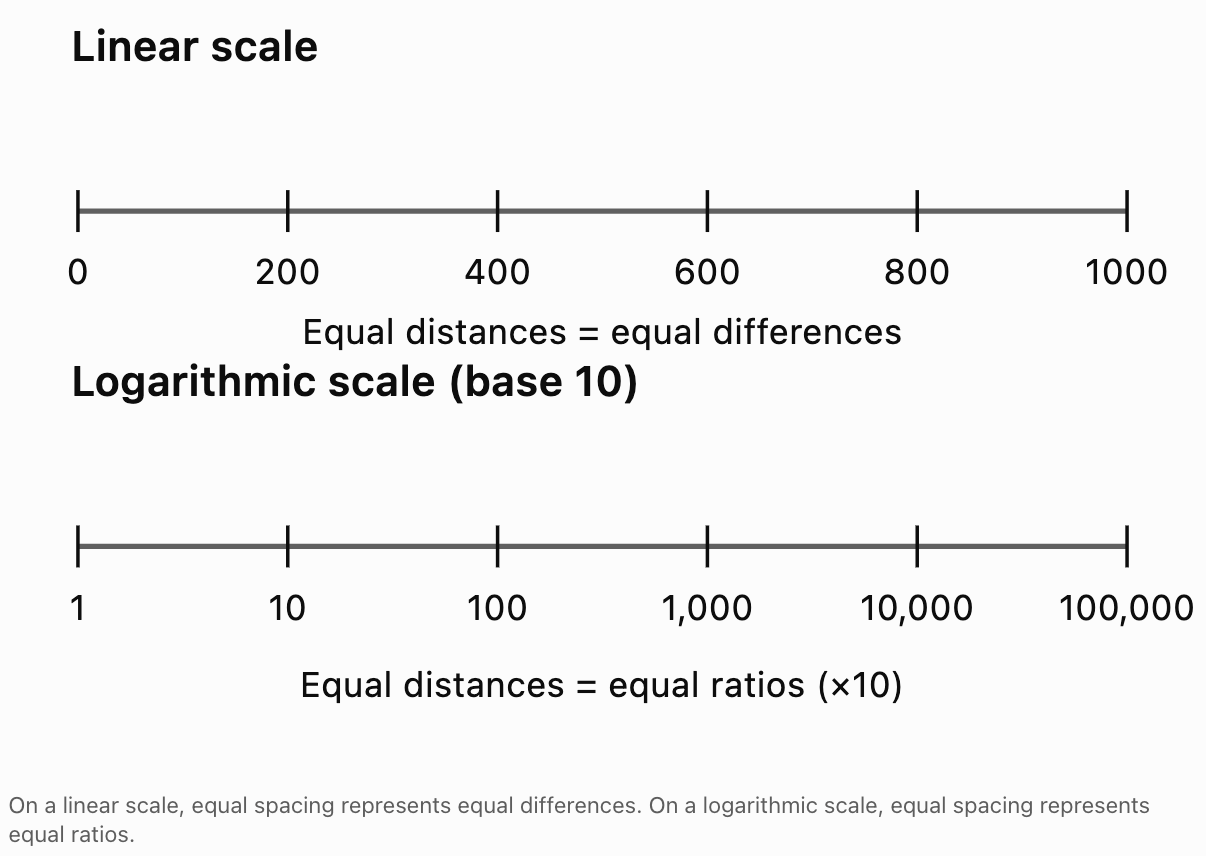
Linear Versus Logarithmic Graphs
On a linear graph, equal distances represent equal numerical differences.
On a logarithmic graph, equal distances represent equal multiplicative ratios.
The pH Scale
The pH scale is used to describe the acidity or alkalinity of aqueous solutions.
It is based on the activity of hydrogen ions.
The mathematical definition is:
pH = −log₁₀(a_H⁺)
where:
-
pH is the acidity measure.
-
a_H⁺ is the dimensionless activity of hydrogen ions.
For dilute aqueous solutions, hydrogen-ion activity is often approximated using hydrogen-ion concentration relative to 1 mol/L.
This gives the familiar school-level approximation:
pH ≈ −log₁₀([H⁺]/(1 mol/L))
where [H⁺] is the hydrogen-ion concentration.
Understanding pH Values
At approximately 25°C:
-
pH below 7 indicates an acidic solution.
-
pH of 7 indicates a neutral solution.
-
pH above 7 indicates a basic or alkaline solution.
These familiar boundaries apply to typical dilute aqueous solutions at 25°C. The pH of neutrality changes with temperature, and pH values can fall outside the usual 0–14 range.

Why pH Is Logarithmic
The pH scale is logarithmic because hydrogen-ion activity can vary enormously.
Consider two solutions:
Solution A:
a_H⁺ = 0.01
Solution B:
a_H⁺ = 0.0001
For Solution A:
pH = −log₁₀(0.01)
pH = 2
For Solution B:
pH = −log₁₀(0.0001)
pH = 4
The difference is only 2 pH units.
However, the hydrogen-ion activity differs by a factor of:
0.01/0.0001 = 100
Solution A has 100 times the hydrogen-ion activity of Solution B.
This is why small differences in pH can represent large chemical differences.
Interpreting pH Differences
For two solutions with pH values pH₁ and pH₂:
a₁/a₂ = 10^(pH₂ − pH₁)
where a₁ and a₂ are their hydrogen-ion activities.
Examples
|
Difference in pH |
Hydrogen-ion activity ratio |
|---|---|
|
1 unit |
10 times |
|
2 units |
100 times |
|
3 units |
1000 times |
|
4 units |
10000 times |
|
5 units |
100000 times |
A decrease of 1 pH unit represents a tenfold increase in hydrogen-ion activity.
A decrease of 2 pH units represents a hundredfold increase.
Worked Example: Calculating pH
A solution has a hydrogen-ion activity of:
a_H⁺ = 3.2 × 10⁻⁴
Calculate its pH.
Step 1: Write the Formula
pH = −log₁₀(a_H⁺)
Step 2: Substitute
pH = −log₁₀(3.2 × 10⁻⁴)
Step 3: Apply Logarithm Rules
pH = −[log₁₀(3.2) + log₁₀(10⁻⁴)]
Since:
log₁₀(10⁻⁴) = −4
we obtain:
pH = −[log₁₀(3.2) − 4]
Step 4: Calculate
log₁₀(3.2) ≈ 0.50515
pH ≈ −(0.50515 − 4)
pH ≈ 3.49
Interpretation
The solution is acidic.
Worked Example: Comparing Two pH Values
A solution has pH 3.
Another solution has pH 6.
How many times greater is the hydrogen-ion activity in the first solution?
Step 1: Find the pH Difference
6 − 3 = 3
Step 2: Calculate the Ratio
Ratio = 10³
Ratio = 1000
Final Answer
The solution with pH 3 has 1000 times greater hydrogen-ion activity than the solution with pH 6.
Important Distinction
A solution with pH 3 is not simply twice as acidic as a solution with pH 6.
The pH scale is logarithmic, not linear.
Worked Example: Finding Hydrogen-Ion Activity
A solution has:
pH = 5.5
Calculate its hydrogen-ion activity.
Step 1: Write the Formula
pH = −log₁₀(a_H⁺)
Step 2: Substitute
5.5 = −log₁₀(a_H⁺)
Step 3: Rearrange
−5.5 = log₁₀(a_H⁺)
Step 4: Convert to Exponential Form
a_H⁺ = 10⁻⁵·⁵
Step 5: Calculate
a_H⁺ ≈ 3.16 × 10⁻⁶
This illustrates how logarithms can be reversed to determine the original physical quantity.
Applications of pH
The pH scale is important in:
-
Drinking water treatment.
-
Agriculture and soil management.
-
Aquatic ecosystems.
-
Food production.
-
Human physiology.
-
Industrial chemistry.
-
Environmental monitoring.
For example, aquatic organisms may be sensitive to changes in water pH because these changes affect chemical equilibria and the availability or toxicity of dissolved substances.


Earthquake Magnitude and the Richter Scale
Earthquakes produce seismic waves that travel through the Earth.
Seismographs record these waves, allowing scientists to estimate earthquake magnitude.
The original Richter scale, developed in 1935, was a logarithmic local-magnitude scale based on seismic-wave amplitudes recorded under specified conditions.
Modern seismology more commonly uses the moment magnitude scale (Mw), especially for large earthquakes.
Both use logarithmic relationships, but they are not identical measurement systems.


Understanding the Richter Scale
A simplified model of the Richter scale is:
M = log₁₀(A/A₀)
where:
-
M is the earthquake magnitude.
-
A is a measured seismic-wave amplitude.
-
A₀ is a reference amplitude.
Actual Richter local-magnitude calculations also account for factors such as the distance between the earthquake and the recording station.
Meaning of the Scale
An increase of one magnitude unit corresponds to a tenfold increase in the relevant corrected seismic-wave amplitude.
For example:
-
Magnitude 4 to magnitude 5: amplitude increases by a factor of 10.
-
Magnitude 4 to magnitude 6: amplitude increases by a factor of 100.
-
Magnitude 4 to magnitude 7: amplitude increases by a factor of 1000.
Important Distinction
Earthquake magnitude is not the same as earthquake damage.
Damage depends on factors such as:
-
Earthquake depth.
-
Distance from the epicentre.
-
Local geology.
-
Building construction.
-
Duration of shaking.
-
Population density.
Worked Example: Comparing Earthquake Amplitudes
Earthquake A has magnitude 4.5.
Earthquake B has magnitude 6.5.
Compare their seismic-wave amplitudes using the simplified logarithmic relationship.
Step 1: Calculate the Magnitude Difference
ΔM = 6.5 − 4.5
ΔM = 2
Step 2: Calculate the Amplitude Ratio
Amplitude ratio = 10^ΔM
= 10²
= 100
Final Answer
The relevant corrected seismic-wave amplitude of Earthquake B is 100 times that of Earthquake A.
Worked Example: Finding a Magnitude Difference
One earthquake produces a corrected seismic-wave amplitude 500 times that of another earthquake.
Find the difference in magnitude.
Step 1: Write the Relationship
ΔM = log₁₀(A₂/A₁)
Step 2: Substitute
ΔM = log₁₀(500)
Step 3: Calculate
ΔM ≈ 2.699
Final Answer
The magnitude difference is approximately 2.70 units.
This shows that a very large amplitude difference can correspond to a relatively small numerical magnitude difference.
Earthquake Energy and Magnitude
Earthquake magnitude is also related to the energy released.
For moment magnitude, an increase of one magnitude unit corresponds approximately to an energy increase by a factor of:
10¹·⁵ ≈ 31.6
A commonly used approximate energy relationship is:
log₁₀(E) ≈ 1.5Mw + 4.8
where:
-
E is seismic energy in joules.
-
Mw is moment magnitude.
This is an approximate relationship, not an exact energy measurement for every earthquake.
Comparing Earthquake Energy
For two earthquakes:
E₂/E₁ ≈ 10^[1.5(M₂ − M₁)]
Worked Example
Compare the approximate energy released by magnitude 5 and magnitude 7 earthquakes.
Step 1: Find the Magnitude Difference
7 − 5 = 2
Step 2: Apply the Energy Relationship
E₂/E₁ ≈ 10^(1.5 × 2)
= 10³
= 1000
Final Answer
A magnitude 7 earthquake releases approximately 1000 times as much seismic energy as a magnitude 5 earthquake.
Important Principle
A tenfold increase in corrected seismic-wave amplitude per magnitude unit is not the same as a tenfold increase in released energy.
The energy relationship is much steeper.
Sound Intensity and Decibels
Sound is produced by vibrations that transfer energy through a medium.
Sound intensity measures the sound power passing through a unit area.
The SI unit of sound intensity is:
W/m²
The human auditory system can respond to sound intensities spanning an enormous range.
A logarithmic scale makes these values easier to compare.
The sound intensity level is measured in decibels (dB).


The Decibel Formula
Sound intensity level is calculated using:
L = 10log₁₀(I/I₀)
where:
-
L is sound intensity level in decibels.
-
I is measured sound intensity.
-
I₀ is reference sound intensity.
A common reference intensity in air is:
I₀ = 10⁻¹² W/m²
Understanding the Formula
If:
I = I₀
then:
L = 10log₁₀(1)
Since:
log₁₀(1) = 0
L = 0 dB
Zero decibels does not mean no sound.
It means the intensity equals the chosen reference intensity.
Understanding Decibel Differences
Because decibels use a logarithmic scale, equal increases in decibels represent equal multiplicative changes in intensity.
|
Increase in sound intensity level |
Intensity multiplier |
|---|---|
|
3 dB |
Approximately 2 |
|
10 dB |
10 |
|
20 dB |
100 |
|
30 dB |
1000 |
|
40 dB |
10000 |
|
60 dB |
1000000 |
A 10 dB increase represents a tenfold increase in sound intensity.
A 20 dB increase represents a hundredfold increase.
A 30 dB increase represents a thousandfold increase.
Perceived loudness is different from physical intensity and depends on frequency, duration, and human hearing.
Worked Example: Calculating Sound Intensity Level
A sound has an intensity of:
I = 10⁻⁶ W/m²
Calculate its intensity level.
Step 1: Write the Formula
L = 10log₁₀(I/I₀)
Step 2: Substitute
L = 10log₁₀(10⁻⁶/10⁻¹²)
Step 3: Simplify
10⁻⁶/10⁻¹² = 10⁶
Therefore:
L = 10log₁₀(10⁶)
Step 4: Evaluate
log₁₀(10⁶) = 6
L = 10 × 6
L = 60 dB
Worked Example: Comparing Two Sounds
Sound A has an intensity level of 40 dB.
Sound B has an intensity level of 70 dB.
How many times greater is the intensity of Sound B?
Step 1: Find the Difference
ΔL = 70 − 40
ΔL = 30 dB
Step 2: Rearrange the Decibel Relationship
ΔL = 10log₁₀(I₂/I₁)
Therefore:
I₂/I₁ = 10^(ΔL/10)
Step 3: Substitute
I₂/I₁ = 10^(30/10)
= 10³
= 1000
Final Answer
Sound B has 1000 times the intensity of Sound A.
Worked Example: Finding Sound Intensity
A sound intensity level is 85 dB.
Calculate its intensity using:
I₀ = 10⁻¹² W/m²
Step 1: Write the Formula
85 = 10log₁₀(I/I₀)
Step 2: Divide by 10
8.5 = log₁₀(I/I₀)
Step 3: Convert to Exponential Form
I/I₀ = 10⁸·⁵
Step 4: Rearrange
I = I₀ × 10⁸·⁵
Step 5: Substitute
I = 10⁻¹² × 10⁸·⁵
I = 10⁻³·⁵
I ≈ 3.16 × 10⁻⁴ W/m²
Comparing pH, Earthquake Magnitude, and Decibels
All three applications use logarithms, but they represent different physical relationships.
|
Feature |
pH |
Earthquake magnitude |
Sound intensity level |
|---|---|---|---|
|
Main quantity |
Hydrogen-ion activity |
Seismic measurement |
Sound intensity |
|
Typical logarithm base |
10 |
10 |
10 |
|
Basic relationship |
pH = −log₁₀(a_H⁺) |
M = log₁₀(A/A₀), simplified |
L = 10log₁₀(I/I₀) |
|
Change of 1 unit |
Tenfold change in hydrogen-ion activity |
Tenfold change in corrected amplitude |
Intensity multiplied by 10^0.1 ≈ 1.259 |
|
Change of 10 units |
Ten-billionfold activity ratio |
Ten-billionfold amplitude ratio |
Tenfold intensity ratio |
The same logarithmic principle appears in each system, but the coefficients and physical meanings differ.
A General Formula for Logarithmic Scales
Many logarithmic scales can be expressed as:
S = k log₁₀(Q/Q₀)
where:
-
S is the logarithmic scale value.
-
k is a scale factor.
-
Q is the measured quantity.
-
Q₀ is a reference quantity.
Comparing Two Measurements
For two values:
S₁ = k log₁₀(Q₁/Q₀)
S₂ = k log₁₀(Q₂/Q₀)
Subtract:
S₂ − S₁ = k log₁₀(Q₂/Q₁)
Therefore:
ΔS = k log₁₀(Q₂/Q₁)
Rearranging:
Q₂/Q₁ = 10^(ΔS/k)
This formula is useful for comparing quantities on logarithmic scales.
Examples
For a decibel intensity scale:
k = 10
Therefore:
I₂/I₁ = 10^(ΔL/10)
For the simplified earthquake amplitude relationship:
k = 1
Therefore:
A₂/A₁ = 10^ΔM
For pH, the negative sign reverses the direction of the relationship.
Logarithmic Graphs in Scientific Data
Logarithmic axes are useful when data covers a wide range of values.
Scientists may use:
-
Linear-linear graphs.
-
Semilogarithmic graphs.
-
Log-log graphs.
Linear-Linear Graphs
Both axes use ordinary linear scales.
These are useful for relationships involving additive changes.
Semilogarithmic Graphs
One axis is logarithmic.
These are useful for exponential growth or decay.
For example:
y = Ae^(kx)
Taking natural logarithms:
ln = ln(A) + kx
This is a straight-line relationship between ln and x.
Log-Log Graphs
Both axes are logarithmic.
These are useful for power-law relationships.
For example:
y = Cxⁿ
Taking logarithms:
log = log(C) + nlog(x)
A graph of log against log(x) is a straight line with slope n.


Worked Example: Exponential Growth on a Semilogarithmic Graph
A bacterial population follows:
P(t) = 500e^(0.3t)
where t is measured in hours.
Step 1: Take Natural Logarithms
ln[P(t)] = ln[500e^(0.3t)]
Step 2: Apply Logarithmic Properties
ln[P(t)] = ln(500) + ln[e^(0.3t)]
Therefore:
ln[P(t)] = ln(500) + 0.3t
Step 3: Interpret
A graph of ln(P) against t is a straight line.
Its:
-
Slope is 0.3 per hour.
-
Vertical intercept is ln(500).
This makes logarithmic graphs useful for identifying exponential relationships in experimental data.
Worked Example: A Power Law on a Log-Log Graph
Suppose a physical quantity follows:
F = Cr²
where C is a positive constant.
Take logarithms:
log(F) = log(Cr²)
Apply the product rule:
log(F) = log(C) + log(r²)
Apply the power rule:
log(F) = log(C) + 2log(r)
Therefore, a graph of log(F) against log(r) is a straight line with slope 2.
This is a powerful technique for identifying mathematical relationships from data.
Other Applications of Logarithms
Logarithms appear in many additional fields.
Astronomy
The astronomical magnitude system uses logarithms to compare the apparent brightness of celestial objects.
A difference of 5 magnitudes corresponds to a brightness ratio of 100.
Brighter objects have smaller numerical magnitudes.
Finance
Logarithms help determine how long investments take to reach a target value.
For example:
A = P(1 + r)ᵗ
Taking logarithms:
t = log(A/P)/log(1 + r)
Population Growth
Exponential growth models can be solved using logarithms.
For:
P(t) = P₀e^(kt)
the time required to reach a target population is:
t = ln[P(t)/P₀]/k
for k ≠ 0.
Computer Science
Logarithms describe the efficiency of algorithms such as binary search.
Repeatedly halving a search space produces logarithmic growth in the number of steps required.
Information Theory
The information content of an event with probability p can be represented as:
I = −log₂(p)
This measures information in bits.


A General Strategy for Real-World Logarithmic Problems
When solving a practical logarithmic problem:
-
Identify the physical quantity being measured.
-
Determine the appropriate logarithmic formula.
-
Identify the reference value and any scale factors.
-
Substitute known values with consistent units.
-
Use logarithm rules to simplify the expression.
-
Apply inverse logarithmic operations when necessary.
-
Calculate the result using suitable technology.
-
Check whether the result is reasonable.
-
Interpret the result in the context of the problem.
Example of Reasonableness Checking
Suppose a sound intensity increases by a factor of 100.
The intensity level should increase by:
10log₁₀(100)
= 10 × 2
= 20 dB
If a calculation produces 200 dB, an error has probably occurred.
Estimating expected results is an important mathematical skill.
Common Mistakes
Assuming logarithmic scales are linear
Equal numerical changes on a logarithmic scale represent multiplicative changes in the original quantity.
Confusing pH values with hydrogen-ion activity
A one-unit pH decrease represents a tenfold increase in hydrogen-ion activity.
Assuming pH is always between 0 and 14
Real solutions can have pH values outside this familiar range.
Confusing earthquake magnitude with earthquake damage
Magnitude measures earthquake size, while damage depends on additional factors.
Confusing earthquake amplitude ratios with energy ratios
A one-unit magnitude increase corresponds to approximately tenfold corrected amplitude and about 31.6-fold energy.
Assuming a 10 dB increase doubles sound intensity
A 10 dB increase corresponds to tenfold intensity.
Confusing sound intensity with perceived loudness
Human perception does not respond directly and uniformly to physical intensity.
Forgetting the reference quantity
Logarithmic measurements often describe ratios relative to a reference value.
Ignoring logarithmic coefficients
The factor of 10 in the decibel formula changes the relationship between numerical differences and intensity ratios.
Using logarithms of dimensional quantities without appropriate ratios
Physical logarithmic formulas require dimensionless arguments.
Rounding too early
Intermediate rounding can produce inaccurate final results.
Failing to interpret the answer
A complete solution should explain what the logarithmic value means physically.
Key Terms
-
Logarithm: The exponent required to raise a base to a specified positive value.
-
Logarithmic Scale: A scale that represents multiplicative changes using logarithmic values.
-
Linear Scale: A scale in which equal distances represent equal numerical differences.
-
Common Logarithm: A logarithm with base 10.
-
Natural Logarithm: A logarithm with base e.
-
Order of Magnitude: A measure of numerical scale, usually expressed using powers of 10.
-
Ratio: A comparison between two quantities by division.
-
Reference Value: A standard quantity used for comparison.
-
Dimensionless Quantity: A quantity with no physical units, often formed from a ratio.
-
pH: A logarithmic measure related to hydrogen-ion activity in a solution.
-
Hydrogen-Ion Activity: A thermodynamic measure of the effective behaviour of hydrogen ions in a solution.
-
Acidic Solution: An aqueous solution with greater hydrogen-ion activity than a neutral solution at the same temperature.
-
Basic Solution: An aqueous solution with lower hydrogen-ion activity than a neutral solution at the same temperature.
-
Seismic Wave: A wave of energy travelling through the Earth.
-
Seismograph: An instrument used to record ground motion.
-
Richter Scale: A historical logarithmic local-magnitude scale based on corrected seismic-wave amplitudes.
-
Moment Magnitude: A modern measure of earthquake size based on seismic moment.
-
Earthquake Energy: The energy released during an earthquake.
-
Epicentre: The point on Earth's surface directly above the earthquake focus.
-
Sound Intensity: Sound power transmitted per unit area.
-
Decibel: A logarithmic unit used to express ratios such as sound intensity.
-
Sound Intensity Level: A logarithmic measure comparing sound intensity with a reference intensity.
-
Semilogarithmic Graph: A graph with one logarithmic axis.
-
Log-Log Graph: A graph with two logarithmic axes.
-
Exponential Growth: Growth by a constant multiplicative factor over equal intervals.
-
Exponential Decay: Decrease by a constant multiplicative factor over equal intervals.
-
Power Law: A mathematical relationship of the form y = Cxⁿ.
-
Mathematical Model: A mathematical representation of a real-world system.
-
Logarithmic Transformation: The process of applying logarithms to simplify or analyse mathematical relationships.
Key Takeaways
-
Logarithmic scales convert multiplicative relationships into additive relationships.
-
Logarithmic scales are useful when quantities span several orders of magnitude.
-
The pH scale uses a negative base-10 logarithm to describe hydrogen-ion activity.
-
A decrease of one pH unit corresponds to a tenfold increase in hydrogen-ion activity.
-
A difference of two pH units corresponds to a hundredfold difference in hydrogen-ion activity.
-
The Richter scale is a historical logarithmic measure of earthquake magnitude.
-
Modern earthquake measurements commonly use moment magnitude.
-
A one-unit increase in earthquake magnitude corresponds approximately to a tenfold increase in corrected seismic-wave amplitude.
-
A one-unit increase in moment magnitude corresponds approximately to a 31.6-fold increase in released energy.
-
Sound intensity levels are measured in decibels.
-
A 10 dB increase represents a tenfold increase in sound intensity.
-
A 20 dB increase represents a hundredfold increase in sound intensity.
-
Decibels describe physical ratios and should not be confused directly with perceived loudness.
-
Logarithmic formulas often involve ratios relative to reference quantities.
-
Semilogarithmic graphs are useful for analysing exponential growth and decay.
-
Log-log graphs are useful for identifying power-law relationships.
-
Logarithms are used in chemistry, geology, acoustics, astronomy, finance, and computer science.
-
Practical logarithmic problems often require converting between logarithmic and exponential forms.
-
Accurate mathematical solutions should include correct formulas, substitutions, units, and interpretations.
-
Understanding logarithmic scales allows scientists to compare quantities that would otherwise be difficult to represent using ordinary linear measurements.
Check Your Understanding
Recall and Understanding
-
Explain the difference between a linear scale and a logarithmic scale.
-
Describe why the pH scale is logarithmic.
-
Explain what a one-unit increase in earthquake magnitude means for corrected seismic-wave amplitude.
-
Explain why a 10 dB increase does not mean sound intensity has increased by only 10%.
-
Describe the difference between a semilogarithmic graph and a log-log graph.
Application
-
Calculate the pH of a solution with hydrogen-ion activity of 1 × 10⁻⁵.
-
Two solutions have pH values of 2 and 5. Calculate the ratio of their hydrogen-ion activities.
-
Two earthquakes have magnitudes of 4.2 and 6.2. Compare their corrected seismic-wave amplitudes.
-
Calculate the sound intensity level when I = 10⁻⁷ W/m² and I₀ = 10⁻¹² W/m².
-
Two sounds have intensity levels of 50 dB and 80 dB. Determine their intensity ratio.
Analysis and Challenge
-
A solution has pH 3.8. Calculate its hydrogen-ion activity and explain what the result means.
-
Compare the approximate energy released by magnitude 5.5 and magnitude 7.5 earthquakes.
-
A sound intensity increases by a factor of 250. Calculate the increase in sound intensity level in decibels.
-
A population follows P(t) = 800e^(0.12t). Determine when the population reaches 5000 and explain how logarithms help solve the problem.
-
A scientist records data that follows y = 4x³. Show how logarithms transform this relationship into a straight-line equation and identify the slope of the resulting log-log graph.
Final Summary
Logarithms are essential for representing and interpreting quantities that vary across extremely large ranges.
The pH scale uses logarithms to describe acidity and hydrogen-ion activity.
Earthquake magnitude scales use logarithmic relationships to represent seismic measurements and compare earthquakes of different sizes.
The decibel scale uses logarithms to express sound intensity ratios in manageable numerical values.
Although these scales measure different physical phenomena, they share an important mathematical principle: multiplicative changes in the original quantity become additive changes on the logarithmic scale.
Logarithmic transformations are also valuable for analysing scientific data, particularly exponential and power-law relationships.
By understanding the formulas, interpreting ratios, and applying logarithmic properties, students can solve practical problems involving chemistry, geology, sound, population growth, finance, and technology.
The central principle is that logarithms make enormous differences in physical quantities easier to measure, compare, graph, and understand.