Logarithmic Functions
4. Changing Logarithm Bases
Learning outcomes
- I can apply the change-of-base formula.
- I can evaluate logarithms using technology.
- I can compare logarithms with different bases.
- I can simplify logarithmic calculations.
- I can solve practical logarithmic problems.
Changing Logarithm Bases
Introduction to Changing Logarithm Bases
Logarithms are useful for solving exponential equations, comparing quantities, and investigating mathematical relationships involving growth and decay.
However, logarithms can have many different bases.
For example:
-
log₂(8) = 3
-
log₃(81) = 4
-
log₅(125) = 3
-
log₁₀(1000) = 3
Some logarithms are easy to evaluate mentally because their arguments are familiar powers of their bases.
Others are more difficult.
Consider:
log₃(20)
This asks:
"To what power must 3 be raised to produce 20?"
Since:
3² = 9
and:
3³ = 27
the answer must lie between 2 and 3.
However, determining its exact numerical value requires a more powerful method.
The change-of-base formula allows logarithms with any valid base to be rewritten using another valid base.
This makes logarithms easier to evaluate, compare, simplify, and apply to practical problems.


Reviewing Logarithmic Notation
Recall that logarithms are inverse operations of exponentiation.
The relationship is:
aˣ = b ⇔ logₐ(b) = x
where:
-
a is the base.
-
b is the argument.
-
x is the exponent.
For real logarithms:
-
a > 0.
-
a ≠ 1.
-
b > 0.
Example
Consider:
2⁴ = 16
The equivalent logarithmic expression is:
log₂(16) = 4
The logarithm determines the exponent needed to produce the argument.
An Unfamiliar Logarithm
Consider:
log₂(10)
Since:
2³ = 8
and:
2⁴ = 16
we know:
3 < log₂(10) < 4
But how can we calculate a more precise answer?
The change-of-base formula provides the solution.
The Change-of-Base Formula
The change-of-base formula states:
logₐ(b) = log꜀(b)/log꜀(a)
where a and c are positive bases other than 1, and b > 0.
This means that a logarithm can be rewritten using any other valid logarithmic base.
Two particularly useful forms are:
logₐ(b) = log(b)/log(a)
and:
logₐ(b) = ln(b)/ln(a)
Here:
-
log represents the common logarithm, with base 10.
-
ln represents the natural logarithm, with base e.
Both formulas produce exactly the same result.
Example
To calculate:
log₃(20)
we can write:
log₃(20) = log(20)/log(3)
or:
log₃(20) = ln(20)/ln(3)
Both expressions evaluate to approximately:
2.727
Why the Change-of-Base Formula Works
The change-of-base formula follows directly from the definition of logarithms and the power rule.
Derivation
Let:
x = logₐ(b)
Convert to exponential form:
aˣ = b
Take the natural logarithm of both sides:
ln(aˣ) = ln(b)
Apply the power rule:
x ln(a) = ln(b)
Divide both sides by ln(a):
x = ln(b)/ln(a)
Since:
x = logₐ(b)
we obtain:
logₐ(b) = ln(b)/ln(a)
The same reasoning works with common logarithms:
logₐ(b) = log(b)/log(a)
Important Conclusion
The change-of-base formula is not an approximation.
It is an exact mathematical identity.
Approximation occurs only when the result is rounded to a decimal value.
Evaluating Logarithms Using Common Logarithms
Most scientific calculators include a LOG key.
This usually calculates logarithms to base 10.
Worked Example
Evaluate:
log₂(10)
Step 1: Apply Change of Base
log₂(10) = log(10)/log(2)
Step 2: Evaluate
log(10) = 1
log(2) ≈ 0.301030
Therefore:
log₂(10) ≈ 1/0.301030
log₂(10) ≈ 3.322
Step 3: Check Reasonableness
We know:
2³ = 8
2⁴ = 16
Since 10 lies between 8 and 16, the exponent must lie between 3 and 4.
The calculated value is reasonable.
Evaluating Logarithms Using Natural Logarithms
Natural logarithms use base e, where:
e ≈ 2.71828
The natural logarithm is written:
ln(x)
Worked Example
Evaluate:
log₅(18)
Step 1: Apply Change of Base
log₅(18) = ln(18)/ln(5)
Step 2: Calculate
ln(18) ≈ 2.890372
ln(5) ≈ 1.609438
Therefore:
log₅(18) ≈ 2.890372/1.609438
log₅(18) ≈ 1.796
Step 3: Verify
Since:
5¹ = 5
5² = 25
the logarithm of 18 to base 5 must lie between 1 and 2.
The answer is consistent with this estimate.
Common Logarithms and Natural Logarithms
Common and natural logarithms are especially useful because calculators and mathematical software support them directly.
|
Feature |
Common logarithm |
Natural logarithm |
|---|---|---|
|
Base |
10 |
e ≈ 2.71828 |
|
Notation |
log(x) |
ln(x) |
|
Calculator key |
LOG |
LN |
|
Example |
log(100) = 2 |
ln(e²) = 2 |
|
Common applications |
Scientific notation, logarithmic scales |
Calculus, continuous growth and decay |
Which Should You Use?
For ordinary numerical calculations, either is suitable.
For example:
log₇(25) = log(25)/log(7)
and:
log₇(25) = ln(25)/ln(7)
Both give approximately:
1.654
Natural logarithms are often preferred in calculus and continuous growth models because they work naturally with exponential functions involving e.
Using a Scientific Calculator
A scientific calculator can evaluate logarithms with unfamiliar bases using the change-of-base formula.
Example: Calculate log₄(30)
Enter:
log(30) ÷ log(4)
or:
ln(30) ÷ ln(4)
The result is:
log₄(30) ≈ 2.453
Some calculators also provide a logarithm template that allows the base and argument to be entered directly.
Calculator Procedure
-
Identify the base and argument.
-
Enter LOG or LN of the argument.
-
Divide by LOG or LN of the base.
-
Evaluate.
-
Round only the final answer to the required precision.
Important Calculator Rule
Use the same logarithmic base in the numerator and denominator.
Correct:
log(30)/log(4)
Correct:
ln(30)/ln(4)
Incorrect:
log(30)/ln(4)
The final expression does not represent log₄(30).
Evaluating Logarithms with Technology
Graphing calculators, spreadsheets, and mathematical software can also evaluate logarithms.
Spreadsheet Examples
In many spreadsheet applications:
=LOG(20,3)
calculates log₃(20).
Alternatively:
=LN(20)/LN(3)
produces the same result.
For common logarithms:
=LOG10(1000)
returns 3.
For natural logarithms:
=LN(EXP(2))
returns 2, apart from possible floating-point rounding.
Benefits of Technology
Technology is especially useful when:
-
The logarithmic base is unfamiliar.
-
The argument is not a simple power.
-
High numerical precision is required.
-
Many logarithmic calculations must be performed.
-
Logarithmic values are used in graphs or models.
However, students should still understand what the result means and whether it is reasonable.
Comparing Logarithms with Different Bases
The value of a logarithm depends on both its base and its argument.
For example:
log₂(16) = 4
log₄(16) = 2
log₁₆(16) = 1
The argument remains 16, but the logarithmic value changes because the base changes.
Why Does This Happen?
Consider the equivalent exponential equations:
2⁴ = 16
4² = 16
16¹ = 16
Different bases require different exponents to produce the same number.
Numerical Comparison
|
Argument x |
log₂(x) |
log₃(x) |
log₁₀(x) |
|---|---|---|---|
|
1 |
0 |
0 |
0 |
|
2 |
1 |
0.631 |
0.301 |
|
4 |
2 |
1.262 |
0.602 |
|
8 |
3 |
1.893 |
0.903 |
|
16 |
4 |
2.524 |
1.204 |
|
32 |
5 |
3.155 |
1.505 |
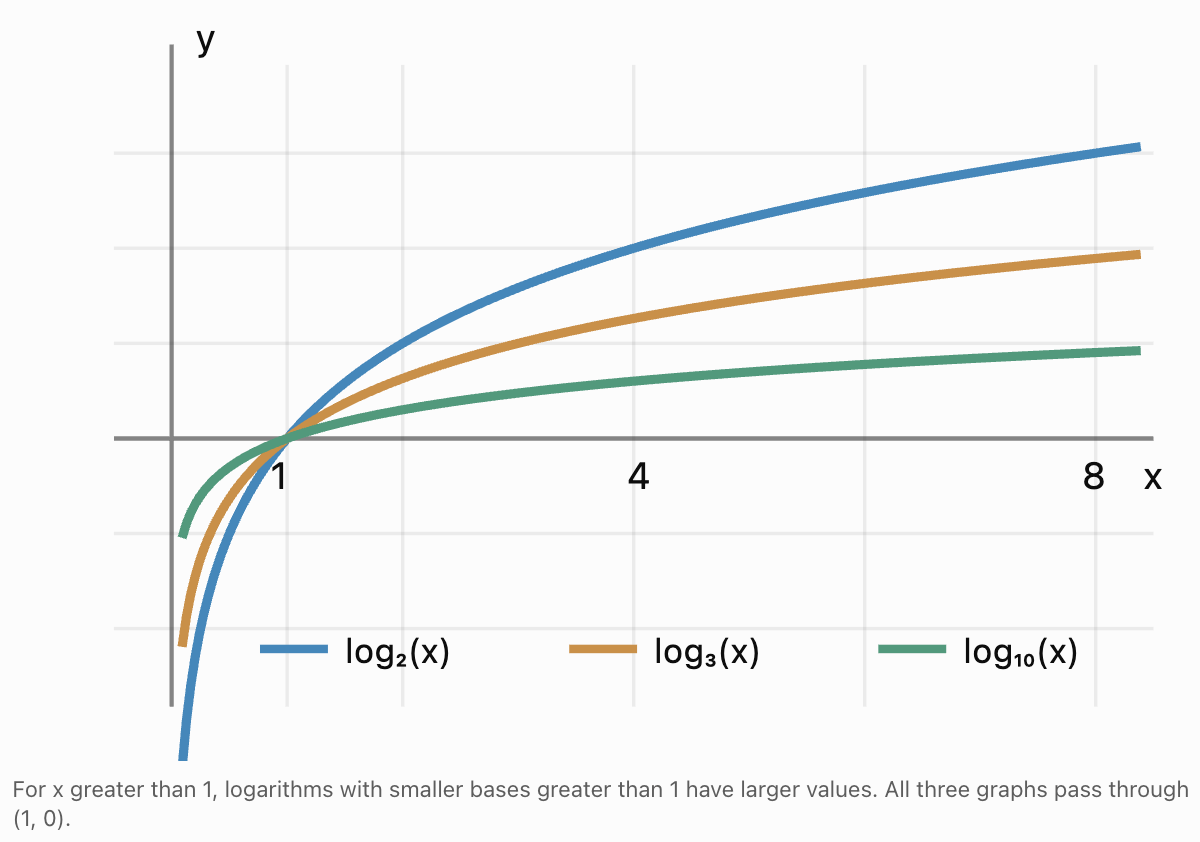
For x > 1, a smaller base greater than 1 produces a larger logarithmic value.
For 0 < x < 1, the ordering reverses.
Comparing Logarithmic Graphs
Consider:
y = log₂(x)
y = log₃(x)
y = log₁₀(x)
All three functions:
-
Have domain x > 0.
-
Have range all real numbers.
-
Pass through (1, 0).
-
Have vertical asymptote x = 0.
-
Increase from left to right.
However, they increase at different rates.
Comparing Bases Between Zero and One
Logarithms can also have bases between 0 and 1.
For example:
y = log₁/₂(x)
Since:
(1/2)⁻¹ = 2
we know:
log₁/₂(2) = −1
Unlike logarithmic functions with bases greater than 1, these functions decrease from left to right.
Change-of-Base Example
Evaluate:
log₁/₂(8)
Apply change of base:
log₁/₂(8) = ln(8)/ln(1/2)
Since:
ln(1/2) = −ln(2)
and:
ln(8) = 3ln(2)
we obtain:
log₁/₂(8) = −3
Important Observation
The change-of-base formula works for all valid positive bases other than 1, including bases between 0 and 1.
Useful Identities Involving Different Bases
Changing bases reveals several important logarithmic identities.
Reciprocal Identity
logₐ(b) = 1/logᵦ(a)
for positive a and b other than 1.
Derivation
Using change of base:
logₐ(b) = ln(b)/ln(a)
Also:
logᵦ(a) = ln(a)/ln(b)
These expressions are reciprocals.
Worked Example
Evaluate:
log₂(8) × log₈(2)
Since:
log₂(8) = 3
and:
log₈(2) = 1/3
their product is:
1
Chain Identity
Another useful relationship is:
logₐ(b) × logᵦ(c) = logₐ(c)
where all bases and arguments are valid.
Derivation
logₐ(b) = ln(b)/ln(a)
logᵦ(c) = ln(c)/ln(b)
Multiply:
[ln(b)/ln(a)] × [ln(c)/ln(b)]
Cancel ln(b):
= ln(c)/ln(a)
Therefore:
logₐ(b) × logᵦ(c) = logₐ(c)
Worked Example
Simplify:
log₂(5) × log₅(32)
Using the chain identity:
= log₂(32)
Since:
2⁵ = 32
Answer = 5
Simplifying Calculations by Choosing a Convenient Base
Although any valid base can be used, some choices make calculations easier.
Example
Evaluate:
log₄(64)
Using change of base:
log₄(64) = log₂(64)/log₂(4)
Since:
log₂(64) = 6
log₂(4) = 2
Answer = 3
This is simpler than evaluating decimal logarithms.
Another Example
Evaluate:
log₉(27)
Rewrite using base 3:
log₉(27) = log₃(27)/log₃(9)
= 3/2
Answer = 1.5
General Strategy
When the base and argument are powers of a common number, changing to that common base may produce an exact answer.
Logarithms with Powers as Bases
The change-of-base formula can simplify logarithms whose bases are powers.
Consider:
logₐᵏ(b)
Using change of base:
logₐᵏ(b) = ln(b)/ln(aᵏ)
Apply the power rule:
= ln(b)/[kln(a)]
Therefore:
logₐᵏ(b) = (1/k)logₐ(b)
provided a > 0, a ≠ 1, and k ≠ 0.
Worked Example
Simplify:
log₈(64)
Since:
8 = 2³
and:
64 = 2⁶
we obtain:
log₈(64) = 6/3
Answer = 2
Another Example
Simplify:
log₂₅(125)
Since:
25 = 5²
and:
125 = 5³
we obtain:
log₂₅(125) = 3/2
Answer = 1.5
Solving Exponential Equations Using Change of Base
One of the most important applications of the change-of-base formula is solving equations where the variable appears in an exponent.
Worked Example
Solve:
3ˣ = 20
Step 1: Convert to Logarithmic Form
x = log₃(20)
Step 2: Apply Change of Base
x = ln(20)/ln(3)
Step 3: Evaluate
x ≈ 2.995732/1.098612
x ≈ 2.727
Verification
3² = 9
3³ = 27
Since 20 lies between 9 and 27, the exponent must lie between 2 and 3.
The answer is reasonable.
Solving Multi-Step Exponential Equations
Worked Example
Solve:
5^(2x−1) = 40
Step 1: Take Logarithms
ln[5^(2x−1)] = ln(40)
Step 2: Apply the Power Rule
(2x − 1)ln(5) = ln(40)
Step 3: Divide
2x − 1 = ln(40)/ln(5)
Step 4: Solve for x
2x = 1 + ln(40)/ln(5)
x = [1 + ln(40)/ln(5)]/2
Step 5: Calculate
x ≈ 1.646
Interpretation
The exponent is approximately:
2(1.646) − 1 ≈ 2.292
Raising 5 to this power gives approximately 40.
Practical Application: Compound Interest
Compound interest can be modelled by:
A = P(1 + r/n)^(nt)
where:
-
A = final amount.
-
P = initial principal.
-
r = annual interest rate as a decimal.
-
n = number of compounding periods per year.
-
t = time in years.
Logarithms allow us to solve for time.
Worked Example
An investment of $5000 earns 6% annual interest, compounded monthly.
How long will it take to grow to $8000?
Step 1: Write the Formula
8000 = 5000(1 + 0.06/12)^(12t)
Step 2: Simplify
1.6 = 1.005^(12t)
Step 3: Take Natural Logarithms
ln(1.6) = 12t ln(1.005)
Step 4: Solve
t = ln(1.6)/[12ln(1.005)]
Step 5: Calculate
t ≈ 7.85 years
Interpretation
The investment reaches $8000 after approximately 7.85 years according to the continuous-time solution of the monthly-compounding formula.
Because interest is actually credited monthly, the balance first reaches at least $8000 after 95 complete monthly compounding periods, or approximately 7.92 years.
Practical Application: Population Growth
Suppose a population increases by 4% each year.
The model is:
P(t) = P₀(1.04)ᵗ
Find the time required for the population to double.
Step 1: Set Up the Equation
2P₀ = P₀(1.04)ᵗ
Divide by P₀:
2 = 1.04ᵗ
Step 2: Apply Logarithms
t = log₁.₀₄(2)
Step 3: Change Base
t = ln(2)/ln(1.04)
Step 4: Calculate
t ≈ 17.67 years
Interpretation
The population takes approximately 17.67 years to double under this exponential growth model.


Practical Application: Radioactive Decay
Radioactive decay is commonly modelled by:
N(t) = N₀e^(−λt)
where:
-
N(t) = amount remaining.
-
N₀ = initial amount.
-
λ = decay constant.
-
t = time.
The half-life is the time required for half the original material to remain.
Worked Example
A radioactive substance has a decay constant of 0.035 per year.
Find its half-life.
Step 1: Set Up the Equation
N(t) = N₀/2
Therefore:
1/2 = e^(−0.035t)
Step 2: Take Natural Logarithms
ln(1/2) = −0.035t
Step 3: Solve
t = ln(1/2)/(−0.035)
Since:
ln(1/2) = −ln(2)
we obtain:
t = ln(2)/0.035
Step 4: Calculate
t ≈ 19.80 years
Natural logarithms are especially convenient for models involving the base e.
Practical Application: Sound Intensity
Sound intensity levels are measured in decibels.
The formula is:
L = 10log₁₀(I/I₀)
where:
-
L = intensity level in decibels.
-
I = measured intensity.
-
I₀ = reference intensity.
Worked Example
A sound has an intensity 500 times the reference intensity.
Calculate its intensity level.
Step 1: Substitute
L = 10log₁₀(500)
Step 2: Evaluate
log₁₀(500) ≈ 2.69897
Therefore:
L ≈ 10 × 2.69897
L ≈ 26.99 dB
Interpretation
The sound intensity level is approximately 27.0 dB above the reference level.
Logarithmic scales make large intensity ratios easier to express and compare.
Practical Application: pH
The pH scale measures acidity using a logarithmic relationship.
pH = −log₁₀(a_H⁺)
where a_H⁺ represents dimensionless hydrogen-ion activity.
In dilute solutions, hydrogen-ion activity is often approximated using concentration relative to 1 mol/L.
Worked Example
Suppose the hydrogen-ion activity is:
a_H⁺ = 2.5 × 10⁻⁴
Calculate the pH.
Step 1: Substitute
pH = −log₁₀(2.5 × 10⁻⁴)
Step 2: Apply the Product Rule
pH = −[log₁₀(2.5) + log₁₀(10⁻⁴)]
Step 3: Simplify
log₁₀(10⁻⁴) = −4
Therefore:
pH = −[log₁₀(2.5) − 4]
Step 4: Calculate
log₁₀(2.5) ≈ 0.39794
pH ≈ −(0.39794 − 4)
pH ≈ 3.60
This example combines logarithmic properties with scientific measurement.


Practical Application: Computer Science
Logarithms are important in computer science because some algorithms repeatedly divide a problem into smaller parts.
For example, binary search repeatedly halves the number of possibilities.
Suppose a sorted collection contains 1024 items.
Since:
1024 = 2¹⁰
a binary search can locate an item or establish its absence using at most approximately 11 comparisons, depending on the exact implementation and how comparisons are counted.
The logarithm:
log₂(1024) = 10
describes the number of times 1024 can be halved to reach 1.
Worked Example
A data structure contains 5000 items.
Estimate:
log₂(5000)
Using change of base:
log₂(5000) = ln(5000)/ln(2)
≈ 12.288
This indicates that the number of halving stages grows much more slowly than the number of items.
Choosing the Best Logarithmic Base
Different problems may benefit from different logarithmic bases.
|
Situation |
Convenient base |
|---|---|
|
Powers of 2 |
Base 2 |
|
Powers of 3 |
Base 3 |
|
Powers of 10 |
Base 10 |
|
Scientific notation |
Base 10 |
|
Continuous growth and decay |
Base e |
|
Compound interest calculations |
Base 10 or e |
|
Calculator evaluation |
Base 10 or e |
|
Binary search and information theory |
Base 2 |
|
Simplifying powers of a common number |
That common base |
The change-of-base formula allows us to choose whichever base makes a calculation easiest.
A Strategy for Logarithmic Calculations
When solving a logarithmic problem:
-
Identify the base and argument.
-
Check that the logarithm is defined.
-
Determine whether the answer can be found using familiar powers.
-
Look for common bases that simplify the expression.
-
Apply the change-of-base formula when necessary.
-
Use logarithmic properties to simplify expressions.
-
Evaluate using appropriate technology.
-
Check the answer against nearby powers or the original equation.
-
Round only at the final stage.
-
Interpret the result in the context of the problem.
This approach helps reduce errors and encourages efficient mathematical reasoning.
Common Mistakes
Reversing the numerator and denominator
Correct:
logₐ(b) = log(b)/log(a)
The argument goes in the numerator, and the original base goes in the denominator.
Using different logarithm bases in the numerator and denominator
Correct:
ln(b)/ln(a)
Incorrect:
ln(b)/log(a)
Confusing common and natural logarithms
LOG normally means base 10, while LN means base e.
Assuming changing the base changes the value
The change-of-base formula produces an equivalent expression with exactly the same value.
Using an invalid logarithmic base
The base must be positive and cannot equal 1.
Using zero or negative arguments
Real logarithms require positive arguments.
Ignoring bases between zero and one
These are valid logarithmic bases and produce decreasing logarithmic functions.
Rounding too early
Intermediate rounding can reduce the accuracy of multi-step calculations.
Failing to estimate the answer
Comparing the argument with nearby powers provides a useful reasonableness check.
Confusing logarithmic growth with exponential growth
Exponential functions increase multiplicatively, while logarithmic functions describe the exponents associated with those changes.
Using an inappropriate real-world model
Exponential models depend on assumptions such as constant proportional growth or decay.
Key Terms
-
Logarithm: The exponent required to raise a given base to a positive argument.
-
Base: The positive number, other than 1, used in a logarithmic expression.
-
Argument: The positive number or expression inside a logarithm.
-
Change-of-Base Formula: A mathematical identity used to express a logarithm using a different base.
-
Common Logarithm: A logarithm with base 10.
-
Natural Logarithm: A logarithm with base e.
-
Euler's Number (e): An irrational constant approximately equal to 2.71828.
-
Exponential Form: A mathematical expression involving a base raised to a power.
-
Logarithmic Form: An equivalent expression that identifies the exponent.
-
Inverse Function: A function that reverses another function.
-
Power Rule: A logarithmic property that converts an exponent into a multiplier.
-
Product Rule: A logarithmic property that converts multiplication into addition.
-
Quotient Rule: A logarithmic property that converts division into subtraction.
-
Equivalent Expressions: Expressions that produce the same values throughout their common domain.
-
Reciprocal Identity: A relationship connecting logₐ(b) and logᵦ(a).
-
Chain Identity: A relationship in which logₐ(b) × logᵦ(c) = logₐ(c).
-
Scientific Calculator: A calculator capable of evaluating advanced mathematical functions.
-
Numerical Approximation: A decimal value close to an exact mathematical result.
-
Precision: The level of detail or number of significant digits in a numerical result.
-
Exponential Equation: An equation containing a variable in an exponent.
-
Compound Interest: Interest calculated on an initial principal and previously accumulated interest.
-
Exponential Growth: Growth by a constant multiplicative factor over equal time intervals.
-
Exponential Decay: Decrease by a constant multiplicative factor over equal time intervals.
-
Decay Constant: A parameter describing the rate of continuous exponential decay.
-
Half-Life: The time required for a decaying quantity to decrease to half its original value.
-
Logarithmic Scale: A scale that represents multiplicative changes through logarithmic values.
-
Decibel: A logarithmic unit used to describe ratios such as sound intensity.
-
Binary Search: An algorithm that repeatedly divides a sorted search interval approximately in half.
-
Mathematical Model: A mathematical representation of a real-world system.
-
Verification: The process of checking whether a calculated answer satisfies the original conditions.
Key Takeaways
-
The change-of-base formula allows logarithms with any valid base to be rewritten using another valid base.
-
The general formula is logₐ(b) = log꜀(b)/log꜀(a).
-
Common logarithms and natural logarithms are especially useful for calculator evaluations.
-
The formulas logₐ(b) = log(b)/log(a) and logₐ(b) = ln(b)/ln(a) are mathematically equivalent.
-
The change-of-base formula follows from the power rule of logarithms.
-
Changing the base does not change the numerical value of a logarithm.
-
Logarithms with different bases can be compared using common or natural logarithms.
-
For x > 1, smaller bases greater than 1 produce larger logarithmic values.
-
Logarithms with bases between zero and one decrease as their arguments increase.
-
The reciprocal identity connects logarithms with reversed bases and arguments.
-
The chain identity allows products of logarithms with related bases to be simplified.
-
Choosing a convenient common base can produce exact answers without a calculator.
-
The change-of-base formula is useful for solving exponential equations with unfamiliar bases.
-
Technology allows logarithms to be evaluated accurately, but mathematical estimation remains important.
-
Logarithms are used to calculate growth times, doubling times, and decay rates.
-
Natural logarithms are especially convenient for models involving continuous exponential change.
-
Logarithmic scales simplify comparisons involving large numerical ranges.
-
Applications include compound interest, population growth, radioactive decay, sound intensity, chemistry, and computer science.
-
A complete solution should include the appropriate formula, correct substitution, accurate calculation, and a meaningful interpretation.
-
Understanding how to change logarithmic bases makes logarithms more flexible and provides an important foundation for advanced algebra, scientific modelling, and calculus.
Check Your Understanding
Recall and Understanding
-
State the change-of-base formula.
-
Explain why the change-of-base formula works.
-
Describe the difference between common logarithms and natural logarithms.
-
Explain why log₂(16) and log₄(16) have different values.
-
Explain why a calculator can evaluate logarithms with unfamiliar bases using only LOG or LN.
Application
-
Evaluate log₃(25), correct to three decimal places.
-
Use change of base to calculate log₇(40).
-
Simplify log₄(64) using a convenient common base.
-
Evaluate log₁/₃(27).
-
Solve 4ˣ = 75, giving your answer to three decimal places.
Analysis and Challenge
-
Prove that logₐ(b) = 1/logᵦ(a), stating the necessary restrictions.
-
Simplify log₂(7) × log₇(49) without using a calculator.
-
An investment grows by 5% annually. Determine how long it will take to double in value.
-
A radioactive substance follows N(t) = 800e^(−0.025t). Determine when only 200 units remain.
-
A sound intensity is 2500 times a reference intensity. Calculate its sound intensity level in decibels and explain how the logarithmic scale represents this large ratio.
Final Summary
Changing logarithmic bases is an essential technique in algebra and mathematical modelling.
The change-of-base formula allows logarithms with unfamiliar bases to be expressed using common or natural logarithms.
This makes it possible to evaluate logarithms accurately using scientific calculators, spreadsheets, and mathematical software.
The formula also reveals important relationships between logarithms with different bases, including reciprocal and chain identities.
By choosing convenient bases, complicated logarithmic expressions can often be simplified into exact values.
Changing bases is especially useful when solving exponential equations, calculating growth and decay times, and interpreting logarithmic scales in science and engineering.
The central principle is that the value of a logarithm does not depend on the notation used to calculate it. By changing to a convenient base, we can make difficult logarithmic calculations simpler without changing their mathematical meaning.