Advanced Probability
2. Independent and Dependent Events
Learning outcomes
- I can distinguish independent and dependent events.
- I can calculate joint probabilities.
- I can analyse probability models.
- I can solve complex probability problems.
- I can justify probability calculations.
Independent and Dependent Events
Introduction to Independent and Dependent Events
Many probability problems involve more than one event. When two or more events occur, we need to determine whether the outcome of one event changes the probability of another.
Consider these situations:
-
A coin is tossed twice.
-
Two cards are drawn from a deck without replacement.
-
Two students are selected randomly from a class.
-
A machine produces several components.
-
A person receives two results from diagnostic tests.
In some situations, the events do not influence one another. In others, the occurrence of one event changes the probability of another.
This distinction is fundamental to probability.
Independent events are events where the occurrence of one does not change the probability of the other.
Dependent events are events where the occurrence of one changes the probability of the other.
Understanding independence and dependence allows us to calculate joint probabilities, interpret probability models, and solve more complex problems involving multiple events.


Understanding Independent Events
Two events are independent if knowing that one has occurred does not change the probability of the other.
For example, suppose a fair coin is tossed twice.
Let:
A = obtaining heads on the first toss
B = obtaining heads on the second toss
The probability of heads on the second toss is:
P(B) = 0.5
Even if the first toss produces heads, the probability of heads on the second toss remains:
P(B | A) = 0.5
Therefore, A and B are independent.
Mathematical Definition
Two events A and B are independent when:
P(A ∩ B) = P(A) × P(B)
The symbol ∩ means "and" or "intersection."
P(A ∩ B) represents the probability that both events occur.
An equivalent condition, when P(B) > 0, is:
P(A | B) = P(A)
Similarly, when P(A) > 0:
P(B | A) = P(B)
These conditions express the same idea: learning that one event occurred does not change the probability of the other.
Worked Example: Tossing Two Coins
Two fair coins are tossed.
Find the probability that both coins show heads.
Step 1: Identify the Events
A = first coin shows heads
B = second coin shows heads
Step 2: Determine the Probabilities
P(A) = 1/2
P(B) = 1/2
Step 3: Multiply
Since the events are independent:
P(A ∩ B) = P(A) × P(B)
= 1/2 × 1/2
P(A ∩ B) = 1/4 = 0.25
There is a 25% probability that both coins show heads.
Checking with a Sample Space
The possible outcomes are:
HH, HT, TH, TT
Only HH satisfies both events.
Therefore:
P(both heads) = 1/4
The sample-space method confirms the calculation.
More Examples of Independent Events
Independent events commonly arise in repeated experiments conducted under unchanged conditions.
Examples include:
-
Tossing a fair coin several times.
-
Rolling a fair die repeatedly.
-
Selecting a card, replacing it, shuffling, and selecting again.
-
Repeated independent trials in a binomial experiment.
However, events are not independent simply because they occur at different times or involve different objects.
For example, the performance of two machines may depend on the same power supply. Their failures could therefore be dependent.
Independence must be justified by the situation or supported by an appropriate model.
Understanding Dependent Events
Two events are dependent if the occurrence of one changes the probability of the other.
A common example involves selecting objects without replacement.
Suppose a bag contains:
-
3 red balls
-
2 blue balls
There are five balls altogether.
A ball is selected and not returned to the bag.
A second ball is then selected.
The probability of selecting a red ball on the second draw depends on what happened during the first draw.
If the First Ball Was Red
There are now:
-
2 red balls
-
2 blue balls
The probability that the second ball is red is:
P(second red | first red) = 2/4 = 0.5
If the First Ball Was Blue
There are now:
-
3 red balls
-
1 blue ball
The probability that the second ball is red is:
P(second red | first blue) = 3/4 = 0.75
The probabilities are different.
Therefore, the two draws are dependent.

Conditional Probability
Conditional probability is essential when working with dependent events.
The conditional probability of A given B is written as:
P(A | B)
This means:
"The probability of A occurring, given that B has occurred."
The conditional probability formula is:
P(A | B) = P(A ∩ B)/P(B)
provided P(B) > 0.
Rearranging gives:
P(A ∩ B) = P(B) × P(A | B)
Alternatively:
P(A ∩ B) = P(A) × P(B | A)
These are the general multiplication rules for joint probabilities.
They work for dependent events and independent events.
Calculating Joint Probabilities
A joint probability describes the probability that two events both occur.
It is represented by:
P(A ∩ B)
The correct calculation depends on whether the events are independent.
Independent Events
P(A ∩ B) = P(A) × P(B)
Dependent Events
P(A ∩ B) = P(A) × P(B | A)
The second formula accounts for changes in probability after the first event occurs.
Important Principle
The general conditional multiplication rule always applies when the relevant conditional probability is defined.
The independent multiplication rule is a special case.
Worked Example: Drawing Two Cards Without Replacement
A standard deck contains 52 cards.
There are 13 hearts.
Two cards are drawn without replacement.
Find the probability that both cards are hearts.
Step 1: Probability of the First Heart
P(first heart) = 13/52
= 1/4
Step 2: Probability of the Second Heart
After drawing one heart, there are:
-
12 hearts remaining
-
51 cards remaining
Therefore:
P(second heart | first heart) = 12/51
Step 3: Multiply
P(both hearts) = 13/52 × 12/51
= 156/2652
P(both hearts) = 1/17 ≈ 0.0588
There is approximately a 5.88% probability that both cards are hearts.
The events are dependent because the first draw changes the composition of the deck.
Comparing With Replacement and Without Replacement
Consider drawing two hearts from a standard deck.
With Replacement
The first card is returned and the deck is shuffled before the second draw.
P(both hearts) = 13/52 × 13/52
= 1/4 × 1/4
P(both hearts) = 1/16 = 0.0625
Without Replacement
The first card is not returned.
P(both hearts) = 13/52 × 12/51
P(both hearts) = 1/17 ≈ 0.0588
|
Situation |
Probability of two hearts |
|---|---|
|
With replacement |
6.25% |
|
Without replacement |
5.88% |
Replacing the first card preserves the original probabilities.
Without replacement, the probabilities change.
Probability Tree Diagrams
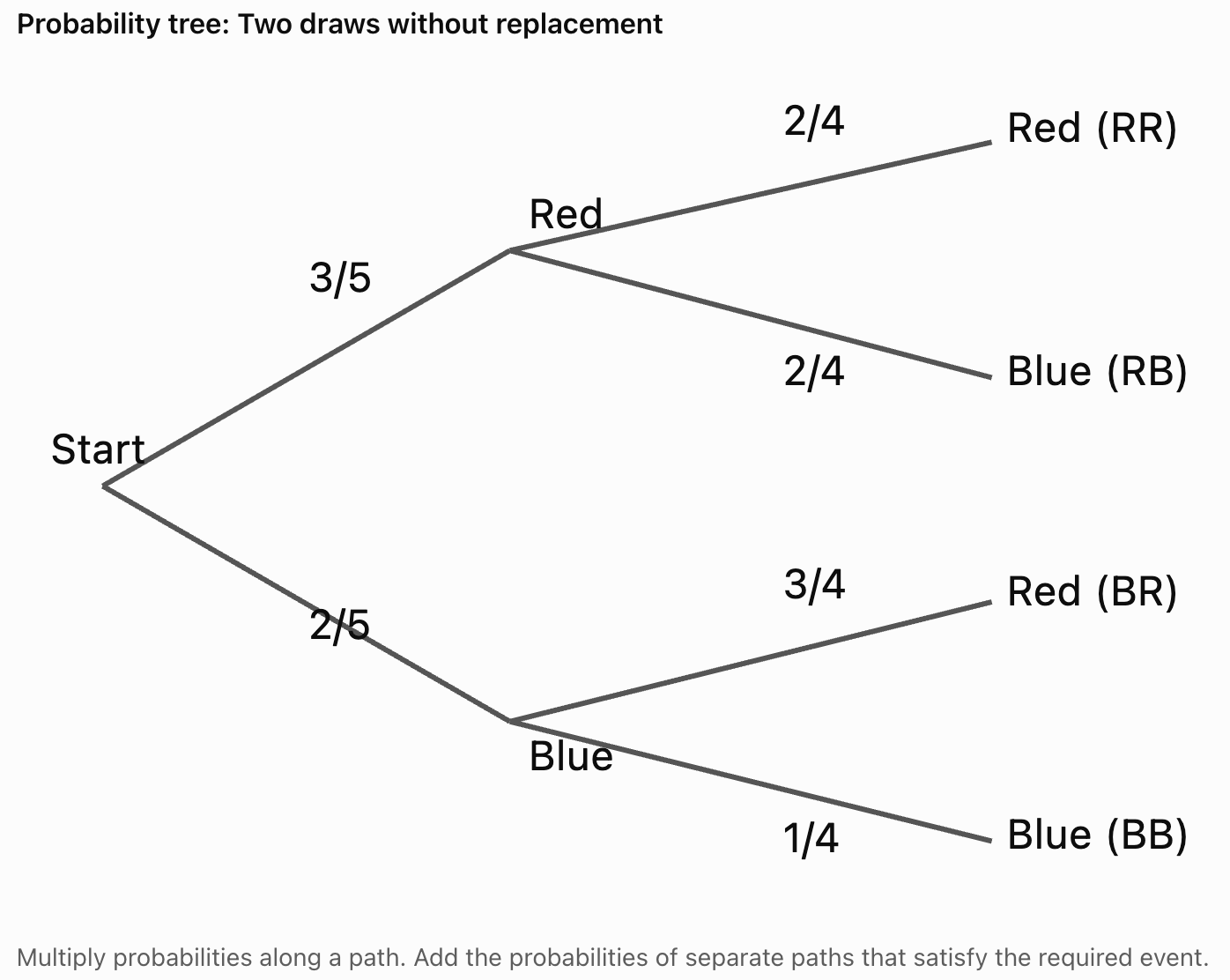
Probability tree diagrams are useful for organizing experiments involving several stages.
Each branch represents a possible outcome and its probability.
Consider a bag containing three red balls and two blue balls.
Two balls are drawn without replacement.
Calculating the Path Probabilities
Red, then red
P(RR) = 3/5 × 2/4
= 6/20 = 0.30
Red, then blue
P(RB) = 3/5 × 2/4
= 6/20 = 0.30
Blue, then red
P(BR) = 2/5 × 3/4
= 6/20 = 0.30
Blue, then blue
P(BB) = 2/5 × 1/4
= 2/20 = 0.10
The probabilities add to:
0.30 + 0.30 + 0.30 + 0.10 = 1
This confirms that all possible outcomes have been included.
Calculating Probabilities Involving Different Paths
Suppose we want the probability of selecting one red ball and one blue ball.
There are two possible sequences:
-
Red, then blue.
-
Blue, then red.
Therefore:
P(one red and one blue) = P(RB) + P(BR)
= 0.30 + 0.30
P(one red and one blue) = 0.60
There is a 60% probability of selecting one ball of each colour.
Important Principle
When solving multi-stage probability problems:
-
Multiply probabilities along a path.
-
Add probabilities for mutually exclusive paths that satisfy the event.
This principle is fundamental to probability tree diagrams.
Independent Events and the Multiplication Rule
Consider rolling two fair six-sided dice.
Let:
A = first die shows a 4
B = second die shows an even number
The events are independent.
P(A) = 1/6
P(B) = 3/6 = 1/2
Therefore:
P(A ∩ B) = 1/6 × 1/2
P(A ∩ B) = 1/12
There is an approximately 8.33% probability that the first die shows a 4 and the second die shows an even number.
Independent Events and the Addition Rule
Sometimes a problem asks for the probability that at least one of two events occurs.
The general addition rule is:
P(A ∪ B) = P(A) + P(B) − P(A ∩ B)
The symbol ∪ means "or."
The intersection is subtracted to avoid counting outcomes that satisfy both events twice.
Worked Example: At Least One Six
Two fair dice are rolled.
Find the probability that at least one die shows a 6.
Let:
A = first die shows a 6
B = second die shows a 6
P(A) = 1/6
P(B) = 1/6
P(A ∩ B) = 1/36
Therefore:
P(A ∪ B) = 1/6 + 1/6 − 1/36
= 6/36 + 6/36 − 1/36
P(A ∪ B) = 11/36 ≈ 0.3056
There is approximately a 30.56% probability that at least one die shows a 6.
Using Complementary Probability
Some probability problems are easier to solve using the complement.
The complement of an event A is the event that A does not occur.
P(not A) = 1 − P(A)
Worked Example: At Least One Head
A fair coin is tossed four times.
Find the probability of obtaining at least one head.
Instead of calculating the probabilities of one, two, three, or four heads separately, consider the opposite event.
The opposite of obtaining at least one head is obtaining no heads.
P(no heads) = (1/2)⁴
= 1/16
Therefore:
P(at least one head) = 1 − 1/16
P(at least one head) = 15/16 = 0.9375
There is a 93.75% probability of obtaining at least one head.
Independence Versus Mutual Exclusivity
Two events are mutually exclusive if they cannot occur at the same time.
For example, when rolling one die:
A = rolling a 2
B = rolling a 5
These events are mutually exclusive because one roll cannot produce both outcomes.
Therefore:
P(A ∩ B) = 0
However, these events are not independent.
If a 2 has occurred, the probability that the same roll is a 5 becomes zero.
Important Distinction
Independent events: One event does not change the probability of the other.
Mutually exclusive events: The two events cannot occur together.
For events with positive probabilities, mutual exclusivity and independence cannot both hold.
Comparison
|
Feature |
Independent events |
Mutually exclusive events |
|---|---|---|
|
Can both occur? |
Yes, if both have positive probability |
No |
|
Does one affect the other? |
No |
Yes, if both have positive probability |
|
Intersection probability |
P(A)P(B) |
0 |
|
Example |
Heads on two separate tosses |
Rolling a 2 and a 5 on one die |
Testing Whether Events Are Independent
Sometimes we are given probabilities and must determine whether two events are independent.
The test is:
P(A ∩ B) = P(A)P(B)
If this equality holds, the events are independent.
If it does not hold, the events are dependent.
Worked Example: Checking Independence
Suppose:
P(A) = 0.4
P(B) = 0.5
P(A ∩ B) = 0.2
Calculate:
P(A)P(B) = 0.4 × 0.5
= 0.2
Since:
P(A ∩ B) = P(A)P(B)
the events are independent.
A Dependent Example
Suppose instead:
P(A ∩ B) = 0.3
Then:
0.3 ≠ 0.4 × 0.5
Therefore, the events are dependent.
Using Two-Way Tables
Two-way tables are another useful method for analysing probability relationships.
Suppose 200 students are surveyed about participation in sports and music.
|
Plays music |
Does not play music |
Total |
|
|---|---|---|---|
|
Plays sports |
50 |
70 |
120 |
|
Does not play sports |
30 |
50 |
80 |
|
Total |
80 |
120 |
200 |
Let:
S = student plays sports
M = student plays music
Calculate the Individual Probabilities
P(S) = 120/200 = 0.60
P(M) = 80/200 = 0.40
Calculate the Joint Probability
P(S ∩ M) = 50/200
= 0.25
Test Independence
If the events were independent:
P(S)P(M) = 0.60 × 0.40
= 0.24
But:
P(S ∩ M) = 0.25
Since:
0.25 ≠ 0.24
the events are not exactly independent in this table.
Conditional Probability
P(M | S) = 50/120
≈ 0.4167
P(M) = 0.40
Knowing that a student plays sports changes the observed probability of playing music.
The table therefore shows dependence between these events.
This describes the observed data; a small difference alone does not establish a meaningful relationship in the wider population.
Probability with Three or More Events
The multiplication rule can be extended to several events.
For three events:
P(A ∩ B ∩ C) = P(A) × P(B | A) × P(C | A ∩ B)
This is called the chain rule of probability.
It accounts for how earlier events may affect later events.
If All Three Events Are Independent
Then:
P(A ∩ B ∩ C) = P(A) × P(B) × P(C)
Worked Example: Three Cards Without Replacement
Three cards are drawn from a standard deck without replacement.
Find the probability that all three are aces.
There are four aces in the deck.
First ace:
P(A₁) = 4/52
Second ace, given the first was an ace:
P(A₂ | A₁) = 3/51
Third ace, given the first two were aces:
P(A₃ | A₁ ∩ A₂) = 2/50
Multiply:
P(three aces) = 4/52 × 3/51 × 2/50
= 24/132600
P(three aces) = 1/5525 ≈ 0.000181
The probability is approximately 0.0181%.
Practical Application: Manufacturing Quality Control
A factory produces electronic components.
Suppose each component has a 2% probability of being defective, independently of the others.
Five components are selected.
Find the probability that all five are non-defective.
Step 1: Determine the Probability of a Non-Defective Component
P(non-defective) = 1 − 0.02
= 0.98
Step 2: Multiply
P(all five non-defective) = 0.98⁵
P(all five non-defective) ≈ 0.9039
There is approximately a 90.39% probability that all five components are non-defective.
Probability of At Least One Defect
Use complementary probability:
P(at least one defective) = 1 − 0.98⁵
P(at least one defective) ≈ 0.0961
There is approximately a 9.61% probability that at least one component is defective.

Practical Application: Medical Testing
Suppose a diagnostic test has a 95% probability of detecting a particular condition in someone who has it.
If two tests are conditionally independent given that the person has the condition, the probability that both tests are positive is:
P(both positive | condition) = 0.95 × 0.95
= 0.9025
There is a 90.25% probability of receiving two positive results under these assumptions.
Important Limitation
Medical tests may share sources of error.
For example, both tests may be affected by the same biological factor.
In that situation, the tests may not be conditionally independent.
Multiplying probabilities without checking the assumptions can produce misleading results.
Practical Application: Weather Events
Suppose a weather model estimates:
P(rain on Saturday) = 0.4
P(rain on Sunday) = 0.5
If the events were independent:
P(rain on both days) = 0.4 × 0.5
= 0.20
However, weather conditions often persist across multiple days.
Rain on Saturday may affect the probability of rain on Sunday.
If:
P(rain Sunday | rain Saturday) = 0.7
then:
P(rain both days) = 0.4 × 0.7
= 0.28
The dependent model produces a different result.
This illustrates why independence assumptions must be evaluated carefully.

Analysing Probability Models
A probability model represents uncertain events using mathematical assumptions.
When analysing a model, consider whether the events are independent or dependent.
Questions to Ask
-
Does the first event change the available outcomes?
-
Is an object replaced after being selected?
-
Do earlier results influence later results?
-
Are the events affected by common conditions?
-
Is the probability of each event constant?
-
Are the assumptions supported by the situation?
Example: Sampling Without Replacement
When sampling without replacement, probabilities generally change after each selection.
However, if the population is extremely large compared with the sample, the change may be very small.
In some applications, independence can be used as an approximation.
The accuracy of that approximation depends on the population size and sampling method.
Justifying Probability Calculations
A complete probability solution should include more than a numerical answer.
Students should explain why the chosen probability rule is appropriate.
Example of a Strong Justification
Two cards are drawn without replacement.
The probability of drawing two kings is:
P(two kings) = 4/52 × 3/51
= 1/221
The multiplication rule for dependent events is used because the first card is not replaced. After drawing one king, only three kings remain among 51 cards.
Why This Matters
A correct explanation demonstrates understanding of:
-
The events being considered.
-
The probability model.
-
Whether events are independent.
-
The mathematical rule being applied.
-
The meaning of the final result.
Justification is particularly important when solving complex probability problems.
Common Mistakes
Assuming events are independent because they happen separately
Separate events can still be dependent if they share underlying causes or influence one another.
Multiplying unconditional probabilities for dependent events
Use conditional probabilities when earlier events affect later ones.
Forgetting to adjust probabilities after drawing without replacement
Both the number of favourable outcomes and the total number of remaining outcomes may change.
Confusing independent and mutually exclusive events
Independent events do not influence one another, while mutually exclusive events cannot occur together.
Using addition instead of multiplication for joint events
When calculating the probability that events occur together, use the appropriate multiplication rule.
Forgetting to add separate valid paths
When an event can occur through multiple mutually exclusive sequences, calculate and add their probabilities.
Ignoring complementary probability
Problems involving at least one success are often easier to solve using the complement.
Assuming replacement always guarantees independence
Replacement can preserve probabilities in a well-shuffled random sampling experiment, but independence also depends on how the experiment is conducted.
Ignoring model assumptions
Real-world events may be influenced by shared conditions or changing probabilities.
Providing a numerical answer without justification
Probability calculations should include an explanation of why the method is appropriate.
Key Terms
-
Independent Events: Events where the occurrence of one does not change the probability of the other.
-
Dependent Events: Events where the occurrence of one changes the probability of the other.
-
Joint Probability: The probability that two or more events occur together.
-
Conditional Probability: The probability of an event occurring given that another event has occurred.
-
Intersection: The event that two or more specified events all occur.
-
Union: The event that at least one of two or more specified events occurs.
-
Multiplication Rule: A rule for calculating joint probabilities.
-
Addition Rule: A rule for calculating the probability of the union of events.
-
Mutually Exclusive Events: Events that cannot occur simultaneously.
-
Complementary Event: The event that a specified event does not occur.
-
Sample Space: The set of all possible outcomes of an experiment.
-
Probability Tree: A branching diagram showing possible sequences of events and their probabilities.
-
Two-Way Table: A table organizing frequencies or probabilities according to two categorical variables.
-
With Replacement: A sampling method in which an object is returned before the next selection.
-
Without Replacement: A sampling method in which selected objects are not returned before later selections.
-
Chain Rule of Probability: A multiplication rule expressing the probability of several events using conditional probabilities.
-
Conditional Independence: A relationship in which events are independent after conditioning on specified information.
-
Probability Model: A mathematical representation of uncertain outcomes.
-
Random Sampling: A method of selecting outcomes or individuals using a random process.
-
Independence Assumption: An assumption that one event does not influence the probability of another.
-
Complementary Probability: The probability of an event not occurring.
-
Bayesian Reasoning: Updating probabilities when new information becomes available.
-
Probability Justification: An explanation showing why a particular probability rule or calculation is appropriate.
Key Takeaways
-
Independent events do not change one another's probabilities.
-
Dependent events occur when the outcome of one event changes the probability of another.
-
The joint probability of independent events is P(A ∩ B) = P(A)P(B).
-
The general multiplication rule is P(A ∩ B) = P(A)P(B | A).
-
Conditional probability describes the probability of an event given that another event has occurred.
-
Drawing objects without replacement usually creates dependent events.
-
Drawing with replacement can produce independent events when the random sampling process remains unchanged.
-
Probability trees help organize multi-stage experiments.
-
Multiply probabilities along a probability-tree path.
-
Add probabilities for mutually exclusive paths that satisfy the event of interest.
-
The general addition rule is P(A ∪ B) = P(A) + P(B) − P(A ∩ B).
-
Complementary probability is useful for calculating the probability of at least one event occurring.
-
Independent events and mutually exclusive events are different concepts.
-
For events with positive probabilities, mutually exclusive events cannot be independent.
-
Two-way tables can be used to calculate conditional and joint probabilities.
-
The chain rule extends probability calculations to three or more events.
-
Real-world probability models must be evaluated for independence assumptions.
-
A complete probability solution should justify the chosen method and interpret the result.
Check Your Understanding
Recall and Understanding
-
Define independent events and provide an example.
-
Define dependent events and explain how they differ from independent events.
-
State the multiplication rule for independent events.
-
Explain the difference between independent and mutually exclusive events.
-
Describe how a probability tree can be used to calculate joint probabilities.
Application
-
Two fair coins are tossed. Calculate the probability that both show tails.
-
Two fair dice are rolled. Calculate the probability that the first die shows a 3 and the second shows an even number.
-
A bag contains four red balls and three blue balls. Two balls are drawn without replacement. Calculate the probability that both are red.
-
A standard deck contains 52 cards. Two cards are drawn without replacement. Calculate the probability that both are kings.
-
A machine produces components with a 3% probability of being defective, independently of one another. Calculate the probability that all four selected components are non-defective.
Analysis and Challenge
-
A bag contains five red balls, three blue balls, and two green balls. Two balls are drawn without replacement. Calculate the probability that one is red and the other is blue, in either order.
-
Suppose P(A) = 0.6, P(B) = 0.4, and P(A ∩ B) = 0.24. Determine whether A and B are independent and justify your answer.
-
A school survey finds that 80 students play sports, 60 play music, and 30 do both, out of 150 students. Determine whether playing sports and playing music are independent events in the survey data.
-
Three cards are drawn from a standard deck without replacement. Calculate the probability that all three are hearts.
-
A factory uses two machines. Machine A produces 60% of the products and Machine B produces 40%. Machine A has a 2% defect rate, while Machine B has a 5% defect rate. Calculate the probability that a randomly selected product is defective, and explain why the relevant events must be treated carefully when constructing the probability model.
Final Summary
Independent and dependent events are fundamental concepts in probability.
Independent events do not influence one another's probabilities, while dependent events involve changes in probability based on earlier outcomes or additional information.
By applying multiplication rules, conditional probabilities, probability trees, and complementary probability, students can calculate joint probabilities and solve problems involving multiple events.
The distinction between independence and dependence is especially important in sampling, manufacturing, medical testing, weather forecasting, and scientific investigations.
Understanding how events interact allows students to select appropriate probability models, justify calculations, and interpret uncertain situations accurately.