Trigonometry in Advanced Mathematics
5. Comprehensive Problem Solving
Learning outcomes
- I can combine multiple trigonometric concepts to solve complex problems.
- I can select appropriate mathematical techniques.
- I can justify each step in my reasoning.
- I can communicate complete mathematical solutions.
- I can connect concepts from throughout the course.
Introduction
Many mathematical problems cannot be solved using a single formula or technique. Real-world situations often involve several connected relationships, and solving them requires us to combine ideas from different areas of trigonometry.
For example, determining the height of a mountain may require angles of elevation, right-triangle trigonometry, and the Law of Sines. Designing a rotating mechanical system may require circular motion, trigonometric functions, and equations involving time. Analysing a navigation route may involve bearings, vector components, the Law of Cosines, and inverse trigonometric functions.
In these situations, success depends on more than knowing formulas. We must understand the problem, choose appropriate mathematical tools, connect different relationships, justify our reasoning, and evaluate whether the final answer makes sense.
This lesson brings together the major concepts studied throughout trigonometry, including:
-
Right-triangle trigonometry and inverse functions.
-
Angles in radians and degrees.
-
The unit circle and trigonometric identities.
-
Trigonometric equations and inequalities.
-
The Law of Sines and Law of Cosines.
-
Bearings, navigation, and surveying.
-
Trigonometric graphs and periodic modelling.
-
Polar coordinates and parametric equations.
-
Complex numbers in polar form.
-
Applications in physics, engineering, and mathematics.
The central goal is to develop a flexible approach to mathematical problem solving: identify the structure of a problem, select efficient techniques, connect the results, and communicate a complete, justified solution.
Learning Target 1: Combining Multiple Trigonometric Concepts
Why Complex Problems Require Multiple Techniques
A simple trigonometry question may ask us to calculate the height of a triangle using a known angle and side length.
A more complex question may require us to calculate an unknown angle first, use it to determine a distance, and then apply that distance in a second calculation.
The key is recognizing that a complicated problem can often be divided into smaller, manageable stages.
Consider a surveying problem in which two observation points are separated by a known distance. Angles are measured to a distant tower, and we want to calculate its height.
We might need to:
-
Use the Law of Sines to calculate a horizontal distance.
-
Use tangent to calculate the height above the observer.
-
Add the instrument height.
-
Check whether the result is physically reasonable.
Each stage uses a familiar concept, but the complete problem requires several concepts working together.
A General Problem-Solving Framework
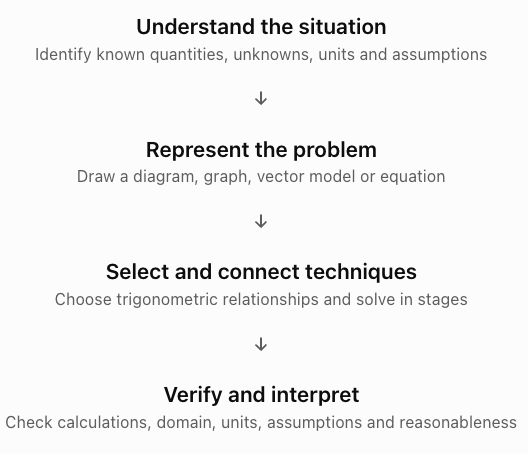
This framework is useful throughout mathematics, not only in trigonometry.
Learning Target 2: Selecting Appropriate Mathematical Techniques
A major part of advanced problem solving is deciding which technique is most appropriate.
Choosing a Technique
|
Problem characteristics |
Useful technique |
|---|---|
|
Right triangle with known sides or angles |
Sine, cosine, tangent |
|
Unknown angle from a trigonometric ratio |
Inverse trigonometric functions |
|
Non-right triangle with an angle and opposite side pair |
Law of Sines |
|
Non-right triangle with SAS or SSS information |
Law of Cosines |
|
Navigation using distances and directions |
Bearings and vector components |
|
Repeating behaviour over time |
Sine or cosine models |
|
Multiple solutions to a trigonometric equation |
Unit circle, identities, general solutions |
|
Rotations and positions around an origin |
Polar coordinates |
|
Motion described by time |
Parametric equations |
|
Complex-number powers and roots |
Polar form and De Moivre's theorem |
|
Forces at angles |
Vector resolution |
|
Maximum and minimum values |
Function analysis and trigonometric bounds |
Recognizing Hidden Triangles
Many problems do not explicitly mention a triangle.
For example:
-
A ladder leaning against a wall forms a right triangle.
-
Two forces acting at an angle form a vector triangle.
-
A navigation route with two successive journeys forms a triangle.
-
A support cable, vertical mast, and horizontal ground form a right triangle.
-
Two survey stations and a distant landmark form an oblique triangle.
Drawing an appropriate diagram often reveals the mathematics needed.
Worked Example 1: Choosing Between the Law of Sines and Law of Cosines
A triangle has sides of 12 cm and 17 cm with an included angle of 65°.
Find the third side.
Step 1: Identify the known information.
We know two sides and the angle between them.
This is a side-angle-side (SAS) situation.
Step 2: Select the appropriate technique.
The Law of Cosines is appropriate:
c² = a² + b² − 2ab cos C
Step 3: Substitute.
c² = 12² + 17² − 2(12)(17)cos 65°
c² = 144 + 289 − 408 cos 65°
c² ≈ 260.57
c ≈ √260.57
c ≈ 16.14 cm
Step 4: Verify.
The third side should be shorter than 12 + 17 = 29 cm and longer than |17 − 12| = 5 cm.
The result satisfies the triangle inequality.
It is also reasonable because the included angle is moderately large.
Worked Example 2: A Multi-Stage Surveying Problem
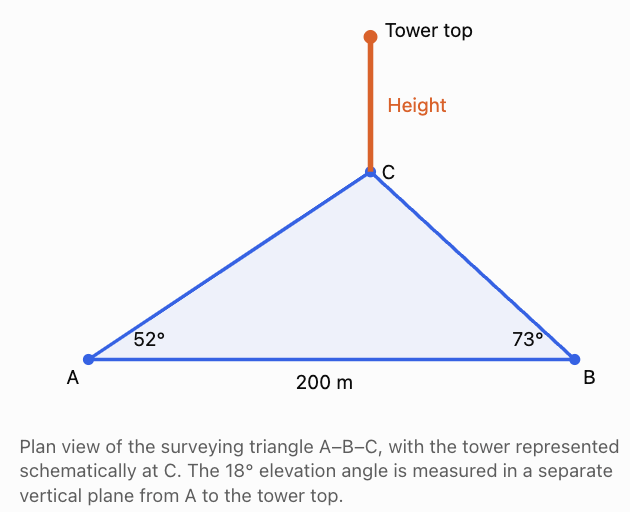
Two observation stations, A and B, are 200 m apart on level ground.
A tower stands at point C.
The measured horizontal angles are:
∠A = 52°
∠B = 73°
The angle of elevation from station A to the top of the tower is 18°.
Assume C is the base of the vertical tower and all three ground points are at the same elevation.
Find the tower's height.
Step 1: Calculate angle C.
C = 180° − 52° − 73°
C = 55°
Step 2: Use the Law of Sines to find AC.
AC/sin 73° = 200/sin 55°
AC = 200 sin 73°/sin 55°
AC ≈ 233.48 m
Step 3: Use the angle of elevation.
Let h be the tower's height.
tan 18° = h/AC
h = AC tan 18°
h ≈ 233.48 tan 18°
h ≈ 75.86 m
Step 4: Interpret.
The tower is approximately 75.9 m tall.
The calculation combines an oblique-triangle relationship with right-triangle trigonometry.
Step 5: Evaluate assumptions.
The model assumes level ground, a vertical tower, accurate angle measurements, and a negligible instrument height. If the instrument is elevated, its height must be accounted for.
Learning Target 3: Justifying Mathematical Reasoning
A complete solution should explain not only what calculations were performed but also why they are valid.
What Makes a Mathematical Justification?
A strong justification identifies:
-
The mathematical principle being used.
-
Why the principle applies.
-
Any necessary assumptions.
-
The logical connection between steps.
-
The meaning of the result.
For example, instead of writing only:
x = 10 sin 35°
we can explain:
The vertical component of a 10-unit vector at 35° above the horizontal is found using sine because it is opposite the given angle.
The second explanation demonstrates mathematical understanding.
Worked Example 3: Proving a Trigonometric Identity
Prove:
(1 − cos² θ)/sin θ = sin θ
for sin θ ≠ 0.
Step 1: Identify the relevant identity.
The Pythagorean identity states:
sin² θ + cos² θ = 1
Therefore:
1 − cos² θ = sin² θ
Step 2: Substitute into the left-hand side.
(1 − cos² θ)/sin θ
= sin² θ/sin θ
Step 3: Simplify.
= sin θ
Therefore:
(1 − cos² θ)/sin θ = sin θ
for all θ where sin θ ≠ 0.
The identity is proven on its stated domain.
Why Domain Restrictions Matter
The original expression contains division by sin θ.
Therefore:
sin θ ≠ 0
This excludes:
θ = nπ
where n is any integer.
Even though the simplified expression sin θ is defined at those angles, the original expression is not.
A complete proof must preserve the original domain.
Worked Example 4: Solving an Equation with Full Justification
Solve:
2 sin² θ − 3 sin θ + 1 = 0
for 0° ≤ θ < 360°.
Step 1: Recognize the algebraic structure.
The equation is quadratic in sin θ.
Factor:
(2 sin θ − 1)(sin θ − 1) = 0
Step 2: Apply the zero-product property.
2 sin θ − 1 = 0
or:
sin θ − 1 = 0
Therefore:
sin θ = 1/2
or:
sin θ = 1
Step 3: Solve using the unit circle.
For sin θ = 1/2:
θ = 30°, 150°
For sin θ = 1:
θ = 90°
Step 4: State all solutions.
θ = 30°, 90°, 150°
Step 5: Verify.
At sin θ = 1/2:
2(1/4) − 3(1/2) + 1 = 0
At sin θ = 1:
2 − 3 + 1 = 0
All three angles satisfy the equation.
A Useful Communication Structure
For complex problems, organize your work using:
Given → Required → Method → Calculation → Verification → Interpretation
This helps make mathematical solutions clear, logical, and easy to follow.
Learning Target 4: Communicating Complete Mathematical Solutions
A mathematical solution should be understandable to someone who has not seen the problem before.
Good mathematical communication is especially important in engineering, science, research, and education because other people must be able to check the reasoning.
Writing a Complete Solution
A complete mathematical response should normally include:
-
A clear statement of the known information.
-
A definition of any variables.
-
A suitable diagram or mathematical model.
-
The formula or principle used.
-
Substitution and algebraic working.
-
A final answer with appropriate units.
-
Verification and interpretation.
Worked Example 5: Navigation and Resultant Displacement
A boat travels 18 km on a bearing of 040°, followed by 25 km on a bearing of 130°.
Find its resultant displacement and the bearing of its final position from its starting point.
Given:
First displacement = 18 km at 040°.
Second displacement = 25 km at 130°.
Required:
Resultant distance and bearing.
Method:
Resolve both displacements into eastward and northward components.
Because bearings are measured clockwise from north:
East component = d sin β
North component = d cos β
Step 1: First displacement.
E₁ = 18 sin 40° ≈ 11.57 km
N₁ = 18 cos 40° ≈ 13.79 km
Step 2: Second displacement.
E₂ = 25 sin 130° ≈ 19.15 km
N₂ = 25 cos 130° ≈ −16.07 km
The negative northward component indicates southward displacement.
Step 3: Add the components.
E = 11.57 + 19.15 ≈ 30.72 km
N = 13.79 − 16.07 ≈ −2.28 km
The final position is east and slightly south of the starting point.
Step 4: Calculate the resultant distance.
R = √(E² + N²)
Using unrounded components:
R ≈ 30.81 km
Step 5: Calculate the bearing.
The angle south of east is:
α = tan⁻¹(|N|/E)
α ≈ 4.25°
Because east corresponds to bearing 090°:
β = 90° + 4.25°
Bearing ≈ 094.25°
Step 6: Verify geometrically.
The two travel directions differ by 90°.
Therefore, the two displacement vectors are perpendicular.
Using Pythagoras:
R = √(18² + 25²)
R = √949
R ≈ 30.81 km
This agrees with the component method.
Final answer: The boat's resultant displacement is approximately 30.81 km on a bearing of 094.25°.
What Makes This a Strong Solution?
The solution explains the bearing convention, shows the component calculations, interprets the negative component, and verifies the magnitude using an independent method.
Learning Target 5: Connecting Concepts from Throughout Trigonometry
The most powerful applications arise when we recognize that different trigonometric topics describe related mathematical structures.
Connection 1: The Unit Circle and Trigonometric Functions
On the unit circle:
x = cos θ
y = sin θ
This explains why:
sin² θ + cos² θ = 1
It also connects trigonometry to coordinate geometry, periodic functions, polar coordinates, and complex numbers.
Connection 2: Circular Motion and Sinusoidal Motion
Consider a point moving around a circle of radius 5 with constant angular speed π/3 rad/s.
Its position can be modelled by:
x(t) = 5 cos(πt/3)
y(t) = 5 sin(πt/3)
The point moves around a circle, but each coordinate varies sinusoidally with time.
The period is:
T = 2π/(π/3)
T = 6 s
This means the point completes one revolution every 6 seconds.
Its horizontal and vertical coordinates also repeat every 6 seconds.
Worked Example 6: Connecting Parametric Equations and Trigonometric Graphs
A rotating wheel has radius 2 m. A point on its rim begins at the rightmost position and completes one revolution every 8 seconds.
Find parametric equations for its position, assuming anticlockwise rotation.
Step 1: Determine angular speed.
ω = 2π/T
ω = 2π/8
ω = π/4 rad/s
Step 2: Write the coordinate equations.
x(t) = 2 cos(πt/4)
y(t) = 2 sin(πt/4)
Step 3: Calculate the position after 2 seconds.
x(2) = 2 cos(π/2) = 0
y(2) = 2 sin(π/2) = 2
Position after 2 seconds: (0, 2)
Step 4: Interpret.
After 2 seconds, the wheel has completed one-quarter of a revolution.
The point has moved from the rightmost position to the top of the circle.
Connection 3: Polar Coordinates and Complex Numbers
A complex number in polar form is:
z = r(cos θ + i sin θ)
The same point in polar coordinates is:
(r, θ)
Therefore, polar coordinates and complex numbers use the same geometric quantities: magnitude and direction.
Worked Example 7: Rotation Using Complex Numbers
A point is represented by:
z = 3 + 4i
Rotate the point 60° anticlockwise about the origin.
Step 1: Determine the original modulus and argument.
r = √(3² + 4²) = 5
θ = tan⁻¹(4/3) ≈ 53.13°
Step 2: Add the rotation angle.
New argument:
θ(new) ≈ 53.13° + 60°
θ(new) ≈ 113.13°
Step 3: Write the new polar form.
z(new) = 5 cis 113.13°
Step 4: Convert to rectangular form.
Using the exact rotation multiplier:
z(new) = (3 + 4i)(cos 60° + i sin 60°)
= (3 + 4i)(1/2 + (√3/2)i)
Real part:
3/2 − 2√3
Imaginary part:
2 + 3√3/2
Therefore:
z(new) = (3/2 − 2√3) + (2 + 3√3/2)i
Approximately:
z(new) ≈ −1.964 + 4.598i
Step 5: Verify.
The modulus should remain 5 because rotation does not change distance from the origin.
√[(-1.964)² + 4.598²] ≈ 5
The result is consistent.
Connection 4: Trigonometric Identities and Wave Superposition
Suppose two oscillations have the same frequency:
y₁ = 3 sin t
y₂ = 4 cos t
Their combined displacement is:
y = 3 sin t + 4 cos t
This can be written as a single sinusoidal function:
y = R sin(t + φ)
Expanding:
R sin(t + φ) = R sin t cos φ + R cos t sin φ
Compare coefficients:
R cos φ = 3
R sin φ = 4
Square and add:
R²(cos² φ + sin² φ) = 9 + 16
R² = 25
R = 5
Also:
tan φ = 4/3
φ ≈ 53.13°
Therefore:
3 sin t + 4 cos t = 5 sin(t + 53.13°)
Here t and the phase angle must be interpreted in consistent units; equivalently, the expression is 5 sin(t + 0.9273) when t is in radians.
This technique is useful for combining oscillations of the same frequency.
Connection 5: The Law of Cosines and Vector Magnitudes
Suppose two vectors have magnitudes A and B and an angle θ between them.
Their resultant magnitude satisfies:
R² = A² + B² + 2AB cos θ
The plus sign appears because we are finding the magnitude of the vector sum.
This relationship can be derived from the Law of Cosines using the supplementary interior angle of the head-to-tail triangle.
Worked Example 8: Resultant Force
Two forces of 40 N and 60 N act on an object with an angle of 70° between them.
Find the magnitude of their resultant.
R² = 40² + 60² + 2(40)(60)cos 70°
R² = 1600 + 3600 + 4800 cos 70°
R² ≈ 6841.70
R ≈ 82.71 N
The result is between |60 − 40| = 20 N and 60 + 40 = 100 N, as expected.
Advanced Integrated Problem Solving
Worked Example 9: Combining a Trigonometric Model with an Inequality
The height of a seat on a Ferris wheel is modelled by:
h(t) = 18 − 15 cos(πt/20)
where h is measured in metres and t is measured in seconds.
The model begins with the seat at its lowest position.
Determine when the seat is at least 25 m above the ground during its first revolution.
Step 1: Determine the period.
ω = π/20
T = 2π/(π/20)
T = 40 s
Step 2: Form the inequality.
18 − 15 cos(πt/20) ≥ 25
Subtract 18:
−15 cos(πt/20) ≥ 7
Divide by −15, reversing the inequality:
cos(πt/20) ≤ −7/15
Step 3: Find the boundary angles.
Let:
u = πt/20
Then:
cos u = −7/15
For 0 ≤ u ≤ 2π, the boundary angles are approximately:
u₁ ≈ 2.056 rad
u₂ ≈ 4.227 rad
Cosine is at most −7/15 between these angles.
Step 4: Convert to time.
t = 20u/π
t₁ ≈ 13.09 s
t₂ ≈ 26.91 s
Final answer: The seat is at least 25 m above the ground from approximately 13.09 s to 26.91 s during the first revolution.
Verification: At t = 20 s, the seat is at its highest point:
h(20) = 18 − 15 cos π
h(20) = 33 m
Since 33 m is above 25 m, the interval correctly contains the highest point.
Worked Example 10: An Ambiguous Triangle Problem
A triangle has:
a = 12 cm
b = 16 cm
A = 40°
Determine all possible values of angle B and side c.
Step 1: Apply the Law of Sines.
sin B/b = sin A/a
sin B = 16 sin 40°/12
sin B ≈ 0.85705
Step 2: Determine possible angles.
B₁ ≈ 58.99°
B₂ = 180° − 58.99°
B₂ ≈ 121.01°
Step 3: Check both possibilities.
For B₁:
C₁ = 180° − 40° − 58.99°
C₁ ≈ 81.01°
For B₂:
C₂ = 180° − 40° − 121.01°
C₂ ≈ 18.99°
Both values are positive, so both triangles are possible.
Step 4: Find c in each triangle.
Using:
c/sin C = a/sin A
For the first triangle:
c₁ = 12 sin 81.01°/sin 40°
c₁ ≈ 18.44 cm
For the second triangle:
c₂ = 12 sin 18.99°/sin 40°
c₂ ≈ 6.07 cm
Final answer: Two triangles are possible, with approximately:
-
B = 58.99°, C = 81.01°, c = 18.44 cm.
-
B = 121.01°, C = 18.99°, c = 6.07 cm.
This demonstrates why the sine rule's ambiguous case must be checked rather than assuming the inverse sine gives the only answer.
Evaluating the Reasonableness of Solutions
A solution is not complete simply because a calculator produces a number.
We must determine whether the answer is mathematically and physically meaningful.
Check 1: Does the Answer Satisfy the Original Equation?
Substitute the result into the original equation whenever possible.
For trigonometric equations, this is particularly important after squaring, dividing, or using inverse functions.
Check 2: Is the Angle in the Correct Quadrant?
The signs of sine, cosine, and tangent depend on the quadrant.
For example, if a vector has a negative horizontal component and a positive vertical component, its direction must lie in Quadrant II.
Check 3: Are All Possible Solutions Included?
Trigonometric equations may have several solutions within a specified interval.
For example:
sin θ = 1/2
has two solutions between 0° and 360°:
θ = 30°, 150°.
Check 4: Does the Result Respect Physical Constraints?
A calculated distance cannot be negative.
An angle inside a triangle must be greater than 0° and less than 180°.
A triangle must satisfy the triangle inequality.
Check 5: Are the Units Correct?
A calculation involving speed and time should produce distance when the units are compatible.
A frequency should be expressed in hertz, not radians per second.
Check 6: Is the Model Appropriate?
A sinusoidal model may describe a repeating phenomenon well, but it may not account for irregular disturbances, damping, seasonal variation, or changing conditions.
A projectile model without air resistance may be useful for an introductory calculation but less accurate for a real object travelling at high speed.
Check 7: Is the Precision Reasonable?
A final answer should not imply more precision than the measurements support.
For example, if a distance is measured to the nearest metre, reporting a calculated height to six decimal places is usually misleading.
Common Mistakes
Mistake 1: Choosing a Formula Before Understanding the Problem
A familiar formula may not apply to the given information.
Better approach: Identify the geometry, known quantities, and unknowns before selecting a method.
Mistake 2: Assuming Every Triangle Is Right-Angled
The Pythagorean theorem and basic right-triangle ratios apply directly only to right triangles.
For non-right triangles, consider the Law of Sines or Law of Cosines.
Mistake 3: Ignoring the Ambiguous Case
The Law of Sines can produce two possible triangles in an SSA situation.
Check whether both possible angles produce valid triangles.
Mistake 4: Mixing Degrees and Radians
The period formula T = 2π/ω assumes angular quantities are expressed in radians.
Check calculator settings and the units used in the model.
Mistake 5: Confusing Bearings and Standard Angles
Bearings are measured clockwise from north.
Standard mathematical angles are measured anticlockwise from the positive x-axis.
Mistake 6: Using an Identity Without Considering Its Domain
Dividing by sin θ removes cases where sin θ = 0.
Such cases may contain valid solutions to the original equation and must be checked before division.
Mistake 7: Rounding Too Early
Rounding intermediate values can introduce noticeable errors in multi-stage problems.
Keep additional digits until the final calculation.
Mistake 8: Giving an Answer Without Justification
A numerical answer does not show why the selected method is valid.
State the relevant formula and explain its use.
Mistake 9: Failing to Interpret the Result
An answer of 120° might represent an interior triangle angle, a compass bearing, a phase difference, or a rotation.
Its meaning must be clear.
Mistake 10: Forgetting to Check Reasonableness
A negative physical distance, an impossible triangle, or a frequency with incorrect units should signal a need to review the calculation.
Key Terms
-
Comprehensive problem solving: Combining multiple mathematical ideas to solve a problem.
-
Mathematical reasoning: Using logical steps and mathematical principles to justify a conclusion.
-
Mathematical model: A representation of a real or abstract situation using mathematical relationships.
-
Assumption: A condition accepted when constructing a model or solution.
-
Verification: Checking whether a result satisfies the original conditions.
-
Reasonableness: Whether a result is consistent with mathematical and real-world constraints.
-
Right-triangle trigonometry: Relationships involving sine, cosine, and tangent in right triangles.
-
Inverse trigonometric function: A function used to determine an angle from a trigonometric value.
-
Unit circle: A circle of radius 1 centred at the origin.
-
Trigonometric identity: An equality involving trigonometric expressions that is valid throughout its stated domain.
-
Trigonometric equation: An equation containing trigonometric functions.
-
Law of Sines: A relationship between triangle sides and the sines of their opposite angles.
-
Law of Cosines: A relationship involving three sides and an included angle of a triangle.
-
Ambiguous case: An SSA triangle situation in which more than one triangle may satisfy the given information.
-
Bearing: A direction measured clockwise from north.
-
Vector component: The part of a vector acting along a chosen axis.
-
Resultant vector: The vector sum of two or more vectors.
-
Amplitude: Maximum displacement from the midline of a sinusoidal model.
-
Period: Length of one complete cycle.
-
Frequency: Number of cycles per unit time.
-
Phase shift: Horizontal displacement of a periodic graph.
-
Polar coordinates: Coordinates describing a point using radius and angle.
-
Parametric equations: Equations expressing coordinates using a common parameter.
-
Complex number: A number of the form a + bi.
-
Modulus: Magnitude of a complex number or vector.
-
Argument: Direction angle of a nonzero complex number.
-
De Moivre's theorem: A rule for powers of complex numbers in polar form.
-
Domain restriction: A limitation on values for which an expression or equation is defined.
-
Extraneous solution: A value introduced during algebraic manipulation that does not satisfy the original equation.
Key Takeaways
-
Complex problems often require several connected mathematical techniques.
-
Understanding the situation is more important than immediately selecting a formula.
-
Diagrams help reveal hidden geometric relationships.
-
Right-triangle trigonometry, the Law of Sines, and the Law of Cosines solve different triangle situations.
-
Trigonometric identities can simplify expressions and equations.
-
Trigonometric equations may have multiple solutions.
-
Vector components connect trigonometry with navigation, forces, and motion.
-
Sinusoidal models describe many repeating phenomena.
-
Polar coordinates, parametric equations, and complex numbers connect geometry with rotation.
-
Complete solutions should include explanations, calculations, units, verification, and interpretation.
-
The most effective technique is the one that matches the structure of the problem.
-
Mathematical results should always be checked for validity and reasonableness.
Check Your Understanding
These questions combine concepts from across the trigonometry course. Try to identify the appropriate techniques before beginning each calculation.
Part A: Triangles and Geometry
Question 1
A triangle has sides of 9 cm and 14 cm with an included angle of 75°.
Calculate the third side.
Question 2
A surveyor stands 50 m from a building on level ground and measures an angle of elevation of 32° to the top. The instrument is 1.6 m above the ground.
Calculate the building's height.
Question 3
A triangle has A = 35°, a = 10 cm, and b = 14 cm.
Determine whether one or two triangles are possible and calculate the possible values of angle B.
Part B: Trigonometric Identities and Equations
Question 4
Prove:
(1 − sin² θ)/cos θ = cos θ
State any necessary domain restrictions.
Question 5
Solve:
2 cos² θ − cos θ − 1 = 0
for 0° ≤ θ < 360°.
Part C: Navigation and Vectors
Question 6
A hiker walks 12 km east and then 9 km north.
Find the resultant displacement and its three-figure bearing.
Question 7
Two forces of 50 N and 70 N act at an angle of 60° to each other.
Find the magnitude of their resultant.
Part D: Periodic Models
Question 8
A rotating wheel has radius 3 m and completes one revolution every 12 seconds.
Write parametric equations for a point beginning at the rightmost position and rotating anticlockwise.
Find its position after 3 seconds.
Question 9
The height of a platform is modelled by:
h(t) = 12 + 5 sin(πt/6)
Find the midline, amplitude, period, maximum height, and minimum height.
Part E: Polar Coordinates and Complex Numbers
Question 10
Convert:
z = −3 + 3i
into polar form using a principal argument.
Question 11
Calculate:
(3 cis 40°)(4 cis 80°)
Give your answer in polar form.
Question 12
A point is represented by z = 2 + 3i.
It is rotated 90° anticlockwise about the origin and enlarged by a factor of 2.
Find its new position.
Check Your Understanding — Fully Worked Answers
Answer 1: Law of Cosines
Given:
a = 9 cm
b = 14 cm
C = 75°
Because two sides and the included angle are known, use the Law of Cosines.
c² = a² + b² − 2ab cos C
c² = 9² + 14² − 2(9)(14)cos 75°
c² = 81 + 196 − 252 cos 75°
c² ≈ 211.78
c ≈ 14.55 cm
Verification: 5 < 14.55 < 23, so the triangle inequality is satisfied.
Answer 2: Building Height
Given:
Horizontal distance = 50 m
Angle of elevation = 32°
Instrument height = 1.6 m
Let h be the height above the instrument.
tan 32° = h/50
h = 50 tan 32°
h ≈ 31.24 m
Add the instrument height:
H = 31.24 + 1.6
Building height ≈ 32.84 m
Answer 3: Ambiguous Case
Given:
A = 35°
a = 10 cm
b = 14 cm
Using the Law of Sines:
sin B/b = sin A/a
sin B = 14 sin 35°/10
sin B ≈ 0.8030
First possible angle:
B₁ ≈ 53.42°
Second possible angle:
B₂ = 180° − 53.42°
B₂ ≈ 126.58°
Check the triangle angle sums:
For B₁:
C₁ = 180° − 35° − 53.42° ≈ 91.58°
For B₂:
C₂ = 180° − 35° − 126.58° ≈ 18.42°
Both third angles are positive.
Two triangles are possible, with B ≈ 53.42° or B ≈ 126.58°.
Answer 4: Identity Proof
Prove:
(1 − sin² θ)/cos θ = cos θ
Start with the Pythagorean identity:
sin² θ + cos² θ = 1
Rearrange:
1 − sin² θ = cos² θ
Substitute:
(1 − sin² θ)/cos θ
= cos² θ/cos θ
= cos θ
Therefore, the identity is proven.
Domain restriction: cos θ ≠ 0.
This excludes θ = 90° + 180°n, where n is any integer.
Answer 5: Trigonometric Equation
Solve:
2 cos² θ − cos θ − 1 = 0
Factor:
(2 cos θ + 1)(cos θ − 1) = 0
Therefore:
cos θ = −1/2
or:
cos θ = 1
For cos θ = −1/2:
θ = 120°, 240°
For cos θ = 1:
θ = 0° within the given interval.
Solutions: θ = 0°, 120°, 240°
Answer 6: Navigation
The hiker travels:
East = 12 km
North = 9 km
Resultant distance:
R = √(12² + 9²)
R = √225
R = 15 km
Bearing is measured clockwise from north.
tan β = 12/9
β = tan⁻¹(12/9)
β ≈ 53.13°
Bearing ≈ 053°
Final answer: 15 km on a bearing of 053°, rounded to the nearest degree.
Answer 7: Resultant Force
Given:
F₁ = 50 N
F₂ = 70 N
Angle between forces = 60°
For the vector sum:
R² = F₁² + F₂² + 2F₁F₂ cos 60°
R² = 50² + 70² + 2(50)(70)(0.5)
R² = 2500 + 4900 + 3500
R² = 10,900
R ≈ 104.40 N
The result is reasonable because it lies between 20 N and 120 N.
Answer 8: Parametric Equations
Given:
Radius = 3 m
Period = 12 s
Angular speed:
ω = 2π/12 = π/6 rad/s
Since the point begins at the rightmost position and rotates anticlockwise:
x(t) = 3 cos(πt/6)
y(t) = 3 sin(πt/6)
At t = 3:
x(3) = 3 cos(π/2) = 0
y(3) = 3 sin(π/2) = 3
Position after 3 seconds: (0, 3)
This is one-quarter of a revolution.
Answer 9: Sinusoidal Model
Given:
h(t) = 12 + 5 sin(πt/6)
Midline:
h = 12
Amplitude:
A = 5
Angular frequency:
ω = π/6
Period:
T = 2π/(π/6)
T = 12 time units
Maximum height:
12 + 5 = 17
Minimum height:
12 − 5 = 7
Maximum height = 17 units
Minimum height = 7 units
The units depend on those assigned to h and t in the physical model.
Answer 10: Complex Number in Polar Form
Given:
z = −3 + 3i
Modulus:
r = √[(-3)² + 3²]
r = √18
r = 3√2
The point is in Quadrant II.
Reference angle:
α = tan⁻¹(3/3) = 45°
Principal argument:
θ = 180° − 45°
θ = 135°
z = 3√2 cis 135°
Answer 11: Complex Multiplication
Given:
z₁ = 3 cis 40°
z₂ = 4 cis 80°
Multiply moduli:
3 × 4 = 12
Add arguments:
40° + 80° = 120°
Answer: 12 cis 120°
Answer 12: Rotation and Enlargement
Given:
z = 2 + 3i
A 90° anticlockwise rotation corresponds to multiplication by i.
An enlargement by factor 2 corresponds to multiplication by 2.
Combined multiplier:
2i
Calculate:
z(new) = (2 + 3i)(2i)
z(new) = 4i + 6i²
Since i² = −1:
z(new) = 4i − 6
New complex number: −6 + 4i
New Cartesian position: (−6, 4)
Verification:
Original modulus = √(2² + 3²) = √13
New modulus = √[(-6)² + 4²] = √52 = 2√13
The distance from the origin has doubled, as expected.
Final Integrated Challenge: Designing a Rotating Observation System
An engineering team is designing a rotating observation platform.
A sensor is attached 8 m from the centre of rotation. The platform completes one anticlockwise revolution every 20 seconds.
At t = 0, the sensor is at the rightmost point of its circular path.
A stationary observation point P is located 12 m east and 5 m north of the centre.
The engineers need to determine the sensor's position, its distance from P, and the times when the sensor is directly north of the centre.
Tasks
-
Calculate the angular speed.
-
Write parametric equations for the sensor's position.
-
Find its position after 5 seconds.
-
Calculate the distance from the sensor to P after 5 seconds.
-
Find the times during the first revolution when the sensor is directly north of the centre.
-
Express the sensor's position after 5 seconds as a complex number.
-
Explain how the problem connects trigonometric functions, coordinate geometry, circular motion, and complex numbers.
Fully Worked Solution
Step 1: Angular speed
The platform completes one revolution every 20 seconds.
ω = 2π/T
ω = 2π/20
ω = π/10 rad/s
Step 2: Parametric equations
Radius = 8 m
The sensor begins at the rightmost position.
Therefore:
x(t) = 8 cos(πt/10)
y(t) = 8 sin(πt/10)
for 0 ≤ t ≤ 20.
Step 3: Position after 5 seconds
x(5) = 8 cos(π/2) = 0
y(5) = 8 sin(π/2) = 8
Sensor position: (0, 8)
Step 4: Distance to observation point P
P = (12, 5)
Sensor = (0, 8)
Use the distance formula:
d = √[(12 − 0)² + (5 − 8)²]
d = √(144 + 9)
d = √153 ≈ 12.37 m
Step 5: When is the sensor directly north?
The sensor is directly north of the centre when:
x = 0
and:
y > 0
Therefore:
cos(πt/10) = 0
with positive sine.
During the first revolution, this occurs at:
πt/10 = π/2
t = 5
The sensor is directly north after 5 seconds.
It is directly south after 15 seconds, which does not satisfy the condition.
Step 6: Complex-number representation
The sensor's position after 5 seconds is:
(0, 8)
Therefore:
z = 8i
In polar form:
z = 8 cis 90°
Step 7: Explain the connections
The problem uses several mathematical ideas:
-
Circular motion: Angular speed determines how quickly the sensor rotates.
-
Trigonometric functions: Sine and cosine determine horizontal and vertical coordinates.
-
Parametric equations: The position is expressed as a function of time.
-
Coordinate geometry: The distance formula determines the separation between two points.
-
Trigonometric equations: Solving cos θ = 0 identifies particular positions.
-
Complex numbers: The sensor's position can be represented using modulus and argument.
Final Challenge Summary
|
Quantity |
Result |
|---|---|
|
Radius |
8 m |
|
Period |
20 s |
|
Angular speed |
π/10 rad/s |
|
Horizontal position |
x(t) = 8 cos(πt/10) |
|
Vertical position |
y(t) = 8 sin(πt/10) |
|
Position after 5 s |
(0, 8) |
|
Distance to P after 5 s |
√153 ≈ 12.37 m |
|
Time directly north |
5 s |
|
Complex position after 5 s |
8i |
|
Polar complex form |
8 cis 90° |
Conclusion
Comprehensive trigonometric problem solving requires more than the ability to apply individual formulas.
It requires us to recognize relationships, select appropriate methods, organize calculations, justify reasoning, and connect mathematical results to the situation being studied.
Right-triangle trigonometry helps solve problems involving lengths and angles. The Law of Sines and Law of Cosines extend these methods to non-right triangles. Trigonometric identities and equations provide algebraic tools for simplifying and solving relationships. Periodic functions describe waves, oscillations, and repeating motion. Polar coordinates, parametric equations, and complex numbers provide additional ways to describe position, direction, and rotation.
These ideas are not separate mathematical topics. They are different parts of a connected system.
The ultimate goal of trigonometry is not simply to calculate unknown values, but to develop the ability to represent complex situations mathematically, reason through them logically, and communicate solutions that are accurate, complete, and meaningful.