Trigonometry in Advanced Mathematics
4. Trigonometry in Science and Engineering
Learning outcomes
- I can apply trigonometry to physics problems.
- I can apply trigonometry to engineering and architecture.
- I can interpret wave motion using trigonometric functions.
- I can analyse periodic motion mathematically.
- I can solve practical STEM applications.
Introduction
Trigonometry is one of the most important mathematical tools used in science, engineering, architecture, and technology.
Whenever a problem involves angles, distances, forces, rotations, waves, or repeating motion, trigonometry provides methods for describing and calculating relationships.
Engineers use trigonometry to design bridges, calculate forces in structures, and determine the correct angles for supporting beams. Architects use it to calculate roof slopes, building heights, and the dimensions of complex structures. Physicists use it to analyse projectile motion, forces on inclined planes, circular motion, and oscillations.
Trigonometric functions also describe many natural and technological phenomena, including sound waves, alternating electrical signals, vibrations, and periodic motion.
For example, a pendulum swings back and forth, a rotating wheel moves through a repeating cycle, and a vibrating string produces a wave. Although these situations appear different, many can be described using sine and cosine functions.
The central idea is that trigonometry connects geometry with physical quantities, allowing us to turn real-world situations into mathematical models.
In this lesson, we will explore how trigonometry is applied to physics, engineering, architecture, wave motion, periodic systems, and practical STEM problems.
The Mathematical Foundations
Before exploring applications, we need to understand several important trigonometric relationships.
Right-Triangle Trigonometry
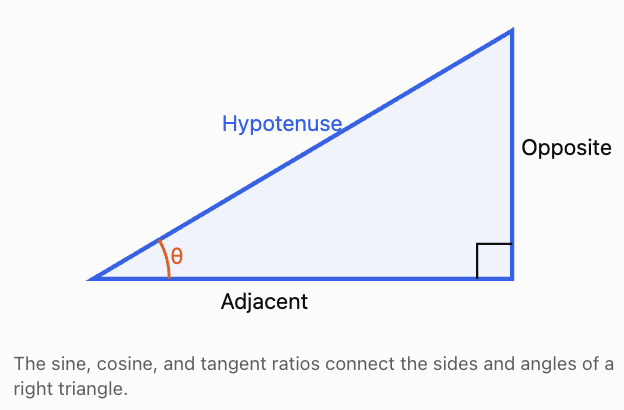
For a right triangle with an acute angle θ:
sin θ = opposite / hypotenuse
cos θ = adjacent / hypotenuse
tan θ = opposite / adjacent
These relationships allow us to calculate unknown distances and angles.
Resolving a Vector into Components
Many scientific quantities have both magnitude and direction.
These quantities are called vectors.
Examples include:
-
Force
-
Velocity
-
Acceleration
-
Displacement
-
Momentum
A vector of magnitude V making an angle θ above the positive horizontal axis has components:
Vₓ = V cos θ
Vᵧ = V sin θ
These formulas are fundamental in physics and engineering.
The Pythagorean Theorem
If perpendicular components are known:
V = √(Vₓ² + Vᵧ²)
The direction can be found from:
tan θ = Vᵧ/Vₓ
The correct quadrant must be considered when determining θ.
General Sinusoidal Model
Many repeating physical processes can be approximated by:
y(t) = A sin(ωt + φ) + D
or:
y(t) = A cos(ωt + φ) + D
where:
-
A is the signed amplitude coefficient.
-
|A| is the amplitude.
-
ω is the angular frequency.
-
φ is the phase constant.
-
D is the equilibrium or midline value.
-
t is time.
For ω ≠ 0:
Period: T = 2π/|ω|
Frequency: f = 1/T
Angular frequency: |ω| = 2πf
These relationships will appear repeatedly throughout the lesson.
Learning Target 1: Applying Trigonometry to Physics Problems
Forces Acting at Angles
Forces often act at angles rather than directly horizontally or vertically.
To analyse the motion of an object, we resolve each force into perpendicular components.
Suppose a force F acts at an angle θ above the horizontal.
Its components are:
Fₓ = F cos θ
Fᵧ = F sin θ
Worked Example 1: Pulling a Sled
A person pulls a sled with a force of 120 N at an angle of 30° above the horizontal.
Calculate the horizontal and vertical components of the force.
Step 1: Calculate the horizontal component.
Fₓ = 120 cos 30°
Fₓ = 120(√3/2)
Fₓ ≈ 103.9 N
Step 2: Calculate the vertical component.
Fᵧ = 120 sin 30°
Fᵧ = 120(0.5)
Fᵧ = 60 N
Interpretation: The horizontal component helps move the sled forward, while the upward component reduces the normal force exerted by the ground, provided the sled remains in contact with it.
Forces on an Inclined Plane
An inclined plane is a sloping surface.
When an object rests on a slope, gravity acts vertically downward.
The gravitational force can be resolved into two components:
-
Parallel to the slope.
-
Perpendicular to the slope.
For a slope angle θ:
F∥ = mg sin θ
F⊥ = mg cos θ
where m is mass and g is gravitational acceleration.
Worked Example 2: A Box on a Ramp
A 20 kg box rests on a frictionless ramp inclined at 25° to the horizontal.
Calculate:
a) The component of weight parallel to the ramp.
b) The component of weight perpendicular to the ramp.
c) The acceleration of the box if released.
Take g = 9.8 m/s².
Step 1: Calculate the weight.
W = mg
W = 20 × 9.8
W = 196 N
Step 2: Parallel component.
F∥ = 196 sin 25°
F∥ ≈ 82.8 N
Step 3: Perpendicular component.
F⊥ = 196 cos 25°
F⊥ ≈ 177.6 N
Step 4: Calculate acceleration.
On a frictionless ramp, the net force along the slope is mg sin θ.
Using Newton's Second Law:
ma = mg sin θ
Cancel m:
a = g sin θ
a = 9.8 sin 25°
a ≈ 4.14 m/s² down the slope
The mass cancels because gravitational acceleration along a frictionless slope does not depend on the object's mass.
Projectile Motion
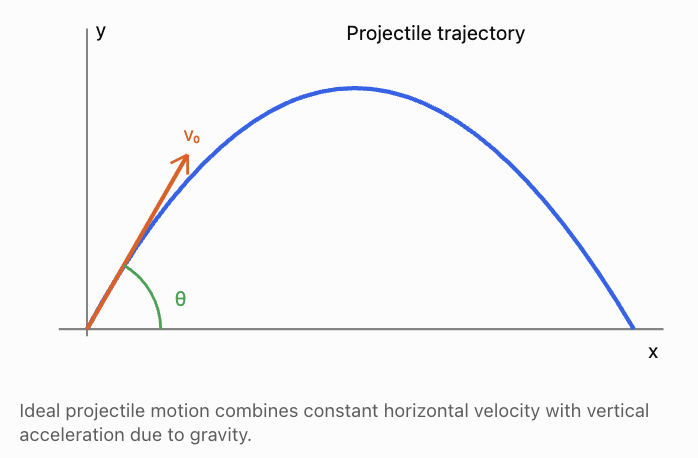
When an object is launched at an angle, its initial velocity can be divided into horizontal and vertical components.
For initial speed v₀ and launch angle θ:
vₓ = v₀ cos θ
vᵧ = v₀ sin θ
Ignoring air resistance:
x(t) = v₀ cos θ × t
y(t) = y₀ + v₀ sin θ × t − ½gt²
where y₀ is the initial height.
Worked Example 3: Launching a Ball
A ball is launched at 25 m/s at an angle of 40° above the horizontal from ground level.
Ignore air resistance.
Calculate the initial horizontal and vertical velocities, maximum height, time of flight, and horizontal range.
Step 1: Horizontal velocity.
vₓ = 25 cos 40°
vₓ ≈ 19.15 m/s
Step 2: Initial vertical velocity.
vᵧ = 25 sin 40°
vᵧ ≈ 16.07 m/s
Step 3: Maximum height.
At maximum height, vertical velocity is zero.
Using:
v² = u² + 2as
0 = vᵧ² − 2gH
Therefore:
H = vᵧ²/(2g)
H = (25 sin 40°)²/(19.6)
H ≈ 13.18 m
Step 4: Time of flight.
Because the ball lands at the same height from which it was launched:
T = 2vᵧ/g
T = 2(25 sin 40°)/9.8
T ≈ 3.28 s
Step 5: Horizontal range.
R = vₓT
R ≈ 19.15 × 3.2795
R ≈ 62.8 m
The range can also be calculated using:
R = v₀² sin(2θ)/g
This formula is valid for level-ground projectile motion without air resistance.
Circular Motion
An object moving around a circle has a continuously changing direction.
If a point moves around a circle of radius r with angular position θ:
x = r cos θ
y = r sin θ
If the angular speed is constant:
θ = ωt + φ
Therefore:
x(t) = r cos(ωt + φ)
y(t) = r sin(ωt + φ)
These equations connect circular motion directly to trigonometric functions.
For uniform circular motion:
v = r|ω|
a꜀ = v²/r = rω²
where a꜀ is the magnitude of centripetal acceleration, directed toward the centre.
Worked Example 4: Rotating Wheel
A wheel has a radius of 0.40 m and rotates at 3 revolutions per second.
Calculate its angular speed and the tangential speed of a point on its rim.
Frequency:
f = 3 Hz
Angular speed:
ω = 2πf
ω = 6π rad/s
ω ≈ 18.85 rad/s
Tangential speed:
v = rω
v = 0.40(6π)
v ≈ 7.54 m/s
This is the speed of a point on the rim, even though its velocity direction continually changes.
Learning Target 2: Applying Trigonometry to Engineering and Architecture
Trigonometry is essential when designing structures that must be safe, stable, and accurately constructed.
Engineers and architects regularly calculate heights, slopes, lengths, angles, and force components.
Roof Pitch and Building Design
The pitch of a roof describes its steepness.
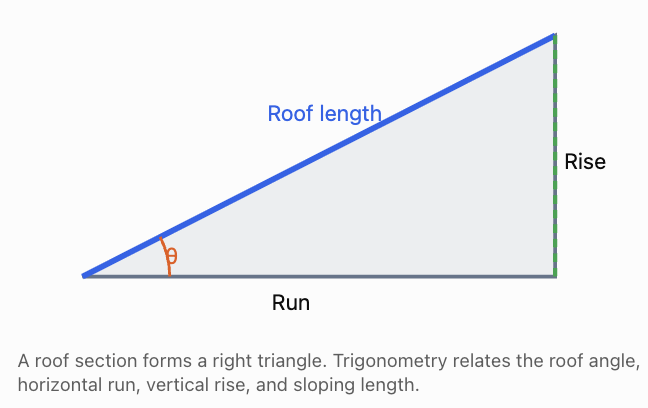
For a roof inclined at angle θ to the horizontal:
tan θ = rise/run
where:
-
Rise is the vertical height gained.
-
Run is the horizontal distance.
-
θ is the roof angle.
The sloping length of a roof section can be calculated using:
L = run/cos θ
or:
L = rise/sin θ
Worked Example 5: Designing a Roof
A symmetrical pitched roof covers a building 12 m wide. The roof rises at an angle of 35° from each outer wall toward the central ridge.
Calculate the height of the ridge above the walls and the sloping length of one roof section.
Step 1: Determine the run.
Because the roof is symmetrical:
Run = 12/2 = 6 m
Step 2: Calculate the rise.
tan 35° = rise/6
Rise = 6 tan 35°
Rise ≈ 4.20 m
Step 3: Calculate the sloping length.
cos 35° = 6/L
L = 6/cos 35°
L ≈ 7.32 m
Interpretation: Each sloping side is approximately 7.32 m long, and the ridge is approximately 4.20 m above the tops of the outer walls.
In a real roof design, engineers must also account for structural thickness, overhangs, loads, drainage, and building regulations.
Trigonometry in Structural Forces
A bridge or roof truss contains members arranged in triangular patterns.
Triangles are useful because their geometry provides rigidity when joints and members behave as designed.
Forces in inclined members can be resolved into horizontal and vertical components.
Consider two identical support cables making an angle θ above the horizontal and supporting a vertical load W.
If the system is symmetrical and in static equilibrium:
2T sin θ = W
Therefore:
T = W/(2 sin θ)
where T is the tension in each cable.
Worked Example 6: Supporting a Suspended Load
A 1000 N load is supported by two identical cables, each inclined at 40° above the horizontal.
Find the tension in each cable.
Vertical equilibrium requires:
2T sin 40° = 1000
T = 1000/(2 sin 40°)
T ≈ 778 N
The horizontal components of the two cable tensions cancel because the arrangement is symmetrical.
If the cables were closer to horizontal, the tension required in each cable would be greater.
This is an important engineering consideration.
Surveying and Measuring Inaccessible Heights
Surveyors use trigonometry to measure objects that cannot be measured directly.
For example, the height of a building can be determined from a horizontal distance and an angle of elevation.
If the observer's instrument is at height h₀:
Building height = d tan θ + h₀
where d is the horizontal distance to the building.
Worked Example 7: Measuring a Tower
A surveyor stands 80 m from a tower. The angle of elevation to the top is 38°. The survey instrument is 1.5 m above the ground.
Calculate the tower's height, assuming level ground.
Height above instrument:
h = 80 tan 38°
h ≈ 62.50 m
Add instrument height:
H = 62.50 + 1.5
Tower height ≈ 64.00 m
Surveying with Two Observation Points
Sometimes a direct distance cannot be measured, such as when surveying across a river.
The Law of Sines and Law of Cosines can be used with a measured baseline and observation angles.
Worked Example 8: Measuring Across a River
Two survey stations, A and B, are 150 m apart on the same side of a river.
A landmark C lies across the river.
The measured triangle angles are:
∠A = 48°
∠B = 67°
Calculate AC.
Step 1: Find angle C.
C = 180° − 48° − 67°
C = 65°
Step 2: Apply the Law of Sines.
AC/sin 67° = AB/sin 65°
AC = 150 sin 67°/sin 65°
AC ≈ 152.35 m
The distance from station A to the landmark is approximately 152 m.
This is an example of triangulation, where distances are determined from measured angles and a known baseline.
Structural Safety and Model Limitations
Trigonometry helps determine geometry and force components, but it does not by itself guarantee a safe structure.
Actual engineering design must also consider material strength, buckling, joint behaviour, wind, earthquakes, load combinations, and appropriate safety factors.
Learning Target 3: Interpreting Wave Motion Using Trigonometric Functions
Waves are disturbances that transfer energy through a medium or, in the case of electromagnetic waves, through fields.
Many waves can be approximated by sine or cosine functions.
Examples include:
-
Sound waves.
-
Water waves.
-
Light and other electromagnetic waves.
-
Vibrations in strings.
-
Alternating electrical signals.
The Sinusoidal Wave Model
A simple travelling wave can be represented by:
y(x, t) = A sin(kx − ωt + φ)
where:
-
y is the displacement from equilibrium.
-
A is amplitude.
-
x is position.
-
t is time.
-
k is angular wave number.
-
ω is angular frequency.
-
φ is the phase constant.
For a wave travelling in the positive x-direction, the form kx − ωt is commonly used.
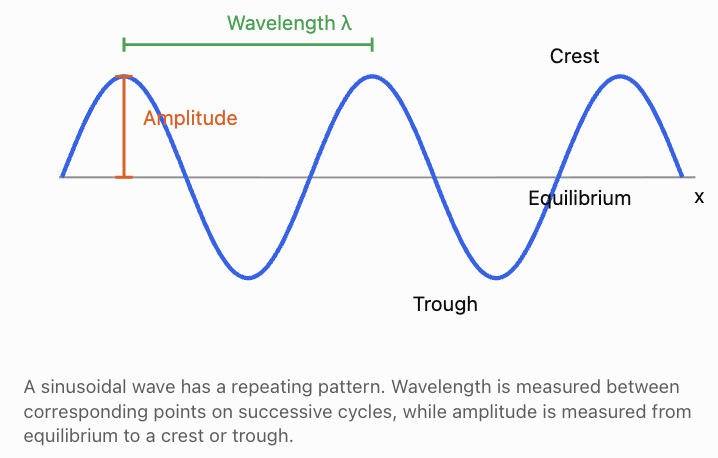
Important Wave Quantities
Amplitude (A)
The maximum displacement from equilibrium.
Wavelength (λ)
The distance between consecutive points in the same phase, such as successive crests.
Period (T)
The time required for one complete oscillation.
Frequency (f)
The number of oscillations per second.
Wave speed (v)
The rate at which the wave pattern propagates.
The main relationships are:
f = 1/T
v = fλ
k = 2π/λ
ω = 2πf = 2π/T
Worked Example 9: Calculating Wave Properties
A wave is described at a fixed instant by:
y(x) = 0.08 sin(4πx)
where x and y are measured in metres.
Find the amplitude and wavelength.
Step 1: Identify amplitude.
The coefficient of sine is 0.08.
Amplitude = 0.08 m
Step 2: Identify wave number.
k = 4π rad/m
Step 3: Calculate wavelength.
λ = 2π/k
λ = 2π/(4π)
Wavelength = 0.50 m
If the wave travels at 3 m/s, its frequency is:
f = v/λ
f = 3/0.50
Frequency = 6 Hz
Worked Example 10: A Travelling Wave
A wave is modelled by:
y(x, t) = 0.05 sin(2πx − 10πt)
where x and y are in metres and t is in seconds.
Find the amplitude, wavelength, frequency, period, and wave speed.
Step 1: Amplitude.
A = 0.05 m
Step 2: Wavelength.
k = 2π
λ = 2π/(2π)
λ = 1 m
Step 3: Frequency.
ω = 10π
f = ω/(2π)
f = 5 Hz
Step 4: Period.
T = 1/f
T = 0.20 s
Step 5: Wave speed.
v = fλ
v = 5 × 1
v = 5 m/s
The negative sign in kx − ωt indicates propagation in the positive x-direction when k and ω are positive.
Sound Waves
Sound is a mechanical wave that travels through a medium.
In air, sound is primarily a longitudinal pressure wave.
A simplified pressure variation at a fixed location can be modelled by:
Δp(t) = P sin(2πft + φ)
where P is pressure amplitude.
Frequency is closely related to perceived pitch, while pressure amplitude is related to sound intensity. Perceived loudness also depends on frequency and human hearing sensitivity.
Worked Example 11: Sound Frequency
A sound wave has a frequency of 440 Hz.
Calculate its period.
T = 1/f
T = 1/440
T ≈ 0.00227 s = 2.27 ms
The pressure pattern completes approximately 440 cycles each second.
Phase Difference
Two waves can have the same frequency and amplitude but reach their peaks at different times.
For example:
y₁(t) = 3 sin(2πt)
y₂(t) = 3 sin(2πt + π/2)
The second wave has a phase lead of π/2 radians, or 90°.
For waves with the same angular frequency, a phase difference Δφ corresponds to a time shift with magnitude:
|Δt| = |Δφ|/ω
Interference
When waves overlap, their displacements add according to the superposition principle in a linear medium.
If two equal-amplitude waves are in phase, they reinforce each other.
If they differ in phase by 180°, they cancel completely when their amplitudes are equal.
This is the basis of many technologies, including noise cancellation, interference measurement, and wave-based sensing.
Learning Target 4: Analysing Periodic Motion Mathematically
Periodic motion occurs when a system repeats its behaviour after a fixed time interval.
Examples include a vibrating spring, a rotating wheel, and an idealized pendulum.
Simple Harmonic Motion
Simple harmonic motion (SHM) occurs when the acceleration of an object is directly proportional to its displacement from equilibrium and acts in the opposite direction.
Mathematically:
a = −ω²x
A typical displacement model is:
x(t) = A cos(ωt + φ)
where A is the amplitude and φ determines the initial phase.
For ideal SHM:
v(t) = −Aω sin(ωt + φ)
a(t) = −Aω² cos(ωt + φ)
Therefore:
v(max) = Aω
a(max) = Aω²
Here v(max) and a(max) mean the maximum magnitudes of velocity and acceleration.
Worked Example 12: A Vibrating Spring
A mass attached to a spring oscillates according to:
x(t) = 0.12 cos(5πt)
where x is measured in metres and t in seconds.
Find the amplitude, angular frequency, frequency, period, maximum speed, and maximum acceleration.
Step 1: Amplitude.
A = 0.12 m
Step 2: Angular frequency.
ω = 5π rad/s
Step 3: Frequency.
f = ω/(2π)
f = 5π/(2π)
f = 2.5 Hz
Step 4: Period.
T = 1/f
T = 0.40 s
Step 5: Maximum speed.
v(max) = Aω
v(max) = 0.12(5π)
v(max) ≈ 1.88 m/s
Step 6: Maximum acceleration.
a(max) = Aω²
a(max) = 0.12(5π)²
a(max) ≈ 29.61 m/s²
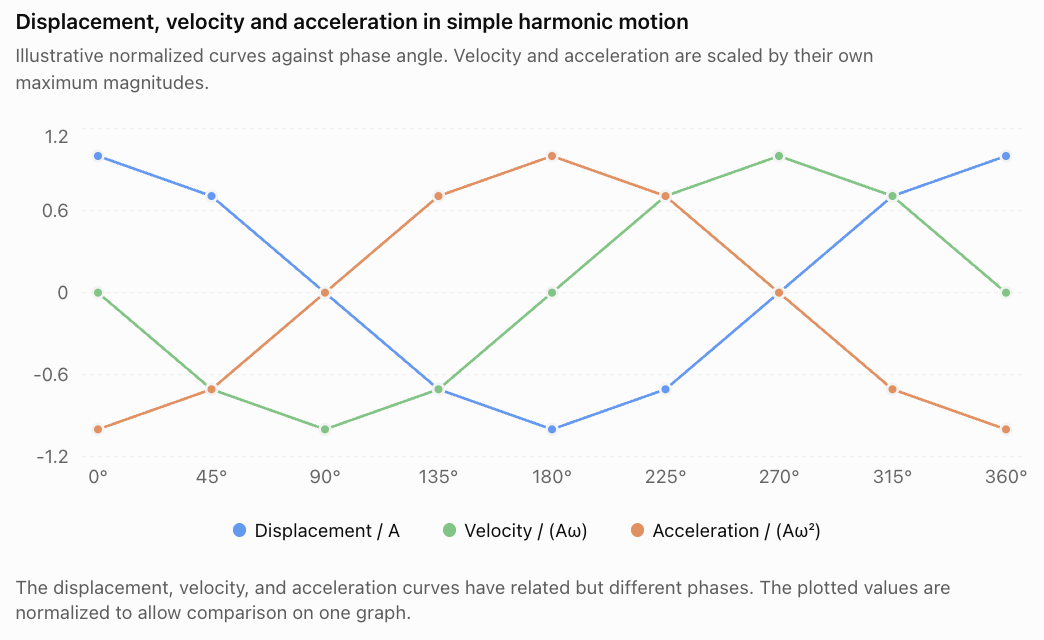
Position, Velocity, and Acceleration
These quantities do not reach their maximum magnitudes at the same time.
For x(t) = A cos(ωt):
-
At maximum positive displacement, velocity is zero and acceleration is most negative.
-
At equilibrium, speed is greatest and acceleration is zero.
-
At maximum negative displacement, velocity is zero and acceleration is most positive.
Pendulum Motion
For a simple pendulum of length L undergoing small oscillations:
T ≈ 2π√(L/g)
where g is gravitational acceleration.
This formula assumes a point mass, a massless string, negligible friction, and a sufficiently small swing angle.
Worked Example 13: Pendulum Period
A simple pendulum has a length of 1.5 m.
Calculate its approximate period using g = 9.8 m/s².
T = 2π√(1.5/9.8)
T ≈ 2.46 s
The pendulum completes one full oscillation approximately every 2.46 seconds.
For large swing angles, the period is longer than this small-angle approximation predicts.
Spring-Mass Systems
For an ideal mass attached to a spring obeying Hooke's law:
F = −kx
where k is the spring constant.
Newton's Second Law gives:
ma = −kx
Therefore:
a = −(k/m)x
Comparing this with a = −ω²x:
ω = √(k/m)
and:
T = 2π√(m/k)
Worked Example 14: Designing a Spring Oscillator
A mass of 0.50 kg is attached to a spring with spring constant 200 N/m.
Find the natural angular frequency and period.
Angular frequency:
ω = √(200/0.50)
ω = √400
ω = 20 rad/s
Period:
T = 2π/20
T ≈ 0.314 s
Damped Oscillations
Real systems lose energy due to friction, air resistance, or other dissipative effects.
Their amplitude often decreases over time.
A simplified underdamped model is:
x(t) = Ae^(−bt) cos(ωdt + φ)
where b > 0 is a decay constant and ωd is the damped angular frequency.
The exponential factor reduces the amplitude as time increases.
This type of model is useful for vehicle suspension, vibration control, and mechanical testing.
Resonance
Resonance occurs when a driven system responds strongly near one of its natural frequencies.
For example, a mechanical structure may vibrate significantly when exposed to periodic forcing near a natural frequency.
Engineers use trigonometric and differential-equation models to investigate resonance and reduce the risk of damaging vibrations.
Learning Target 5: Solving Practical STEM Applications
Many real-world problems combine several trigonometric ideas rather than using only one formula.
The key is to identify the physical quantities, construct a suitable model, and interpret the result.
Worked Example 15: Designing a Solar Panel
A solar panel has an area of 2.0 m².
Sunlight strikes the panel at an angle of 25° from the panel's normal (the direction perpendicular to its surface).
Calculate the effective projected area facing the incoming sunlight.
The projected area is:
A(effective) = A cos θ
Therefore:
A(effective) = 2.0 cos 25°
A(effective) ≈ 1.81 m²
This means the panel intercepts the same amount of direct radiation as a 1.81 m² surface oriented perpendicular to the rays, under the idealized geometric model.
Actual electrical output also depends on irradiance, panel efficiency, temperature, shading, and other factors.
Worked Example 16: A Wind Turbine Blade
A wind turbine blade is 30 m long and rotates at 15 revolutions per minute.
Calculate its angular speed and the tangential speed at its tip.
Step 1: Convert frequency to revolutions per second.
f = 15/60
f = 0.25 Hz
Step 2: Angular speed.
ω = 2πf
ω = 0.5π
ω ≈ 1.57 rad/s
Step 3: Tip speed.
v = rω
v = 30(0.5π)
v ≈ 47.12 m/s
The tip moves much faster than points closer to the centre because tangential speed is proportional to radius.
Worked Example 17: Aircraft Navigation
An aircraft travels at an airspeed of 200 km/h on a heading of 060°, measured clockwise from north.
Assume no wind.
Calculate its eastward and northward velocity components.
For a compass bearing β:
East component = v sin β
North component = v cos β
East:
v(E) = 200 sin 60°
v(E) ≈ 173.2 km/h
North:
v(N) = 200 cos 60°
v(N) = 100 km/h
This differs from the standard polar-angle convention because compass bearings are measured clockwise from north.
Worked Example 18: Analysing an Electrical Signal
An ideal alternating voltage is modelled by:
V(t) = 170 sin(100πt)
where V is in volts and t is in seconds.
Find the peak voltage, frequency, period, and root mean square (RMS) voltage.
Step 1: Peak voltage.
V(peak) = 170 V
Step 2: Angular frequency.
ω = 100π rad/s
Step 3: Frequency.
f = ω/(2π)
f = 50 Hz
Step 4: Period.
T = 1/f
T = 0.020 s
Step 5: RMS voltage.
For a pure sinusoidal voltage:
V(RMS) = V(peak)/√2
V(RMS) = 170/√2
V(RMS) ≈ 120.2 V
RMS voltage is useful because it relates an alternating voltage to its equivalent heating effect in a resistor.
Worked Example 19: Measuring a Bridge Support
An engineer observes the top of a vertical bridge support at an elevation angle of 28° from a point 45 m away horizontally.
The observation instrument is 1.7 m above the base level.
Find the support's height above that level.
Height above instrument:
h = 45 tan 28°
h ≈ 23.93 m
Total height:
H = 23.93 + 1.7
H ≈ 25.63 m
This result assumes the horizontal distance is measured accurately and the base and instrument reference levels are correctly established.
Choosing an Appropriate Trigonometric Method
Problem type
Useful method
Finding a height from distance and angle
Tangent
Finding components of a force
Sine and cosine
Calculating motion along a slope
Weight components
Analysing projectile motion
Velocity components and kinematics
Finding unknown sides in a non-right triangle
Law of Sines or Law of Cosines
Analysing wave frequency and wavelength
v = fλ
Modelling periodic displacement
Sine or cosine functions
Calculating rotation speed
ω = 2πf and v = rω
Analysing ideal spring oscillations
T = 2π√(m/k)
Analysing small-angle pendulum motion
T ≈ 2π√(L/g)
Calculating phase differences
Angular phase relationships
Analysing alternating electrical signals
Sinusoidal models and RMS relationships
The most important step is not memorizing every formula independently. It is recognizing the underlying geometry or repeating pattern.
A General Strategy for STEM Problems
Trigonometric applications become easier when we use a systematic approach.
Step 1: Understand the physical situation.
Identify what is happening and which quantities are known.
Step 2: Draw a diagram.
Include angles, lengths, directions, forces, or wave features.
Step 3: Identify the mathematical relationship.
Decide whether the problem requires triangle trigonometry, vector components, circular motion, or a sinusoidal model.
Step 4: Check units and angle conventions.
Distinguish degrees from radians, compass bearings from standard mathematical angles, and frequencies in hertz from angular frequencies in radians per second.
Step 5: Solve symbolically when possible.
Rearrange the formula before substituting numerical values.
Step 6: Calculate carefully.
Retain sufficient precision until the final answer.
Step 7: Interpret and verify.
Ask whether the result is physically reasonable and whether the model's assumptions are appropriate.
Common Mistakes
Mistake 1: Confusing Sine and Cosine When Resolving Forces
When θ is measured from the horizontal:
Fₓ = F cos θ
Fᵧ = F sin θ
If θ is measured from the vertical, the component relationships change accordingly.
Always use the angle shown in the diagram.
Mistake 2: Using the Wrong Angle Convention
Compass bearings are measured clockwise from north.
Standard mathematical angles are measured anticlockwise from the positive x-axis.
Mistake 3: Forgetting Units
Frequency is measured in hertz.
Angular frequency is measured in radians per second.
Wavelength is measured in metres.
Wave speed is measured in metres per second.
Mistake 4: Confusing Amplitude and Peak-to-Peak Value
If a vibration moves from −4 cm to +4 cm, its amplitude is 4 cm, not 8 cm.
Its peak-to-peak displacement is 8 cm.
Mistake 5: Confusing Frequency and Period
Frequency measures cycles per second.
Period measures seconds per cycle.
They are reciprocals:
f = 1/T
Mistake 6: Assuming All Motion Is Sinusoidal
Uniform circular motion has sinusoidal coordinate components, but not every type of periodic motion is simple harmonic.
Some periodic systems contain multiple frequencies, nonlinear effects, or changing amplitudes.
Mistake 7: Applying Projectile Formulas Outside Their Assumptions
The standard range formula R = v₀²sin(2θ)/g assumes that launch and landing heights are equal and air resistance is negligible.
Mistake 8: Assuming the Normal Force Always Equals mg
On an inclined plane without other perpendicular forces:
N = mg cos θ
It is not generally equal to mg.
Mistake 9: Ignoring Model Limitations
Real structures and machines may experience friction, drag, damping, deformation, turbulence, and other effects absent from simplified models.
Mistake 10: Reporting Unrealistic Precision
Measurements have limited precision.
A calculated building height of 64.003728 m is usually inappropriate if the input measurements are only accurate to a few centimetres or less.
Key Terms
-
Trigonometry: The study of relationships involving angles and lengths.
-
Vector: A quantity with magnitude and direction.
-
Scalar: A quantity with magnitude but no direction.
-
Component: The part of a vector acting along a chosen axis.
-
Resultant force: The vector sum of all forces acting on an object.
-
Inclined plane: A sloping surface.
-
Angle of elevation: The angle measured upward from the horizontal to an object.
-
Projectile motion: Motion under gravity after launch, often modelled without air resistance.
-
Circular motion: Motion along a circular path.
-
Angular speed: Rate of change of angular position.
-
Centripetal acceleration: Acceleration directed toward the centre of circular motion.
-
Triangulation: Determining locations or distances using measured angles and a known baseline.
-
Wave: A propagating disturbance that transfers energy.
-
Amplitude: Maximum displacement from equilibrium.
-
Wavelength: Distance between corresponding points of consecutive wave cycles.
-
Frequency: Number of cycles per second.
-
Period: Time required for one cycle.
-
Angular frequency: Rate of change of phase in radians per second.
-
Phase: Position within a repeating cycle.
-
Phase difference: Difference between the phases of two oscillations.
-
Interference: The combination of overlapping waves.
-
Simple harmonic motion: Motion in which acceleration is proportional to displacement and opposite in direction.
-
Equilibrium position: Position where the net restoring force is zero.
-
Damping: Reduction of oscillation amplitude through energy loss.
-
Resonance: Strong response of a driven system near a natural frequency.
-
Root mean square: A measure related to the mean square of a varying quantity.
-
Mathematical model: A mathematical representation of a physical system.
-
Assumption: A condition accepted when constructing or applying a model.
Key Takeaways
-
Trigonometry is used throughout physics, engineering, architecture, and technology.
-
Sine and cosine resolve vectors into perpendicular components.
-
Inclined-plane forces depend on the sine and cosine of the slope angle.
-
Projectile motion combines horizontal and vertical motion.
-
Trigonometry helps calculate structural dimensions, slopes, tensions, and inaccessible distances.
-
Sine and cosine functions describe many waves and oscillations.
-
Wave speed, frequency, and wavelength satisfy v = fλ.
-
Angular frequency and period are related by ω = 2π/T.
-
Ideal simple harmonic motion can be described by sinusoidal displacement functions.
-
Uniform circular motion and oscillations share important trigonometric relationships.
-
Real-world applications require attention to units, assumptions, and physical meaning.
-
A mathematically correct answer must also be interpreted in context.
Check Your Understanding
Part A: Physics Applications
Question 1
A force of 80 N acts at 35° above the horizontal.
Calculate its horizontal and vertical components.
Question 2
A 12 kg object rests on a frictionless slope inclined at 20°.
Calculate the force acting down the slope and the object's acceleration.
Use g = 9.8 m/s².
Question 3
A ball is launched at 30 m/s at 45° above the horizontal from ground level.
Calculate its maximum height and horizontal range, ignoring air resistance.
Part B: Engineering and Architecture
Question 4
A roof has a horizontal run of 5 m and an inclination of 30°.
Find its rise and sloping length.
Question 5
A 600 N load is supported by two identical cables inclined at 50° above the horizontal.
Find the tension in each cable.
Question 6
A surveyor stands 60 m from a building and measures an angle of elevation of 42°. The instrument is 1.6 m above ground level.
Find the building's height.
Part C: Wave Motion
Question 7
A wave has frequency 25 Hz and wavelength 0.80 m.
Calculate its speed and period.
Question 8
A travelling wave is described by:
y(x, t) = 0.04 sin(5πx − 20πt)
Find its amplitude, wavelength, frequency, period, and speed.
Part D: Periodic Motion
Question 9
A vibrating object has displacement:
x(t) = 0.08 cos(8πt)
Calculate its amplitude, frequency, period, maximum speed, and maximum acceleration.
Question 10
A simple pendulum has a length of 0.80 m.
Calculate its approximate period for small oscillations.
Part E: Integrated STEM Applications
Question 11
A rotating machine has a radius of 0.60 m and rotates at 120 revolutions per minute.
Find its angular speed and tangential speed at the rim.
Question 12
An alternating voltage is given by:
V(t) = 325 sin(100πt)
Find its peak voltage, frequency, period, and RMS voltage.
Check Your Understanding — Fully Worked Answers
Answer 1: Force Components
Given:
F = 80 N
θ = 35°
Horizontal component:
Fₓ = 80 cos 35°
Fₓ ≈ 65.5 N
Vertical component:
Fᵧ = 80 sin 35°
Fᵧ ≈ 45.9 N
Answer 2: Object on a Slope
Weight:
W = mg = 12 × 9.8 = 117.6 N
Force down slope:
F∥ = mg sin 20°
F∥ = 117.6 sin 20°
F∥ ≈ 40.2 N
Acceleration:
a = g sin 20°
a ≈ 3.35 m/s² down the slope
Answer 3: Projectile Motion
Initial vertical velocity:
vᵧ = 30 sin 45°
vᵧ ≈ 21.21 m/s
Maximum height:
H = vᵧ²/(2g)
H = (30 sin 45°)²/19.6
H ≈ 22.96 m
Horizontal range:
R = v₀² sin(2θ)/g
R = 30² sin 90°/9.8
R ≈ 91.84 m
Answer 4: Roof Design
Rise:
h = 5 tan 30°
h ≈ 2.89 m
Sloping length:
L = 5/cos 30°
L ≈ 5.77 m
Answer 5: Cable Tension
Vertical equilibrium:
2T sin 50° = 600
T = 600/(2 sin 50°)
T ≈ 391.6 N per cable
Answer 6: Building Height
Height above instrument:
h = 60 tan 42°
h ≈ 54.02 m
Add instrument height:
H = 54.02 + 1.6
H ≈ 55.62 m
Answer 7: Wave Speed and Period
Given:
f = 25 Hz
λ = 0.80 m
Wave speed:
v = fλ
v = 25 × 0.80
v = 20 m/s
Period:
T = 1/f
T = 1/25
T = 0.040 s
Answer 8: Travelling Wave
Given:
y(x, t) = 0.04 sin(5πx − 20πt)
Amplitude:
A = 0.04 m
Wave number:
k = 5π
Wavelength:
λ = 2π/(5π)
λ = 0.40 m
Angular frequency:
ω = 20π
Frequency:
f = 20π/(2π)
f = 10 Hz
Period:
T = 1/10
T = 0.10 s
Wave speed:
v = fλ
v = 10 × 0.40
v = 4 m/s
Answer 9: Vibrating Object
Given:
x(t) = 0.08 cos(8πt)
Amplitude:
A = 0.08 m
Angular frequency:
ω = 8π rad/s
Frequency:
f = 8π/(2π)
f = 4 Hz
Period:
T = 1/4
T = 0.25 s
Maximum speed:
v(max) = Aω
v(max) = 0.08(8π)
v(max) ≈ 2.01 m/s
Maximum acceleration:
a(max) = Aω²
a(max) = 0.08(8π)²
a(max) ≈ 50.53 m/s²
Answer 10: Pendulum
Given:
L = 0.80 m
g = 9.8 m/s²
T ≈ 2π√(L/g)
T ≈ 2π√(0.80/9.8)
T ≈ 1.80 s
Answer 11: Rotating Machine
Frequency:
f = 120/60 = 2 Hz
Angular speed:
ω = 2πf
ω = 4π
ω ≈ 12.57 rad/s
Tangential speed:
v = rω
v = 0.60(4π)
v ≈ 7.54 m/s
Answer 12: Alternating Voltage
Given:
V(t) = 325 sin(100πt)
Peak voltage:
V(peak) = 325 V
Angular frequency:
ω = 100π
Frequency:
f = 100π/(2π)
f = 50 Hz
Period:
T = 1/50
T = 0.020 s
RMS voltage:
V(RMS) = 325/√2
V(RMS) ≈ 229.8 V
Final Integrated Challenge: Designing a Vibration-Control System
An engineer is testing a machine that vibrates horizontally.
Its displacement is modelled by:
x(t) = 0.015 cos(12πt)
where x is measured in metres and t in seconds.
The machine is mounted on a spring system supporting a 25 kg mass.
Assume ideal simple harmonic motion.
Tasks
-
Determine the amplitude.
-
Calculate the frequency and period.
-
Calculate the maximum speed.
-
Calculate the maximum acceleration.
-
Determine the effective spring constant.
-
Calculate the maximum restoring force.
-
Explain two limitations of the model.
Fully Worked Solution
Step 1: Amplitude
A = 0.015 m
Amplitude = 15 mm
Step 2: Angular frequency
ω = 12π rad/s
Step 3: Frequency
f = ω/(2π)
f = 12π/(2π)
f = 6 Hz
Step 4: Period
T = 1/f
T ≈ 0.167 s
Step 5: Maximum speed
v(max) = Aω
v(max) = 0.015(12π)
v(max) ≈ 0.565 m/s
Step 6: Maximum acceleration
a(max) = Aω²
a(max) = 0.015(12π)²
a(max) ≈ 21.32 m/s²
Step 7: Effective spring constant
For ideal spring-mass motion:
ω² = k/m
Therefore:
k = mω²
k = 25(12π)²
k ≈ 35,531 N/m
Step 8: Maximum restoring force
F(max) = kA
F(max) ≈ 35,531 × 0.015
F(max) ≈ 533 N
We can verify using Newton's Second Law:
F(max) = ma(max)
F(max) ≈ 25 × 21.32
F(max) ≈ 533 N
The two approaches agree.
Step 9: Evaluate the model
The model assumes that the motion is perfectly sinusoidal and that the spring system behaves linearly.
In reality, damping may reduce the amplitude, and machine operation may introduce additional frequencies or changing forces.
A more realistic model may need to include damping and external driving forces.
Final Challenge Summary
Quantity
Result
Amplitude
0.015 m
Frequency
6 Hz
Period
0.167 s
Angular frequency
12π rad/s
Maximum speed
0.565 m/s
Maximum acceleration
21.32 m/s²
Effective spring constant
35,531 N/m
Maximum restoring force
533 N
Conclusion
Trigonometry provides a mathematical foundation for understanding many of the most important relationships in science and engineering.
In physics, it allows us to resolve forces, calculate projectile trajectories, analyse circular motion, and understand oscillations.
In engineering and architecture, it helps determine structural dimensions, support forces, roof slopes, and inaccessible distances.
In wave science, sine and cosine functions describe repeating disturbances, allowing us to calculate amplitude, wavelength, frequency, period, and phase.
Periodic-motion models extend these ideas to springs, pendulums, rotating machinery, and vibrating systems.
The most important skill is learning to recognize the mathematical structure of a real-world situation, choose an appropriate trigonometric relationship, and interpret the result using the physical context.
Trigonometry is more than a method for calculating angles and lengths. It is a language for describing motion, forces, waves, structures, and the mathematical patterns that appear throughout science and engineering.
-