Trigonometry in Advanced Mathematics
3. Complex Numbers and Trigonometry
Learning outcomes
- I can represent complex numbers in polar form.
- I can relate trigonometry to complex numbers.
- I can perform operations using polar form.
- I can interpret geometric representations of complex numbers.
- I can solve problems involving polar representations.
Introduction
Complex numbers and trigonometry are closely connected. Together, they provide a powerful way to describe rotation, magnitude, direction, and periodic behaviour.
A complex number such as:
z = 3 + 4i
can be interpreted algebraically as a sum of real and imaginary components. However, it can also be represented geometrically as a point in a coordinate plane.
This geometric interpretation reveals an important connection: a complex number can be described using its distance from the origin and its angle with the positive real axis.
These are the same ideas used in polar coordinates and trigonometry.
By expressing complex numbers in polar form, operations such as multiplication, division, powers, and roots become easier to understand and often simpler to calculate.
For example, multiplying two complex numbers can be interpreted as combining their magnitudes and adding their angles. Raising a complex number to a power becomes a process of raising its magnitude to that power and multiplying its angle.
These relationships are useful in mathematics, physics, electrical engineering, signal processing, computer graphics, and the study of rotations.
In this lesson, we will explore the connection between complex numbers and trigonometry, convert between rectangular and polar forms, perform operations using polar form, interpret complex numbers geometrically, and solve practical problems involving complex-number representations.
Understanding Complex Numbers
Rectangular Form
A complex number is usually written as:
z = a + bi
where:
-
a is the real part.
-
b is the imaginary part.
-
i is the imaginary unit, defined by i² = −1.
For example:
z = 5 + 2i
has:
Real part = 5
Imaginary part = 2
Another example:
z = −3 + 4i
has:
Real part = −3
Imaginary part = 4
The real and imaginary components can be represented on a coordinate plane.
The Complex Plane
The complex plane, also called the Argand plane, uses:
-
A horizontal real axis.
-
A vertical imaginary axis.
A complex number z = a + bi corresponds to the point (a, b).
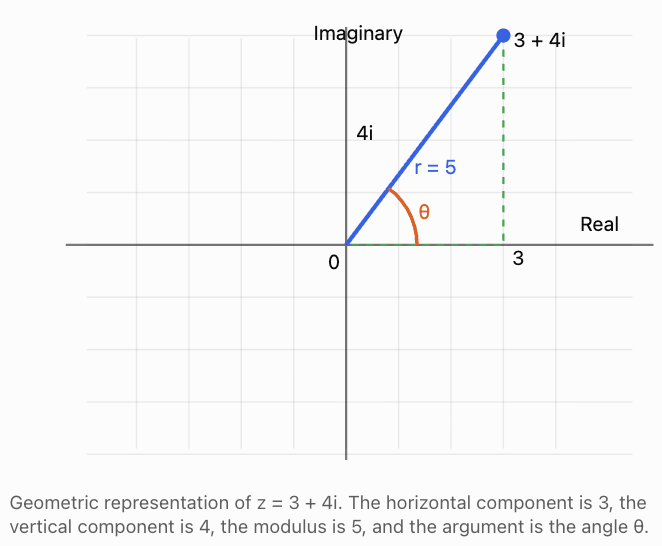
This diagram reveals two important quantities:
-
The distance of the point from the origin.
-
The angle the point makes with the positive real axis.
These lead directly to the polar form of a complex number.
Learning Target 1: Representing Complex Numbers in Polar Form
The Modulus of a Complex Number
The modulus of a complex number is its distance from the origin in the complex plane.
For:
z = a + bi
the modulus is:
|z| = √(a² + b²)
The modulus is always nonnegative.
Worked Example 1: Calculating the Modulus
Find the modulus of:
z = 6 + 8i
Step 1: Identify the components.
a = 6
b = 8
Step 2: Apply the modulus formula.
|z| = √(6² + 8²)
|z| = √(36 + 64)
|z| = √100
|z| = 10
Geometrically, the point (6, 8) lies 10 units from the origin.
The Argument of a Complex Number
The argument is the angle measured anticlockwise from the positive real axis to the line joining the origin to the complex number.
It is represented by:
arg(z) = θ
For z ≠ 0, we can use:
tan θ = b/a
when a ≠ 0.
However, inverse tangent must be interpreted using the correct quadrant.
For example, a point with negative real and positive imaginary parts lies in Quadrant II.
A calculator's inverse tangent may return a negative acute angle, so the quadrant must be considered.
The Principal Argument
A nonzero complex number has infinitely many possible arguments because full revolutions do not change its direction.
If θ is an argument, then:
θ + 2πk
is also an argument, where k is any integer.
The principal argument, written Arg(z), is commonly chosen in the interval:
−π < Arg(z) ≤ π
Some textbooks use a different convention, such as 0 ≤ θ < 2π. Both are valid if used consistently.
The complex number zero has no defined argument.
Worked Example 2: Finding the Argument
Find the argument of:
z = 3 + 3i
The point is in Quadrant I.
tan θ = 3/3 = 1
θ = 45° = π/4
Arg(z) = π/4
Worked Example 3: Argument in Quadrant II
Find the principal argument of:
z = −4 + 4i
The point is in Quadrant II.
The reference angle is:
α = tan⁻¹(4/4) = 45°
Therefore:
θ = 180° − 45°
Arg(z) = 135° = 3π/4
Deriving Polar Form
Consider a complex number:
z = a + bi
Let its modulus be r and its argument be θ.
From trigonometry:
a = r cos θ
b = r sin θ
Substitute into rectangular form:
z = r cos θ + i(r sin θ)
Factor out r:
z = r(cos θ + i sin θ)
This is the polar form, also called the trigonometric form, of a complex number.
For z ≠ 0, r > 0 and θ may be any argument of z.
Worked Example 4: Rectangular to Polar Form
Convert:
z = 3 + 4i
Step 1: Find the modulus.
r = √(3² + 4²)
r = 5
Step 2: Find the argument.
tan θ = 4/3
θ ≈ 53.13°
Step 3: Write the polar form.
z = 5(cos 53.13° + i sin 53.13°)
Using radians:
z ≈ 5(cos 0.9273 + i sin 0.9273)
Worked Example 5: Polar to Rectangular Form
Convert:
z = 8(cos 150° + i sin 150°)
Use:
cos 150° = −√3/2
sin 150° = 1/2
Therefore:
z = 8(−√3/2 + i/2)
z = −4√3 + 4i
Using the cis Notation
To simplify repeated expressions, mathematicians sometimes use:
cis θ = cos θ + i sin θ
Therefore:
z = r cis θ
For example:
5(cos 60° + i sin 60°)
can be written:
5 cis 60°
The cis notation is especially useful for multiplication, division, powers, and roots.
Special Cases
|
Complex number |
Modulus |
Principal argument |
|---|---|---|
|
5 |
5 |
0 |
|
4i |
4 |
π/2 |
|
−6 |
6 |
π |
|
−3i |
3 |
−π/2 |
|
1 + i |
√2 |
π/4 |
|
−1 + i |
√2 |
3π/4 |
|
−1 − i |
√2 |
−3π/4 |
|
1 − i |
√2 |
−π/4 |
For z = 0, the modulus is 0 but the argument is undefined.
Learning Target 2: Relating Trigonometry to Complex Numbers
The Unit Circle Connection
A complex number with modulus 1 lies on the unit circle.
For r = 1:
z = cos θ + i sin θ
The real part is cos θ and the imaginary part is sin θ.
This is exactly the same relationship used in trigonometry and polar coordinates.
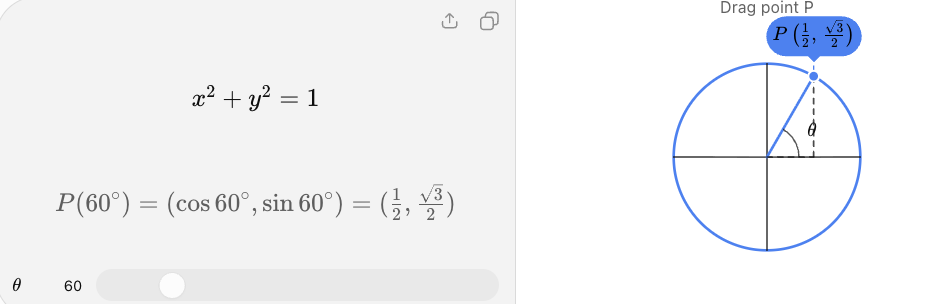
For θ = 60°:
cos 60° = 1/2
sin 60° = √3/2
Therefore, the corresponding complex number is:
z = 1/2 + (√3/2)i
Its modulus is:
|z| = √(1/4 + 3/4) = 1
Euler's Formula
One of the most important relationships in mathematics is Euler's formula:
e^(iθ) = cos θ + i sin θ
Here θ is measured in radians.
This allows polar form to be written as:
z = re^(iθ)
For example:
z = 5(cos π/3 + i sin π/3)
can be written:
z = 5e^(iπ/3)
Euler's formula connects exponential functions, complex numbers, and trigonometry.
Why Euler's Formula Matters
Euler's formula makes complex multiplication especially elegant.
Consider:
z₁ = r₁e^(iθ₁)
z₂ = r₂e^(iθ₂)
Multiplying:
z₁z₂ = r₁r₂e^[i(θ₁ + θ₂)]
This shows that multiplying complex numbers:
-
Multiplies their moduli.
-
Adds their arguments.
Geometrically, multiplication combines scaling and rotation.
Euler's Identity
Setting θ = π in Euler's formula gives:
e^(iπ) = cos π + i sin π
e^(iπ) = −1
Therefore:
e^(iπ) + 1 = 0
This famous identity connects five fundamental mathematical constants:
e, i, π, 1, and 0.
Complex Conjugates and Trigonometry
The complex conjugate of:
z = a + bi
is:
z̄ = a − bi
In polar form:
z = r(cos θ + i sin θ)
Its conjugate is:
z̄ = r(cos θ − i sin θ)
Since cosine is even and sine is odd:
z̄ = r[cos(−θ) + i sin(−θ)]
Thus, conjugation changes the sign of the argument.
Geometrically, this reflects the complex number across the real axis.
Worked Example 6: Conjugate in Polar Form
Given:
z = 6 cis 40°
Find its conjugate.
The modulus remains 6.
The argument changes from 40° to −40°.
z̄ = 6 cis(−40°)
Modulus of a Product
For any complex numbers z₁ and z₂:
|z₁z₂| = |z₁||z₂|
This is consistent with the multiplication rule in polar form.
For example, if:
|z₁| = 3
|z₂| = 5
then:
|z₁z₂| = 15
regardless of their arguments.
Learning Target 3: Performing Operations Using Polar Form
Polar form is particularly useful for multiplication, division, powers, and roots.
Addition and subtraction are usually easier in rectangular form.
Multiplying Complex Numbers
Suppose:
z₁ = r₁ cis θ₁
z₂ = r₂ cis θ₂
Then:
z₁z₂ = r₁r₂ cis(θ₁ + θ₂)
This means:
-
Multiply the moduli.
-
Add the arguments.
Why Does This Rule Work?
Start with:
z₁z₂ = r₁(cos θ₁ + i sin θ₁) × r₂(cos θ₂ + i sin θ₂)
Expand:
z₁z₂ = r₁r₂[(cos θ₁ cos θ₂ − sin θ₁ sin θ₂) + i(sin θ₁ cos θ₂ + cos θ₁ sin θ₂)]
Using the trigonometric addition identities:
cos(θ₁ + θ₂) = cos θ₁ cos θ₂ − sin θ₁ sin θ₂
sin(θ₁ + θ₂) = sin θ₁ cos θ₂ + cos θ₁ sin θ₂
Therefore:
z₁z₂ = r₁r₂[cos(θ₁ + θ₂) + i sin(θ₁ + θ₂)]
This establishes the multiplication rule.
Worked Example 7: Multiplication in Polar Form
Calculate:
z₁ = 4 cis 30°
z₂ = 3 cis 70°
Step 1: Multiply the moduli.
4 × 3 = 12
Step 2: Add the arguments.
30° + 70° = 100°
Answer:
z₁z₂ = 12 cis 100°
The resulting complex number has modulus 12 and argument 100°.
Worked Example 8: Multiplication with an Argument Greater Than 360°
Calculate:
(5 cis 250°)(2 cis 160°)
Multiply the moduli:
5 × 2 = 10
Add the arguments:
250° + 160° = 410°
Therefore:
z = 10 cis 410°
Since 410° − 360° = 50°:
z = 10 cis 50°
Both expressions represent the same complex number.
Dividing Complex Numbers
For z₂ ≠ 0:
z₁/z₂ = (r₁/r₂) cis(θ₁ − θ₂)
This means:
-
Divide the moduli.
-
Subtract the arguments.
Worked Example 9: Division in Polar Form
Calculate:
z₁ = 18 cis 130°
z₂ = 3 cis 40°
Step 1: Divide the moduli.
18/3 = 6
Step 2: Subtract the arguments.
130° − 40° = 90°
Answer:
z₁/z₂ = 6 cis 90°
Since cos 90° = 0 and sin 90° = 1:
z₁/z₂ = 6i
Worked Example 10: Division with a Negative Argument
Calculate:
(20 cis 25°)/(4 cis 100°)
Divide the moduli:
20/4 = 5
Subtract the arguments:
25° − 100° = −75°
Answer: 5 cis(−75°)
An equivalent positive argument is 285°.
Powers of Complex Numbers: De Moivre's Theorem
Repeated multiplication leads to an important theorem.
If:
z = r(cos θ + i sin θ)
then, for any integer n:
zⁿ = rⁿ[cos(nθ) + i sin(nθ)]
This is De Moivre's theorem.
It also works for negative integers when z ≠ 0.
In cis notation:
(r cis θ)ⁿ = rⁿ cis(nθ)
To raise a complex number to a power:
-
Raise the modulus to that power.
-
Multiply the argument by the power.
Worked Example 11: Calculating a Power
Calculate:
(2 cis 30°)⁴
Apply De Moivre's theorem.
Modulus:
2⁴ = 16
Argument:
4 × 30° = 120°
Therefore:
z⁴ = 16 cis 120°
Convert to rectangular form:
z⁴ = 16(cos 120° + i sin 120°)
z⁴ = 16(−1/2 + i√3/2)
z⁴ = −8 + 8√3i
Worked Example 12: Evaluating (1 + i)⁸
Step 1: Convert to polar form.
For z = 1 + i:
r = √(1² + 1²) = √2
θ = 45°
Therefore:
z = √2 cis 45°
Step 2: Apply De Moivre's theorem.
z⁸ = (√2)⁸ cis(8 × 45°)
z⁸ = 16 cis 360°
Step 3: Convert to rectangular form.
cos 360° = 1
sin 360° = 0
(1 + i)⁸ = 16
This calculation is much shorter than multiplying 1 + i by itself eight times.
Roots of Complex Numbers
Finding roots reverses the process of raising a complex number to a power.
Suppose:
wⁿ = z
where:
z = r cis θ
For z ≠ 0, the n distinct complex nth roots are:
wₖ = r^(1/n) cis[(θ + 360°k)/n]
where:
k = 0, 1, 2, ..., n − 1
In radians:
wₖ = r^(1/n) cis[(θ + 2πk)/n]
The different values of k account for all possible arguments.
Why Are There n Roots?
If w has modulus s and argument φ, then:
wⁿ = sⁿ cis(nφ)
For wⁿ = r cis θ:
sⁿ = r
and:
nφ = θ + 360°k
Therefore:
s = r^(1/n)
φ = (θ + 360°k)/n
There are n distinct angles before the pattern repeats.
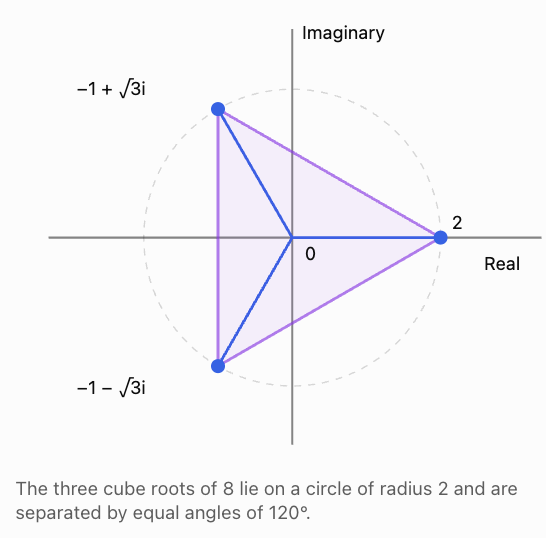
Worked Example 13: Finding the Cube Roots of 8
Solve:
z³ = 8
Write 8 in polar form:
8 = 8 cis 0°
The cube-root modulus is:
r = ∛8 = 2
The arguments are:
θₖ = (0° + 360°k)/3
For k = 0:
θ₀ = 0°
For k = 1:
θ₁ = 120°
For k = 2:
θ₂ = 240°
Therefore, the three roots are:
z₀ = 2 cis 0° = 2
z₁ = 2 cis 120° = −1 + √3i
z₂ = 2 cis 240° = −1 − √3i
Final answers:
-
2
-
−1 + √3i
-
−1 − √3i
Worked Example 14: Finding Fourth Roots
Solve:
z⁴ = −16
Write:
−16 = 16 cis 180°
The root modulus is:
r = 16^(1/4) = 2
The arguments are:
θₖ = (180° + 360°k)/4
For k = 0, 1, 2, 3:
-
θ₀ = 45°
-
θ₁ = 135°
-
θ₂ = 225°
-
θ₃ = 315°
Therefore:
z = 2 cis 45°, 2 cis 135°, 2 cis 225°, or 2 cis 315°
In rectangular form:
-
√2 + √2i
-
−√2 + √2i
-
−√2 − √2i
-
√2 − √2i
The four roots form the vertices of a square centred at the origin.
Addition and Subtraction
Polar form is usually less convenient for addition and subtraction.
For example:
z₁ = 4 cis 0° = 4
z₂ = 4 cis 90° = 4i
Their sum is:
z₁ + z₂ = 4 + 4i
Converting back to polar form:
r = √(4² + 4²) = 4√2
θ = 45°
Therefore:
z₁ + z₂ = 4√2 cis 45°
Notice that we did not add the moduli and arguments. That rule applies to multiplication, not addition.
Operations Summary
Operation
Polar-form rule
Multiplication
Multiply moduli; add arguments
Division
Divide moduli; subtract arguments
Integer powers
Raise modulus to power; multiply argument
nth roots
Take nth root of modulus; divide all possible arguments by n
Addition
Usually convert to rectangular form
Subtraction
Usually convert to rectangular form
Conjugation
Keep modulus; negate argument
Learning Target 4: Interpreting Geometric Representations of Complex Numbers
Complex numbers are not only algebraic expressions. They also represent vectors, rotations, reflections, and transformations.
Complex Numbers as Vectors
A complex number:
z = a + bi
can be represented by a vector from the origin to the point (a, b).
Its modulus represents the vector's length.
Its argument represents the vector's direction.
For example:
z = 3 + 4i
corresponds to a vector with:
-
Horizontal component = 3
-
Vertical component = 4
-
Length = 5
-
Direction ≈ 53.13° from the positive real axis
Addition as Vector Addition
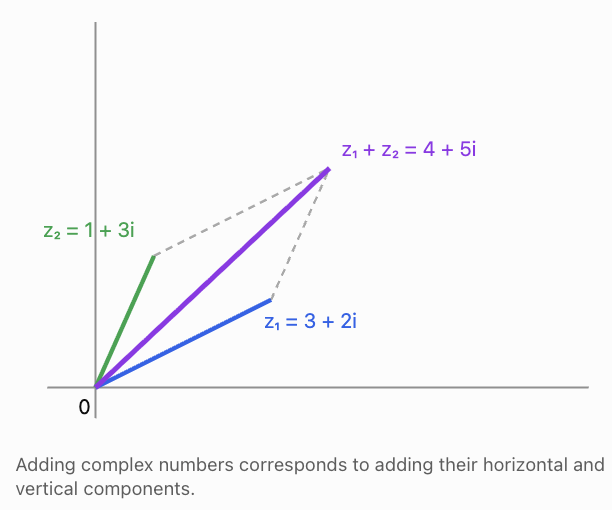
Consider:
z₁ = 3 + 2i
z₂ = 1 + 3i
Add the real components:
3 + 1 = 4
Add the imaginary components:
2i + 3i = 5i
Therefore:
z₁ + z₂ = 4 + 5i
Geometrically, the two vectors can be added using the parallelogram or head-to-tail method.
Multiplication as Rotation and Scaling
Multiplication has a different geometric meaning.
Suppose:
z = r cis θ
and:
w = s cis φ
Then:
zw = rs cis(θ + φ)
Multiplication by w:
-
Scales the distance from the origin by s.
-
Rotates the point anticlockwise by φ.
If s = 1, the transformation is a pure rotation.
If φ = 0°, the transformation is a pure scaling by a positive factor.
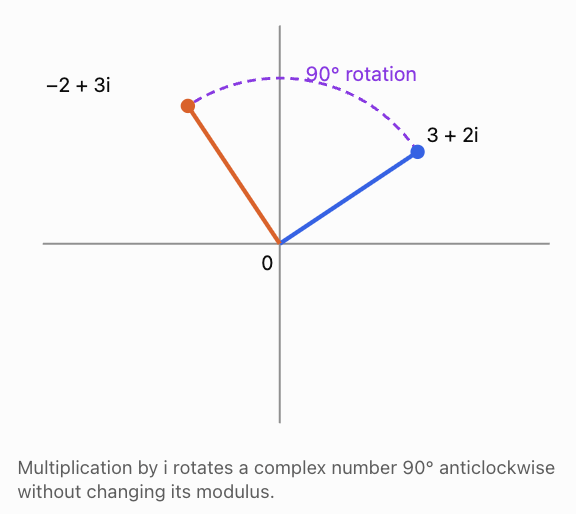
Worked Example 15: Rotation by 90°
Consider:
z = 3 + 2i
Multiply by i.
iz = i(3 + 2i)
iz = 3i + 2i²
Since i² = −1:
iz = −2 + 3i
The original point is (3, 2).
The new point is (−2, 3).
This is a 90° anticlockwise rotation about the origin.
Rotating by Any Angle
To rotate a complex number by an angle α anticlockwise, multiply it by:
cos α + i sin α
or:
cis α
For example, to rotate z by 60°:
z(new) = z cis 60°
Because cis 60° has modulus 1, the distance from the origin does not change.
Worked Example 16: Rotation and Scaling Together
A point is represented by:
z = 2 cis 30°
It is transformed by multiplying by:
w = 3 cis 45°
Find the new position.
Step 1: Multiply the moduli.
2 × 3 = 6
Step 2: Add the angles.
30° + 45° = 75°
Therefore:
zw = 6 cis 75°
The transformation triples the point's distance from the origin and rotates it 45° anticlockwise.
Reflection Across the Real Axis
The complex conjugate reflects a point across the real axis.
For example:
z = 2 + 5i
z̄ = 2 − 5i
The point (2, 5) becomes (2, −5).
The modulus remains unchanged, while the argument changes sign.
Reflection Across the Imaginary Axis
To reflect z = a + bi across the imaginary axis:
a + bi → −a + bi
This can be expressed as:
z(new) = −z̄
For example:
z = 3 + 4i
z̄ = 3 − 4i
−z̄ = −3 + 4i
The point (3, 4) becomes (−3, 4).
Distance Between Complex Numbers
If z₁ and z₂ represent two points, their distance is:
d = |z₂ − z₁|
This is the same as the Cartesian distance formula.
Worked Example 17: Distance in the Complex Plane
Find the distance between:
z₁ = 2 + 3i
z₂ = 7 − i
Subtract:
z₂ − z₁ = (7 − i) − (2 + 3i)
z₂ − z₁ = 5 − 4i
Calculate the modulus:
d = √(5² + (−4)²)
d = √41 ≈ 6.40 units
Geometric Loci
A locus is the set of points satisfying a given condition.
Complex notation can describe geometric loci concisely.
For example:
|z − (2 + 3i)| = 5
means that the distance from z to the point (2, 3) is always 5.
Therefore, the locus is a circle with centre (2, 3) and radius 5.
Another example:
|z − 2| = |z + 2|
means that z is equally distant from the points (2, 0) and (−2, 0).
The locus is the imaginary axis:
Re(z) = 0
These connections show how complex numbers can simplify geometric reasoning.
Learning Target 5: Solving Problems Involving Polar Representations
The polar form of a complex number is especially useful when a problem involves repeated rotations, powers, roots, or relationships between magnitude and direction.
Worked Example 18: Solving a Complex Equation
Solve:
z³ = −8i
Step 1: Express the right-hand side in polar form.
The modulus is 8.
An argument is 270°.
Therefore:
−8i = 8 cis 270°
Step 2: Find the cube-root modulus.
∛8 = 2
Step 3: Find the three arguments.
θₖ = (270° + 360°k)/3
For k = 0:
θ₀ = 90°
For k = 1:
θ₁ = 210°
For k = 2:
θ₂ = 330°
Step 4: Write the roots.
z₀ = 2 cis 90° = 2i
z₁ = 2 cis 210° = −√3 − i
z₂ = 2 cis 330° = √3 − i
Final answers:
-
2i
-
−√3 − i
-
√3 − i
The roots have equal modulus and are separated by 120°.
Worked Example 19: Finding an Unknown Complex Number
Suppose:
z × (2 cis 40°) = 12 cis 150°
Find z.
Divide both sides by 2 cis 40°:
z = (12 cis 150°)/(2 cis 40°)
Divide the moduli:
12/2 = 6
Subtract the arguments:
150° − 40° = 110°
z = 6 cis 110°
Worked Example 20: Repeated Rotations
A point begins at:
z₀ = 5 + 0i
It is rotated anticlockwise by 30° six times.
Find its final position.
Each rotation corresponds to multiplication by cis 30°.
After six rotations:
z₆ = 5(cis 30°)⁶
Using De Moivre's theorem:
z₆ = 5 cis(6 × 30°)
z₆ = 5 cis 180°
z₆ = −5
The point ends at (−5, 0), directly opposite its starting position.
Worked Example 21: Scaling and Rotating a Design
A point in a digital design is represented by:
z = 4 cis 20°
A transformation enlarges the distance from the origin by a factor of 1.5 and rotates the point 70° anticlockwise.
The transformation multiplier is:
w = 1.5 cis 70°
Therefore:
zw = 4 × 1.5 cis(20° + 70°)
zw = 6 cis 90°
Final position: z = 6i
The point lies 6 units above the origin.
Worked Example 22: Solving z⁴ = 16
Write:
16 = 16 cis 0°
The fourth-root modulus is:
16^(1/4) = 2
The arguments are:
θₖ = (0° + 360°k)/4
For k = 0, 1, 2, 3:
θ = 0°, 90°, 180°, 270°
The four roots are:
2, 2i, −2, −2i
They form the vertices of a square centred at the origin.
Worked Example 23: A Geometric Problem with Complex Numbers
Two points on a circle of radius 5 have arguments of 20° and 100°.
Find the distance between the points.
The corresponding complex numbers are:
z₁ = 5 cis 20°
z₂ = 5 cis 100°
The angle between the radius vectors is:
100° − 20° = 80°
Using the Law of Cosines:
d² = 5² + 5² − 2(5)(5)cos 80°
d² = 50 − 50 cos 80°
d ≈ 6.43
Distance ≈ 6.43 units
Alternatively, using the chord formula:
d = 2r sin(θ/2)
d = 10 sin 40°
d ≈ 6.43
This demonstrates how complex-number geometry connects with triangle trigonometry.
Real-World Applications
Electrical Engineering: Alternating Current
Alternating-current circuits often involve voltage and current signals that differ in magnitude and phase.
Complex numbers provide a convenient representation of sinusoidal quantities.
For example, a voltage phasor may be represented as:
V = 120 cis 30° V
A current phasor may be represented as:
I = 5 cis(−20°) A
The phase difference is:
30° − (−20°) = 50°
The voltage leads the current by 50° under this phasor convention.
In circuit analysis, complex division is used to calculate impedance:
Z = V/I
Therefore:
Z = (120/5) cis[30° − (−20°)]
Z = 24 cis 50° Ω
The impedance has magnitude 24 Ω and phase angle 50°.
Computer Graphics: Rotations
A point can be rotated about the origin using complex multiplication.
If a point is represented by z, rotating it through angle θ gives:
z(new) = z cis θ
This avoids repeatedly applying separate coordinate formulas.
For rotations about a centre c rather than the origin:
z(new) = c + (z − c)cis θ
This first moves the centre to the origin, performs the rotation, and moves the result back.
Signal Processing
Complex exponentials are widely used to represent oscillations and waves.
A sinusoidal signal can be associated with:
e^(iωt) = cos(ωt) + i sin(ωt)
where ω is angular frequency.
The real and imaginary components describe two oscillations separated in phase by 90°.
This relationship underlies many methods in signal analysis, including Fourier techniques.
Robotics and Navigation
Complex numbers can represent two-dimensional positions and rotations.
A robot moving in a plane may use complex multiplication to update its orientation.
The modulus describes a distance, while the argument describes a direction.
Mathematics: Roots and Symmetry
The nth roots of a nonzero complex number are equally spaced around a circle.
Their positions form the vertices of a regular n-sided polygon.
This connection is important in algebra, geometry, and the study of polynomial equations.
Common Mistakes
Mistake 1: Confusing Modulus and Argument
The modulus is the distance from the origin.
The argument is the direction measured from the positive real axis.
For z = 3 + 4i:
|z| = 5
Arg(z) ≈ 53.13°
These quantities have different meanings.
Mistake 2: Using the Wrong Quadrant
For z = −3 + 3i, inverse tangent of 3/(−3) gives −45°.
However, the point is in Quadrant II.
The principal argument is 135°, not −45°.
Mistake 3: Adding Arguments During Complex Addition
The rule for adding arguments applies to multiplication, not addition.
In general:
r₁ cis θ₁ + r₂ cis θ₂ ≠ (r₁ + r₂)cis(θ₁ + θ₂)
Convert to rectangular form before adding.
Mistake 4: Forgetting to Raise the Modulus to the Power
For:
(3 cis 20°)²
the modulus becomes 3² = 9.
The correct answer is:
9 cis 40°
not 3 cis 40°.
Mistake 5: Finding Only One Complex Root
The equation z³ = 8 has three distinct complex solutions.
When finding nth roots of a nonzero complex number, calculate all n roots.
Mistake 6: Mixing Degrees and Radians
De Moivre's theorem works with either degrees or radians, provided the units are used consistently.
Euler's formula uses radians.
Mistake 7: Forgetting That Arguments Repeat
The angles 30°, 390°, and −330° represent the same direction.
Arguments differing by complete revolutions represent the same complex number when the modulus is unchanged.
Mistake 8: Assigning an Argument to Zero
The complex number 0 has modulus 0 but no defined argument.
Mistake 9: Misinterpreting Multiplication Geometrically
Multiplication does not correspond to ordinary vector addition.
Multiplication combines scaling and rotation.
Mistake 10: Ignoring the Geometry of Roots
The nth roots of a nonzero complex number are equally spaced around a circle.
A root calculation that produces unequal angular spacing should be checked.
Key Terms
-
Complex number: A number of the form a + bi.
-
Imaginary unit: The number i satisfying i² = −1.
-
Real part: The coefficient a in a + bi.
-
Imaginary part: The coefficient b in a + bi.
-
Complex plane: A coordinate plane representing real and imaginary components.
-
Argand diagram: A geometric diagram of complex numbers.
-
Rectangular form: The representation z = a + bi.
-
Polar form: The representation z = r(cos θ + i sin θ).
-
Modulus: The distance of a complex number from the origin.
-
Argument: An angle specifying the direction of a nonzero complex number.
-
Principal argument: An argument selected from a specified standard interval.
-
cis notation: The abbreviation cis θ = cos θ + i sin θ.
-
Euler's formula: The identity e^(iθ) = cos θ + i sin θ.
-
Euler's identity: The relationship e^(iπ) + 1 = 0.
-
Complex conjugate: The number a − bi associated with a + bi.
-
De Moivre's theorem: A rule for raising complex numbers in polar form to integer powers.
-
Complex roots: Solutions to equations involving powers of complex numbers.
-
Rotation: A transformation changing the argument of a complex number.
-
Scaling: A transformation changing the modulus.
-
Locus: A set of points satisfying a geometric condition.
-
Phasor: A complex representation of a sinusoidal quantity's magnitude and phase.
-
Impedance: A complex measure of opposition to alternating electrical current.
Key Takeaways
-
Complex numbers can be represented algebraically and geometrically.
-
The rectangular form is z = a + bi.
-
The modulus is |z| = √(a² + b²).
-
The argument describes the direction of a nonzero complex number.
-
Polar form is z = r(cos θ + i sin θ).
-
Euler's formula gives an equivalent representation, z = re^(iθ).
-
Multiplication multiplies moduli and adds arguments.
-
Division divides moduli and subtracts arguments.
-
De Moivre's theorem simplifies powers of complex numbers.
-
The nth roots of a nonzero complex number are equally spaced around a circle.
-
Multiplication by a unit complex number produces a rotation.
-
Complex conjugation reflects a point across the real axis.
-
Polar form is especially useful for rotations, oscillations, electrical circuits, and geometric transformations.
Check Your Understanding
Attempt these questions before consulting the solutions.
Part A: Polar Form and Trigonometry
Question 1
Convert z = 5 + 5i into polar form. Give the exact modulus and argument.
Question 2
Convert z = −3√3 + 3i into polar form.
Question 3
Convert z = 10 cis 150° into rectangular form.
Question 4
Given z = 8 cis 35°, determine its modulus, an argument, and its complex conjugate in polar form.
Part B: Operations in Polar Form
Question 5
Calculate:
(4 cis 25°)(5 cis 80°)
Question 6
Calculate:
(18 cis 140°)/(3 cis 50°)
Question 7
Evaluate:
(2 cis 40°)³
Question 8
Evaluate (1 − i)⁶ in rectangular form.
Part C: Roots and Complex Equations
Question 9
Find all cube roots of −8.
Question 10
Solve:
z⁴ = 81
Give the answers in rectangular form.
Part D: Geometric Interpretation
Question 11
The point z = 4 + 3i is rotated 90° anticlockwise about the origin.
Find its new complex-number representation.
Question 12
Find the distance between z₁ = 1 + 2i and z₂ = 7 − 6i.
Part E: Applications
Question 13
A complex number has modulus 6 and argument 20°.
It is multiplied by a complex number with modulus 2 and argument −50°.
Describe the geometric transformation and determine the result.
Question 14
A voltage phasor is V = 100 cis 40° V and a current phasor is I = 4 cis 10° A.
Calculate the impedance Z = V/I.
Check Your Understanding — Fully Worked Answers
Answer 1
Given:
z = 5 + 5i
Modulus:
r = √(5² + 5²)
r = √50 = 5√2
Argument:
tan θ = 5/5 = 1
The point is in Quadrant I.
θ = 45°
Answer: z = 5√2 cis 45°
Answer 2
Given:
z = −3√3 + 3i
Modulus:
r = √[(-3√3)² + 3²]
r = √(27 + 9)
r = 6
Reference angle:
tan α = 3/(3√3) = 1/√3
α = 30°
The point is in Quadrant II.
θ = 180° − 30° = 150°
Answer: z = 6 cis 150°
Answer 3
Given:
z = 10 cis 150°
Expand:
z = 10(cos 150° + i sin 150°)
z = 10(−√3/2 + i/2)
Answer: z = −5√3 + 5i
Answer 4
Given:
z = 8 cis 35°
Modulus:
|z| = 8
An argument:
θ = 35°
The conjugate has the same modulus and opposite argument.
z̄ = 8 cis(−35°)
Answer 5
Multiply moduli:
4 × 5 = 20
Add arguments:
25° + 80° = 105°
Answer: 20 cis 105°
Answer 6
Divide moduli:
18/3 = 6
Subtract arguments:
140° − 50° = 90°
z = 6 cis 90°
Answer: 6i
Answer 7
Apply De Moivre's theorem.
(2 cis 40°)³ = 2³ cis(3 × 40°)
Answer: 8 cis 120°
In rectangular form:
8(cos 120° + i sin 120°)
Answer: −4 + 4√3i
Answer 8
Given:
z = 1 − i
Modulus:
r = √(1² + (−1)²) = √2
Argument:
θ = −45°
Therefore:
z = √2 cis(−45°)
Apply De Moivre's theorem:
z⁶ = (√2)⁶ cis(−270°)
z⁶ = 8 cis 90°
Answer: (1 − i)⁶ = 8i
Answer 9
Solve:
z³ = −8
Write:
−8 = 8 cis 180°
The cube-root modulus is:
∛8 = 2
Arguments:
θₖ = (180° + 360°k)/3
For k = 0, 1, 2:
θ₀ = 60°
θ₁ = 180°
θ₂ = 300°
The roots are:
2 cis 60° = 1 + √3i
2 cis 180° = −2
2 cis 300° = 1 − √3i
Answers:
-
1 + √3i
-
−2
-
1 − √3i
Answer 10
Solve:
z⁴ = 81
Write:
81 = 81 cis 0°
Fourth-root modulus:
81^(1/4) = 3
Arguments:
θₖ = (360°k)/4
For k = 0, 1, 2, 3:
θ = 0°, 90°, 180°, 270°
Therefore:
Answers: 3, 3i, −3, −3i
Answer 11
Given:
z = 4 + 3i
A 90° anticlockwise rotation corresponds to multiplication by i.
iz = i(4 + 3i)
iz = 4i + 3i²
iz = 4i − 3
Answer: −3 + 4i
The point moves from (4, 3) to (−3, 4).
Answer 12
Given:
z₁ = 1 + 2i
z₂ = 7 − 6i
Difference:
z₂ − z₁ = 6 − 8i
Distance:
d = |6 − 8i|
d = √(6² + (−8)²)
d = √100
Answer: 10 units
Answer 13
Given:
z₁ = 6 cis 20°
z₂ = 2 cis(−50°)
Multiply:
z₁z₂ = 12 cis(20° − 50°)
Answer: 12 cis(−30°)
Geometrically, the transformation doubles the distance from the origin and rotates the point 50° clockwise.
Answer 14
Given:
V = 100 cis 40°
I = 4 cis 10°
Impedance:
Z = V/I
Divide the moduli:
100/4 = 25
Subtract the arguments:
40° − 10° = 30°
Answer: Z = 25 cis 30° Ω
Final Integrated Challenge: Complex Transformations in Computer Graphics
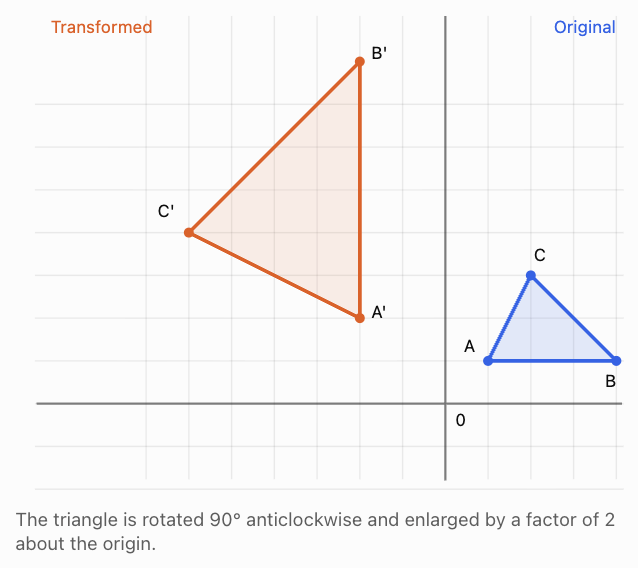
A graphic designer represents the vertices of a triangle using complex numbers:
A = 1 + i
B = 4 + i
C = 2 + 3i
The designer wants to rotate the triangle 90° anticlockwise about the origin and then enlarge it by a factor of 2.
Tasks
-
Express vertex A in polar form.
-
Determine the complex multiplier representing the combined transformation.
-
Calculate the transformed coordinates of A, B, and C.
-
Explain the effect on the triangle's side lengths.
-
Explain the effect on the triangle's area.
-
Verify the transformed length of AB.
Fully Worked Solution
Step 1: Express A in polar form.
A = 1 + i
Modulus:
r = √(1² + 1²) = √2
Argument:
θ = 45°
Therefore:
A = √2 cis 45°
Step 2: Determine the transformation multiplier.
A rotation of 90° corresponds to multiplication by:
cis 90° = i
An enlargement by factor 2 corresponds to multiplication by 2.
Combining both:
w = 2i
In polar form:
w = 2 cis 90°
Step 3: Transform vertex A.
A' = (1 + i)(2i)
A' = 2i + 2i²
A' = −2 + 2i
Step 4: Transform vertex B.
B' = (4 + i)(2i)
B' = 8i + 2i²
B' = −2 + 8i
Step 5: Transform vertex C.
C' = (2 + 3i)(2i)
C' = 4i + 6i²
C' = −6 + 4i
The transformed vertices are:
-
A' = (−2, 2)
-
B' = (−2, 8)
-
C' = (−6, 4)
Step 6: Determine the effect on side lengths.
Multiplication by 2i has modulus 2.
Therefore, every side length is multiplied by 2.
The triangle remains similar to the original.
Step 7: Determine the effect on area.
An enlargement by scale factor 2 multiplies area by:
2² = 4
Therefore, the transformed triangle has four times the original area.
Step 8: Verify using side AB.
Original vertices:
A = (1, 1)
B = (4, 1)
Original length:
AB = √[(4 − 1)² + (1 − 1)²]
AB = 3
Transformed vertices:
A' = (−2, 2)
B' = (−2, 8)
Transformed length:
A'B' = √[(−2 + 2)² + (8 − 2)²]
A'B' = √36
A'B' = 6
Verification: 6/3 = 2
The side length has doubled, exactly as expected.
Final Challenge Summary
Property
Result
Transformation multiplier
2i
Rotation
90° anticlockwise
Enlargement factor
2
New vertex A
−2 + 2i
New vertex B
−2 + 8i
New vertex C
−6 + 4i
Side-length scale factor
2
Area scale factor
4
Conclusion
Complex numbers and trigonometry provide two complementary ways to understand mathematical relationships involving magnitude and direction.
Rectangular form describes complex numbers using real and imaginary components, while polar form expresses them using modulus and argument.
The connection to sine and cosine makes it possible to interpret complex numbers as points and vectors in a plane.
Polar form also transforms multiplication and division into operations involving magnitudes and angles. De Moivre's theorem extends this relationship to powers, while the root formulas reveal beautiful geometric patterns and symmetry.
Complex multiplication can represent rotations and enlargements, making these ideas especially useful in computer graphics, robotics, engineering, and signal processing.
The central idea is that complex numbers combine algebra and geometry: their magnitudes describe size, their arguments describe direction, and their operations describe transformations.
-