Trigonometry in Advanced Mathematics
2. Polar Coordinates and Parametric Curves
Learning outcomes
- I can define polar coordinates.
- I can convert between Cartesian and polar coordinates.
- I can graph simple polar equations.
- I can interpret parametric equations.
- I can connect multiple coordinate systems.
Introduction
Most of the mathematics we study begins with the Cartesian coordinate system. A point is described by two numbers, x and y, representing its horizontal and vertical positions.
However, Cartesian coordinates are not always the most convenient way to describe a location or a curve.
Imagine a radar operator tracking an aircraft. Rather than reporting how far east and north the aircraft is, it may be easier to describe its distance from the radar station and the direction in which it lies.
Similarly, a rotating wheel is easier to describe using a distance from its centre and an angle of rotation.
These situations lead to polar coordinates, which describe positions using a distance and an angle.
Another useful approach is to describe the coordinates of a moving point using a third variable, usually time. This leads to parametric equations.
Polar and parametric representations allow us to describe circles, spirals, curved paths, rotating objects, and complex geometric relationships in ways that are sometimes much simpler than ordinary Cartesian equations.
Understanding how these systems connect is an important foundation for advanced trigonometry, calculus, physics, engineering, and computer graphics.
Learning Target 1: Defining Polar Coordinates
What Are Polar Coordinates?
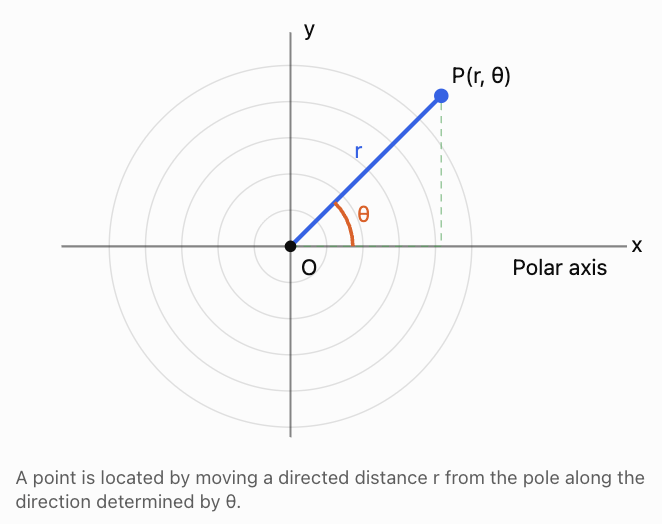
The polar coordinate system identifies a point using two values:
(r, θ)
where:
-
r is the directed distance from the origin.
-
θ is the angle measured from a fixed reference direction, normally the positive x-axis.
The origin is called the pole.
The positive x-axis is called the polar axis.
Angles are normally measured anticlockwise from the polar axis, although clockwise angles can be represented using negative values.
Understanding the Radius
For positive r, the point lies in the direction of angle θ.
For negative r, the point lies in the opposite direction.
For example:
(4, 30°)
means moving 4 units from the origin in the direction 30° anticlockwise from the positive x-axis.
But:
(−4, 30°)
means moving 4 units in the opposite direction, equivalent to a positive radius at 210°.
Understanding the Angle
Angles may be measured in degrees or radians.
Important equivalents include:
|
Degrees |
Radians |
|---|---|
|
0° |
0 |
|
30° |
π/6 |
|
45° |
π/4 |
|
60° |
π/3 |
|
90° |
π/2 |
|
180° |
π |
|
270° |
3π/2 |
|
360° |
2π |
In advanced mathematics, radians are normally preferred because they simplify calculus and many trigonometric formulas.
Worked Example 1: Plotting a Polar Point
Plot:
P = (5, 60°)
Step 1: Begin at the pole.
Step 2: Measure 60° anticlockwise from the positive x-axis.
Step 3: Move 5 units along that direction.
The resulting point lies in the first quadrant.
Worked Example 2: A Negative Radius
Interpret:
Q = (−3, 45°)
A negative radius means that the point lies in the direction opposite 45°.
The equivalent positive-radius angle is:
45° + 180° = 225°
Therefore:
(−3, 45°) = (3, 225°)
Both coordinate pairs represent the same point.
Why Polar Coordinates Are Not Unique
Unlike Cartesian coordinates, polar coordinates do not have a unique representation.
For example, the same point can be written as:
(4, 30°)
(4, 390°)
(4, −330°)
(−4, 210°)
Adding or subtracting a complete revolution does not change the location.
In general:
(r, θ) = (r, θ + 2πk)
and:
(r, θ) = (−r, θ + (2k + 1)π)
where k is any integer.
At the pole, r = 0, every angle represents the same point.
Polar Coordinates and Compass Bearings
Polar angles and navigation bearings use different conventions.
-
Polar angles are usually measured anticlockwise from east.
-
Compass bearings are measured clockwise from north.
If a compass bearing is β, the corresponding standard polar angle is:
θ = 90° − β, interpreted modulo 360°.
For example, a bearing of 030° corresponds to a polar angle of 60°.
This relationship is useful when connecting navigation problems with coordinate geometry.
Learning Target 2: Converting Between Cartesian and Polar Coordinates
Cartesian and polar coordinates describe the same plane.
A point may be represented as:
Cartesian: (x, y)
Polar: (r, θ)
We can convert between them using trigonometry.
Converting Polar to Cartesian
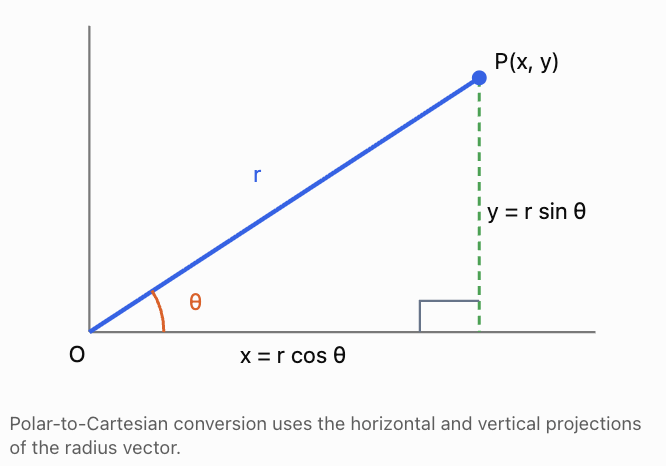
Consider a point P(r, θ).
The coordinates form a right triangle with the horizontal and vertical axes.
Using cosine:
cos θ = x/r
Therefore:
x = r cos θ
Using sine:
sin θ = y/r
Therefore:
y = r sin θ
These formulas work for positive or negative r.
Worked Example 3: Polar to Cartesian
Convert:
P = (6, 30°)
Step 1: Calculate x.
x = 6 cos 30°
x = 6(√3/2)
x = 3√3
Step 2: Calculate y.
y = 6 sin 30°
y = 6(1/2)
y = 3
Answer:
Cartesian coordinates:
(3√3, 3)
Approximately:
(5.20, 3.00)
Worked Example 4: Polar to Cartesian in Another Quadrant
Convert:
Q = (8, 150°)
x = 8 cos 150°
x = −4√3
y = 8 sin 150°
y = 4
Answer: (−4√3, 4)
This is reasonable because an angle of 150° places the point in Quadrant II, where x is negative and y is positive.
Converting Cartesian to Polar
Starting with:
x² + y² = r²
we obtain:
r = √(x² + y²)
For the angle:
tan θ = y/x
However, inverse tangent alone may give the wrong quadrant.
A reliable conversion must use the signs of x and y to determine the correct angle.
Worked Example 5: Cartesian to Polar
Convert:
P = (3, 4)
Step 1: Calculate r.
r = √(3² + 4²)
r = √25
r = 5
Step 2: Calculate θ.
tan θ = 4/3
θ = tan⁻¹(4/3)
θ ≈ 53.13°
Since the point lies in Quadrant I, the angle is correct.
Answer: (5, 53.13°)
Worked Example 6: A Point in Quadrant II
Convert:
Q = (−4, 4)
Step 1: Calculate r.
r = √[(-4)² + 4²]
r = √32
r = 4√2
Step 2: Determine θ.
The reference angle is:
tan⁻¹(|4/−4|) = 45°
Since x is negative and y is positive, the point is in Quadrant II.
θ = 180° − 45°
θ = 135°
Answer: (4√2, 135°)
Worked Example 7: A Point in Quadrant III
Convert:
R = (−5, −5√3)
Radius:
r = √[25 + 75]
r = 10
Reference angle:
α = tan⁻¹(√3) = 60°
The point is in Quadrant III.
θ = 180° + 60°
θ = 240°
Answer: (10, 240°)
Quadrant Reference Guide
|
Quadrant |
Signs of (x, y) |
Angle from reference angle α |
|---|---|---|
|
I |
(+, +) |
θ = α |
|
II |
(−, +) |
θ = 180° − α |
|
III |
(−, −) |
θ = 180° + α |
|
IV |
(+, −) |
θ = 360° − α |
Here α is the acute reference angle, found from the absolute values of x and y.
For points on the coordinate axes, determine the angle directly rather than using inverse tangent.
A Useful Connection to the Unit Circle
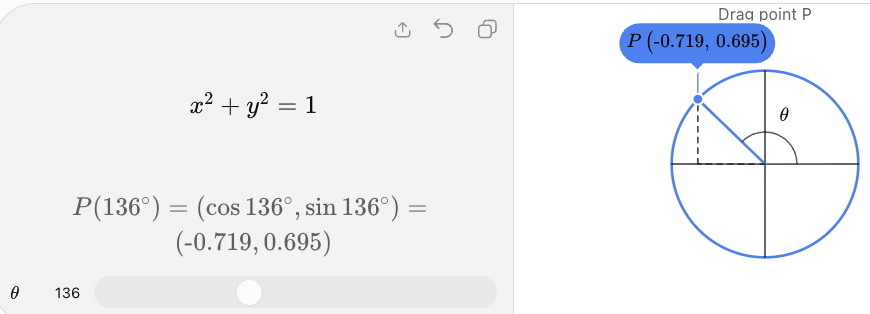
For r = 1:
x = cos θ
y = sin θ
The unit circle is therefore a special case of the polar coordinate system.
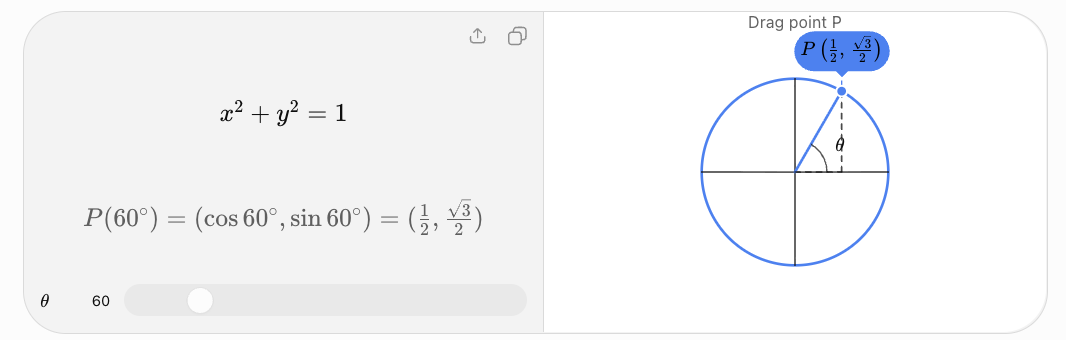
At θ = 60°:
x = cos 60° = 1/2
y = sin 60° = √3/2
So the corresponding Cartesian point is:
(1/2, √3/2)
Learning Target 3: Graphing Simple Polar Equations
In Cartesian coordinates, equations describe relationships between x and y.
In polar coordinates, equations describe relationships between r and θ.
A polar equation may be written as:
r = f(θ)
As θ changes, the value of r determines how far the point lies from the pole.
The resulting points form a curve.
How to Graph a Polar Equation
A useful method is to:
-
Choose several values of θ.
-
Calculate the corresponding values of r.
-
Plot the polar points (r, θ).
-
Connect the points smoothly, following the order of increasing θ.
-
Check whether the graph repeats or has symmetry.
For negative values of r, plot the point in the opposite direction.
Example 8: Graphing r = 3
Consider:
r = 3
The distance from the pole is always 3, regardless of θ.
Therefore, the graph is a circle with:
-
Centre at the pole.
-
Radius 3.
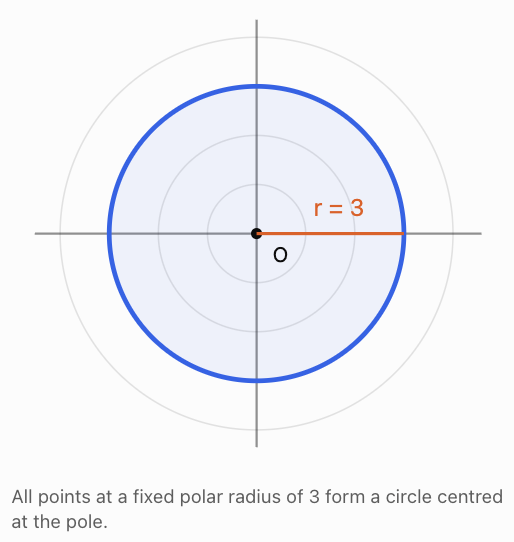 All points at a fixed polar radius of 3 form a circle centred at the pole.
In Cartesian form:
r² = x² + y²
Since r = 3:
x² + y² = 9
This confirms that the graph is a circle of radius 3.
Example 9: Graphing θ = 45°
Consider:
θ = 45°
The angle is fixed, but r can vary.
If r is restricted to nonnegative values, the graph is a ray extending from the pole at 45°.
If r can be any real number, negative radii extend the graph in the opposite direction, producing the complete line through the pole.
Its Cartesian equation is:
y = x
The important distinction is that the domain of r affects whether we obtain a ray or a full line.
Example 10: Graphing r = 4 cos θ
We can create a table.
θ
r = 4 cos θ
Cartesian point
0°
4
(4, 0)
60°
2
(1, √3)
90°
0
(0, 0)
120°
−2
(1, −√3)
180°
−4
(4, 0)
Notice that negative radii do not mean that the Cartesian x-coordinate must be negative.
At θ = 180°, r = −4 represents the point (4, 0).
To identify the curve, multiply by r:
r² = 4r cos θ
Substitute:
r² = x² + y²
r cos θ = x
Therefore:
x² + y² = 4x
Complete the square:
x² − 4x + y² = 0
(x − 2)² + y² = 4
The graph is a circle with centre (2, 0) and radius 2.
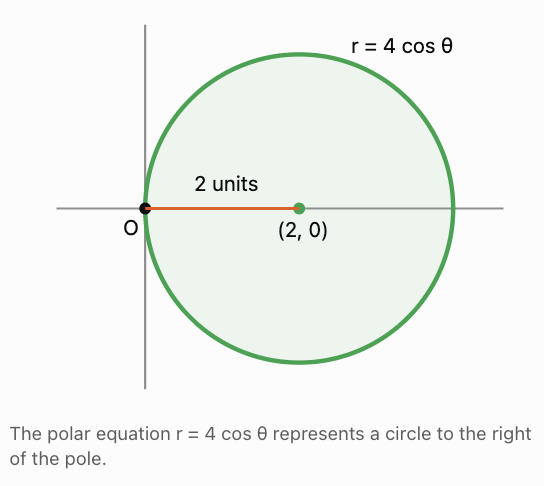
Example 11: Graphing r = 4 sin θ
Multiply by r:
r² = 4r sin θ
Substitute:
x² + y² = 4y
Rearrange:
x² + y² − 4y = 0
Complete the square:
x² + (y − 2)² = 4
This is a circle with:
-
Centre (0, 2).
-
Radius 2.
-
Tangency to the x-axis at the origin.
This provides a useful comparison:
-
r = 4 cos θ gives a circle to the right.
-
r = 4 sin θ gives a circle above the origin.
Example 12: Graphing a Cardioid
Consider:
r = 2(1 + cos θ)
A cardioid is a heart-shaped polar curve with a cusp.
Calculate some values.
θ
r
0°
4
60°
3
90°
2
120°
1
180°
0
240°
1
270°
2
300°
3
360°
4
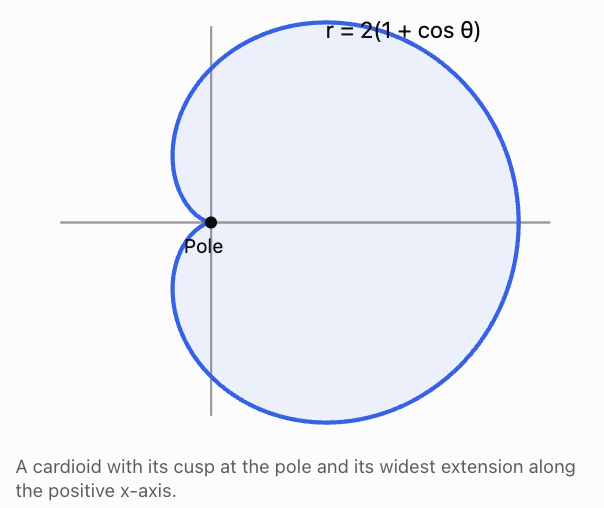
At θ = 0°, r reaches its maximum of 4.
At θ = 180°, r = 0, producing the cusp.
The graph is symmetric about the polar axis because replacing θ with −θ does not change cos θ.
Example 13: Rose Curves
Consider:
r = 3 cos(2θ)
This equation produces a four-petal rose curve.
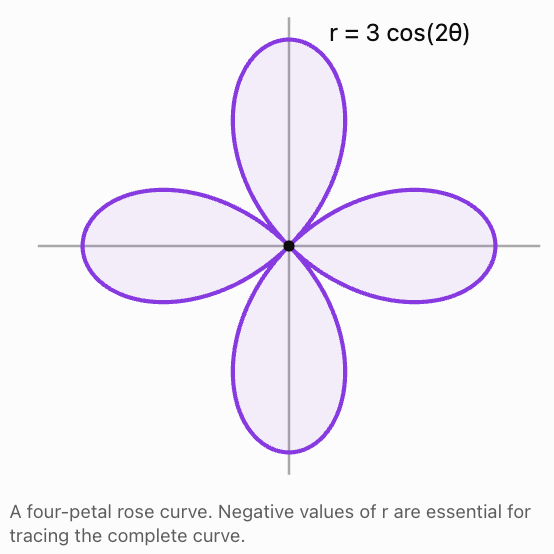
For equations of the form:
r = a cos(nθ)
or:
r = a sin(nθ)
where n is a positive integer:
-
If n is odd, the graph has n petals.
-
If n is even, the graph has 2n petals.
Each petal has maximum distance |a| from the pole.
Example 14: An Archimedean Spiral
Consider:
r = θ, for θ ≥ 0.
As θ increases, the distance from the pole also increases.
The point rotates while moving outward, creating a spiral.
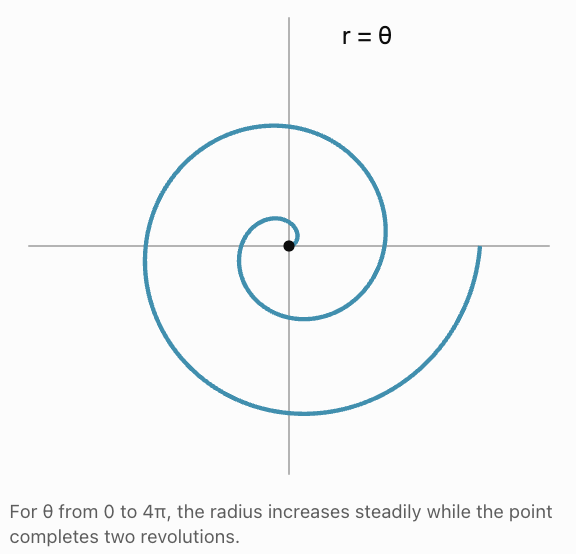
This type of curve is useful in geometric design and in describing idealized spiral motion.
Recognizing Polar Graphs
Polar equation
Typical graph
r = a, a > 0
Circle centred at pole
θ = α
Line through pole if all real r are allowed
r = a cos θ
Circle on horizontal axis
r = a sin θ
Circle on vertical axis
r = a(1 + cos θ)
Cardioid
r = a cos(nθ)
Rose curve
r = aθ
Archimedean spiral
The precise orientation and scale depend on the constants and signs.
Learning Target 4: Interpreting Parametric Equations
What Are Parametric Equations?
A parametric curve describes x and y separately using a third variable called a parameter.
The parameter is often represented by t.
A general parametric representation is:
x = f(t)
y = g(t)
As t changes, the point (x, y) moves along a curve.
The parameter may represent time, an angle, or another quantity.
Unlike an ordinary Cartesian equation, a parametric representation can describe not only the shape of a curve but also the direction in which it is traced.
Worked Example 15: A Straight-Line Path
Consider:
x = 2t + 1
y = 3t − 2
for 0 ≤ t ≤ 3.
Construct a table.
t
x
y
0
1
−2
1
3
1
2
5
4
3
7
7
The point moves from (1, −2) to (7, 7) along a straight line.
To find the Cartesian equation, eliminate t.
From:
x = 2t + 1
t = (x − 1)/2
Substitute into y:
y = 3(x − 1)/2 − 2
y = (3/2)x − 7/2
The Cartesian equation describes the line, while the parameter interval describes the specific segment and its direction of travel.
Worked Example 16: Parametric Equations of a Circle
Consider:
x = 5 cos t
y = 5 sin t
for 0 ≤ t ≤ 2π.
Square both equations:
x² = 25 cos² t
y² = 25 sin² t
Add:
x² + y² = 25(cos² t + sin² t)
Using the identity:
cos² t + sin² t = 1
we obtain:
x² + y² = 25
The curve is a circle of radius 5 centred at the origin.
At t = 0, the point is (5, 0).
At t = π/2, the point is (0, 5).
At t = π, the point is (−5, 0).
At t = 3π/2, the point is (0, −5).
The circle is traced anticlockwise as t increases.
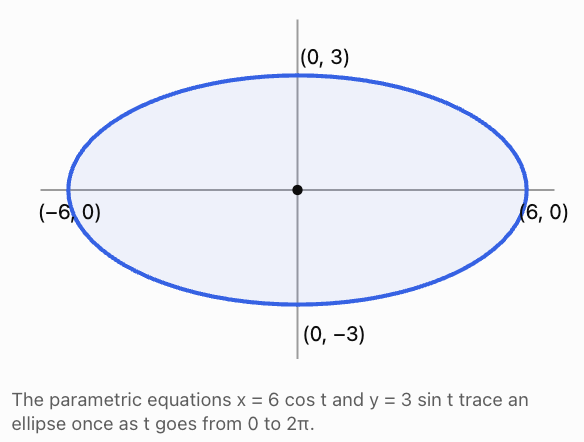
Worked Example 17: Parametric Equations of an Ellipse
Consider:
x = 6 cos t
y = 3 sin t
for 0 ≤ t ≤ 2π.
Divide and square:
x²/36 = cos² t
y²/9 = sin² t
Add:
x²/36 + y²/9 = 1
The curve is an ellipse centred at the origin.
Its horizontal semiaxis is 6 and its vertical semiaxis is 3.
Worked Example 18: Projectile Motion
Parametric equations are especially useful in physics because horizontal and vertical motion can be described separately.
Ignoring air resistance, a projectile launched from the origin at speed v₀ and angle α above the horizontal follows:
x(t) = v₀ cos α × t
y(t) = v₀ sin α × t − ½gt²
where:
-
v₀ is the initial speed.
-
α is the launch angle.
-
g is gravitational acceleration.
-
t is elapsed time.
Suppose a ball is launched at 20 m/s at an angle of 30°.
Take g = 9.8 m/s².
Horizontal motion:
x(t) = 20 cos 30° × t
x(t) = 10√3 t
Vertical motion:
y(t) = 20 sin 30° × t − 4.9t²
y(t) = 10t − 4.9t²
At t = 1 second:
x(1) ≈ 17.32 m
y(1) = 10 − 4.9 = 5.1 m
The ball is approximately 17.32 m horizontally from its starting point and 5.1 m above its launch height.
Interpreting the Parameter
A parametric representation gives more information than the shape of the curve alone.
It can describe:
-
Where a moving object begins.
-
The direction of motion.
-
The speed of motion.
-
Whether the path is traced once or repeatedly.
-
Which part of the curve is included.
For example:
x = cos t, y = sin t
and:
x = cos(2t), y = sin(2t)
describe the same unit circle.
However, over 0 ≤ t ≤ 2π, the first representation traces the circle once, while the second traces it twice.
If t represents time, the second point moves around the circle at twice the angular speed.
Learning Target 5: Connecting Multiple Coordinate Systems
Cartesian, polar, and parametric equations are different ways to represent the same geometric objects.
Understanding the connections allows us to choose the most useful representation for a particular problem.
Three Representations of a Circle
Consider a circle of radius 4 centred at the origin.
Cartesian form:
x² + y² = 16
Polar form:
r = 4
Parametric form:
x = 4 cos t
y = 4 sin t
for 0 ≤ t ≤ 2π.
All three describe the same circle.
However, each emphasizes different information.
-
Cartesian form expresses a relationship between x and y.
-
Polar form emphasizes constant distance from the origin.
-
Parametric form describes how a point travels around the circle.
Worked Example 19: Converting a Polar Equation to Cartesian Form
Convert:
r = 6 cos θ
Multiply by r:
r² = 6r cos θ
Substitute:
r² = x² + y²
r cos θ = x
Therefore:
x² + y² = 6x
Complete the square:
x² − 6x + y² = 0
(x − 3)² + y² = 9
Cartesian equation: (x − 3)² + y² = 9
The curve is a circle with centre (3, 0) and radius 3.
Worked Example 20: Converting Cartesian to Polar Form
Convert:
x² + y² = 8y
Use:
x² + y² = r²
y = r sin θ
Therefore:
r² = 8r sin θ
For r ≠ 0:
r = 8 sin θ
The pole r = 0 also satisfies both equations, so it is included in the curve.
Polar equation: r = 8 sin θ
The graph is a circle with centre (0, 4) and radius 4.
Worked Example 21: Connecting Polar and Parametric Equations
Consider the polar curve:
r = 2 + cos θ
We know:
x = r cos θ
y = r sin θ
Substitute the expression for r:
x = (2 + cos θ)cos θ
y = (2 + cos θ)sin θ
Let the parameter t = θ.
Then:
x(t) = (2 + cos t)cos t
y(t) = (2 + cos t)sin t
for 0 ≤ t ≤ 2π.
These parametric equations describe the same curve as the polar equation.
The curve is a limacon, with no inner loop because r remains positive.
Worked Example 22: Converting a Parametric Curve to Polar Form
Consider:
x = 3t cos t
y = 3t sin t
for t ≥ 0.
Calculate r:
r = √(x² + y²)
r = √(9t²cos²t + 9t²sin²t)
r = √(9t²)
Since t ≥ 0:
r = 3t
The angle of the point is:
θ = t, modulo 2π.
Using the continuous angle parameter θ = t:
r = 3θ, for θ ≥ 0.
This is an Archimedean spiral.
The parameter t describes both the rotation and the increasing distance from the origin.
Choosing the Most Useful Coordinate System
Situation
Useful representation
Reason
Straight lines and standard function graphs
Cartesian
Direct x-y relationships
Circular motion around a centre
Polar or parametric
Radius and angle are natural
Radar location
Polar
Distance and direction are measured
Projectile motion
Parametric
Coordinates change with time
Spiral curves
Polar
Radius depends on angle
Ellipses traced by moving points
Parametric
Easy to describe using sine and cosine
Intersections of algebraic curves
Cartesian
Algebraic methods are often convenient
No coordinate system is universally best.
The most effective representation depends on the geometry, the given information, and the purpose of the calculation.
Real-World Applications
Radar and Navigation
Radar systems often measure the distance and direction of an object relative to a fixed station.
These are naturally polar measurements.
For example, an aircraft located 50 km away at a standard polar angle of 35° has Cartesian coordinates:
x = 50 cos 35° ≈ 40.96 km
y = 50 sin 35° ≈ 28.68 km
The aircraft is approximately 40.96 km east and 28.68 km north of the station, assuming the positive axes represent east and north.
If the direction is instead given as a compass bearing, the angle convention must first be converted.
Computer Graphics and Animation
Parametric equations are widely used to animate moving objects.
A point moving around a circle may be represented by:
x(t) = 100 cos t
y(t) = 100 sin t
The point moves around a circle of radius 100 units.
Changing the coefficient of t changes the angular speed.
Robotics
A robot arm rotating around a fixed joint can be modelled using:
x = L cos θ
y = L sin θ
where L is the arm length.
For a 2 m arm rotated to 60°:
x = 2 cos 60° = 1 m
y = 2 sin 60° = √3 m
This allows engineers to calculate the position of the arm's endpoint.
Astronomy
Polar coordinates are useful for describing positions relative to a central body.
For example, the orbit of an object under an ideal inverse-square gravitational force can be expressed in polar form, with the central body at a focus:
r = p/(1 + e cos θ)
where p is a length parameter and e is eccentricity.
For 0 ≤ e < 1, this describes an ellipse; e = 0 gives a circle.
Physics and Engineering
Parametric equations can describe:
-
Projectile trajectories.
-
Circular and elliptical motion.
-
Oscillations.
-
Paths of moving machinery.
-
Fluid particle trajectories.
They are particularly useful when the horizontal and vertical coordinates depend on time.
Common Mistakes
Mistake 1: Measuring Polar Angles from North
Standard polar angles are measured from the positive x-axis, usually anticlockwise.
Compass bearings use a different convention.
Mistake 2: Assuming Polar Coordinates Are Unique
A point may have infinitely many polar representations.
For example:
(3, 45°) and (3, 405°) represent the same point.
Mistake 3: Ignoring Negative Radii
A negative radius reverses the direction of the point.
For example:
(−5, 30°) = (5, 210°)
Mistake 4: Using the Wrong Quadrant
When converting Cartesian coordinates to polar form, inverse tangent alone may not give the correct angle.
Always examine the signs of x and y.
Mistake 5: Confusing x = r cos θ and y = r sin θ
Cosine gives the horizontal component.
Sine gives the vertical component.
Mistake 6: Forgetting the Parameter Interval
Parametric equations may describe only part of a curve.
For example:
x = cos t, y = sin t, 0 ≤ t ≤ π
traces the upper semicircle, not the full circle.
Mistake 7: Ignoring the Direction of a Parametric Curve
The parameter determines how the curve is traced.
Two parameterizations may have the same geometric graph but opposite directions.
Mistake 8: Losing Points When Dividing by r
When converting polar equations, dividing by r may exclude the pole.
Always check separately whether r = 0 satisfies the original equation.
Mistake 9: Using Degrees in a Radian-Based Formula
Most calculus and parametric formulas use radians.
Check the angle units before calculating.
Mistake 10: Assuming Every Curve Is a Function y = f(x)
A circle cannot be represented by one single-valued function y = f(x) over its full horizontal extent.
Polar and parametric representations can describe such curves naturally.
Key Terms
-
Cartesian coordinates: Coordinates (x, y) describing horizontal and vertical position.
-
Polar coordinates: Coordinates (r, θ) describing directed distance and angle.
-
Pole: The origin of the polar coordinate system.
-
Polar axis: The reference direction from which polar angles are measured.
-
Radius: The directed distance r used in polar coordinates.
-
Polar angle: The angular coordinate θ.
-
Reference angle: An acute angle used to determine trigonometric values and coordinate quadrants.
-
Quadrant: One of the four regions formed by the Cartesian axes.
-
Polar equation: An equation relating r and θ.
-
Parametric equation: An equation expressing a coordinate in terms of a parameter.
-
Parameter: A variable used to describe points on a curve.
-
Parameterization: A representation of a curve using one or more parameter-dependent coordinates.
-
Circle: The set of points at a fixed distance from a centre.
-
Ellipse: A closed curve characterized by two focal points.
-
Cardioid: A heart-shaped polar curve with a cusp.
-
Limacon: A family of polar curves that may have an inner loop, dimple, or convex shape.
-
Rose curve: A polar curve with petal-like loops.
-
Archimedean spiral: A spiral whose radius changes linearly with its angle.
-
Coordinate transformation: A conversion between coordinate systems.
-
Eliminating a parameter: Rewriting parametric equations as a direct relationship between x and y.
-
Trajectory: The path followed by a moving object.
-
Angular speed: The rate of change of angle with respect to time.
Key Takeaways
-
Polar coordinates describe a point using a directed radius and an angle.
-
The standard polar angle is measured anticlockwise from the positive x-axis.
-
Polar coordinates are not unique.
-
The conversion formulas are x = r cos θ and y = r sin θ.
-
For the usual nonnegative-radius representation, r = √(x² + y²).
-
The angle must be selected using the correct quadrant.
-
Polar equations can represent circles, cardioids, rose curves, and spirals.
-
Parametric equations describe x and y using a common parameter.
-
The parameter can describe motion, direction, speed, and the portion of a curve traced.
-
Cartesian, polar, and parametric forms can represent the same geometric curve.
-
Choosing an appropriate coordinate system can simplify mathematical problems.
-
These coordinate systems are important in navigation, physics, engineering, robotics, and computer graphics.
Check Your Understanding
Part A: Polar Coordinates
Question 1
Explain the meaning of each polar coordinate pair.
a) (5, 30°)
b) (4, 135°)
c) (−3, 60°)
Question 2
Write two other polar representations of the point (6, 45°).
Part B: Coordinate Conversion
Question 3
Convert the following polar coordinates into Cartesian coordinates.
a) (4, 60°)
b) (6, 180°)
c) (8, 225°)
Question 4
Convert the following Cartesian coordinates into polar coordinates with r ≥ 0 and 0° ≤ θ < 360°.
a) (3, 3)
b) (−5, 0)
c) (−4, −4)
Part C: Polar Graphs
Question 5
Describe the graph of:
r = 5
Question 6
Convert the following polar equation into Cartesian form and identify the curve.
r = 6 cos θ
Question 7
Explain why:
r = 2(1 + cos θ)
has a cusp at the pole.
Part D: Parametric Equations
Question 8
Given:
x = 3t + 2
y = 2t − 1
a) Find the point when t = 4.
b) Eliminate t to obtain a Cartesian equation.
Question 9
Consider:
x = 4 cos t
y = 4 sin t
for 0 ≤ t ≤ 2π.
a) Identify the curve.
b) State its radius.
c) Describe its direction of travel.
Question 10
Given:
x = 5 cos t
y = 2 sin t
eliminate the parameter and identify the curve.
Part E: Connecting Coordinate Systems
Question 11
Convert the Cartesian equation:
x² + y² = 10x
into polar form.
Question 12
A point moves according to:
x = 2t cos t
y = 2t sin t
for t ≥ 0.
a) Find its polar radius.
b) Describe its angle.
c) Identify the resulting curve.
Check Your Understanding — Fully Worked Answers
Answer 1
a) (5, 30°)
Move 5 units from the pole at an angle of 30° anticlockwise from the positive x-axis.
b) (4, 135°)
Move 4 units from the pole in the direction 135°, placing the point in Quadrant II.
c) (−3, 60°)
The negative radius means moving 3 units opposite the direction 60°.
Equivalent positive-radius coordinates:
(3, 240°)
Answer 2
Adding 360°:
(6, 45° + 360°) = (6, 405°)
Using a negative radius:
(−6, 45° + 180°) = (−6, 225°)
Answers: (6, 405°) and (−6, 225°)
Answer 3
a) (4, 60°)
x = 4 cos 60° = 2
y = 4 sin 60° = 2√3
Answer: (2, 2√3)
b) (6, 180°)
x = 6 cos 180° = −6
y = 6 sin 180° = 0
Answer: (−6, 0)
c) (8, 225°)
x = 8 cos 225° = −4√2
y = 8 sin 225° = −4√2
Answer: (−4√2, −4√2)
Answer 4
a) (3, 3)
r = √(9 + 9) = 3√2
θ = 45°
Answer: (3√2, 45°)
b) (−5, 0)
r = 5
The point lies on the negative x-axis.
θ = 180°
Answer: (5, 180°)
c) (−4, −4)
r = √(16 + 16) = 4√2
The reference angle is 45°.
The point is in Quadrant III.
θ = 225°
Answer: (4√2, 225°)
Answer 5
The equation r = 5 represents all points at a distance of 5 units from the pole.
The graph is a circle of radius 5 centred at the origin.
Its Cartesian equation is:
x² + y² = 25
Answer 6
Given:
r = 6 cos θ
Multiply by r:
r² = 6r cos θ
Substitute:
x² + y² = 6x
Complete the square:
x² − 6x + y² = 0
(x − 3)² + y² = 9
This is a circle with centre (3, 0) and radius 3.
Answer 7
Given:
r = 2(1 + cos θ)
At θ = 180°:
cos 180° = −1
Therefore:
r = 2(1 − 1) = 0
The curve reaches the pole at θ = 180°.
The two branches meet there, producing a cusp.
Answer 8
Given:
x = 3t + 2
y = 2t − 1
a) At t = 4
x = 3(4) + 2 = 14
y = 2(4) − 1 = 7
Answer: (14, 7)
b) Eliminate t
From x = 3t + 2:
t = (x − 2)/3
Substitute into y:
y = 2(x − 2)/3 − 1
y = (2x − 4)/3 − 1
y = (2x − 7)/3
Answer 9
Given:
x = 4 cos t
y = 4 sin t
Square and add:
x² + y² = 16(cos²t + sin²t)
x² + y² = 16
a) The curve is a circle centred at the origin.
b) Radius = 4 units.
c) The circle is traced anticlockwise as t increases from 0 to 2π, starting at (4, 0).
Answer 10
Given:
x = 5 cos t
y = 2 sin t
Divide:
x/5 = cos t
y/2 = sin t
Square and add:
x²/25 + y²/4 = cos²t + sin²t
x²/25 + y²/4 = 1
The curve is an ellipse centred at the origin with horizontal semiaxis 5 and vertical semiaxis 2.
Answer 11
Given:
x² + y² = 10x
Substitute:
x² + y² = r²
x = r cos θ
Therefore:
r² = 10r cos θ
For r ≠ 0:
r = 10 cos θ
The pole is also included.
Answer: r = 10 cos θ
Answer 12
Given:
x = 2t cos t
y = 2t sin t
for t ≥ 0.
a) Calculate the radius.
r = √(x² + y²)
r = √(4t²cos²t + 4t²sin²t)
r = √(4t²)
Since t ≥ 0:
r = 2t
b) Determine the angle.
The polar angle is t modulo 2π.
Using a continuous angle:
θ = t
c) Identify the curve.
Substitute t = θ:
r = 2θ
The curve is an Archimedean spiral.
Final Integrated Challenge: Designing a Robotic Tracking System
A robot moves around a central observation station.
Its distance from the station depends on its angle according to:
r = 4 + 2 cos θ
where r is measured in metres and 0 ≤ θ ≤ 2π.
Tasks
-
Explain what the polar equation represents.
-
Determine the maximum and minimum distances from the station.
-
Calculate the robot's Cartesian coordinates at θ = 0, π/2, π, and 3π/2.
-
Write parametric equations for its motion.
-
Explain why this curve is easier to represent in polar coordinates than in Cartesian coordinates.
-
Evaluate whether the model describes constant-speed motion.
Fully Worked Solution
Step 1: Interpret the polar equation.
The robot's distance from the observation station changes according to its angular position.
The radius is:
r = 4 + 2 cos θ
Since cos θ varies between −1 and 1:
2 ≤ r ≤ 6
The robot follows a closed limacon-shaped path without an inner loop.
Step 2: Find the maximum distance.
The maximum occurs when cos θ = 1.
r(max) = 4 + 2(1)
Maximum distance = 6 m
Step 3: Find the minimum distance.
The minimum occurs when cos θ = −1.
r(min) = 4 + 2(−1)
Minimum distance = 2 m
Step 4: Calculate Cartesian coordinates.
Use:
x = r cos θ
y = r sin θ
θ
r
x
y
0
6
6
0
π/2
4
0
4
π
2
−2
0
3π/2
4
0
−4
These points show that the curve extends farther to the right than to the left.
Step 5: Construct parametric equations.
Let t = θ.
Then:
r = 4 + 2 cos t
Substitute into the coordinate conversion formulas:
x(t) = (4 + 2 cos t)cos t
y(t) = (4 + 2 cos t)sin t
for 0 ≤ t ≤ 2π.
Step 6: Compare coordinate systems.
The polar equation is compact:
r = 4 + 2 cos θ
The parametric representation requires two equations.
A Cartesian equation can also be derived, but it is more complicated.
Using:
r = √(x² + y²)
cos θ = x/r
we obtain:
r = 4 + 2x/r
Multiply by r:
r² = 4r + 2x
Therefore:
x² + y² = 4√(x² + y²) + 2x
This implicit Cartesian equation represents the same curve, but the polar form is easier to interpret.
Step 7: Evaluate the motion.
The parametric equations describe the path and the direction in which it is traced.
However, the model does not automatically imply constant speed.
If t represents time and θ = t, then angular speed is constant, but the radius changes.
The speed depends on both the radial change and angular motion.
For r = 4 + 2 cos t:
dr/dt = −2 sin t
With dθ/dt = 1 rad/s, speed is:
v = √[(dr/dt)² + (r dθ/dt)²]
v = √[4 sin²t + (4 + 2 cos t)²]
This expression changes with t.
Therefore, the robot does not move at constant speed under this time parameterization.
Final Challenge Summary
Property
Result
Polar equation
r = 4 + 2 cos θ
Curve type
Limacon without inner loop
Maximum radius
6 m
Minimum radius
2 m
Rightmost point
(6, 0)
Leftmost point
(−2, 0)
Upper-axis point
(0, 4)
Lower-axis point
(0, −4)
Constant speed when θ = t?
No
Conclusion
Polar coordinates and parametric curves extend coordinate geometry beyond the familiar Cartesian system.
Polar coordinates describe locations using distance and direction, making them especially useful for circular motion, radar tracking, spirals, and other rotational patterns.
The conversion formulas allow us to move between polar and Cartesian representations, while careful attention to quadrants and negative radii ensures that coordinates are interpreted correctly.
Polar equations provide elegant descriptions of circles, cardioids, rose curves, and spirals.
Parametric equations offer another powerful perspective by expressing x and y in terms of a shared parameter. This makes it possible to describe not only the shape of a curve but also how a point moves along it.
By connecting Cartesian, polar, and parametric systems, we gain flexibility in solving mathematical problems and modelling physical situations.
The most important skill is recognizing which coordinate system best represents the geometry or motion being studied, and understanding how to translate between different representations of the same mathematical relationship.
-