Non-Right Triangles
5. Applications of Non-Right Triangles
Learning outcomes
- I can model real-world situations using oblique triangles.
- I can select appropriate solution methods.
- I can solve engineering and surveying problems.
- I can communicate mathematical reasoning clearly.
- I can evaluate the reasonableness of solutions.
Introduction
Imagine an engineer designing a bridge across a deep valley. The engineer needs to determine the distance between two support points, but the terrain makes direct measurement impossible.
Or consider a surveyor measuring a triangular piece of land, a pilot calculating the separation between two aircraft, or an architect designing an angled roof structure.
These situations often involve triangles that do not contain a right angle.
Such triangles are called non-right triangles, or oblique triangles.
Unlike right triangles, where the Pythagorean theorem and basic trigonometric ratios are often sufficient, oblique triangles usually require more advanced techniques.
Two particularly important tools are the Law of Sines and the Law of Cosines.
By combining these relationships with geometric reasoning, bearings, area formulas, and mathematical modelling, we can solve many practical measurement problems.
In this lesson, we will learn how to model real-world situations using oblique triangles, select efficient solution methods, solve engineering and surveying problems, communicate mathematical reasoning clearly, and evaluate whether our solutions are reasonable.
Understanding Oblique Triangles
An oblique triangle is any triangle that does not contain a 90° angle.
There are two main types.
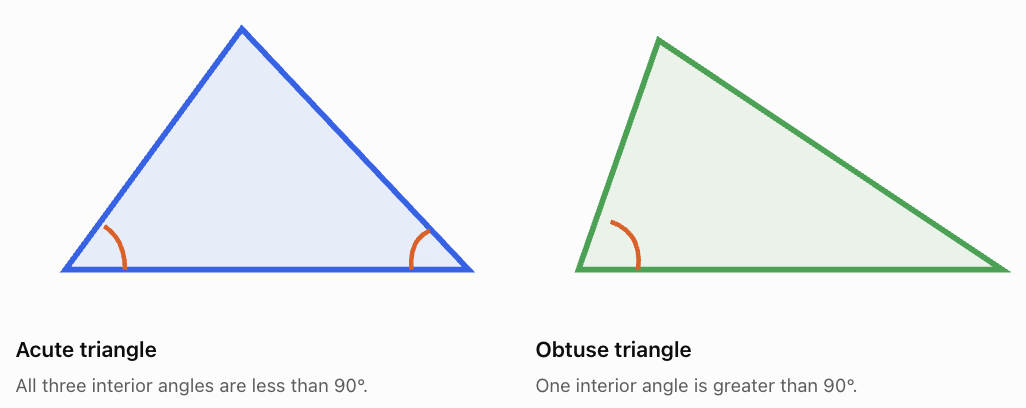
(The second triangle is not shown as obtuse as it should be!)
Every triangle has three sides and three interior angles.
Using standard notation:
-
A, B, and C represent the angles.
-
a is the side opposite angle A.
-
b is the side opposite angle B.
-
c is the side opposite angle C.
The interior angles always satisfy:
A + B + C = 180°
The longest side is opposite the largest angle, while the shortest side is opposite the smallest angle.
These relationships are essential when solving and checking practical problems.
Mathematical Tools for Oblique Triangles
Several formulas form the foundation of non-right triangle applications.
The Law of Sines
a / sin A = b / sin B = c / sin C
This is especially useful when we know an angle and its opposite side, such as in ASA, AAS, or SSA problems.
The Law of Cosines
a² = b² + c² − 2bc cos A
Equivalent forms:
b² = a² + c² − 2ac cos B
c² = a² + b² − 2ab cos C
This is especially useful for SAS and SSS problems.
The Trigonometric Area Formula
Area = ½ab sin C
Equivalent forms:
Area = ½bc sin A
Area = ½ac sin B
This formula is useful when two sides and their included angle are known.
Heron's Formula
When all three sides are known:
s = (a + b + c) / 2
Area = √[s(s − a)(s − b)(s − c)]
Here, s represents the semiperimeter.
These formulas can be used individually or combined to solve more complex problems.
Learning Target 1: Modelling Real-World Situations Using Oblique Triangles
Mathematical modelling is the process of representing a real-world situation using mathematical relationships.
In oblique triangle problems, modelling usually involves identifying three important locations or points and connecting them to form a triangle.
The Mathematical Modelling Process
-
Identify the physical situation and the quantity to be determined.
-
Draw a simplified geometric diagram.
-
Label known sides, angles, and directions.
-
Identify unknown measurements.
-
State any necessary assumptions.
-
Select appropriate mathematical relationships.
-
Calculate the unknown values.
-
Interpret and evaluate the results.
Example 1: Modelling a River Crossing
A surveyor wants to calculate the distance between two points on opposite sides of a river.
The surveyor identifies three locations:
-
A: a measuring station on the near bank.
-
B: a second station 120 m along the bank.
-
C: a tree on the opposite bank.
The surveyor measures:
-
AB = 120 m
-
Angle A = 50°
-
Angle B = 65°
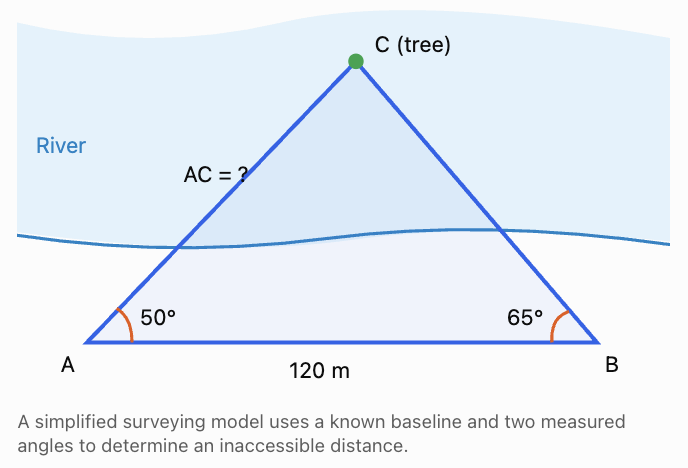
The real situation becomes a triangle with one known side and two known angles.
This is an ASA problem.
Step 1: Find angle C.
C = 180° − 50° − 65°
C = 65°
Step 2: Apply the Law of Sines.
AC / sin 65° = 120 / sin 65°
AC = 120 m
Interpretation: The straight-line distance from A to the tree is 120 m.
However, this is not necessarily the perpendicular width of the river.
If the riverbank is represented by the line AB, the perpendicular distance from C to AB is:
h = AC sin 50°
h = 120 sin 50°
h ≈ 91.93 m
The model provides two different measurements, depending on what the surveyor needs.
Assumptions in the Model
The model assumes that:
-
The three observation points are fixed.
-
The baseline is measured accurately.
-
The angles are measured in the same horizontal plane.
-
The local region can be treated as flat.
-
Measurement uncertainty is small enough for the required accuracy.
In real surveying, slopes and instrument errors may need to be considered.
Example 2: Modelling Two Roads
Two straight roads leave a junction.
One road extends 8 km to town A.
The second road extends 12 km to town B.
The angle between the roads is 65°.
The distance between the towns is the third side of the triangle.
Since we know two sides and the included angle, the model is SAS.
Using the Law of Cosines:
AB² = 8² + 12² − 2(8)(12)cos 65°
AB² ≈ 140.86
AB ≈ 11.87 km
The model assumes that the roads and the connecting distance can be represented by straight lines on a flat map.
The straight-line distance is not necessarily the distance a vehicle would travel along existing roads.
Learning Target 2: Selecting Appropriate Solution Methods
One of the most important mathematical skills is deciding which method to use before beginning a calculation.
A problem may involve the Law of Sines, Law of Cosines, triangle area formulas, right-triangle trigonometry, or a combination of methods.
The most efficient method depends on the available information and the quantity being calculated.
Identifying the Given Information
Given measurements
Triangle type
Recommended method
Two angles and included side
ASA
Law of Sines
Two angles and non-included side
AAS
Law of Sines
Two sides and non-included angle
SSA
Law of Sines; check ambiguity
Two sides and included angle
SAS
Law of Cosines
Three sides
SSS
Law of Cosines
Two sides and included angle, finding area
SAS
Sine area formula
Three sides, finding area
SSS
Heron's formula
A Problem-Solving Decision Guide
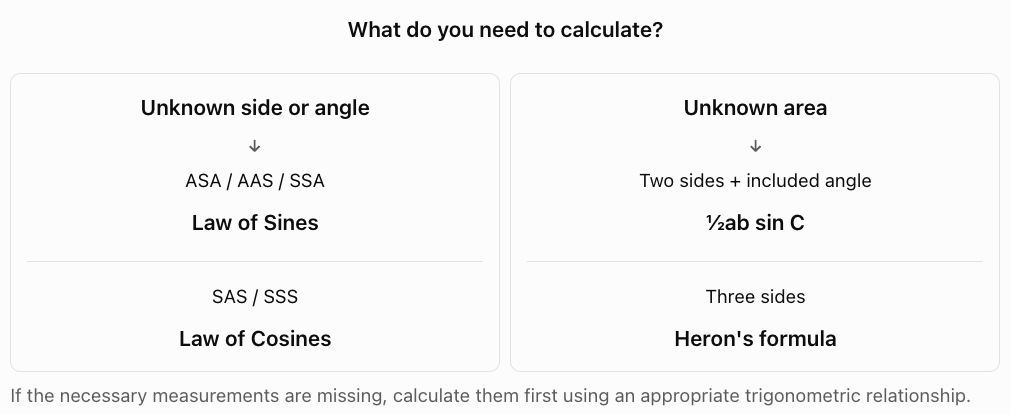
Worked Example 3: Choosing Between the Laws
An engineer knows that two support beams are 7 m and 10 m long. The angle between them is 115°.
Find the distance between their endpoints.
Step 1: Identify the information.
Two sides and their included angle are known.
This is SAS.
Step 2: Choose the Law of Cosines.
d² = 7² + 10² − 2(7)(10)cos 115°
d² = 149 − 140 cos 115°
d² ≈ 208.17
d ≈ 14.43 m
The Law of Sines would not be the best first choice because no complete opposite side-angle pair is known.
Worked Example 4: Finding an Unknown Angle
A triangular steel frame has side lengths:
a = 6 m, b = 9 m, c = 11 m
Calculate angle C.
Because all three sides are known, use the Law of Cosines.
cos C = (a² + b² − c²) / (2ab)
cos C = (36 + 81 − 121) / 108
cos C = −4/108
C = cos⁻¹(−4/108)
C ≈ 92.12°
The result is reasonable because the longest side, c, is opposite the largest angle, C.
Worked Example 5: Choosing a Method for Area
A triangular property has side lengths of 13 m, 14 m, and 15 m.
Calculate its area.
We know all three sides, so Heron's formula is the most direct method.
s = (13 + 14 + 15)/2 = 21 m
Area = √[21(21−13)(21−14)(21−15)]
Area = √7056
Area = 84 m²
Using the Law of Cosines to find an angle and then applying the sine area formula would also work, but it would require more calculations.
When Multiple Methods Are Needed
Some practical problems require more than one formula.
For example, suppose we know two angles and one side, but need to calculate the area.
We might:
-
Use the triangle angle sum to find the third angle.
-
Use the Law of Sines to find another side.
-
Use the sine area formula to calculate the area.
Choosing the correct sequence is part of mathematical problem-solving.
Learning Target 3: Solving Engineering and Surveying Problems
Oblique triangles are widely used in engineering and surveying because many structures and measurement networks contain angled sides.
Application 1: Engineering a Triangular Bridge Support
A bridge engineer designs a triangular steel support.
Two beams have lengths of 8 m and 11 m, with an included angle of 75°.
Calculate the length of the connecting beam.
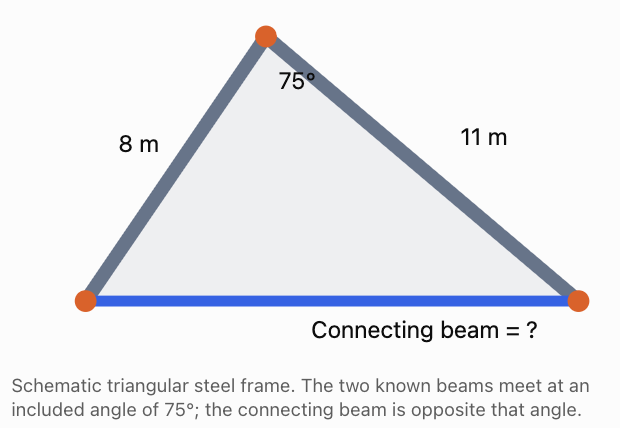
Step 1: Apply the Law of Cosines.
c² = 8² + 11² − 2(8)(11)cos 75°
c² = 64 + 121 − 176 cos 75°
c² ≈ 139.45
c ≈ 11.81 m
Step 2: Interpret the result.
The connecting beam must span approximately 11.81 m between the two endpoints.
In practice, the required manufactured length would also depend on the connection details and construction tolerances.
Application 2: Measuring the Distance Between Two Towers
A surveyor stands at point P.
-
Tower A is 180 m from P.
-
Tower B is 240 m from P.
-
The angle between the directions to the towers is 68°.
Find the distance between the towers.
Using the Law of Cosines:
AB² = 180² + 240² − 2(180)(240)cos 68°
AB² = 32,400 + 57,600 − 86,400 cos 68°
AB² ≈ 57,634
AB ≈ 240.07 m
The two towers are approximately 240.07 m apart in a straight line.
This is an example of indirect measurement, where a distance can be calculated without physically travelling between the objects.
Application 3: Calculating the Area of a Triangular Construction Site
A construction site has two boundaries measuring 75 m and 110 m.
The angle between them is 58°.
Calculate the area of the site.
Area = ½ab sin C
Area = ½ × 75 × 110 × sin 58°
Area = 4125 sin 58°
Area ≈ 3498.20 m²
If landscaping costs $18 per square metre:
Cost = 3498.198... × 18
Cost ≈ $62,967.57
This estimate excludes additional expenses such as site preparation, drainage, and material waste.
Application 4: A Triangular Roof Structure
A roof truss forms a triangle with side lengths:
-
5 m
-
7 m
-
9 m
Calculate its largest interior angle and enclosed area.
Step 1: Calculate the largest angle.
The largest angle is opposite the 9 m side.
cos C = (5² + 7² − 9²)/(2 × 5 × 7)
cos C = (25 + 49 − 81)/70
cos C = −7/70 = −0.1
C = cos⁻¹(−0.1)
C ≈ 95.74°
Step 2: Calculate the area.
Area = ½ × 5 × 7 × sin C
Area = 17.5 sin 95.74°
Area ≈ 17.41 m²
Step 3: Interpret.
The triangle is obtuse, and its enclosed area is approximately 17.41 m².
For an actual roof, this geometric calculation alone would not determine the structural strength or required beam sizes. Those decisions also require load and material analysis.
Application 5: Surveying Across a Valley
Two observation stations A and B are 250 m apart.
They observe a landmark C across a valley.
The measured interior angles are:
A = 42°
B = 73°
Find the distances from both stations to the landmark.
Step 1: Find angle C.
C = 180° − 42° − 73°
C = 65°
Step 2: Find AC.
AC/sin 73° = 250/sin 65°
AC = 250 sin 73°/sin 65°
AC ≈ 263.79 m
Step 3: Find BC.
BC/sin 42° = 250/sin 65°
BC = 250 sin 42°/sin 65°
BC ≈ 184.58 m
The landmark is farther from A than from B.
This agrees with the angle-side relationship: AC is opposite the larger angle of 73°.
Learning Target 4: Communicating Mathematical Reasoning Clearly
A mathematical answer should explain not only what the result is, but also how and why it was obtained.
In engineering and surveying, clear communication is particularly important because calculations may be used by other people to make practical decisions.
The Structure of a Complete Mathematical Solution
A well-communicated solution normally includes:
-
Define the problem. Identify the required measurement.
-
Represent the situation. Draw a labelled diagram and state known information.
-
Choose a method. Explain why the formula is appropriate.
-
Show calculations. Substitute values and demonstrate the mathematical steps.
-
State the result. Include appropriate units and rounding.
-
Interpret and verify. Explain what the answer means and why it is reasonable.
Worked Example 6: A Complete Engineering Explanation
Two support cables extend from a common attachment point.
-
Cable A is 12 m long.
-
Cable B is 16 m long.
-
The angle between them is 70°.
Calculate the distance between the free ends.
Define the unknown.
Let d represent the straight-line distance between the free ends of the cables.
Select the method.
The two cable lengths and their included angle are known. Therefore, the Law of Cosines is appropriate.
Calculate.
d² = 12² + 16² − 2(12)(16)cos 70°
d² = 144 + 256 − 384 cos 70°
d² ≈ 268.66
d ≈ 16.39 m
Interpret.
The free ends of the cables are approximately 16.39 m apart.
Verify.
The triangle inequality requires:
|16 − 12| < d < 16 + 12
4 < 16.39 < 28
The answer satisfies this requirement.
This solution is stronger than simply writing "16.39 m" because the mathematical reasoning is visible and can be checked.
Explaining Why a Formula Is Appropriate
Compare the following explanations.
Incomplete explanation:
"I used the Law of Cosines because it is a triangle."
Complete explanation:
"The Law of Cosines is appropriate because two side lengths and the included angle are known. This is an SAS problem, and the unknown measurement is the side opposite the included angle."
The second explanation identifies the mathematical structure of the problem.
Communicating Assumptions
Real-world models often simplify complicated situations.
For example, a surveyor might assume that:
-
The observation points lie in the same horizontal plane.
-
The measured baseline is straight.
-
The terrain does not affect the horizontal distances.
-
The angles are measured accurately.
These assumptions should be stated when they influence the reliability of the result.
Communicating Precision
Suppose a calculator produces:
d = 18.4376295 m
If the input measurements are given only to the nearest metre, reporting d = 18.4376295 m suggests unrealistic precision.
A more appropriate result might be:
d ≈ 18.4 m
The rounding should reflect the precision of the measurements and the requirements of the problem.
For multi-step calculations, keep unrounded values internally and round only the final result.
Learning Target 5: Evaluating the Reasonableness of Solutions
Mathematical calculations can produce incorrect answers if we use the wrong formula, misinterpret an angle, or enter values incorrectly.
Reasonableness checks help us identify these errors.
Check 1: The Triangle Inequality
For a triangle with sides a, b, and c:
a + b > c
a + c > b
b + c > a
Suppose a triangle has two sides of 7 m and 12 m.
The third side must satisfy:
|12 − 7| < c < 12 + 7
5 < c < 19
Any calculated third side outside this interval is impossible.
Check 2: Compare Angles and Opposite Sides
The largest angle must be opposite the longest side.
For example:
Angle
Opposite side
35°
a
60°
b
85°
c
The sides must satisfy:
a < b < c
This checks the ordering of the measurements, although it does not establish their exact numerical correctness.
Check 3: Check the Angle Sum
Every triangle must satisfy:
A + B + C = 180°
If calculated angles are:
A = 42.5°
B = 68.3°
C = 69.2°
Then:
42.5° + 68.3° + 69.2° = 180°
The angles pass the angle-sum check.
Check 4: Check Maximum Possible Area
For two fixed sides a and b:
Area = ½ab sin C
Since sin C cannot exceed 1:
Area ≤ ½ab
For two sides measuring 8 m and 12 m:
Maximum area = ½ × 8 × 12
Maximum area = 48 m²
A calculated area of 60 m² would be impossible.
Check 5: Verify with Another Method
Consider a triangle with sides:
a = 6 cm, b = 8 cm, c = 10 cm
Using the Pythagorean theorem:
6² + 8² = 10²
36 + 64 = 100
The triangle is right-angled.
Area = ½ × 6 × 8 = 24 cm²
We can also verify using Heron's formula.
s = (6 + 8 + 10)/2 = 12
Area = √[12(12−6)(12−8)(12−10)]
Area = √(12 × 6 × 4 × 2)
Area = √576
Area = 24 cm²
Both methods agree.
Check 6: Evaluate the Physical Context
Suppose an engineer calculates that two attachment points are 18 m apart, but the available connecting beam is only 12 m long.
The mathematical result may be correct, but the proposed design is not feasible without changing the structure or material.
Similarly, a surveying calculation may give a valid horizontal distance, but a construction project might require the actual sloping distance across uneven terrain.
A good mathematical model must answer the correct physical question.
Worked Example 7: Identifying an Incorrect Result
A student is given:
a = 9 cm, b = 13 cm, C = 40°
The student calculates:
c = 21 cm
Is the result reasonable?
Step 1: Check the triangle inequality.
|13 − 9| < c < 13 + 9
4 < c < 22
The student's answer passes this check, but this alone does not prove it is correct.
Step 2: Check the included angle.
C = 40° is acute.
The opposite side c should be relatively short compared with the length it would have if the included angle were 90°.
Step 3: Recalculate.
c² = 9² + 13² − 2(9)(13)cos 40°
c² = 250 − 234 cos 40°
c² ≈ 70.75
c ≈ 8.41 cm
The student's result of 21 cm is incorrect.
This example shows why multiple checks are valuable. A result can satisfy the triangle inequality and still be wrong.
Combining Multiple Oblique Triangles
Some real-world situations involve several connected triangles.
For example, a surveyor may establish a network of observation points to determine the location of a distant landmark.
Worked Example 8: Two Connected Surveying Triangles
A surveyor measures a straight baseline AC consisting of two segments:
-
AB = 100 m
-
BC = 150 m
Points A, B, and C lie on the same straight line, with B between A and C.
A landmark D is observed from A and C.
The measured angles are:
-
Angle DAC = 40°
-
Angle ACD = 65°
Calculate the distance BD.
Step 1: Calculate the full baseline.
AC = AB + BC
AC = 100 + 150
AC = 250 m
Step 2: Find angle ADC.
Angle ADC = 180° − 40° − 65°
Angle ADC = 75°
Step 3: Calculate AD using the Law of Sines.
AD/sin 65° = 250/sin 75°
AD = 250 sin 65°/sin 75°
AD ≈ 234.57 m
Step 4: Consider triangle ABD.
Since B lies on AC:
Angle DAB = 40°
We know:
AB = 100 m
AD ≈ 234.57 m
Angle DAB = 40°
Use the Law of Cosines:
BD² = 100² + AD² − 2(100)(AD)cos 40°
Substituting the unrounded value of AD:
BD ≈ 171.98 m
Interpretation:
The landmark is approximately 171.98 m from observation point B.
This solution required two connected triangles and two different trigonometric laws.
Common Mistakes
Mistake 1: Choosing a Formula Before Identifying the Given Information
Students sometimes select the Law of Sines or Law of Cosines without checking whether the available measurements match the formula.
Correction: Identify ASA, AAS, SSA, SAS, or SSS first.
Mistake 2: Using the Wrong Included Angle
In the Law of Cosines, the angle must be between the two known sides.
Correction: Draw and label the triangle carefully.
Mistake 3: Ignoring the SSA Ambiguous Case
When two sides and a non-included angle are known, zero, one, or two triangles may be possible.
Correction: Check whether the supplementary angle also gives a valid triangle.
Mistake 4: Confusing Direct Distance with Horizontal Distance
A sloping distance across a valley is not necessarily the same as the horizontal separation.
Correction: Identify which distance the practical problem requires.
Mistake 5: Using Incorrect Units
If side lengths are measured in metres, the area must be expressed in square metres.
Correction: Include units throughout the solution.
Mistake 6: Rounding Too Early
Intermediate rounding can introduce errors into later calculations.
Correction: Retain full precision until the final result.
Mistake 7: Accepting an Answer Without Verification
A calculator can produce a numerical result even when the wrong formula or angle has been used.
Correction: Check angle sums, side relationships, and physical reasonableness.
Mistake 8: Ignoring the Assumptions of the Model
A flat triangle model may not represent a large or uneven landscape accurately.
Correction: State assumptions and recognize the limitations of the mathematical model.
Key Terms
-
Oblique triangle: A triangle that does not contain a right angle.
-
Acute triangle: A triangle with three angles smaller than 90°.
-
Obtuse triangle: A triangle containing one angle greater than 90°.
-
Law of Sines: A relationship between side lengths and the sines of their opposite angles.
-
Law of Cosines: A relationship connecting three sides and an included angle.
-
Included angle: The angle between two specified sides.
-
Opposite side: The side directly across from an angle.
-
ASA: Angle-Side-Angle; two angles and the included side are known.
-
AAS: Angle-Angle-Side; two angles and a non-included side are known.
-
SSA: Side-Side-Angle; two sides and a non-included angle are known.
-
SAS: Side-Angle-Side; two sides and the included angle are known.
-
SSS: Side-Side-Side; all three sides are known.
-
Ambiguous case: An SSA situation that may produce zero, one, or two valid triangles.
-
Triangulation: A method of determining unknown distances or positions using triangles.
-
Baseline: A known reference distance used in surveying.
-
Mathematical model: A mathematical representation of a real-world situation.
-
Assumption: A condition accepted as true when constructing a model.
-
Verification: Checking that a calculated result satisfies the mathematical conditions.
-
Reasonableness: Whether a result is consistent with geometry and the physical situation.
-
Heron's formula: A formula for calculating triangle area from three side lengths.
-
Semiperimeter: Half the perimeter of a triangle.
Key Takeaways
-
Oblique triangles are non-right triangles that may be acute or obtuse.
-
Real-world situations can often be represented using labelled triangles.
-
The Law of Sines is particularly useful for ASA, AAS, and SSA problems.
-
The Law of Cosines is particularly useful for SAS and SSS problems.
-
The sine area formula calculates area from two sides and their included angle.
-
Heron's formula calculates area from three side lengths.
-
Some practical problems require several connected triangles or multiple formulas.
-
Clear mathematical reasoning includes diagrams, formulas, substitutions, units, and interpretation.
-
The triangle inequality, angle sum, and side-angle relationships help verify answers.
-
A mathematically correct result must also be evaluated in its real-world context.
-
Assumptions and measurement uncertainty affect the reliability of mathematical models.
Check Your Understanding
The following questions cover all five learning targets. Attempt each problem before consulting the fully worked solutions.
Part A: Mathematical Modelling
Question 1
Two straight roads leave a junction at an angle of 55°.
One road leads to a village 9 km away. The other leads to a town 14 km away.
a) Explain how the situation can be represented by an oblique triangle.
b) Identify the given information.
c) Calculate the straight-line distance between the village and town.
Question 2
A surveyor measures a baseline of 180 m between points A and B.
A landmark C is observed at angles of 45° from A and 70° from B, measured inside triangle ABC.
a) Identify the triangle type.
b) Calculate the distance AC.
c) State two assumptions of the model.
Part B: Selecting Appropriate Methods
Question 3
Choose the most efficient initial method for each situation and explain why.
a) A triangle has two angles and one side.
b) A triangle has three known sides.
c) A triangle has two sides and their included angle.
d) A triangular field has three known sides, and its area is required.
e) A triangle has two sides and an angle opposite one of them.
Question 4
A triangular structure has side lengths of 7 m, 10 m, and 13 m.
Calculate the largest angle.
Part C: Engineering and Surveying
Question 5
An engineer designs a triangular steel frame with two beams measuring 6 m and 9 m.
The included angle is 110°.
Calculate the length of the connecting beam.
Question 6
A surveyor observes two landmarks from point P.
-
PA = 150 m
-
PB = 210 m
-
Angle APB = 72°
Calculate the distance AB.
Question 7
A triangular construction site has two boundaries measuring 85 m and 120 m.
The included angle is 63°.
Calculate:
a) The area of the site.
b) The estimated landscaping cost at $15 per square metre.
Part D: Mathematical Communication
Question 8
A student writes the following solution:
"Two sides are 8 m and 12 m. The angle is 60°. The answer is 10.58 m."
Explain what is missing from the student's solution, then provide a complete mathematical explanation.
Question 9
A surveyor calculates that a landmark is 175.63842 m away.
Explain why reporting the result as 175.6 m may be more appropriate in a real surveying report.
Part E: Reasonableness and Verification
Question 10
A triangle has two sides measuring 5 cm and 9 cm.
A student calculates the third side as 16 cm.
Explain why the result is impossible.
Question 11
A triangular field has two sides measuring 20 m and 30 m.
A student calculates its area as 400 m².
Explain why this answer cannot be correct.
Question 12
A triangle has sides of 9 cm, 12 cm, and 15 cm.
Calculate its area using two different methods and verify that the results agree.
Check Your Understanding — Fully Worked Answers
Answer 1
a) Represent the road junction as one vertex of a triangle, with the village and town as the other two vertices.
b) The given information is SAS:
-
One side = 9 km
-
Second side = 14 km
-
Included angle = 55°
c) Apply the Law of Cosines.
d² = 9² + 14² − 2(9)(14)cos 55°
d² = 81 + 196 − 252 cos 55°
d² ≈ 132.45
d ≈ 11.51 km
The straight-line distance between the village and town is approximately 11.51 km.
Answer 2
a) The triangle is ASA.
b) Find angle C.
C = 180° − 45° − 70°
C = 65°
Use the Law of Sines:
AC/sin 70° = 180/sin 65°
AC = 180 sin 70°/sin 65°
AC ≈ 186.63 m
c) Possible assumptions include:
-
The observation points lie in the same horizontal plane.
-
The baseline and angles are measured accurately.
-
The local area can be modelled using flat geometry.
Answer 3
a) Law of Sines, because two angles and one side are known.
b) Law of Cosines, because all three sides are known.
c) Law of Cosines, because two sides and their included angle are known.
d) Heron's formula, because the area is required and all three sides are known.
e) Law of Sines, because an opposite side-angle pair is known. The ambiguous case must be checked.
Answer 4
The largest angle is opposite the longest side, 13 m.
cos C = (7² + 10² − 13²)/(2 × 7 × 10)
cos C = (49 + 100 − 169)/140
cos C = −20/140
C = cos⁻¹(−1/7)
C ≈ 98.21°
The triangle is obtuse.
Answer 5
Using the Law of Cosines:
c² = 6² + 9² − 2(6)(9)cos 110°
c² = 36 + 81 − 108 cos 110°
c² ≈ 153.94
c ≈ 12.41 m
The connecting beam must span approximately 12.41 m.
Answer 6
AB² = 150² + 210² − 2(150)(210)cos 72°
AB² = 22,500 + 44,100 − 63,000 cos 72°
AB² ≈ 47,131.93
AB ≈ 217.10 m
The landmarks are approximately 217.10 m apart.
Answer 7
a) Calculate area.
Area = ½ab sin C
Area = ½ × 85 × 120 × sin 63°
Area = 5100 sin 63°
Area ≈ 4544.13 m²
b) Calculate landscaping cost.
Cost = Area × 15
Cost ≈ 4544.133... × 15
Cost ≈ $68,162.00
This is an estimated cost based on the mathematical area and the stated price.
Answer 8
The student's solution is incomplete because it does not identify the unknown side, explain the method, show the formula, or demonstrate the calculations.
A complete solution is:
Let c represent the unknown side opposite the 60° angle.
Because two sides and their included angle are known, use the Law of Cosines.
c² = 8² + 12² − 2(8)(12)cos 60°
c² = 64 + 144 − 96
c² = 112
c = √112
c ≈ 10.58 m
The result satisfies the triangle inequality:
4 < 10.58 < 20
Therefore, the calculated length is reasonable.
Answer 9
Reporting 175.63842 m suggests that the measurement is accurate to a very small fraction of a millimetre.
In real surveying, the original measurements may not support that level of precision.
Reporting 175.6 m may better reflect the accuracy of the instruments and the measurements.
The appropriate number of decimal places should depend on the measurement uncertainty and the purpose of the survey.
Answer 10
The triangle inequality requires:
|9 − 5| < c < 9 + 5
4 < c < 14
Since 16 > 14, the student's answer is impossible.
Answer 11
The maximum possible area is:
Area(max) = ½ × 20 × 30
Area(max) = 300 m²
This occurs when the included angle is 90°.
Since 400 m² exceeds the maximum, the student's result is impossible.
Answer 12
Given sides:
a = 9 cm, b = 12 cm, c = 15 cm
Method 1: Pythagorean theorem and basic area formula
9² + 12² = 81 + 144 = 225
15² = 225
Therefore, the triangle is right-angled.
Area = ½ × 9 × 12
Area = 54 cm²
Method 2: Heron's formula
s = (9 + 12 + 15)/2
s = 18 cm
Area = √[18(18−9)(18−12)(18−15)]
Area = √(18 × 9 × 6 × 3)
Area = √2916
Area = 54 cm²
Both methods agree exactly.
Final Integrated Challenge: Planning a Mountain Research Station
A research organization is planning a new observation station in a mountainous region.
Three locations, A, B, and C, form a triangular network.
The measured distances are:
-
AB = 320 m
-
AC = 450 m
-
Angle BAC = 58°
The organization needs to calculate the distance between B and C, the area of the triangular region, and the remaining angles.
Tasks
-
Identify the triangle type and choose an appropriate method.
-
Calculate BC.
-
Calculate angle B.
-
Calculate angle C.
-
Calculate the area of triangle ABC.
-
Estimate the cost of preparing the area at $22 per square metre.
-
Verify the results and explain the limitations of the model.
Fully Worked Solution
Step 1: Identify the information.
We know two sides and the included angle.
This is an SAS problem.
The Law of Cosines is appropriate for finding BC.
Step 2: Calculate BC.
BC² = 320² + 450² − 2(320)(450)cos 58°
BC² = 102,400 + 202,500 − 288,000 cos 58°
BC² ≈ 152,287.25
BC ≈ 390.24 m
Step 3: Calculate angle B.
Angle B is opposite side AC = 450 m.
Using the Law of Cosines:
cos B = (AB² + BC² − AC²)/(2 × AB × BC)
cos B = (320² + BC² − 450²)/(2 × 320 × BC)
Using the unrounded value of BC:
B ≈ 77.86°
Step 4: Calculate angle C.
C = 180° − 58° − 77.86°
C ≈ 44.14°
Step 5: Calculate the area.
Area = ½ × AB × AC × sin A
Area = ½ × 320 × 450 × sin 58°
Area = 72,000 sin 58°
Area ≈ 61,059.46 m²
Step 6: Calculate the estimated cost.
Cost = Area × $22
Cost = 61,059.462... × 22
Cost ≈ $1,343,308.17
Step 7: Verify the results.
Angle sum:
58° + 77.86° + 44.14° = 180°
Side-angle comparison:
-
Longest side: AC = 450 m, opposite the largest angle B.
-
Middle side: BC ≈ 390.24 m, opposite angle A = 58°.
-
Shortest side: AB = 320 m, opposite the smallest angle C.
Triangle inequality:
320 + 390.24 > 450
All conditions are satisfied.
Step 8: Evaluate the model.
The calculations assume that the three locations form a triangle on a flat horizontal plane.
In mountainous terrain, actual ground distances and usable surface areas may differ because of slopes and elevation changes.
A real engineering project would require additional topographical measurements.
Final Results
Quantity
Result
Distance BC
390.24 m
Angle B
77.86°
Angle C
44.14°
Horizontal triangular area
61,059.46 m²
Estimated preparation cost
$1,343,308.17
Conclusion
Non-right triangles provide powerful mathematical models for solving real-world measurement problems.
By recognizing the information available and selecting appropriate formulas, we can calculate inaccessible distances, unknown angles, areas, and dimensions in practical situations.
The Law of Sines and Law of Cosines are especially useful in surveying, navigation, construction, and engineering. Combined with area formulas and geometric reasoning, they allow us to solve increasingly complex problems.
However, obtaining a numerical answer is only one part of mathematical problem-solving.
We must also communicate our reasoning clearly, justify our choice of methods, verify our calculations, and evaluate whether our results make sense in the real world.
The ability to model, solve, explain, and evaluate oblique triangle problems is an important foundation for advanced trigonometry, engineering mathematics, surveying, and applied geometry.
-