Non-Right Triangles
| Site: | Young Education |
| Cursus: | Trigonometry |
| Boek: | Non-Right Triangles |
| Afgedrukt door: | Guest user |
| Datum: | maandag, 9 november 2026, 16:41 |
1. The Law of Sines
Learning outcomes
- I can apply the Law of Sines to solve triangles.
- I can identify when the Law of Sines is appropriate.
- I can solve ambiguous case problems.
- I can verify triangle solutions.
- I can apply the Law of Sines in real-world contexts.
Imagine standing on one side of a river and trying to determine the distance to a tree on the opposite bank. You cannot walk directly across the river with a measuring tape, but you can measure angles and distances from your side.
How can you calculate a distance that you cannot measure directly?
The answer lies in trigonometry, particularly a powerful relationship known as the Law of Sines.
The Law of Sines allows us to calculate unknown sides and angles in triangles, even when the triangles do not contain a right angle. It is especially useful in surveying, navigation, engineering, astronomy, and construction.
Unlike the basic trigonometric ratios sine, cosine, and tangent, which are commonly introduced using right triangles, the Law of Sines works with any triangle.
In this lesson, we will explore how the Law of Sines works, when to use it, how to solve triangles with multiple possible solutions, and how to apply it to real-world problems.
Understanding Triangle Notation
Before applying the Law of Sines, we must understand how triangles are labelled.
A triangle has three vertices, three angles, and three sides.
-
A, B, and C represent the three angles.
-
a represents the side opposite angle A.
-
b represents the side opposite angle B.
-
c represents the side opposite angle C.
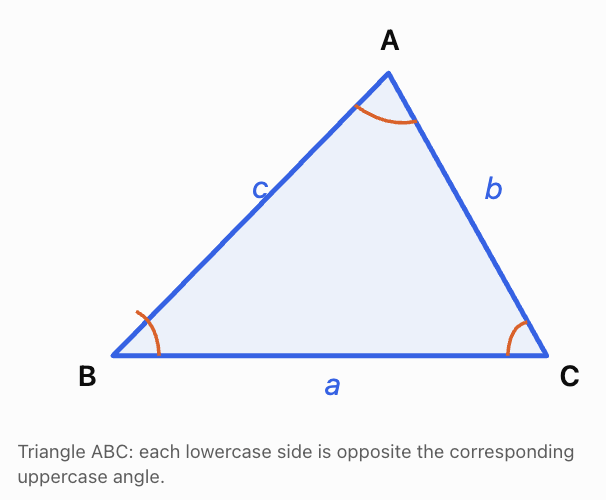
The relationship between each angle and its opposite side is essential.
For example, if angle A is the largest angle, side a must be the longest side.
This is an important property of triangles:
The larger the angle, the longer the side opposite it.
Conversely, the smallest angle is opposite the shortest side.
What Is the Law of Sines?
The Law of Sines states that the ratio of the length of a side to the sine of its opposite angle is constant for all three sides of a triangle.
The formula is:
a / sin A = b / sin B = c / sin C
We can also write it in reciprocal form:
sin A / a = sin B / b = sin C / c
Both forms are mathematically equivalent.
The first form is often convenient when finding an unknown side, while the second is often convenient when finding an unknown angle.
Understanding the Formula
Consider a triangle with the following measurements:
-
A = 40°
-
B = 60°
-
C = 80°
-
a = 8 cm
Using the Law of Sines:
8 / sin 40° = b / sin 60° = c / sin 80°
We can use the known side and angle to calculate the remaining two sides.
The Law of Sines works because the lengths of the sides are related to the sines of their opposite angles.
Why Does the Law of Sines Work?
The Law of Sines can be derived by dividing a triangle into two right triangles.
Consider triangle ABC. Draw a perpendicular height, h, from vertex C to side AB.
In the left right triangle:
sin A = h / b
Rearranging:
h = b sin A
In the right right triangle:
sin B = h / a
Rearranging:
h = a sin B
Because both expressions equal the same height:
b sin A = a sin B
Dividing both sides by sin A × sin B:
a / sin A = b / sin B
Repeating the process using another altitude gives the complete relationship:
a / sin A = b / sin B = c / sin C
This derivation shows that the Law of Sines is not simply a formula to memorize. It follows directly from the geometry of triangles and the definition of sine.
The reasoning also applies when an altitude falls outside an obtuse triangle, using the supplementary-angle identity sin(180° − θ) = sin θ.
When Should We Use the Law of Sines?
The Law of Sines is particularly useful when we know at least one complete pair consisting of an angle and its opposite side.
There are three common situations.
Situation
Information given
Appropriate?
ASA
Two angles and the included side
Yes
AAS
Two angles and a non-included side
Yes
SSA
Two sides and an angle opposite one of them
Yes, but ambiguous
SAS
Two sides and the included angle
Usually use Law of Cosines first
SSS
Three sides
Usually use Law of Cosines first
Case 1: Angle-Side-Angle (ASA)
We know two angles and the side between them.
For example:
A = 45°, B = 70°, c = 12 cm
First find angle C:
C = 180° − 45° − 70° = 65°
We now have an angle and its opposite side, so we can use the Law of Sines.
Case 2: Angle-Angle-Side (AAS)
We know two angles and a side that is not between those angles.
For example:
A = 35°, B = 80°, a = 10 cm
We can immediately write:
10 / sin 35° = b / sin 80°
Case 3: Side-Side-Angle (SSA)
We know two sides and an angle opposite one of those sides.
For example:
A = 35°, a = 8 cm, b = 12 cm
This case requires special care because the given measurements may produce:
-
No triangle
-
Exactly one triangle
-
Two different triangles
This is called the ambiguous case, which we will explore in detail later.
Solving Triangles Using the Law of Sines
To solve a triangle means to determine all three side lengths and all three angles.
The most reliable method is to follow these steps:
-
Draw and label the triangle.
-
Identify the known angles and sides.
-
Find a known angle–opposite side pair.
-
Substitute into the Law of Sines.
-
Rearrange to find the unknown value.
-
Find any remaining angles using the angle sum of 180°.
-
Verify that the answers are reasonable.
Worked Example 1: Finding an Unknown Side (AAS)
A triangle has the following measurements:
-
A = 40°
-
B = 75°
-
a = 12 cm
Find side b and angle C.
Step 1: Calculate angle C.
A + B + C = 180°
C = 180° − 40° − 75°
C = 65°
Step 2: Apply the Law of Sines.
a / sin A = b / sin B
12 / sin 40° = b / sin 75°
Step 3: Rearrange to isolate b.
b = 12 × sin 75° / sin 40°
b = 12 × 0.9659 / 0.6428
b ≈ 18.03 cm
Step 4: Verify the result.
Since B = 75° is larger than A = 40°, side b should be longer than side a.
Our result confirms this:
18.03 cm > 12 cm
The solution is reasonable.
Worked Example 2: Solving an ASA Triangle
Triangle ABC has:
-
A = 50°
-
C = 65°
-
b = 14 cm
Find angles B and sides a and c.
Step 1: Find angle B.
B = 180° − 50° − 65°
B = 65°
Step 2: Find side a.
a / sin 50° = 14 / sin 65°
a = 14 × sin 50° / sin 65°
a ≈ 11.83 cm
Step 3: Find side c.
c / sin 65° = 14 / sin 65°
c = 14 cm
Final answers:
-
A = 50°
-
B = 65°
-
C = 65°
-
a ≈ 11.83 cm
-
b = 14 cm
-
c = 14 cm
Notice that B and C are equal, so their opposite sides b and c must also be equal.
This triangle is an isosceles triangle.
Worked Example 3: Finding an Unknown Angle
A triangle has:
-
A = 30°
-
a = 8 cm
-
b = 10 cm
Find angle B.
Step 1: Apply the Law of Sines.
sin A / a = sin B / b
sin 30° / 8 = sin B / 10
Step 2: Isolate sin B.
sin B = 10 × sin 30° / 8
sin B = 10 × 0.5 / 8
sin B = 0.625
Step 3: Use inverse sine.
B = sin⁻¹(0.625)
B ≈ 38.68°
However, there is an important complication.
Because sin 38.68° = sin 141.32°, another possible angle is:
B = 180° − 38.68°
B ≈ 141.32°
Both possibilities satisfy A + B < 180°.
Therefore, two different triangles are possible.
We must consider both solutions whenever we encounter this type of problem.
The Ambiguous Case (SSA)
One of the most important applications of the Law of Sines involves the ambiguous case.
This occurs when we know:
-
Two sides of a triangle.
-
One angle that is not between those sides.
Unlike ASA and AAS triangles, which determine a unique triangle, SSA measurements do not always determine a unique triangle.
Depending on the measurements, there may be zero, one, or two possible triangles.
Why Can Two Triangles Exist?
Imagine that one side of a triangle has a fixed length, while another side can rotate around a fixed point.
The rotating side may intersect the required position in two different places, creating two triangles with different angles but the same given measurements.
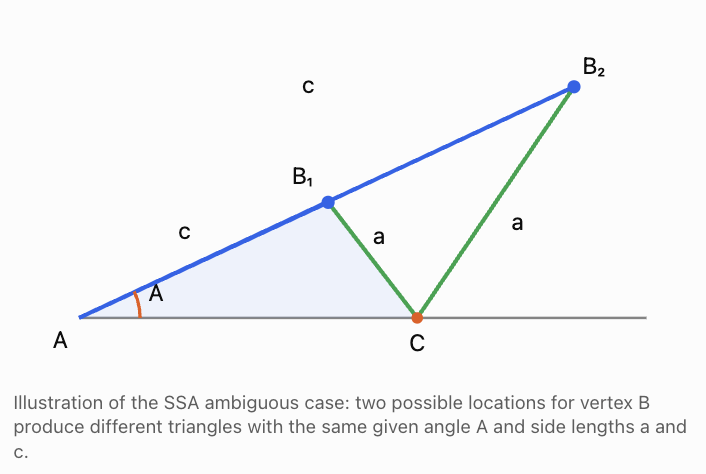
The ambiguity arises because sine has the same value for supplementary angles:
sin θ = sin(180° − θ)
For example:
sin 40° = sin 140°
Therefore, when we use inverse sine to calculate an angle, we must check whether its supplementary angle is also possible.
Determining the Number of Solutions
Suppose angle A is acute and we know sides a and b.
Calculate the height:
h = b sin A
The following rules determine how many triangles are possible.
Condition
Number of triangles
a < h
0
a = h
1 (right triangle)
h < a < b
2
a ≥ b
1
These conditions apply when A is acute.
If A is obtuse, the situation is different:
-
If a ≤ b, no triangle exists.
-
If a > b, exactly one triangle exists.
The reason is that the side opposite an obtuse angle must be the longest side of the triangle.
Worked Example 4: Two Possible Triangles
Given:
-
A = 30°
-
a = 8 cm
-
b = 10 cm
Find all possible values of B, C, and c.
Step 1: Check the height.
h = b sin A
h = 10 × sin 30°
h = 5 cm
Since:
5 < 8 < 10
there are two possible triangles.
Step 2: Find angle B.
sin B = b sin A / a
sin B = 10 × sin 30° / 8
sin B = 0.625
First possibility:
B₁ = sin⁻¹(0.625) ≈ 38.68°
Second possibility:
B₂ = 180° − 38.68° ≈ 141.32°
Step 3: Find angle C in each triangle.
Triangle 1:
C₁ = 180° − 30° − 38.68°
C₁ ≈ 111.32°
Triangle 2:
C₂ = 180° − 30° − 141.32°
C₂ ≈ 8.68°
Both triangles have positive angles that add to 180°.
Step 4: Find side c for each triangle.
Triangle 1:
c₁ / sin 111.32° = 8 / sin 30°
c₁ = 8 × sin 111.32° / sin 30°
c₁ ≈ 14.90 cm
Triangle 2:
c₂ / sin 8.68° = 8 / sin 30°
c₂ = 8 × sin 8.68° / sin 30°
c₂ ≈ 2.42 cm
Final answers:
Measurement
Triangle 1
Triangle 2
A
30°
30°
B
38.68°
141.32°
C
111.32°
8.68°
a
8 cm
8 cm
b
10 cm
10 cm
c
14.90 cm
2.42 cm
Both triangles satisfy the original measurements.
Worked Example 5: No Possible Triangle
Given:
A = 40°, a = 5 cm, b = 12 cm
Determine whether a triangle exists.
Step 1: Calculate the height.
h = b sin A
h = 12 × sin 40°
h ≈ 7.71 cm
Step 2: Compare the side with the height.
a = 5 cm
h ≈ 7.71 cm
Since a < h, the side is too short to complete the triangle.
Answer: No triangle is possible.
We can verify algebraically:
sin B = 12 × sin 40° / 5
sin B ≈ 1.543
The sine of a real angle cannot be greater than 1, confirming that no triangle exists.
Worked Example 6: Exactly One Triangle
Given:
A = 45°, a = 12 cm, b = 8 cm
Determine the number of triangles.
h = 8 × sin 45°
h ≈ 5.66 cm
Since a ≥ b, there is exactly one triangle.
Using the Law of Sines:
sin B = 8 × sin 45° / 12
sin B ≈ 0.4714
B ≈ 28.13°
The supplementary possibility would be:
180° − 28.13° = 151.87°
But:
45° + 151.87° > 180°
Therefore, the supplementary angle is impossible.
Exactly one triangle exists.
Verifying Triangle Solutions
Finding an answer is only part of solving a trigonometry problem. We must also determine whether the answer is mathematically correct and reasonable.
There are several ways to verify a triangle solution.
Method 1: Check the Angle Sum
The interior angles of every triangle must add to 180°.
For example:
A = 42°, B = 68°, C = 70°
42° + 68° + 70° = 180°
The angles satisfy the triangle angle-sum rule.
Method 2: Compare Side Lengths and Angles
The longest side must be opposite the largest angle.
For example:
Angle
Opposite side
A = 35°
a = 7 cm
B = 60°
b = 12 cm
C = 85°
c = 15 cm
The side lengths follow the same increasing order as the angles.
This is consistent with triangle geometry, although it does not by itself prove that the measurements are correct.
Method 3: Substitute into the Law of Sines
Consider:
A = 30°, B = 60°, C = 90°
a = 5 cm, b ≈ 8.66 cm, c = 10 cm
Check the ratios:
a / sin A = 5 / sin 30° = 10
b / sin B ≈ 8.66 / sin 60° ≈ 10
c / sin C = 10 / sin 90° = 10
All three ratios are approximately equal.
The measurements satisfy the Law of Sines.
Method 4: Check the Triangle Inequality
The sum of any two sides of a triangle must be greater than the third side.
For example, sides of 5 cm, 7 cm, and 10 cm form a possible triangle because:
5 + 7 > 10
5 + 10 > 7
7 + 10 > 5
However, sides of 3 cm, 4 cm, and 9 cm cannot form a triangle because:
3 + 4 < 9
This is another useful check, particularly when solving ambiguous-case problems.
Real-World Applications of the Law of Sines
The Law of Sines is especially useful when direct measurement is difficult, expensive, or dangerous.
Application 1: Measuring the Width of a River
A surveyor wants to determine the distance from point A to a tree at point C on the opposite side of a river.
The surveyor measures a 100 m baseline between points A and B on the accessible bank.
The measured angles are:
-
A = 50°
-
B = 65°
-
AB = 100 m
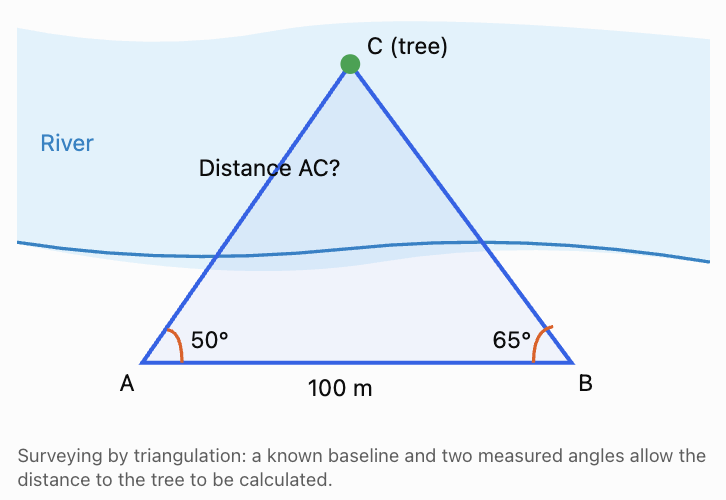
Step 1: Find angle C.
C = 180° − 50° − 65°
C = 65°
Step 2: Apply the Law of Sines.
AC / sin 65° = 100 / sin 65°
AC = 100 m
Answer: The straight-line distance from A to the tree is 100 m.
This is a direct distance, not necessarily the perpendicular width of the river. To find the perpendicular distance from C to the baseline, we could calculate:
h = 100 sin 50°
h ≈ 76.60 m
This illustrates how trigonometry can determine distances without crossing an obstacle.
Application 2: Navigation at Sea
Two ships leave the same harbour and travel in different directions.
Ship A travels 15 km on a bearing of 045°.
Ship B travels 20 km on a bearing of 110°.
How far apart are the ships?
The angle between their routes is:
110° − 45° = 65°
This problem gives two sides and the included angle (SAS). We should therefore begin with the Law of Cosines rather than the Law of Sines.
d² = 15² + 20² − 2(15)(20)cos 65°
d² ≈ 371.43
d ≈ 19.27 km
Answer: The ships are approximately 19.27 km apart.
Once we know the third side, we can use the Law of Sines to calculate the remaining angles of the triangle.
For example, the angle opposite the 15 km side is:
sin B / 15 = sin 65° / 19.27
sin B ≈ 0.7054
B ≈ 44.86°
The remaining angle is approximately:
180° − 65° − 44.86° = 70.14°
This demonstrates how the Law of Sines and Law of Cosines can work together in practical problems.
Application 3: Engineering and Construction
Engineers often need to calculate unknown distances in triangular frameworks, bridges, roof supports, and structural braces.
Suppose a triangular support has:
-
A = 42°
-
B = 78°
-
a = 3.5 m
Find the length of side b.
b / sin 78° = 3.5 / sin 42°
b = 3.5 × sin 78° / sin 42°
b ≈ 5.12 m
Answer: The required support length is approximately 5.12 m.
This type of calculation can help engineers estimate material requirements and determine structural dimensions.
Application 4: Astronomy
Astronomers use triangulation to estimate distances to objects that cannot be reached directly.
Two observation points are separated by a known baseline. By measuring the direction to an object from both points, astronomers can construct a triangle.
The Law of Sines can then be used to determine unknown distances.
For very distant objects, the angles may be extremely small, so precise instruments and specialized techniques are required.
The underlying mathematical principle is the same as the method used by surveyors on Earth.
Common Mistakes
Mistake 1: Matching the Wrong Side and Angle
Incorrect:
a / sin B = b / sin A
Correct:
a / sin A = b / sin B
Always match each side with its opposite angle.
Mistake 2: Forgetting the Ambiguous Case
When solving an SSA triangle, students sometimes calculate only:
B = sin⁻¹(value)
They forget to consider:
B₂ = 180° − B₁
Always check whether the supplementary angle also produces a valid triangle.
Mistake 3: Using the Wrong Calculator Mode
If angles are measured in degrees, the calculator must be in degree mode.
For example:
sin 30° = 0.5
A calculator in radian mode will produce a different value when entering 30.
Mistake 4: Rounding Too Early
Suppose:
sin B = 0.64382
Rounding this to 0.6 before using inverse sine can introduce a significant error.
Keep several decimal places during calculations and round only the final answer.
Mistake 5: Accepting an Impossible Triangle
An inverse sine calculation may produce a valid numerical angle, but the resulting triangle may still be impossible.
For example:
A = 70°, B = 120°
A + B = 190°
Since the angles already exceed 180°, no triangle exists.
Mistake 6: Using the Law of Sines Without a Known Opposite Pair
If a triangle has two known sides and the included angle, the Law of Sines usually cannot be applied immediately.
Use the Law of Cosines first to calculate the third side.
Key Terms
-
Law of Sines: A relationship connecting the sides of a triangle to the sines of their opposite angles.
-
Opposite side: The side located directly across from a particular angle.
-
Sine: A trigonometric function relating angles to side-length ratios.
-
ASA: Angle-Side-Angle; two angles and their included side are known.
-
AAS: Angle-Angle-Side; two angles and a non-included side are known.
-
SSA: Side-Side-Angle; two sides and a non-included angle are known.
-
Ambiguous case: A situation in which SSA information may produce zero, one, or two triangles.
-
Supplementary angles: Two angles whose sum is 180°.
-
Inverse sine: The operation used to find an angle from its sine value.
-
Triangulation: A technique for determining distances or positions using measured angles and a known baseline.
-
Triangle inequality: The rule that the sum of any two sides of a triangle must exceed the third side.
-
Law of Cosines: A relationship used to solve triangles when SAS or SSS information is given.
Key Takeaways
- The Law of Sines is:
a / sin A = b / sin B = c / sin C
-
It works for acute, right, and obtuse triangles.
-
It is especially useful for ASA, AAS, and SSA problems.
-
Every side must be matched with its opposite angle.
-
SSA is called the ambiguous case because it may produce zero, one, or two triangles.
-
When using inverse sine, consider both an angle and its supplement.
-
The interior angles of a triangle always sum to 180°.
-
The longest side is opposite the largest angle.
-
Triangle solutions should be verified using angle sums, side relationships, and substitution.
-
The Law of Sines is used in surveying, navigation, engineering, construction, and astronomy.
Check Your Understanding
Attempt these questions before looking at the solutions.
Question 1: Identifying the Correct Method
For each set of information, determine whether the Law of Sines is appropriate as the first method.
a) A = 40°, B = 70°, a = 8 cm
b) a = 5 cm, b = 7 cm, c = 9 cm
c) A = 35°, a = 6 cm, b = 9 cm
d) a = 12 cm, b = 15 cm, C = 60°
Question 2: Finding an Unknown Side
A triangle has:
A = 35°, B = 80°, a = 9 cm
Calculate side b to two decimal places.
Question 3: Solving a Triangle
Triangle ABC has:
A = 48°, C = 72°, b = 16 cm
Find B, a, and c.
Question 4: Finding an Angle
A triangle has:
A = 40°, a = 12 cm, b = 15 cm
Calculate all possible values of B.
Question 5: The Ambiguous Case
Given:
A = 30°, a = 7 cm, b = 10 cm
Determine the number of possible triangles and calculate the missing angles for each triangle.
Question 6: No Triangle
Given:
A = 50°, a = 6 cm, b = 10 cm
Explain why no triangle is possible.
Question 7: Surveying Application
Two surveyors stand 150 m apart at points A and B. They observe a distant landmark at point C.
The angles are:
A = 55°, B = 65°
Calculate the distance from A to the landmark.
Question 8: Error Analysis
A student calculates:
sin B = 0.8
and concludes:
B = 53.13°
Explain why this answer might be incomplete.
Check Your Understanding — Fully Worked Answers
Answer 1
a) Yes. Two angles and an opposite side are known (AAS).
b) No. Three sides are known (SSS). Use the Law of Cosines first.
c) Yes. Two sides and a non-included angle are known (SSA). Check the ambiguous case.
d) No. Two sides and the included angle are known (SAS). Use the Law of Cosines first.
Answer 2
Using the Law of Sines:
b / sin 80° = 9 / sin 35°
b = 9 × sin 80° / sin 35°
b ≈ 15.45 cm
Answer: b ≈ 15.45 cm
Answer 3
First find B:
B = 180° − 48° − 72°
B = 60°
Find side a:
a / sin 48° = 16 / sin 60°
a = 16 × sin 48° / sin 60°
a ≈ 13.73 cm
Find side c:
c / sin 72° = 16 / sin 60°
c = 16 × sin 72° / sin 60°
c ≈ 17.57 cm
Answers: B = 60°, a ≈ 13.73 cm, c ≈ 17.57 cm
Answer 4
sin B = 15 × sin 40° / 12
sin B ≈ 0.80348
First solution:
B₁ = sin⁻¹(0.80348)
B₁ ≈ 53.46°
Second solution:
B₂ = 180° − 53.46°
B₂ ≈ 126.54°
Check:
40° + 126.54° = 166.54°
Since this is less than 180°, both possibilities are valid.
Answers: B ≈ 53.46° or B ≈ 126.54°
Answer 5
Given:
A = 30°, a = 7 cm, b = 10 cm
Calculate the height:
h = 10 × sin 30° = 5 cm
Since:
5 < 7 < 10
two triangles are possible.
Calculate B:
sin B = 10 × sin 30° / 7
sin B = 5 / 7
B₁ ≈ 45.58°
B₂ = 180° − 45.58° ≈ 134.42°
Find C for each triangle.
Triangle 1:
C₁ = 180° − 30° − 45.58°
C₁ ≈ 104.42°
Triangle 2:
C₂ = 180° − 30° − 134.42°
C₂ ≈ 15.58°
Answer: Two triangles are possible.
-
Triangle 1: B ≈ 45.58°, C ≈ 104.42°
-
Triangle 2: B ≈ 134.42°, C ≈ 15.58°
Answer 6
Calculate the height:
h = b sin A
h = 10 × sin 50°
h ≈ 7.66 cm
Since a = 6 cm is shorter than the required height:
6 < 7.66
the triangle cannot be formed.
Answer: No triangle exists.
Answer 7
First calculate angle C:
C = 180° − 55° − 65°
C = 60°
We want distance AC, which is side b.
Using the Law of Sines:
b / sin 65° = 150 / sin 60°
b = 150 × sin 65° / sin 60°
b ≈ 156.98 m
Answer: The landmark is approximately 156.98 m from point A.
Answer 8
The student calculated only the principal inverse sine value:
B₁ = sin⁻¹(0.8) ≈ 53.13°
However, sine is positive in both the first and second quadrants.
The supplementary angle is:
B₂ = 180° − 53.13°
B₂ ≈ 126.87°
Therefore, depending on the other information in the triangle, both angles might be possible.
Answer: The student must check whether 126.87° also produces a valid triangle.
Final Challenge: Triangulating a Remote Location
Two observation stations, A and B, are separated by a straight baseline of 250 m.
Both stations observe a remote object at point C.
The measured angles are:
A = 42°
B = 73°
Calculate:
a) Angle C
b) Distance AC
c) Distance BC
d) Explain how the measurements could be verified.
Fully Worked Solution
Part a: Find C.
C = 180° − 42° − 73°
C = 65°
Part b: Find AC.
AC / sin 73° = 250 / sin 65°
AC = 250 × sin 73° / sin 65°
AC ≈ 263.79 m
Part c: Find BC.
BC / sin 42° = 250 / sin 65°
BC = 250 × sin 42° / sin 65°
BC ≈ 184.57 m
Part d: Verify the results.
Angle sum:
42° + 73° + 65° = 180°
Side-angle comparison:
-
Largest angle: 73° → longest side: AC ≈ 263.79 m
-
Middle angle: 65° → middle side: AB = 250 m
-
Smallest angle: 42° → shortest side: BC ≈ 184.57 m
Triangle inequality:
184.57 + 250 > 263.79
All checks are satisfied.
Final answers:
-
C = 65°
-
AC ≈ 263.79 m
-
BC ≈ 184.57 m
The Law of Sines has allowed us to determine distances to a remote location using only a measured baseline and two observed angles.
Conclusion
The Law of Sines is one of the most useful tools for solving non-right triangles. It connects side lengths and their opposite angles, allowing us to calculate unknown measurements without directly measuring every part of a triangle.
Understanding when to use the formula is just as important as knowing how to calculate with it. ASA and AAS problems generally produce a unique triangle, while SSA problems require careful examination because multiple solutions may exist.
By checking the angle sum, comparing opposite sides and angles, and substituting results into the original relationship, we can verify that our solutions are mathematically sound.
The same mathematical principles are used by surveyors, navigators, engineers, and scientists to measure distances and solve practical problems where direct measurement is difficult or impossible.
Mastering the Law of Sines prepares us for more advanced trigonometry, including the Law of Cosines, triangle area formulas, and three-dimensional applications.
-
-
2. The Law of Cosines
Learning outcomes
- I can apply the Law of Cosines to determine unknown sides.
- I can apply the Law of Cosines to determine unknown angles.
- I can identify when the Law of Cosines should be used.
- I can solve practical measurement problems.
- I can verify my solutions.
Introduction
Imagine two roads leaving the same intersection in different directions. One road extends 8 km, and the other extends 12 km. The angle between them is 65°.
How far apart are the endpoints of these roads?
We cannot simply add or subtract the distances because the roads form an angle. We also cannot use the Pythagorean theorem directly because the angle is not 90°.
Instead, we can use a powerful trigonometric relationship called the Law of Cosines.
The Law of Cosines allows us to calculate unknown sides and angles in triangles, including triangles that do not contain a right angle. It is especially useful in navigation, surveying, engineering, construction, physics, and geometry.
In this lesson, we will learn how to calculate missing sides, determine unknown angles, select the correct trigonometric method, solve practical measurement problems, and verify that our answers are correct.
Understanding the Law of Cosines
The Law of Cosines is a relationship between the three sides of a triangle and the cosine of one of its angles.
Consider triangle ABC.
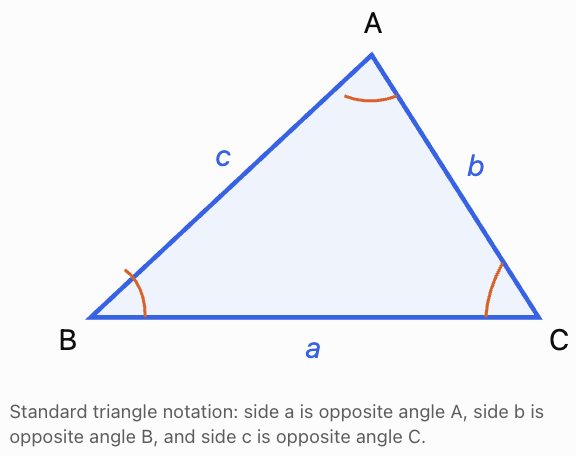
The Law of Cosines can be written in three equivalent forms:
To find side a:
a² = b² + c² − 2bc cos A
To find side b:
b² = a² + c² − 2ac cos B
To find side c:
c² = a² + b² − 2ab cos C
Each formula follows the same pattern:
(Opposite side)² = (first adjacent side)² + (second adjacent side)² − 2 × (adjacent sides) × cos(included angle)
The included angle is the angle between the two known sides.
Exploring How the Law of Cosines Works
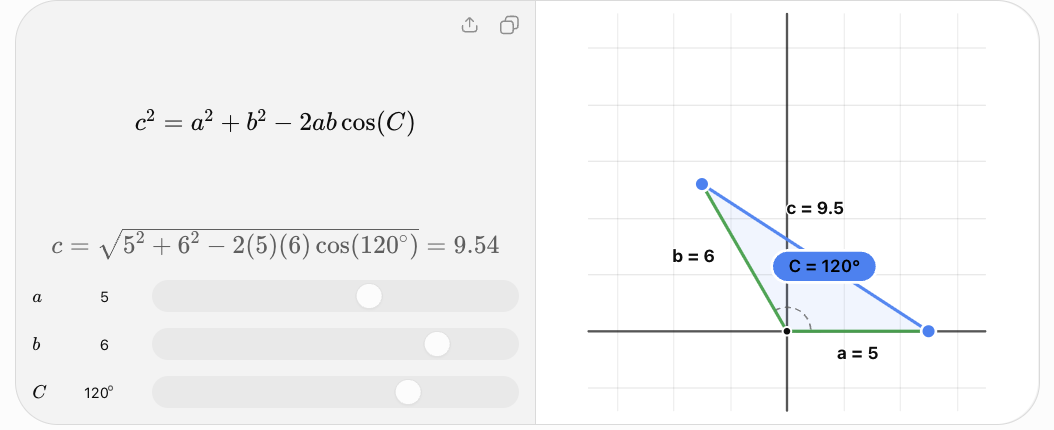
Change the side lengths and the included angle in the interactive triangle. Observe how the opposite side changes.
In particular:
-
Increasing the included angle while keeping the adjacent sides fixed increases the opposite side.
-
Decreasing the included angle decreases the opposite side.
-
When the included angle is 90°, the Law of Cosines becomes the Pythagorean theorem.
Connection to the Pythagorean Theorem
For a right triangle:
c² = a² + b²
The Law of Cosines gives:
c² = a² + b² − 2ab cos C
If C = 90°:
cos 90° = 0
Therefore:
c² = a² + b² − 2ab(0)
c² = a² + b²
This shows that the Pythagorean theorem is a special case of the Law of Cosines.
The Law of Cosines extends the Pythagorean theorem to triangles with acute or obtuse angles.
Why Does the Law of Cosines Work?
We can derive the formula using the Pythagorean theorem.
Consider a triangle with sides a, b, and c, where angle C lies between sides a and b.
Draw a perpendicular from the opposite vertex to the line containing side a.
For an acute angle C, the horizontal projection of side b is:
x = b cos C
The vertical height is:
h = b sin C
The remaining horizontal distance is:
a − b cos C
Using the Pythagorean theorem:
c² = (a − b cos C)² + (b sin C)²
Expand the squared expression:
c² = a² − 2ab cos C + b² cos² C + b² sin² C
Factor the final two terms:
c² = a² − 2ab cos C + b²(cos² C + sin² C)
Recall the identity:
cos² C + sin² C = 1
Therefore:
c² = a² − 2ab cos C + b²
Rearranging:
c² = a² + b² − 2ab cos C
The same coordinate argument works for obtuse angles because cosine becomes negative and the horizontal projection is signed.
This derivation demonstrates that the Law of Cosines follows directly from the Pythagorean theorem and basic trigonometric identities.
Learning Target 1: Determining Unknown Sides
The Law of Cosines is particularly useful when we know two sides of a triangle and the angle between them.
This is called the Side-Angle-Side (SAS) case.
Steps for Finding an Unknown Side
-
Draw and label the triangle.
-
Identify the two known sides and their included angle.
-
Select the correct version of the Law of Cosines.
-
Substitute the known values.
-
Calculate the squared unknown side.
-
Take the positive square root.
-
Check whether the result is reasonable.
Worked Example 1: Finding a Missing Side
Triangle ABC has:
-
a = 7 cm
-
b = 10 cm
-
C = 60°
Find side c.
Step 1: Write the formula.
c² = a² + b² − 2ab cos C
Step 2: Substitute.
c² = 7² + 10² − 2(7)(10)cos 60°
Step 3: Simplify.
c² = 49 + 100 − 140(0.5)
c² = 149 − 70
c² = 79
Step 4: Take the square root.
c = √79
c ≈ 8.89 cm
Verification: The side length lies between the difference and sum of the other two sides:
3 < 8.89 < 17
The triangle is possible.
Worked Example 2: An Obtuse Triangle
A triangle has:
-
a = 9 m
-
b = 12 m
-
C = 120°
Find side c.
c² = a² + b² − 2ab cos C
c² = 9² + 12² − 2(9)(12)cos 120°
Since cos 120° = −0.5:
c² = 81 + 144 − 216(−0.5)
c² = 225 + 108
c² = 333
c = √333
c ≈ 18.25 m
Notice that the side opposite the obtuse angle is the longest side.
This makes sense because the largest angle in a triangle must be opposite the longest side.
Worked Example 3: Comparing Different Included Angles
Suppose two sides of a triangle are fixed at 6 cm and 9 cm.
How does the third side change as the included angle increases?
|
Included angle C |
Calculation |
Side c |
|---|---|---|
|
30° |
√(36 + 81 − 108 cos 30°) |
4.84 cm |
|
60° |
√(36 + 81 − 108 cos 60°) |
7.94 cm |
|
90° |
√117 |
10.82 cm |
|
120° |
√(36 + 81 − 108 cos 120°) |
13.08 cm |
|
150° |
√(36 + 81 − 108 cos 150°) |
14.51 cm |
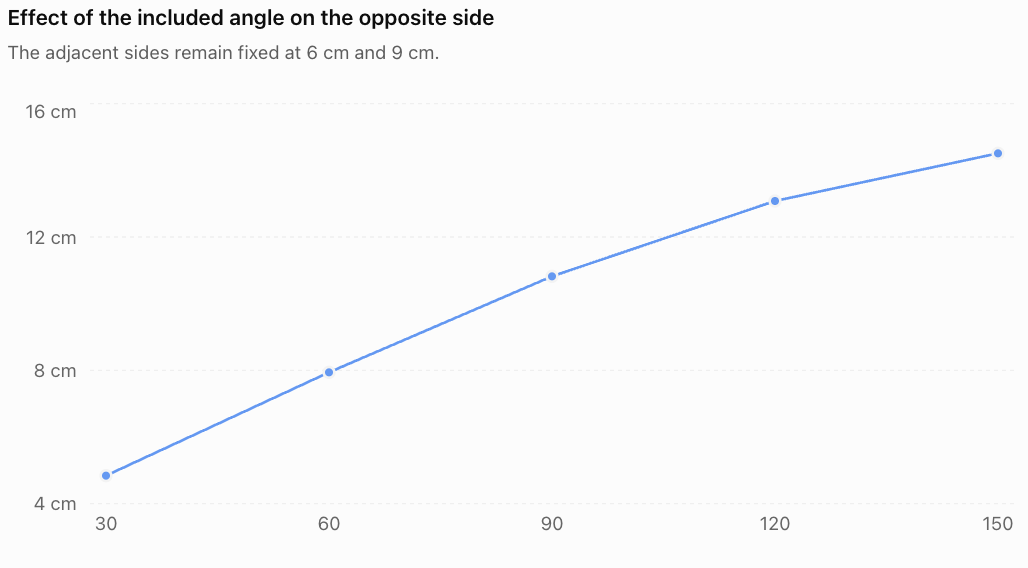
As the included angle increases, the opposite side becomes longer.
This is an important geometric relationship and a useful way to check answers.
Learning Target 2: Determining Unknown Angles
The Law of Cosines can also be used to calculate angles when all three side lengths are known.
This is called the Side-Side-Side (SSS) case.
To calculate an angle, we must first rearrange the formula.
Starting with:
a² = b² + c² − 2bc cos A
Move terms:
2bc cos A = b² + c² − a²
Divide by 2bc:
cos A = (b² + c² − a²) / (2bc)
Use inverse cosine:
A = cos⁻¹[(b² + c² − a²) / (2bc)]
Similarly:
B = cos⁻¹[(a² + c² − b²) / (2ac)]
C = cos⁻¹[(a² + b² − c²) / (2ab)]
Worked Example 4: Finding an Angle from Three Sides
A triangle has:
-
a = 8 cm
-
b = 11 cm
-
c = 13 cm
Find angle C.
Step 1: Write the rearranged formula.
cos C = (a² + b² − c²) / (2ab)
Step 2: Substitute.
cos C = (8² + 11² − 13²) / (2 × 8 × 11)
Step 3: Simplify.
cos C = (64 + 121 − 169) / 176
cos C = 16 / 176
cos C ≈ 0.09091
Step 4: Use inverse cosine.
C = cos⁻¹(0.09091)
C ≈ 84.78°
This is an acute angle, consistent with the fact that 13² is slightly less than 8² + 11².
Worked Example 5: Finding All Three Angles
A triangle has side lengths:
a = 5 cm, b = 7 cm, c = 9 cm
Find all three angles.
Step 1: Find angle A.
cos A = (7² + 9² − 5²) / (2 × 7 × 9)
cos A = (49 + 81 − 25) / 126
cos A = 105 / 126
A ≈ 33.56°
Step 2: Find angle B.
cos B = (5² + 9² − 7²) / (2 × 5 × 9)
cos B = (25 + 81 − 49) / 90
cos B = 57 / 90
B ≈ 50.70°
Step 3: Find angle C.
C = 180° − A − B
C ≈ 180° − 33.56° − 50.70°
C ≈ 95.74°
Final answers:
-
A ≈ 33.56°
-
B ≈ 50.70°
-
C ≈ 95.74°
Check:
33.56° + 50.70° + 95.74° = 180°
The longest side, c = 9 cm, is opposite the largest angle, C.
Worked Example 6: Classifying a Triangle Using Side Lengths
A triangle has side lengths:
6 cm, 8 cm, and 11 cm.
Determine whether it is acute, right, or obtuse.
The longest side is 11 cm.
Compare:
11² = 121
6² + 8² = 36 + 64 = 100
Since:
121 > 100
the triangle is obtuse.
We can calculate the largest angle:
cos C = (6² + 8² − 11²) / (2 × 6 × 8)
cos C = −21 / 96
C ≈ 102.64°
Answer: The triangle is obtuse, with its largest angle approximately 102.64°.
This gives a useful classification rule, provided the side lengths form a valid triangle:
-
Longest side squared < sum of the other two squares: acute triangle.
-
Longest side squared = sum of the other two squares: right triangle.
-
Longest side squared > sum of the other two squares: obtuse triangle.
Learning Target 3: Identifying When to Use the Law of Cosines
Choosing the correct trigonometric method is an essential mathematical skill.
Not every triangle problem should be solved using the same formula. The most efficient method depends on which sides and angles are known.
Comparing the Law of Sines and Law of Cosines
|
Given information |
Recommended method |
Reason |
|---|---|---|
|
SAS |
Law of Cosines |
Two sides and their included angle are known |
|
SSS |
Law of Cosines |
All three sides are known |
|
ASA |
Law of Sines |
Two angles and the included side are known |
|
AAS |
Law of Sines |
Two angles and a non-included side are known |
|
SSA |
Law of Sines |
An opposite angle-side pair is known; check ambiguity |
The Law of Cosines can sometimes be used after applying the Law of Sines, and vice versa.
For example, in an SAS triangle, we might use the Law of Cosines to calculate the third side, then use the Law of Sines to calculate an angle.
Decision Guide
What measurements are given?
SAS or SSS
Law of Cosines
Find a side or angle
ASA, AAS or SSA
Law of Sines
Check SSA ambiguity
Worked Example 7: Selecting the Correct Method
For each triangle, decide which method should be used first.
Triangle A
a = 8 cm, b = 11 cm, C = 45°
We know two sides and the included angle.
This is SAS.
Use the Law of Cosines.
Triangle B
A = 40°, B = 75°, a = 12 cm
We know two angles and a side.
This is AAS.
Use the Law of Sines.
Triangle C
a = 7 cm, b = 9 cm, c = 13 cm
We know all three sides.
This is SSS.
Use the Law of Cosines.
Triangle D
A = 35°, a = 8 cm, b = 10 cm
We know two sides and a non-included angle.
This is SSA.
Use the Law of Sines and check for multiple solutions.
Worked Example 8: Using Both Laws to Solve a Triangle
A triangle has:
a = 9 cm, b = 13 cm, C = 55°
Find the remaining side and angles.
Step 1: Find side c using the Law of Cosines.
c² = 9² + 13² − 2(9)(13)cos 55°
c² ≈ 115.77
c ≈ 10.76 cm
Step 2: Find angle A using the Law of Sines.
sin A / 9 = sin 55° / 10.76
sin A ≈ 0.685
A ≈ 43.24°
Step 3: Find angle B.
B = 180° − 55° − 43.24°
B ≈ 81.76°
Final answers:
-
a = 9 cm
-
b = 13 cm
-
c ≈ 10.76 cm
-
A ≈ 43.24°
-
B ≈ 81.76°
-
C = 55°
Since side b is the longest, angle B should be the largest. Our answer is consistent.
There is no second triangle here because the original SAS information uniquely determines the triangle.
Learning Target 4: Solving Practical Measurement Problems
The Law of Cosines is particularly useful when distances and directions are known but a direct measurement is difficult.
Application 1: Navigation — Two Ships
Two ships leave the same harbour.
-
Ship A travels 15 km.
-
Ship B travels 20 km.
-
The angle between their routes is 65°.
How far apart are the ships?
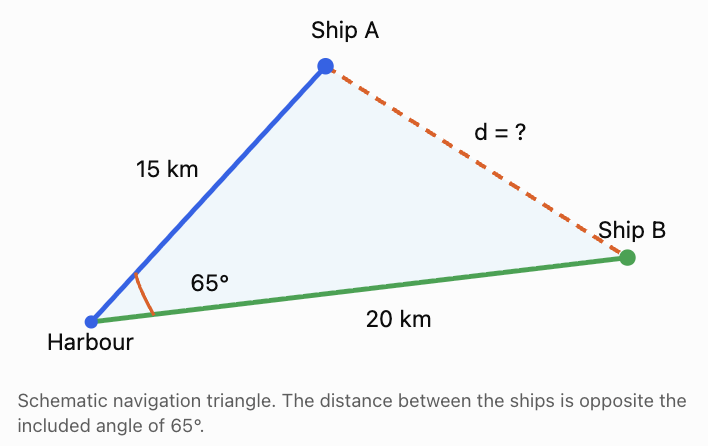
Step 1: Identify the known measurements.
We have two sides and the included angle (SAS).
Step 2: Apply the Law of Cosines.
d² = 15² + 20² − 2(15)(20)cos 65°
d² = 225 + 400 − 600 cos 65°
d² ≈ 371.43
Step 3: Calculate the distance.
d = √371.43
d ≈ 19.27 km
The ships are approximately 19.27 km apart.
Application 2: Surveying — Distance Between Two Landmarks
A surveyor stands at point P and observes two landmarks, A and B.
The measurements are:
-
PA = 120 m
-
PB = 175 m
-
Angle APB = 78°
Calculate the distance between the landmarks.
Step 1: Write the formula.
AB² = PA² + PB² − 2(PA)(PB)cos 78°
Step 2: Substitute.
AB² = 120² + 175² − 2(120)(175)cos 78°
AB² = 14,400 + 30,625 − 42,000 cos 78°
AB² ≈ 36,292.71
Step 3: Calculate AB.
AB = √36,292.71
AB ≈ 190.51 m
The landmarks are approximately 190.51 m apart.
This technique is useful when obstacles prevent a direct measurement between landmarks.
Application 3: Construction — A Roof Support
Two structural beams meet at an angle of 110°.
One beam is 4.5 m long and the other is 6 m long.
Calculate the distance between their free ends.
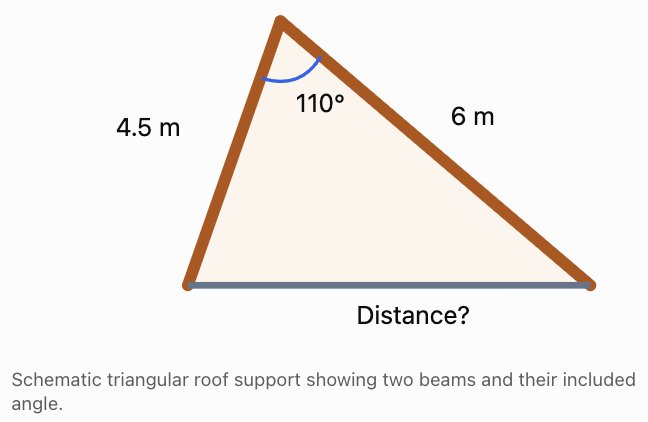
Using the Law of Cosines:
d² = 4.5² + 6² − 2(4.5)(6)cos 110°
d² = 20.25 + 36 − 54 cos 110°
d² ≈ 74.72
d ≈ 8.64 m
Answer: The free ends are approximately 8.64 m apart.
This information can be used when determining the length of a connecting support.
Application 4: Physics — Resultant Forces
The Law of Cosines can also be used to calculate the magnitude of a resultant force.
Suppose two forces act on an object:
-
F₁ = 40 N
-
F₂ = 60 N
-
Angle between the forces = 70°
We want to calculate the magnitude of their resultant.
For two vectors added tail-to-tail, the resultant magnitude is:
R² = F₁² + F₂² + 2F₁F₂ cos θ
Notice the plus sign.
This happens because the interior angle opposite the resultant in the head-to-tail triangle is 180° − θ, and cos(180° − θ) = −cos θ.
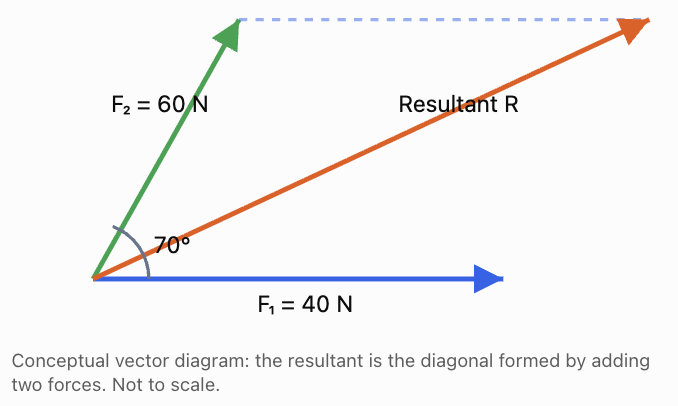
Substitute:
R² = 40² + 60² + 2(40)(60)cos 70°
R² = 1600 + 3600 + 4800 cos 70°
R² ≈ 6841.70
R = √6841.70
R ≈ 82.71 N
This application demonstrates that the geometry of triangles is closely connected to vector addition in physics.
Application 5: A Drone Flight
A drone travels 3 km east and then 4 km in a direction 50° north of east.
Calculate its straight-line displacement from its starting point.
The angle between the two displacement vectors is 50°.
Using the vector-resultant form:
d² = 3² + 4² + 2(3)(4)cos 50°
d² = 9 + 16 + 24 cos 50°
d² ≈ 40.43
d ≈ 6.36 km
Answer: The drone is approximately 6.36 km from its starting point.
The total distance travelled is:
3 + 4 = 7 km
However, the magnitude of the displacement is only approximately 6.36 km.
This highlights the difference between distance and displacement.
Learning Target 5: Verifying Solutions
Solving a triangle is not complete until we have checked that the result is mathematically valid and reasonable.
The Law of Cosines provides several ways to verify calculations.
Method 1: Check the Triangle Inequality
The sum of any two sides must be greater than the third side.
For example, consider a triangle with sides:
a = 7 cm, b = 10 cm, c = 14 cm
Check:
7 + 10 > 14
7 + 14 > 10
10 + 14 > 7
All three inequalities are satisfied.
The side lengths can form a triangle.
However, consider:
a = 3 cm, b = 5 cm, c = 9 cm
Since:
3 + 5 < 9
the triangle is impossible.
Always check that the given measurements describe a valid triangle before attempting to calculate its angles.
Method 2: Check the Angle Sum
Every triangle must satisfy:
A + B + C = 180°
Suppose we calculate:
A = 45.2°
B = 63.7°
C = 71.1°
Check:
45.2° + 63.7° + 71.1° = 180°
The angles are consistent.
Method 3: Compare Sides and Angles
The longest side must be opposite the largest angle.
For example:
|
Side |
Length |
Opposite angle |
|---|---|---|
|
a |
6 cm |
30° |
|
b |
10 cm |
60° |
|
c |
12 cm |
90° |
The ordering is consistent: larger angles are opposite longer sides.
However, these particular side lengths and angles are not an exact matching triangle. This comparison checks the ordering only, not the complete numerical solution.
Method 4: Substitute into the Original Formula
Consider a triangle with:
a = 7 cm, b = 10 cm, C = 60°
We previously calculated:
c = √79 ≈ 8.89 cm
Substitute the exact result:
c² = 7² + 10² − 2(7)(10)cos 60°
c² = 49 + 100 − 70
c² = 79
Since c = √79, both sides agree exactly.
The solution is verified.
Method 5: Check Whether the Angle Is Reasonable
The sign of cosine provides a useful test.
|
Angle type |
Cosine value |
|---|---|
|
Acute (0°–90°) |
Positive |
|
Right (90°) |
Zero |
|
Obtuse (90°–180°) |
Negative |
Suppose a calculation gives:
cos C = −0.4
Then angle C must be obtuse.
C = cos⁻¹(−0.4)
C ≈ 113.58°
An answer of 66.42° would be incorrect because it is acute and has a positive cosine.
Worked Example 9: Finding and Verifying an Angle
A triangle has:
a = 6 cm, b = 8 cm, c = 11 cm
Calculate angle C and verify that the result is reasonable.
Step 1: Use the Law of Cosines.
cos C = (a² + b² − c²) / (2ab)
cos C = (36 + 64 − 121) / 96
cos C = −21 / 96
cos C = −0.21875
Step 2: Find the angle.
C = cos⁻¹(−0.21875)
C ≈ 102.64°
Step 3: Verify using side lengths.
The longest side is c = 11 cm.
Therefore, angle C must be the largest angle.
Since C is obtuse, the other two angles must be acute.
This is consistent.
Step 4: Verify using the squared side lengths.
11² = 121
6² + 8² = 100
Since 121 > 100, the triangle must be obtuse.
Our calculated angle of approximately 102.64° confirms this.
Common Mistakes
Mistake 1: Using the Wrong Angle
Incorrect:
c² = a² + b² − 2ab cos A
Correct:
c² = a² + b² − 2ab cos C
The angle in the formula must be opposite the unknown side and between the two known sides.
Mistake 2: Forgetting the Square Root
If:
c² = 144
then:
c = 12
not 144.
When calculating a side length, take the positive square root at the end.
Mistake 3: Incorrectly Rearranging the Formula
Starting with:
a² = b² + c² − 2bc cos A
The correct rearrangement is:
cos A = (b² + c² − a²) / (2bc)
Be careful with the negative sign when moving terms.
Mistake 4: Using the Wrong Calculator Mode
If an angle is measured in degrees, the calculator must be in degree mode.
For example:
cos 60° = 0.5
Using radian mode will produce an incorrect result for an input of 60.
Mistake 5: Using the Law of Sines for SAS
If two sides and their included angle are known, there is no immediately available opposite side-angle pair.
The Law of Cosines is normally the most efficient first method.
Mistake 6: Confusing Vector Addition with Triangle Side Calculations
For the interior angle C of a triangle:
c² = a² + b² − 2ab cos C
For the magnitude of the resultant of two vectors separated by an angle θ:
R² = a² + b² + 2ab cos θ
The formulas describe related geometric situations but use different angle conventions.
Mistake 7: Rounding Too Early
If a calculation produces:
c² = 127.638492
keep the full calculator value before taking the square root.
Round only the final answer to the required accuracy.
Key Terms
-
Law of Cosines: A trigonometric relationship connecting the three sides of a triangle and the cosine of an angle.
-
Included angle: The angle located between two specified sides.
-
Opposite side: The side directly across from an angle.
-
SAS (Side-Angle-Side): Two sides and the angle between them are known.
-
SSS (Side-Side-Side): All three sides of a triangle are known.
-
Cosine: A trigonometric function used to relate angles and side lengths.
-
Inverse cosine: The operation used to determine an angle from its cosine value.
-
Acute triangle: A triangle in which all three angles are less than 90°.
-
Right triangle: A triangle containing one angle of exactly 90°.
-
Obtuse triangle: A triangle containing one angle greater than 90°.
-
Pythagorean theorem: A relationship between the sides of a right triangle.
-
Triangle inequality: The rule that the sum of any two sides must exceed the third side.
-
Resultant vector: A single vector representing the combined effect of two or more vectors.
-
Triangulation: A measurement technique using known distances and angles to determine unknown positions or distances.
-
Verification: The process of checking whether a calculated solution satisfies the original conditions.
Key Takeaways
-
The Law of Cosines works for acute, right, and obtuse triangles.
-
It is particularly useful for SAS and SSS problems.
-
To find a missing side, use the two known sides and their included angle.
-
To find a missing angle, rearrange the formula and use inverse cosine.
-
The Law of Cosines becomes the Pythagorean theorem when the included angle is 90°.
-
The Law of Sines is generally preferred for ASA, AAS, and SSA problems.
-
The Law of Cosines is useful in surveying, navigation, engineering, construction, and physics.
-
Always check the triangle inequality, angle sum, side-angle relationships, and original equation.
-
Keep full precision during calculations and round only final answers.
-
A complete mathematical solution includes correct calculations, units, and verification.
Check Your Understanding
These questions assess all five learning targets.
Part A: Finding Unknown Sides
Question 1
A triangle has:
a = 8 cm, b = 12 cm, C = 50°
Calculate side c to two decimal places.
Question 2
Two sides of a triangle measure 15 m and 20 m. The included angle is 120°.
Find the third side.
Part B: Finding Unknown Angles
Question 3
A triangle has:
a = 7 cm, b = 9 cm, c = 11 cm
Calculate angle C.
Question 4
A triangle has sides of 5 cm, 8 cm, and 10 cm.
Calculate the largest angle and classify the triangle.
Part C: Selecting the Correct Method
Question 5
Choose the most appropriate method for each triangle.
a) A = 40°, B = 70°, a = 9 cm
b) a = 6 cm, b = 10 cm, C = 55°
c) a = 7 cm, b = 8 cm, c = 12 cm
d) A = 35°, a = 8 cm, b = 11 cm
Part D: Practical Applications
Question 6
Two roads leave an intersection at an angle of 75°.
A vehicle travels 10 km along one road, and another vehicle travels 14 km along the other.
Calculate the straight-line distance between the vehicles.
Question 7
Two forces of 30 N and 45 N act on an object at an angle of 60° to each other.
Calculate the magnitude of the resultant force.
Part E: Verification and Reasoning
Question 8
A student claims that a triangle with sides of 4 cm, 7 cm, and 12 cm has an angle of 110°.
Explain why the triangle is impossible.
Question 9
A triangle has sides:
a = 9 cm, b = 12 cm, c = 15 cm
Use the Law of Cosines to calculate angle C and explain why the result is reasonable.
Question 10: Integrated Challenge
A surveyor stands at point P and measures distances to two buildings.
-
PA = 180 m
-
PB = 240 m
-
Angle APB = 68°
Calculate:
a) The distance AB between the buildings.
b) Angle PAB.
c) Angle PBA.
d) Verify that the three angles add to 180°.
Check Your Understanding — Fully Worked Answers
Answer 1
Given:
a = 8 cm, b = 12 cm, C = 50°
c² = a² + b² − 2ab cos C
c² = 8² + 12² − 2(8)(12)cos 50°
c² = 64 + 144 − 192 cos 50°
c² ≈ 84.58
c ≈ 9.20 cm
Answer: c ≈ 9.20 cm
Answer 2
Given:
a = 15 m, b = 20 m, C = 120°
c² = 15² + 20² − 2(15)(20)cos 120°
c² = 225 + 400 − 600(−0.5)
c² = 925
c = √925
Answer: c ≈ 30.41 m
The result is reasonable because the side opposite the obtuse angle must be the longest.
Answer 3
Given:
a = 7 cm, b = 9 cm, c = 11 cm
cos C = (a² + b² − c²) / (2ab)
cos C = (49 + 81 − 121) / 126
cos C = 9 / 126
C = cos⁻¹(9 / 126)
Answer: C ≈ 85.90°
Answer 4
The longest side is 10 cm, so the largest angle lies opposite it.
cos C = (5² + 8² − 10²) / (2 × 5 × 8)
cos C = (25 + 64 − 100) / 80
cos C = −11 / 80
C = cos⁻¹(−0.1375)
Answer: C ≈ 97.90°
Since C > 90°, the triangle is obtuse.
Answer 5
a) AAS → Law of Sines
b) SAS → Law of Cosines
c) SSS → Law of Cosines
d) SSA → Law of Sines, with an ambiguous-case check
Answer 6
Given:
a = 10 km, b = 14 km, C = 75°
d² = 10² + 14² − 2(10)(14)cos 75°
d² = 100 + 196 − 280 cos 75°
d² ≈ 223.53
d = √223.53
Answer: d ≈ 14.95 km
Answer 7
For vector addition:
R² = F₁² + F₂² + 2F₁F₂ cos θ
R² = 30² + 45² + 2(30)(45)cos 60°
R² = 900 + 2025 + 1350
R² = 4275
R = √4275
Answer: R ≈ 65.38 N
Answer 8
The triangle inequality states that the sum of any two sides must exceed the third.
However:
4 + 7 = 11
11 < 12
Therefore, the three sides cannot form a triangle.
Answer: The triangle is impossible, so the claimed angle cannot be valid.
Answer 9
Given:
a = 9 cm, b = 12 cm, c = 15 cm
cos C = (9² + 12² − 15²) / (2 × 9 × 12)
cos C = (81 + 144 − 225) / 216
cos C = 0
C = cos⁻¹(0)
C = 90°
Verification:
9² + 12² = 81 + 144 = 225
15² = 225
The triangle satisfies the Pythagorean theorem.
Answer: Angle C is 90°, and the triangle is right-angled.
Answer 10
Given:
PA = 180 m, PB = 240 m, angle P = 68°
Part a: Calculate AB.
AB² = 180² + 240² − 2(180)(240)cos 68°
AB² = 32,400 + 57,600 − 86,400 cos 68°
AB² ≈ 57,634.0
AB ≈ 240.07 m
Part b: Calculate angle PAB.
Using the Law of Cosines:
cos A = (180² + AB² − 240²) / (2 × 180 × AB)
Substituting the unrounded value of AB:
A ≈ 68.02°
Part c: Calculate angle PBA.
B = 180° − 68° − 68.02°
B ≈ 43.98°
Part d: Verify.
68° + 68.02° + 43.98° = 180°
The largest side is approximately AB = 240.07 m, opposite angle P = 68°, which is slightly larger than angle A.
The solution is consistent.
Final answers:
-
AB ≈ 240.07 m
-
Angle PAB ≈ 68.02°
-
Angle PBA ≈ 43.98°
Final Challenge: Designing a Triangular Park
A city is designing a triangular public park.
Two paths extend from a common entrance:
-
Path 1 is 85 m long.
-
Path 2 is 110 m long.
-
The angle between them is 105°.
The city wants to build a third path connecting the endpoints.
Calculate:
-
The required length of the connecting path.
-
The two remaining interior angles.
-
The perimeter of the park.
-
Whether the solution is geometrically reasonable.
Fully Worked Solution
Step 1: Calculate the connecting path.
Let the connecting path be c.
c² = 85² + 110² − 2(85)(110)cos 105°
c² = 7225 + 12100 − 18700 cos 105°
c² ≈ 24,164.92
c ≈ 155.45 m
Step 2: Find the angle opposite the 85 m side.
Using the Law of Sines:
sin A / 85 = sin 105° / 155.45
sin A ≈ 0.5282
A ≈ 31.89°
Step 3: Find the final angle.
B = 180° − 105° − 31.89°
B ≈ 43.11°
Step 4: Calculate the perimeter.
P = 85 + 110 + 155.45
P ≈ 350.45 m
Step 5: Verify.
Angle sum:
105° + 31.89° + 43.11° = 180°
Side-angle comparison:
-
105° is opposite 155.45 m, the longest side.
-
43.11° is opposite 110 m.
-
31.89° is opposite 85 m, the shortest side.
Triangle inequality:
85 + 110 > 155.45
All checks are satisfied.
Final answers:
-
Connecting path ≈ 155.45 m
-
Remaining angles ≈ 31.89° and 43.11°
-
Perimeter ≈ 350.45 m
Conclusion
The Law of Cosines is a powerful extension of the Pythagorean theorem that allows us to solve triangles without requiring a right angle.
By mastering the formula, we can determine unknown sides from SAS information, calculate unknown angles from SSS information, and select the most efficient method for a given triangle.
The Law of Cosines is not only a theoretical mathematical relationship. It has practical applications in navigation, engineering, surveying, construction, and physics.
Equally important is the ability to verify solutions. Checking angle sums, triangle inequalities, side-angle relationships, and the original formula helps ensure that our answers are accurate and meaningful.
Together, the Law of Sines and Law of Cosines provide the foundation for solving almost any triangle when sufficient measurements are known.
3. Area of Triangles
Learning outcomes
- I can calculate triangle area using trigonometry.
- I can determine unknown measurements before calculating area.
- I can compare different methods for finding area.
- I can solve practical area problems.
- I can justify my solutions.
Introduction
Imagine that an architect is designing a triangular glass window, a farmer is measuring a triangular field, or an engineer is calculating the surface area of a triangular support structure.
In each situation, knowing the area of the triangle is essential. The area tells us how much surface is enclosed within its three sides.
You may already know the familiar formula:
Area = ½ × base × perpendicular height
However, what happens when the perpendicular height is unknown?
What if we only know two sides and the angle between them? Or what if we know all three sides but none of the angles?
Fortunately, trigonometry provides several powerful methods for calculating the area of a triangle without directly measuring its height.
In this lesson, we will explore how to calculate triangle areas using sine, determine missing measurements before calculating area, compare different methods, solve practical measurement problems, and justify our solutions mathematically.
Understanding the Area of a Triangle
The area of a triangle is the amount of two-dimensional space enclosed by its three sides.
Area is measured in square units, such as:
-
Square millimetres (mm²)
-
Square centimetres (cm²)
-
Square metres (m²)
-
Square kilometres (km²)
The basic area formula uses the length of a base and its perpendicular height.
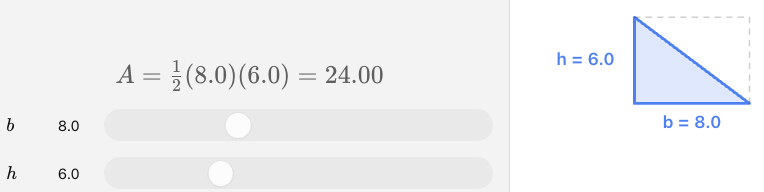
The perpendicular height is the shortest distance from the opposite vertex to the line containing the base.
It must form a 90° angle with that line.
For example, a triangle with a base of 12 cm and a perpendicular height of 7 cm has area:
Area = ½ × 12 × 7
Area = 42 cm²
This formula works for every triangle, including acute, right, and obtuse triangles.
Why Is the Formula One-Half?
A triangle can be paired with an identical copy to form a parallelogram.
The parallelogram has area:
Area = base × height
Each triangle occupies half of that parallelogram.
Therefore:
Area of triangle = ½ × base × height
This geometric relationship is the foundation for the trigonometric area formulas we will develop.
Triangle Notation
In triangle ABC:
-
a is the side opposite angle A.
-
b is the side opposite angle B.
-
c is the side opposite angle C.
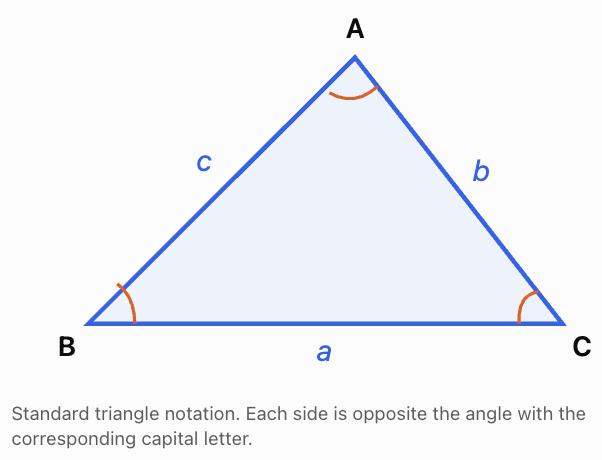
Correctly matching sides and angles is essential when using trigonometric formulas.
Learning Target 1: Calculating Triangle Area Using Trigonometry
When we know two sides of a triangle and the angle between them, we can calculate its area without first determining the perpendicular height numerically.
This is called the sine area formula.
The Sine Area Formula
For triangle ABC:
Area = ½bc sin A
We can also write:
Area = ½ac sin B
or
Area = ½ab sin C
All three formulas give the same area.
The important rule is:
Use two sides and the angle included between them.
Deriving the Sine Area Formula
Consider a triangle with sides b and c meeting at angle A.
Draw a perpendicular height, h, to the line containing side c.
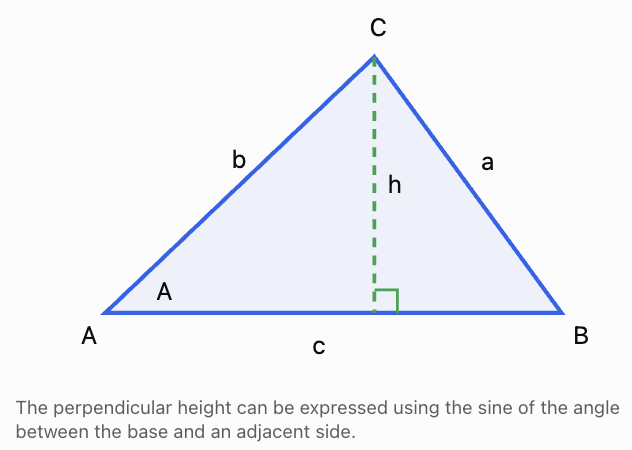
From the right triangle:
sin A = h / b
Therefore:
h = b sin A
The basic area formula is:
Area = ½ × base × height
Using c as the base:
Area = ½ × c × h
Substitute h = b sin A:
Area = ½ × c × b sin A
Therefore:
Area = ½bc sin A
This derivation explains why the sine of the included angle appears in the formula.
For an obtuse included angle, the same formula works because the altitude lies outside the triangle and sin(180° − A) = sin A.
Worked Example 1: Two Sides and an Included Angle
A triangle has:
-
b = 8 cm
-
c = 12 cm
-
A = 40°
Calculate its area.
Step 1: Choose the formula.
Area = ½bc sin A
Step 2: Substitute.
Area = ½ × 8 × 12 × sin 40°
Step 3: Simplify.
Area = 48 × sin 40°
Area ≈ 48 × 0.6428
Area ≈ 30.85 cm²
The area is approximately 30.85 square centimetres.
Worked Example 2: An Obtuse Triangle
A triangle has:
-
a = 10 m
-
b = 15 m
-
C = 120°
Calculate the area.
Area = ½ab sin C
Area = ½ × 10 × 15 × sin 120°
Area = 75 × 0.8660
Area ≈ 64.95 m²
Notice that sin 120° = sin 60°.
The sine area formula works for obtuse triangles just as it does for acute triangles.
Worked Example 3: An Equilateral Triangle
An equilateral triangle has side length 10 cm.
Find its area using trigonometry.
Every interior angle of an equilateral triangle is 60°.
Area = ½ab sin C
Area = ½ × 10 × 10 × sin 60°
Area = 50 × √3/2
Area = 25√3
Area ≈ 43.30 cm²
This leads to the general formula for an equilateral triangle of side length s:
Area = (√3/4)s²
This is a useful special result derived directly from the sine area formula.
How the Included Angle Affects Area
Suppose two sides remain fixed at 10 cm and 12 cm.
The area depends on the included angle:
Area = 60 sin θ
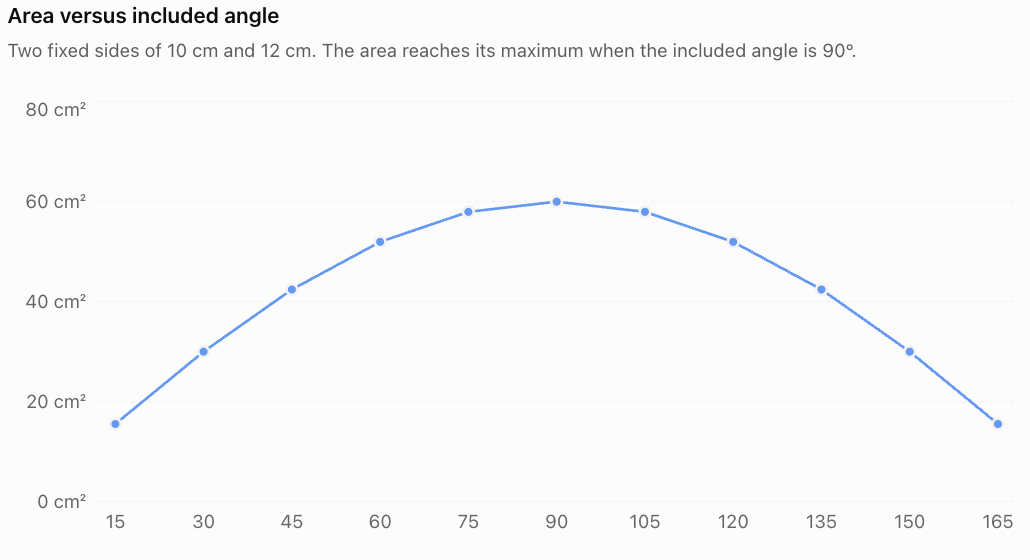
The area increases as the included angle approaches 90°, then decreases as the angle approaches 180°.
This happens because:
sin 90° = 1
which is the maximum possible value of sine.
Therefore, for two fixed side lengths, the maximum area occurs when the included angle is 90°.
This is an important result in geometric design and optimization.
Learning Target 2: Determining Unknown Measurements Before Calculating Area
In many triangle problems, the information needed for an area formula is not given directly.
We may first need to calculate:
-
A missing angle using the angle sum of a triangle.
-
An unknown side using the Law of Sines.
-
An unknown side or angle using the Law of Cosines.
-
A perpendicular height using trigonometric ratios.
This requires combining several mathematical techniques.
Worked Example 4: Finding a Missing Angle First
Triangle ABC has:
-
A = 45°
-
B = 70°
-
a = 12 cm
-
c = 15 cm
Calculate its area.
Step 1: Find angle C.
C = 180° − 45° − 70°
C = 65°
Step 2: Identify the included angle between sides a and c.
Sides a and c meet at angle B.
Therefore, we can use:
Area = ½ac sin B
Step 3: Substitute.
Area = ½ × 12 × 15 × sin 70°
Area = 90 × sin 70°
Area ≈ 84.57 cm²
Although we calculated C, it was not actually necessary for finding the area. Recognizing that B is already the included angle between the known sides is a more efficient approach.
This illustrates an important problem-solving skill: calculate only the missing information that is genuinely needed.
Worked Example 5: Using the Law of Sines First
Triangle ABC has:
-
A = 40°
-
B = 75°
-
a = 10 cm
Calculate its area.
We know only one side, so we must calculate another side before using the sine area formula.
Step 1: Find angle C.
C = 180° − 40° − 75°
C = 65°
Step 2: Find side b using the Law of Sines.
a / sin A = b / sin B
10 / sin 40° = b / sin 75°
b = 10 sin 75° / sin 40°
b ≈ 15.03 cm
Step 3: Calculate the area.
Sides a and b meet at angle C.
Area = ½ab sin C
Area = ½ × 10 × (10 sin 75° / sin 40°) × sin 65°
Area ≈ 68.08 cm²
We retained the unrounded value of b during the calculation to minimize rounding error.
Worked Example 6: Using the Law of Cosines First
A triangle has side lengths:
-
a = 7 cm
-
b = 9 cm
-
c = 12 cm
Calculate its area using trigonometry.
All three sides are known, but none of the angles is given.
Step 1: Calculate angle C using the Law of Cosines.
c² = a² + b² − 2ab cos C
Rearrange:
cos C = (a² + b² − c²) / (2ab)
Substitute:
cos C = (49 + 81 − 144) / 126
cos C = −14 / 126
cos C = −1/9
C ≈ 96.38°
Step 2: Use the sine area formula.
Area = ½ab sin C
Area = ½ × 7 × 9 × sin 96.38°
Area ≈ 31.30 cm²
The triangle is obtuse, but the sine area formula still gives a positive area.
Worked Example 7: Finding a Height Using Trigonometry
A triangular field has a base of 80 m.
An adjacent side is 65 m long and makes an angle of 52° with the base.
Calculate the area.
Step 1: Calculate the perpendicular height.
sin 52° = h / 65
h = 65 sin 52°
h ≈ 51.22 m
Step 2: Use the basic area formula.
Area = ½ × 80 × h
Area = ½ × 80 × 65 sin 52°
Area ≈ 2048.83 m²
We could also calculate this directly using:
Area = ½ × 80 × 65 × sin 52°
Both approaches are equivalent.
A Useful Formula for ASA and AAS Problems
Sometimes we know one side and two angles.
Rather than repeatedly calculating missing sides, we can derive a direct area formula.
Starting with:
Area = ½bc sin A
From the Law of Sines:
b = a sin B / sin A
c = a sin C / sin A
Substitute:
Area = ½ × (a sin B / sin A) × (a sin C / sin A) × sin A
Simplify:
Area = a² sin B sin C / (2 sin A)
Similarly:
Area = b² sin A sin C / (2 sin B)
Area = c² sin A sin B / (2 sin C)
These formulas are useful when one side and all three angles are known.
Learning Target 3: Comparing Different Methods for Finding Area
There is no single best formula for every triangle.
An efficient mathematician chooses the method that uses the available information with the fewest unnecessary calculations.
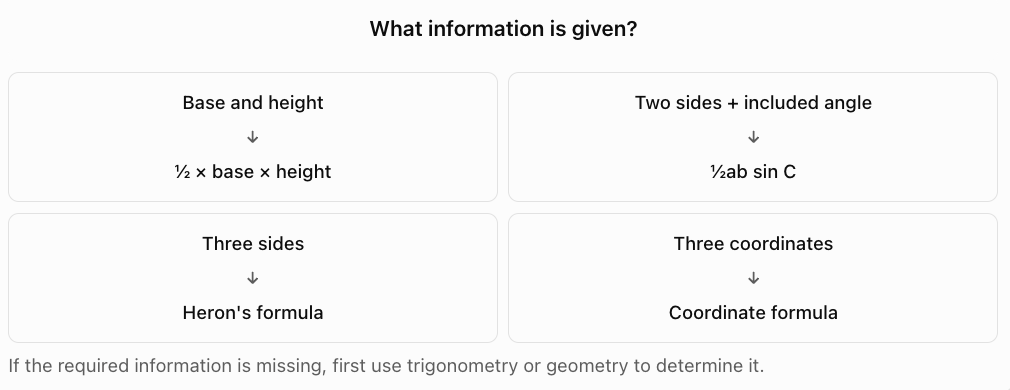
Four Important Area Methods
|
Method |
Formula |
Information needed |
|---|---|---|
|
Base and height |
Area = ½bh |
Base and perpendicular height |
|
Sine area formula |
Area = ½ab sin C |
Two sides and included angle |
|
Heron's formula |
Area = √[s(s−a)(s−b)(s−c)] |
Three sides |
|
Coordinate formula |
Area = ½|x₁(y₂−y₃) + x₂(y₃−y₁) + x₃(y₁−y₂)| |
Three vertex coordinates |
In Heron's formula:
s = (a + b + c) / 2
The value s is called the semiperimeter.
Heron's Formula
Heron's formula allows us to calculate the area of a triangle using only its three side lengths.
It is particularly useful for SSS problems because no angle calculation is required.
Area = √[s(s−a)(s−b)(s−c)]
where:
s = (a + b + c) / 2
Worked Example 8: Finding Area Using Heron's Formula
A triangle has sides:
a = 13 cm, b = 14 cm, c = 15 cm
Step 1: Calculate the semiperimeter.
s = (13 + 14 + 15) / 2
s = 21 cm
Step 2: Apply Heron's formula.
Area = √[21(21−13)(21−14)(21−15)]
Area = √(21 × 8 × 7 × 6)
Area = √7056
Area = 84 cm²
This is an exact answer.
Worked Example 9: Comparing Heron's Formula and Trigonometry
Use both methods to calculate the area of a triangle with sides 5 cm, 6 cm, and 7 cm.
Method 1: Heron's Formula
s = (5 + 6 + 7) / 2 = 9 cm
Area = √[9(9−5)(9−6)(9−7)]
Area = √(9 × 4 × 3 × 2)
Area = √216
Area = 6√6
Area ≈ 14.70 cm²
Method 2: Law of Cosines and Sine Area Formula
Let a = 5, b = 6, and c = 7.
First find C:
cos C = (5² + 6² − 7²) / (2 × 5 × 6)
cos C = (25 + 36 − 49) / 60
cos C = 0.2
C ≈ 78.46°
Now calculate area:
Area = ½ × 5 × 6 × sin 78.46°
Area ≈ 14.70 cm²
Both methods produce the same result.
Which method is better?
For this particular SSS problem, Heron's formula is more efficient because it avoids calculating an angle.
However, the trigonometric method is valuable because it connects triangle area with the Law of Cosines.
Area from Coordinates
When a triangle is given on a coordinate plane, its area can be calculated directly from the coordinates of its vertices.
Suppose:
A = (1, 2)
B = (7, 2)
C = (4, 6)
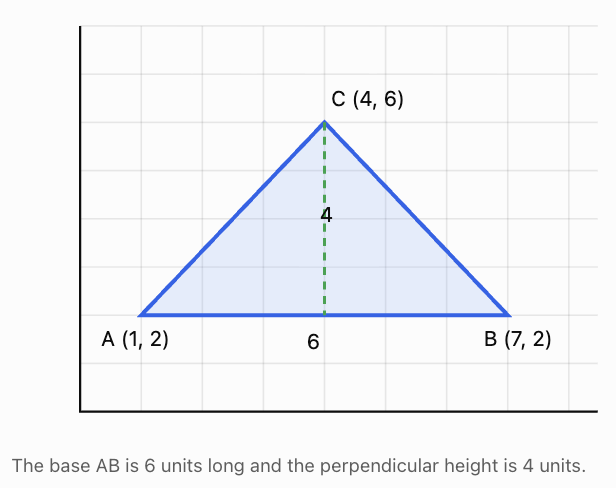
The base is:
7 − 1 = 6 units
The height is:
6 − 2 = 4 units
Area = ½ × 6 × 4
Area = 12 square units
Using the coordinate formula:
Area = ½|1(2−6) + 7(6−2) + 4(2−2)|
Area = ½|−4 + 28 + 0|
Area = 12 square units
The coordinate method is especially useful when the triangle is tilted and its base or height is not immediately obvious.
Choosing the Most Efficient Method
Learning Target 4: Solving Practical Area Problems
Triangle area calculations are used in surveying, architecture, construction, engineering, land management, and design.
Real-world problems often require us to interpret measurements, select an appropriate formula, and convert units.
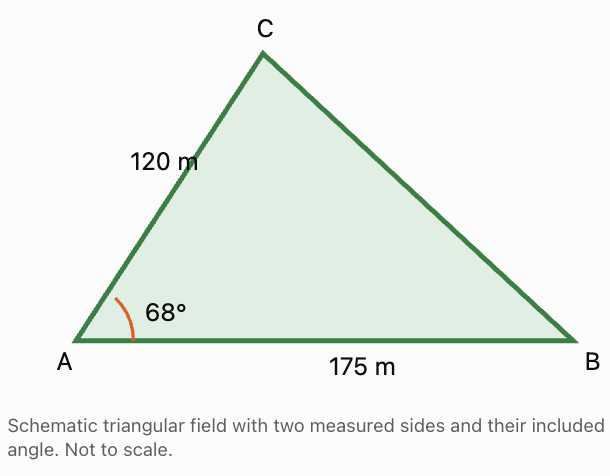
Application 1: Measuring a Triangular Field
A farmer owns a triangular field.
Two sides measure 120 m and 175 m, and the included angle is 68°.
Calculate the area of the field.
Step 1: Identify the formula.
Area = ½ab sin C
Step 2: Substitute.
Area = ½ × 120 × 175 × sin 68°
Area = 10,500 × sin 68°
Area ≈ 9,735.43 m²
Step 3: Convert to hectares.
1 hectare = 10,000 m²
Area ≈ 9,735.43 / 10,000
Area ≈ 0.974 hectares
This is useful when estimating the amount of seed, fertilizer, or irrigation needed for the field.
Application 2: Designing a Triangular Glass Window
An architect designs a triangular glass window with two sides measuring 2.4 m and 3.1 m.
The angle between the sides is 55°.
Calculate the area of glass required.
Area = ½ × 2.4 × 3.1 × sin 55°
Area = 3.72 × sin 55°
Area ≈ 3.05 m²
Suppose the glass costs $85 per square metre.
Estimated material cost:
Cost = 3.047... × 85
Cost ≈ $259.03
The actual purchase cost may be higher because cutting, waste, installation, and framing are not included.
Application 3: A Triangular Roof Panel
A triangular roof panel has sides of 5 m, 7 m, and 9 m.
Calculate its area.
Since all three sides are known, Heron's formula is appropriate.
s = (5 + 7 + 9) / 2
s = 10.5 m
Area = √[10.5(10.5−5)(10.5−7)(10.5−9)]
Area = √(10.5 × 5.5 × 3.5 × 1.5)
Area ≈ 17.41 m²
If roof covering is sold in panels covering 2 m² each:
17.41 / 2 ≈ 8.71
The minimum theoretical number of panels is 9.
In practice, additional panels may be required because of cutting and waste.
Application 4: A Triangular Sail
A sailboat has a triangular sail.
Two edges of the sail measure 6 m and 8 m, and the angle between them is 70°.
Calculate the sail area.
Area = ½ × 6 × 8 × sin 70°
Area = 24 × sin 70°
Area ≈ 22.55 m²
The sail area influences the amount of wind force the sail can experience, although the actual force also depends on wind speed, sail shape, orientation, and aerodynamic conditions.
Application 5: Land Surveying with Coordinates
A surveyor records the following positions in metres:
A = (0, 0)
B = (80, 20)
C = (30, 90)
Find the area enclosed by the three points.
Using the coordinate formula:
Area = ½|x₁(y₂−y₃) + x₂(y₃−y₁) + x₃(y₁−y₂)|
Substitute:
Area = ½|0(20−90) + 80(90−0) + 30(0−20)|
Area = ½|0 + 7200 − 600|
Area = ½ × 6600
Area = 3300 m²
This method is particularly useful for mapping irregular parcels of land using GPS or surveying coordinates.
Application 6: Finding the Maximum Area of a Triangular Design
An engineer has two support beams measuring 8 m and 12 m.
The angle between them can be adjusted.
What is the maximum possible triangular area?
Area = ½ × 8 × 12 × sin θ
Area = 48 sin θ
Since the maximum value of sin θ is 1:
Maximum area = 48 × 1
Maximum area = 48 m²
This occurs when:
θ = 90°
The result demonstrates an important optimization principle: when two side lengths are fixed, their included angle should be 90° to maximize the triangle's area.
Learning Target 5: Justifying Triangle Area Solutions
A complete mathematical solution should do more than provide a numerical answer.
It should explain:
-
Why a particular formula is appropriate.
-
How the known measurements relate to the formula.
-
Why the calculated area is reasonable.
-
Whether the answer has the correct units.
-
Whether the result can be verified independently.
Method 1: Explain Why the Formula Applies
Suppose a triangle has two sides of 9 cm and 14 cm, with an included angle of 65°.
The sine area formula is appropriate because we know two sides and the angle between them.
Area = ½ × 9 × 14 × sin 65°
Area ≈ 57.10 cm²
A complete justification might state:
"The sine area formula is appropriate because two sides and their included angle are known. The calculated area is positive and is expressed in square centimetres."
Method 2: Check the Maximum Possible Area
For two fixed sides a and b:
Area = ½ab sin C
Because:
0 < sin C ≤ 1 for 0° < C < 180°
the area must satisfy:
0 < Area ≤ ½ab
For sides of 9 cm and 14 cm:
Maximum area = ½ × 9 × 14
Maximum area = 63 cm²
Our calculated area of 57.10 cm² is below the maximum, so it passes this check.
If a calculation produced 80 cm², we would know immediately that an error had occurred.
Method 3: Verify Using Another Formula
Consider a triangle with sides 13 cm, 14 cm, and 15 cm.
Using Heron's formula, we found:
Area = 84 cm²
We can verify this using trigonometry.
First calculate the angle C opposite the 15 cm side:
cos C = (13² + 14² − 15²) / (2 × 13 × 14)
cos C = (169 + 196 − 225) / 364
cos C = 140 / 364 = 5/13
Therefore:
sin C = √[1 − (5/13)²]
sin C = 12/13
Now calculate area:
Area = ½ × 13 × 14 × (12/13)
Area = 84 cm²
Both methods agree exactly.
This provides strong verification.
Method 4: Check Units
If the side lengths are measured in metres, the area must be measured in square metres.
For example:
Area = ½ × 5 m × 8 m × sin 40°
Area ≈ 12.86 m²
The sine function has no units, so multiplying two lengths produces squared units.
An answer of 12.86 m would be incorrect because metres measure length, not area.
Method 5: Evaluate the Context
Suppose a triangular garden has two sides of 4 m and 6 m.
A student calculates an area of 25 m².
The maximum possible area is:
½ × 4 × 6 = 12 m²
Therefore, 25 m² is impossible.
The answer should be rejected even before checking the detailed calculation.
This demonstrates why mathematical reasoning and estimation are important parts of problem-solving.
Common Mistakes
Mistake 1: Using an Angle That Is Not Included
Incorrect:
Area = ½ab sin A
when A is not the angle between sides a and b.
Correct:
Area = ½ab sin C
The angle must be between the two selected sides.
Mistake 2: Forgetting the Factor of One-Half
Incorrect:
Area = ab sin C
Correct:
Area = ½ab sin C
Forgetting ½ doubles the answer.
Mistake 3: Using a Sloping Side as the Perpendicular Height
The height must be perpendicular to the base.
If a sloping side makes an angle θ with the base, the height may be calculated using:
h = side × sin θ
Mistake 4: Using Heron's Formula Without Calculating the Semiperimeter
Heron's formula uses:
s = (a + b + c) / 2
It does not use the full perimeter.
Mistake 5: Using the Wrong Calculator Mode
When angles are measured in degrees, the calculator must be in degree mode.
For example:
sin 30° = 0.5
Mistake 6: Giving Area in Linear Units
Incorrect:
Area = 45 cm
Correct:
Area = 45 cm²
Area always requires square units.
Mistake 7: Rounding Intermediate Values Too Early
If you first calculate an unknown side or angle, retain the unrounded value when using it to find the area.
Rounding intermediate values can introduce unnecessary errors.
Mistake 8: Assuming Every Triangle Requires Trigonometry
If the base and perpendicular height are already known, use:
Area = ½bh
There is no need to calculate an angle.
The most efficient method is usually the one that uses the given information directly.
Key Terms
-
Area: The amount of two-dimensional space enclosed by a shape.
-
Base: A selected side of a triangle used when calculating its area.
-
Perpendicular height: The shortest distance from a vertex to the line containing the opposite side.
-
Included angle: The angle between two specified sides.
-
Sine area formula: A trigonometric formula for finding area using two sides and their included angle.
-
Heron's formula: A formula for finding the area of a triangle using its three side lengths.
-
Semiperimeter: Half the perimeter of a triangle.
-
Law of Sines: A relationship connecting the sides of a triangle with the sines of their opposite angles.
-
Law of Cosines: A relationship connecting the sides of a triangle and the cosine of an included angle.
-
Coordinate area formula: A method for calculating area from the coordinates of three vertices.
-
Optimization: The process of finding a maximum or minimum value under given conditions.
-
Verification: Checking whether a mathematical result satisfies the original information and constraints.
-
Square units: Units used to measure area, such as cm² or m².
-
Triangulation: A measurement technique that uses triangles to determine unknown distances or positions.
Key Takeaways
-
The basic triangle area formula is Area = ½bh.
-
The sine area formula is Area = ½ab sin C, where C is the included angle.
-
The sine area formula works for acute, right, and obtuse triangles.
-
Missing sides or angles can be calculated using the Law of Sines or Law of Cosines before finding area.
-
Heron's formula calculates area directly from three side lengths.
-
Coordinate geometry provides another method when the vertices are known.
-
Choosing an efficient method depends on the given measurements.
-
For two fixed side lengths, the maximum area occurs when the included angle is 90°.
-
Area must always be expressed in square units.
-
A strong mathematical solution includes appropriate formulas, accurate calculations, clear reasoning, and verification.
Check Your Understanding
These questions assess all five learning targets, including calculating areas, finding missing measurements, comparing methods, solving practical problems, and justifying answers.
Part A: Calculating Area Using Trigonometry
Question 1
A triangle has two sides measuring 8 cm and 11 cm. The included angle is 50°.
Calculate its area to two decimal places.
Question 2
A triangle has sides a = 12 m and b = 15 m, with included angle C = 120°.
Calculate its area and explain why the formula works for an obtuse triangle.
Part B: Determining Missing Measurements
Question 3
Triangle ABC has:
A = 40°, B = 60°, a = 10 cm
Calculate the area of the triangle.
Question 4
A triangle has side lengths 6 cm, 8 cm, and 10 cm.
Use the Law of Cosines to determine the largest angle, then calculate the area.
Part C: Comparing Methods
Question 5
Choose the most efficient method for each situation.
a) Base = 12 cm, perpendicular height = 7 cm
b) Two sides of 9 cm and 13 cm, included angle = 45°
c) Three sides of 8 cm, 10 cm, and 12 cm
d) Vertices at (1, 1), (7, 1), and (4, 5)
Explain each choice.
Part D: Practical Applications
Question 6
A triangular garden has two sides measuring 18 m and 24 m, with an included angle of 65°.
Calculate the area of the garden.
Question 7
A triangular metal plate has sides measuring 5 m, 7 m, and 8 m.
Calculate its area using Heron's formula.
Question 8
An architect designs a triangular window with two sides of 2 m and 3 m.
What is the maximum possible area of the window? At what included angle does this occur?
Part E: Justification and Reasoning
Question 9
A student calculates the area of a triangle with two sides of 6 cm and 10 cm as 40 cm².
Explain why this answer must be incorrect, regardless of the included angle.
Question 10
A triangle has sides of 13 cm, 14 cm, and 15 cm.
Calculate its area using Heron's formula and explain how you could verify the result using trigonometry.
Check Your Understanding — Fully Worked Answers
Answer 1
Area = ½ab sin C
Area = ½ × 8 × 11 × sin 50°
Area = 44 sin 50°
Area ≈ 33.71 cm²
Answer 2
Area = ½ × 12 × 15 × sin 120°
Area = 90 × sin 120°
Area ≈ 77.94 m²
The formula works because the sine of an obtuse angle between 90° and 180° is positive. The perpendicular height is related to the supplementary acute angle, which has the same sine.
Answer 3
Given:
A = 40°, B = 60°, a = 10 cm
Step 1: Find angle C.
C = 180° − 40° − 60° = 80°
Step 2: Find side b.
b = 10 sin 60° / sin 40°
b ≈ 13.47 cm
Step 3: Find the area.
Area = ½ab sin C
Area = ½ × 10 × (10 sin 60° / sin 40°) × sin 80°
Area ≈ 66.34 cm²
Answer 4
Given sides 6 cm, 8 cm, and 10 cm.
Let C be the angle opposite the longest side.
cos C = (6² + 8² − 10²) / (2 × 6 × 8)
cos C = (36 + 64 − 100) / 96
cos C = 0
Therefore:
C = 90°
Area = ½ × 6 × 8 × sin 90°
Area = 24 cm²
Answer 5
a) Base and height formula, because both required measurements are known.
b) Sine area formula, because two sides and their included angle are known.
c) Heron's formula, because all three sides are known.
d) Coordinate formula, because the three vertices are known. In this particular case, the base-height formula is also straightforward.
Answer 6
Area = ½ × 18 × 24 × sin 65°
Area = 216 sin 65°
Area ≈ 195.76 m²
Answer 7
Given:
a = 5 m, b = 7 m, c = 8 m
Semiperimeter:
s = (5 + 7 + 8) / 2 = 10 m
Heron's formula:
Area = √[10(10−5)(10−7)(10−8)]
Area = √(10 × 5 × 3 × 2)
Area = √300
Area ≈ 17.32 m²
Answer 8
Area = ½ × 2 × 3 × sin θ
Area = 3 sin θ
The maximum value of sine is 1, which occurs at θ = 90°.
Maximum area = 3 m²
Included angle = 90°
Answer 9
The maximum possible area is:
Area(max) = ½ × 6 × 10
Area(max) = 30 cm²
Since 40 cm² exceeds the maximum possible area, the student's result is impossible.
The area cannot exceed 30 cm².
Answer 10
Given:
a = 13 cm, b = 14 cm, c = 15 cm
Semiperimeter:
s = (13 + 14 + 15) / 2
s = 21 cm
Heron's formula:
Area = √[21(21−13)(21−14)(21−15)]
Area = √(21 × 8 × 7 × 6)
Area = 84 cm²
To verify, calculate the included angle between the 13 cm and 14 cm sides using the Law of Cosines, then substitute into:
Area = ½ × 13 × 14 × sin C
This also gives 84 cm².
Final Challenge: Designing a Triangular Recreation Area
A town plans to construct a triangular recreation area with sides measuring:
-
80 m
-
110 m
-
130 m
The town needs to determine the total area before estimating landscaping costs.
Calculate:
-
The area using Heron's formula.
-
The angle between the 80 m and 110 m sides.
-
The area again using the sine area formula.
-
The landscaping cost if the price is $12 per square metre.
-
Explain why the two area calculations agree.
Fully Worked Solution
Step 1: Calculate the semiperimeter.
s = (80 + 110 + 130) / 2
s = 160 m
Step 2: Apply Heron's formula.
Area = √[160(160−80)(160−110)(160−130)]
Area = √(160 × 80 × 50 × 30)
Area = √19,200,000
Area ≈ 4381.78 m²
Step 3: Calculate the included angle.
Let θ be the angle between the 80 m and 110 m sides.
Using the Law of Cosines:
cos θ = (80² + 110² − 130²) / (2 × 80 × 110)
cos θ = (6400 + 12100 − 16900) / 17600
cos θ = 1600 / 17600
cos θ = 1/11
θ ≈ 84.78°
Step 4: Verify using the sine area formula.
Area = ½ × 80 × 110 × sin θ
Using cos θ = 1/11:
sin θ = √(1 − 1/121)
sin θ = √120/11
Therefore:
Area = 4400 × √120/11
Area = 400√120
Area ≈ 4381.78 m²
The two methods agree.
Step 5: Calculate the landscaping cost.
Cost = Area × $12
Cost = 4381.780... × 12
Cost ≈ $52,581.36
Final Results
|
Measurement |
Result |
|---|---|
|
Semiperimeter |
160 m |
|
Included angle |
84.78° |
|
Area using Heron's formula |
4381.78 m² |
|
Area using trigonometry |
4381.78 m² |
|
Estimated landscaping cost |
$52,581.36 |
The two area calculations agree because both formulas describe the same geometric property of the triangle, using different measurements.
This provides an independent verification of the solution.
Conclusion
Calculating the area of a triangle is much more than substituting values into a single formula.
By combining geometry and trigonometry, we can determine triangle areas from a variety of measurements, even when the perpendicular height is unknown.
The sine area formula is especially useful when two sides and their included angle are known. The Law of Sines and Law of Cosines allow us to calculate missing measurements, while Heron's formula and coordinate geometry provide alternative methods.
Knowing which method to choose is an important part of mathematical problem-solving. Efficient solutions use the available information directly and avoid unnecessary calculations.
Equally important is the ability to justify and verify results. Comparing methods, checking units, and evaluating whether an answer is reasonable help us develop mathematical confidence.
The ability to calculate and justify triangle areas is essential in surveying, architecture, construction, engineering, land management, and many other practical applications of mathematics.
4. Bearings and Navigation
Learning outcomes
- I can interpret compass bearings.
- I can solve navigation problems.
- I can apply trigonometry to surveying situations.
- I can solve problems involving multiple triangles.
- I can interpret solutions in context.
Introduction
Imagine being the captain of a ship travelling across the ocean. There are no roads, street signs, or visible pathways to follow. Instead, you must determine your direction using a compass, calculate distances between locations, and plan a route that will take you safely to your destination.
Or imagine a surveyor standing on a hill, trying to determine the location of a distant building without walking directly to it.
Both situations involve bearings and navigation, which combine geometry, trigonometry, and spatial reasoning to solve practical measurement problems.
Bearings describe directions using angles measured from north. When combined with distances, they allow us to calculate positions, determine routes, measure inaccessible distances, and solve problems involving multiple triangles.
These mathematical techniques are used in aviation, shipping, surveying, engineering, mapping, search and rescue, and many other fields.
In this lesson, we will learn to interpret compass bearings, solve navigation problems, apply trigonometry to surveying, work with multiple connected triangles, and interpret mathematical results in realistic situations.
Understanding Compass Directions
A compass identifies four main directions:
-
North (N): 0° or 360°
-
East (E): 90°
-
South (S): 180°
-
West (W): 270°
The four intermediate directions are:
-
Northeast (NE): 45°
-
Southeast (SE): 135°
-
Southwest (SW): 225°
-
Northwest (NW): 315°
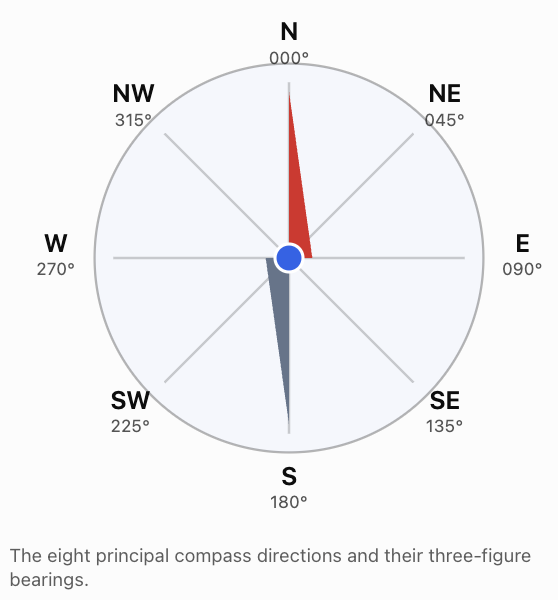
In mathematics, navigation bearings are normally measured clockwise from north.
This differs from standard mathematical angles, which are usually measured anticlockwise from the positive x-axis.
Learning Target 1: Interpreting Compass Bearings
What Is a Bearing?
A bearing is an angle that describes the direction of one location from another.
Bearings are measured:
-
From north.
-
In a clockwise direction.
-
Using angles between 000° and 360°.
-
Usually written with three digits.
For example:
-
045° means 45° clockwise from north.
-
090° means due east.
-
180° means due south.
-
270° means due west.
-
315° means northwest.
A bearing of 070° is not the same as 70° anticlockwise from east.
The starting direction and direction of rotation are essential.
Three-Figure Bearings
Bearings are normally written using three digits.
Direction
Bearing
North
000°
Northeast
045°
East
090°
Southeast
135°
South
180°
Southwest
225°
West
270°
Northwest
315°
For example, a bearing of 025° means 25° clockwise from north.
A bearing of 250° means 250° clockwise from north, placing the direction between south and west.
Visualizing a Bearing
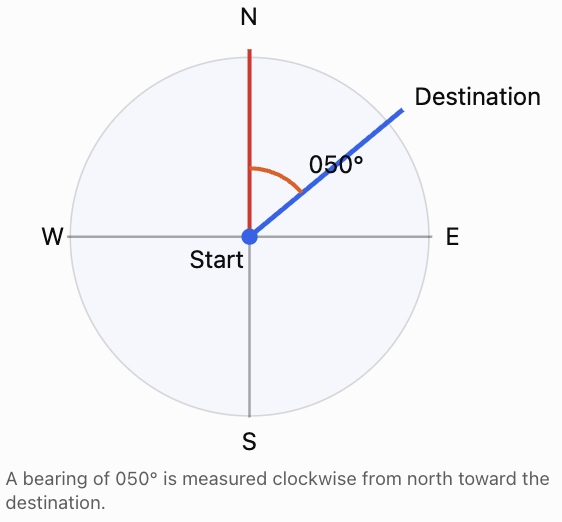
Compass Bearings and Quadrant Bearings
Some navigation problems use quadrant bearings instead of three-figure bearings.
A quadrant bearing begins with north or south and turns toward east or west through an angle of at most 90°.
For example:
N 35° E means 35° east of north.
S 20° W means 20° west of south.
The following conversions are useful.
Quadrant bearing
Three-figure bearing
N 30° E
030°
S 40° E
140°
S 25° W
205°
N 50° W
310°
Worked Example 1: Converting Bearings
Convert the following directions into three-figure bearings.
a) N 40° E
Start at north and rotate 40° toward east.
Bearing = 040°
b) S 35° E
Start at south (180°) and rotate 35° toward east.
Bearing = 180° − 35°
Bearing = 145°
c) S 60° W
Start at south and rotate 60° toward west.
Bearing = 180° + 60°
Bearing = 240°
d) N 25° W
Start at north and rotate 25° toward west.
Bearing = 360° − 25°
Bearing = 335°
Reverse Bearings
The reverse bearing is the direction back to the starting point.
If the bearing from A to B is θ, the reverse bearing from B to A differs by 180°.
Use:
-
If θ < 180°, add 180°.
-
If θ ≥ 180°, subtract 180°.
Worked Example 2: Finding a Reverse Bearing
The bearing from A to B is 065°.
Find the bearing from B to A.
Reverse bearing = 065° + 180°
Answer: 245°
Another example:
The bearing from P to Q is 290°.
Reverse bearing = 290° − 180°
Answer: 110°
Reverse bearings are especially important when solving navigation problems involving several locations.
Learning Target 2: Solving Navigation Problems
Navigation problems often involve a journey consisting of one or more straight-line movements.
A ship, aircraft, or vehicle may travel a known distance on a particular bearing, then change direction.
We can use trigonometry to calculate:
-
Horizontal and vertical components of a journey.
-
Straight-line displacement.
-
Distance between locations.
-
The bearing required to reach a destination.
-
The difference between total distance travelled and displacement.
Resolving a Bearing into Components
Suppose an object travels a distance d on a bearing θ.
Taking east as the positive x-direction and north as the positive y-direction:
Eastward displacement = d sin θ
Northward displacement = d cos θ
These formulas work for all bearings when the signs are retained.
For example:
-
Positive eastward component means east.
-
Negative eastward component means west.
-
Positive northward component means north.
-
Negative northward component means south.
Worked Example 3: Finding Eastward and Northward Displacement
A ship travels 20 km on a bearing of 060°.
Find its eastward and northward displacement.
Step 1: Calculate the eastward component.
East = 20 sin 60°
East ≈ 17.32 km
Step 2: Calculate the northward component.
North = 20 cos 60°
North = 10 km
Answer:
-
17.32 km east
-
10 km north
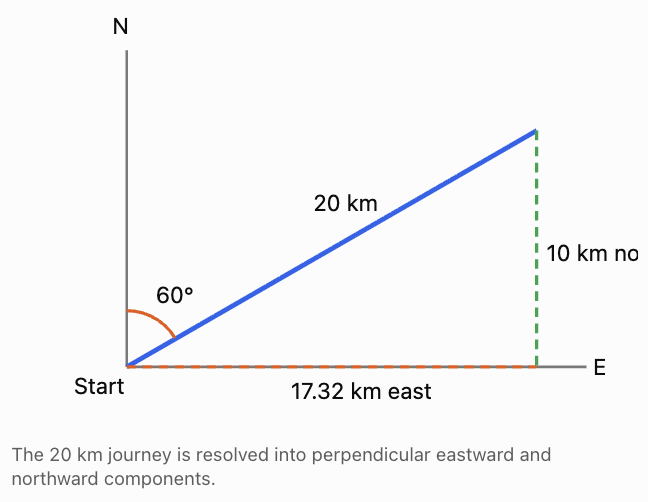
Worked Example 4: Two-Stage Navigation
A boat travels:
-
12 km due east.
-
Then 9 km due north.
Calculate its displacement and bearing from the starting point.
Step 1: Calculate displacement.
The journey forms a right triangle.
d² = 12² + 9²
d² = 144 + 81
d² = 225
d = 15 km
Step 2: Calculate the bearing.
The angle east of north is:
tan θ = 12 / 9
θ = tan⁻¹(12/9)
θ ≈ 53.13°
Answer:
-
Displacement = 15 km
-
Bearing = 053.13°, approximately 053° to the nearest degree
The total distance travelled is:
12 + 9 = 21 km
However, the displacement is only 15 km.
This illustrates the distinction between distance and displacement.
Worked Example 5: Navigation Using the Law of Cosines
A ship leaves a harbour and travels 15 km on a bearing of 045°.
A second ship leaves the same harbour and travels 20 km on a bearing of 110°.
Calculate the distance between the ships.
Step 1: Find the included angle.
110° − 45° = 65°
Step 2: Apply the Law of Cosines.
d² = 15² + 20² − 2(15)(20)cos 65°
d² = 225 + 400 − 600 cos 65°
d² ≈ 371.43
d ≈ 19.27 km
Answer: The ships are approximately 19.27 km apart.
Worked Example 6: Finding the Bearing to a Destination
A rescue station is located 8 km east and 15 km north of a ship.
Calculate the distance and bearing from the ship to the rescue station.
Step 1: Calculate the distance.
d² = 8² + 15²
d² = 64 + 225
d = 17 km
Step 2: Calculate the bearing.
tan θ = east / north
tan θ = 8 / 15
θ = tan⁻¹(8/15)
θ ≈ 28.07°
Answer:
The rescue station is 17 km away on a bearing of approximately 028°.
Because the station is northeast of the ship, a bearing between 000° and 090° is reasonable.
Learning Target 3: Applying Trigonometry to Surveying Situations
Surveying involves measuring distances, angles, elevations, and positions to determine the locations of objects and boundaries.
Surveyors frequently need to measure distances that cannot be reached directly, such as:
-
The width of a river.
-
The distance to a building across a valley.
-
The separation between two distant landmarks.
-
The boundaries of a large property.
-
The location of an object relative to known reference points.
Trigonometry makes these measurements possible using a technique called triangulation.
What Is Triangulation?
Triangulation involves forming a triangle using a known baseline and measured angles.
Once enough information is available, the Law of Sines or Law of Cosines can be used to calculate unknown distances.
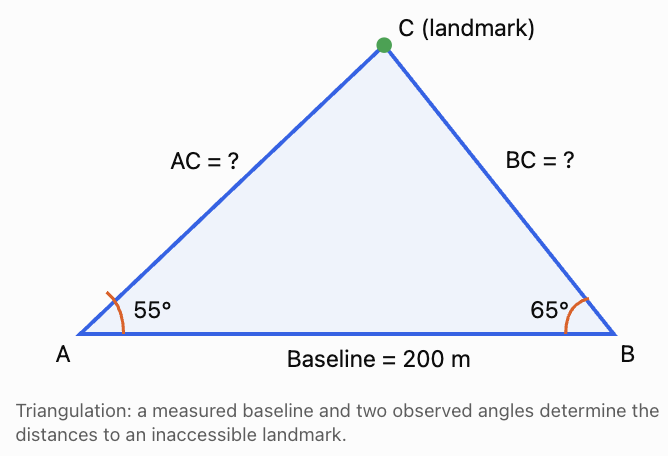
Worked Example 7: Surveying a Distant Landmark
Two surveyors stand 200 m apart at points A and B.
They observe a landmark at point C.
The measured interior angles are:
-
A = 55°
-
B = 65°
Calculate the distances AC and BC.
Step 1: Find angle C.
C = 180° − 55° − 65°
C = 60°
Step 2: Calculate AC using the Law of Sines.
AC / sin 65° = 200 / sin 60°
AC = 200 sin 65° / sin 60°
AC ≈ 209.30 m
Step 3: Calculate BC.
BC / sin 55° = 200 / sin 60°
BC = 200 sin 55° / sin 60°
BC ≈ 189.18 m
Step 4: Interpret the results.
The landmark is approximately:
-
209.30 m from surveyor A.
-
189.18 m from surveyor B.
The landmark is closer to B, which is consistent with the triangle: BC is opposite the smaller angle A.
Worked Example 8: Calculating the Perpendicular Width of a River
A surveyor stands at point A on a straight riverbank. A second observation point B is 100 m farther along the bank.
A tree at point C is directly across the river from point D, which lies between A and B.
The measured angle between AB and AC is 40°.
The angle between BA and BC is 65°.
Find the perpendicular width CD.
Step 1: Find angle C.
C = 180° − 40° − 65°
C = 75°
Step 2: Calculate AC.
AC / sin 65° = 100 / sin 75°
AC = 100 sin 65° / sin 75°
AC ≈ 93.83 m
Step 3: Calculate the perpendicular height CD.
In right triangle ACD:
sin 40° = CD / AC
CD = AC sin 40°
CD = (100 sin 65° / sin 75°) sin 40°
CD ≈ 60.32 m
The river is approximately 60.32 m wide at this location.
Notice the distinction between the direct distance AC and the perpendicular river width CD.
Worked Example 9: Using Bearings in Surveying
A surveyor at point P observes two buildings.
-
Building A is 150 m away on a bearing of 035°.
-
Building B is 220 m away on a bearing of 110°.
Calculate the distance between the buildings.
Step 1: Calculate the angle between the bearings.
110° − 35° = 75°
Step 2: Apply the Law of Cosines.
AB² = 150² + 220² − 2(150)(220)cos 75°
AB² = 22,500 + 48,400 − 66,000 cos 75°
AB² ≈ 53,817.95
AB = √53,817.95
AB ≈ 231.99 m
Step 3: Interpret.
The buildings are approximately 231.99 m apart in a straight line.
The surveyor can determine their separation without physically measuring the distance between them.
Why Surveying Measurements Need Careful Interpretation
Mathematical calculations assume that the measurements describe the intended geometric model accurately.
In practice, surveyors must consider:
-
Measurement uncertainty.
-
Instrument calibration.
-
Whether distances are horizontal or sloping.
-
Terrain elevation.
-
The difference between grid north, true north, and magnetic north.
-
Whether Earth's curvature matters over the measured distance.
For short, local problems, a flat two-dimensional model is usually appropriate.
For large-scale mapping, more advanced geodetic methods may be required.
Learning Target 4: Solving Problems Involving Multiple Triangles
Many navigation problems cannot be solved using a single triangle.
A journey may involve several changes of direction, creating a chain of connected triangles.
The key is to solve the problem systematically.
Strategies for Multiple-Triangle Problems
-
Draw the complete journey.
-
Label every point, distance, and bearing.
-
Draw north lines at relevant locations.
-
Identify smaller triangles that can be solved.
-
Calculate missing angles using bearings and angle relationships.
-
Use the Law of Sines, Law of Cosines, or right-triangle trigonometry.
-
Combine the results to find the required distance or bearing.
An alternative is to use eastward and northward components. This is often more efficient for journeys involving several stages.
Worked Example 10: A Three-Stage Journey
A research vessel travels:
-
12 km east from A to B.
-
9 km north from B to C.
-
8 km west from C to D.
Find the vessel's displacement and bearing from A to D.
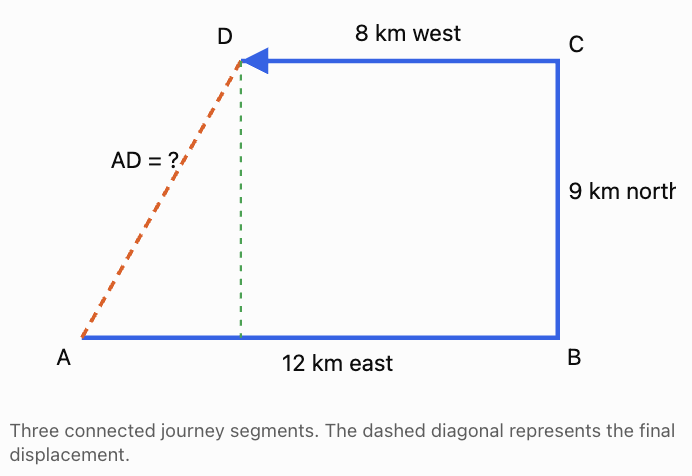
Method 1: Resolve into components.
Total eastward displacement:
12 − 8 = 4 km east
Total northward displacement:
9 km north
Step 2: Calculate the displacement.
AD² = 4² + 9²
AD² = 16 + 81
AD = √97
AD ≈ 9.85 km
Step 3: Calculate the bearing.
tan θ = 4 / 9
θ = tan⁻¹(4/9)
θ ≈ 23.96°
Answer:
The vessel is approximately 9.85 km from its starting point on a bearing of 024°.
The total distance travelled is:
12 + 9 + 8 = 29 km
The displacement is much shorter because the vessel changes direction.
Worked Example 11: A Journey with Two Oblique Bearings
An aircraft travels:
-
100 km on a bearing of 060°.
-
Then 80 km on a bearing of 150°.
Calculate its displacement from the starting point and the final bearing.
Step 1: Resolve the first journey.
East₁ = 100 sin 60° ≈ 86.60 km
North₁ = 100 cos 60° = 50 km
Step 2: Resolve the second journey.
East₂ = 80 sin 150° = 40 km
North₂ = 80 cos 150° ≈ −69.28 km
The negative north component means the aircraft travels south during the second stage.
Step 3: Calculate the total components.
Total east:
E = 86.60 + 40
E ≈ 126.60 km
Total north:
N = 50 − 69.28
N ≈ −19.28 km
The aircraft is southeast of its starting point.
Step 4: Calculate the displacement.
d = √(E² + N²)
d ≈ √(126.60² + 19.28²)
d ≈ 128.06 km
Step 5: Calculate the bearing.
The direction is slightly south of east.
Angle south of east:
α = tan⁻¹(19.28 / 126.60)
α ≈ 8.66°
Bearing = 90° + 8.66°
Bearing ≈ 098.66°
Final answer:
The aircraft is approximately 128.06 km from its starting point on a bearing of 099° to the nearest degree.
Worked Example 12: Solving Two Connected Triangles
A hiker travels from A to B, then B to C, then C to D.
-
AB = 10 km due east.
-
BC = 8 km due north.
-
CD = 6 km due east.
Calculate AD using two connected triangles.
Step 1: Find AC.
Triangle ABC is right-angled.
AC² = 10² + 8²
AC = √164
AC ≈ 12.81 km
Step 2: Find angle A in triangle ABC.
tan A = 8/10
A ≈ 38.66°
Step 3: Use triangle ACD.
Since CD is due east, the angle between CA and CD at C is:
180° − 38.66° = 141.34°
Using the Law of Cosines:
AD² = AC² + CD² − 2(AC)(CD)cos 141.34°
AD² ≈ 164 + 36 + 120
AD² = 320
AD ≈ 17.89 km
Verification using components:
Total eastward displacement:
10 + 6 = 16 km
Total northward displacement:
8 km
AD = √(16² + 8²)
AD = √320
AD ≈ 17.89 km
Both methods agree.
This demonstrates how multiple-triangle problems can often be solved more efficiently using components.
Worked Example 13: A Four-Stage Journey
A drone makes the following movements:
-
5 km north.
-
7 km east.
-
3 km south.
-
4 km west.
Find the final displacement and bearing.
Step 1: Combine north-south movements.
5 − 3 = 2 km north
Step 2: Combine east-west movements.
7 − 4 = 3 km east
Step 3: Calculate displacement.
d = √(2² + 3²)
d = √13
d ≈ 3.61 km
Step 4: Calculate bearing.
tan θ = 3/2
θ = tan⁻¹(3/2)
θ ≈ 56.31°
Answer:
The drone is approximately 3.61 km from its starting point on a bearing of 056°.
Its total distance travelled is 19 km.
Learning Target 5: Interpreting Navigation Solutions in Context
A correct calculation is only part of solving a navigation problem.
We must also explain what the result means and determine whether it makes sense in the real situation.
For example, a displacement of 25 km is incomplete if the question also asks for a direction.
Likewise, a bearing of 035° is incorrect if the destination is actually southwest of the starting point.
Distance Versus Displacement
Distance is the total length of the path travelled.
Displacement is the straight-line distance and direction from the starting point to the final position.
Consider a person who walks:
-
6 km east.
-
8 km north.
Total distance = 6 + 8 = 14 km
Displacement = √(6² + 8²) = 10 km
Bearing:
θ = tan⁻¹(6/8)
θ ≈ 36.87°
Therefore, the displacement is 10 km on a bearing of approximately 037°.
The distinction is important because navigation questions may ask for either quantity.
Worked Example 14: Interpreting a Rescue Route
A rescue helicopter is 12 km west and 16 km south of a stranded hiker.
Calculate the straight-line distance and bearing the helicopter must travel to reach the hiker.
Step 1: Identify the direction.
From the helicopter, the hiker is 12 km east and 16 km north.
Therefore, the required bearing must be between 000° and 090°.
Step 2: Calculate distance.
d = √(12² + 16²)
d = √400
d = 20 km
Step 3: Calculate bearing.
tan θ = 12/16
θ = tan⁻¹(0.75)
θ ≈ 36.87°
Answer: The helicopter must travel approximately 20 km on a bearing of 037°.
In reality, the helicopter's route may need adjustment for wind, terrain, restricted airspace, and other operational factors.
Interpreting Bearings in Different Quadrants
When calculating a bearing from components, the signs determine the quadrant.
East component
North component
Quadrant
Bearing range
Positive
Positive
Northeast
000°–090°
Positive
Negative
Southeast
090°–180°
Negative
Negative
Southwest
180°–270°
Negative
Positive
Northwest
270°–360°
For a non-axis-aligned displacement, calculate the reference angle:
α = tan⁻¹(|E| / |N|)
Then convert according to the quadrant:
-
Northeast: bearing = α
-
Southeast: bearing = 180° − α
-
Southwest: bearing = 180° + α
-
Northwest: bearing = 360° − α
For movements exactly north, east, south, or west, use the corresponding cardinal bearing directly.
Worked Example 15: A Southwest Destination
A vessel is located 15 km west and 20 km south of its starting point.
Find its displacement and bearing.
Step 1: Calculate distance.
d = √(15² + 20²)
d = 25 km
Step 2: Calculate the reference angle.
α = tan⁻¹(15/20)
α ≈ 36.87°
Step 3: Convert to a southwest bearing.
Bearing = 180° + 36.87°
Bearing ≈ 216.87°
Answer: The vessel is 25 km from its starting point on a bearing of approximately 217°.
A bearing of 037° would be incorrect because it points northeast rather than southwest.
Understanding Real-World Limitations
Navigation calculations often assume:
-
Travel occurs along straight-line segments.
-
Bearings are measured accurately.
-
The surface can be treated as flat.
-
Distances are measured consistently.
-
Environmental effects are ignored.
For short distances, these assumptions are usually reasonable.
For long-distance aviation or ocean navigation, Earth's curvature becomes important. The shortest path on a sphere follows a great-circle route, which may not have a constant compass bearing.
Real navigation must also consider magnetic variation, wind, currents, obstacles, and measurement uncertainty.
Common Mistakes
Mistake 1: Measuring Bearings Anticlockwise
Bearings are measured clockwise from north.
A direction 40° east of north has a bearing of 040°, not 320°.
Mistake 2: Forgetting Three-Figure Notation
Write 075°, not simply 75°, when reporting a conventional three-figure bearing.
Mistake 3: Confusing a Bearing with Its Reverse
If the bearing from A to B is 060°, the bearing from B to A is 240°.
The reverse direction differs by 180°.
Mistake 4: Using the Wrong Trigonometric Components
For bearings measured clockwise from north:
East = d sin θ
North = d cos θ
These differ from the usual x = d cos θ and y = d sin θ convention for angles measured anticlockwise from east.
Mistake 5: Ignoring Negative Components
A negative eastward component means west.
A negative northward component means south.
Do not remove negative signs before combining displacements.
Mistake 6: Using the Wrong Included Angle
When applying the Law of Cosines, carefully calculate the interior angle of the triangle.
A bearing measured from north is not automatically an interior triangle angle.
Mistake 7: Confusing Distance and Displacement
The total path length and straight-line displacement are usually different.
Always identify which quantity the question asks for.
Mistake 8: Using Inverse Tangent Without Checking the Quadrant
A calculator may give a positive acute reference angle even when the actual bearing is southwest or northwest.
Always examine the signs of the components.
Mistake 9: Rounding Too Early
Keep full calculator precision during intermediate calculations.
Round the final distance or bearing only when presenting the answer.
Mistake 10: Giving an Answer Without Context
An answer such as "25" is incomplete.
A better answer is:
"The vessel is 25 km southwest of its starting point, on a bearing of approximately 217°."
Key Terms
-
Bearing: A direction measured clockwise from north.
-
Three-figure bearing: A bearing written using three digits, such as 045° or 270°.
-
Compass direction: A direction described using north, south, east, or west.
-
Quadrant bearing: A direction described by an angle measured from north or south toward east or west.
-
Reverse bearing: The bearing from a destination back toward the starting point.
-
Navigation: The process of determining position, direction, and routes between locations.
-
Distance: The total length of a travelled path.
-
Displacement: The straight-line change in position, including direction.
-
Vector: A quantity with both magnitude and direction.
-
Component: The horizontal or vertical part of a vector.
-
Resultant displacement: The combined displacement produced by several movements.
-
Triangulation: A method of determining unknown distances or positions using triangles.
-
Baseline: A known distance used as a reference in surveying.
-
Law of Sines: A trigonometric relationship between sides and opposite angles.
-
Law of Cosines: A relationship connecting three sides and an included angle.
-
Included angle: The angle between two specified sides.
-
Surveying: The measurement and mapping of positions, distances, and land features.
-
Great-circle route: The shortest route between two points along a spherical surface.
-
Magnetic variation: The angle between magnetic north and true north at a location.
-
Verification: Checking that a solution is mathematically and contextually reasonable.
Key Takeaways
-
Bearings are measured clockwise from north and normally written using three digits.
-
The main compass bearings are north 000°, east 090°, south 180°, and west 270°.
-
Reverse bearings differ by 180°.
-
For a distance d on bearing θ, the eastward component is d sin θ and the northward component is d cos θ.
-
Positive and negative components indicate direction.
-
The Pythagorean theorem, Law of Sines, and Law of Cosines can be used to solve navigation problems.
-
Surveying uses triangulation to determine inaccessible distances.
-
Multiple-stage journeys can be solved using connected triangles or vector components.
-
Distance is the total path travelled; displacement is the straight-line change in position.
-
Bearings must be checked against the destination's quadrant.
-
Solutions should include units, directions, and an explanation of their meaning.
Check Your Understanding
These questions assess all five learning targets.
Part A: Interpreting Bearings
Question 1
Convert the following quadrant bearings into three-figure bearings.
a) N 35° E
b) S 40° E
c) S 25° W
d) N 60° W
Question 2
The bearing from A to B is 075°.
Find the bearing from B to A.
Part B: Navigation Problems
Question 3
A ship travels 30 km on a bearing of 060°.
Calculate its eastward and northward displacement.
Question 4
A boat travels 12 km east and then 16 km north.
Calculate its displacement and bearing from the starting point.
Part C: Surveying Applications
Question 5
Two surveyors stand 150 m apart at points A and B.
They observe a landmark C.
The interior angles are:
A = 45°
B = 70°
Calculate AC.
Question 6
A surveyor observes two towers from point P.
Tower A is 100 m away on a bearing of 030°.
Tower B is 180 m away on a bearing of 110°.
Calculate the distance between the towers.
Part D: Multiple-Triangle Problems
Question 7
A hiker travels:
-
8 km east.
-
6 km north.
-
3 km west.
Find the final displacement and bearing from the starting point.
Question 8
An aircraft travels:
-
80 km on a bearing of 045°.
-
Then 60 km on a bearing of 135°.
Find the displacement and bearing from the starting point.
Part E: Interpretation and Reasoning
Question 9
A student calculates that a destination is 10 km west and 10 km south of the starting point.
The student reports a bearing of 045°.
Explain the error and calculate the correct bearing.
Question 10
A rescue boat travels 15 km east and 20 km north.
Calculate:
a) Total distance travelled.
b) Displacement.
c) Bearing from the starting point.
d) Explain why distance and displacement are different.
Check Your Understanding — Fully Worked Answers
Answer 1
a) N 35° E = 035°
b) S 40° E = 180° − 40° = 140°
c) S 25° W = 180° + 25° = 205°
d) N 60° W = 360° − 60° = 300°
Answer 2
Reverse bearing = 075° + 180°
Answer: 255°
Answer 3
Eastward displacement:
E = 30 sin 60°
E ≈ 25.98 km
Northward displacement:
N = 30 cos 60°
N = 15 km
Answer: 25.98 km east and 15 km north.
Answer 4
Distance:
d = √(12² + 16²)
d = √400
d = 20 km
Bearing:
tan θ = 12/16
θ ≈ 36.87°
Answer: 20 km on a bearing of approximately 037°.
Answer 5
Find angle C:
C = 180° − 45° − 70°
C = 65°
Apply the Law of Sines:
AC / sin 70° = 150 / sin 65°
AC = 150 sin 70° / sin 65°
Answer: AC ≈ 155.53 m
Answer 6
The angle between the bearings is:
110° − 30° = 80°
Apply the Law of Cosines:
AB² = 100² + 180² − 2(100)(180)cos 80°
AB² = 10,000 + 32,400 − 36,000 cos 80°
AB² ≈ 36,148.67
Answer: AB ≈ 190.13 m
Answer 7
Total eastward displacement:
8 − 3 = 5 km
Northward displacement:
6 km
Distance:
d = √(5² + 6²)
d = √61
d ≈ 7.81 km
Bearing:
tan θ = 5/6
θ ≈ 39.81°
Answer: 7.81 km on a bearing of approximately 040°.
Answer 8
First journey:
E₁ = 80 sin 45° ≈ 56.57 km
N₁ = 80 cos 45° ≈ 56.57 km
Second journey:
E₂ = 60 sin 135° ≈ 42.43 km
N₂ = 60 cos 135° ≈ −42.43 km
Total components:
E ≈ 98.99 km
N ≈ 14.14 km
Distance:
d = √(98.99² + 14.14²)
d = 100 km
Bearing:
θ = tan⁻¹(98.99/14.14)
θ ≈ 81.87°
Answer: 100 km on a bearing of approximately 082°.
Answer 9
The destination is southwest, not northeast.
A bearing of 045° points northeast.
The reference angle is:
tan α = 10/10
α = 45°
For the southwest quadrant:
Bearing = 180° + 45°
Correct bearing = 225°
Answer 10
a) Total distance travelled
15 + 20 = 35 km
b) Displacement
d = √(15² + 20²)
d = 25 km
c) Bearing
tan θ = 15/20
θ ≈ 36.87°
Bearing ≈ 037°
d) Interpretation
The boat travels a total distance of 35 km along its two-stage route.
However, its final position is only 25 km from the starting point in a straight line.
Final answer: 35 km travelled; displacement 25 km on a bearing of 037°.
Final Challenge: A Coastal Navigation and Surveying Mission
A research vessel leaves harbour A and follows this route:
-
It travels 24 km on a bearing of 060° to point B.
-
It then travels 18 km on a bearing of 150° to point C.
-
From C, it travels 12 km due west to point D.
Calculate:
-
The eastward and northward displacement of each stage.
-
The final eastward and northward displacement from A to D.
-
The straight-line distance AD.
-
The bearing from A to D.
-
The total distance travelled.
-
Explain why the final bearing and displacement are reasonable.
Fully Worked Solution
Step 1: Resolve AB into components.
AB = 24 km, bearing 060°.
East₁ = 24 sin 60° ≈ 20.78 km
North₁ = 24 cos 60° = 12 km
Step 2: Resolve BC into components.
BC = 18 km, bearing 150°.
East₂ = 18 sin 150° = 9 km
North₂ = 18 cos 150° ≈ −15.59 km
Step 3: Resolve CD into components.
CD = 12 km due west.
East₃ = −12 km
North₃ = 0 km
Step 4: Calculate the total components.
Total east:
E = 20.78 + 9 − 12
E ≈ 17.78 km
Total north:
N = 12 − 15.59
N ≈ −3.59 km
The vessel is approximately 17.78 km east and 3.59 km south of the harbour.
Step 5: Calculate displacement.
AD = √(E² + N²)
AD ≈ √(17.78² + 3.59²)
AD ≈ 18.14 km
Step 6: Calculate bearing.
The vessel is southeast of the harbour.
Angle south of east:
α = tan⁻¹(3.59/17.78)
α ≈ 11.41°
Bearing = 90° + 11.41°
Bearing ≈ 101.41°
Step 7: Calculate total distance.
Total distance = 24 + 18 + 12
Total distance = 54 km
Step 8: Interpret and verify.
The eastward component is positive and the northward component is negative, so the final destination must be southeast of the harbour.
A bearing of approximately 101° is consistent with this direction.
The displacement of approximately 18.14 km is less than the total distance travelled of 54 km because the vessel changes direction.
Final Results
Quantity
Result
Eastward displacement
17.78 km
Southward displacement
3.59 km
Straight-line displacement
18.14 km
Bearing from A to D
101.41°
Total distance travelled
54 km
Conclusion
Bearings and navigation provide a practical application of geometry, trigonometry, and vector mathematics.
By interpreting compass bearings correctly, we can describe directions precisely and determine the positions of objects relative to one another.
Using the Pythagorean theorem, Law of Sines, and Law of Cosines, we can calculate distances between locations, solve surveying problems, and determine unknown routes.
More complex journeys can be analyzed using multiple connected triangles or by resolving movements into eastward and northward components.
The ability to interpret results is equally important. A meaningful navigation solution must include the correct distance, direction, units, and an explanation of how the result relates to the real situation.
Mastering bearings and navigation develops spatial reasoning and mathematical problem-solving skills that are essential in surveying, aviation, shipping, engineering, mapping, and many other practical fields.
-
5. Applications of Non-Right Triangles
Learning outcomes
- I can model real-world situations using oblique triangles.
- I can select appropriate solution methods.
- I can solve engineering and surveying problems.
- I can communicate mathematical reasoning clearly.
- I can evaluate the reasonableness of solutions.
Introduction
Imagine an engineer designing a bridge across a deep valley. The engineer needs to determine the distance between two support points, but the terrain makes direct measurement impossible.
Or consider a surveyor measuring a triangular piece of land, a pilot calculating the separation between two aircraft, or an architect designing an angled roof structure.
These situations often involve triangles that do not contain a right angle.
Such triangles are called non-right triangles, or oblique triangles.
Unlike right triangles, where the Pythagorean theorem and basic trigonometric ratios are often sufficient, oblique triangles usually require more advanced techniques.
Two particularly important tools are the Law of Sines and the Law of Cosines.
By combining these relationships with geometric reasoning, bearings, area formulas, and mathematical modelling, we can solve many practical measurement problems.
In this lesson, we will learn how to model real-world situations using oblique triangles, select efficient solution methods, solve engineering and surveying problems, communicate mathematical reasoning clearly, and evaluate whether our solutions are reasonable.
Understanding Oblique Triangles
An oblique triangle is any triangle that does not contain a 90° angle.
There are two main types.
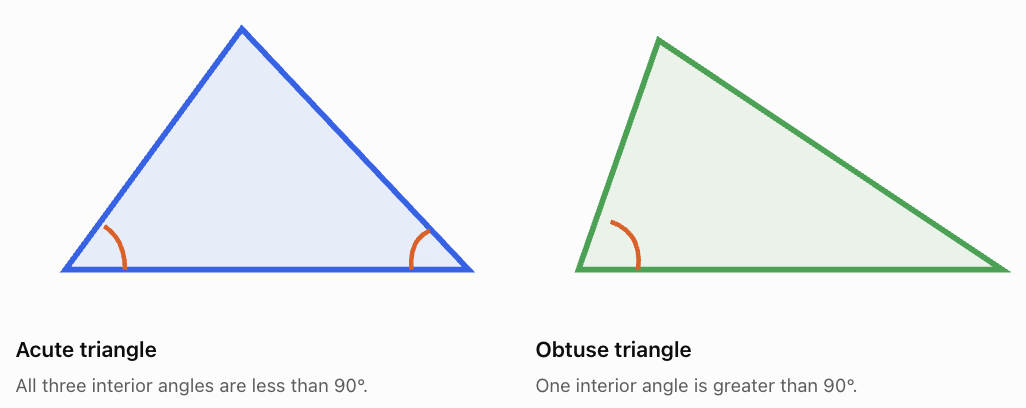
(The second triangle is not shown as obtuse as it should be!)
Every triangle has three sides and three interior angles.
Using standard notation:
-
A, B, and C represent the angles.
-
a is the side opposite angle A.
-
b is the side opposite angle B.
-
c is the side opposite angle C.
The interior angles always satisfy:
A + B + C = 180°
The longest side is opposite the largest angle, while the shortest side is opposite the smallest angle.
These relationships are essential when solving and checking practical problems.
Mathematical Tools for Oblique Triangles
Several formulas form the foundation of non-right triangle applications.
The Law of Sines
a / sin A = b / sin B = c / sin C
This is especially useful when we know an angle and its opposite side, such as in ASA, AAS, or SSA problems.
The Law of Cosines
a² = b² + c² − 2bc cos A
Equivalent forms:
b² = a² + c² − 2ac cos B
c² = a² + b² − 2ab cos C
This is especially useful for SAS and SSS problems.
The Trigonometric Area Formula
Area = ½ab sin C
Equivalent forms:
Area = ½bc sin A
Area = ½ac sin B
This formula is useful when two sides and their included angle are known.
Heron's Formula
When all three sides are known:
s = (a + b + c) / 2
Area = √[s(s − a)(s − b)(s − c)]
Here, s represents the semiperimeter.
These formulas can be used individually or combined to solve more complex problems.
Learning Target 1: Modelling Real-World Situations Using Oblique Triangles
Mathematical modelling is the process of representing a real-world situation using mathematical relationships.
In oblique triangle problems, modelling usually involves identifying three important locations or points and connecting them to form a triangle.
The Mathematical Modelling Process
-
Identify the physical situation and the quantity to be determined.
-
Draw a simplified geometric diagram.
-
Label known sides, angles, and directions.
-
Identify unknown measurements.
-
State any necessary assumptions.
-
Select appropriate mathematical relationships.
-
Calculate the unknown values.
-
Interpret and evaluate the results.
Example 1: Modelling a River Crossing
A surveyor wants to calculate the distance between two points on opposite sides of a river.
The surveyor identifies three locations:
-
A: a measuring station on the near bank.
-
B: a second station 120 m along the bank.
-
C: a tree on the opposite bank.
The surveyor measures:
-
AB = 120 m
-
Angle A = 50°
-
Angle B = 65°
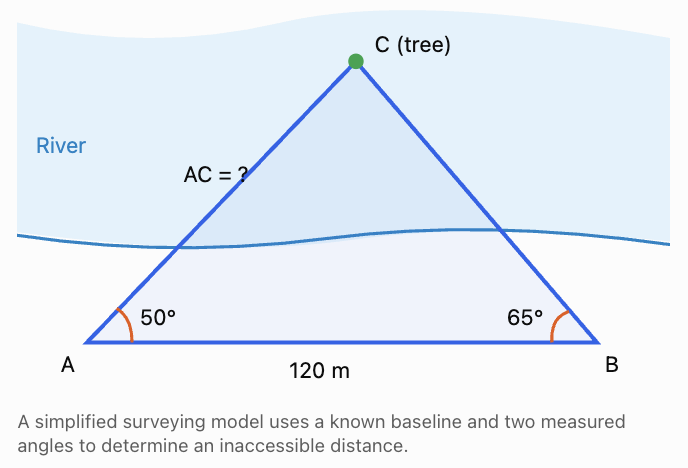
The real situation becomes a triangle with one known side and two known angles.
This is an ASA problem.
Step 1: Find angle C.
C = 180° − 50° − 65°
C = 65°
Step 2: Apply the Law of Sines.
AC / sin 65° = 120 / sin 65°
AC = 120 m
Interpretation: The straight-line distance from A to the tree is 120 m.
However, this is not necessarily the perpendicular width of the river.
If the riverbank is represented by the line AB, the perpendicular distance from C to AB is:
h = AC sin 50°
h = 120 sin 50°
h ≈ 91.93 m
The model provides two different measurements, depending on what the surveyor needs.
Assumptions in the Model
The model assumes that:
-
The three observation points are fixed.
-
The baseline is measured accurately.
-
The angles are measured in the same horizontal plane.
-
The local region can be treated as flat.
-
Measurement uncertainty is small enough for the required accuracy.
In real surveying, slopes and instrument errors may need to be considered.
Example 2: Modelling Two Roads
Two straight roads leave a junction.
One road extends 8 km to town A.
The second road extends 12 km to town B.
The angle between the roads is 65°.
The distance between the towns is the third side of the triangle.
Since we know two sides and the included angle, the model is SAS.
Using the Law of Cosines:
AB² = 8² + 12² − 2(8)(12)cos 65°
AB² ≈ 140.86
AB ≈ 11.87 km
The model assumes that the roads and the connecting distance can be represented by straight lines on a flat map.
The straight-line distance is not necessarily the distance a vehicle would travel along existing roads.
Learning Target 2: Selecting Appropriate Solution Methods
One of the most important mathematical skills is deciding which method to use before beginning a calculation.
A problem may involve the Law of Sines, Law of Cosines, triangle area formulas, right-triangle trigonometry, or a combination of methods.
The most efficient method depends on the available information and the quantity being calculated.
Identifying the Given Information
Given measurements
Triangle type
Recommended method
Two angles and included side
ASA
Law of Sines
Two angles and non-included side
AAS
Law of Sines
Two sides and non-included angle
SSA
Law of Sines; check ambiguity
Two sides and included angle
SAS
Law of Cosines
Three sides
SSS
Law of Cosines
Two sides and included angle, finding area
SAS
Sine area formula
Three sides, finding area
SSS
Heron's formula
A Problem-Solving Decision Guide
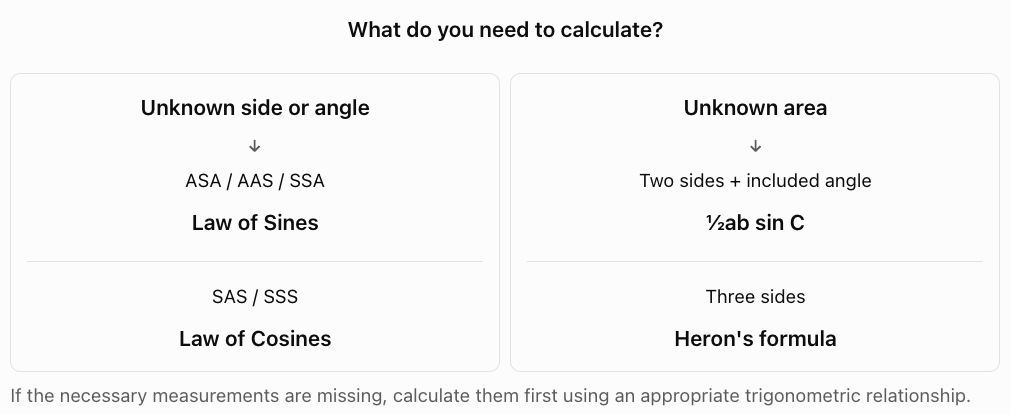
Worked Example 3: Choosing Between the Laws
An engineer knows that two support beams are 7 m and 10 m long. The angle between them is 115°.
Find the distance between their endpoints.
Step 1: Identify the information.
Two sides and their included angle are known.
This is SAS.
Step 2: Choose the Law of Cosines.
d² = 7² + 10² − 2(7)(10)cos 115°
d² = 149 − 140 cos 115°
d² ≈ 208.17
d ≈ 14.43 m
The Law of Sines would not be the best first choice because no complete opposite side-angle pair is known.
Worked Example 4: Finding an Unknown Angle
A triangular steel frame has side lengths:
a = 6 m, b = 9 m, c = 11 m
Calculate angle C.
Because all three sides are known, use the Law of Cosines.
cos C = (a² + b² − c²) / (2ab)
cos C = (36 + 81 − 121) / 108
cos C = −4/108
C = cos⁻¹(−4/108)
C ≈ 92.12°
The result is reasonable because the longest side, c, is opposite the largest angle, C.
Worked Example 5: Choosing a Method for Area
A triangular property has side lengths of 13 m, 14 m, and 15 m.
Calculate its area.
We know all three sides, so Heron's formula is the most direct method.
s = (13 + 14 + 15)/2 = 21 m
Area = √[21(21−13)(21−14)(21−15)]
Area = √7056
Area = 84 m²
Using the Law of Cosines to find an angle and then applying the sine area formula would also work, but it would require more calculations.
When Multiple Methods Are Needed
Some practical problems require more than one formula.
For example, suppose we know two angles and one side, but need to calculate the area.
We might:
-
Use the triangle angle sum to find the third angle.
-
Use the Law of Sines to find another side.
-
Use the sine area formula to calculate the area.
Choosing the correct sequence is part of mathematical problem-solving.
Learning Target 3: Solving Engineering and Surveying Problems
Oblique triangles are widely used in engineering and surveying because many structures and measurement networks contain angled sides.
Application 1: Engineering a Triangular Bridge Support
A bridge engineer designs a triangular steel support.
Two beams have lengths of 8 m and 11 m, with an included angle of 75°.
Calculate the length of the connecting beam.
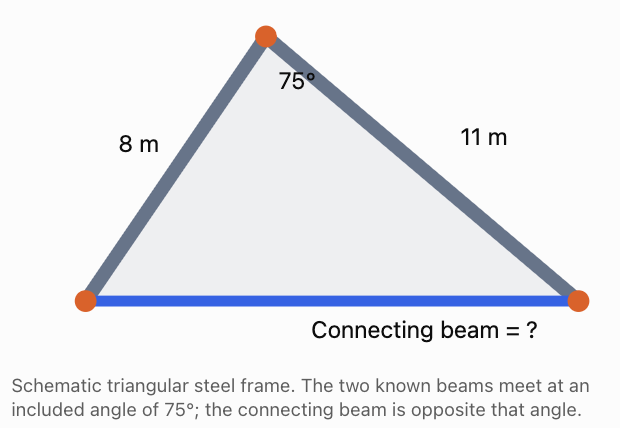
Step 1: Apply the Law of Cosines.
c² = 8² + 11² − 2(8)(11)cos 75°
c² = 64 + 121 − 176 cos 75°
c² ≈ 139.45
c ≈ 11.81 m
Step 2: Interpret the result.
The connecting beam must span approximately 11.81 m between the two endpoints.
In practice, the required manufactured length would also depend on the connection details and construction tolerances.
Application 2: Measuring the Distance Between Two Towers
A surveyor stands at point P.
-
Tower A is 180 m from P.
-
Tower B is 240 m from P.
-
The angle between the directions to the towers is 68°.
Find the distance between the towers.
Using the Law of Cosines:
AB² = 180² + 240² − 2(180)(240)cos 68°
AB² = 32,400 + 57,600 − 86,400 cos 68°
AB² ≈ 57,634
AB ≈ 240.07 m
The two towers are approximately 240.07 m apart in a straight line.
This is an example of indirect measurement, where a distance can be calculated without physically travelling between the objects.
Application 3: Calculating the Area of a Triangular Construction Site
A construction site has two boundaries measuring 75 m and 110 m.
The angle between them is 58°.
Calculate the area of the site.
Area = ½ab sin C
Area = ½ × 75 × 110 × sin 58°
Area = 4125 sin 58°
Area ≈ 3498.20 m²
If landscaping costs $18 per square metre:
Cost = 3498.198... × 18
Cost ≈ $62,967.57
This estimate excludes additional expenses such as site preparation, drainage, and material waste.
Application 4: A Triangular Roof Structure
A roof truss forms a triangle with side lengths:
-
5 m
-
7 m
-
9 m
Calculate its largest interior angle and enclosed area.
Step 1: Calculate the largest angle.
The largest angle is opposite the 9 m side.
cos C = (5² + 7² − 9²)/(2 × 5 × 7)
cos C = (25 + 49 − 81)/70
cos C = −7/70 = −0.1
C = cos⁻¹(−0.1)
C ≈ 95.74°
Step 2: Calculate the area.
Area = ½ × 5 × 7 × sin C
Area = 17.5 sin 95.74°
Area ≈ 17.41 m²
Step 3: Interpret.
The triangle is obtuse, and its enclosed area is approximately 17.41 m².
For an actual roof, this geometric calculation alone would not determine the structural strength or required beam sizes. Those decisions also require load and material analysis.
Application 5: Surveying Across a Valley
Two observation stations A and B are 250 m apart.
They observe a landmark C across a valley.
The measured interior angles are:
A = 42°
B = 73°
Find the distances from both stations to the landmark.
Step 1: Find angle C.
C = 180° − 42° − 73°
C = 65°
Step 2: Find AC.
AC/sin 73° = 250/sin 65°
AC = 250 sin 73°/sin 65°
AC ≈ 263.79 m
Step 3: Find BC.
BC/sin 42° = 250/sin 65°
BC = 250 sin 42°/sin 65°
BC ≈ 184.58 m
The landmark is farther from A than from B.
This agrees with the angle-side relationship: AC is opposite the larger angle of 73°.
Learning Target 4: Communicating Mathematical Reasoning Clearly
A mathematical answer should explain not only what the result is, but also how and why it was obtained.
In engineering and surveying, clear communication is particularly important because calculations may be used by other people to make practical decisions.
The Structure of a Complete Mathematical Solution
A well-communicated solution normally includes:
-
Define the problem. Identify the required measurement.
-
Represent the situation. Draw a labelled diagram and state known information.
-
Choose a method. Explain why the formula is appropriate.
-
Show calculations. Substitute values and demonstrate the mathematical steps.
-
State the result. Include appropriate units and rounding.
-
Interpret and verify. Explain what the answer means and why it is reasonable.
Worked Example 6: A Complete Engineering Explanation
Two support cables extend from a common attachment point.
-
Cable A is 12 m long.
-
Cable B is 16 m long.
-
The angle between them is 70°.
Calculate the distance between the free ends.
Define the unknown.
Let d represent the straight-line distance between the free ends of the cables.
Select the method.
The two cable lengths and their included angle are known. Therefore, the Law of Cosines is appropriate.
Calculate.
d² = 12² + 16² − 2(12)(16)cos 70°
d² = 144 + 256 − 384 cos 70°
d² ≈ 268.66
d ≈ 16.39 m
Interpret.
The free ends of the cables are approximately 16.39 m apart.
Verify.
The triangle inequality requires:
|16 − 12| < d < 16 + 12
4 < 16.39 < 28
The answer satisfies this requirement.
This solution is stronger than simply writing "16.39 m" because the mathematical reasoning is visible and can be checked.
Explaining Why a Formula Is Appropriate
Compare the following explanations.
Incomplete explanation:
"I used the Law of Cosines because it is a triangle."
Complete explanation:
"The Law of Cosines is appropriate because two side lengths and the included angle are known. This is an SAS problem, and the unknown measurement is the side opposite the included angle."
The second explanation identifies the mathematical structure of the problem.
Communicating Assumptions
Real-world models often simplify complicated situations.
For example, a surveyor might assume that:
-
The observation points lie in the same horizontal plane.
-
The measured baseline is straight.
-
The terrain does not affect the horizontal distances.
-
The angles are measured accurately.
These assumptions should be stated when they influence the reliability of the result.
Communicating Precision
Suppose a calculator produces:
d = 18.4376295 m
If the input measurements are given only to the nearest metre, reporting d = 18.4376295 m suggests unrealistic precision.
A more appropriate result might be:
d ≈ 18.4 m
The rounding should reflect the precision of the measurements and the requirements of the problem.
For multi-step calculations, keep unrounded values internally and round only the final result.
Learning Target 5: Evaluating the Reasonableness of Solutions
Mathematical calculations can produce incorrect answers if we use the wrong formula, misinterpret an angle, or enter values incorrectly.
Reasonableness checks help us identify these errors.
Check 1: The Triangle Inequality
For a triangle with sides a, b, and c:
a + b > c
a + c > b
b + c > a
Suppose a triangle has two sides of 7 m and 12 m.
The third side must satisfy:
|12 − 7| < c < 12 + 7
5 < c < 19
Any calculated third side outside this interval is impossible.
Check 2: Compare Angles and Opposite Sides
The largest angle must be opposite the longest side.
For example:
Angle
Opposite side
35°
a
60°
b
85°
c
The sides must satisfy:
a < b < c
This checks the ordering of the measurements, although it does not establish their exact numerical correctness.
Check 3: Check the Angle Sum
Every triangle must satisfy:
A + B + C = 180°
If calculated angles are:
A = 42.5°
B = 68.3°
C = 69.2°
Then:
42.5° + 68.3° + 69.2° = 180°
The angles pass the angle-sum check.
Check 4: Check Maximum Possible Area
For two fixed sides a and b:
Area = ½ab sin C
Since sin C cannot exceed 1:
Area ≤ ½ab
For two sides measuring 8 m and 12 m:
Maximum area = ½ × 8 × 12
Maximum area = 48 m²
A calculated area of 60 m² would be impossible.
Check 5: Verify with Another Method
Consider a triangle with sides:
a = 6 cm, b = 8 cm, c = 10 cm
Using the Pythagorean theorem:
6² + 8² = 10²
36 + 64 = 100
The triangle is right-angled.
Area = ½ × 6 × 8 = 24 cm²
We can also verify using Heron's formula.
s = (6 + 8 + 10)/2 = 12
Area = √[12(12−6)(12−8)(12−10)]
Area = √(12 × 6 × 4 × 2)
Area = √576
Area = 24 cm²
Both methods agree.
Check 6: Evaluate the Physical Context
Suppose an engineer calculates that two attachment points are 18 m apart, but the available connecting beam is only 12 m long.
The mathematical result may be correct, but the proposed design is not feasible without changing the structure or material.
Similarly, a surveying calculation may give a valid horizontal distance, but a construction project might require the actual sloping distance across uneven terrain.
A good mathematical model must answer the correct physical question.
Worked Example 7: Identifying an Incorrect Result
A student is given:
a = 9 cm, b = 13 cm, C = 40°
The student calculates:
c = 21 cm
Is the result reasonable?
Step 1: Check the triangle inequality.
|13 − 9| < c < 13 + 9
4 < c < 22
The student's answer passes this check, but this alone does not prove it is correct.
Step 2: Check the included angle.
C = 40° is acute.
The opposite side c should be relatively short compared with the length it would have if the included angle were 90°.
Step 3: Recalculate.
c² = 9² + 13² − 2(9)(13)cos 40°
c² = 250 − 234 cos 40°
c² ≈ 70.75
c ≈ 8.41 cm
The student's result of 21 cm is incorrect.
This example shows why multiple checks are valuable. A result can satisfy the triangle inequality and still be wrong.
Combining Multiple Oblique Triangles
Some real-world situations involve several connected triangles.
For example, a surveyor may establish a network of observation points to determine the location of a distant landmark.
Worked Example 8: Two Connected Surveying Triangles
A surveyor measures a straight baseline AC consisting of two segments:
-
AB = 100 m
-
BC = 150 m
Points A, B, and C lie on the same straight line, with B between A and C.
A landmark D is observed from A and C.
The measured angles are:
-
Angle DAC = 40°
-
Angle ACD = 65°
Calculate the distance BD.
Step 1: Calculate the full baseline.
AC = AB + BC
AC = 100 + 150
AC = 250 m
Step 2: Find angle ADC.
Angle ADC = 180° − 40° − 65°
Angle ADC = 75°
Step 3: Calculate AD using the Law of Sines.
AD/sin 65° = 250/sin 75°
AD = 250 sin 65°/sin 75°
AD ≈ 234.57 m
Step 4: Consider triangle ABD.
Since B lies on AC:
Angle DAB = 40°
We know:
AB = 100 m
AD ≈ 234.57 m
Angle DAB = 40°
Use the Law of Cosines:
BD² = 100² + AD² − 2(100)(AD)cos 40°
Substituting the unrounded value of AD:
BD ≈ 171.98 m
Interpretation:
The landmark is approximately 171.98 m from observation point B.
This solution required two connected triangles and two different trigonometric laws.
Common Mistakes
Mistake 1: Choosing a Formula Before Identifying the Given Information
Students sometimes select the Law of Sines or Law of Cosines without checking whether the available measurements match the formula.
Correction: Identify ASA, AAS, SSA, SAS, or SSS first.
Mistake 2: Using the Wrong Included Angle
In the Law of Cosines, the angle must be between the two known sides.
Correction: Draw and label the triangle carefully.
Mistake 3: Ignoring the SSA Ambiguous Case
When two sides and a non-included angle are known, zero, one, or two triangles may be possible.
Correction: Check whether the supplementary angle also gives a valid triangle.
Mistake 4: Confusing Direct Distance with Horizontal Distance
A sloping distance across a valley is not necessarily the same as the horizontal separation.
Correction: Identify which distance the practical problem requires.
Mistake 5: Using Incorrect Units
If side lengths are measured in metres, the area must be expressed in square metres.
Correction: Include units throughout the solution.
Mistake 6: Rounding Too Early
Intermediate rounding can introduce errors into later calculations.
Correction: Retain full precision until the final result.
Mistake 7: Accepting an Answer Without Verification
A calculator can produce a numerical result even when the wrong formula or angle has been used.
Correction: Check angle sums, side relationships, and physical reasonableness.
Mistake 8: Ignoring the Assumptions of the Model
A flat triangle model may not represent a large or uneven landscape accurately.
Correction: State assumptions and recognize the limitations of the mathematical model.
Key Terms
-
Oblique triangle: A triangle that does not contain a right angle.
-
Acute triangle: A triangle with three angles smaller than 90°.
-
Obtuse triangle: A triangle containing one angle greater than 90°.
-
Law of Sines: A relationship between side lengths and the sines of their opposite angles.
-
Law of Cosines: A relationship connecting three sides and an included angle.
-
Included angle: The angle between two specified sides.
-
Opposite side: The side directly across from an angle.
-
ASA: Angle-Side-Angle; two angles and the included side are known.
-
AAS: Angle-Angle-Side; two angles and a non-included side are known.
-
SSA: Side-Side-Angle; two sides and a non-included angle are known.
-
SAS: Side-Angle-Side; two sides and the included angle are known.
-
SSS: Side-Side-Side; all three sides are known.
-
Ambiguous case: An SSA situation that may produce zero, one, or two valid triangles.
-
Triangulation: A method of determining unknown distances or positions using triangles.
-
Baseline: A known reference distance used in surveying.
-
Mathematical model: A mathematical representation of a real-world situation.
-
Assumption: A condition accepted as true when constructing a model.
-
Verification: Checking that a calculated result satisfies the mathematical conditions.
-
Reasonableness: Whether a result is consistent with geometry and the physical situation.
-
Heron's formula: A formula for calculating triangle area from three side lengths.
-
Semiperimeter: Half the perimeter of a triangle.
Key Takeaways
-
Oblique triangles are non-right triangles that may be acute or obtuse.
-
Real-world situations can often be represented using labelled triangles.
-
The Law of Sines is particularly useful for ASA, AAS, and SSA problems.
-
The Law of Cosines is particularly useful for SAS and SSS problems.
-
The sine area formula calculates area from two sides and their included angle.
-
Heron's formula calculates area from three side lengths.
-
Some practical problems require several connected triangles or multiple formulas.
-
Clear mathematical reasoning includes diagrams, formulas, substitutions, units, and interpretation.
-
The triangle inequality, angle sum, and side-angle relationships help verify answers.
-
A mathematically correct result must also be evaluated in its real-world context.
-
Assumptions and measurement uncertainty affect the reliability of mathematical models.
Check Your Understanding
The following questions cover all five learning targets. Attempt each problem before consulting the fully worked solutions.
Part A: Mathematical Modelling
Question 1
Two straight roads leave a junction at an angle of 55°.
One road leads to a village 9 km away. The other leads to a town 14 km away.
a) Explain how the situation can be represented by an oblique triangle.
b) Identify the given information.
c) Calculate the straight-line distance between the village and town.
Question 2
A surveyor measures a baseline of 180 m between points A and B.
A landmark C is observed at angles of 45° from A and 70° from B, measured inside triangle ABC.
a) Identify the triangle type.
b) Calculate the distance AC.
c) State two assumptions of the model.
Part B: Selecting Appropriate Methods
Question 3
Choose the most efficient initial method for each situation and explain why.
a) A triangle has two angles and one side.
b) A triangle has three known sides.
c) A triangle has two sides and their included angle.
d) A triangular field has three known sides, and its area is required.
e) A triangle has two sides and an angle opposite one of them.
Question 4
A triangular structure has side lengths of 7 m, 10 m, and 13 m.
Calculate the largest angle.
Part C: Engineering and Surveying
Question 5
An engineer designs a triangular steel frame with two beams measuring 6 m and 9 m.
The included angle is 110°.
Calculate the length of the connecting beam.
Question 6
A surveyor observes two landmarks from point P.
-
PA = 150 m
-
PB = 210 m
-
Angle APB = 72°
Calculate the distance AB.
Question 7
A triangular construction site has two boundaries measuring 85 m and 120 m.
The included angle is 63°.
Calculate:
a) The area of the site.
b) The estimated landscaping cost at $15 per square metre.
Part D: Mathematical Communication
Question 8
A student writes the following solution:
"Two sides are 8 m and 12 m. The angle is 60°. The answer is 10.58 m."
Explain what is missing from the student's solution, then provide a complete mathematical explanation.
Question 9
A surveyor calculates that a landmark is 175.63842 m away.
Explain why reporting the result as 175.6 m may be more appropriate in a real surveying report.
Part E: Reasonableness and Verification
Question 10
A triangle has two sides measuring 5 cm and 9 cm.
A student calculates the third side as 16 cm.
Explain why the result is impossible.
Question 11
A triangular field has two sides measuring 20 m and 30 m.
A student calculates its area as 400 m².
Explain why this answer cannot be correct.
Question 12
A triangle has sides of 9 cm, 12 cm, and 15 cm.
Calculate its area using two different methods and verify that the results agree.
Check Your Understanding — Fully Worked Answers
Answer 1
a) Represent the road junction as one vertex of a triangle, with the village and town as the other two vertices.
b) The given information is SAS:
-
One side = 9 km
-
Second side = 14 km
-
Included angle = 55°
c) Apply the Law of Cosines.
d² = 9² + 14² − 2(9)(14)cos 55°
d² = 81 + 196 − 252 cos 55°
d² ≈ 132.45
d ≈ 11.51 km
The straight-line distance between the village and town is approximately 11.51 km.
Answer 2
a) The triangle is ASA.
b) Find angle C.
C = 180° − 45° − 70°
C = 65°
Use the Law of Sines:
AC/sin 70° = 180/sin 65°
AC = 180 sin 70°/sin 65°
AC ≈ 186.63 m
c) Possible assumptions include:
-
The observation points lie in the same horizontal plane.
-
The baseline and angles are measured accurately.
-
The local area can be modelled using flat geometry.
Answer 3
a) Law of Sines, because two angles and one side are known.
b) Law of Cosines, because all three sides are known.
c) Law of Cosines, because two sides and their included angle are known.
d) Heron's formula, because the area is required and all three sides are known.
e) Law of Sines, because an opposite side-angle pair is known. The ambiguous case must be checked.
Answer 4
The largest angle is opposite the longest side, 13 m.
cos C = (7² + 10² − 13²)/(2 × 7 × 10)
cos C = (49 + 100 − 169)/140
cos C = −20/140
C = cos⁻¹(−1/7)
C ≈ 98.21°
The triangle is obtuse.
Answer 5
Using the Law of Cosines:
c² = 6² + 9² − 2(6)(9)cos 110°
c² = 36 + 81 − 108 cos 110°
c² ≈ 153.94
c ≈ 12.41 m
The connecting beam must span approximately 12.41 m.
Answer 6
AB² = 150² + 210² − 2(150)(210)cos 72°
AB² = 22,500 + 44,100 − 63,000 cos 72°
AB² ≈ 47,131.93
AB ≈ 217.10 m
The landmarks are approximately 217.10 m apart.
Answer 7
a) Calculate area.
Area = ½ab sin C
Area = ½ × 85 × 120 × sin 63°
Area = 5100 sin 63°
Area ≈ 4544.13 m²
b) Calculate landscaping cost.
Cost = Area × 15
Cost ≈ 4544.133... × 15
Cost ≈ $68,162.00
This is an estimated cost based on the mathematical area and the stated price.
Answer 8
The student's solution is incomplete because it does not identify the unknown side, explain the method, show the formula, or demonstrate the calculations.
A complete solution is:
Let c represent the unknown side opposite the 60° angle.
Because two sides and their included angle are known, use the Law of Cosines.
c² = 8² + 12² − 2(8)(12)cos 60°
c² = 64 + 144 − 96
c² = 112
c = √112
c ≈ 10.58 m
The result satisfies the triangle inequality:
4 < 10.58 < 20
Therefore, the calculated length is reasonable.
Answer 9
Reporting 175.63842 m suggests that the measurement is accurate to a very small fraction of a millimetre.
In real surveying, the original measurements may not support that level of precision.
Reporting 175.6 m may better reflect the accuracy of the instruments and the measurements.
The appropriate number of decimal places should depend on the measurement uncertainty and the purpose of the survey.
Answer 10
The triangle inequality requires:
|9 − 5| < c < 9 + 5
4 < c < 14
Since 16 > 14, the student's answer is impossible.
Answer 11
The maximum possible area is:
Area(max) = ½ × 20 × 30
Area(max) = 300 m²
This occurs when the included angle is 90°.
Since 400 m² exceeds the maximum, the student's result is impossible.
Answer 12
Given sides:
a = 9 cm, b = 12 cm, c = 15 cm
Method 1: Pythagorean theorem and basic area formula
9² + 12² = 81 + 144 = 225
15² = 225
Therefore, the triangle is right-angled.
Area = ½ × 9 × 12
Area = 54 cm²
Method 2: Heron's formula
s = (9 + 12 + 15)/2
s = 18 cm
Area = √[18(18−9)(18−12)(18−15)]
Area = √(18 × 9 × 6 × 3)
Area = √2916
Area = 54 cm²
Both methods agree exactly.
Final Integrated Challenge: Planning a Mountain Research Station
A research organization is planning a new observation station in a mountainous region.
Three locations, A, B, and C, form a triangular network.
The measured distances are:
-
AB = 320 m
-
AC = 450 m
-
Angle BAC = 58°
The organization needs to calculate the distance between B and C, the area of the triangular region, and the remaining angles.
Tasks
-
Identify the triangle type and choose an appropriate method.
-
Calculate BC.
-
Calculate angle B.
-
Calculate angle C.
-
Calculate the area of triangle ABC.
-
Estimate the cost of preparing the area at $22 per square metre.
-
Verify the results and explain the limitations of the model.
Fully Worked Solution
Step 1: Identify the information.
We know two sides and the included angle.
This is an SAS problem.
The Law of Cosines is appropriate for finding BC.
Step 2: Calculate BC.
BC² = 320² + 450² − 2(320)(450)cos 58°
BC² = 102,400 + 202,500 − 288,000 cos 58°
BC² ≈ 152,287.25
BC ≈ 390.24 m
Step 3: Calculate angle B.
Angle B is opposite side AC = 450 m.
Using the Law of Cosines:
cos B = (AB² + BC² − AC²)/(2 × AB × BC)
cos B = (320² + BC² − 450²)/(2 × 320 × BC)
Using the unrounded value of BC:
B ≈ 77.86°
Step 4: Calculate angle C.
C = 180° − 58° − 77.86°
C ≈ 44.14°
Step 5: Calculate the area.
Area = ½ × AB × AC × sin A
Area = ½ × 320 × 450 × sin 58°
Area = 72,000 sin 58°
Area ≈ 61,059.46 m²
Step 6: Calculate the estimated cost.
Cost = Area × $22
Cost = 61,059.462... × 22
Cost ≈ $1,343,308.17
Step 7: Verify the results.
Angle sum:
58° + 77.86° + 44.14° = 180°
Side-angle comparison:
-
Longest side: AC = 450 m, opposite the largest angle B.
-
Middle side: BC ≈ 390.24 m, opposite angle A = 58°.
-
Shortest side: AB = 320 m, opposite the smallest angle C.
Triangle inequality:
320 + 390.24 > 450
All conditions are satisfied.
Step 8: Evaluate the model.
The calculations assume that the three locations form a triangle on a flat horizontal plane.
In mountainous terrain, actual ground distances and usable surface areas may differ because of slopes and elevation changes.
A real engineering project would require additional topographical measurements.
Final Results
Quantity
Result
Distance BC
390.24 m
Angle B
77.86°
Angle C
44.14°
Horizontal triangular area
61,059.46 m²
Estimated preparation cost
$1,343,308.17
Conclusion
Non-right triangles provide powerful mathematical models for solving real-world measurement problems.
By recognizing the information available and selecting appropriate formulas, we can calculate inaccessible distances, unknown angles, areas, and dimensions in practical situations.
The Law of Sines and Law of Cosines are especially useful in surveying, navigation, construction, and engineering. Combined with area formulas and geometric reasoning, they allow us to solve increasingly complex problems.
However, obtaining a numerical answer is only one part of mathematical problem-solving.
We must also communicate our reasoning clearly, justify our choice of methods, verify our calculations, and evaluate whether our results make sense in the real world.
The ability to model, solve, explain, and evaluate oblique triangle problems is an important foundation for advanced trigonometry, engineering mathematics, surveying, and applied geometry.
-