Non-Right Triangles
4. Bearings and Navigation
Learning outcomes
- I can interpret compass bearings.
- I can solve navigation problems.
- I can apply trigonometry to surveying situations.
- I can solve problems involving multiple triangles.
- I can interpret solutions in context.
Introduction
Imagine being the captain of a ship travelling across the ocean. There are no roads, street signs, or visible pathways to follow. Instead, you must determine your direction using a compass, calculate distances between locations, and plan a route that will take you safely to your destination.
Or imagine a surveyor standing on a hill, trying to determine the location of a distant building without walking directly to it.
Both situations involve bearings and navigation, which combine geometry, trigonometry, and spatial reasoning to solve practical measurement problems.
Bearings describe directions using angles measured from north. When combined with distances, they allow us to calculate positions, determine routes, measure inaccessible distances, and solve problems involving multiple triangles.
These mathematical techniques are used in aviation, shipping, surveying, engineering, mapping, search and rescue, and many other fields.
In this lesson, we will learn to interpret compass bearings, solve navigation problems, apply trigonometry to surveying, work with multiple connected triangles, and interpret mathematical results in realistic situations.
Understanding Compass Directions
A compass identifies four main directions:
-
North (N): 0° or 360°
-
East (E): 90°
-
South (S): 180°
-
West (W): 270°
The four intermediate directions are:
-
Northeast (NE): 45°
-
Southeast (SE): 135°
-
Southwest (SW): 225°
-
Northwest (NW): 315°
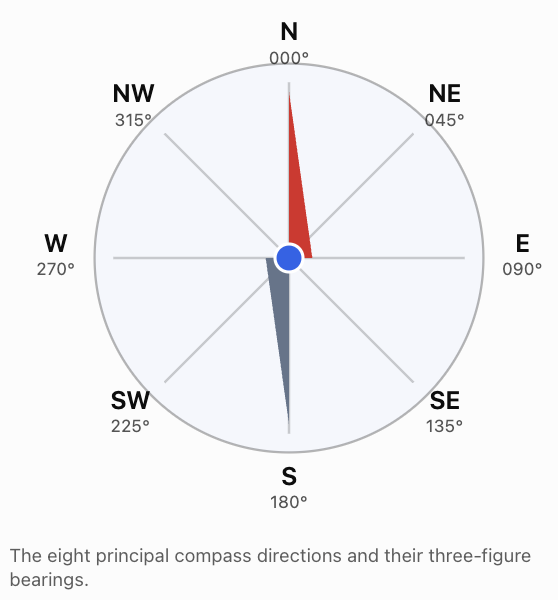
In mathematics, navigation bearings are normally measured clockwise from north.
This differs from standard mathematical angles, which are usually measured anticlockwise from the positive x-axis.
Learning Target 1: Interpreting Compass Bearings
What Is a Bearing?
A bearing is an angle that describes the direction of one location from another.
Bearings are measured:
-
From north.
-
In a clockwise direction.
-
Using angles between 000° and 360°.
-
Usually written with three digits.
For example:
-
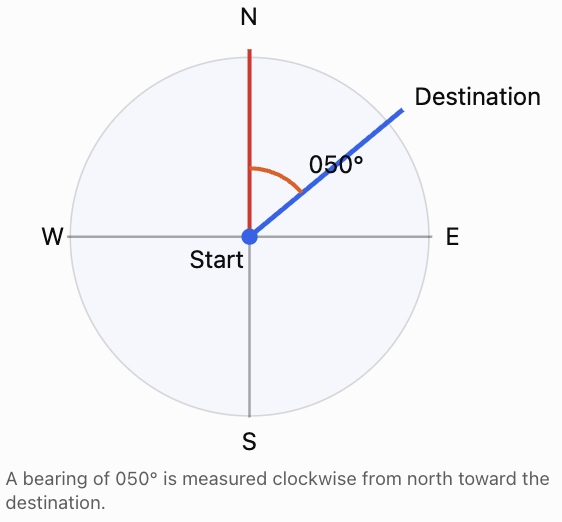
045° means 45° clockwise from north.
-
090° means due east.
-
180° means due south.
-
270° means due west.
-
315° means northwest.
A bearing of 070° is not the same as 70° anticlockwise from east.
The starting direction and direction of rotation are essential.
Three-Figure Bearings
Bearings are normally written using three digits.
Direction
Bearing
North
000°
Northeast
045°
East
090°
Southeast
135°
South
180°
Southwest
225°
West
270°
Northwest
315°
For example, a bearing of 025° means 25° clockwise from north.
A bearing of 250° means 250° clockwise from north, placing the direction between south and west.
Visualizing a Bearing
Compass Bearings and Quadrant Bearings
Some navigation problems use quadrant bearings instead of three-figure bearings.
A quadrant bearing begins with north or south and turns toward east or west through an angle of at most 90°.
For example:
N 35° E means 35° east of north.
S 20° W means 20° west of south.
The following conversions are useful.
Quadrant bearing
Three-figure bearing
N 30° E
030°
S 40° E
140°
S 25° W
205°
N 50° W
310°
Worked Example 1: Converting Bearings
Convert the following directions into three-figure bearings.
a) N 40° E
Start at north and rotate 40° toward east.
Bearing = 040°
b) S 35° E
Start at south (180°) and rotate 35° toward east.
Bearing = 180° − 35°
Bearing = 145°
c) S 60° W
Start at south and rotate 60° toward west.
Bearing = 180° + 60°
Bearing = 240°
d) N 25° W
Start at north and rotate 25° toward west.
Bearing = 360° − 25°
Bearing = 335°
Reverse Bearings
The reverse bearing is the direction back to the starting point.
If the bearing from A to B is θ, the reverse bearing from B to A differs by 180°.
Use:
-
If θ < 180°, add 180°.
-
If θ ≥ 180°, subtract 180°.
Worked Example 2: Finding a Reverse Bearing
The bearing from A to B is 065°.
Find the bearing from B to A.
Reverse bearing = 065° + 180°
Answer: 245°
Another example:
The bearing from P to Q is 290°.
Reverse bearing = 290° − 180°
Answer: 110°
Reverse bearings are especially important when solving navigation problems involving several locations.
Learning Target 2: Solving Navigation Problems
Navigation problems often involve a journey consisting of one or more straight-line movements.
A ship, aircraft, or vehicle may travel a known distance on a particular bearing, then change direction.
We can use trigonometry to calculate:
-
Horizontal and vertical components of a journey.
-
Straight-line displacement.
-
Distance between locations.
-
The bearing required to reach a destination.
-
The difference between total distance travelled and displacement.
Resolving a Bearing into Components
Suppose an object travels a distance d on a bearing θ.
Taking east as the positive x-direction and north as the positive y-direction:
Eastward displacement = d sin θ
Northward displacement = d cos θ
These formulas work for all bearings when the signs are retained.
For example:
-
Positive eastward component means east.
-
Negative eastward component means west.
-
Positive northward component means north.
-
Negative northward component means south.
Worked Example 3: Finding Eastward and Northward Displacement
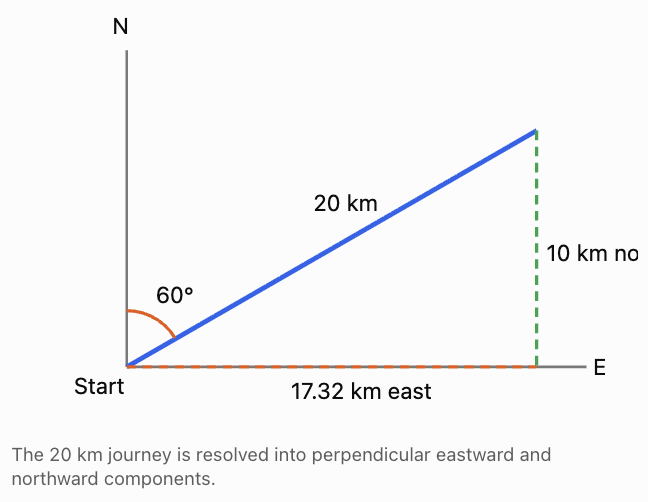
A ship travels 20 km on a bearing of 060°.
Find its eastward and northward displacement.
Step 1: Calculate the eastward component.
East = 20 sin 60°
East ≈ 17.32 km
Step 2: Calculate the northward component.
North = 20 cos 60°
North = 10 km
Answer:
-
17.32 km east
-
10 km north
Worked Example 4: Two-Stage Navigation
A boat travels:
-
12 km due east.
-
Then 9 km due north.
Calculate its displacement and bearing from the starting point.
Step 1: Calculate displacement.
The journey forms a right triangle.
d² = 12² + 9²
d² = 144 + 81
d² = 225
d = 15 km
Step 2: Calculate the bearing.
The angle east of north is:
tan θ = 12 / 9
θ = tan⁻¹(12/9)
θ ≈ 53.13°
Answer:
-
Displacement = 15 km
-
Bearing = 053.13°, approximately 053° to the nearest degree
The total distance travelled is:
12 + 9 = 21 km
However, the displacement is only 15 km.
This illustrates the distinction between distance and displacement.
Worked Example 5: Navigation Using the Law of Cosines
A ship leaves a harbour and travels 15 km on a bearing of 045°.
A second ship leaves the same harbour and travels 20 km on a bearing of 110°.
Calculate the distance between the ships.
Step 1: Find the included angle.
110° − 45° = 65°
Step 2: Apply the Law of Cosines.
d² = 15² + 20² − 2(15)(20)cos 65°
d² = 225 + 400 − 600 cos 65°
d² ≈ 371.43
d ≈ 19.27 km
Answer: The ships are approximately 19.27 km apart.
Worked Example 6: Finding the Bearing to a Destination
A rescue station is located 8 km east and 15 km north of a ship.
Calculate the distance and bearing from the ship to the rescue station.
Step 1: Calculate the distance.
d² = 8² + 15²
d² = 64 + 225
d = 17 km
Step 2: Calculate the bearing.
tan θ = east / north
tan θ = 8 / 15
θ = tan⁻¹(8/15)
θ ≈ 28.07°
Answer:
The rescue station is 17 km away on a bearing of approximately 028°.
Because the station is northeast of the ship, a bearing between 000° and 090° is reasonable.
Learning Target 3: Applying Trigonometry to Surveying Situations
Surveying involves measuring distances, angles, elevations, and positions to determine the locations of objects and boundaries.
Surveyors frequently need to measure distances that cannot be reached directly, such as:
-
The width of a river.
-
The distance to a building across a valley.
-
The separation between two distant landmarks.
-
The boundaries of a large property.
-
The location of an object relative to known reference points.
Trigonometry makes these measurements possible using a technique called triangulation.
What Is Triangulation?
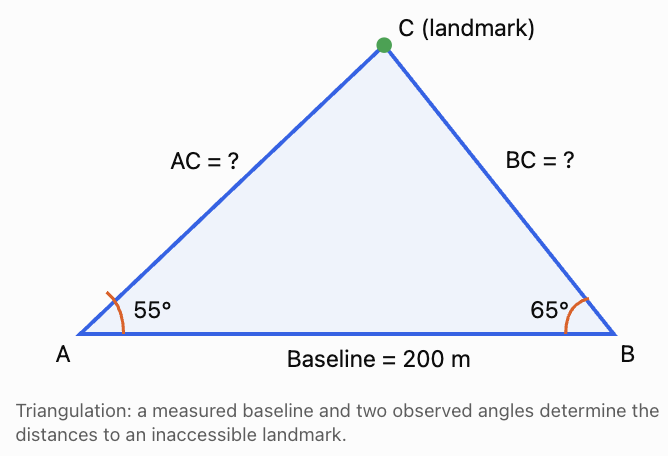
Triangulation involves forming a triangle using a known baseline and measured angles.
Once enough information is available, the Law of Sines or Law of Cosines can be used to calculate unknown distances.
Worked Example 7: Surveying a Distant Landmark
Two surveyors stand 200 m apart at points A and B.
They observe a landmark at point C.
The measured interior angles are:
-
A = 55°
-
B = 65°
Calculate the distances AC and BC.
Step 1: Find angle C.
C = 180° − 55° − 65°
C = 60°
Step 2: Calculate AC using the Law of Sines.
AC / sin 65° = 200 / sin 60°
AC = 200 sin 65° / sin 60°
AC ≈ 209.30 m
Step 3: Calculate BC.
BC / sin 55° = 200 / sin 60°
BC = 200 sin 55° / sin 60°
BC ≈ 189.18 m
Step 4: Interpret the results.
The landmark is approximately:
-
209.30 m from surveyor A.
-
189.18 m from surveyor B.
The landmark is closer to B, which is consistent with the triangle: BC is opposite the smaller angle A.
Worked Example 8: Calculating the Perpendicular Width of a River
A surveyor stands at point A on a straight riverbank. A second observation point B is 100 m farther along the bank.
A tree at point C is directly across the river from point D, which lies between A and B.
The measured angle between AB and AC is 40°.
The angle between BA and BC is 65°.
Find the perpendicular width CD.
Step 1: Find angle C.
C = 180° − 40° − 65°
C = 75°
Step 2: Calculate AC.
AC / sin 65° = 100 / sin 75°
AC = 100 sin 65° / sin 75°
AC ≈ 93.83 m
Step 3: Calculate the perpendicular height CD.
In right triangle ACD:
sin 40° = CD / AC
CD = AC sin 40°
CD = (100 sin 65° / sin 75°) sin 40°
CD ≈ 60.32 m
The river is approximately 60.32 m wide at this location.
Notice the distinction between the direct distance AC and the perpendicular river width CD.
Worked Example 9: Using Bearings in Surveying
A surveyor at point P observes two buildings.
-
Building A is 150 m away on a bearing of 035°.
-
Building B is 220 m away on a bearing of 110°.
Calculate the distance between the buildings.
Step 1: Calculate the angle between the bearings.
110° − 35° = 75°
Step 2: Apply the Law of Cosines.
AB² = 150² + 220² − 2(150)(220)cos 75°
AB² = 22,500 + 48,400 − 66,000 cos 75°
AB² ≈ 53,817.95
AB = √53,817.95
AB ≈ 231.99 m
Step 3: Interpret.
The buildings are approximately 231.99 m apart in a straight line.
The surveyor can determine their separation without physically measuring the distance between them.
Why Surveying Measurements Need Careful Interpretation
Mathematical calculations assume that the measurements describe the intended geometric model accurately.
In practice, surveyors must consider:
-
Measurement uncertainty.
-
Instrument calibration.
-
Whether distances are horizontal or sloping.
-
Terrain elevation.
-
The difference between grid north, true north, and magnetic north.
-
Whether Earth's curvature matters over the measured distance.
For short, local problems, a flat two-dimensional model is usually appropriate.
For large-scale mapping, more advanced geodetic methods may be required.
Learning Target 4: Solving Problems Involving Multiple Triangles
Many navigation problems cannot be solved using a single triangle.
A journey may involve several changes of direction, creating a chain of connected triangles.
The key is to solve the problem systematically.
Strategies for Multiple-Triangle Problems
-
Draw the complete journey.
-
Label every point, distance, and bearing.
-
Draw north lines at relevant locations.
-
Identify smaller triangles that can be solved.
-
Calculate missing angles using bearings and angle relationships.
-
Use the Law of Sines, Law of Cosines, or right-triangle trigonometry.
-
Combine the results to find the required distance or bearing.
An alternative is to use eastward and northward components. This is often more efficient for journeys involving several stages.
Worked Example 10: A Three-Stage Journey
A research vessel travels:
-
12 km east from A to B.
-
9 km north from B to C.
-
8 km west from C to D.
Find the vessel's displacement and bearing from A to D.
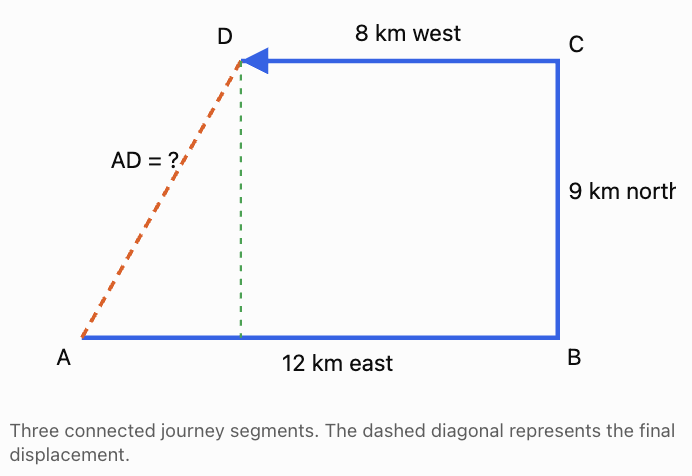
Method 1: Resolve into components.
Total eastward displacement:
12 − 8 = 4 km east
Total northward displacement:
9 km north
Step 2: Calculate the displacement.
AD² = 4² + 9²
AD² = 16 + 81
AD = √97
AD ≈ 9.85 km
Step 3: Calculate the bearing.
tan θ = 4 / 9
θ = tan⁻¹(4/9)
θ ≈ 23.96°
Answer:
The vessel is approximately 9.85 km from its starting point on a bearing of 024°.
The total distance travelled is:
12 + 9 + 8 = 29 km
The displacement is much shorter because the vessel changes direction.
Worked Example 11: A Journey with Two Oblique Bearings
An aircraft travels:
-
100 km on a bearing of 060°.
-
Then 80 km on a bearing of 150°.
Calculate its displacement from the starting point and the final bearing.
Step 1: Resolve the first journey.
East₁ = 100 sin 60° ≈ 86.60 km
North₁ = 100 cos 60° = 50 km
Step 2: Resolve the second journey.
East₂ = 80 sin 150° = 40 km
North₂ = 80 cos 150° ≈ −69.28 km
The negative north component means the aircraft travels south during the second stage.
Step 3: Calculate the total components.
Total east:
E = 86.60 + 40
E ≈ 126.60 km
Total north:
N = 50 − 69.28
N ≈ −19.28 km
The aircraft is southeast of its starting point.
Step 4: Calculate the displacement.
d = √(E² + N²)
d ≈ √(126.60² + 19.28²)
d ≈ 128.06 km
Step 5: Calculate the bearing.
The direction is slightly south of east.
Angle south of east:
α = tan⁻¹(19.28 / 126.60)
α ≈ 8.66°
Bearing = 90° + 8.66°
Bearing ≈ 098.66°
Final answer:
The aircraft is approximately 128.06 km from its starting point on a bearing of 099° to the nearest degree.
Worked Example 12: Solving Two Connected Triangles
A hiker travels from A to B, then B to C, then C to D.
-
AB = 10 km due east.
-
BC = 8 km due north.
-
CD = 6 km due east.
Calculate AD using two connected triangles.
Step 1: Find AC.
Triangle ABC is right-angled.
AC² = 10² + 8²
AC = √164
AC ≈ 12.81 km
Step 2: Find angle A in triangle ABC.
tan A = 8/10
A ≈ 38.66°
Step 3: Use triangle ACD.
Since CD is due east, the angle between CA and CD at C is:
180° − 38.66° = 141.34°
Using the Law of Cosines:
AD² = AC² + CD² − 2(AC)(CD)cos 141.34°
AD² ≈ 164 + 36 + 120
AD² = 320
AD ≈ 17.89 km
Verification using components:
Total eastward displacement:
10 + 6 = 16 km
Total northward displacement:
8 km
AD = √(16² + 8²)
AD = √320
AD ≈ 17.89 km
Both methods agree.
This demonstrates how multiple-triangle problems can often be solved more efficiently using components.
Worked Example 13: A Four-Stage Journey
A drone makes the following movements:
-
5 km north.
-
7 km east.
-
3 km south.
-
4 km west.
Find the final displacement and bearing.
Step 1: Combine north-south movements.
5 − 3 = 2 km north
Step 2: Combine east-west movements.
7 − 4 = 3 km east
Step 3: Calculate displacement.
d = √(2² + 3²)
d = √13
d ≈ 3.61 km
Step 4: Calculate bearing.
tan θ = 3/2
θ = tan⁻¹(3/2)
θ ≈ 56.31°
Answer:
The drone is approximately 3.61 km from its starting point on a bearing of 056°.
Its total distance travelled is 19 km.
Learning Target 5: Interpreting Navigation Solutions in Context
A correct calculation is only part of solving a navigation problem.
We must also explain what the result means and determine whether it makes sense in the real situation.
For example, a displacement of 25 km is incomplete if the question also asks for a direction.
Likewise, a bearing of 035° is incorrect if the destination is actually southwest of the starting point.
Distance Versus Displacement
Distance is the total length of the path travelled.
Displacement is the straight-line distance and direction from the starting point to the final position.
Consider a person who walks:
-
6 km east.
-
8 km north.
Total distance = 6 + 8 = 14 km
Displacement = √(6² + 8²) = 10 km
Bearing:
θ = tan⁻¹(6/8)
θ ≈ 36.87°
Therefore, the displacement is 10 km on a bearing of approximately 037°.
The distinction is important because navigation questions may ask for either quantity.
Worked Example 14: Interpreting a Rescue Route
A rescue helicopter is 12 km west and 16 km south of a stranded hiker.
Calculate the straight-line distance and bearing the helicopter must travel to reach the hiker.
Step 1: Identify the direction.
From the helicopter, the hiker is 12 km east and 16 km north.
Therefore, the required bearing must be between 000° and 090°.
Step 2: Calculate distance.
d = √(12² + 16²)
d = √400
d = 20 km
Step 3: Calculate bearing.
tan θ = 12/16
θ = tan⁻¹(0.75)
θ ≈ 36.87°
Answer: The helicopter must travel approximately 20 km on a bearing of 037°.
In reality, the helicopter's route may need adjustment for wind, terrain, restricted airspace, and other operational factors.
Interpreting Bearings in Different Quadrants
When calculating a bearing from components, the signs determine the quadrant.
East component
North component
Quadrant
Bearing range
Positive
Positive
Northeast
000°–090°
Positive
Negative
Southeast
090°–180°
Negative
Negative
Southwest
180°–270°
Negative
Positive
Northwest
270°–360°
For a non-axis-aligned displacement, calculate the reference angle:
α = tan⁻¹(|E| / |N|)
Then convert according to the quadrant:
-
Northeast: bearing = α
-
Southeast: bearing = 180° − α
-
Southwest: bearing = 180° + α
-
Northwest: bearing = 360° − α
For movements exactly north, east, south, or west, use the corresponding cardinal bearing directly.
Worked Example 15: A Southwest Destination
A vessel is located 15 km west and 20 km south of its starting point.
Find its displacement and bearing.
Step 1: Calculate distance.
d = √(15² + 20²)
d = 25 km
Step 2: Calculate the reference angle.
α = tan⁻¹(15/20)
α ≈ 36.87°
Step 3: Convert to a southwest bearing.
Bearing = 180° + 36.87°
Bearing ≈ 216.87°
Answer: The vessel is 25 km from its starting point on a bearing of approximately 217°.
A bearing of 037° would be incorrect because it points northeast rather than southwest.
Understanding Real-World Limitations
Navigation calculations often assume:
-
Travel occurs along straight-line segments.
-
Bearings are measured accurately.
-
The surface can be treated as flat.
-
Distances are measured consistently.
-
Environmental effects are ignored.
For short distances, these assumptions are usually reasonable.
For long-distance aviation or ocean navigation, Earth's curvature becomes important. The shortest path on a sphere follows a great-circle route, which may not have a constant compass bearing.
Real navigation must also consider magnetic variation, wind, currents, obstacles, and measurement uncertainty.
Common Mistakes
Mistake 1: Measuring Bearings Anticlockwise
Bearings are measured clockwise from north.
A direction 40° east of north has a bearing of 040°, not 320°.
Mistake 2: Forgetting Three-Figure Notation
Write 075°, not simply 75°, when reporting a conventional three-figure bearing.
Mistake 3: Confusing a Bearing with Its Reverse
If the bearing from A to B is 060°, the bearing from B to A is 240°.
The reverse direction differs by 180°.
Mistake 4: Using the Wrong Trigonometric Components
For bearings measured clockwise from north:
East = d sin θ
North = d cos θ
These differ from the usual x = d cos θ and y = d sin θ convention for angles measured anticlockwise from east.
Mistake 5: Ignoring Negative Components
A negative eastward component means west.
A negative northward component means south.
Do not remove negative signs before combining displacements.
Mistake 6: Using the Wrong Included Angle
When applying the Law of Cosines, carefully calculate the interior angle of the triangle.
A bearing measured from north is not automatically an interior triangle angle.
Mistake 7: Confusing Distance and Displacement
The total path length and straight-line displacement are usually different.
Always identify which quantity the question asks for.
Mistake 8: Using Inverse Tangent Without Checking the Quadrant
A calculator may give a positive acute reference angle even when the actual bearing is southwest or northwest.
Always examine the signs of the components.
Mistake 9: Rounding Too Early
Keep full calculator precision during intermediate calculations.
Round the final distance or bearing only when presenting the answer.
Mistake 10: Giving an Answer Without Context
An answer such as "25" is incomplete.
A better answer is:
"The vessel is 25 km southwest of its starting point, on a bearing of approximately 217°."
Key Terms
-
Bearing: A direction measured clockwise from north.
-
Three-figure bearing: A bearing written using three digits, such as 045° or 270°.
-
Compass direction: A direction described using north, south, east, or west.
-
Quadrant bearing: A direction described by an angle measured from north or south toward east or west.
-
Reverse bearing: The bearing from a destination back toward the starting point.
-
Navigation: The process of determining position, direction, and routes between locations.
-
Distance: The total length of a travelled path.
-
Displacement: The straight-line change in position, including direction.
-
Vector: A quantity with both magnitude and direction.
-
Component: The horizontal or vertical part of a vector.
-
Resultant displacement: The combined displacement produced by several movements.
-
Triangulation: A method of determining unknown distances or positions using triangles.
-
Baseline: A known distance used as a reference in surveying.
-
Law of Sines: A trigonometric relationship between sides and opposite angles.
-
Law of Cosines: A relationship connecting three sides and an included angle.
-
Included angle: The angle between two specified sides.
-
Surveying: The measurement and mapping of positions, distances, and land features.
-
Great-circle route: The shortest route between two points along a spherical surface.
-
Magnetic variation: The angle between magnetic north and true north at a location.
-
Verification: Checking that a solution is mathematically and contextually reasonable.
Key Takeaways
-
Bearings are measured clockwise from north and normally written using three digits.
-
The main compass bearings are north 000°, east 090°, south 180°, and west 270°.
-
Reverse bearings differ by 180°.
-
For a distance d on bearing θ, the eastward component is d sin θ and the northward component is d cos θ.
-
Positive and negative components indicate direction.
-
The Pythagorean theorem, Law of Sines, and Law of Cosines can be used to solve navigation problems.
-
Surveying uses triangulation to determine inaccessible distances.
-
Multiple-stage journeys can be solved using connected triangles or vector components.
-
Distance is the total path travelled; displacement is the straight-line change in position.
-
Bearings must be checked against the destination's quadrant.
-
Solutions should include units, directions, and an explanation of their meaning.
Check Your Understanding
These questions assess all five learning targets.
Part A: Interpreting Bearings
Question 1
Convert the following quadrant bearings into three-figure bearings.
a) N 35° E
b) S 40° E
c) S 25° W
d) N 60° W
Question 2
The bearing from A to B is 075°.
Find the bearing from B to A.
Part B: Navigation Problems
Question 3
A ship travels 30 km on a bearing of 060°.
Calculate its eastward and northward displacement.
Question 4
A boat travels 12 km east and then 16 km north.
Calculate its displacement and bearing from the starting point.
Part C: Surveying Applications
Question 5
Two surveyors stand 150 m apart at points A and B.
They observe a landmark C.
The interior angles are:
A = 45°
B = 70°
Calculate AC.
Question 6
A surveyor observes two towers from point P.
Tower A is 100 m away on a bearing of 030°.
Tower B is 180 m away on a bearing of 110°.
Calculate the distance between the towers.
Part D: Multiple-Triangle Problems
Question 7
A hiker travels:
-
8 km east.
-
6 km north.
-
3 km west.
Find the final displacement and bearing from the starting point.
Question 8
An aircraft travels:
-
80 km on a bearing of 045°.
-
Then 60 km on a bearing of 135°.
Find the displacement and bearing from the starting point.
Part E: Interpretation and Reasoning
Question 9
A student calculates that a destination is 10 km west and 10 km south of the starting point.
The student reports a bearing of 045°.
Explain the error and calculate the correct bearing.
Question 10
A rescue boat travels 15 km east and 20 km north.
Calculate:
a) Total distance travelled.
b) Displacement.
c) Bearing from the starting point.
d) Explain why distance and displacement are different.
Check Your Understanding — Fully Worked Answers
Answer 1
a) N 35° E = 035°
b) S 40° E = 180° − 40° = 140°
c) S 25° W = 180° + 25° = 205°
d) N 60° W = 360° − 60° = 300°
Answer 2
Reverse bearing = 075° + 180°
Answer: 255°
Answer 3
Eastward displacement:
E = 30 sin 60°
E ≈ 25.98 km
Northward displacement:
N = 30 cos 60°
N = 15 km
Answer: 25.98 km east and 15 km north.
Answer 4
Distance:
d = √(12² + 16²)
d = √400
d = 20 km
Bearing:
tan θ = 12/16
θ ≈ 36.87°
Answer: 20 km on a bearing of approximately 037°.
Answer 5
Find angle C:
C = 180° − 45° − 70°
C = 65°
Apply the Law of Sines:
AC / sin 70° = 150 / sin 65°
AC = 150 sin 70° / sin 65°
Answer: AC ≈ 155.53 m
Answer 6
The angle between the bearings is:
110° − 30° = 80°
Apply the Law of Cosines:
AB² = 100² + 180² − 2(100)(180)cos 80°
AB² = 10,000 + 32,400 − 36,000 cos 80°
AB² ≈ 36,148.67
Answer: AB ≈ 190.13 m
Answer 7
Total eastward displacement:
8 − 3 = 5 km
Northward displacement:
6 km
Distance:
d = √(5² + 6²)
d = √61
d ≈ 7.81 km
Bearing:
tan θ = 5/6
θ ≈ 39.81°
Answer: 7.81 km on a bearing of approximately 040°.
Answer 8
First journey:
E₁ = 80 sin 45° ≈ 56.57 km
N₁ = 80 cos 45° ≈ 56.57 km
Second journey:
E₂ = 60 sin 135° ≈ 42.43 km
N₂ = 60 cos 135° ≈ −42.43 km
Total components:
E ≈ 98.99 km
N ≈ 14.14 km
Distance:
d = √(98.99² + 14.14²)
d = 100 km
Bearing:
θ = tan⁻¹(98.99/14.14)
θ ≈ 81.87°
Answer: 100 km on a bearing of approximately 082°.
Answer 9
The destination is southwest, not northeast.
A bearing of 045° points northeast.
The reference angle is:
tan α = 10/10
α = 45°
For the southwest quadrant:
Bearing = 180° + 45°
Correct bearing = 225°
Answer 10
a) Total distance travelled
15 + 20 = 35 km
b) Displacement
d = √(15² + 20²)
d = 25 km
c) Bearing
tan θ = 15/20
θ ≈ 36.87°
Bearing ≈ 037°
d) Interpretation
The boat travels a total distance of 35 km along its two-stage route.
However, its final position is only 25 km from the starting point in a straight line.
Final answer: 35 km travelled; displacement 25 km on a bearing of 037°.
Final Challenge: A Coastal Navigation and Surveying Mission
A research vessel leaves harbour A and follows this route:
-
It travels 24 km on a bearing of 060° to point B.
-
It then travels 18 km on a bearing of 150° to point C.
-
From C, it travels 12 km due west to point D.
Calculate:
-
The eastward and northward displacement of each stage.
-
The final eastward and northward displacement from A to D.
-
The straight-line distance AD.
-
The bearing from A to D.
-
The total distance travelled.
-
Explain why the final bearing and displacement are reasonable.
Fully Worked Solution
Step 1: Resolve AB into components.
AB = 24 km, bearing 060°.
East₁ = 24 sin 60° ≈ 20.78 km
North₁ = 24 cos 60° = 12 km
Step 2: Resolve BC into components.
BC = 18 km, bearing 150°.
East₂ = 18 sin 150° = 9 km
North₂ = 18 cos 150° ≈ −15.59 km
Step 3: Resolve CD into components.
CD = 12 km due west.
East₃ = −12 km
North₃ = 0 km
Step 4: Calculate the total components.
Total east:
E = 20.78 + 9 − 12
E ≈ 17.78 km
Total north:
N = 12 − 15.59
N ≈ −3.59 km
The vessel is approximately 17.78 km east and 3.59 km south of the harbour.
Step 5: Calculate displacement.
AD = √(E² + N²)
AD ≈ √(17.78² + 3.59²)
AD ≈ 18.14 km
Step 6: Calculate bearing.
The vessel is southeast of the harbour.
Angle south of east:
α = tan⁻¹(3.59/17.78)
α ≈ 11.41°
Bearing = 90° + 11.41°
Bearing ≈ 101.41°
Step 7: Calculate total distance.
Total distance = 24 + 18 + 12
Total distance = 54 km
Step 8: Interpret and verify.
The eastward component is positive and the northward component is negative, so the final destination must be southeast of the harbour.
A bearing of approximately 101° is consistent with this direction.
The displacement of approximately 18.14 km is less than the total distance travelled of 54 km because the vessel changes direction.
Final Results
Quantity
Result
Eastward displacement
17.78 km
Southward displacement
3.59 km
Straight-line displacement
18.14 km
Bearing from A to D
101.41°
Total distance travelled
54 km
Conclusion
Bearings and navigation provide a practical application of geometry, trigonometry, and vector mathematics.
By interpreting compass bearings correctly, we can describe directions precisely and determine the positions of objects relative to one another.
Using the Pythagorean theorem, Law of Sines, and Law of Cosines, we can calculate distances between locations, solve surveying problems, and determine unknown routes.
More complex journeys can be analyzed using multiple connected triangles or by resolving movements into eastward and northward components.
The ability to interpret results is equally important. A meaningful navigation solution must include the correct distance, direction, units, and an explanation of how the result relates to the real situation.
Mastering bearings and navigation develops spatial reasoning and mathematical problem-solving skills that are essential in surveying, aviation, shipping, engineering, mapping, and many other practical fields.
-