Non-Right Triangles
1. The Law of Sines
Learning outcomes
- I can apply the Law of Sines to solve triangles.
- I can identify when the Law of Sines is appropriate.
- I can solve ambiguous case problems.
- I can verify triangle solutions.
- I can apply the Law of Sines in real-world contexts.
Imagine standing on one side of a river and trying to determine the distance to a tree on the opposite bank. You cannot walk directly across the river with a measuring tape, but you can measure angles and distances from your side.
How can you calculate a distance that you cannot measure directly?
The answer lies in trigonometry, particularly a powerful relationship known as the Law of Sines.
The Law of Sines allows us to calculate unknown sides and angles in triangles, even when the triangles do not contain a right angle. It is especially useful in surveying, navigation, engineering, astronomy, and construction.
Unlike the basic trigonometric ratios sine, cosine, and tangent, which are commonly introduced using right triangles, the Law of Sines works with any triangle.
In this lesson, we will explore how the Law of Sines works, when to use it, how to solve triangles with multiple possible solutions, and how to apply it to real-world problems.
Understanding Triangle Notation
Before applying the Law of Sines, we must understand how triangles are labelled.
A triangle has three vertices, three angles, and three sides.
-
A, B, and C represent the three angles.
-
a represents the side opposite angle A.
-
b represents the side opposite angle B.
-
c represents the side opposite angle C.
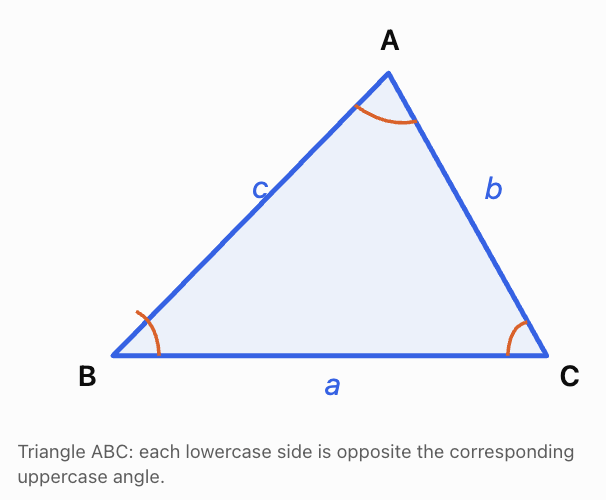
The relationship between each angle and its opposite side is essential.
For example, if angle A is the largest angle, side a must be the longest side.
This is an important property of triangles:
The larger the angle, the longer the side opposite it.
Conversely, the smallest angle is opposite the shortest side.
What Is the Law of Sines?
The Law of Sines states that the ratio of the length of a side to the sine of its opposite angle is constant for all three sides of a triangle.
The formula is:
a / sin A = b / sin B = c / sin C
We can also write it in reciprocal form:
sin A / a = sin B / b = sin C / c
Both forms are mathematically equivalent.
The first form is often convenient when finding an unknown side, while the second is often convenient when finding an unknown angle.
Understanding the Formula
Consider a triangle with the following measurements:
-
A = 40°
-
B = 60°
-
C = 80°
-
a = 8 cm
Using the Law of Sines:
8 / sin 40° = b / sin 60° = c / sin 80°
We can use the known side and angle to calculate the remaining two sides.
The Law of Sines works because the lengths of the sides are related to the sines of their opposite angles.
Why Does the Law of Sines Work?
The Law of Sines can be derived by dividing a triangle into two right triangles.
Consider triangle ABC. Draw a perpendicular height, h, from vertex C to side AB.
In the left right triangle:
sin A = h / b
Rearranging:
h = b sin A
In the right right triangle:
sin B = h / a
Rearranging:
h = a sin B
Because both expressions equal the same height:
b sin A = a sin B
Dividing both sides by sin A × sin B:
a / sin A = b / sin B
Repeating the process using another altitude gives the complete relationship:
a / sin A = b / sin B = c / sin C
This derivation shows that the Law of Sines is not simply a formula to memorize. It follows directly from the geometry of triangles and the definition of sine.
The reasoning also applies when an altitude falls outside an obtuse triangle, using the supplementary-angle identity sin(180° − θ) = sin θ.
When Should We Use the Law of Sines?
The Law of Sines is particularly useful when we know at least one complete pair consisting of an angle and its opposite side.
There are three common situations.
Situation
Information given
Appropriate?
ASA
Two angles and the included side
Yes
AAS
Two angles and a non-included side
Yes
SSA
Two sides and an angle opposite one of them
Yes, but ambiguous
SAS
Two sides and the included angle
Usually use Law of Cosines first
SSS
Three sides
Usually use Law of Cosines first
Case 1: Angle-Side-Angle (ASA)
We know two angles and the side between them.
For example:
A = 45°, B = 70°, c = 12 cm
First find angle C:
C = 180° − 45° − 70° = 65°
We now have an angle and its opposite side, so we can use the Law of Sines.
Case 2: Angle-Angle-Side (AAS)
We know two angles and a side that is not between those angles.
For example:
A = 35°, B = 80°, a = 10 cm
We can immediately write:
10 / sin 35° = b / sin 80°
Case 3: Side-Side-Angle (SSA)
We know two sides and an angle opposite one of those sides.
For example:
A = 35°, a = 8 cm, b = 12 cm
This case requires special care because the given measurements may produce:
-
No triangle
-
Exactly one triangle
-
Two different triangles
This is called the ambiguous case, which we will explore in detail later.
Solving Triangles Using the Law of Sines
To solve a triangle means to determine all three side lengths and all three angles.
The most reliable method is to follow these steps:
-
Draw and label the triangle.
-
Identify the known angles and sides.
-
Find a known angle–opposite side pair.
-
Substitute into the Law of Sines.
-
Rearrange to find the unknown value.
-
Find any remaining angles using the angle sum of 180°.
-
Verify that the answers are reasonable.
Worked Example 1: Finding an Unknown Side (AAS)
A triangle has the following measurements:
-
A = 40°
-
B = 75°
-
a = 12 cm
Find side b and angle C.
Step 1: Calculate angle C.
A + B + C = 180°
C = 180° − 40° − 75°
C = 65°
Step 2: Apply the Law of Sines.
a / sin A = b / sin B
12 / sin 40° = b / sin 75°
Step 3: Rearrange to isolate b.
b = 12 × sin 75° / sin 40°
b = 12 × 0.9659 / 0.6428
b ≈ 18.03 cm
Step 4: Verify the result.
Since B = 75° is larger than A = 40°, side b should be longer than side a.
Our result confirms this:
18.03 cm > 12 cm
The solution is reasonable.
Worked Example 2: Solving an ASA Triangle
Triangle ABC has:
-
A = 50°
-
C = 65°
-
b = 14 cm
Find angles B and sides a and c.
Step 1: Find angle B.
B = 180° − 50° − 65°
B = 65°
Step 2: Find side a.
a / sin 50° = 14 / sin 65°
a = 14 × sin 50° / sin 65°
a ≈ 11.83 cm
Step 3: Find side c.
c / sin 65° = 14 / sin 65°
c = 14 cm
Final answers:
-
A = 50°
-
B = 65°
-
C = 65°
-
a ≈ 11.83 cm
-
b = 14 cm
-
c = 14 cm
Notice that B and C are equal, so their opposite sides b and c must also be equal.
This triangle is an isosceles triangle.
Worked Example 3: Finding an Unknown Angle
A triangle has:
-
A = 30°
-
a = 8 cm
-
b = 10 cm
Find angle B.
Step 1: Apply the Law of Sines.
sin A / a = sin B / b
sin 30° / 8 = sin B / 10
Step 2: Isolate sin B.
sin B = 10 × sin 30° / 8
sin B = 10 × 0.5 / 8
sin B = 0.625
Step 3: Use inverse sine.
B = sin⁻¹(0.625)
B ≈ 38.68°
However, there is an important complication.
Because sin 38.68° = sin 141.32°, another possible angle is:
B = 180° − 38.68°
B ≈ 141.32°
Both possibilities satisfy A + B < 180°.
Therefore, two different triangles are possible.
We must consider both solutions whenever we encounter this type of problem.
The Ambiguous Case (SSA)
One of the most important applications of the Law of Sines involves the ambiguous case.
This occurs when we know:
-
Two sides of a triangle.
-
One angle that is not between those sides.
Unlike ASA and AAS triangles, which determine a unique triangle, SSA measurements do not always determine a unique triangle.
Depending on the measurements, there may be zero, one, or two possible triangles.
Why Can Two Triangles Exist?
Imagine that one side of a triangle has a fixed length, while another side can rotate around a fixed point.
The rotating side may intersect the required position in two different places, creating two triangles with different angles but the same given measurements.
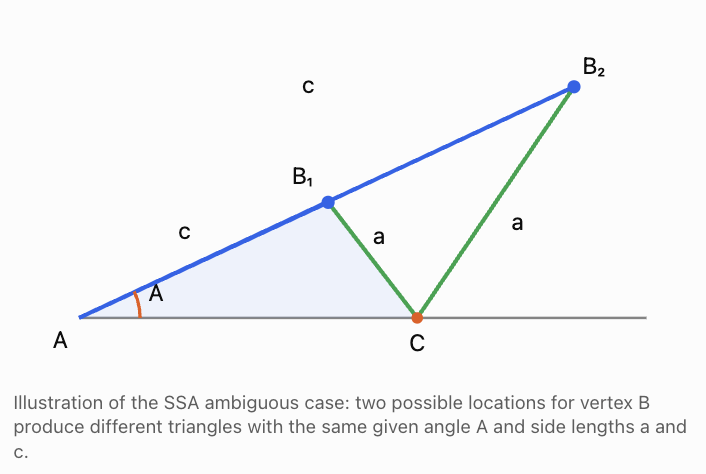
The ambiguity arises because sine has the same value for supplementary angles:
sin θ = sin(180° − θ)
For example:
sin 40° = sin 140°
Therefore, when we use inverse sine to calculate an angle, we must check whether its supplementary angle is also possible.
Determining the Number of Solutions
Suppose angle A is acute and we know sides a and b.
Calculate the height:
h = b sin A
The following rules determine how many triangles are possible.
Condition
Number of triangles
a < h
0
a = h
1 (right triangle)
h < a < b
2
a ≥ b
1
These conditions apply when A is acute.
If A is obtuse, the situation is different:
-
If a ≤ b, no triangle exists.
-
If a > b, exactly one triangle exists.
The reason is that the side opposite an obtuse angle must be the longest side of the triangle.
Worked Example 4: Two Possible Triangles
Given:
-
A = 30°
-
a = 8 cm
-
b = 10 cm
Find all possible values of B, C, and c.
Step 1: Check the height.
h = b sin A
h = 10 × sin 30°
h = 5 cm
Since:
5 < 8 < 10
there are two possible triangles.
Step 2: Find angle B.
sin B = b sin A / a
sin B = 10 × sin 30° / 8
sin B = 0.625
First possibility:
B₁ = sin⁻¹(0.625) ≈ 38.68°
Second possibility:
B₂ = 180° − 38.68° ≈ 141.32°
Step 3: Find angle C in each triangle.
Triangle 1:
C₁ = 180° − 30° − 38.68°
C₁ ≈ 111.32°
Triangle 2:
C₂ = 180° − 30° − 141.32°
C₂ ≈ 8.68°
Both triangles have positive angles that add to 180°.
Step 4: Find side c for each triangle.
Triangle 1:
c₁ / sin 111.32° = 8 / sin 30°
c₁ = 8 × sin 111.32° / sin 30°
c₁ ≈ 14.90 cm
Triangle 2:
c₂ / sin 8.68° = 8 / sin 30°
c₂ = 8 × sin 8.68° / sin 30°
c₂ ≈ 2.42 cm
Final answers:
Measurement
Triangle 1
Triangle 2
A
30°
30°
B
38.68°
141.32°
C
111.32°
8.68°
a
8 cm
8 cm
b
10 cm
10 cm
c
14.90 cm
2.42 cm
Both triangles satisfy the original measurements.
Worked Example 5: No Possible Triangle
Given:
A = 40°, a = 5 cm, b = 12 cm
Determine whether a triangle exists.
Step 1: Calculate the height.
h = b sin A
h = 12 × sin 40°
h ≈ 7.71 cm
Step 2: Compare the side with the height.
a = 5 cm
h ≈ 7.71 cm
Since a < h, the side is too short to complete the triangle.
Answer: No triangle is possible.
We can verify algebraically:
sin B = 12 × sin 40° / 5
sin B ≈ 1.543
The sine of a real angle cannot be greater than 1, confirming that no triangle exists.
Worked Example 6: Exactly One Triangle
Given:
A = 45°, a = 12 cm, b = 8 cm
Determine the number of triangles.
h = 8 × sin 45°
h ≈ 5.66 cm
Since a ≥ b, there is exactly one triangle.
Using the Law of Sines:
sin B = 8 × sin 45° / 12
sin B ≈ 0.4714
B ≈ 28.13°
The supplementary possibility would be:
180° − 28.13° = 151.87°
But:
45° + 151.87° > 180°
Therefore, the supplementary angle is impossible.
Exactly one triangle exists.
Verifying Triangle Solutions
Finding an answer is only part of solving a trigonometry problem. We must also determine whether the answer is mathematically correct and reasonable.
There are several ways to verify a triangle solution.
Method 1: Check the Angle Sum
The interior angles of every triangle must add to 180°.
For example:
A = 42°, B = 68°, C = 70°
42° + 68° + 70° = 180°
The angles satisfy the triangle angle-sum rule.
Method 2: Compare Side Lengths and Angles
The longest side must be opposite the largest angle.
For example:
Angle
Opposite side
A = 35°
a = 7 cm
B = 60°
b = 12 cm
C = 85°
c = 15 cm
The side lengths follow the same increasing order as the angles.
This is consistent with triangle geometry, although it does not by itself prove that the measurements are correct.
Method 3: Substitute into the Law of Sines
Consider:
A = 30°, B = 60°, C = 90°
a = 5 cm, b ≈ 8.66 cm, c = 10 cm
Check the ratios:
a / sin A = 5 / sin 30° = 10
b / sin B ≈ 8.66 / sin 60° ≈ 10
c / sin C = 10 / sin 90° = 10
All three ratios are approximately equal.
The measurements satisfy the Law of Sines.
Method 4: Check the Triangle Inequality
The sum of any two sides of a triangle must be greater than the third side.
For example, sides of 5 cm, 7 cm, and 10 cm form a possible triangle because:
5 + 7 > 10
5 + 10 > 7
7 + 10 > 5
However, sides of 3 cm, 4 cm, and 9 cm cannot form a triangle because:
3 + 4 < 9
This is another useful check, particularly when solving ambiguous-case problems.
Real-World Applications of the Law of Sines
The Law of Sines is especially useful when direct measurement is difficult, expensive, or dangerous.
Application 1: Measuring the Width of a River
A surveyor wants to determine the distance from point A to a tree at point C on the opposite side of a river.
The surveyor measures a 100 m baseline between points A and B on the accessible bank.
The measured angles are:
-
A = 50°
-
B = 65°
-
AB = 100 m
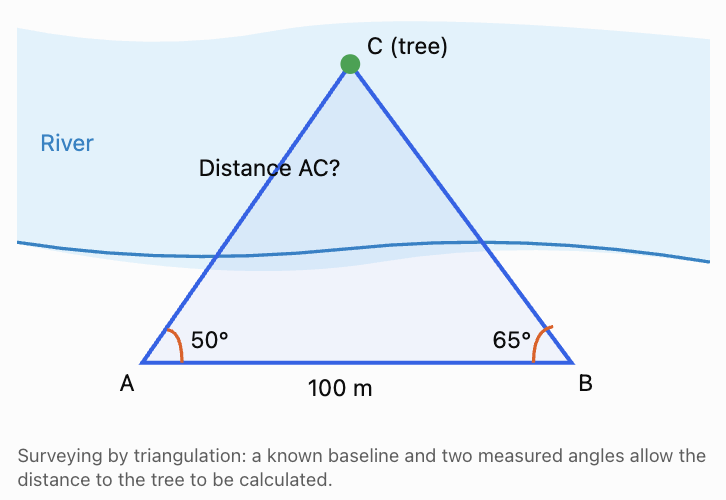
Step 1: Find angle C.
C = 180° − 50° − 65°
C = 65°
Step 2: Apply the Law of Sines.
AC / sin 65° = 100 / sin 65°
AC = 100 m
Answer: The straight-line distance from A to the tree is 100 m.
This is a direct distance, not necessarily the perpendicular width of the river. To find the perpendicular distance from C to the baseline, we could calculate:
h = 100 sin 50°
h ≈ 76.60 m
This illustrates how trigonometry can determine distances without crossing an obstacle.
Application 2: Navigation at Sea
Two ships leave the same harbour and travel in different directions.
Ship A travels 15 km on a bearing of 045°.
Ship B travels 20 km on a bearing of 110°.
How far apart are the ships?
The angle between their routes is:
110° − 45° = 65°
This problem gives two sides and the included angle (SAS). We should therefore begin with the Law of Cosines rather than the Law of Sines.
d² = 15² + 20² − 2(15)(20)cos 65°
d² ≈ 371.43
d ≈ 19.27 km
Answer: The ships are approximately 19.27 km apart.
Once we know the third side, we can use the Law of Sines to calculate the remaining angles of the triangle.
For example, the angle opposite the 15 km side is:
sin B / 15 = sin 65° / 19.27
sin B ≈ 0.7054
B ≈ 44.86°
The remaining angle is approximately:
180° − 65° − 44.86° = 70.14°
This demonstrates how the Law of Sines and Law of Cosines can work together in practical problems.
Application 3: Engineering and Construction
Engineers often need to calculate unknown distances in triangular frameworks, bridges, roof supports, and structural braces.
Suppose a triangular support has:
-
A = 42°
-
B = 78°
-
a = 3.5 m
Find the length of side b.
b / sin 78° = 3.5 / sin 42°
b = 3.5 × sin 78° / sin 42°
b ≈ 5.12 m
Answer: The required support length is approximately 5.12 m.
This type of calculation can help engineers estimate material requirements and determine structural dimensions.
Application 4: Astronomy
Astronomers use triangulation to estimate distances to objects that cannot be reached directly.
Two observation points are separated by a known baseline. By measuring the direction to an object from both points, astronomers can construct a triangle.
The Law of Sines can then be used to determine unknown distances.
For very distant objects, the angles may be extremely small, so precise instruments and specialized techniques are required.
The underlying mathematical principle is the same as the method used by surveyors on Earth.
Common Mistakes
Mistake 1: Matching the Wrong Side and Angle
Incorrect:
a / sin B = b / sin A
Correct:
a / sin A = b / sin B
Always match each side with its opposite angle.
Mistake 2: Forgetting the Ambiguous Case
When solving an SSA triangle, students sometimes calculate only:
B = sin⁻¹(value)
They forget to consider:
B₂ = 180° − B₁
Always check whether the supplementary angle also produces a valid triangle.
Mistake 3: Using the Wrong Calculator Mode
If angles are measured in degrees, the calculator must be in degree mode.
For example:
sin 30° = 0.5
A calculator in radian mode will produce a different value when entering 30.
Mistake 4: Rounding Too Early
Suppose:
sin B = 0.64382
Rounding this to 0.6 before using inverse sine can introduce a significant error.
Keep several decimal places during calculations and round only the final answer.
Mistake 5: Accepting an Impossible Triangle
An inverse sine calculation may produce a valid numerical angle, but the resulting triangle may still be impossible.
For example:
A = 70°, B = 120°
A + B = 190°
Since the angles already exceed 180°, no triangle exists.
Mistake 6: Using the Law of Sines Without a Known Opposite Pair
If a triangle has two known sides and the included angle, the Law of Sines usually cannot be applied immediately.
Use the Law of Cosines first to calculate the third side.
Key Terms
-
Law of Sines: A relationship connecting the sides of a triangle to the sines of their opposite angles.
-
Opposite side: The side located directly across from a particular angle.
-
Sine: A trigonometric function relating angles to side-length ratios.
-
ASA: Angle-Side-Angle; two angles and their included side are known.
-
AAS: Angle-Angle-Side; two angles and a non-included side are known.
-
SSA: Side-Side-Angle; two sides and a non-included angle are known.
-
Ambiguous case: A situation in which SSA information may produce zero, one, or two triangles.
-
Supplementary angles: Two angles whose sum is 180°.
-
Inverse sine: The operation used to find an angle from its sine value.
-
Triangulation: A technique for determining distances or positions using measured angles and a known baseline.
-
Triangle inequality: The rule that the sum of any two sides of a triangle must exceed the third side.
-
Law of Cosines: A relationship used to solve triangles when SAS or SSS information is given.
Key Takeaways
- The Law of Sines is:
a / sin A = b / sin B = c / sin C
-
It works for acute, right, and obtuse triangles.
-
It is especially useful for ASA, AAS, and SSA problems.
-
Every side must be matched with its opposite angle.
-
SSA is called the ambiguous case because it may produce zero, one, or two triangles.
-
When using inverse sine, consider both an angle and its supplement.
-
The interior angles of a triangle always sum to 180°.
-
The longest side is opposite the largest angle.
-
Triangle solutions should be verified using angle sums, side relationships, and substitution.
-
The Law of Sines is used in surveying, navigation, engineering, construction, and astronomy.
Check Your Understanding
Attempt these questions before looking at the solutions.
Question 1: Identifying the Correct Method
For each set of information, determine whether the Law of Sines is appropriate as the first method.
a) A = 40°, B = 70°, a = 8 cm
b) a = 5 cm, b = 7 cm, c = 9 cm
c) A = 35°, a = 6 cm, b = 9 cm
d) a = 12 cm, b = 15 cm, C = 60°
Question 2: Finding an Unknown Side
A triangle has:
A = 35°, B = 80°, a = 9 cm
Calculate side b to two decimal places.
Question 3: Solving a Triangle
Triangle ABC has:
A = 48°, C = 72°, b = 16 cm
Find B, a, and c.
Question 4: Finding an Angle
A triangle has:
A = 40°, a = 12 cm, b = 15 cm
Calculate all possible values of B.
Question 5: The Ambiguous Case
Given:
A = 30°, a = 7 cm, b = 10 cm
Determine the number of possible triangles and calculate the missing angles for each triangle.
Question 6: No Triangle
Given:
A = 50°, a = 6 cm, b = 10 cm
Explain why no triangle is possible.
Question 7: Surveying Application
Two surveyors stand 150 m apart at points A and B. They observe a distant landmark at point C.
The angles are:
A = 55°, B = 65°
Calculate the distance from A to the landmark.
Question 8: Error Analysis
A student calculates:
sin B = 0.8
and concludes:
B = 53.13°
Explain why this answer might be incomplete.
Check Your Understanding — Fully Worked Answers
Answer 1
a) Yes. Two angles and an opposite side are known (AAS).
b) No. Three sides are known (SSS). Use the Law of Cosines first.
c) Yes. Two sides and a non-included angle are known (SSA). Check the ambiguous case.
d) No. Two sides and the included angle are known (SAS). Use the Law of Cosines first.
Answer 2
Using the Law of Sines:
b / sin 80° = 9 / sin 35°
b = 9 × sin 80° / sin 35°
b ≈ 15.45 cm
Answer: b ≈ 15.45 cm
Answer 3
First find B:
B = 180° − 48° − 72°
B = 60°
Find side a:
a / sin 48° = 16 / sin 60°
a = 16 × sin 48° / sin 60°
a ≈ 13.73 cm
Find side c:
c / sin 72° = 16 / sin 60°
c = 16 × sin 72° / sin 60°
c ≈ 17.57 cm
Answers: B = 60°, a ≈ 13.73 cm, c ≈ 17.57 cm
Answer 4
sin B = 15 × sin 40° / 12
sin B ≈ 0.80348
First solution:
B₁ = sin⁻¹(0.80348)
B₁ ≈ 53.46°
Second solution:
B₂ = 180° − 53.46°
B₂ ≈ 126.54°
Check:
40° + 126.54° = 166.54°
Since this is less than 180°, both possibilities are valid.
Answers: B ≈ 53.46° or B ≈ 126.54°
Answer 5
Given:
A = 30°, a = 7 cm, b = 10 cm
Calculate the height:
h = 10 × sin 30° = 5 cm
Since:
5 < 7 < 10
two triangles are possible.
Calculate B:
sin B = 10 × sin 30° / 7
sin B = 5 / 7
B₁ ≈ 45.58°
B₂ = 180° − 45.58° ≈ 134.42°
Find C for each triangle.
Triangle 1:
C₁ = 180° − 30° − 45.58°
C₁ ≈ 104.42°
Triangle 2:
C₂ = 180° − 30° − 134.42°
C₂ ≈ 15.58°
Answer: Two triangles are possible.
-
Triangle 1: B ≈ 45.58°, C ≈ 104.42°
-
Triangle 2: B ≈ 134.42°, C ≈ 15.58°
Answer 6
Calculate the height:
h = b sin A
h = 10 × sin 50°
h ≈ 7.66 cm
Since a = 6 cm is shorter than the required height:
6 < 7.66
the triangle cannot be formed.
Answer: No triangle exists.
Answer 7
First calculate angle C:
C = 180° − 55° − 65°
C = 60°
We want distance AC, which is side b.
Using the Law of Sines:
b / sin 65° = 150 / sin 60°
b = 150 × sin 65° / sin 60°
b ≈ 156.98 m
Answer: The landmark is approximately 156.98 m from point A.
Answer 8
The student calculated only the principal inverse sine value:
B₁ = sin⁻¹(0.8) ≈ 53.13°
However, sine is positive in both the first and second quadrants.
The supplementary angle is:
B₂ = 180° − 53.13°
B₂ ≈ 126.87°
Therefore, depending on the other information in the triangle, both angles might be possible.
Answer: The student must check whether 126.87° also produces a valid triangle.
Final Challenge: Triangulating a Remote Location
Two observation stations, A and B, are separated by a straight baseline of 250 m.
Both stations observe a remote object at point C.
The measured angles are:
A = 42°
B = 73°
Calculate:
a) Angle C
b) Distance AC
c) Distance BC
d) Explain how the measurements could be verified.
Fully Worked Solution
Part a: Find C.
C = 180° − 42° − 73°
C = 65°
Part b: Find AC.
AC / sin 73° = 250 / sin 65°
AC = 250 × sin 73° / sin 65°
AC ≈ 263.79 m
Part c: Find BC.
BC / sin 42° = 250 / sin 65°
BC = 250 × sin 42° / sin 65°
BC ≈ 184.57 m
Part d: Verify the results.
Angle sum:
42° + 73° + 65° = 180°
Side-angle comparison:
-
Largest angle: 73° → longest side: AC ≈ 263.79 m
-
Middle angle: 65° → middle side: AB = 250 m
-
Smallest angle: 42° → shortest side: BC ≈ 184.57 m
Triangle inequality:
184.57 + 250 > 263.79
All checks are satisfied.
Final answers:
-
C = 65°
-
AC ≈ 263.79 m
-
BC ≈ 184.57 m
The Law of Sines has allowed us to determine distances to a remote location using only a measured baseline and two observed angles.
Conclusion
The Law of Sines is one of the most useful tools for solving non-right triangles. It connects side lengths and their opposite angles, allowing us to calculate unknown measurements without directly measuring every part of a triangle.
Understanding when to use the formula is just as important as knowing how to calculate with it. ASA and AAS problems generally produce a unique triangle, while SSA problems require careful examination because multiple solutions may exist.
By checking the angle sum, comparing opposite sides and angles, and substituting results into the original relationship, we can verify that our solutions are mathematically sound.
The same mathematical principles are used by surveyors, navigators, engineers, and scientists to measure distances and solve practical problems where direct measurement is difficult or impossible.
Mastering the Law of Sines prepares us for more advanced trigonometry, including the Law of Cosines, triangle area formulas, and three-dimensional applications.
-
-