Foundations of Trigonometry
2. Right Triangle Trigonometry
Learning outcomes
- I can identify the sides of a right triangle relative to an angle.
- I can define the sine, cosine, and tangent ratios.
- I can determine unknown side lengths using trigonometry.
- I can determine unknown angles using inverse trigonometric functions.
- I can solve real-world problems involving right triangles.
Introduction
Trigonometry is the branch of mathematics that studies the relationships between the angles and sides of triangles. It has countless real-world applications, from measuring the height of buildings and mountains to designing bridges, navigating ships, programming computer graphics, and exploring space.
The simplest form of trigonometry involves right triangles—triangles that contain one angle of 90°. By understanding the relationships between the sides of a right triangle, we can calculate unknown lengths and angles without measuring them directly. These relationships are known as the trigonometric ratios: sine, cosine, and tangent.
What Is a Right Triangle?
A right triangle is a triangle that contains one right angle (90°).
The side opposite the right angle is always the hypotenuse.
The other two sides are called the legs.
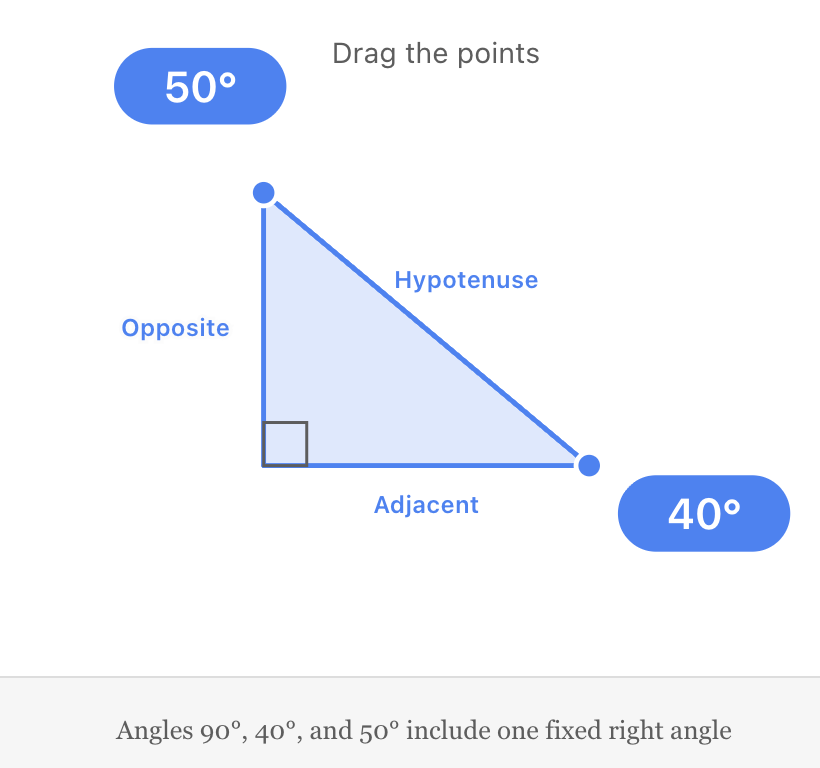
The hypotenuse is always:
- The longest side.
- Opposite the 90° angle.
Identifying the Sides
The names of the sides depend on the reference angle (θ).
Hypotenuse
- Opposite the right angle.
- Always the longest side.
Opposite Side
- Across from the reference angle.
Adjacent Side
- Next to the reference angle.
- Not the hypotenuse.
These names change if you choose a different reference angle.


Figure 1. The names of the sides depend on the chosen reference angle.
The Trigonometric Ratios
The three basic trigonometric ratios are:
- Sine (sin)
- Cosine (cos)
- Tangent (tan)
A useful memory aid is:
SOH CAH TOA
where:
- SOH → Sine = Opposite ÷ Hypotenuse
- CAH → Cosine = Adjacent ÷ Hypotenuse
- TOA → Tangent = Opposite ÷ Adjacent
\( sine = \frac{opposite}{hypotenuse} \)
Sine
The sine ratio compares:
Opposite side ÷ Hypotenuse
Example:
If:
- Opposite = 3
- Hypotenuse = 5
Then:
sin θ = 3/5 = 0.60
Cosine
The cosine ratio compares:
Adjacent side ÷ Hypotenuse
Example:
If:
- Adjacent = 4
- Hypotenuse = 5
Then:
cos θ = 4/5 = 0.80
Tangent
The tangent ratio compares:
Opposite side ÷ Adjacent
\( tan \theta = \frac{sin \theta }{cos \theta } \)
Example:
If:
- Opposite = 3
- Adjacent = 4
Then:
tan θ = 3/4 = 0.75


Figure 2. SOH CAH TOA helps remember the three trigonometric ratios.
Finding Unknown Side Lengths
Once the correct ratio is chosen, unknown sides can be calculated.
Example
A ladder leans against a wall.
- Angle with ground = 40°
- Ladder length = 8 m
Find the height reached.
Known:
- Hypotenuse = 8
- Opposite = ?
Use sine.
sin 40° = Opposite ÷ 8
Opposite = 8 × sin 40°
Opposite ≈ 5.14 m
Always:
- Draw a diagram.
- Label the known sides.
- Choose the correct ratio.
- Rearrange if necessary.
- Calculate.
Finding Unknown Angles
Sometimes the side lengths are known, but the angle is unknown.
To solve these problems we use inverse trigonometric functions.
Examples:
- sin⁻¹
- cos⁻¹
- tan⁻¹
Example:
Opposite = 6
Adjacent = 8
tan θ = 6/8
tan θ = 0.75
θ = tan⁻¹(0.75)
θ ≈ 36.9°
Most scientific calculators have inverse trigonometric buttons.


Figure 3. Scientific calculators use inverse trigonometric functions to calculate unknown angles.
Choosing the Correct Ratio
| Information Known | Ratio to Use |
|---|---|
| Opposite & Hypotenuse. | Sine |
| Adjacent & Hypotenuse | Cosine |
| Opposite & Adjacent | Tangent |
Always identify which sides are known before selecting the ratio.
Solving Real-World Problems
Right triangle trigonometry is used in many situations.
Examples include:
- Finding the height of buildings.
- Measuring the width of rivers.
- Surveying land.
- Designing wheelchair ramps.
- Calculating aircraft flight paths.
- Construction and engineering.
- Navigation.
- Computer graphics.
Many measurements that are difficult to obtain directly can be calculated using trigonometry.


Figure 4. Trigonometry allows heights and distances to be calculated without direct measurement.
Common Problem-Solving Strategy
When solving a trigonometry question:
- Draw the triangle.
- Mark the known angle.
- Label the opposite, adjacent, and hypotenuse.
- Identify the known values.
- Choose the correct trigonometric ratio.
- Solve using a calculator.
- Check that the answer is reasonable.
Following a consistent method reduces mistakes.
Worked Example
Question
A tree casts a shadow 12 m long.
The angle of elevation of the Sun is 50°.
Find the height of the tree.
Solution
Known:
- Adjacent = 12 m
- Opposite = ?
Use tangent.
tan 50° = Height ÷ 12
Height = 12 × tan 50°
Height ≈ 14.3 m
Answer: The tree is approximately 14.3 m tall.
Real-World Connection
Surveyors use trigonometry to measure the heights of mountains, buildings, and towers without climbing them. By measuring one distance and one angle with specialised instruments, they can calculate otherwise inaccessible heights accurately. Trigonometry is also essential in architecture, aviation, robotics, astronomy, and satellite navigation.
Did You Know?
Long before modern calculators existed, sailors, astronomers, and engineers relied on trigonometric tables to perform calculations. These printed tables listed the values of sine, cosine, and tangent for thousands of angles and were essential tools for navigation and scientific discovery.
Key Terms
Adjacent side – The side next to the reference angle that is not the hypotenuse.
Hypotenuse – The side opposite the right angle and the longest side of a right triangle.
Inverse trigonometric function – A function (sin⁻¹, cos⁻¹, or tan⁻¹) used to determine an angle from a trigonometric ratio.
Opposite side – The side directly across from the reference angle.
Reference angle – The angle used to identify the opposite and adjacent sides in a right triangle.
Right triangle – A triangle containing one 90° angle.
Sine (sin) – The ratio of the opposite side to the hypotenuse.
Cosine (cos) – The ratio of the adjacent side to the hypotenuse.
Tangent (tan) – The ratio of the opposite side to the adjacent side.
Trigonometry – The branch of mathematics that studies the relationships between the sides and angles of triangles.
Key Takeaways
- A right triangle contains one 90° angle, and its longest side is the hypotenuse.
- The names opposite and adjacent depend on the chosen reference angle.
- The three basic trigonometric ratios are sine, cosine, and tangent, remembered using SOH CAH TOA.
- Trigonometric ratios can be used to calculate unknown side lengths.
- Inverse trigonometric functions are used to calculate unknown angles.
- Right triangle trigonometry is widely used in engineering, surveying, navigation, construction, and many other real-world applications.