Foundations of Trigonometry
| Website: | Young Education |
| Kurs: | Trigonometry |
| Buch: | Foundations of Trigonometry |
| Gedruckt von: | Guest user |
| Datum: | Freitag, 25. September 2026, 01:05 |
1. Angles and Angle Measurement
Learning outcomes
- I can define angles and identify their parts.
- I can measure angles in degrees and radians.
- I can convert between degrees and radians.
- I can identify positive and negative angles.
- I can determine coterminal angles.
Introduction
Angles are one of the most important concepts in mathematics. They are used to describe turns, rotations, and the positions of lines and objects. From the hands of a clock and the steering of a car to engineering, architecture, navigation, and computer graphics, angles help us describe direction and movement.
Although most people measure angles in degrees, mathematicians and scientists also use another unit called the radian. Understanding both units, along with concepts such as positive and negative angles and coterminal angles, provides the foundation for studying geometry, trigonometry, and calculus.
What Is an Angle?
An angle is formed when two rays share a common endpoint.
The common endpoint is called the vertex.
The two rays are called the arms or sides of the angle.
The size of an angle measures the amount of rotation from one ray to the other.


Figure 1. An angle is formed by two rays that meet at a common endpoint called the vertex.
Parts of an Angle
An angle has three main parts.
- Vertex – The point where the two rays meet.
- Initial side – The ray where the rotation begins.
- Terminal side – The ray where the rotation ends.
Angles are commonly labelled using three letters.
Example:
∠ABC
The middle letter (B) is always the vertex.
Measuring Angles in Degrees
The most familiar unit for measuring angles is the degree (°).
A complete circle contains:
360°
Some common angles are:
| Angle | Measurement |
|---|---|
| Quarter turn | 90° |
| Half turn | 180° |
| Three-quarter turn. | 270° |
| Full turn | 360° |
Angles are usually measured using a protractor.


Figure 2. A protractor is used to measure angles in degrees.
Measuring Angles in Radians
In higher mathematics, angles are often measured in radians (rad).
A radian is based on the radius of a circle rather than dividing a circle into 360 parts.
A complete circle contains:
2π radians
Important radian measurements include:
| Degrees. | Radians |
|---|---|
| 0° | 0 |
| 30° | π/6 |
| 45° | π/4 |
| 60° | π/3 |
| 90° | π/2 |
| 180° | π |
| 270° | 3π/2 |
| 360° | 2π |
Radians are the standard unit used in calculus, physics, and many areas of engineering.


Figure 3. The unit circle shows the relationship between common degree and radian measures.
Converting Between Degrees and Radians
To convert between degrees and radians, use the relationships:
- 180° = π radians
- 360° = 2π radians
Degrees to Radians
Multiply by:
π/180
Example:
60°
= 60 × π/180
= π/3
Radians to Degrees
Multiply by:
180/π
Example:
π/4
= π/4 × 180/π
= 45°
These conversions allow us to switch easily between the two measurement systems.
Positive and Negative Angles
The direction of rotation determines whether an angle is positive or negative.
Positive Angles
Measured by rotating counterclockwise.
Examples:
- 45°
- 120°
- π/2
Negative Angles
Measured by rotating clockwise.
Examples:
- –45°
- –90°
- –π
Positive and negative angles describe the same amount of rotation but in opposite directions.


Figure 4. Positive angles rotate counterclockwise, while negative angles rotate clockwise.
Co-terminal Angles
Co-terminal angles are angles that:
- Start from the same initial side.
- End at the same terminal side.
They differ by whole numbers of complete rotations.
A complete rotation is:
- 360°
- 2π radians
Examples:
45°
405°
765°
All are coterminal because:
405° = 45° + 360°
765° = 45° + 720°
Negative co-terminal angles are also possible.
Example:
45°
–315°
These have the same terminal side.
Finding Co-terminal Angles
To find a co-terminal angle:
Degrees
Add or subtract multiples of 360°.
Example:
120°
120° + 360° = 480°
120° – 360° = –240°
Radians
Add or subtract multiples of 2π.
Example:
π/3
π/3 + 2π
= 7π/3


Figure 5. Co-terminal angles share the same initial and terminal sides but differ by complete rotations.
Why Angle Measurement Is Important
Angles are used in:
- Geometry
- Trigonometry
- Engineering
- Architecture
- Navigation
- Robotics
- Computer graphics
- Astronomy
- Physics
Understanding angle measurement allows us to describe rotations, directions, and positions accurately.
Worked Example
Question 1
Convert 150° to radians.
Solution
Multiply by:
π/180
150 × π/180
= 5π/6
Question 2
Find one positive and one negative coterminal angle for 60°.
Solution
Positive:
60° + 360°
= 420°
Negative:
60° – 360°
= –300°
Real-World Connection
Pilots, ship captains, engineers, and computer programmers all work with angles. Aircraft headings are measured in degrees, robotic arms rotate through precise angles, and video game designers use angles and radians to calculate movement and animation. Even GPS navigation systems rely on accurate angle measurements to determine direction and position.
Did You Know?
Although degrees are commonly used in everyday life, radians are the preferred unit in higher mathematics because they are directly related to the geometry of circles. Many important formulas in physics and calculus become much simpler when angles are measured in radians instead of degrees.
Key Terms
Angle – The amount of rotation between two rays that share a common endpoint.
Co-terminal angles – Angles that share the same initial and terminal sides but differ by whole numbers of full rotations.
Degree (°) – A unit of angle measurement in which one complete rotation equals 360°.
Initial side – The ray from which an angle begins.
Negative angle – An angle measured by rotating clockwise.
Positive angle – An angle measured by rotating counterclockwise.
Radian (rad) – A unit of angle measurement based on the radius of a circle, where one complete rotation equals 2π radians.
Terminal side – The ray where an angle ends after rotation.
Vertex – The common endpoint of the two rays forming an angle.
Key Takeaways
- An angle measures the amount of rotation between two rays sharing a common vertex.
- Angles can be measured in degrees or radians.
- A full circle measures 360° or 2π radians.
- Degrees and radians can be converted using the relationship 180° = π radians.
- Positive angles rotate counterclockwise, while negative angles rotate clockwise.
- Co-terminal angles have the same initial and terminal sides but differ by one or more complete rotations.
2. Right Triangle Trigonometry
Learning outcomes
- I can identify the sides of a right triangle relative to an angle.
- I can define the sine, cosine, and tangent ratios.
- I can determine unknown side lengths using trigonometry.
- I can determine unknown angles using inverse trigonometric functions.
- I can solve real-world problems involving right triangles.
Introduction
Trigonometry is the branch of mathematics that studies the relationships between the angles and sides of triangles. It has countless real-world applications, from measuring the height of buildings and mountains to designing bridges, navigating ships, programming computer graphics, and exploring space.
The simplest form of trigonometry involves right triangles—triangles that contain one angle of 90°. By understanding the relationships between the sides of a right triangle, we can calculate unknown lengths and angles without measuring them directly. These relationships are known as the trigonometric ratios: sine, cosine, and tangent.
What Is a Right Triangle?
A right triangle is a triangle that contains one right angle (90°).
The side opposite the right angle is always the hypotenuse.
The other two sides are called the legs.
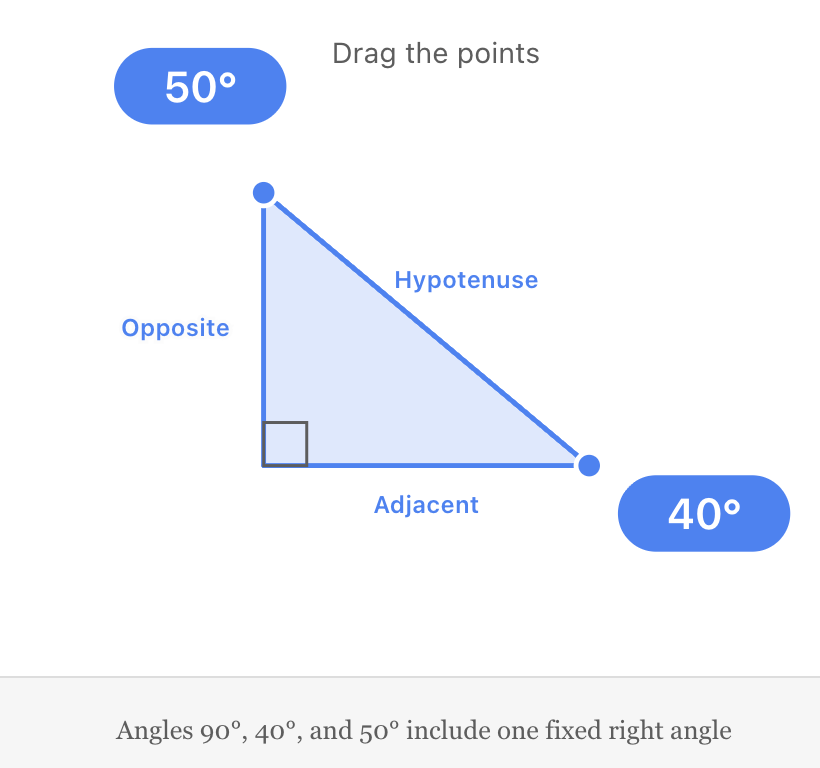
The hypotenuse is always:
- The longest side.
- Opposite the 90° angle.
Identifying the Sides
The names of the sides depend on the reference angle (θ).
Hypotenuse
- Opposite the right angle.
- Always the longest side.
Opposite Side
- Across from the reference angle.
Adjacent Side
- Next to the reference angle.
- Not the hypotenuse.
These names change if you choose a different reference angle.


Figure 1. The names of the sides depend on the chosen reference angle.
The Trigonometric Ratios
The three basic trigonometric ratios are:
- Sine (sin)
- Cosine (cos)
- Tangent (tan)
A useful memory aid is:
SOH CAH TOA
where:
- SOH → Sine = Opposite ÷ Hypotenuse
- CAH → Cosine = Adjacent ÷ Hypotenuse
- TOA → Tangent = Opposite ÷ Adjacent
\( sine = \frac{opposite}{hypotenuse} \)
Sine
The sine ratio compares:
Opposite side ÷ Hypotenuse
Example:
If:
- Opposite = 3
- Hypotenuse = 5
Then:
sin θ = 3/5 = 0.60
Cosine
The cosine ratio compares:
Adjacent side ÷ Hypotenuse
Example:
If:
- Adjacent = 4
- Hypotenuse = 5
Then:
cos θ = 4/5 = 0.80
Tangent
The tangent ratio compares:
Opposite side ÷ Adjacent
\( tan \theta = \frac{sin \theta }{cos \theta } \)
Example:
If:
- Opposite = 3
- Adjacent = 4
Then:
tan θ = 3/4 = 0.75


Figure 2. SOH CAH TOA helps remember the three trigonometric ratios.
Finding Unknown Side Lengths
Once the correct ratio is chosen, unknown sides can be calculated.
Example
A ladder leans against a wall.
- Angle with ground = 40°
- Ladder length = 8 m
Find the height reached.
Known:
- Hypotenuse = 8
- Opposite = ?
Use sine.
sin 40° = Opposite ÷ 8
Opposite = 8 × sin 40°
Opposite ≈ 5.14 m
Always:
- Draw a diagram.
- Label the known sides.
- Choose the correct ratio.
- Rearrange if necessary.
- Calculate.
Finding Unknown Angles
Sometimes the side lengths are known, but the angle is unknown.
To solve these problems we use inverse trigonometric functions.
Examples:
- sin⁻¹
- cos⁻¹
- tan⁻¹
Example:
Opposite = 6
Adjacent = 8
tan θ = 6/8
tan θ = 0.75
θ = tan⁻¹(0.75)
θ ≈ 36.9°
Most scientific calculators have inverse trigonometric buttons.


Figure 3. Scientific calculators use inverse trigonometric functions to calculate unknown angles.
Choosing the Correct Ratio
| Information Known | Ratio to Use |
|---|---|
| Opposite & Hypotenuse. | Sine |
| Adjacent & Hypotenuse | Cosine |
| Opposite & Adjacent | Tangent |
Always identify which sides are known before selecting the ratio.
Solving Real-World Problems
Right triangle trigonometry is used in many situations.
Examples include:
- Finding the height of buildings.
- Measuring the width of rivers.
- Surveying land.
- Designing wheelchair ramps.
- Calculating aircraft flight paths.
- Construction and engineering.
- Navigation.
- Computer graphics.
Many measurements that are difficult to obtain directly can be calculated using trigonometry.


Figure 4. Trigonometry allows heights and distances to be calculated without direct measurement.
Common Problem-Solving Strategy
When solving a trigonometry question:
- Draw the triangle.
- Mark the known angle.
- Label the opposite, adjacent, and hypotenuse.
- Identify the known values.
- Choose the correct trigonometric ratio.
- Solve using a calculator.
- Check that the answer is reasonable.
Following a consistent method reduces mistakes.
Worked Example
Question
A tree casts a shadow 12 m long.
The angle of elevation of the Sun is 50°.
Find the height of the tree.
Solution
Known:
- Adjacent = 12 m
- Opposite = ?
Use tangent.
tan 50° = Height ÷ 12
Height = 12 × tan 50°
Height ≈ 14.3 m
Answer: The tree is approximately 14.3 m tall.
Real-World Connection
Surveyors use trigonometry to measure the heights of mountains, buildings, and towers without climbing them. By measuring one distance and one angle with specialised instruments, they can calculate otherwise inaccessible heights accurately. Trigonometry is also essential in architecture, aviation, robotics, astronomy, and satellite navigation.
Did You Know?
Long before modern calculators existed, sailors, astronomers, and engineers relied on trigonometric tables to perform calculations. These printed tables listed the values of sine, cosine, and tangent for thousands of angles and were essential tools for navigation and scientific discovery.
Key Terms
Adjacent side – The side next to the reference angle that is not the hypotenuse.
Hypotenuse – The side opposite the right angle and the longest side of a right triangle.
Inverse trigonometric function – A function (sin⁻¹, cos⁻¹, or tan⁻¹) used to determine an angle from a trigonometric ratio.
Opposite side – The side directly across from the reference angle.
Reference angle – The angle used to identify the opposite and adjacent sides in a right triangle.
Right triangle – A triangle containing one 90° angle.
Sine (sin) – The ratio of the opposite side to the hypotenuse.
Cosine (cos) – The ratio of the adjacent side to the hypotenuse.
Tangent (tan) – The ratio of the opposite side to the adjacent side.
Trigonometry – The branch of mathematics that studies the relationships between the sides and angles of triangles.
Key Takeaways
- A right triangle contains one 90° angle, and its longest side is the hypotenuse.
- The names opposite and adjacent depend on the chosen reference angle.
- The three basic trigonometric ratios are sine, cosine, and tangent, remembered using SOH CAH TOA.
- Trigonometric ratios can be used to calculate unknown side lengths.
- Inverse trigonometric functions are used to calculate unknown angles.
- Right triangle trigonometry is widely used in engineering, surveying, navigation, construction, and many other real-world applications.
3. The Reciprocal Trigonometric Ratios
Learning outcomes
- I can define cosecant, secant, and cotangent.
- I can relate reciprocal ratios to sine, cosine, and tangent.
- I can evaluate reciprocal trigonometric ratios.
- I can determine reciprocal relationships from diagrams.
- I can solve problems involving all six trigonometric ratios.


4. Solving Right Triangles
Learning outcomes
- I can determine all unknown sides and angles of a right triangle.
- I can select appropriate trigonometric methods.
- I can verify the reasonableness of solutions.
- I can solve multi-step triangle problems.
- I can communicate complete mathematical solutions.


What Does It Mean to Solve a Right Triangle?
To solve a triangle means to determine every unknown side length and every unknown angle.
Every triangle has:
- three sides
- three interior angles
A right triangle already contains one known angle:
90°
Therefore, solving a right triangle usually means finding:
- any unknown side lengths
- the two acute angles
A complete solution gives enough information to describe the entire triangle.
The Parts of a Right Triangle
A right triangle contains one 90° angle.
Relative to one of the other angles, the sides are called:
- opposite
- adjacent
- hypotenuse
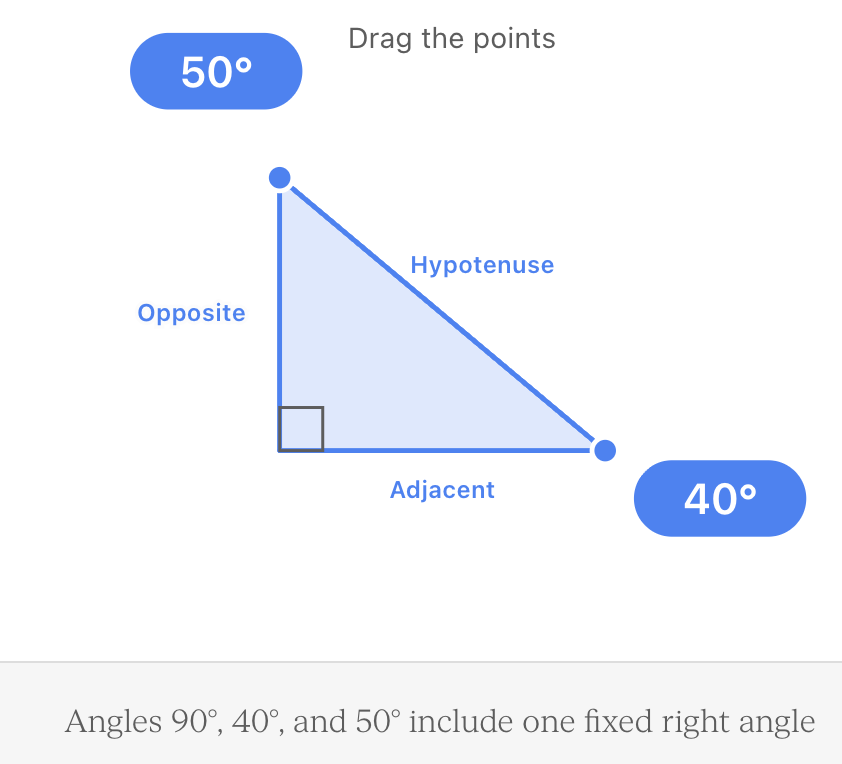
The hypotenuse is always opposite the 90° angle and is always the longest side.
The terms opposite and adjacent depend on which acute angle is being considered.
Information Needed to Solve a Right Triangle
To solve a right triangle, you normally need at least two additional pieces of information besides the 90° angle.
For example:
- two sides
- one side and one acute angle
From these measurements, the remaining sides and angles can usually be calculated.
The Main Tools
Several mathematical tools can be used when solving right triangles:
Pythagorean Theorem
Used when two sides are known and the third side is required.
Sine
Used with the opposite side and hypotenuse.
Cosine
Used with the adjacent side and hypotenuse.
Tangent
Used with the opposite and adjacent sides.
Inverse trigonometric functions
Used when side lengths are known and an angle must be found.
Angle sum
Used to find the remaining acute angle.
The important skill is deciding which tool is most efficient for the information available.
The Pythagorean Theorem
When two sides of a right triangle are known, the third can often be calculated using the Pythagorean theorem.
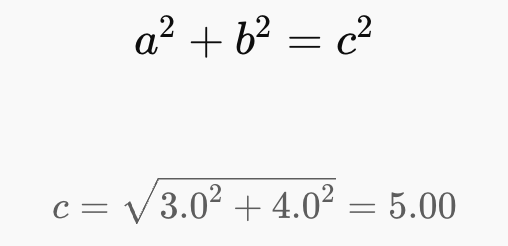
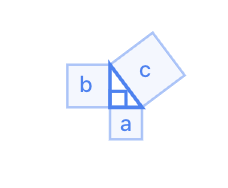
Here:
a and b are the shorter sides.
c is the hypotenuse.
Example 1: Finding the Hypotenuse
Suppose the shorter sides are:
a = 6 cm
b = 8 cm
Then:
c² = 6² + 8²
c² = 36 + 64
c² = 100
c = √100
c = 10 cm
The hypotenuse is 10 cm.
This is the well-known 6–8–10 right triangle.
Finding a Shorter Side
If the hypotenuse and one shorter side are known, rearrange the Pythagorean theorem.
Suppose:
c = 13 cm
a = 5 cm
Find b.
5² + b² = 13²
25 + b² = 169
b² = 144
b = 12 cm
The missing side is 12 cm.
SOH CAH TOA
When an angle and at least one side are involved, trigonometric ratios are often useful.
SOH
sin θ = opposite ÷ hypotenuse
CAH
cos θ = adjacent ÷ hypotenuse
TOA
tan θ = opposite ÷ adjacent
Remember:
SOH – CAH – TOA


Selecting the Correct Trigonometric Method
Ask:
Which sides do I know or need?
If the problem involves:
Opposite + Hypotenuse → sine
Adjacent + Hypotenuse → cosine
Opposite + Adjacent → tangent
Do not select a trig function based on habit.
Select it based on the sides involved.
Example 2: Finding a Side Using Sine
A right triangle has:
Angle = 35°
Hypotenuse = 12 cm
Find the side opposite the 35° angle.
Use sine:
sin 35° = opposite ÷ 12
Let the opposite side be x.
sin 35° = x ÷ 12
x = 12 sin 35°
x ≈ 6.88 cm
The opposite side is approximately 6.88 cm.
Example 3: Finding a Side Using Cosine
A right triangle has:
Angle = 42°
Hypotenuse = 18 m
Find the adjacent side.
cos 42° = adjacent ÷ 18
Let the adjacent side be x.
cos 42° = x ÷ 18
x = 18 cos 42°
x ≈ 13.38 m
The adjacent side is approximately 13.4 m.
Example 4: Finding a Side Using Tangent
A right triangle has:
Angle = 28°
Adjacent side = 15 cm
Find the opposite side.
tan 28° = opposite ÷ 15
Let the opposite side be x.
tan 28° = x ÷ 15
x = 15 tan 28°
x ≈ 7.98 cm
The opposite side is approximately 7.98 cm.
Finding Angles
When side lengths are known but an angle is unknown, use an inverse trigonometric function.
These are:
sin⁻¹
cos⁻¹
tan⁻¹
These functions allow us to work backward from a side ratio to an angle.
Example 5: Finding an Angle Using Tangent
Suppose:
Opposite = 7 cm
Adjacent = 10 cm
Find θ.
tan θ = 7 ÷ 10
tan θ = 0.7
θ = tan⁻¹(0.7)
θ ≈ 35.0°
θ ≈ 35.0°
Example 6: Finding an Angle Using Sine
Suppose:
Opposite = 9 m
Hypotenuse = 15 m
sin θ = 9 ÷ 15
sin θ = 0.6
θ = sin⁻¹(0.6)
θ ≈ 36.9°
θ ≈ 36.9°
Example 7: Finding an Angle Using Cosine
Suppose:
Adjacent = 12 cm
Hypotenuse = 20 cm
cos θ = 12 ÷ 20
cos θ = 0.6
θ = cos⁻¹(0.6)
θ ≈ 53.1°
θ ≈ 53.1°
Finding the Remaining Angle
The angles inside every triangle add to:
180°
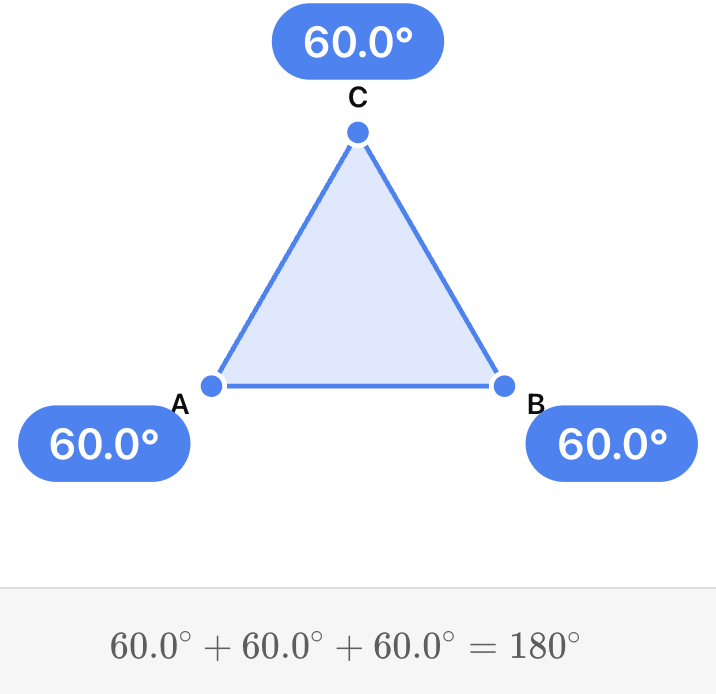
In a right triangle, one angle is already 90°.
Therefore, the two remaining angles must add to:
90°
If one acute angle is θ and the other is φ:
θ + φ = 90°
So:
φ = 90° − θ
Example 8: Finding the Remaining Angle
Suppose one acute angle is:
37°
Then the other is:
90° − 37°
= 53°
The remaining angle is 53°.
This is usually faster than using another trigonometric calculation.
Complementary Angles
The two acute angles of a right triangle are complementary.
That means their sum is:
90°
For example:
20° + 70° = 90°
35° + 55° = 90°
48° + 42° = 90°
This provides an important way to check your answers.
Solving an Entire Triangle
Consider a right triangle with:
One acute angle = 32°
Hypotenuse = 15 cm
We want to determine:
- opposite side
- adjacent side
- remaining angle
This requires several steps.
Step 1: Find the Opposite Side
sin 32° = opposite ÷ 15
Opposite = 15 sin 32°
Opposite ≈ 7.95 cm
Step 2: Find the Adjacent Side
cos 32° = adjacent ÷ 15
Adjacent = 15 cos 32°
Adjacent ≈ 12.72 cm
Step 3: Find the Remaining Angle
Remaining angle:
90° − 32°
= 58°
Therefore the complete triangle contains:
Angles: 90°, 32°, 58°
Sides: 15 cm, 12.72 cm, 7.95 cm
The triangle is now solved.
There Is Often More Than One Method
Suppose you know:
Hypotenuse = 15 cm
Opposite = 9 cm
You could find the remaining shorter side using the Pythagorean theorem.
Or you could:
- calculate an angle using inverse sine
- use cosine or tangent to find the missing side
Both approaches can work.
Usually, choose the method that:
- uses the fewest steps
- uses the original information
- avoids unnecessary rounding
Example 9: Solving from Two Sides
Suppose:
Opposite = 9 cm
Adjacent = 12 cm
Find all remaining measurements.
First find the hypotenuse:
c² = 9² + 12²
c² = 81 + 144
c² = 225
c = 15 cm
Now find one angle:
tan θ = 9 ÷ 12
θ = tan⁻¹(9 ÷ 12)
θ ≈ 36.9°
Find the other angle:
90° − 36.9°
= 53.1°
Complete solution:
Sides: 9 cm, 12 cm, 15 cm
Angles: 36.9°, 53.1°, 90°
Example 10: Solving from a Side and an Angle
A right triangle has:
Adjacent side = 20 m
Angle = 41°
Find the opposite side, hypotenuse, and remaining angle.
Opposite Side
tan 41° = opposite ÷ 20
Opposite = 20 tan 41°
Opposite ≈ 17.39 m
Hypotenuse
cos 41° = 20 ÷ hypotenuse
Hypotenuse = 20 ÷ cos 41°
Hypotenuse ≈ 26.50 m
Remaining Angle
90° − 41° = 49°
Complete solution:
Adjacent = 20 m
Opposite ≈ 17.39 m
Hypotenuse ≈ 26.50 m
Angles = 41°, 49°, 90°
Multi-Step Triangle Problems
Some problems require information from one calculation before the next calculation can be completed.
For example:
- Find a missing side using trigonometry.
- Use that side in a second triangle.
- Find another distance.
- Interpret the final result.


Breaking a complicated diagram into smaller right triangles can make the problem much easier.
Example 11: Two Connected Triangles
A support structure contains two right triangles.
The first triangle has:
Angle = 30°
Adjacent side = 8 m
First find its vertical height:
tan 30° = h ÷ 8
h = 8 tan 30°
h ≈ 4.62 m
That height may then become a known side in another triangle.
If the second triangle has:
Opposite = 4.62 m
Angle = 40°
then:
tan 40° = 4.62 ÷ x
x = 4.62 ÷ tan 40°
x ≈ 5.51 m
The result from the first triangle became information needed for the second.
Draw Before You Calculate
For complicated problems, start with a diagram.
A useful diagram should show:
- right angles
- known angles
- known side lengths
- unknown quantities
- labels for important points
Do not worry if the diagram is not perfectly to scale.
Its purpose is to organize the mathematical information.
Mark the Reference Angle
Before labeling:
opposite
and:
adjacent
identify the angle you are working with.
The same side can be opposite one acute angle and adjacent to the other.


The hypotenuse, however, is always the same side.
A Decision Strategy
When solving a right triangle, ask:
Do I know two sides?
If yes, consider:
- Pythagorean theorem for the third side
- inverse trig for an angle
Do I know one side and one acute angle?
If yes, use:
- sine
- cosine
- tangent
depending on the sides involved.
Do I already know one acute angle?
Find the other using:
90° − known angle
This simple decision process can reduce unnecessary calculations.
Use Original Information When Possible
Suppose you calculate:
x ≈ 7.3 cm
and then use 7.3 cm in another calculation.
The actual calculator value may have been:
7.347829...
Using the rounded value introduces additional rounding error.
Whenever possible:
- use original measurements
- keep full calculator values during working
- round only the final answers
Verifying Your Solution
A complete triangle solution should be checked.
Several methods are available.
Check 1: Angle Sum
Your angles should add to:
180°
For a right triangle:
90° + angle A + angle B = 180°
Therefore:
angle A + angle B = 90°
If you obtain:
90°, 42°, and 58°
then:
90 + 42 + 58 = 190°
Something is wrong.
Check 2: Hypotenuse Must Be Longest
Suppose your calculated sides are:
6 cm
8 cm
7 cm
and you have identified 7 cm as the hypotenuse.
This cannot be correct.
The hypotenuse must be the longest side.
Check 3: Pythagorean Theorem
Suppose your calculated sides are approximately:
5 cm
12 cm
13 cm
Check:
5² + 12²
= 25 + 144
= 169
13² = 169
The sides satisfy the Pythagorean theorem.
This supports the solution.
Check 4: Use a Different Trigonometric Ratio
Suppose:
Opposite = 6 cm
Adjacent = 8 cm
Hypotenuse = 10 cm
For angle θ:
sin θ = 6/10
and:
tan θ = 6/8
Both calculations should produce the same angle, allowing for rounding.
This provides an independent check.
Check 5: Compare Angles and Sides
Larger angles should be opposite longer sides.
Suppose one angle is:
65°
and another is:
25°
The side opposite 65° should be longer than the side opposite 25°.


If your answer contradicts this relationship, check your work.
Check 6: Estimate Before Calculating
Suppose:
Angle = 45°
Adjacent side = 10 cm
At 45°, the two shorter sides of a right triangle are equal.
Therefore, the opposite side should be approximately:
10 cm
If your calculator gives:
1.0 cm
or:
100 cm
you should immediately suspect an error.
Special Right Triangle: 45°–45°–90°
A right triangle with one angle of 45° must have:
45°, 45°, 90°
The two shorter sides are equal.
If each shorter side is:
x
then the hypotenuse is:
x√2
For example:
Short sides = 5 cm and 5 cm
Hypotenuse:
5√2 ≈ 7.07 cm
Special Right Triangle: 30°–60°–90°
Another useful right triangle has angles:
30°, 60°, 90°
Its side ratio is:
1 : √3 : 2
where:
- shortest side is opposite 30°
- longer leg is opposite 60°
- hypotenuse is opposite 90°


Recognizing these patterns can sometimes make calculations faster.
Communicating a Complete Solution
A strong mathematical solution should show enough information that another person can follow your reasoning.
For example:
Given:
θ = 38°
Adjacent = 12.0 m
Find: Opposite side.
Method:
tan θ = opposite ÷ adjacent
tan 38° = x ÷ 12.0
x = 12.0 tan 38°
x ≈ 9.38 m
Answer:
The opposite side is approximately 9.38 m.
This is clearer than writing only:
9.38
Include Units
If the sides represent lengths, include appropriate units.
Examples:
8.4 cm
12.7 m
3.2 km
Angles should include:
°
For example:
θ = 37.5°
Units help communicate what the answer represents.
Use Appropriate Precision
Suppose the measurements are given as:
12.0 m
and:
35°
It would usually be unreasonable to report:
8.402574931 m
A more appropriate answer might be:
8.4 m
or:
8.40 m
depending on the context and expected precision.
Worked Example: Complete Triangle
A right triangle has:
Hypotenuse = 18 cm
Angle A = 37°
Find:
- side opposite A
- side adjacent to A
- angle B
Opposite Side
sin 37° = opposite ÷ 18
Opposite = 18 sin 37°
Opposite ≈ 10.83 cm
Adjacent Side
cos 37° = adjacent ÷ 18
Adjacent = 18 cos 37°
Adjacent ≈ 14.38 cm
Remaining Angle
B = 90° − 37°
B = 53°
Complete solution:
Sides ≈ 10.83 cm, 14.38 cm, 18 cm
Angles = 37°, 53°, 90°
Worked Example: Two Known Legs
A right triangle has shorter sides:
16 m
and:
30 m
Find all remaining information.
Hypotenuse
c² = 16² + 30²
c² = 256 + 900
c² = 1156
c = 34 m
First Angle
Let θ be opposite the 16 m side.
tan θ = 16 ÷ 30
θ = tan⁻¹(16/30)
θ ≈ 28.1°
Second Angle
90° − 28.1°
= 61.9°
Complete solution:
Sides = 16 m, 30 m, 34 m
Angles ≈ 28.1°, 61.9°, 90°
Worked Example: Hypotenuse and One Leg
Suppose:
Hypotenuse = 25 cm
One leg = 15 cm
Find the missing side and angles.
Missing Side
15² + b² = 25²
225 + b² = 625
b² = 400
b = 20 cm
Angle Opposite the 15 cm Side
sin θ = 15 ÷ 25
θ = sin⁻¹(0.6)
θ ≈ 36.9°
Remaining Angle
90° − 36.9°
= 53.1°
Complete solution:
Sides = 15 cm, 20 cm, 25 cm
Angles ≈ 36.9°, 53.1°, 90°
Worked Example: One Side and One Angle
Suppose:
Angle A = 63°
Adjacent side = 7.5 m
Find the opposite side, hypotenuse, and remaining angle.
Opposite
tan 63° = opposite ÷ 7.5
Opposite = 7.5 tan 63°
Opposite ≈ 14.72 m
Hypotenuse
cos 63° = 7.5 ÷ hypotenuse
Hypotenuse = 7.5 ÷ cos 63°
Hypotenuse ≈ 16.52 m
Remaining Angle
90° − 63°
= 27°
Complete solution:
Sides ≈ 7.5 m, 14.72 m, 16.52 m
Angles = 27°, 63°, 90°
Multi-Step Example: Support Cable
A vertical pole is supported by a cable.
The cable is:
18 m long
and makes an angle of:
55°
with the ground.
Find:
- the height where the cable attaches to the pole
- the horizontal distance from the pole to the cable anchor


Height
sin 55° = height ÷ 18
height = 18 sin 55°
height ≈ 14.74 m
Horizontal Distance
cos 55° = distance ÷ 18
distance = 18 cos 55°
distance ≈ 10.32 m
The cable attaches approximately 14.74 m above the ground and is anchored approximately 10.32 m horizontally from the pole.
Multi-Step Example: Roof
One half of a symmetrical roof forms a right triangle.
Horizontal run = 5.5 m
Roof angle = 32°
Find:
- the vertical rise
- the sloping roof length
Rise
tan 32° = rise ÷ 5.5
rise = 5.5 tan 32°
rise ≈ 3.44 m
Roof Length
cos 32° = 5.5 ÷ roof length
Roof length = 5.5 ÷ cos 32°
roof length ≈ 6.49 m
The roof rises approximately 3.44 m and has a sloping length of approximately 6.49 m.
Multi-Step Example: Ladder
A 7 m ladder leans against a wall.
Its base is:
2.5 m
from the wall.
Find:
- the height reached
- the angle the ladder makes with the ground
Height
h² + 2.5² = 7²
h² = 49 − 6.25
h² = 42.75
h ≈ 6.54 m
Angle
cos θ = 2.5 ÷ 7
θ = cos⁻¹(2.5/7)
θ ≈ 69.1°
The ladder reaches approximately 6.54 m up the wall and makes an angle of approximately 69.1° with the ground.
Multi-Step Problems with Shared Sides
Some diagrams contain several right triangles that share a side.
A useful strategy is:
Triangle 1 → calculate shared side → Triangle 2 → calculate final unknown
Do not try to solve the entire diagram in one step.


Identify one triangle containing enough information to begin.
Then use its result in the next triangle.
Choosing the Most Efficient Method
Suppose two sides are known.
You could sometimes use several methods.
For example:
Legs = 8 cm and 15 cm
To find the hypotenuse, the most direct method is:
Pythagorean theorem
rather than finding an angle first and then using sine or cosine.
Efficient mathematical reasoning means choosing a method that minimizes unnecessary steps.
Avoiding Unnecessary Calculations
Suppose one acute angle is:
24°
You do not need trigonometry to find the other acute angle.
Simply calculate:
90° − 24°
= 66°
Use the simplest valid method.
Common Mistake: Using the Wrong Angle
Suppose the side you call "opposite" is actually opposite the other acute angle.
Your trig equation will be incorrect.
Always mark the angle you are working from before labeling O and A.
Common Mistake: Treating the Hypotenuse as Adjacent
The hypotenuse touches both acute angles, but it is never called the adjacent side in SOH–CAH–TOA.
The adjacent side means the shorter side beside the reference angle.
Common Mistake: Forgetting Inverse Trig
If you know:
tan θ = 0.75
you cannot simply write:
θ = 0.75°
Instead:
θ = tan⁻¹(0.75)
θ ≈ 36.9°
Common Mistake: Using Inverse Trig to Find a Side
Inverse trig functions are primarily used to determine angles.
If you know:
θ = 40°
Adjacent = 12 m
and need the opposite side, use:
tan 40° = opposite ÷ 12
not inverse tangent.
Common Mistake: Calculator Mode
If angles are given in degrees, your calculator should normally be in:
DEG
not:
RAD
A calculator in the wrong mode can produce completely different answers.
Common Mistake: Rounding Too Early
Suppose an intermediate result is:
13.728419...
Do not immediately round it to:
14
if it will be used in another calculation.
Keep the calculator value and round the final answer.
This reduces accumulated rounding error.
Common Mistake: Incomplete Answers
If the question says:
Solve the triangle
finding only one missing side is not enough.
You should determine:
- all three sides
- all three angles
and present them clearly.
A Reliable Solving Strategy
When asked to solve a right triangle:
Step 1: Draw or inspect the triangle.
Step 2: Identify the 90° angle.
Step 3: Identify the hypotenuse.
Step 4: Record all known sides and angles.
Step 5: Decide which unknown should be found first.
Step 6: Select Pythagoras, sine, cosine, tangent, or inverse trig.
Step 7: Write the equation.
Step 8: Substitute known values.
Step 9: Solve without excessive intermediate rounding.
Step 10: Find the remaining measurements.
Step 11: Verify the solution.
Step 12: Present all sides, angles, units, and appropriate rounding.
A Triangle-Solving Decision Guide
Two sides known?
→ Use Pythagorean theorem for the third side.
→ Use inverse trig for an angle.
→ Use 90° minus that angle for the final angle.
One side + one acute angle known?
→ Use SOH–CAH–TOA to calculate missing sides.
→ Use 90° minus the known acute angle for the remaining angle.
Two acute angles known?
→ Their values alone determine the shape but not the size of the triangle.
At least one side length is required to determine actual side lengths.
Verifying a Complete Solution
Suppose you obtain:
Sides:
8.0 cm, 15.0 cm, 17.0 cm
Angles:
28.1°, 61.9°, 90°
Check the angles:
28.1 + 61.9 + 90 = 180°
Check the sides:
8² + 15² = 64 + 225
= 289
17² = 289
The solution passes both checks.
Communicating Mathematical Reasoning
A complete solution should normally contain:
Diagram or labels
Show what each value represents.
Formula or ratio
For example:
tan θ = O/A
Substitution
tan θ = 8/15
Calculation
θ = tan⁻¹(8/15)
θ ≈ 28.1°
Final statement
The angle is approximately 28.1°.
This allows another person to understand and verify your reasoning.
Real-World Interpretation
Right triangles appear in many situations involving:
- ramps
- roofs
- ladders
- roads
- bridges
- navigation
- surveying
- support cables
- heights
- distances
- slopes


In real-world problems, the final answer should describe what the calculated value actually represents.
Instead of:
x = 12.6
write:
The support cable is approximately 12.6 m long.
Did You Know?
Right triangle trigonometry provides several independent ways to check a solution.
If you know all three sides, you can:
- check them with the Pythagorean theorem
- calculate an angle using sine
- calculate the same angle using cosine
- calculate it again using tangent
All of these methods should produce consistent results, allowing for rounding.
This is an important mathematical habit:
Do not only calculate an answer — look for evidence that the answer makes sense.
Key Terms
- Right triangle: Triangle containing one 90° angle.
- Hypotenuse: Longest side of a right triangle, opposite the right angle.
- Opposite side: Side across from the reference angle.
- Adjacent side: Non-hypotenuse side beside the reference angle.
- Sine: Ratio of opposite side to hypotenuse.
- Cosine: Ratio of adjacent side to hypotenuse.
- Tangent: Ratio of opposite side to adjacent side.
- Inverse sine: Function used to determine an angle from a sine ratio.
- Inverse cosine: Function used to determine an angle from a cosine ratio.
- Inverse tangent: Function used to determine an angle from a tangent ratio.
- Pythagorean theorem: Relationship between the three sides of a right triangle.
- Complementary angles: Two angles whose measures total 90°.
- Reference angle: Acute angle used when identifying opposite and adjacent sides.
- Solve a triangle: Determine all unknown sides and angles.
- Multi-step problem: Problem requiring more than one mathematical calculation or relationship.
- Verification: Process of checking whether a solution is mathematically reasonable and consistent.
Key Relationships
For right triangles:
a² + b² = c²
where c is the hypotenuse.
Trigonometric ratios:
sin θ = opposite ÷ hypotenuse
cos θ = adjacent ÷ hypotenuse
tan θ = opposite ÷ adjacent
Inverse trigonometry:
θ = sin⁻¹(O/H)
θ = cos⁻¹(A/H)
θ = tan⁻¹(O/A)
Acute-angle relationship:
Angle A + Angle B = 90°
Whole triangle:
Angle A + Angle B + 90° = 180°
Key Takeaways
- Solving a right triangle means determining all unknown sides and angles.
- A right triangle already contains one 90° angle.
- The two acute angles of a right triangle are complementary.
- The Pythagorean theorem can find a missing side when two sides are known.
- Sine relates the opposite side and hypotenuse.
- Cosine relates the adjacent side and hypotenuse.
- Tangent relates the opposite and adjacent sides.
- Inverse trigonometric functions are used to calculate unknown angles from side ratios.
- SOH–CAH–TOA helps identify the appropriate trigonometric ratio.
- Opposite and adjacent sides depend on the chosen reference angle.
- The hypotenuse is always opposite the right angle and is always the longest side.
- When two sides are known, Pythagoras and inverse trigonometry can usually solve the triangle.
- When one side and one acute angle are known, trigonometric ratios can usually solve the triangle.
- Knowing only the angles determines the shape of a triangle but not its actual size.
- Multi-step problems should be divided into smaller calculations.
- In compound diagrams, one calculated side may become a known side in another triangle.
- Original information should be used whenever possible to reduce rounding error.
- Intermediate values should not be rounded excessively.
- Solutions can be checked using angle sums, the Pythagorean theorem, alternative trig ratios, and estimation.
- The two acute angles should always add to 90°.
- The hypotenuse must always be the longest side.
- Larger angles should be opposite longer sides.
- Efficient problem solving means selecting the simplest appropriate method.
- Complete mathematical solutions should show the method, substitution, calculation, units, and final answer.
- A numerical result should be interpreted in the context of the problem.
- Good mathematics includes both solving and verifying the solution.
5. Applications of Right Triangle Trigonometry
Learning outcomes
- I can solve problems involving angles of elevation and depression.
- I can model real-world situations using right triangles.
- I can solve navigation and surveying problems.
- I can apply trigonometry to practical measurement tasks.
- I can interpret solutions within context.


Why Is Right Triangle Trigonometry Useful?
Right triangle trigonometry allows us to calculate distances, heights, and angles that may be difficult or impossible to measure directly.
Imagine trying to measure:
- the height of a tall building
- the height of a tree
- the width of a river
- the distance to a ship
- the slope of a hill
- the height of a cliff
- the distance between two locations
In many situations, we can measure one distance and one angle, construct an imaginary right triangle, and use trigonometry to calculate the missing measurement.
This makes trigonometry useful in fields such as:
- surveying
- navigation
- engineering
- architecture
- construction
- astronomy
- aviation
- mapping
Review: The Right Triangle
A right triangle contains one angle of:
90°
Relative to another angle θ, the three sides are called:
- opposite
- adjacent
- hypotenuse
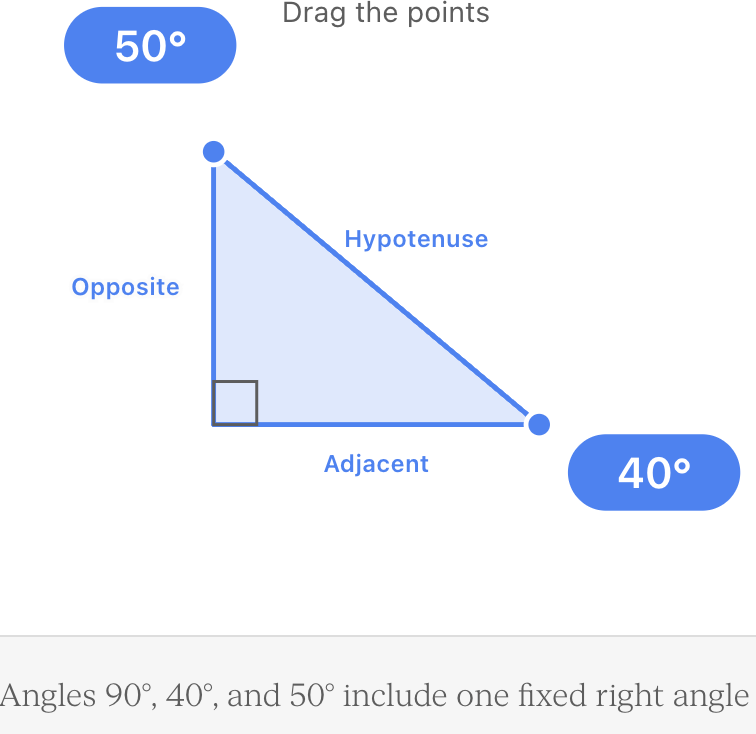
The hypotenuse is always opposite the 90° angle and is always the longest side.
The opposite and adjacent sides depend on which angle you are considering.
SOH CAH TOA
The three basic trigonometric ratios are:
SOH
sin θ = opposite ÷ hypotenuse
CAH
cos θ = adjacent ÷ hypotenuse
TOA
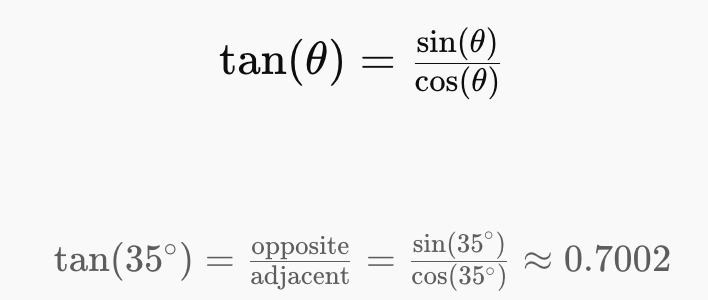
tan θ = opposite ÷ adjacent
A useful memory aid is:
SOH – CAH – TOA
Choosing the Correct Ratio
Before calculating anything:
Step 1: Identify the angle.
Step 2: Label the known and unknown sides relative to that angle.
Step 3: Determine which two sides are involved.
Step 4: Choose sine, cosine, or tangent.
| Sides involved | Ratio |
|---|---|
| Opposite and hypotenuse | sine |
| Adjacent and hypotenuse | cosine |
| Opposite and adjacent | tangent |
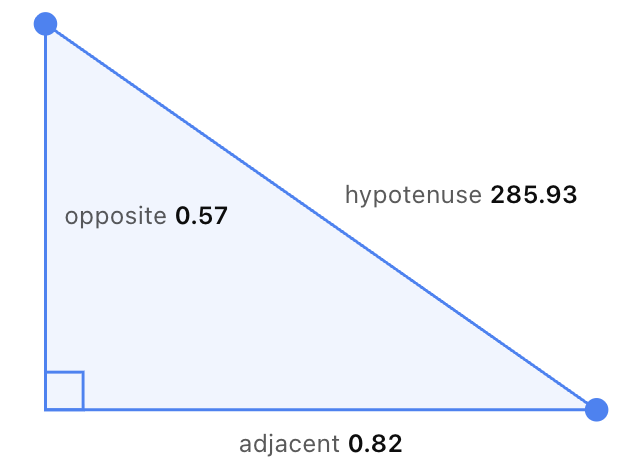
For many height and distance problems, tangent is particularly useful because the horizontal distance is adjacent and the vertical height is opposite.
Modeling Real-World Situations
The most important skill in applied trigonometry is often not performing the calculation.
It is recognizing the triangle hidden inside the situation.
Consider a person looking at the top of a building.
The situation contains:
- a horizontal distance along the ground
- a vertical building
- a line of sight
- an angle between the horizontal and the line of sight
These form a right triangle.


Once the triangle has been identified, the problem becomes a normal right-triangle calculation.
Angle of Elevation
An angle of elevation is the angle measured upward from a horizontal line.
Imagine standing on level ground and looking toward the top of a tower.
Your eyes begin looking horizontally.
You then look upward.
The angle through which your line of sight moves is the:
angle of elevation
Example 1: Finding the Height of a Building
A student stands 30 m from a building.
The angle of elevation to the top is:
40°
Assume the student's eye level is ignored for now.
We know:
Adjacent = 30 m
Opposite = building height
Angle = 40°
We need opposite and know adjacent.
Therefore use:
tan θ = opposite ÷ adjacent
tan 40° = h ÷ 30
h = 30 tan 40°
h ≈ 25.2 m
The building is approximately 25.2 m tall.
But What About Eye Height?
In real measurements, the angle is normally measured from the observer's eye or from an instrument above the ground.
Suppose the student's eye level is:
1.6 m
The trigonometric calculation gives the vertical distance from the student's eyes to the top of the building.
Therefore:
Building height = calculated vertical height + eye height
Building height = 25.2 + 1.6
Building height ≈ 26.8 m


This is an important example of interpreting the answer within context.
Angle of Depression
An angle of depression is measured downward from a horizontal line.
Imagine standing on a cliff and looking downward toward a boat.
Your horizontal line of sight points straight ahead.
Your actual line of sight points downward toward the boat.
The angle between these lines is the:
angle of depression


Elevation and Depression Are Related
Horizontal lines are parallel.
Therefore, the angle of depression from the observer is equal to the corresponding angle of elevation from the object.
For example:
Angle of depression = 32°
Corresponding angle of elevation = 32°
This often makes it easier to label the right triangle.
Example 2: Lighthouse and Boat
A lighthouse is:
45 m tall
The angle of depression from the top of the lighthouse to a boat is:
28°
How far is the boat from the base of the lighthouse?
Let horizontal distance = d.
Opposite = 45 m
Adjacent = d
Angle = 28°
Use tangent:
tan 28° = 45 ÷ d
Rearrange:
d = 45 ÷ tan 28°
d ≈ 84.6 m
The boat is approximately 84.6 m horizontally from the base of the lighthouse.
Drawing the Diagram First
Many trigonometry mistakes can be avoided by drawing a diagram before calculating.
Your diagram does not need to be perfectly to scale.
It should show:
- the right angle
- the known angle
- known distances
- unknown distance
- horizontal and vertical directions
- line of sight
Then label the sides:
O = opposite
A = adjacent
H = hypotenuse
Example 3: Finding the Length of a Ramp
A wheelchair ramp rises:
0.8 m
and makes an angle of:
6°
with the horizontal.
Find the length of the ramp.


We know:
Opposite = 0.8 m
Hypotenuse = ramp length
Angle = 6°
Use sine:
sin 6° = 0.8 ÷ L
L = 0.8 ÷ sin 6°
L ≈ 7.65 m
The ramp must be approximately 7.65 m long.
Example 4: Ladder Against a Wall
A 5 m ladder leans against a wall.
The ladder makes an angle of:
68°
with the ground.
How high up the wall does the ladder reach?
Known:
Hypotenuse = 5 m
Opposite = h
Angle = 68°
Use sine:
sin 68° = h ÷ 5
h = 5 sin 68°
h ≈ 4.64 m
The ladder reaches approximately 4.64 m up the wall.


Example 5: Finding a Distance
A person observes the top of a tower at an angle of elevation of:
35°
The tower is:
50 m high
How far is the person from the tower?
Opposite = 50 m
Adjacent = d
tan 35° = 50 ÷ d
Therefore:
d = 50 ÷ tan 35°
d ≈ 71.4 m
The observer is approximately 71.4 m from the base of the tower.
Finding an Angle
Sometimes the sides are known and the angle is unknown.
This requires an inverse trigonometric function.
Suppose:
Opposite = 20 m
Adjacent = 35 m
Then:
tan θ = 20 ÷ 35
tan θ ≈ 0.5714
Use inverse tangent:
θ = tan⁻¹(0.5714)
θ ≈ 29.7°
The angle is approximately 29.7°.
Inverse Trigonometric Functions
If you know the ratio and need the angle, use:
θ = sin⁻¹(opposite ÷ hypotenuse)
θ = cos⁻¹(adjacent ÷ hypotenuse)
θ = tan⁻¹(opposite ÷ adjacent)
On many calculators these appear as:
sin⁻¹
cos⁻¹
tan⁻¹
You may need to use a SHIFT, 2nd, or similar button.
Calculator Mode Matters
For these problems, angles are normally measured in:
degrees
Make sure your calculator is in:
DEG mode
not:
RAD mode
If your calculator is in radians, you may obtain an answer that looks completely incorrect.
Surveying
Surveying involves measuring positions, distances, elevations, and angles to determine the locations of points on Earth's surface.
Surveyors may use trigonometry to determine:
- building heights
- land elevations
- slopes
- distances across obstacles
- positions of boundaries
- distances between inaccessible locations


Modern surveyors often use instruments such as:
- total stations
- laser distance meters
- GPS/GNSS equipment
- electronic levels
The underlying geometry still relies heavily on angles and distances.
Example 6: Surveying a Tower
A surveyor stands:
75 m
from a tower.
The survey instrument is:
1.5 m
above the ground.
The angle of elevation to the top of the tower is:
52°
First calculate the height above the instrument:
tan 52° = h ÷ 75
h = 75 tan 52°
h ≈ 96.0 m
Now include the instrument height:
Total height ≈ 96.0 + 1.5
Total height ≈ 97.5 m
Again, context matters.
The triangle gave the height above the instrument, not automatically the entire tower height.
Measuring an Inaccessible Distance
Trigonometry is especially valuable when direct measurement is difficult.
Imagine trying to measure the width of a river.
Walking across the river with a measuring tape may be impractical.
Instead, measurements can be taken from accessible locations and used to construct a triangle mathematically.


This is one reason trigonometry became so important in surveying and mapping.
Navigation
Navigation frequently involves:
- direction
- distance
- angles
- coordinates
A journey can sometimes be represented by a right triangle.
Suppose a boat travels:
12 km east
and then:
5 km north
The straight-line distance from its starting point can be calculated using the Pythagorean theorem.
Distance² = 12² + 5²
Distance² = 144 + 25
Distance² = 169
Distance = 13 km
Trigonometry can then determine the direction of the boat relative to its starting position.
Example 7: Navigation Direction
A boat is:
12 km east
and:
5 km north
of its starting point.
Let θ be the angle north of east.
tan θ = 5 ÷ 12
θ = tan⁻¹(5 ÷ 12)
θ ≈ 22.6°
Therefore the boat is:
13 km from its starting point at approximately 22.6° north of east.


Bearings
Navigation often describes direction using bearings.
A bearing is usually:
- measured clockwise from north
- written using three digits
For example:
North = 000°
East = 090°
South = 180°
West = 270°
If a direction is 30° east of north, its bearing is:
030°
If a direction is 20° south of east:
90° + 20° = 110°
Example 8: Navigation Using a Bearing
A rescue boat travels:
15 km
on a bearing of:
060°
This means the boat travels:
60° clockwise from north
The journey can be separated into north and east components.
Because the angle is measured from north:
North component = 15 cos 60°
North component = 7.5 km
East component = 15 sin 60°
East component ≈ 13.0 km
So the boat is approximately:
7.5 km north
and:
13.0 km east
of its starting point.
Horizontal Distance vs Line-of-Sight Distance
These are not the same thing.
Suppose you look toward the top of a mountain.
The horizontal distance is measured along a level line.
The line-of-sight distance runs directly from you to the point you are observing.
In the right triangle:
Horizontal distance = adjacent
Vertical height = opposite
Line-of-sight distance = hypotenuse


Always determine which distance the question is asking for.
Example 9: Line-of-Sight Distance
A drone is:
120 m
above the ground.
The angle of elevation from an observer is:
38°
Find the straight-line distance from the observer to the drone.
Opposite = 120 m
Hypotenuse = d
sin 38° = 120 ÷ d
d = 120 ÷ sin 38°
d ≈ 194.9 m
The drone is approximately 195 m from the observer along the line of sight.
Example 10: Horizontal Distance to a Drone
Using the same situation:
Drone height = 120 m
Angle of elevation = 38°
Now find the horizontal distance.
Opposite = 120 m
Adjacent = d
tan 38° = 120 ÷ d
d = 120 ÷ tan 38°
d ≈ 153.6 m
Notice:
Horizontal distance ≈ 153.6 m
but:
Line-of-sight distance ≈ 194.9 m
The question determines which side of the triangle you need.
Practical Measurement with a Clinometer
A clinometer measures angles of elevation or depression.


A simple clinometer can be made using:
- protractor
- straw
- string
- small weight
To estimate the height of a tree:
- Measure your horizontal distance from the tree.
- Measure the angle of elevation to the top.
- Measure your eye height.
- Use tangent to calculate the vertical distance above your eyes.
- Add your eye height.
This turns right-triangle trigonometry into a practical measurement technique.
Example 11: Measuring a Tree
A student stands:
18 m
from a tree.
Angle of elevation:
47°
Eye height:
1.55 m
Calculate the height above eye level:
tan 47° = h ÷ 18
h = 18 tan 47°
h ≈ 19.3 m
Add eye height:
Total height ≈ 19.3 + 1.55
Total height ≈ 20.85 m
The tree is approximately 20.9 m tall.
Measuring Shadows
Trigonometry can also be applied when the Sun creates shadows.
Suppose a flagpole casts a:
12 m shadow
and the Sun's angle of elevation is:
35°
Then:
tan 35° = height ÷ 12
height = 12 tan 35°
height ≈ 8.4 m
The flagpole is approximately 8.4 m tall.


Engineering and Construction
Right triangle trigonometry is important when designing:
- roofs
- ramps
- bridges
- staircases
- roads
- drainage systems
- support structures
Engineers frequently need to calculate:
- slopes
- heights
- horizontal runs
- diagonal lengths
- angles
Example 12: Roof Design
A roof rises:
3.5 m
over a horizontal distance of:
6 m
Find the roof angle.
Opposite = 3.5 m
Adjacent = 6 m
tan θ = 3.5 ÷ 6
θ = tan⁻¹(3.5 ÷ 6)
θ ≈ 30.3°
The roof angle is approximately 30.3°.


Slopes
A slope can often be represented as:
rise ÷ run
This has a direct connection to tangent:
tan θ = rise ÷ run
Therefore:
θ = tan⁻¹(rise ÷ run)
This relationship connects:
- trigonometry
- gradient
- road slope
- roof pitch
- ramps
- surveying
Interpreting the Answer
Calculating a number is not the final step.
You should ask:
What does this number represent?
If your calculator gives:
42.7
you should not simply write:
42.7
Instead:
The tower is approximately 42.7 m tall.
or:
The angle of elevation is approximately 42.7°.
A mathematical answer should be connected back to the original situation.
Check Whether Your Answer Is Reasonable
Before accepting an answer, estimate what should make sense.
For example:
A ladder is:
5 m long
Could it reach:
7 m
up a wall?
No.
The ladder is the hypotenuse and therefore must be the longest side.
So a calculated height of 7 m immediately indicates an error.
Another Reasonableness Check
Suppose the angle of elevation to a building is:
80°
and the observer is only:
10 m
away.
The building should be relatively tall because the viewing angle is steep.
If your calculation gives:
2 m
something is probably wrong.
Common Mistake 1: Choosing the Wrong Ratio
If you know:
Opposite and adjacent
use:
tangent
If you know:
Opposite and hypotenuse
use:
sine
If you know:
Adjacent and hypotenuse
use:
cosine
Do not choose a trig function simply because it appears familiar.
Common Mistake 2: Misidentifying the Hypotenuse
The hypotenuse is:
- opposite the 90° angle
- always the longest side
It is not automatically the vertical side or the sloping side in every drawing.
Identify the right angle first.
Common Mistake 3: Mixing Up Opposite and Adjacent
Opposite and adjacent depend on the reference angle.
If you change the angle being considered, the side labels may change.
The hypotenuse does not change.
Common Mistake 4: Forgetting Eye or Instrument Height
If the angle is measured from:
1.6 m above the ground
the trigonometric calculation usually finds the vertical distance relative to that level.
You may need to:
add 1.6 m
or occasionally subtract a height depending on the situation.
Common Mistake 5: Confusing Elevation and Depression
Remember:
Elevation → look upward
Depression → look downward
Both are measured relative to a horizontal line.


Common Mistake 6: Calculator in Radian Mode
If the problem gives:
35°
your calculator should normally be in:
degree mode
Always check the display before calculating.
Common Mistake 7: Rounding Too Early
Keep several digits during intermediate calculations.
For example, if:
h = 30 tan 37°
do not heavily round tan 37° before multiplying.
Calculate using the full calculator value and round the final answer appropriately.
Common Mistake 8: Giving an Impossible Level of Precision
Suppose measurements were:
Distance = 20 m
Angle = 37°
Reporting:
15.07182643 m
suggests unrealistic precision.
A more sensible result might be:
15.1 m
depending on the precision of the original measurements.
A Reliable Problem-Solving Method
For applied right-triangle problems:
Step 1: Draw the situation.
Convert the real-world problem into a right triangle.
Step 2: Mark the right angle.
This identifies the hypotenuse.
Step 3: Mark the known angle.
Be especially careful with elevation and depression.
Step 4: Label the sides.
Opposite, adjacent, hypotenuse.
Step 5: Identify known and unknown quantities.
Step 6: Choose SOH, CAH, or TOA.
Step 7: Write the equation before substituting values.
Step 8: Solve.
Step 9: Include units.
Step 10: Interpret the answer in context.
Step 11: Check whether the answer is reasonable.
Worked Example: Angle of Elevation
A person stands 42 m from a tower.
The angle of elevation to the top is 38°.
The person's eye height is 1.7 m.
Find the tower height.
First calculate the height above eye level:
tan 38° = h ÷ 42
h = 42 tan 38°
h ≈ 32.8 m
Now add eye height:
Total height = 32.8 + 1.7
Total height ≈ 34.5 m
The tower is approximately 34.5 m tall.
Worked Example: Angle of Depression
A person stands at the top of a 65 m cliff.
The angle of depression to a boat is:
24°
Find the horizontal distance to the boat.
The corresponding angle of elevation from the boat is also:
24°
tan 24° = 65 ÷ d
d = 65 ÷ tan 24°
d ≈ 146 m
The boat is approximately 146 m horizontally from the base of the cliff.
Worked Example: Surveying
A survey instrument stands 1.4 m above the ground and is positioned 50 m from a building.
The angle of elevation to the roof is:
43°
Height above instrument:
h = 50 tan 43°
h ≈ 46.6 m
Building height:
46.6 + 1.4 = 48.0 m
The building is approximately 48.0 m tall.
Worked Example: Navigation
A hiker travels:
8 km east
then:
6 km north
Straight-line distance:
d² = 8² + 6²
d² = 100
d = 10 km
Direction:
tan θ = 6 ÷ 8
θ = tan⁻¹(0.75)
θ ≈ 36.9°
Therefore:
The hiker is 10 km from the starting point at approximately 36.9° north of east.
Worked Example: Practical Measurement
A student wants to estimate the height of a flagpole.
Measurements:
Horizontal distance = 15 m
Angle of elevation = 55°
Eye height = 1.6 m
Vertical height above eyes:
h = 15 tan 55°
h ≈ 21.4 m
Total height:
21.4 + 1.6 = 23.0 m
The flagpole is approximately 23.0 m tall.
A Practical Trigonometry Investigation
You can use these ideas to measure something around your school or community.
Possible objects include:
- tree
- building
- flagpole
- basketball hoop support
- light pole
Equipment:
- measuring tape
- clinometer or phone angle-measuring tool
- calculator
Measure:
horizontal distance
angle of elevation
eye height
Then calculate:
Height = distance × tan(angle) + eye height
Repeat the measurement from several distances.
If your calculated heights are similar, this provides evidence that your method is reasonably consistent.


Did You Know?
Long before electronic measuring equipment existed, surveyors used carefully measured angles and distances to map large areas of land.
This process is closely related to triangulation.


By creating networks of triangles and measuring selected angles and distances, surveyors could calculate locations that were difficult to reach directly.
Modern surveying uses lasers, satellite positioning, and electronic instruments, but triangle geometry and trigonometry remain fundamental mathematical tools.
Key Terms
- Right triangle: Triangle containing one 90° angle.
- Hypotenuse: Longest side of a right triangle, opposite the 90° angle.
- Opposite: Side directly across from the reference angle.
- Adjacent: Non-hypotenuse side beside the reference angle.
- Sine: Ratio of opposite to hypotenuse.
- Cosine: Ratio of adjacent to hypotenuse.
- Tangent: Ratio of opposite to adjacent.
- Angle of elevation: Angle measured upward from a horizontal line.
- Angle of depression: Angle measured downward from a horizontal line.
- Line of sight: Imaginary straight line from an observer to an object.
- Clinometer: Instrument used to measure angles of elevation or depression.
- Surveying: Measuring positions, distances, elevations, and angles of locations.
- Bearing: Direction measured clockwise from north.
- Navigation: Determining position, direction, and movement between locations.
- Inverse trigonometric function: Function used to determine an angle from a trigonometric ratio.
- Rise: Vertical change.
- Run: Horizontal change.
- Triangulation: Determining positions or distances using triangles and measured angles or sides.
Key Relationships
SOH
sin θ = opposite ÷ hypotenuse
CAH
cos θ = adjacent ÷ hypotenuse
TOA
tan θ = opposite ÷ adjacent
For many height problems:
height above eye level = horizontal distance × tan(angle of elevation)
For total object height:
total height = calculated height + eye/instrument height
For a slope:
tan θ = rise ÷ run
To find an angle:
θ = sin⁻¹(O/H)
θ = cos⁻¹(A/H)
θ = tan⁻¹(O/A)
Key Takeaways
- Right triangle trigonometry can be used to calculate heights, distances, and angles that are difficult to measure directly.
- Many real-world situations can be modeled by constructing an imaginary right triangle.
- SOH–CAH–TOA helps determine which trigonometric ratio to use.
- Sine relates the opposite side and hypotenuse.
- Cosine relates the adjacent side and hypotenuse.
- Tangent relates the opposite and adjacent sides.
- Angles of elevation are measured upward from the horizontal.
- Angles of depression are measured downward from the horizontal.
- Corresponding angles of elevation and depression are often equal because horizontal lines are parallel.
- Eye height or instrument height may need to be included in height calculations.
- Inverse trigonometric functions are used when the angle is unknown.
- Calculators should normally be in degree mode for problems involving angles given in degrees.
- Surveying uses angles and distances to determine inaccessible measurements.
- Navigation uses trigonometry to connect distances and directions.
- Bearings are measured clockwise from north.
- Horizontal distance and line-of-sight distance are different quantities.
- Clinometers can be used to measure angles of elevation and depression.
- Trigonometry has practical applications in surveying, navigation, construction, architecture, engineering, and measurement.
- Drawing and labeling the triangle is often the most important step in solving an applied problem.
- Answers should include appropriate units and sensible precision.
- A numerical answer should always be interpreted within the context of the original problem.
- Checking whether an answer is physically reasonable can reveal calculation or modeling errors.