Geometric Reasoning and Applications
1. Area and Volume
Learning outcomes
- I can calculate the area of composite figures.
- I can calculate the surface area of three-dimensional objects.
- I can calculate the volume of prisms, cylinders, pyramids, cones, and spheres.
- I can select appropriate formulas for different solids.
- I can solve real-world measurement problems.
Introduction
How much paint is needed to cover the walls of a room? How much water can a cylindrical tank hold? How much cardboard is needed to make a box? How can we calculate the area of an irregular garden or the volume of a cone-shaped container?
These questions involve area, surface area, and volume.
Area measures the amount of two-dimensional space inside a shape. Surface area measures the total area of the surfaces of a three-dimensional object. Volume measures the amount of three-dimensional space occupied by a solid.
Although many objects have complicated shapes, we can often calculate their measurements by dividing them into simpler figures.
In this lesson, we will explore how to calculate the area of composite figures, determine surface areas and volumes of common solids, select appropriate formulas, and solve practical measurement problems.
Understanding Area, Surface Area, and Volume
|
Measurement |
Meaning |
Typical units |
|---|---|---|
|
Perimeter |
Distance around a 2D shape |
cm, m, km |
|
Area |
Space enclosed by a 2D shape |
cm², m², km² |
|
Surface area |
Total area of the exposed surfaces of a 3D object |
cm², m² |
|
Volume |
Space occupied by a 3D object |
cm³, m³ |
|
Capacity |
Amount a container can hold |
mL, L |
These measurements are related but are not interchangeable.
For example, a rectangular box may have:
-
A perimeter around its base.
-
An area for each face.
-
A total surface area.
-
An internal volume.
Each measurement answers a different question.
Units of Measurement
Length
Length is measured in one-dimensional units.
Examples:
1 m = 100 cm
1 km = 1000 m
Area
Area is measured in square units.
1 m² = 10,000 cm²
This is because:
1 m² = 100 cm × 100 cm = 10,000 cm².
Volume
Volume is measured in cubic units.
1 m³ = 1,000,000 cm³
This is because:
1 m³ = 100 cm × 100 cm × 100 cm.
Capacity
1 cm³ = 1 mL
1000 cm³ = 1 L
1 m³ = 1000 L
These conversions are especially important in practical problems involving containers, tanks, swimming pools, and liquids.
Essential Area Formulas
Before calculating composite areas, we need to understand the formulas for common two-dimensional shapes.
|
Shape |
Area formula |
|---|---|
|
Rectangle |
A = lw |
|
Square |
A = s² |
|
Triangle |
A = ½bh |
|
Parallelogram |
A = bh |
|
Trapezoid |
A = ½(a + b)h |
|
Circle |
A = πr² |
|
Semicircle |
A = ½πr² |
|
Quarter-circle |
A = ¼πr² |
|
Sector |
A = (θ/360°)πr² |
Where:
-
l = length
-
w = width
-
s = side length
-
b = base
-
h = perpendicular height
-
a and b = parallel sides of a trapezoid
-
r = radius
-
θ = central angle of a sector
The height used in area formulas must be perpendicular to the base.
Area of Composite Figures
A composite figure is a shape formed by combining two or more simpler shapes.
For example, an L-shaped floor can be divided into rectangles. A garden may consist of a rectangle and a semicircle. A metal plate may contain a circular hole that must be subtracted from its total area.
There are two main strategies.
Addition method: Divide the figure into non-overlapping shapes and add their areas.
Subtraction method: Calculate the area of a larger shape and subtract missing regions.
Worked Example 1: L-Shaped Floor
An L-shaped floor is formed from a rectangle measuring 12 m by 8 m, with a 5 m by 3 m rectangle removed from one corner.
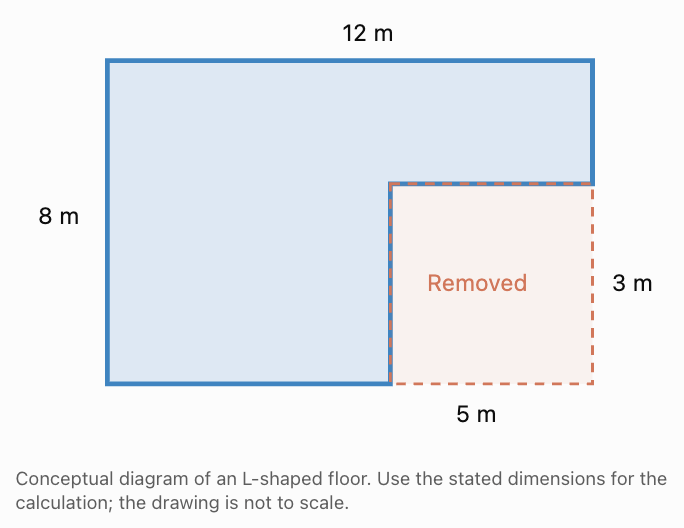
Step 1: Calculate the area of the large rectangle.
A = 12 × 8 = 96 m².
Step 2: Calculate the area of the removed rectangle.
A = 5 × 3 = 15 m².
Step 3: Subtract.
Composite area = 96 − 15
Answer: 81 m².
Worked Example 2: Rectangle with a Semicircle
A garden consists of a rectangle measuring 10 m by 6 m, with a semicircle attached along one of the 6 m sides.
Find the total area.
Step 1: Rectangle area
A_rectangle = 10 × 6 = 60 m².
Step 2: Semicircle radius
The diameter is 6 m.
r = 6/2 = 3 m.
Step 3: Semicircle area
A_semicircle = ½πr²
= ½π(3²)
= 4.5π
≈ 14.14 m².
Step 4: Add.
A_total = 60 + 4.5π
≈ 74.14 m².
Answer: Approximately 74.14 m².
Worked Example 3: Circular Hole in a Square
A square metal plate has side length 20 cm. A circular hole of radius 4 cm is cut from its centre.
Find the remaining metal area.
Square area:
A_square = 20² = 400 cm².
Hole area:
A_circle = π(4²) = 16π cm².
Remaining area:
A = 400 − 16π
≈ 349.73 cm².
Answer: Approximately 349.73 cm².
Worked Example 4: Trapezoid and Triangle
A composite figure consists of a trapezoid with parallel sides 8 cm and 14 cm and perpendicular height 5 cm, together with a triangle of base 8 cm and perpendicular height 4 cm. The two regions meet along an edge without overlapping.
Trapezoid area:
A₁ = ½(8 + 14)(5)
= 55 cm².
Triangle area:
A₂ = ½(8)(4)
= 16 cm².
Total area:
A = 55 + 16
Answer: 71 cm².
Choosing the Best Composite-Area Strategy
When solving a composite-area problem:
-
Identify the simple shapes making up the figure.
-
Mark all known dimensions.
-
Calculate missing dimensions if necessary.
-
Decide whether addition or subtraction is more efficient.
-
Calculate each area separately.
-
Combine the areas.
-
Check that the final answer has square units.
A common error is adding areas that overlap, thereby counting the same region twice.
Surface Area of Three-Dimensional Objects
The surface area of a solid is the total area of its outer surfaces.
For a closed solid, every exterior face or curved surface is included.
For an open container, any missing face must be excluded.
A net is a two-dimensional arrangement of surfaces that can be folded to form a three-dimensional object.
Nets are especially useful for understanding surface-area formulas.
Surface Area of a Rectangular Prism
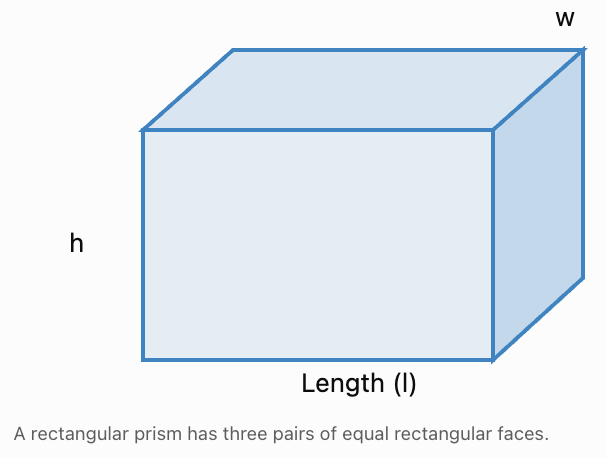
A rectangular prism has six rectangular faces.
If its length is l, width is w, and height is h:
SA = 2lw + 2lh + 2wh
or:
SA = 2(lw + lh + wh)
Worked Example 5: Surface Area of a Box
A closed box measures:
Length = 12 cm
Width = 5 cm
Height = 8 cm.
Calculate its total surface area.
SA = 2(lw + lh + wh)
= 2(12 × 5 + 12 × 8 + 5 × 8)
= 2(60 + 96 + 40)
= 2(196)
Answer: 392 cm².
Worked Example 6: Open-Top Box
A box measures 10 cm by 6 cm by 4 cm and has no lid.
Find its surface area.
Base:
10 × 6 = 60 cm².
Two longer sides:
2(10 × 4) = 80 cm².
Two shorter sides:
2(6 × 4) = 48 cm².
Total:
SA = 60 + 80 + 48
Answer: 188 cm².
Do not include the missing top face.
Surface Area of a Cube
A cube has six congruent square faces.
If its side length is s:
SA = 6s²
Worked Example 7: Cube
A cube has side length 7 cm.
SA = 6 × 7²
= 6 × 49
Answer: 294 cm².
Surface Area of a Prism
A prism has two congruent parallel bases and a constant cross-section.
For a right prism:
SA = 2B + Ph
Where:
-
B = area of one base.
-
P = perimeter of the base.
-
h = perpendicular distance between the bases.
The expression Ph represents the lateral surface area of a right prism.
Worked Example 8: Triangular Prism
A right triangular prism has a right-triangle base with sides 3 cm, 4 cm, and 5 cm.
The prism length is 10 cm.
Step 1: Area of one triangular base
B = ½ × 3 × 4
= 6 cm².
Step 2: Perimeter of the base
P = 3 + 4 + 5 = 12 cm.
Step 3: Lateral surface area
Ph = 12 × 10 = 120 cm².
Step 4: Total surface area
SA = 2(6) + 120
Answer: 132 cm².
Surface Area of a Cylinder
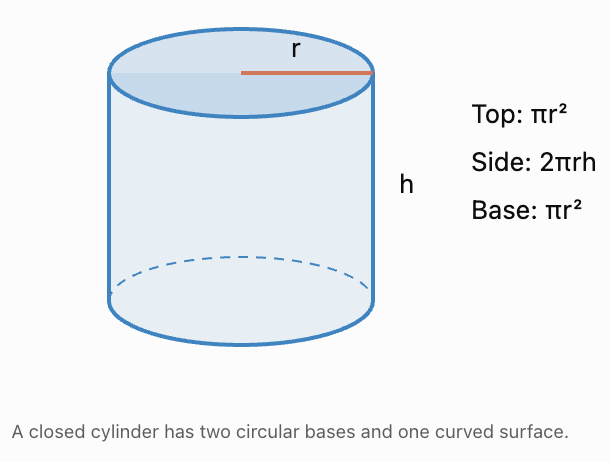
A cylinder has:
-
Two circular bases.
-
One curved surface.
If a cylinder is cut along its curved surface and unfolded, the curved surface forms a rectangle.
The rectangle's width is the circumference of the circular base, 2πr.
Its height is h.
Therefore:
Curved surface area = 2πrh.
The two circular bases have combined area:
2πr².
For a closed cylinder:
SA = 2πr² + 2πrh
or:
SA = 2πr(r + h)
Worked Example 9: Closed Cylinder
A cylinder has radius 4 cm and height 10 cm.
SA = 2πr² + 2πrh
= 2π(4²) + 2π(4)(10)
= 32π + 80π
= 112π
≈ 351.86 cm².
Answer: Approximately 351.86 cm².
Worked Example 10: Open-Top Cylinder
A cylindrical container has radius 3 m and height 5 m. It has a base but no lid.
Surface area:
SA = πr² + 2πrh
= π(3²) + 2π(3)(5)
= 9π + 30π
= 39π
≈ 122.52 m².
Answer: Approximately 122.52 m².
Surface Area of a Pyramid
A pyramid has one polygonal base and triangular side faces meeting at an apex.
For a regular right pyramid:
SA = B + ½Pl
Where:
-
B = base area.
-
P = base perimeter.
-
l = slant height of a triangular face.
The slant height is measured along the face from its apex to the midpoint of the corresponding base edge.
It is not the vertical height.
Worked Example 11: Square Pyramid
A regular square pyramid has:
Base side length = 8 cm
Slant height = 5 cm.
Base area:
B = 8² = 64 cm².
Base perimeter:
P = 4 × 8 = 32 cm.
Lateral surface area:
½Pl = ½ × 32 × 5 = 80 cm².
Total:
SA = 64 + 80
Answer: 144 cm².
For an irregular pyramid, calculate the area of each triangular face individually and add the base area.
Surface Area of a Cone
A cone has:
-
One circular base.
-
One curved surface.
For a right circular cone:
SA = πr² + πrl
Where:
-
r = radius.
-
l = slant height.
The curved surface area is:
CSA = πrl
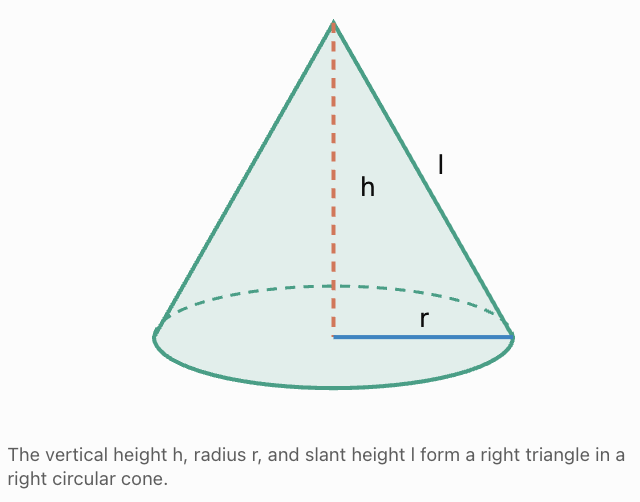
The slant height can be found using:
l = √(r² + h²)
Worked Example 12: Cone Surface Area
A right cone has radius 6 cm and vertical height 8 cm.
First calculate slant height:
l = √(6² + 8²)
= √100 = 10 cm.
Now calculate surface area:
SA = πr² + πrl
= π(6²) + π(6)(10)
= 36π + 60π
= 96π
≈ 301.59 cm².
Answer: Approximately 301.59 cm².
Surface Area of a Sphere
A sphere is a perfectly round three-dimensional solid.
Every point on its surface is the same distance from its centre.
The surface area formula is:
SA = 4πr²
Worked Example 13: Sphere
A sphere has radius 5 cm.
SA = 4π(5²)
= 4π(25)
= 100π
≈ 314.16 cm².
Answer: Approximately 314.16 cm².
Surface Area Formula Summary
|
Solid |
Total surface area |
|---|---|
|
Cube |
6s² |
|
Rectangular prism |
2(lw + lh + wh) |
|
Right prism |
2B + Ph |
|
Closed cylinder |
2πr² + 2πrh |
|
Regular right pyramid |
B + ½Pl |
|
Right circular cone |
πr² + πrl |
|
Sphere |
4πr² |
For open or composite solids, identify which surfaces are actually exposed rather than automatically applying the closed-solid formula.
Volume of Three-Dimensional Solids
Volume measures the space occupied by a solid.
For prisms and cylinders, the volume is the area of the base multiplied by the perpendicular height.
For pyramids and cones, the volume is one-third of the corresponding prism or cylinder with the same base area and height.
Volume of a Prism
For any prism:
V = Bh
Where:
-
B = area of the base.
-
h = perpendicular height between the bases.
For a rectangular prism:
V = lwh
Worked Example 14: Rectangular Prism
A storage box measures:
Length = 15 cm
Width = 8 cm
Height = 6 cm.
V = 15 × 8 × 6
Answer: 720 cm³.
Worked Example 15: Triangular Prism
A triangular prism has a triangular base with base 10 cm and perpendicular height 6 cm.
The prism length is 12 cm.
Area of triangular base:
B = ½ × 10 × 6
= 30 cm².
Volume:
V = 30 × 12
Answer: 360 cm³.
Volume of a Cylinder
The base of a cylinder is a circle.
Base area:
B = πr².
Therefore:
V = πr²h
Worked Example 16: Cylinder
A cylinder has radius 5 cm and height 12 cm.
V = π(5²)(12)
= 300π
≈ 942.48 cm³.
Answer: Approximately 942.48 cm³.
Volume of a Pyramid
The volume of a pyramid is:
V = ⅓Bh
Where B is the base area and h is the perpendicular height from the apex to the plane of the base.
Worked Example 17: Square Pyramid
A square pyramid has:
Base side = 9 cm
Vertical height = 12 cm.
Base area:
B = 9² = 81 cm².
Volume:
V = ⅓ × 81 × 12
Answer: 324 cm³.
The slant height is not used in the volume formula.
Volume of a Cone
The volume of a right circular cone is:
V = ⅓πr²h
Worked Example 18: Cone
A cone has radius 4 cm and vertical height 9 cm.
V = ⅓π(4²)(9)
= ⅓π(16)(9)
= 48π
≈ 150.80 cm³.
Answer: Approximately 150.80 cm³.
Why Is a Cone One-Third of a Cylinder?
A cone and cylinder with the same base area and perpendicular height have volumes in the ratio:
Cone : Cylinder = 1 : 3
For example, if a cylinder holds 900 mL, a cone with the same base radius and height holds:
900/3 = 300 mL.
The same relationship holds between a pyramid and a prism with equal base areas and perpendicular heights.
Volume of a Sphere
The volume of a sphere is:
V = ⁴⁄₃πr³
Worked Example 19: Sphere
A sphere has radius 6 cm.
V = ⁴⁄₃π(6³)
= ⁴⁄₃π(216)
= 288π
≈ 904.78 cm³.
Answer: Approximately 904.78 cm³.
Volume of a Hemisphere
A hemisphere is half a sphere.
Its volume is:
V = ⅔πr³
Worked Example 20: Hemisphere
A hemisphere has radius 3 cm.
V = ⅔π(3³)
= ⅔π(27)
= 18π
≈ 56.55 cm³.
Answer: Approximately 56.55 cm³.
Volume Formula Summary
|
Solid |
Volume |
|---|---|
|
Cube |
s³ |
|
Rectangular prism |
lwh |
|
Any prism |
Bh |
|
Cylinder |
πr²h |
|
Pyramid |
⅓Bh |
|
Cone |
⅓πr²h |
|
Sphere |
⁴⁄₃πr³ |
|
Hemisphere |
⅔πr³ |
Selecting the Appropriate Formula
A useful first question is: What type of solid am I measuring?
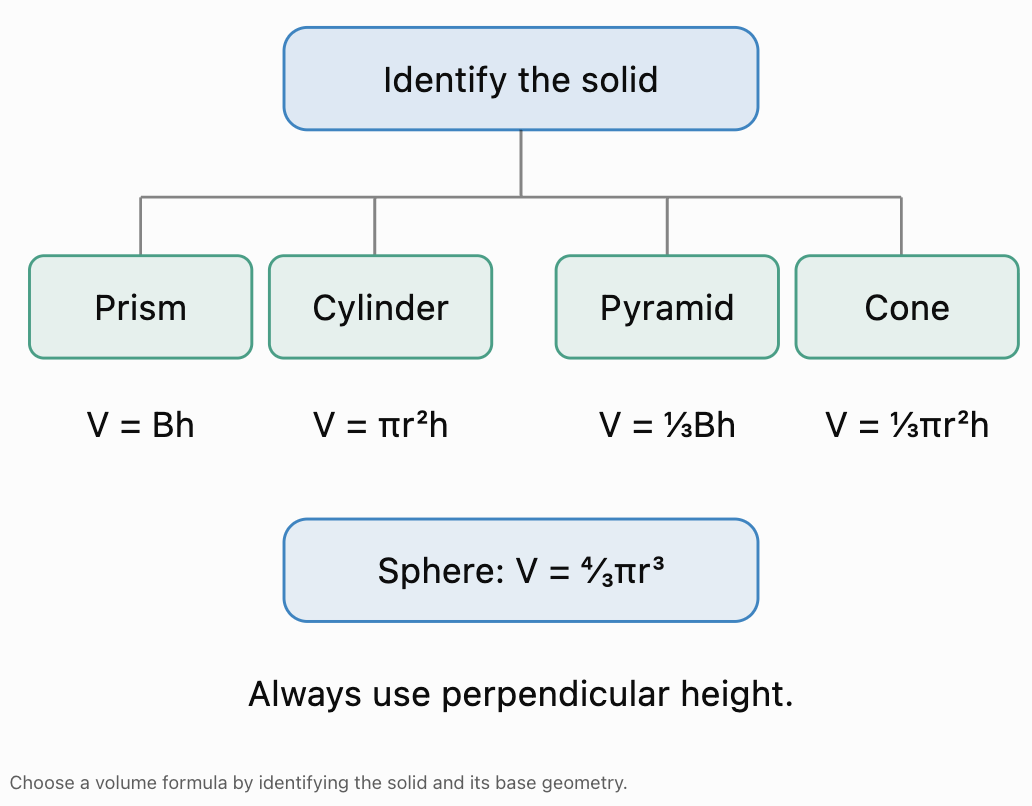
For surface area, identify the exposed faces and curved surfaces. For volume, identify the base area and perpendicular height, except for spheres, which use the radius directly.
Composite Three-Dimensional Solids
Some objects are formed by joining or removing simpler solids.
The volume of a composite solid can often be found by:
V_total = V₁ + V₂ + …
or:
V_remaining = V_large − V_removed
Worked Example 21: Cylinder with a Hemisphere
A solid consists of a cylinder with a hemisphere attached to its top.
Both have radius 3 cm.
The cylinder has height 10 cm.
Cylinder volume:
V_cylinder = π(3²)(10)
= 90π cm³.
Hemisphere volume:
V_hemisphere = ⅔π(3³)
= 18π cm³.
Total:
V = 90π + 18π
= 108π
≈ 339.29 cm³.
Answer: Approximately 339.29 cm³.
Worked Example 22: Drilled Cylindrical Hole
A rectangular block measures 12 cm by 10 cm by 8 cm.
A cylindrical hole of radius 2 cm is drilled vertically through its 8 cm height.
Rectangular prism volume:
V₁ = 12 × 10 × 8 = 960 cm³.
Cylindrical hole volume:
V₂ = π(2²)(8) = 32π cm³.
Remaining volume:
V = 960 − 32π
≈ 859.47 cm³.
Answer: Approximately 859.47 cm³.
Surface Area of Composite Solids
Surface area requires additional care.
When two solids are joined, their shared contact surfaces are not exposed.
Therefore, we must exclude these internal surfaces.
Worked Example 23: Cylinder with Hemispherical Top
A closed solid consists of a cylinder of radius 4 cm and height 8 cm, with a hemisphere attached to its top.
Find its external surface area.
The exposed surfaces are:
-
Curved surface of the cylinder.
-
Curved surface of the hemisphere.
-
Circular base of the cylinder.
Cylinder curved surface:
2πrh = 2π(4)(8) = 64π.
Hemisphere curved surface:
2πr² = 2π(4²) = 32π.
Bottom base:
πr² = 16π.
Total:
SA = 64π + 32π + 16π
= 112π
≈ 351.86 cm².
Answer: Approximately 351.86 cm².
The circular contact surface between the cylinder and hemisphere is internal and is not counted.
Real-World Measurement Problems
Area, surface area, and volume calculations are used in construction, manufacturing, engineering, packaging, architecture, and everyday life.
Painting and decorating
Surface area determines how much paint, wallpaper, or protective coating is needed.
Water storage
Volume calculations determine the capacity of tanks, reservoirs, and containers.
Packaging
Surface area estimates material requirements, while volume determines internal storage capacity.
Landscaping
Composite area calculations determine the amount of turf, paving, or soil needed.
Worked Example 24: Painting a Room
A room measures:
Length = 6 m
Width = 4 m
Height = 3 m.
There is one door measuring 2 m by 0.9 m and two windows, each measuring 1.5 m by 1.2 m.
Calculate the wall area to be painted, excluding the door and windows.
Step 1: Total wall area
Two longer walls:
2(6 × 3) = 36 m².
Two shorter walls:
2(4 × 3) = 24 m².
Total wall area:
36 + 24 = 60 m².
Step 2: Door area
2 × 0.9 = 1.8 m².
Step 3: Window area
2(1.5 × 1.2) = 3.6 m².
Step 4: Subtract openings
Paintable area:
60 − 1.8 − 3.6
Answer: 54.6 m².
If one litre of paint covers 10 m² per coat:
54.6/10 = 5.46 L.
For two coats:
5.46 × 2 = 10.92 L.
Allowing for some waste, approximately 12 L would be a reasonable purchase quantity.
Worked Example 25: Water Tank Capacity
A cylindrical tank has internal radius 1.5 m and internal height 4 m.
Find its capacity in litres.
Volume:
V = πr²h
= π(1.5²)(4)
= 9π
≈ 28.274 m³.
Convert to litres:
28.274 × 1000
≈ 28,274 L.
Answer: Approximately 28,274 L.
Worked Example 26: Cost of Flooring
An L-shaped room has an area of 72 m².
Floor tiles cost $28 per square metre.
Calculate the tile cost, allowing 10% extra for cutting and breakage.
Required tile area:
72 × 1.10 = 79.2 m².
Cost:
79.2 × 28
Answer: $2,217.60.
This assumes tiles can be purchased in the exact required quantity. In practice, packages may need to be rounded up.
Worked Example 27: Comparing Containers
A cylindrical container has radius 4 cm and height 12 cm.
A cone has the same radius and height.
Compare their volumes.
Cylinder:
V = π(4²)(12)
= 192π cm³.
Cone:
V = ⅓π(4²)(12)
= 64π cm³.
Ratio:
192π : 64π = 3 : 1.
Answer: The cylinder has three times the volume of the cone.
Scaling and Measurement
When a three-dimensional object is enlarged or reduced, its dimensions change according to the scale factor.
If the linear scale factor is k:
Length scale factor = k
Surface area scale factor = k²
Volume scale factor = k³
For positive k, these formulas apply directly. For negative coordinate dilations, lengths scale by |k|, areas by k², and volumes by |k|³.
Worked Example 28: Enlarging a Cube
A cube has side length 3 cm.
It is enlarged by linear scale factor 4.
Original surface area:
SA = 6(3²) = 54 cm².
New surface area:
SA′ = 54 × 4²
= 54 × 16
= 864 cm².
Original volume:
V = 3³ = 27 cm³.
New volume:
V′ = 27 × 4³
= 27 × 64
= 1728 cm³.
Answers: New surface area = 864 cm²; new volume = 1728 cm³.
Common Mistakes
Mistake 1: Confusing Area and Volume
Area is measured in square units, while volume is measured in cubic units.
Mistake 2: Using Diameter Instead of Radius
For circles, cylinders, cones, and spheres, formulas use the radius.
If the diameter is 10 cm, the radius is 5 cm.
Mistake 3: Forgetting to Square or Cube the Radius
Cylinder volume uses r².
Sphere volume uses r³.
Mistake 4: Using Slant Height Instead of Vertical Height
Cone and pyramid volume formulas use perpendicular height.
Mistake 5: Forgetting the One-Third Factor
Pyramids and cones have volume equal to one-third of the corresponding prism or cylinder.
Mistake 6: Counting Hidden Surfaces
When solids are joined, their internal contact surfaces are not part of the external surface area.
Mistake 7: Including Missing Faces
An open-top box or cylinder does not include a top surface.
Mistake 8: Adding Overlapping Areas Twice
Composite figures should be divided into non-overlapping regions.
Mistake 9: Incorrect Unit Conversions
1 m² = 10,000 cm², not 100 cm².
1 m³ = 1,000,000 cm³, not 1000 cm³.
Mistake 10: Using the Wrong Formula
A cylinder and a cone may have similar appearances but different volume formulas.
Mistake 11: Rounding Too Early
Keep π and intermediate values exact until the final step when possible.
Mistake 12: Forgetting Units
Area answers require squared units.
Volume answers require cubed units.
Mistake 13: Confusing Surface Area with Capacity
A tank's surface area determines material requirements.
Its volume determines how much liquid it can hold.
Mistake 14: Ignoring Practical Constraints
Real-world problems may require extra material for waste, seams, overlaps, or packaging.
Mistake 15: Using the Linear Scale Factor for Area or Volume
A scale factor of 2 multiplies surface area by 4 and volume by 8.
Key Terms
-
Area: The amount of two-dimensional space inside a figure.
-
Composite Figure: A figure formed from two or more simpler shapes.
-
Perimeter: The distance around a two-dimensional figure.
-
Surface Area: The total area of the surfaces of a three-dimensional object.
-
Volume: The amount of three-dimensional space occupied by a solid.
-
Capacity: The amount a container can hold.
-
Square Unit: A unit used to measure area.
-
Cubic Unit: A unit used to measure volume.
-
Prism: A solid with two congruent parallel polygonal bases and a constant cross-section.
-
Rectangular Prism: A prism with rectangular faces.
-
Cube: A solid with six congruent square faces.
-
Cylinder: A solid with two congruent parallel circular bases and a curved surface.
-
Pyramid: A solid with a polygonal base and triangular faces meeting at an apex.
-
Cone: A solid with a circular base and a curved surface meeting at an apex.
-
Sphere: A solid whose surface points are equally distant from its centre.
-
Hemisphere: Half of a sphere.
-
Base Area: The area of a solid's base.
-
Lateral Surface Area: The area of the side faces or curved side surface, excluding bases.
-
Curved Surface Area: The area of a curved exterior surface.
-
Slant Height: The height measured along a face or sloping surface.
-
Perpendicular Height: The shortest distance measured at right angles to a base plane.
-
Radius: The distance from the centre of a circle or sphere to its boundary.
-
Diameter: Twice the radius.
-
Net: A flat arrangement of faces that can be folded into a solid.
-
Cross-Section: The shape formed by slicing a solid with a plane.
-
Scale Factor: A multiplier used to enlarge or reduce dimensions.
-
Unit Conversion: Changing a measurement from one unit to another.
-
Displacement: A method of measuring volume by the amount of fluid displaced.
-
Exact Value: A value expressed without approximation, often using π or radicals.
-
Approximation: A rounded or estimated value.
Key Takeaways
-
Area measures two-dimensional space.
-
Surface area measures the exposed surfaces of a three-dimensional solid.
-
Volume measures three-dimensional space.
-
Composite areas can be calculated by addition or subtraction.
-
Rectangle area is lw.
-
Triangle area is ½bh.
-
Circle area is πr².
-
Rectangular prism volume is lwh.
-
General prism volume is Bh.
-
Cylinder volume is πr²h.
-
Pyramid volume is ⅓Bh.
-
Cone volume is ⅓πr²h.
-
Sphere volume is ⁴⁄₃πr³.
-
A closed cylinder has surface area 2πr² + 2πrh.
-
A right cone has surface area πr² + πrl.
-
A sphere has surface area 4πr².
-
Surface-area problems require identifying the exposed faces.
-
Volume problems require the correct base area and perpendicular height.
-
Linear scaling by k changes area by k² and volume by k³ for positive k.
-
Real-world measurement problems require correct units, suitable formulas, and reasonable interpretation.
Check Your Understanding
Show your working. Use π where appropriate and round decimal answers to two decimal places unless otherwise stated.
Question 1: Composite Area
An L-shaped figure is formed from a rectangle measuring 14 cm by 9 cm, with a 6 cm by 4 cm rectangle removed.
Find the remaining area.
Question 2: Rectangle and Semicircle
A composite figure consists of a rectangle measuring 12 cm by 8 cm with a semicircle attached along an 8 cm side.
Find the total area.
Question 3: Circular Hole
A square plate has side length 18 cm.
A circular hole of radius 5 cm is removed.
Find the remaining area.
Question 4: Trapezoid
A trapezoid has parallel sides of 9 cm and 15 cm and perpendicular height 7 cm.
Find its area.
Question 5: Rectangular Prism Surface Area
A closed rectangular prism measures 10 cm by 6 cm by 4 cm.
Find its total surface area.
Question 6: Cube Surface Area
A cube has side length 9 cm.
Find its total surface area.
Question 7: Triangular Prism Surface Area
A right triangular prism has a triangular base with sides 5 cm, 12 cm, and 13 cm.
The prism length is 8 cm.
Find its total surface area.
Question 8: Cylinder Surface Area
A closed cylinder has radius 3 cm and height 11 cm.
Find its total surface area.
Question 9: Cone Surface Area
A right cone has radius 5 cm and vertical height 12 cm.
Find its total surface area.
Question 10: Sphere Surface Area
A sphere has diameter 14 cm.
Find its surface area.
Question 11: Rectangular Prism Volume
A box measures 18 cm by 7 cm by 5 cm.
Find its volume.
Question 12: Cylinder Volume
A cylinder has radius 6 cm and height 9 cm.
Find its volume.
Question 13: Pyramid Volume
A square pyramid has base side length 10 cm and perpendicular height 15 cm.
Find its volume.
Question 14: Cone Volume
A cone has radius 3 cm and height 14 cm.
Find its volume.
Question 15: Sphere Volume
A sphere has radius 4 cm.
Find its volume.
Question 16: Composite Volume
A solid consists of a cylinder with a hemisphere attached on top.
Both have radius 5 cm.
The cylinder height is 12 cm.
Find the total volume.
Question 17: Water Tank
A cylindrical water tank has radius 2 m and height 3.5 m.
Find its capacity in litres.
Question 18: Painting a Wall
A wall measures 8 m by 3 m.
It contains a window measuring 2 m by 1.5 m.
Paint covers 6 m² per litre per coat.
How many litres are needed for two coats, before allowing for waste?
Question 19: Scaling
A cube has volume 64 cm³.
It is enlarged by a linear scale factor of 3.
Find:
a) Its new volume.
b) Its original side length.
c) Its new side length.
d) Its new surface area.
Question 20: Comprehensive Challenge
A closed solid consists of a cylinder with a cone attached on top.
Both have radius 4 cm.
The cylinder height is 10 cm.
The cone has vertical height 3 cm.
Find:
a) The volume of the cylinder.
b) The volume of the cone.
c) The total volume.
d) The slant height of the cone.
e) The total external surface area, including the bottom circular base but excluding the internal circular surface where the solids meet.
f) The total volume in litres.
Fully Worked Answers
Answer 1: Composite Area
Large rectangle:
A₁ = 14 × 9 = 126 cm².
Removed rectangle:
A₂ = 6 × 4 = 24 cm².
Remaining area:
A = 126 − 24
Answer: 102 cm².
Answer 2: Rectangle and Semicircle
Rectangle area:
A₁ = 12 × 8 = 96 cm².
Semicircle diameter = 8 cm.
Radius = 4 cm.
Semicircle area:
A₂ = ½π(4²) = 8π cm².
Total:
A = 96 + 8π
≈ 121.13 cm².
Answer: 121.13 cm².
Answer 3: Circular Hole
Square area:
18² = 324 cm².
Circle area:
π(5²) = 25π cm².
Remaining area:
324 − 25π
≈ 245.46 cm².
Answer: 245.46 cm².
Answer 4: Trapezoid
A = ½(a + b)h
= ½(9 + 15)(7)
= ½(24)(7)
Answer: 84 cm².
Answer 5: Rectangular Prism Surface Area
SA = 2(lw + lh + wh)
= 2(10 × 6 + 10 × 4 + 6 × 4)
= 2(60 + 40 + 24)
Answer: 248 cm².
Answer 6: Cube Surface Area
SA = 6s²
= 6(9²)
= 6 × 81
Answer: 486 cm².
Answer 7: Triangular Prism Surface Area
The base is a right triangle with legs 5 cm and 12 cm.
Base area:
B = ½ × 5 × 12 = 30 cm².
Base perimeter:
P = 5 + 12 + 13 = 30 cm.
Prism length = 8 cm.
SA = 2B + Ph
= 2(30) + 30(8)
= 60 + 240
Answer: 300 cm².
Answer 8: Cylinder Surface Area
SA = 2πr² + 2πrh
= 2π(3²) + 2π(3)(11)
= 18π + 66π
= 84π
≈ 263.89 cm².
Answer: 263.89 cm².
Answer 9: Cone Surface Area
Radius = 5 cm.
Height = 12 cm.
Slant height:
l = √(5² + 12²)
= √169 = 13 cm.
Surface area:
SA = πr² + πrl
= 25π + 65π
= 90π
≈ 282.74 cm².
Answer: 282.74 cm².
Answer 10: Sphere Surface Area
Diameter = 14 cm.
Radius = 7 cm.
SA = 4πr²
= 4π(7²)
= 196π
≈ 615.75 cm².
Answer: 615.75 cm².
Answer 11: Rectangular Prism Volume
V = lwh
= 18 × 7 × 5
Answer: 630 cm³.
Answer 12: Cylinder Volume
V = πr²h
= π(6²)(9)
= 324π
≈ 1017.88 cm³.
Answer: 1017.88 cm³.
Answer 13: Pyramid Volume
Base area:
B = 10² = 100 cm².
Volume:
V = ⅓Bh
= ⅓(100)(15)
Answer: 500 cm³.
Answer 14: Cone Volume
V = ⅓πr²h
= ⅓π(3²)(14)
= 42π
≈ 131.95 cm³.
Answer: 131.95 cm³.
Answer 15: Sphere Volume
V = ⁴⁄₃πr³
= ⁴⁄₃π(4³)
= 256π/3
≈ 268.08 cm³.
Answer: 268.08 cm³.
Answer 16: Composite Volume
Cylinder:
V₁ = π(5²)(12)
= 300π cm³.
Hemisphere:
V₂ = ⅔π(5³)
= 250π/3 cm³.
Total:
V = 300π + 250π/3
= 1150π/3
≈ 1204.28 cm³.
Answer: 1204.28 cm³.
Answer 17: Water Tank
Radius = 2 m.
Height = 3.5 m.
V = π(2²)(3.5)
= 14π
≈ 43.9823 m³.
Convert to litres:
43.9823 × 1000
≈ 43,982.30 L.
Answer: Approximately 43,982.30 L.
Answer 18: Painting a Wall
Wall area:
8 × 3 = 24 m².
Window area:
2 × 1.5 = 3 m².
Paintable area:
24 − 3 = 21 m².
For two coats:
21 × 2 = 42 m² of coverage.
Paint required:
42/6 = 7 L.
Answer: 7 litres.
Answer 19: Scaling
Original volume = 64 cm³.
Scale factor = 3.
a) New volume
Volume scale factor = 3³ = 27.
V′ = 64 × 27
Answer: 1728 cm³.
b) Original side length
s³ = 64.
s = ∛64 = 4 cm.
Answer: 4 cm.
c) New side length
s′ = 4 × 3
Answer: 12 cm.
d) New surface area
SA = 6(12²)
= 6 × 144
Answer: 864 cm².
Answer 20: Comprehensive Challenge
Cylinder radius = 4 cm.
Cylinder height = 10 cm.
Cone radius = 4 cm.
Cone height = 3 cm.
a) Cylinder volume
V₁ = πr²h
= π(4²)(10)
Answer: 160π cm³.
b) Cone volume
V₂ = ⅓πr²h
= ⅓π(4²)(3)
Answer: 16π cm³.
c) Total volume
V = 160π + 16π
= 176π
≈ 552.92 cm³.
Answer: 552.92 cm³.
d) Slant height
l = √(r² + h²)
= √(4² + 3²)
= √25
Answer: 5 cm.
e) External surface area
The exposed surfaces are:
Cylinder curved surface:
2πrh = 2π(4)(10) = 80π cm².
Cone curved surface:
πrl = π(4)(5) = 20π cm².
Bottom circular base:
πr² = 16π cm².
Total:
SA = 80π + 20π + 16π
= 116π
≈ 364.42 cm².
Answer: 364.42 cm².
f) Convert total volume to litres
Total volume:
176π ≈ 552.92 cm³.
Since 1000 cm³ = 1 L:
552.92/1000 ≈ 0.55292 L.
Answer: Approximately 0.553 L.
Final Course Connections
Area, surface area, and volume are essential tools for understanding and measuring the physical world.
Composite-area calculations help us work with irregular two-dimensional shapes. Surface-area calculations allow us to determine the material needed to cover or construct three-dimensional objects. Volume calculations help us determine how much space objects occupy or how much liquid containers can hold.
The most important skill is learning to identify the shape, select the appropriate formula, use the correct dimensions, and interpret the answer in its real-world context.
This completes Area and Volume, covering all five learning targets with detailed explanations, worked examples, diagrams, practical applications, common mistakes, key terms, key takeaways, and fully worked practice questions.