Algebra of Polynomial Functions
2. Multiplying Polynomials
Learning outcomes
- I can multiply monomials and polynomials.
- I can apply the distributive property correctly.
- I can expand products involving binomials and trinomials.
- I can recognize common polynomial products.
- I can simplify expanded polynomial expressions.
Multiplying Polynomials
Introduction
Multiplying polynomials is an important algebraic skill used to simplify expressions, solve equations, calculate areas, and model real-world situations.
Unlike adding and subtracting polynomials, multiplication often creates new terms with higher powers of variables.
For example:
3x × 4x = 12x²
And:
(x + 2)(x + 3) = x² + 5x + 6
To multiply polynomials correctly, we use the distributive property, exponent rules, and the process of combining like terms.
In this topic, we will explore multiplication involving monomials, binomials, trinomials, and more complicated polynomial expressions.


Review: What Is a Polynomial?
A polynomial is an algebraic expression consisting of one or more terms containing numbers, variables, and nonnegative integer exponents.
Examples include:
-
5x
-
3x + 7
-
2x² − 4x + 5
-
x³ + 2x² − x + 9
Polynomials are classified according to their number of terms.
|
Polynomial type |
Number of terms |
Example |
|---|---|---|
|
Monomial |
1 |
4x² |
|
Binomial |
2 |
x + 5 |
|
Trinomial |
3 |
x² + 3x + 2 |
When multiplying polynomials, each term in one expression must be multiplied by every term in the other expression.
Review: Multiplication of Powers
Before multiplying polynomials, we need to understand how exponents behave during multiplication.
Product of Powers Rule
When multiplying powers with the same base, add their exponents.
xᵃ × xᵇ = xᵃ⁺ᵇ
For example:
x² × x³ = x⁵
x⁴ × x = x⁵
x³ × x³ = x⁶
Multiplying Coefficients
When terms contain numerical coefficients, multiply the coefficients separately.
For example:
3x² × 4x³
Multiply the coefficients:
3 × 4 = 12
Add the exponents:
x² × x³ = x⁵
Therefore:
3x² × 4x³ = 12x⁵
Another Example
−5a³ × 2a²
Multiply:
−5 × 2 = −10
Add the exponents:
a³ × a² = a⁵
Therefore:
−5a³ × 2a² = −10a⁵
Multiplying Monomials
A monomial is a polynomial containing only one term.
To multiply monomials:
-
Multiply the numerical coefficients.
-
Multiply variables with the same base by adding exponents.
-
Include any variables that appear in only one factor.
-
Simplify the result.
Worked Example
Multiply:
4x² × 3x⁴
Coefficients:
4 × 3 = 12
Variables:
x² × x⁴ = x⁶
Final answer: 12x⁶
Worked Example with Multiple Variables
Multiply:
3a²b × 4ab³
Coefficients:
3 × 4 = 12
Variables:
a² × a = a³
b × b³ = b⁴
Therefore:
3a²b × 4ab³ = 12a³b⁴
Worked Example with Negative Coefficients
Multiply:
−2x³y × −5xy²
Coefficients:
−2 × −5 = 10
Variables:
x³ × x = x⁴
y × y² = y³
Final answer: 10x⁴y³
Important Sign Rules
|
First factor |
Second factor |
Product |
|---|---|---|
|
Positive |
Positive |
Positive |
|
Positive |
Negative |
Negative |
|
Negative |
Positive |
Negative |
|
Negative |
Negative |
Positive |
The Distributive Property
The distributive property allows multiplication to be applied to every term inside parentheses.
The general rule is:
a(b + c) = ab + ac
Similarly:
a(b − c) = ab − ac
This property is the foundation of polynomial multiplication.
Worked Example
Expand:
3(x + 4)
Multiply 3 by each term:
3 × x = 3x
3 × 4 = 12
Therefore:
3(x + 4) = 3x + 12
Worked Example with Subtraction
Expand:
5(2x − 3)
Multiply 5 by each term:
5 × 2x = 10x
5 × (−3) = −15
Therefore:
5(2x − 3) = 10x − 15

Multiplying a Monomial by a Polynomial
When multiplying a monomial by a polynomial, distribute the monomial to every term.
Worked Example
Expand:
4x(2x + 5)
Distribute:
4x × 2x = 8x²
4x × 5 = 20x
Therefore:
4x(2x + 5) = 8x² + 20x
Worked Example with a Trinomial
Expand:
3x(2x² − 4x + 5)
Multiply each term:
3x × 2x² = 6x³
3x × (−4x) = −12x²
3x × 5 = 15x
Therefore:
3x(2x² − 4x + 5) = 6x³ − 12x² + 15x
Worked Example with a Negative Monomial
Expand:
−2x(3x² − 5x + 4)
Distribute:
−2x × 3x² = −6x³
−2x × (−5x) = 10x²
−2x × 4 = −8x
Final answer: −6x³ + 10x² − 8x
Multiplying Two Binomials
A binomial contains two terms.
When multiplying two binomials, each term in the first binomial must multiply both terms in the second binomial.
Consider:
(x + 2)(x + 3)
Distribute x:
x(x + 3) = x² + 3x
Distribute 2:
2(x + 3) = 2x + 6
Combine:
x² + 3x + 2x + 6
Combine like terms:
x² + 5x + 6
General Pattern
(a + b)(c + d) = ac + ad + bc + bd
There are four individual products before any like terms are combined.
Understanding Binomial Multiplication with an Area Model
A rectangle can be divided into four smaller regions.
If the rectangle has side lengths:
x + 2
and:
x + 3
its area is:
(x + 2)(x + 3)
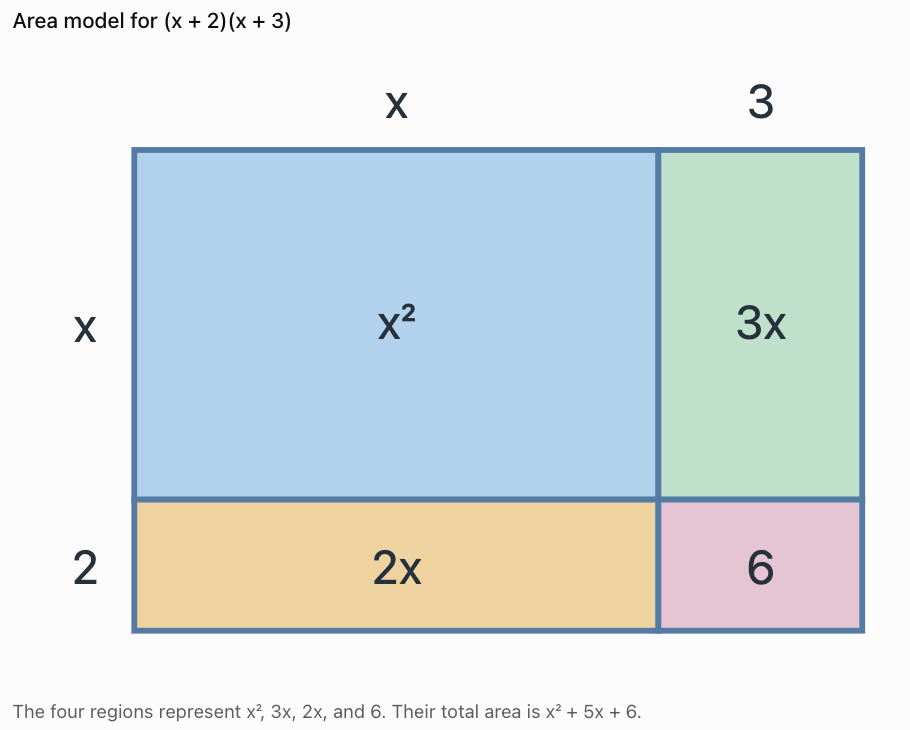
The four smaller areas are:
-
x × x = x²
-
x × 3 = 3x
-
2 × x = 2x
-
2 × 3 = 6
Adding:
x² + 3x + 2x + 6
= x² + 5x + 6
The area model helps explain why every term must be multiplied.
The FOIL Method
FOIL is a memory aid for multiplying two binomials.
FOIL stands for:
-
First: Multiply the first terms.
-
Outer: Multiply the outer terms.
-
Inner: Multiply the inner terms.
-
Last: Multiply the last terms.
Worked Example
Expand:
(x + 4)(x + 7)
First:
x × x = x²
Outer:
x × 7 = 7x
Inner:
4 × x = 4x
Last:
4 × 7 = 28
Combine:
x² + 7x + 4x + 28
= x² + 11x + 28
Important Limitation
FOIL is useful only for multiplying two binomials.
The distributive property is more general and works for all polynomial products.
Multiplying Binomials with Negative Terms
Worked Example
Expand:
(x − 3)(x + 5)
Multiply:
x × x = x²
x × 5 = 5x
−3 × x = −3x
−3 × 5 = −15
Combine:
x² + 5x − 3x − 15
= x² + 2x − 15
Worked Example with Two Negative Terms
Expand:
(x − 4)(x − 6)
Multiply:
x² − 6x − 4x + 24
Combine:
x² − 10x + 24
Notice that:
−4 × −6 = +24
Multiplying Binomials with Coefficients
Not every binomial begins with x.
Worked Example
Expand:
(2x + 3)(4x + 5)
Multiply each pair:
2x × 4x = 8x²
2x × 5 = 10x
3 × 4x = 12x
3 × 5 = 15
Combine:
8x² + 10x + 12x + 15
= 8x² + 22x + 15
Another Example
Expand:
(3x − 2)(2x − 7)
Multiply:
3x × 2x = 6x²
3x × (−7) = −21x
−2 × 2x = −4x
−2 × (−7) = 14
Combine:
6x² − 25x + 14
Multiplying a Binomial by a Trinomial
A binomial contains two terms, while a trinomial contains three.
Each term in the binomial must multiply all three terms in the trinomial.
Worked Example
Expand:
(x + 2)(x² + 3x + 4)
Distribute x:
x(x² + 3x + 4)
= x³ + 3x² + 4x
Distribute 2:
2(x² + 3x + 4)
= 2x² + 6x + 8
Combine:
x³ + 3x² + 4x + 2x² + 6x + 8
Group like terms:
x³ + (3x² + 2x²) + (4x + 6x) + 8
= x³ + 5x² + 10x + 8
Another Example
Expand:
(2x − 3)(x² − 4x + 5)
Distribute 2x:
2x³ − 8x² + 10x
Distribute −3:
−3x² + 12x − 15
Combine:
2x³ − 8x² + 10x − 3x² + 12x − 15
= 2x³ − 11x² + 22x − 15
Multiplying Two Trinomials
Multiplying two trinomials involves nine individual products before like terms are combined.
Worked Example
Expand:
(x² + 2x + 3)(x² + x + 4)
Distribute x²:
x⁴ + x³ + 4x²
Distribute 2x:
2x³ + 2x² + 8x
Distribute 3:
3x² + 3x + 12
Combine:
x⁴ + x³ + 4x² + 2x³ + 2x² + 8x + 3x² + 3x + 12
Group like terms:
x⁴ + (x³ + 2x³) + (4x² + 2x² + 3x²) + (8x + 3x) + 12
= x⁴ + 3x³ + 9x² + 11x + 12
Important Strategy
When multiplying larger polynomials, work systematically.
Multiply every term in the first polynomial by every term in the second polynomial.
Then combine like terms.
Polynomial Multiplication Using a Grid
A multiplication grid helps organise longer calculations.
Consider:
(2x + 3)(x² + 4x + 5)
|
× |
x² |
4x |
5 |
|---|---|---|---|
|
2x |
2x³ |
8x² |
10x |
|
3 |
3x² |
12x |
15 |
Combine all entries:
2x³ + 8x² + 10x + 3x² + 12x + 15
= 2x³ + 11x² + 22x + 15
Advantages of the Grid Method
-
Helps ensure every term is multiplied.
-
Reduces the chance of missing products.
-
Makes negative signs easier to track.
-
Works for binomials, trinomials, and larger polynomials.

Common Polynomial Products
Some polynomial products occur so frequently that recognising their patterns can save time.
These are called special products or special product identities.
The three most important are:
Square of a sum:
(a + b)² = a² + 2ab + b²
Square of a difference:
(a − b)² = a² − 2ab + b²
Product of a sum and a difference:
(a + b)(a − b) = a² − b²
These identities come directly from the distributive property.
Squaring a Binomial: Square of a Sum
Consider:
(x + 3)²
The exponent 2 means the entire binomial is multiplied by itself.
(x + 3)² = (x + 3)(x + 3)
Distribute:
= x² + 3x + 3x + 9
Combine:
(x + 3)² = x² + 6x + 9
General Rule
(a + b)² = a² + 2ab + b²
The result contains:
-
The square of the first term.
-
Twice the product of the two terms.
-
The square of the second term.
Worked Example
Expand:
(2x + 5)²
Let:
a = 2x
b = 5
Apply the identity:
(2x)² + 2(2x)(5) + 5²
= 4x² + 20x + 25
Final answer: 4x² + 20x + 25
Important Reminder
A common error is:
(x + 3)² = x² + 9
This is incorrect because it omits the middle term, 6x.
Squaring a Binomial: Square of a Difference
Consider:
(x − 4)²
Rewrite:
(x − 4)(x − 4)
Distribute:
x² − 4x − 4x + 16
Combine:
(x − 4)² = x² − 8x + 16
General Rule
(a − b)² = a² − 2ab + b²
Worked Example
Expand:
(3x − 2)²
Apply the identity:
(3x)² − 2(3x)(2) + 2²
= 9x² − 12x + 4
Final answer: 9x² − 12x + 4
Notice that the final term is positive because squaring a negative quantity produces a positive result.
Difference of Squares
The product of a sum and a difference produces a particularly useful pattern.
(a + b)(a − b) = a² − b²
The middle terms cancel.
Worked Example
Expand:
(x + 5)(x − 5)
Distribute:
x² − 5x + 5x − 25
Combine:
x² − 25
Another Example
Expand:
(3x + 4)(3x − 4)
Apply the identity:
(3x)² − 4²
= 9x² − 16
Final answer: 9x² − 16
Why Is This Useful?
Recognising the difference-of-squares pattern allows us to expand some expressions without writing every individual product.

Recognising Special Products
Compare these expressions.
|
Expression |
Product type |
Expanded form |
|---|---|---|
|
(x + 2)² |
Square of a sum |
x² + 4x + 4 |
|
(x − 2)² |
Square of a difference |
x² − 4x + 4 |
|
(x + 2)(x − 2) |
Difference of squares |
x² − 4 |
|
(2x + 3)² |
Square of a sum |
4x² + 12x + 9 |
|
(2x − 3)² |
Square of a difference |
4x² − 12x + 9 |
|
(2x + 3)(2x − 3) |
Difference of squares |
4x² − 9 |
The expressions look similar, but their products are different.
Always check whether the binomials are identical or conjugates (a sum and difference of the same terms).
Multiplying Three Binomials
Some expressions contain three or more polynomial factors.
The safest method is to multiply two factors first, simplify, and then multiply the result by the remaining factor.
Worked Example
Expand:
(x + 1)(x + 2)(x + 3)
First multiply:
(x + 1)(x + 2)
= x² + 3x + 2
Now multiply by the third factor:
(x² + 3x + 2)(x + 3)
Distribute x:
x³ + 3x² + 2x
Distribute 3:
3x² + 9x + 6
Combine:
x³ + 6x² + 11x + 6
Another Example
Expand:
(x − 2)(x + 2)(x + 5)
Recognise the difference of squares:
(x − 2)(x + 2) = x² − 4
Now multiply:
(x² − 4)(x + 5)
= x³ + 5x² − 4x − 20
Final answer: x³ + 5x² − 4x − 20
Recognising a special product makes this calculation shorter.
Combining Multiplication, Addition, and Subtraction
Some algebraic expressions contain several polynomial operations.
Follow the order of operations:
-
Simplify inside grouping symbols where possible.
-
Perform multiplication using distribution.
-
Remove parentheses carefully.
-
Combine like terms.
-
Write the result in standard form.
Worked Example
Simplify:
(x + 3)(x + 4) + (2x − 5)
Multiply the binomials:
(x + 3)(x + 4) = x² + 7x + 12
Substitute:
x² + 7x + 12 + 2x − 5
Combine like terms:
x² + 9x + 7
Worked Example with Subtraction
Simplify:
(2x + 1)(x − 3) − (x² − 4x + 5)
First multiply:
(2x + 1)(x − 3)
= 2x² − 6x + x − 3
= 2x² − 5x − 3
Now subtract the second polynomial:
2x² − 5x − 3 − (x² − 4x + 5)
Distribute the negative sign:
2x² − 5x − 3 − x² + 4x − 5
Combine:
x² − x − 8
Polynomial Products with Multiple Variables
The distributive property also works when polynomials contain several variables.
Worked Example
Expand:
(2a + 3b)(a + 4b)
Multiply:
2a × a = 2a²
2a × 4b = 8ab
3b × a = 3ab
3b × 4b = 12b²
Combine:
2a² + 8ab + 3ab + 12b²
= 2a² + 11ab + 12b²
Worked Example
Expand:
(x + y)²
Apply the square-of-a-sum identity:
(x + y)² = x² + 2xy + y²
The terms x², xy, and y² are not like terms, so they cannot be combined further.
Verifying Polynomial Multiplication
One way to check an expanded polynomial is to substitute the same value into the original and expanded expressions.
Worked Example
Verify:
(x + 2)(x + 5) = x² + 7x + 10
Choose x = 3.
Original expression:
(3 + 2)(3 + 5)
= 5 × 8
= 40
Expanded expression:
3² + 7(3) + 10
= 9 + 21 + 10
= 40
Both give 40.
This is a useful check, although agreement at one value does not prove equivalence for every value.
A stronger algebraic verification is to reverse the expansion using the distributive property or factoring.
Real-World Application: Finding the Area of a Rectangle
Suppose a rectangular garden has:
Length = x + 7 metres
Width = x + 3 metres
The area is:
A = Length × Width
Substitute:
A = (x + 7)(x + 3)
Expand:
A = x² + 3x + 7x + 21
Combine:
A = x² + 10x + 21
If x = 5 metres:
A = 5² + 10(5) + 21
= 25 + 50 + 21
A = 96 m²

Real-World Application: Calculating Revenue
A company sells a product.
Suppose the number of units sold depends on price according to:
q = 100 − 2p
where p is the price in dollars.
Revenue is:
R = Price × Quantity
Therefore:
R = p(100 − 2p)
Distribute:
R = 100p − 2p²
This polynomial models the company's revenue.
Example
If the price is $20:
R = 100(20) − 2(20²)
= 2000 − 800
R = $1,200
Polynomial multiplication helps construct models used in business and economics.
Real-World Application: Expanding a Square Garden
Suppose a square garden has side length x metres.
Its original area is:
A₁ = x²
The garden is expanded by adding 3 metres to each side.
Its new side length is:
x + 3
The new area is:
A₂ = (x + 3)²
Expand:
A₂ = x² + 6x + 9
The increase in area is:
A₂ − A₁
= x² + 6x + 9 − x²
= 6x + 9
Interpretation
The increase in area depends on the original side length.
If x = 10 metres:
Increase = 6(10) + 9
= 69 m²
This demonstrates a practical use of the square-of-a-sum identity.
Choosing an Efficient Multiplication Strategy
|
Type of expression |
Recommended method |
|---|---|
|
3x² × 4x³ |
Multiply coefficients and add exponents |
|
2x(x + 5) |
Distributive property |
|
(x + 2)(x + 7) |
Distribution, FOIL, or area model |
|
(x + 2)(x² + 3x + 4) |
Distribute each binomial term |
|
(x² + x + 1)(x² + 2x + 3) |
Grid or systematic distribution |
|
(x + 5)² |
Square-of-a-sum identity |
|
(x − 5)² |
Square-of-a-difference identity |
|
(x + 5)(x − 5) |
Difference-of-squares identity |
|
(x + 1)(x + 2)(x + 3) |
Multiply two factors at a time |
The distributive property always works. Special products simply provide faster methods in particular situations.
Common Mistakes
Adding exponents incorrectly
Incorrect:
x² × x³ = x⁶
Correct:
x² × x³ = x⁵
When multiplying powers with the same base, add the exponents.
Multiplying only the first terms
Incorrect:
(x + 2)(x + 3) = x² + 6
Correct:
(x + 2)(x + 3) = x² + 5x + 6
Every term must be multiplied.
Forgetting negative signs
Incorrect:
(x − 4)(x − 2) = x² − 6x − 8
Correct:
(x − 4)(x − 2) = x² − 6x + 8
Squaring terms separately
Incorrect:
(x + 5)² = x² + 25
Correct:
(x + 5)² = x² + 10x + 25
Confusing addition and multiplication of like terms
Addition:
3x² + 4x² = 7x²
Multiplication:
3x² × 4x² = 12x⁴
Combining unlike terms
Incorrect:
3x² + 5x = 8x³
Correct:
3x² + 5x cannot be combined further.
Forgetting to distribute a negative coefficient
Incorrect:
−2(x − 3) = −2x − 6
Correct:
−2(x − 3) = −2x + 6
Applying FOIL to expressions that are not two binomials
FOIL is not sufficient for multiplying a binomial by a trinomial. Use the full distributive property or a multiplication grid.
Failing to simplify after expanding
An expression such as:
x² + 3x + 4x + 12
should be simplified to:
x² + 7x + 12
Key Terms
-
Polynomial: Algebraic expression consisting of terms with nonnegative integer powers of variables.
-
Monomial: Polynomial containing one term.
-
Binomial: Polynomial containing two terms.
-
Trinomial: Polynomial containing three terms.
-
Coefficient: Numerical factor multiplying a variable.
-
Exponent: Number indicating the power of a variable.
-
Product: Result of multiplication.
-
Factor: Expression or number being multiplied.
-
Distributive Property: Property allowing multiplication across terms in parentheses.
-
Expansion: Rewriting a product as a sum of terms.
-
Like Terms: Terms with identical variable parts and exponents.
-
Simplification: Rewriting an expression in an equivalent, usually more compact form.
-
FOIL: First, Outer, Inner, Last; a method for multiplying two binomials.
-
Area Model: Visual representation of multiplication using rectangular regions.
-
Grid Method: Organised table for multiplying polynomial terms.
-
Special Product: Polynomial product following a commonly recognised identity.
-
Perfect Square Trinomial: Trinomial produced by squaring a binomial.
-
Difference of Squares: Expression of the form a² − b².
-
Conjugate Binomials: Binomials such as a + b and a − b.
-
Standard Form: Polynomial written in descending order of powers.
-
Degree: Highest exponent of a nonzero polynomial in one variable.
-
Equivalent Expressions: Expressions that produce the same value for every permitted input.
-
Verification: Process of checking whether a mathematical result is correct.
Key Takeaways
-
Multiplying polynomials requires the distributive property.
-
When multiplying monomials, multiply coefficients and add exponents of matching variables.
-
Every term in one polynomial must multiply every term in the other polynomial.
-
Two binomials produce four individual products before simplification.
-
FOIL is a memory aid for multiplying two binomials.
-
Area models and multiplication grids can help organise polynomial multiplication.
-
Binomial–trinomial multiplication produces six individual products before simplification.
-
Trinomial–trinomial multiplication produces nine individual products before simplification.
-
Like terms must be combined after expanding.
-
The square of a sum is a² + 2ab + b².
-
The square of a difference is a² − 2ab + b².
-
The product of conjugate binomials is a² − b².
-
Special product identities make some calculations faster.
-
Expressions involving several operations should be expanded before combining like terms.
-
Substitution can help check expanded expressions.
-
Polynomial multiplication is useful for geometry, science, finance, and mathematical modelling.
Check Your Understanding
Multiplying Monomials
-
3x × 4x
-
5x² × 2x³
-
−4a² × 3a
-
2x²y × 5xy³
Using the Distributive Property
-
3(x + 7)
-
4x(2x − 5)
-
−2x(3x² − 4x + 6)
-
5a(2a² + 3a − 4)
Multiplying Binomials
-
(x + 3)(x + 5)
-
(x − 4)(x + 7)
-
(x − 6)(x − 2)
-
(2x + 3)(3x + 4)
Multiplying Larger Polynomials
-
(x + 2)(x² + 3x + 1)
-
(2x − 1)(x² + 4x + 3)
-
(x + 1)(x + 2)(x + 4)
Special Products
-
(x + 6)²
-
(x − 5)²
-
(x + 7)(x − 7)
-
(3x + 2)²
-
(4x − 3)(4x + 3)
Answer Key
|
Question |
Answer |
|---|---|
|
1 |
12x² |
|
2 |
10x⁵ |
|
3 |
−12a³ |
|
4 |
10x³y⁴ |
|
5 |
3x + 21 |
|
6 |
8x² − 20x |
|
7 |
−6x³ + 8x² − 12x |
|
8 |
10a³ + 15a² − 20a |
|
9 |
x² + 8x + 15 |
|
10 |
x² + 3x − 28 |
|
11 |
x² − 8x + 12 |
|
12 |
6x² + 17x + 12 |
|
13 |
x³ + 5x² + 7x + 2 |
|
14 |
2x³ + 7x² + 2x − 3 |
|
15 |
x³ + 7x² + 14x + 8 |
|
16 |
x² + 12x + 36 |
|
17 |
x² − 10x + 25 |
|
18 |
x² − 49 |
|
19 |
9x² + 12x + 4 |
|
20 |
16x² − 9 |
Extended Challenge
Expand and simplify each expression. Show all necessary steps.
Monomial and Polynomial Products
-
−3x²(4x³ − 2x + 5)
-
5a²b(2ab² − 3a²b + 4)
-
−2xy(3x²y − 4xy² + 5)
-
4x³(2x² − 3x + 7)
-
−5a(3a³ − 2a² + 6a − 1)
Binomial Products
-
(3x + 5)(2x − 7)
-
(4x − 3)(5x + 2)
-
(2a + 3b)(4a − 5b)
-
(x² + 3)(x² − 5)
-
(3x² − 2x)(2x² + 5x)
Binomial and Trinomial Products
-
(x + 4)(x² − 3x + 2)
-
(2x − 5)(3x² + 2x − 4)
-
(x² + 2x + 1)(x − 3)
-
(3x + 2)(2x² − 5x + 6)
-
(x² − x + 2)(x² + 3x − 4)
Special Products
-
(2x + 7)²
-
(5x − 3)²
-
(4x + 9)(4x − 9)
-
(3a + 2b)²
-
(5x² − 2y)(5x² + 2y)
Multiple Operations
-
(x + 2)(x + 3) + (x − 4)(x + 5)
-
(2x − 3)² − (x + 4)²
-
(x + 1)(x − 1)(x + 3)
-
2(x + 3)(x − 4) − 3(x − 2)
-
(x² + 2x + 3)(x² − x + 4)
Final Challenge: Designing a Community Garden
A community is designing a rectangular garden.
The garden has the following dimensions:
Length = 2x + 5 metres
Width = x + 3 metres
A rectangular storage area inside the garden has dimensions:
Length = x + 1 metres
Width = x − 1 metres
Assume x > 1 and that the storage area fits inside the garden.
Complete the investigation.
-
Write an expression for the total area of the garden.
-
Expand the expression using the distributive property.
-
Simplify the result.
-
Write an expression for the area of the storage area.
-
Recognise whether the storage area expression is a special product.
-
Expand and simplify the storage area expression.
-
Write an expression for the remaining garden area.
-
Subtract the storage area from the total area.
-
Simplify the resulting polynomial.
-
Evaluate the total garden area when x = 6.
-
Evaluate the storage area when x = 6.
-
Calculate the remaining garden area when x = 6.
-
Verify your results using the original dimension expressions.
-
Explain why the area expressions contain squared terms.
-
Explain how the distributive property helps calculate areas.
-
Describe why combining like terms is necessary.
-
Identify the degree of each simplified area polynomial.
-
Explain how changing x affects the garden dimensions.
-
Draw a labelled diagram of the garden and storage area.
-
Present a complete mathematical solution, including units and a written conclusion.
Further Investigation: Discovering a Pattern
Consider the following products:
(x + 1)(x + 2)
(x + 2)(x + 3)
(x + 3)(x + 4)
(x + 4)(x + 5)
Expand each expression.
Compare the coefficients of x², x, and the constant terms.
Then investigate the general product:
(x + n)(x + n + 1)
where n is a positive integer.
Show that:
(x + n)(x + n + 1) = x² + (2n + 1)x + n(n + 1)
Explain how the distributive property produces this pattern and describe how it can be used to predict polynomial products.