Algebra of Polynomial Functions
| Сайт: | Young Education |
| Курс: | Polynomial and Rational Functions |
| Книга: | Algebra of Polynomial Functions |
| Надруковано: | Guest user |
| Дата: | понеділок 9 листопада 2026 16:37 PM |
1. Adding and Subtracting Polynomials
Learning outcomes
- I can simplify polynomial expressions.
- I can combine like terms correctly.
- I can add polynomial expressions.
- I can subtract polynomial expressions.
- I can simplify expressions involving multiple operations.
Adding and Subtracting Polynomials
Introduction
Polynomials are mathematical expressions made up of numbers, variables, and whole-number exponents. They are used throughout algebra to represent patterns, describe relationships, and solve problems involving quantities that change.
For example:
3x + 5
2x² − 4x + 7
5a³ + 2a² − a + 6
We can add and subtract polynomials by combining terms that have the same variables raised to the same powers.
Consider:
(3x + 4) + (2x + 5)
We can combine the x terms and the constant terms:
3x + 2x + 4 + 5
= 5x + 9
The key to simplifying polynomial expressions is understanding like terms, paying attention to positive and negative signs, and following the correct order of operations.


What Is a Polynomial?
A polynomial is an expression consisting of terms that contain constants, variables, and nonnegative integer exponents.
Examples include:
-
4x + 3
-
2x² − 5x + 1
-
7a³ + 3a² − 2a + 9
-
5
-
−3y⁴ + 2y
Each polynomial consists of one or more terms separated by addition or subtraction signs.
Parts of a Polynomial
Consider:
5x² − 3x + 7
This polynomial contains three terms.
|
Term |
Coefficient |
Variable part |
|---|---|---|
|
5x² |
5 |
x² |
|
−3x |
−3 |
x |
|
7 |
7 |
None |
A coefficient is the numerical factor multiplying a variable.
A constant is a term without a variable.
An exponent indicates how many times a variable is multiplied by itself.
For example:
x³ = x × x × x
Polynomial Vocabulary
Polynomials are sometimes classified by their number of terms.
|
Name |
Number of terms |
Example |
|---|---|---|
|
Monomial |
1 |
6x² |
|
Binomial |
2 |
3x + 5 |
|
Trinomial |
3 |
x² + 4x + 2 |
A polynomial with more than three terms is generally called a polynomial.
Understanding Like Terms
Like terms are terms that have exactly the same variable parts, including the same exponents.
For example:
3x and 7x are like terms.
5x² and −2x² are like terms.
4ab and 9ab are like terms.
However:
3x and 3x² are not like terms.
5x and 5y are not like terms.
2ab and 2a²b are not like terms.
Why Must the Variables and Exponents Match?
Consider:
3 apples + 5 apples = 8 apples
But:
3 apples + 5 oranges cannot be combined into 8 apples or 8 oranges.
Algebra works similarly.
We can combine:
3x + 5x = 8x
But we cannot combine:
3x + 5x²
into a single term because x and x² represent different variable parts.
Identifying Like Terms
|
First term |
Second term |
Like terms? |
|---|---|---|
|
4x |
9x |
Yes |
|
3x² |
−7x² |
Yes |
|
5a |
5b |
No |
|
2xy |
8xy |
Yes |
|
6x² |
6x³ |
No |
|
−4ab² |
7ab² |
Yes |
|
3xy |
3x²y |
No |
|
8 |
−12 |
Yes |
Important: All constant terms are like terms because they contain no variables.
Combining Like Terms
To combine like terms, add or subtract their coefficients while keeping the variable part unchanged.
Example
Simplify:
4x + 7x
Add the coefficients:
4 + 7 = 11
Keep the variable:
4x + 7x = 11x
Another Example
Simplify:
9x² − 4x²
Subtract the coefficients:
9 − 4 = 5
Keep x²:
9x² − 4x² = 5x²
Combining Negative Terms
Simplify:
−3y − 5y
Add the negative coefficients:
−3 + (−5) = −8
Therefore:
−3y − 5y = −8y
Combining Positive and Negative Terms
Simplify:
8a − 12a
8 − 12 = −4
Therefore:
8a − 12a = −4a
Simplifying Polynomials with Several Terms
A polynomial may contain several groups of like terms.
Worked Example
Simplify:
5x + 3 + 2x + 7
Group like terms:
(5x + 2x) + (3 + 7)
Combine:
7x + 10
Final answer: 7x + 10
Worked Example with Different Powers
Simplify:
4x² + 3x − 2x² + 5x + 6
Group like terms:
(4x² − 2x²) + (3x + 5x) + 6
Combine:
2x² + 8x + 6
Final answer: 2x² + 8x + 6
Notice that the x² terms and x terms are combined separately.
Arranging Polynomials in Standard Form
A polynomial is in standard form when its terms are arranged from the highest exponent to the lowest exponent.
For example:
3x³ + 5x² − 2x + 7
is in standard form.
The highest power appears first.
Worked Example
Write the following expression in standard form:
4 + 3x − 2x³ + 5x²
Arrange by descending powers:
−2x³ + 5x² + 3x + 4
Why Use Standard Form?
Standard form makes it easier to:
-
Identify like terms.
-
Compare polynomials.
-
Add and subtract expressions.
-
Identify the degree of a polynomial.
-
Check whether terms have been omitted.
Degree of a Polynomial
The degree of a nonzero polynomial in one variable is its highest exponent with a nonzero coefficient.
For example:
5x³ + 2x² − 7
has degree 3.
The polynomial:
4x⁵ − 3x + 8
has degree 5.
Adding Polynomials
Adding polynomials involves combining all like terms from the expressions.
General Method
-
Write the polynomials inside parentheses.
-
Remove the parentheses when they are preceded by a plus sign.
-
Group like terms.
-
Add their coefficients.
-
Write the result in standard form.
Worked Example
Add:
(3x + 5) + (2x + 7)
Remove the parentheses:
3x + 5 + 2x + 7
Group like terms:
(3x + 2x) + (5 + 7)
Simplify:
5x + 12
Important Rule
When adding polynomials, a plus sign before parentheses does not change the signs of the terms inside.
For example:
+(4x − 3) = 4x − 3
Adding Polynomials with Quadratic Terms
Worked Example
Simplify:
(3x² + 4x + 2) + (5x² − 2x + 7)
Remove the parentheses:
3x² + 4x + 2 + 5x² − 2x + 7
Group like terms:
(3x² + 5x²) + (4x − 2x) + (2 + 7)
Combine:
8x² + 2x + 9
Final answer: 8x² + 2x + 9
Visualising Polynomial Addition
Algebra tiles can represent polynomial terms using shapes of different sizes.
For example:
3x² + 2x + 4
can be represented using:
-
Three x² tiles.
-
Two x tiles.
-
Four unit tiles.
Adding:
2x² + 3x + 1
produces:
Five x² tiles, five x tiles, and five unit tiles.
Therefore:
(3x² + 2x + 4) + (2x² + 3x + 1) = 5x² + 5x + 5
Adding Polynomials Vertically
Polynomials can also be added using a vertical arrangement.
This method is particularly useful for expressions containing many terms.
Worked Example
Add:
4x² + 3x + 7
and:
2x² + 5x − 4
Arrange like terms in columns:
   4x² + 3x + 7
+  2x² + 5x − 4
----------------
   6x² + 8x + 3
The result is:
6x² + 8x + 3
Why Is Vertical Addition Useful?
It helps prevent mistakes by keeping:
-
x² terms together.
-
x terms together.
-
Constant terms together.
This becomes especially useful for higher-degree polynomials.
Adding Polynomials with Missing Terms
Some polynomials do not contain every power of the variable.
Worked Example
Add:
(5x³ + 2x − 4) + (3x³ + 6x² − 7x + 9)
Notice that the first polynomial has no x² term.
Group like terms:
(5x³ + 3x³) + 6x² + (2x − 7x) + (−4 + 9)
Simplify:
8x³ + 6x² − 5x + 5
Missing terms can be treated as having a coefficient of zero.
For example:
5x³ + 2x − 4
can be written as:
5x³ + 0x² + 2x − 4
Subtracting Polynomials
Subtracting polynomials requires special attention to negative signs.
When a polynomial is subtracted, the sign of every term inside its parentheses must change.
Important Rule
−(a + b) = −a − b
−(a − b) = −a + b
This is an application of the distributive property.
Worked Example
Subtract:
(5x + 8) − (2x + 3)
Distribute the negative sign:
5x + 8 − 2x − 3
Group like terms:
(5x − 2x) + (8 − 3)
Simplify:
3x + 5
Subtracting Polynomials with Negative Terms
Worked Example
Simplify:
(7x − 4) − (3x − 9)
Distribute the negative sign:
7x − 4 − 3x + 9
Notice that −9 becomes +9 when the second polynomial is subtracted.
Group:
(7x − 3x) + (−4 + 9)
Simplify:
4x + 5
Another Example
Simplify:
(4x² + 6x − 3) − (2x² − 5x + 8)
Distribute the negative sign:
4x² + 6x − 3 − 2x² + 5x − 8
Group like terms:
(4x² − 2x²) + (6x + 5x) + (−3 − 8)
Simplify:
2x² + 11x − 11
Understanding Why Signs Change
Subtracting a polynomial is equivalent to adding its opposite.
For example:
A − B = A + (−B)
If:
B = 3x − 5
then:
−B = −3x + 5
Therefore:
(7x + 2) − (3x − 5)
becomes:
(7x + 2) + (−3x + 5)
= 4x + 7
This is why every term in the subtracted polynomial changes sign.
Subtracting Polynomials Vertically
Worked Example
Subtract:
(3x² + 2x − 5)
from:
(8x² − 4x + 7)
Write the subtraction:
(8x² − 4x + 7) − (3x² + 2x − 5)
Arrange vertically:
    8x² − 4x + 7
− ( 3x² + 2x − 5 )
------------------
    5x² − 6x + 12
Calculate each column:
8x² − 3x² = 5x²
−4x − 2x = −6x
7 − (−5) = 12
Therefore:
5x² − 6x + 12
Adding and Subtracting Polynomials with Multiple Variables
Polynomials can contain more than one variable.
The same rules apply.
Only terms with identical variable parts can be combined.
Worked Example
Simplify:
(3a + 4b) + (5a − 2b)
Remove parentheses:
3a + 4b + 5a − 2b
Group like terms:
(3a + 5a) + (4b − 2b)
Simplify:
8a + 2b
Worked Example with Products of Variables
Simplify:
(4xy + 3x² − 2y) − (2xy − 5x² + 6y)
Distribute the negative sign:
4xy + 3x² − 2y − 2xy + 5x² − 6y
Group like terms:
(3x² + 5x²) + (4xy − 2xy) + (−2y − 6y)
Simplify:
8x² + 2xy − 8y
Important Reminder
The terms xy and x²y are not like terms.
The terms x²y and yx² are like terms because multiplication is commutative.
Simplifying Expressions with Multiple Operations
Some polynomial expressions contain several additions and subtractions.
The safest approach is to remove parentheses carefully and combine like terms.
Worked Example
Simplify:
(3x² + 2x − 4) + (5x² − 7x + 6) − (2x² + x − 3)
Remove the first two sets of parentheses:
3x² + 2x − 4 + 5x² − 7x + 6
Distribute the negative sign across the final polynomial:
−2x² − x + 3
Combine the complete expression:
3x² + 2x − 4 + 5x² − 7x + 6 − 2x² − x + 3
Group like terms:
(3x² + 5x² − 2x²) + (2x − 7x − x) + (−4 + 6 + 3)
Simplify:
6x² − 6x + 5
Using the Distributive Property Before Combining Terms
Some expressions contain multiplication as well as addition or subtraction.
Multiplication must be completed before like terms are combined.
Worked Example
Simplify:
3(2x + 4) + 2(x − 5)
Distribute:
3(2x + 4) = 6x + 12
2(x − 5) = 2x − 10
Combine:
6x + 12 + 2x − 10
= 8x + 2
Final answer: 8x + 2
Worked Example with a Negative Multiplier
Simplify:
4(x + 3) − 2(3x − 5)
Distribute:
4x + 12 − 6x + 10
Combine:
(4x − 6x) + (12 + 10)
= −2x + 22
Important Observation
The negative multiplier −2 affects both terms:
−2(3x − 5) = −6x + 10
Simplifying Nested Parentheses
Expressions may contain parentheses inside other parentheses.
Worked Example
Simplify:
2x + [3x − (4x − 5)]
Begin with the inner parentheses:
−(4x − 5) = −4x + 5
Substitute:
2x + [3x − 4x + 5]
Simplify inside the brackets:
2x + [−x + 5]
Remove brackets:
2x − x + 5
= x + 5
Another Example
Simplify:
3[2x − (x − 4)] − 5
Inside the brackets:
2x − (x − 4)
= 2x − x + 4
= x + 4
Now multiply:
3(x + 4) − 5
= 3x + 12 − 5
= 3x + 7
Simplifying Higher-Degree Polynomials
The same principles apply to cubic and higher-degree polynomials.
Worked Example
Simplify:
(4x³ − 2x² + 5x − 7) + (3x³ + 6x² − 8x + 4)
Group like terms:
(4x³ + 3x³) + (−2x² + 6x²) + (5x − 8x) + (−7 + 4)
Simplify:
7x³ + 4x² − 3x − 3
Worked Example: Higher-Degree Subtraction
Simplify:
(6x⁴ + 3x³ − 2x + 5) − (2x⁴ − 4x³ + 7x² + x − 8)
Distribute the negative sign:
6x⁴ + 3x³ − 2x + 5 − 2x⁴ + 4x³ − 7x² − x + 8
Group like terms:
(6x⁴ − 2x⁴) + (3x³ + 4x³) − 7x² + (−2x − x) + (5 + 8)
Simplify:
4x⁴ + 7x³ − 7x² − 3x + 13
Checking Polynomial Simplification
A useful way to check polynomial addition and subtraction is to substitute a numerical value for the variable.
The original and simplified expressions should produce the same result.
Worked Example
Suppose we simplify:
(3x + 4) + (2x − 1)
to:
5x + 3
Check using x = 2.
Original Expression
(3(2) + 4) + (2(2) − 1)
= (6 + 4) + (4 − 1)
= 10 + 3
= 13
Simplified Expression
5(2) + 3
= 10 + 3
= 13
Both expressions give the same result.
This supports the simplification.
Important Limitation
Checking one numerical value does not prove that two expressions are equivalent for every possible value.
However, it is a useful method for detecting many common errors.
Interactive Practice: Combining Like Terms
Change the coefficients to investigate how polynomial addition works.
Explore (ax + b) + (cx + d)
Original expression
(3x + 4) + (2x + 5)
Simplified expression
5x + 9
The coefficients of x are added together, and the constants are added separately.
Real-World Application: Perimeter of a Rectangle
Polynomials can represent dimensions of geometric shapes.
Suppose a rectangle has:
Length = 3x + 5
Width = 2x + 1
The perimeter of a rectangle is:
P = 2L + 2W
Substitute:
P = 2(3x + 5) + 2(2x + 1)
Distribute:
P = 6x + 10 + 4x + 2
Combine like terms:
P = 10x + 12
The perimeter is represented by the polynomial 10x + 12.

Extension
If x = 4 cm:
P = 10(4) + 12
= 40 + 12
P = 52 cm
Real-World Application: Comparing Costs
Suppose two companies offer different pricing plans.
Company A:
A(x) = 5x + 20
Company B:
B(x) = 3x + 35
Here, x represents the number of units purchased, and costs are measured in dollars.
Find the difference:
A(x) − B(x)
Substitute:
(5x + 20) − (3x + 35)
Distribute the negative sign:
5x + 20 − 3x − 35
Combine like terms:
A(x) − B(x) = 2x − 15
Interpretation
The expression 2x − 15 represents how much more Company A costs than Company B.
If x = 10:
2(10) − 15 = 5
Company A costs $5 more.
If x = 5:
2(5) − 15 = −5
Company A costs $5 less.
Polynomial subtraction helps us compare changing quantities.
Real-World Application: Combining Areas
Suppose two regions have areas represented by:
A₁ = 3x² + 2x + 5
A₂ = 2x² + 4x + 3
The combined area is:
A_total = A₁ + A₂
Substitute:
(3x² + 2x + 5) + (2x² + 4x + 3)
Combine like terms:
A_total = 5x² + 6x + 8
This type of calculation is useful in geometry, architecture, and engineering.
Common Mistakes
Combining unlike terms
Incorrect:
3x + 4x² = 7x³
Correct:
3x + 4x² cannot be combined into a single term.
Adding exponents when adding like terms
Incorrect:
2x² + 3x² = 5x⁴
Correct:
2x² + 3x² = 5x²
Exponents are not added when combining like terms.
Forgetting to change every sign when subtracting
Incorrect:
(5x + 3) − (2x − 4) = 5x + 3 − 2x − 4
Correct:
5x + 3 − 2x + 4
Ignoring negative coefficients
Incorrect:
4x − 9x = 5x
Correct:
4x − 9x = −5x
Combining constants with variable terms
Incorrect:
3x + 5 = 8x
Correct:
3x + 5 is already simplified.
Forgetting to distribute multiplication
Incorrect:
3(x + 4) = 3x + 4
Correct:
3(x + 4) = 3x + 12
Failing to arrange terms clearly
Writing expressions in standard form makes it easier to identify errors.
Dropping terms during simplification
Every original term must be accounted for when parentheses are removed.
Confusing subtraction order
A − B is generally not equal to B − A.
Key Terms
-
Polynomial: Algebraic expression containing terms with nonnegative integer powers of variables.
-
Term: Individual part of an algebraic expression separated by addition or subtraction.
-
Coefficient: Numerical factor multiplying a variable.
-
Variable: Symbol representing a number or quantity.
-
Constant: Term without a variable.
-
Exponent: Number indicating the power of a variable.
-
Like Terms: Terms with identical variable parts and exponents.
-
Unlike Terms: Terms with different variable parts or exponents.
-
Simplify: Rewrite an expression in an equivalent, usually more compact form.
-
Equivalent Expressions: Expressions that have the same value for every permitted variable value.
-
Monomial: Polynomial with one term.
-
Binomial: Polynomial with two terms.
-
Trinomial: Polynomial with three terms.
-
Degree: Highest exponent in a nonzero polynomial in one variable.
-
Standard Form: Polynomial written in descending order of powers.
-
Distributive Property: Property used to multiply a factor across terms inside parentheses.
-
Additive Inverse: Number or expression that adds to another to produce zero.
-
Polynomial Addition: Combining corresponding like terms from polynomials.
-
Polynomial Subtraction: Adding the opposite of a polynomial.
-
Substitution: Replacing a variable with a numerical value or another expression.
-
Verification: Checking whether a result is correct.
Key Takeaways
-
Polynomials consist of terms containing coefficients, variables, and whole-number exponents.
-
Like terms must have exactly the same variable parts and exponents.
-
Only like terms can be combined through addition or subtraction.
-
When combining like terms, add or subtract coefficients and keep the variable part unchanged.
-
Polynomial addition involves combining corresponding like terms.
-
When adding polynomials, a plus sign before parentheses does not change the signs inside.
-
When subtracting polynomials, change the sign of every term in the polynomial being subtracted.
-
Subtraction can be understood as adding the opposite.
-
The distributive property must be applied before combining terms when multiplication is present.
-
Standard form arranges polynomial terms from highest to lowest degree.
-
Vertical alignment can help simplify longer polynomial expressions.
-
Polynomials with multiple variables follow the same rules.
-
Substituting numerical values can help check simplification.
-
Polynomial operations are useful in geometry, finance, science, and algebraic modelling.
Check Your Understanding
Simplify each expression.
Identifying and Combining Like Terms
-
3x + 5x
-
8a − 3a
-
4x² + 7x²
-
6y − 10y
-
3x² + 5x − x² + 2x
Adding Polynomials
-
(2x + 3) + (5x + 7)
-
(4x − 5) + (3x + 9)
-
(3x² + 2x + 1) + (4x² − x + 6)
-
(5a² − 3a + 4) + (2a² + 6a − 7)
-
(2x³ + 4x² − 5) + (3x³ − 2x² + 7)
Subtracting Polynomials
-
(7x + 5) − (3x + 2)
-
(8x − 4) − (5x − 9)
-
(6x² + 3x − 2) − (2x² − 4x + 5)
-
(9a² − 5a + 8) − (4a² + 2a − 6)
-
(5x³ + 2x² − 3x + 4) − (2x³ − 4x² + x − 7)
Multiple Operations
-
3(x + 4) + 2(x − 5)
-
4(2x − 3) − 3(x + 2)
-
(3x² + 2x − 1) + (2x² − 5x + 4) − (x² + x − 3)
-
2[3x − (x − 4)] + 5
-
3(2x² − x + 4) − 2(x² + 3x − 5)
Answers
|
Question |
Answer |
|---|---|
|
1 |
8x |
|
2 |
5a |
|
3 |
11x² |
|
4 |
−4y |
|
5 |
2x² + 7x |
|
6 |
7x + 10 |
|
7 |
7x + 4 |
|
8 |
7x² + x + 7 |
|
9 |
7a² + 3a − 3 |
|
10 |
5x³ + 2x² + 2 |
|
11 |
4x + 3 |
|
12 |
3x + 5 |
|
13 |
4x² + 7x − 7 |
|
14 |
5a² − 7a + 14 |
|
15 |
3x³ + 6x² − 4x + 11 |
|
16 |
5x + 2 |
|
17 |
5x − 18 |
|
18 |
4x² − 4x + 6 |
|
19 |
4x + 13 |
|
20 |
4x² − 9x + 22 |
Extended Challenge
Combining Like Terms
-
Simplify: 7x² − 4x + 3x² + 9x − 6.
-
Simplify: 5a²b + 3ab² − 2a²b + 7ab².
-
Simplify: 8x³ − 5x² + 4x − 3x³ + 7x² − 9x.
-
Write 5 + 3x² − 7x + 2x³ in standard form.
-
Explain why 3xy and 5yx are like terms.
Adding Polynomials
-
(4x² + 7x − 3) + (6x² − 2x + 9)
-
(3x³ − 5x² + 2x − 7) + (4x³ + 2x² − 6x + 10)
-
(5a² + 3ab − 2b²) + (2a² − 7ab + 4b²)
-
(2x⁴ − 3x³ + 5x − 8) + (4x⁴ + 6x³ − 2x² + 7)
-
Create two different quadratic polynomials whose sum is 8x² + 3x − 5.
Subtracting Polynomials
-
(8x² − 3x + 7) − (5x² + 4x − 9)
-
(6x³ + 2x² − 5x + 3) − (4x³ − 7x² + 2x − 8)
-
(7a² − 4ab + 3b²) − (2a² + 6ab − 5b²)
-
(9x⁴ − 3x³ + 5x² − 2) − (4x⁴ + 2x³ − 7x + 6)
-
Explain why subtracting a polynomial requires changing the signs of all its terms.
Multiple Operations
-
3(2x + 5) − 4(x − 3)
-
2(3x² − 4x + 5) + 3(x² + 2x − 7)
-
4[2x − (3x − 5)] + 3(x − 2)
-
(5x² + 3x − 4) − 2(x² − 5x + 7) + (3x² − x + 6)
-
3[2x² − (x² − 4x + 3)] − 2(x² + x − 5)
Final Challenge: Polynomial Operations Investigation
A community centre is planning two rectangular garden areas.
Garden A has dimensions:
Length = 3x + 4 metres
Width = x + 2 metres
Garden B has dimensions:
Length = 2x + 5 metres
Width = x + 3 metres
Complete the following investigation.
-
Write an expression for the perimeter of Garden A.
-
Simplify the perimeter expression.
-
Write an expression for the perimeter of Garden B.
-
Simplify the perimeter expression.
-
Write a polynomial representing the combined perimeter of both gardens.
-
Simplify the combined perimeter.
-
Subtract the perimeter of Garden B from the perimeter of Garden A.
-
Simplify the difference.
-
Explain what a positive result means.
-
Explain what a negative result means.
-
Evaluate both perimeter expressions when x = 4.
-
Determine which garden has the greater perimeter when x = 4.
-
Find the difference between their perimeters.
-
Explain why like terms must be combined when simplifying the expressions.
-
Verify your results using direct substitution.
-
Write a short explanation of how polynomial addition and subtraction help solve geometric problems.
Further Investigation
Create two different polynomial expressions representing real-world quantities.
Your expressions might represent costs, distances, areas, populations, or quantities produced.
Add the expressions and interpret the result.
Subtract one expression from the other and explain what the difference represents.
Finally, substitute a realistic numerical value for the variable and verify your calculations.
2. Multiplying Polynomials
Learning outcomes
- I can multiply monomials and polynomials.
- I can apply the distributive property correctly.
- I can expand products involving binomials and trinomials.
- I can recognize common polynomial products.
- I can simplify expanded polynomial expressions.
Multiplying Polynomials
Introduction
Multiplying polynomials is an important algebraic skill used to simplify expressions, solve equations, calculate areas, and model real-world situations.
Unlike adding and subtracting polynomials, multiplication often creates new terms with higher powers of variables.
For example:
3x × 4x = 12x²
And:
(x + 2)(x + 3) = x² + 5x + 6
To multiply polynomials correctly, we use the distributive property, exponent rules, and the process of combining like terms.
In this topic, we will explore multiplication involving monomials, binomials, trinomials, and more complicated polynomial expressions.


Review: What Is a Polynomial?
A polynomial is an algebraic expression consisting of one or more terms containing numbers, variables, and nonnegative integer exponents.
Examples include:
-
5x
-
3x + 7
-
2x² − 4x + 5
-
x³ + 2x² − x + 9
Polynomials are classified according to their number of terms.
|
Polynomial type |
Number of terms |
Example |
|---|---|---|
|
Monomial |
1 |
4x² |
|
Binomial |
2 |
x + 5 |
|
Trinomial |
3 |
x² + 3x + 2 |
When multiplying polynomials, each term in one expression must be multiplied by every term in the other expression.
Review: Multiplication of Powers
Before multiplying polynomials, we need to understand how exponents behave during multiplication.
Product of Powers Rule
When multiplying powers with the same base, add their exponents.
xᵃ × xᵇ = xᵃ⁺ᵇ
For example:
x² × x³ = x⁵
x⁴ × x = x⁵
x³ × x³ = x⁶
Multiplying Coefficients
When terms contain numerical coefficients, multiply the coefficients separately.
For example:
3x² × 4x³
Multiply the coefficients:
3 × 4 = 12
Add the exponents:
x² × x³ = x⁵
Therefore:
3x² × 4x³ = 12x⁵
Another Example
−5a³ × 2a²
Multiply:
−5 × 2 = −10
Add the exponents:
a³ × a² = a⁵
Therefore:
−5a³ × 2a² = −10a⁵
Multiplying Monomials
A monomial is a polynomial containing only one term.
To multiply monomials:
-
Multiply the numerical coefficients.
-
Multiply variables with the same base by adding exponents.
-
Include any variables that appear in only one factor.
-
Simplify the result.
Worked Example
Multiply:
4x² × 3x⁴
Coefficients:
4 × 3 = 12
Variables:
x² × x⁴ = x⁶
Final answer: 12x⁶
Worked Example with Multiple Variables
Multiply:
3a²b × 4ab³
Coefficients:
3 × 4 = 12
Variables:
a² × a = a³
b × b³ = b⁴
Therefore:
3a²b × 4ab³ = 12a³b⁴
Worked Example with Negative Coefficients
Multiply:
−2x³y × −5xy²
Coefficients:
−2 × −5 = 10
Variables:
x³ × x = x⁴
y × y² = y³
Final answer: 10x⁴y³
Important Sign Rules
|
First factor |
Second factor |
Product |
|---|---|---|
|
Positive |
Positive |
Positive |
|
Positive |
Negative |
Negative |
|
Negative |
Positive |
Negative |
|
Negative |
Negative |
Positive |
The Distributive Property
The distributive property allows multiplication to be applied to every term inside parentheses.
The general rule is:
a(b + c) = ab + ac
Similarly:
a(b − c) = ab − ac
This property is the foundation of polynomial multiplication.
Worked Example
Expand:
3(x + 4)
Multiply 3 by each term:
3 × x = 3x
3 × 4 = 12
Therefore:
3(x + 4) = 3x + 12
Worked Example with Subtraction
Expand:
5(2x − 3)
Multiply 5 by each term:
5 × 2x = 10x
5 × (−3) = −15
Therefore:
5(2x − 3) = 10x − 15

Multiplying a Monomial by a Polynomial
When multiplying a monomial by a polynomial, distribute the monomial to every term.
Worked Example
Expand:
4x(2x + 5)
Distribute:
4x × 2x = 8x²
4x × 5 = 20x
Therefore:
4x(2x + 5) = 8x² + 20x
Worked Example with a Trinomial
Expand:
3x(2x² − 4x + 5)
Multiply each term:
3x × 2x² = 6x³
3x × (−4x) = −12x²
3x × 5 = 15x
Therefore:
3x(2x² − 4x + 5) = 6x³ − 12x² + 15x
Worked Example with a Negative Monomial
Expand:
−2x(3x² − 5x + 4)
Distribute:
−2x × 3x² = −6x³
−2x × (−5x) = 10x²
−2x × 4 = −8x
Final answer: −6x³ + 10x² − 8x
Multiplying Two Binomials
A binomial contains two terms.
When multiplying two binomials, each term in the first binomial must multiply both terms in the second binomial.
Consider:
(x + 2)(x + 3)
Distribute x:
x(x + 3) = x² + 3x
Distribute 2:
2(x + 3) = 2x + 6
Combine:
x² + 3x + 2x + 6
Combine like terms:
x² + 5x + 6
General Pattern
(a + b)(c + d) = ac + ad + bc + bd
There are four individual products before any like terms are combined.
Understanding Binomial Multiplication with an Area Model
A rectangle can be divided into four smaller regions.
If the rectangle has side lengths:
x + 2
and:
x + 3
its area is:
(x + 2)(x + 3)
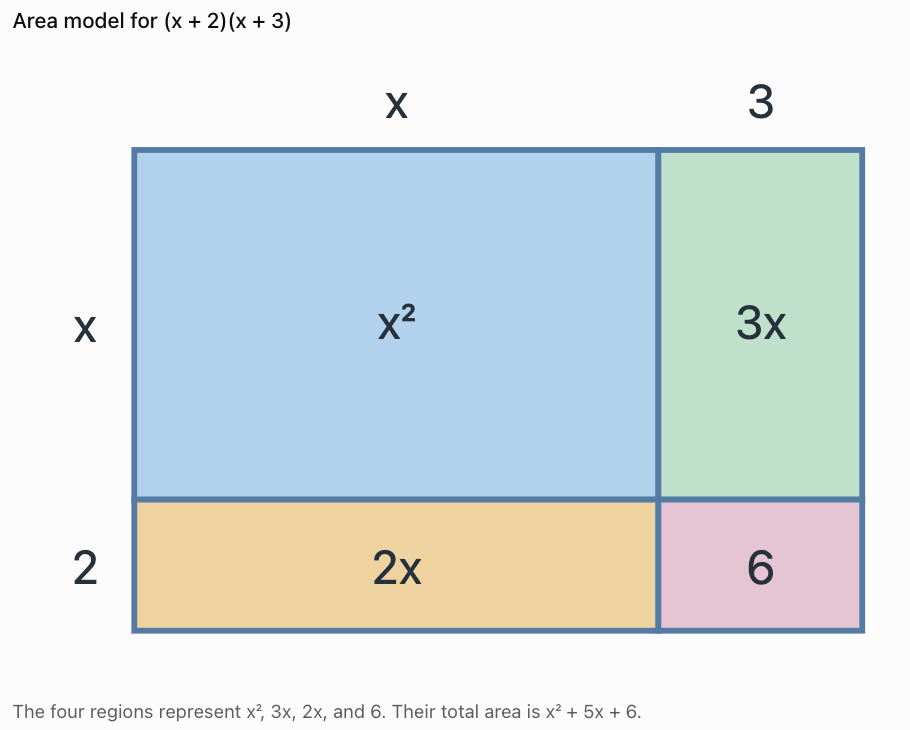
The four smaller areas are:
-
x × x = x²
-
x × 3 = 3x
-
2 × x = 2x
-
2 × 3 = 6
Adding:
x² + 3x + 2x + 6
= x² + 5x + 6
The area model helps explain why every term must be multiplied.
The FOIL Method
FOIL is a memory aid for multiplying two binomials.
FOIL stands for:
-
First: Multiply the first terms.
-
Outer: Multiply the outer terms.
-
Inner: Multiply the inner terms.
-
Last: Multiply the last terms.
Worked Example
Expand:
(x + 4)(x + 7)
First:
x × x = x²
Outer:
x × 7 = 7x
Inner:
4 × x = 4x
Last:
4 × 7 = 28
Combine:
x² + 7x + 4x + 28
= x² + 11x + 28
Important Limitation
FOIL is useful only for multiplying two binomials.
The distributive property is more general and works for all polynomial products.
Multiplying Binomials with Negative Terms
Worked Example
Expand:
(x − 3)(x + 5)
Multiply:
x × x = x²
x × 5 = 5x
−3 × x = −3x
−3 × 5 = −15
Combine:
x² + 5x − 3x − 15
= x² + 2x − 15
Worked Example with Two Negative Terms
Expand:
(x − 4)(x − 6)
Multiply:
x² − 6x − 4x + 24
Combine:
x² − 10x + 24
Notice that:
−4 × −6 = +24
Multiplying Binomials with Coefficients
Not every binomial begins with x.
Worked Example
Expand:
(2x + 3)(4x + 5)
Multiply each pair:
2x × 4x = 8x²
2x × 5 = 10x
3 × 4x = 12x
3 × 5 = 15
Combine:
8x² + 10x + 12x + 15
= 8x² + 22x + 15
Another Example
Expand:
(3x − 2)(2x − 7)
Multiply:
3x × 2x = 6x²
3x × (−7) = −21x
−2 × 2x = −4x
−2 × (−7) = 14
Combine:
6x² − 25x + 14
Multiplying a Binomial by a Trinomial
A binomial contains two terms, while a trinomial contains three.
Each term in the binomial must multiply all three terms in the trinomial.
Worked Example
Expand:
(x + 2)(x² + 3x + 4)
Distribute x:
x(x² + 3x + 4)
= x³ + 3x² + 4x
Distribute 2:
2(x² + 3x + 4)
= 2x² + 6x + 8
Combine:
x³ + 3x² + 4x + 2x² + 6x + 8
Group like terms:
x³ + (3x² + 2x²) + (4x + 6x) + 8
= x³ + 5x² + 10x + 8
Another Example
Expand:
(2x − 3)(x² − 4x + 5)
Distribute 2x:
2x³ − 8x² + 10x
Distribute −3:
−3x² + 12x − 15
Combine:
2x³ − 8x² + 10x − 3x² + 12x − 15
= 2x³ − 11x² + 22x − 15
Multiplying Two Trinomials
Multiplying two trinomials involves nine individual products before like terms are combined.
Worked Example
Expand:
(x² + 2x + 3)(x² + x + 4)
Distribute x²:
x⁴ + x³ + 4x²
Distribute 2x:
2x³ + 2x² + 8x
Distribute 3:
3x² + 3x + 12
Combine:
x⁴ + x³ + 4x² + 2x³ + 2x² + 8x + 3x² + 3x + 12
Group like terms:
x⁴ + (x³ + 2x³) + (4x² + 2x² + 3x²) + (8x + 3x) + 12
= x⁴ + 3x³ + 9x² + 11x + 12
Important Strategy
When multiplying larger polynomials, work systematically.
Multiply every term in the first polynomial by every term in the second polynomial.
Then combine like terms.
Polynomial Multiplication Using a Grid
A multiplication grid helps organise longer calculations.
Consider:
(2x + 3)(x² + 4x + 5)
|
× |
x² |
4x |
5 |
|---|---|---|---|
|
2x |
2x³ |
8x² |
10x |
|
3 |
3x² |
12x |
15 |
Combine all entries:
2x³ + 8x² + 10x + 3x² + 12x + 15
= 2x³ + 11x² + 22x + 15
Advantages of the Grid Method
-
Helps ensure every term is multiplied.
-
Reduces the chance of missing products.
-
Makes negative signs easier to track.
-
Works for binomials, trinomials, and larger polynomials.

Common Polynomial Products
Some polynomial products occur so frequently that recognising their patterns can save time.
These are called special products or special product identities.
The three most important are:
Square of a sum:
(a + b)² = a² + 2ab + b²
Square of a difference:
(a − b)² = a² − 2ab + b²
Product of a sum and a difference:
(a + b)(a − b) = a² − b²
These identities come directly from the distributive property.
Squaring a Binomial: Square of a Sum
Consider:
(x + 3)²
The exponent 2 means the entire binomial is multiplied by itself.
(x + 3)² = (x + 3)(x + 3)
Distribute:
= x² + 3x + 3x + 9
Combine:
(x + 3)² = x² + 6x + 9
General Rule
(a + b)² = a² + 2ab + b²
The result contains:
-
The square of the first term.
-
Twice the product of the two terms.
-
The square of the second term.
Worked Example
Expand:
(2x + 5)²
Let:
a = 2x
b = 5
Apply the identity:
(2x)² + 2(2x)(5) + 5²
= 4x² + 20x + 25
Final answer: 4x² + 20x + 25
Important Reminder
A common error is:
(x + 3)² = x² + 9
This is incorrect because it omits the middle term, 6x.
Squaring a Binomial: Square of a Difference
Consider:
(x − 4)²
Rewrite:
(x − 4)(x − 4)
Distribute:
x² − 4x − 4x + 16
Combine:
(x − 4)² = x² − 8x + 16
General Rule
(a − b)² = a² − 2ab + b²
Worked Example
Expand:
(3x − 2)²
Apply the identity:
(3x)² − 2(3x)(2) + 2²
= 9x² − 12x + 4
Final answer: 9x² − 12x + 4
Notice that the final term is positive because squaring a negative quantity produces a positive result.
Difference of Squares
The product of a sum and a difference produces a particularly useful pattern.
(a + b)(a − b) = a² − b²
The middle terms cancel.
Worked Example
Expand:
(x + 5)(x − 5)
Distribute:
x² − 5x + 5x − 25
Combine:
x² − 25
Another Example
Expand:
(3x + 4)(3x − 4)
Apply the identity:
(3x)² − 4²
= 9x² − 16
Final answer: 9x² − 16
Why Is This Useful?
Recognising the difference-of-squares pattern allows us to expand some expressions without writing every individual product.

Recognising Special Products
Compare these expressions.
|
Expression |
Product type |
Expanded form |
|---|---|---|
|
(x + 2)² |
Square of a sum |
x² + 4x + 4 |
|
(x − 2)² |
Square of a difference |
x² − 4x + 4 |
|
(x + 2)(x − 2) |
Difference of squares |
x² − 4 |
|
(2x + 3)² |
Square of a sum |
4x² + 12x + 9 |
|
(2x − 3)² |
Square of a difference |
4x² − 12x + 9 |
|
(2x + 3)(2x − 3) |
Difference of squares |
4x² − 9 |
The expressions look similar, but their products are different.
Always check whether the binomials are identical or conjugates (a sum and difference of the same terms).
Multiplying Three Binomials
Some expressions contain three or more polynomial factors.
The safest method is to multiply two factors first, simplify, and then multiply the result by the remaining factor.
Worked Example
Expand:
(x + 1)(x + 2)(x + 3)
First multiply:
(x + 1)(x + 2)
= x² + 3x + 2
Now multiply by the third factor:
(x² + 3x + 2)(x + 3)
Distribute x:
x³ + 3x² + 2x
Distribute 3:
3x² + 9x + 6
Combine:
x³ + 6x² + 11x + 6
Another Example
Expand:
(x − 2)(x + 2)(x + 5)
Recognise the difference of squares:
(x − 2)(x + 2) = x² − 4
Now multiply:
(x² − 4)(x + 5)
= x³ + 5x² − 4x − 20
Final answer: x³ + 5x² − 4x − 20
Recognising a special product makes this calculation shorter.
Combining Multiplication, Addition, and Subtraction
Some algebraic expressions contain several polynomial operations.
Follow the order of operations:
-
Simplify inside grouping symbols where possible.
-
Perform multiplication using distribution.
-
Remove parentheses carefully.
-
Combine like terms.
-
Write the result in standard form.
Worked Example
Simplify:
(x + 3)(x + 4) + (2x − 5)
Multiply the binomials:
(x + 3)(x + 4) = x² + 7x + 12
Substitute:
x² + 7x + 12 + 2x − 5
Combine like terms:
x² + 9x + 7
Worked Example with Subtraction
Simplify:
(2x + 1)(x − 3) − (x² − 4x + 5)
First multiply:
(2x + 1)(x − 3)
= 2x² − 6x + x − 3
= 2x² − 5x − 3
Now subtract the second polynomial:
2x² − 5x − 3 − (x² − 4x + 5)
Distribute the negative sign:
2x² − 5x − 3 − x² + 4x − 5
Combine:
x² − x − 8
Polynomial Products with Multiple Variables
The distributive property also works when polynomials contain several variables.
Worked Example
Expand:
(2a + 3b)(a + 4b)
Multiply:
2a × a = 2a²
2a × 4b = 8ab
3b × a = 3ab
3b × 4b = 12b²
Combine:
2a² + 8ab + 3ab + 12b²
= 2a² + 11ab + 12b²
Worked Example
Expand:
(x + y)²
Apply the square-of-a-sum identity:
(x + y)² = x² + 2xy + y²
The terms x², xy, and y² are not like terms, so they cannot be combined further.
Verifying Polynomial Multiplication
One way to check an expanded polynomial is to substitute the same value into the original and expanded expressions.
Worked Example
Verify:
(x + 2)(x + 5) = x² + 7x + 10
Choose x = 3.
Original expression:
(3 + 2)(3 + 5)
= 5 × 8
= 40
Expanded expression:
3² + 7(3) + 10
= 9 + 21 + 10
= 40
Both give 40.
This is a useful check, although agreement at one value does not prove equivalence for every value.
A stronger algebraic verification is to reverse the expansion using the distributive property or factoring.
Real-World Application: Finding the Area of a Rectangle
Suppose a rectangular garden has:
Length = x + 7 metres
Width = x + 3 metres
The area is:
A = Length × Width
Substitute:
A = (x + 7)(x + 3)
Expand:
A = x² + 3x + 7x + 21
Combine:
A = x² + 10x + 21
If x = 5 metres:
A = 5² + 10(5) + 21
= 25 + 50 + 21
A = 96 m²

Real-World Application: Calculating Revenue
A company sells a product.
Suppose the number of units sold depends on price according to:
q = 100 − 2p
where p is the price in dollars.
Revenue is:
R = Price × Quantity
Therefore:
R = p(100 − 2p)
Distribute:
R = 100p − 2p²
This polynomial models the company's revenue.
Example
If the price is $20:
R = 100(20) − 2(20²)
= 2000 − 800
R = $1,200
Polynomial multiplication helps construct models used in business and economics.
Real-World Application: Expanding a Square Garden
Suppose a square garden has side length x metres.
Its original area is:
A₁ = x²
The garden is expanded by adding 3 metres to each side.
Its new side length is:
x + 3
The new area is:
A₂ = (x + 3)²
Expand:
A₂ = x² + 6x + 9
The increase in area is:
A₂ − A₁
= x² + 6x + 9 − x²
= 6x + 9
Interpretation
The increase in area depends on the original side length.
If x = 10 metres:
Increase = 6(10) + 9
= 69 m²
This demonstrates a practical use of the square-of-a-sum identity.
Choosing an Efficient Multiplication Strategy
|
Type of expression |
Recommended method |
|---|---|
|
3x² × 4x³ |
Multiply coefficients and add exponents |
|
2x(x + 5) |
Distributive property |
|
(x + 2)(x + 7) |
Distribution, FOIL, or area model |
|
(x + 2)(x² + 3x + 4) |
Distribute each binomial term |
|
(x² + x + 1)(x² + 2x + 3) |
Grid or systematic distribution |
|
(x + 5)² |
Square-of-a-sum identity |
|
(x − 5)² |
Square-of-a-difference identity |
|
(x + 5)(x − 5) |
Difference-of-squares identity |
|
(x + 1)(x + 2)(x + 3) |
Multiply two factors at a time |
The distributive property always works. Special products simply provide faster methods in particular situations.
Common Mistakes
Adding exponents incorrectly
Incorrect:
x² × x³ = x⁶
Correct:
x² × x³ = x⁵
When multiplying powers with the same base, add the exponents.
Multiplying only the first terms
Incorrect:
(x + 2)(x + 3) = x² + 6
Correct:
(x + 2)(x + 3) = x² + 5x + 6
Every term must be multiplied.
Forgetting negative signs
Incorrect:
(x − 4)(x − 2) = x² − 6x − 8
Correct:
(x − 4)(x − 2) = x² − 6x + 8
Squaring terms separately
Incorrect:
(x + 5)² = x² + 25
Correct:
(x + 5)² = x² + 10x + 25
Confusing addition and multiplication of like terms
Addition:
3x² + 4x² = 7x²
Multiplication:
3x² × 4x² = 12x⁴
Combining unlike terms
Incorrect:
3x² + 5x = 8x³
Correct:
3x² + 5x cannot be combined further.
Forgetting to distribute a negative coefficient
Incorrect:
−2(x − 3) = −2x − 6
Correct:
−2(x − 3) = −2x + 6
Applying FOIL to expressions that are not two binomials
FOIL is not sufficient for multiplying a binomial by a trinomial. Use the full distributive property or a multiplication grid.
Failing to simplify after expanding
An expression such as:
x² + 3x + 4x + 12
should be simplified to:
x² + 7x + 12
Key Terms
-
Polynomial: Algebraic expression consisting of terms with nonnegative integer powers of variables.
-
Monomial: Polynomial containing one term.
-
Binomial: Polynomial containing two terms.
-
Trinomial: Polynomial containing three terms.
-
Coefficient: Numerical factor multiplying a variable.
-
Exponent: Number indicating the power of a variable.
-
Product: Result of multiplication.
-
Factor: Expression or number being multiplied.
-
Distributive Property: Property allowing multiplication across terms in parentheses.
-
Expansion: Rewriting a product as a sum of terms.
-
Like Terms: Terms with identical variable parts and exponents.
-
Simplification: Rewriting an expression in an equivalent, usually more compact form.
-
FOIL: First, Outer, Inner, Last; a method for multiplying two binomials.
-
Area Model: Visual representation of multiplication using rectangular regions.
-
Grid Method: Organised table for multiplying polynomial terms.
-
Special Product: Polynomial product following a commonly recognised identity.
-
Perfect Square Trinomial: Trinomial produced by squaring a binomial.
-
Difference of Squares: Expression of the form a² − b².
-
Conjugate Binomials: Binomials such as a + b and a − b.
-
Standard Form: Polynomial written in descending order of powers.
-
Degree: Highest exponent of a nonzero polynomial in one variable.
-
Equivalent Expressions: Expressions that produce the same value for every permitted input.
-
Verification: Process of checking whether a mathematical result is correct.
Key Takeaways
-
Multiplying polynomials requires the distributive property.
-
When multiplying monomials, multiply coefficients and add exponents of matching variables.
-
Every term in one polynomial must multiply every term in the other polynomial.
-
Two binomials produce four individual products before simplification.
-
FOIL is a memory aid for multiplying two binomials.
-
Area models and multiplication grids can help organise polynomial multiplication.
-
Binomial–trinomial multiplication produces six individual products before simplification.
-
Trinomial–trinomial multiplication produces nine individual products before simplification.
-
Like terms must be combined after expanding.
-
The square of a sum is a² + 2ab + b².
-
The square of a difference is a² − 2ab + b².
-
The product of conjugate binomials is a² − b².
-
Special product identities make some calculations faster.
-
Expressions involving several operations should be expanded before combining like terms.
-
Substitution can help check expanded expressions.
-
Polynomial multiplication is useful for geometry, science, finance, and mathematical modelling.
Check Your Understanding
Multiplying Monomials
-
3x × 4x
-
5x² × 2x³
-
−4a² × 3a
-
2x²y × 5xy³
Using the Distributive Property
-
3(x + 7)
-
4x(2x − 5)
-
−2x(3x² − 4x + 6)
-
5a(2a² + 3a − 4)
Multiplying Binomials
-
(x + 3)(x + 5)
-
(x − 4)(x + 7)
-
(x − 6)(x − 2)
-
(2x + 3)(3x + 4)
Multiplying Larger Polynomials
-
(x + 2)(x² + 3x + 1)
-
(2x − 1)(x² + 4x + 3)
-
(x + 1)(x + 2)(x + 4)
Special Products
-
(x + 6)²
-
(x − 5)²
-
(x + 7)(x − 7)
-
(3x + 2)²
-
(4x − 3)(4x + 3)
Answer Key
|
Question |
Answer |
|---|---|
|
1 |
12x² |
|
2 |
10x⁵ |
|
3 |
−12a³ |
|
4 |
10x³y⁴ |
|
5 |
3x + 21 |
|
6 |
8x² − 20x |
|
7 |
−6x³ + 8x² − 12x |
|
8 |
10a³ + 15a² − 20a |
|
9 |
x² + 8x + 15 |
|
10 |
x² + 3x − 28 |
|
11 |
x² − 8x + 12 |
|
12 |
6x² + 17x + 12 |
|
13 |
x³ + 5x² + 7x + 2 |
|
14 |
2x³ + 7x² + 2x − 3 |
|
15 |
x³ + 7x² + 14x + 8 |
|
16 |
x² + 12x + 36 |
|
17 |
x² − 10x + 25 |
|
18 |
x² − 49 |
|
19 |
9x² + 12x + 4 |
|
20 |
16x² − 9 |
Extended Challenge
Expand and simplify each expression. Show all necessary steps.
Monomial and Polynomial Products
-
−3x²(4x³ − 2x + 5)
-
5a²b(2ab² − 3a²b + 4)
-
−2xy(3x²y − 4xy² + 5)
-
4x³(2x² − 3x + 7)
-
−5a(3a³ − 2a² + 6a − 1)
Binomial Products
-
(3x + 5)(2x − 7)
-
(4x − 3)(5x + 2)
-
(2a + 3b)(4a − 5b)
-
(x² + 3)(x² − 5)
-
(3x² − 2x)(2x² + 5x)
Binomial and Trinomial Products
-
(x + 4)(x² − 3x + 2)
-
(2x − 5)(3x² + 2x − 4)
-
(x² + 2x + 1)(x − 3)
-
(3x + 2)(2x² − 5x + 6)
-
(x² − x + 2)(x² + 3x − 4)
Special Products
-
(2x + 7)²
-
(5x − 3)²
-
(4x + 9)(4x − 9)
-
(3a + 2b)²
-
(5x² − 2y)(5x² + 2y)
Multiple Operations
-
(x + 2)(x + 3) + (x − 4)(x + 5)
-
(2x − 3)² − (x + 4)²
-
(x + 1)(x − 1)(x + 3)
-
2(x + 3)(x − 4) − 3(x − 2)
-
(x² + 2x + 3)(x² − x + 4)
Final Challenge: Designing a Community Garden
A community is designing a rectangular garden.
The garden has the following dimensions:
Length = 2x + 5 metres
Width = x + 3 metres
A rectangular storage area inside the garden has dimensions:
Length = x + 1 metres
Width = x − 1 metres
Assume x > 1 and that the storage area fits inside the garden.
Complete the investigation.
-
Write an expression for the total area of the garden.
-
Expand the expression using the distributive property.
-
Simplify the result.
-
Write an expression for the area of the storage area.
-
Recognise whether the storage area expression is a special product.
-
Expand and simplify the storage area expression.
-
Write an expression for the remaining garden area.
-
Subtract the storage area from the total area.
-
Simplify the resulting polynomial.
-
Evaluate the total garden area when x = 6.
-
Evaluate the storage area when x = 6.
-
Calculate the remaining garden area when x = 6.
-
Verify your results using the original dimension expressions.
-
Explain why the area expressions contain squared terms.
-
Explain how the distributive property helps calculate areas.
-
Describe why combining like terms is necessary.
-
Identify the degree of each simplified area polynomial.
-
Explain how changing x affects the garden dimensions.
-
Draw a labelled diagram of the garden and storage area.
-
Present a complete mathematical solution, including units and a written conclusion.
Further Investigation: Discovering a Pattern
Consider the following products:
(x + 1)(x + 2)
(x + 2)(x + 3)
(x + 3)(x + 4)
(x + 4)(x + 5)
Expand each expression.
Compare the coefficients of x², x, and the constant terms.
Then investigate the general product:
(x + n)(x + n + 1)
where n is a positive integer.
Show that:
(x + n)(x + n + 1) = x² + (2n + 1)x + n(n + 1)
Explain how the distributive property produces this pattern and describe how it can be used to predict polynomial products.
3. Factoring Polynomials
Learning outcomes
- I can factor out common factors.
- I can factor trinomials.
- I can recognize and factor special products.
- I can completely factor polynomial expressions.
- I can verify my factorizations by expansion.
Factoring Polynomials
Introduction
Factoring is the process of rewriting a polynomial as a product of simpler expressions.
It is the reverse of polynomial multiplication.
For example, when we multiply:
(x + 2)(x + 3)
we obtain:
x² + 5x + 6
Factoring reverses this process:
x² + 5x + 6 = (x + 2)(x + 3)
Factoring is an essential algebraic skill used to simplify expressions, solve equations, identify patterns, and model real-world situations.
There are several important factoring techniques:
-
Factoring out a greatest common factor.
-
Factoring quadratic trinomials.
-
Recognising special products.
-
Factoring by grouping.
-
Combining multiple techniques to factor completely.
A reliable way to verify any factorization is to multiply the factors together and check that the original polynomial is recovered.


What Does Factoring Mean?
A factor is a number or expression that is multiplied by another factor to produce a product.
For example:
3 × 4 = 12
The numbers 3 and 4 are factors of 12.
Similarly:
(x + 2)(x + 5) = x² + 7x + 10
The expressions x + 2 and x + 5 are factors of x² + 7x + 10.
Expanded Form and Factored Form
Consider:
x² + 7x + 10
This is the expanded form.
The factored form is:
(x + 2)(x + 5)
Both expressions are equivalent.
They produce the same result for every value of x.
Why Is Factoring Useful?
Factoring helps us:
-
Simplify algebraic expressions.
-
Solve polynomial equations.
-
Find zeros of polynomial functions.
-
Identify the dimensions of geometric shapes.
-
Recognise algebraic patterns.
-
Simplify rational expressions.
-
Understand the structure of polynomials.
Review: Factors and Greatest Common Factors
Before factoring polynomials, it is important to understand factors of numbers.
Consider:
12 and 18
Factors of 12:
1, 2, 3, 4, 6, 12
Factors of 18:
1, 2, 3, 6, 9, 18
The greatest factor shared by both numbers is 6.
Therefore:
GCF(12, 18) = 6
The greatest common factor (GCF) is the largest positive factor shared by two or more integers.
For polynomial terms, the GCF may contain numerical coefficients and variables.
Example
Find the GCF of:
12x³ and 18x²
The greatest common numerical factor is 6.
The greatest common variable factor is x².
Therefore:
GCF = 6x²
Factoring Out a Greatest Common Factor
The simplest factoring method is to identify and remove a factor shared by every term.
This is the reverse of the distributive property.
Recall:
a(b + c) = ab + ac
Factoring reverses this:
ab + ac = a(b + c)
Worked Example
Factor:
6x + 12
The GCF of 6x and 12 is 6.
Divide each term by 6:
6x ÷ 6 = x
12 ÷ 6 = 2
Therefore:
6x + 12 = 6(x + 2)
Verification
Expand:
6(x + 2)
= 6x + 12
The original polynomial is recovered.
Factoring Common Variable Factors
Worked Example
Factor:
8x² + 12x
Find the GCF.
Numerical GCF:
GCF(8, 12) = 4
Variable GCF:
x² and x share x.
Therefore:
GCF = 4x
Divide:
8x² ÷ 4x = 2x
12x ÷ 4x = 3
Thus:
8x² + 12x = 4x(2x + 3)
Another Example
Factor:
15a³b² − 10a²b
Numerical GCF:
5
Variable factors:
a² and b
Therefore:
GCF = 5a²b
Divide each term:
15a³b² ÷ 5a²b = 3ab
−10a²b ÷ 5a²b = −2
Final answer:
15a³b² − 10a²b = 5a²b(3ab − 2)
Factoring a Negative Common Factor
Sometimes it is helpful to factor out a negative number.
Worked Example
Factor:
−6x² + 9x
A common factor is 3x.
However, factoring out −3x makes the leading term inside the parentheses positive.
−6x² ÷ (−3x) = 2x
9x ÷ (−3x) = −3
Therefore:
−6x² + 9x = −3x(2x − 3)
Why Factor Out a Negative?
Factoring out a negative can make the remaining expression easier to work with, particularly when the leading coefficient is negative.
Factoring Common Factors from Three or More Terms
Worked Example
Factor:
12x³ + 18x² − 6x
Find the GCF of all three terms.
Numerical GCF = 6
Variable GCF = x
Therefore:
GCF = 6x
Divide:
12x³ ÷ 6x = 2x²
18x² ÷ 6x = 3x
−6x ÷ 6x = −1
Final answer:
12x³ + 18x² − 6x = 6x(2x² + 3x − 1)
The trinomial inside the parentheses cannot be factored further using integer coefficients.
This is completely factored over the integers.
Factoring Quadratic Trinomials
A quadratic trinomial has three terms and a highest exponent of 2.
A common form is:
x² + bx + c
We want to rewrite it as:
(x + m)(x + n)
where:
m + n = b
and:
mn = c
This means we need two numbers that:
-
Add to the coefficient of x.
-
Multiply to the constant term.
Worked Example
Factor:
x² + 7x + 12
Find two numbers that:
Add to 7.
Multiply to 12.
The numbers are 3 and 4.
Because:
3 + 4 = 7
3 × 4 = 12
Therefore:
x² + 7x + 12 = (x + 3)(x + 4)
Verification
Expand:
(x + 3)(x + 4)
= x² + 4x + 3x + 12
= x² + 7x + 12
Correct.
Factoring Trinomials with Positive Constants
Worked Example
Factor:
x² + 9x + 20
We need two numbers that add to 9 and multiply to 20.
Possible factor pairs of 20:
|
Factor pair |
Sum |
|---|---|
|
1 and 20 |
21 |
|
2 and 10 |
12 |
|
4 and 5 |
9 |
The correct pair is 4 and 5.
Therefore:
x² + 9x + 20 = (x + 4)(x + 5)
Another Example
Factor:
x² + 11x + 24
Find two numbers that:
Add to 11.
Multiply to 24.
The numbers are 3 and 8.
x² + 11x + 24 = (x + 3)(x + 8)
Factoring Trinomials with Negative Constants
When the constant term is negative, the two numbers must have opposite signs.
Worked Example
Factor:
x² + 2x − 15
We need two numbers that:
Add to 2.
Multiply to −15.
The numbers are 5 and −3.
Because:
5 + (−3) = 2
5 × (−3) = −15
Therefore:
x² + 2x − 15 = (x + 5)(x − 3)
Another Example
Factor:
x² − 4x − 21
We need two numbers that:
Add to −4.
Multiply to −21.
The numbers are −7 and 3.
Therefore:
x² − 4x − 21 = (x − 7)(x + 3)
Factoring Trinomials with Negative Middle Terms
When the constant is positive and the middle coefficient is negative, both numbers must be negative.
Worked Example
Factor:
x² − 9x + 20
We need two numbers that:
Add to −9.
Multiply to 20.
The numbers are −4 and −5.
Therefore:
x² − 9x + 20 = (x − 4)(x − 5)
Sign Pattern Summary
|
Middle coefficient |
Constant |
Likely signs of factors |
|---|---|---|
|
Positive |
Positive |
Both positive |
|
Negative |
Positive |
Both negative |
|
Positive |
Negative |
Opposite signs; positive has larger magnitude |
|
Negative |
Negative |
Opposite signs; negative has larger magnitude |
This table applies to monic trinomials of the form x² + bx + c that factor into integer binomials.
Factoring Trinomials with Leading Coefficients Greater Than One
Some trinomials have the form:
ax² + bx + c
where a is not 1.
These expressions require additional steps.
One useful approach is the AC method, also called factoring by splitting the middle term.
Worked Example
Factor:
2x² + 7x + 3
Step 1: Multiply a and c
a = 2
c = 3
ac = 6
Step 2: Find Two Numbers
Find two numbers that:
Multiply to 6.
Add to 7.
The numbers are 6 and 1.
Step 3: Split the Middle Term
Rewrite:
2x² + 6x + x + 3
Step 4: Group Terms
(2x² + 6x) + (x + 3)
Step 5: Factor Each Group
2x(x + 3) + 1(x + 3)
Step 6: Factor the Common Binomial
(2x + 1)(x + 3)
Verification
(2x + 1)(x + 3)
= 2x² + 6x + x + 3
= 2x² + 7x + 3
Correct.
Another Example Using the AC Method
Factor:
6x² + 11x + 3
Multiply:
a × c = 6 × 3 = 18
Find two numbers that:
Multiply to 18.
Add to 11.
The numbers are 9 and 2.
Split:
6x² + 9x + 2x + 3
Group:
(6x² + 9x) + (2x + 3)
Factor:
3x(2x + 3) + 1(2x + 3)
Factor the common binomial:
(3x + 1)(2x + 3)
Factoring Trinomials with Negative Coefficients
Worked Example
Factor:
3x² − 10x + 8
Multiply:
a × c = 3 × 8 = 24
Find two numbers that:
Multiply to 24.
Add to −10.
The numbers are −6 and −4.
Split:
3x² − 6x − 4x + 8
Group:
(3x² − 6x) + (−4x + 8)
Factor:
3x(x − 2) − 4(x − 2)
Therefore:
3x² − 10x + 8 = (3x − 4)(x − 2)
Factoring by Grouping
Factoring by grouping is useful for polynomials with four or more terms.
The goal is to create common factors within groups.
Worked Example
Factor:
ax + ay + bx + by
Group:
(ax + ay) + (bx + by)
Factor each group:
a(x + y) + b(x + y)
Now factor the common binomial:
(a + b)(x + y)
Numerical Example
Factor:
3x² + 6x + 2x + 4
Group:
(3x² + 6x) + (2x + 4)
Factor:
3x(x + 2) + 2(x + 2)
Factor the common binomial:
(3x + 2)(x + 2)
Important Observation
The grouping method is closely related to the AC method.
Both involve creating groups that share a common binomial factor.
Special Products: Difference of Squares
Some polynomials follow patterns that allow us to factor them quickly.
One of the most important is the difference of squares.
Recall:
(a + b)(a − b) = a² − b²
Reversing this identity gives:
a² − b² = (a + b)(a − b)
A difference of squares contains:
-
Two terms.
-
A subtraction sign between them.
-
Two expressions that are perfect squares.
Worked Example
Factor:
x² − 25
Recognise:
x² = (x)²
25 = 5²
Therefore:
x² − 25 = x² − 5²
Apply the identity:
x² − 25 = (x + 5)(x − 5)
Verification
(x + 5)(x − 5)
= x² − 5x + 5x − 25
= x² − 25
The middle terms cancel.

Factoring More Complicated Differences of Squares
Worked Example
Factor:
9x² − 16
Recognise:
9x² = (3x)²
16 = 4²
Therefore:
9x² − 16 = (3x)² − 4²
Apply the identity:
9x² − 16 = (3x + 4)(3x − 4)
Another Example
Factor:
25a² − 49b²
Recognise:
25a² = (5a)²
49b² = (7b)²
Therefore:
25a² − 49b² = (5a + 7b)(5a − 7b)
Important Reminder
The sum of two squares does not factor using the difference-of-squares identity.
For example:
x² + 25
cannot be rewritten as (x + 5)(x − 5).
That product equals x² − 25, not x² + 25.
The expression x² + 25 is irreducible over the real numbers.
Perfect Square Trinomials
Another important pattern is the perfect square trinomial.
Recall:
(a + b)² = a² + 2ab + b²
and:
(a − b)² = a² − 2ab + b²
Factoring reverses these identities.
a² + 2ab + b² = (a + b)²
a² − 2ab + b² = (a − b)²
How to Recognise a Perfect Square Trinomial
Look for three characteristics:
-
The first term is a perfect square.
-
The last term is a perfect square.
-
The middle term is twice the product of the square roots of the first and last terms, with the appropriate sign.
Factoring a Perfect Square Trinomial
Worked Example
Factor:
x² + 10x + 25
The first term is:
x² = (x)²
The last term is:
25 = 5²
Check the middle term:
2 × x × 5 = 10x
The pattern matches.
Therefore:
x² + 10x + 25 = (x + 5)²
Verification
(x + 5)²
= (x + 5)(x + 5)
= x² + 5x + 5x + 25
= x² + 10x + 25
Correct.
Another Example
Factor:
x² − 12x + 36
Recognise:
x² = (x)²
36 = 6²
Middle term:
−2(x)(6) = −12x
Therefore:
x² − 12x + 36 = (x − 6)²
Perfect Square Trinomials with Coefficients
Worked Example
Factor:
4x² + 20x + 25
The first term is:
4x² = (2x)²
The last term is:
25 = 5²
Check:
2(2x)(5) = 20x
Therefore:
4x² + 20x + 25 = (2x + 5)²
Another Example
Factor:
9x² − 24x + 16
Recognise:
9x² = (3x)²
16 = 4²
Middle term:
−2(3x)(4) = −24x
Therefore:
9x² − 24x + 16 = (3x − 4)²
Difference of Cubes
Some higher-degree polynomials can also be factored using special identities.
A difference of cubes follows:
a³ − b³ = (a − b)(a² + ab + b²)
Worked Example
Factor:
x³ − 8
Recognise:
x³ = (x)³
8 = 2³
Apply the identity:
x³ − 2³
= (x − 2)(x² + 2x + 4)
Therefore:
x³ − 8 = (x − 2)(x² + 2x + 4)
Verification
(x − 2)(x² + 2x + 4)
= x³ + 2x² + 4x − 2x² − 4x − 8
= x³ − 8
Correct.
Sum of Cubes
The corresponding sum-of-cubes identity is:
a³ + b³ = (a + b)(a² − ab + b²)
Worked Example
Factor:
x³ + 27
Recognise:
27 = 3³
Therefore:
x³ + 3³
= (x + 3)(x² − 3x + 9)
Final answer: (x + 3)(x² − 3x + 9)
Another Example
Factor:
8x³ + 125
Recognise:
8x³ = (2x)³
125 = 5³
Apply the identity:
8x³ + 125 = (2x + 5)(4x² − 10x + 25)
Recognising Special Factoring Patterns
|
Polynomial |
Pattern |
Factored form |
|---|---|---|
|
x² − 16 |
Difference of squares |
(x + 4)(x − 4) |
|
4x² − 9 |
Difference of squares |
(2x + 3)(2x − 3) |
|
x² + 6x + 9 |
Perfect square trinomial |
(x + 3)² |
|
x² − 8x + 16 |
Perfect square trinomial |
(x − 4)² |
|
9x² + 12x + 4 |
Perfect square trinomial |
(3x + 2)² |
|
x³ − 27 |
Difference of cubes |
(x − 3)(x² + 3x + 9) |
|
x³ + 8 |
Sum of cubes |
(x + 2)(x² − 2x + 4) |
Recognising these patterns can make factoring much faster than using a general method.
Factoring Completely
A polynomial is completely factored when it is written as a product of factors that cannot be factored further within the chosen number system.
In most introductory algebra problems, this means factoring completely over the integers, unless otherwise stated.
A common mistake is to stop after removing the greatest common factor.
Worked Example
Factor completely:
2x² + 10x + 12
Step 1: Find the GCF
All coefficients are divisible by 2.
Factor out 2:
2(x² + 5x + 6)
Step 2: Factor the Trinomial
Find two numbers that:
Add to 5.
Multiply to 6.
The numbers are 2 and 3.
Therefore:
x² + 5x + 6 = (x + 2)(x + 3)
Final Answer
2x² + 10x + 12 = 2(x + 2)(x + 3)
Verification
2(x + 2)(x + 3)
= 2(x² + 5x + 6)
= 2x² + 10x + 12
Correct.
Factoring Completely with Special Products
Worked Example
Factor completely:
3x² − 75
First find the GCF:
3x² − 75 = 3(x² − 25)
Recognise the difference of squares:
x² − 25 = (x + 5)(x − 5)
Therefore:
3x² − 75 = 3(x + 5)(x − 5)
Another Example
Factor completely:
4x³ − 36x
First find the GCF:
4x³ − 36x = 4x(x² − 9)
Recognise:
x² − 9 = (x + 3)(x − 3)
Therefore:
4x³ − 36x = 4x(x + 3)(x − 3)
Factoring Repeated Differences of Squares
Sometimes a polynomial can be factored more than once using the same identity.
Worked Example
Factor completely:
x⁴ − 16
Recognise:
x⁴ = (x²)²
16 = 4²
Apply the difference-of-squares identity:
x⁴ − 16 = (x² + 4)(x² − 4)
The factor x² − 4 is also a difference of squares:
x² − 4 = (x + 2)(x − 2)
Therefore:
x⁴ − 16 = (x² + 4)(x + 2)(x − 2)
The factor x² + 4 cannot be factored further over the real numbers.
Factoring Higher-Degree Polynomials by Grouping
Worked Example
Factor:
x³ + 3x² + 2x + 6
Group the first two and last two terms:
(x³ + 3x²) + (2x + 6)
Factor each group:
x²(x + 3) + 2(x + 3)
Now factor the common binomial:
(x + 3)(x² + 2)
The second factor cannot be factored further over the real numbers.
Another Example
Factor:
2x³ − 6x² + 5x − 15
Group:
(2x³ − 6x²) + (5x − 15)
Factor:
2x²(x − 3) + 5(x − 3)
Therefore:
(x − 3)(2x² + 5)
Factoring Expressions with Multiple Variables
The same techniques apply to expressions containing more than one variable.
Worked Example: Greatest Common Factor
Factor:
12a²b + 18ab²
The numerical GCF is 6.
Both terms contain a and b.
Therefore:
GCF = 6ab
Factor:
12a²b + 18ab² = 6ab(2a + 3b)
Worked Example: Difference of Squares
Factor:
25x² − 36y²
Recognise:
25x² = (5x)²
36y² = (6y)²
Therefore:
25x² − 36y² = (5x + 6y)(5x − 6y)
Worked Example: Perfect Square Trinomial
Factor:
x² + 8xy + 16y²
Recognise:
x² = (x)²
16y² = (4y)²
Middle term:
2(x)(4y) = 8xy
Therefore:
x² + 8xy + 16y² = (x + 4y)²
Factoring and the Zero Product Property
Factoring is especially useful when solving polynomial equations.
The zero product property states:
If:
ab = 0
then:
a = 0 or b = 0
This works because the product of two numbers is zero only when at least one factor is zero.
Worked Example
Solve:
x² + 5x + 6 = 0
Factor:
(x + 2)(x + 3) = 0
Apply the zero product property:
x + 2 = 0
or:
x + 3 = 0
Solve:
x = −2
or:
x = −3
Final Answer
x = −2 or x = −3
These values are called the roots or zeros of the polynomial.

Factoring and Graphs of Quadratic Functions
Consider:
y = x² − 5x + 6
Factor:
y = (x − 2)(x − 3)
The x-intercepts occur when y = 0.
Therefore:
(x − 2)(x − 3) = 0
So:
x = 2 or x = 3
The graph crosses the x-axis at:
(2, 0) and (3, 0)
Factored form makes the zeros of a polynomial easy to identify.
Repeated Factors
Consider:
y = (x − 3)²
The only zero is:
x = 3
Because the factor is repeated, the parabola touches the x-axis at (3, 0) rather than crossing it.

Factoring to Simplify Rational Expressions
Factoring is also useful for simplifying algebraic fractions.
Worked Example
Simplify:
(x² + 5x + 6)/(x + 2)
Factor the numerator:
x² + 5x + 6 = (x + 2)(x + 3)
Substitute:
[(x + 2)(x + 3)]/(x + 2)
Cancel the common nonzero factor:
= x + 3
However, the original expression is undefined when x = −2.
Therefore, the simplified expression is equivalent to the original only for:
x ≠ −2
Important Reminder
We may cancel common factors, not arbitrary terms.
For example:
(x + 3)/(x + 5)
cannot be simplified by cancelling x.
Choosing the Correct Factoring Method
When factoring a polynomial, examine its structure before beginning.
|
Polynomial form |
Recommended method |
|---|---|
|
6x + 12 |
Greatest common factor |
|
8x² + 12x |
Greatest common factor |
|
x² + 7x + 12 |
Trinomial factoring |
|
2x² + 7x + 3 |
AC method |
|
x² − 25 |
Difference of squares |
|
x² + 10x + 25 |
Perfect square trinomial |
|
x³ − 8 |
Difference of cubes |
|
x³ + 27 |
Sum of cubes |
|
ax + ay + bx + by |
Grouping |
|
3x² − 75 |
GCF, then difference of squares |
|
x⁴ − 16 |
Repeated difference of squares |
A Reliable Factoring Strategy
-
Arrange the polynomial in standard form.
-
Look for a greatest common factor.
-
Count the terms.
-
Check for a special product.
-
If it is a trinomial, attempt trinomial factoring.
-
If there are four terms, consider grouping.
-
Check whether any resulting factors can be factored further.
-
Expand the factors to verify the result.
Verifying Factorizations by Expansion
Every factorization should be checked to ensure it produces the original polynomial.
Worked Example
Verify:
6x² + 11x + 3 = (3x + 1)(2x + 3)
Expand the right side:
(3x + 1)(2x + 3)
Multiply:
3x × 2x = 6x²
3x × 3 = 9x
1 × 2x = 2x
1 × 3 = 3
Combine:
6x² + 9x + 2x + 3
= 6x² + 11x + 3
The original polynomial is recovered.
The factorization is correct.
Worked Example: Finding an Error
A student writes:
x² − 7x + 12 = (x − 2)(x − 6)
Check by expansion:
(x − 2)(x − 6)
= x² − 6x − 2x + 12
= x² − 8x + 12
This is not the original polynomial.
The correct factors must add to −7 and multiply to 12.
The numbers are −3 and −4.
Therefore:
x² − 7x + 12 = (x − 3)(x − 4)
Why Verification Matters
Expansion can reveal:
-
Incorrect signs.
-
Incorrect factor pairs.
-
Missing coefficients.
-
Errors when splitting the middle term.
-
Incomplete calculations.
Real-World Application: Finding Rectangle Dimensions
Suppose the area of a rectangular garden is:
A = x² + 9x + 20
The area of a rectangle is:
A = Length × Width
Factor the polynomial:
x² + 9x + 20
Find two numbers that add to 9 and multiply to 20.
The numbers are 4 and 5.
Therefore:
A = (x + 4)(x + 5)
One possible pair of dimensions is:
Length = x + 5 metres
Width = x + 4 metres

Checking the Dimensions
Multiply:
(x + 4)(x + 5)
= x² + 5x + 4x + 20
= x² + 9x + 20
The dimensions produce the required area.
Numerical Example
If x = 3:
Length = 8 m
Width = 7 m
Area = 8 × 7
Area = 56 m²
Check using the original polynomial:
A = 3² + 9(3) + 20
= 9 + 27 + 20
= 56 m²
Both methods agree.
Real-World Application: Projectile Motion
A ball is launched upward from ground level.
Its height after t seconds is modelled by:
h(t) = −5t² + 20t
where height is measured in metres.
We want to determine when the ball returns to the ground.
At ground level:
h(t) = 0
Therefore:
−5t² + 20t = 0
Factor out the greatest common factor:
−5t(t − 4) = 0
Apply the zero product property:
−5t = 0
or:
t − 4 = 0
Therefore:
t = 0 or t = 4
Interpretation
At t = 0, the ball is launched.
At t = 4 seconds, the ball returns to the ground.
The flight lasts 4 seconds.

Real-World Application: Manufacturing
A manufacturer produces rectangular panels.
The area of a panel is represented by:
A = 6x² + 17x + 12
To identify possible expressions for its dimensions, factor the polynomial.
Multiply:
a × c = 6 × 12 = 72
Find two numbers that add to 17 and multiply to 72.
The numbers are 8 and 9.
Split the middle term:
6x² + 8x + 9x + 12
Group:
(6x² + 8x) + (9x + 12)
Factor:
2x(3x + 4) + 3(3x + 4)
Therefore:
A = (2x + 3)(3x + 4)
Possible panel dimensions are:
2x + 3
and:
3x + 4
This demonstrates how factoring can help recover dimensions from an area expression.
Common Mistakes
Forgetting to factor out the GCF first
For example:
2x² + 10x + 12
should be factored completely as:
2(x + 2)(x + 3)
Choosing numbers that multiply correctly but do not add correctly
For x² + 7x + 12, the correct pair is 3 and 4, not 2 and 6.
Ignoring negative signs
For x² − 5x + 6, both numbers must be negative.
The correct factorization is:
(x − 2)(x − 3)
Confusing a difference of squares with a sum of squares
x² − 16 = (x + 4)(x − 4)
But x² + 16 does not factor using this identity.
Forgetting the middle term in a perfect square trinomial
(x + 5)² = x² + 10x + 25
not x² + 25.
Stopping before the expression is completely factored
For example:
x⁴ − 16 = (x² + 4)(x² − 4)
is not completely factored over the integers.
Continue:
(x² + 4)(x + 2)(x − 2)
Incorrect grouping
Both groups must produce the same common binomial factor.
Assuming every quadratic factors into integer binomials
For example:
x² + x + 1
does not factor into real linear factors because its discriminant is negative.
Failing to verify
Always expand the factors to check the original polynomial.
Key Terms
-
Factor: Number or expression multiplied by another to form a product.
-
Factoring: Rewriting an expression as a product of factors.
-
Expanded Form: Polynomial written as a sum of terms.
-
Factored Form: Polynomial written as a product of expressions.
-
Greatest Common Factor (GCF): Largest common factor shared by terms.
-
Coefficient: Numerical factor multiplying a variable.
-
Quadratic Trinomial: Three-term polynomial with degree 2.
-
Monic Polynomial: Polynomial whose leading coefficient is 1.
-
Leading Coefficient: Coefficient of the highest-degree term.
-
AC Method: Technique for factoring trinomials by splitting the middle term.
-
Factoring by Grouping: Method of creating common factors within groups of terms.
-
Common Binomial Factor: Binomial expression shared by two or more terms.
-
Difference of Squares: Expression of the form a² − b².
-
Perfect Square Trinomial: Trinomial produced by squaring a binomial.
-
Sum of Cubes: Expression of the form a³ + b³.
-
Difference of Cubes: Expression of the form a³ − b³.
-
Completely Factored: Written as a product of factors that cannot be factored further in the chosen number system.
-
Irreducible Polynomial: Polynomial that cannot be factored into lower-degree polynomials over the specified number system.
-
Zero Product Property: If a product equals zero, at least one factor must equal zero.
-
Root or Zero: Input value that makes a polynomial equal zero.
-
Expansion: Multiplying factors to obtain a polynomial expression.
-
Verification: Checking a factorization by expanding the factors.
Key Takeaways
-
Factoring is the reverse of polynomial multiplication.
-
The greatest common factor should be checked first.
-
Trinomials of the form x² + bx + c can be factored by finding two numbers whose sum is b and product is c.
-
Trinomials with leading coefficients other than 1 can often be factored using the AC method.
-
Factoring by grouping is useful for polynomials with four terms.
-
A difference of squares factors into conjugate binomials.
-
Perfect square trinomials factor into squared binomials.
-
Sum-of-cubes and difference-of-cubes identities can factor certain cubic expressions.
-
Some polynomials require more than one factoring technique.
-
Factoring completely means continuing until no factor can be reduced further over the specified number system.
-
Factoring can be used to solve polynomial equations using the zero product property.
-
Factored form helps identify zeros and x-intercepts.
-
Every factorization can be verified by expansion.
-
Factoring is useful in geometry, physics, engineering, and algebraic modelling.
Check Your Understanding
Factor each expression completely over the integers where possible.
Greatest Common Factors
-
6x + 18
-
8x² + 12x
-
15a³ − 10a²
-
12x³ − 18x² + 6x
Factoring Trinomials
-
x² + 7x + 12
-
x² + 9x + 20
-
x² − 8x + 15
-
x² + 2x − 24
-
2x² + 7x + 3
-
3x² + 10x + 8
-
4x² − 12x + 9
-
6x² − 7x − 3
Special Products
-
x² − 49
-
9x² − 25
-
x² + 12x + 36
-
4x² − 20x + 25
-
x³ − 27
-
x³ + 64
Factoring Completely
-
2x² + 14x + 24
-
3x² − 27
-
5x³ − 45x
-
x⁴ − 81
-
x³ + 4x² + 3x + 12
-
4x² − 16x + 16
Answer Key
|
Question |
Factored form |
|---|---|
|
1 |
6(x + 3) |
|
2 |
4x(2x + 3) |
|
3 |
5a²(3a − 2) |
|
4 |
6x(2x − 1)(x − 1) |
|
5 |
(x + 3)(x + 4) |
|
6 |
(x + 4)(x + 5) |
|
7 |
(x − 3)(x − 5) |
|
8 |
(x + 6)(x − 4) |
|
9 |
(2x + 1)(x + 3) |
|
10 |
(3x + 4)(x + 2) |
|
11 |
(2x − 3)² |
|
12 |
(3x + 1)(2x − 3) |
|
13 |
(x + 7)(x − 7) |
|
14 |
(3x + 5)(3x − 5) |
|
15 |
(x + 6)² |
|
16 |
(2x − 5)² |
|
17 |
(x − 3)(x² + 3x + 9) |
|
18 |
(x + 4)(x² − 4x + 16) |
|
19 |
2(x + 3)(x + 4) |
|
20 |
3(x + 3)(x − 3) |
|
21 |
5x(x + 3)(x − 3) |
|
22 |
(x² + 9)(x + 3)(x − 3) |
|
23 |
(x + 4)(x² + 3) |
|
24 |
4(x − 2)² |
Extended Challenge
Factor each polynomial completely. Show the steps used and verify selected answers by expansion.
Common Factors
-
18x⁴ − 24x³ + 6x²
-
20a³b² − 30a²b³ + 10ab
-
−12x³ + 36x² − 24x
-
16x⁵ − 81x
-
8a³ − 32a
Quadratic Trinomials
-
2x² + 9x + 10
-
3x² − 14x + 8
-
6x² + x − 12
-
8x² − 14x + 3
-
12x² − 11x − 5
Special Products
-
16x² − 81
-
25a² − 36b²
-
9x² + 30x + 25
-
49x² − 70xy + 25y²
-
8x³ − 125
-
27x³ + 64
-
x⁴ − 625
Grouping and Multiple Techniques
-
x³ + 5x² + 2x + 10
-
3x³ − 6x² + 5x − 10
-
2x³ + 8x² + 6x + 24
-
x³ − 4x² − 9x + 36
-
3x³ + 12x² − 27x − 108
-
x⁴ − 5x² + 4
-
2x⁴ − 18x²
-
x⁶ − 64
Final Challenge: Factoring Investigation
A rectangular garden has an area represented by:
A = 2x² + 13x + 15
The garden designer wants to determine possible expressions for its length and width.
Complete the investigation.
-
Identify the coefficients a, b, and c.
-
Calculate a × c.
-
Find two numbers whose product equals ac and whose sum equals b.
-
Rewrite the middle term using these two numbers.
-
Factor the polynomial by grouping.
-
Identify possible expressions for the garden's length and width.
-
Verify the factorization by expansion.
-
Calculate the garden's area when x = 5.
-
Calculate the dimensions when x = 5.
-
Verify the area using length × width.
-
Explain why factoring can be useful when determining dimensions.
-
Describe how the area model relates to polynomial multiplication and factoring.
Further Investigation: Comparing Factoring Methods
Factor the following expressions:
A = x² − 16
B = x² + 8x + 16
C = 2x² + 10x + 12
D = x³ + 3x² + 4x + 12
E = x⁴ − 81
For each polynomial:
-
Identify the most appropriate factoring method.
-
Explain why you selected that method.
-
Show all factoring steps.
-
Determine whether further factoring is possible.
-
Write the completely factored form over the integers.
-
Expand your answer to verify it.
-
Compare the methods and identify any similarities.
-
Explain why recognising polynomial structure makes factoring more efficient.
4. Dividing Polynomials
Learning outcomes
- I can divide polynomials by monomials.
- I can divide polynomials using long division.
- I can divide polynomials using synthetic division.
- I can interpret quotients and remainders.
- I can verify polynomial division results.
Dividing Polynomials
Introduction
Polynomial division is the process of dividing one polynomial by another polynomial.
It extends the same principles used in ordinary numerical division.
For example:
12 ÷ 3 = 4
Similarly:
12x³ ÷ 3x = 4x²
Polynomial division is useful for simplifying algebraic expressions, solving polynomial equations, finding factors, and investigating polynomial functions.
There are three important methods:
-
Division by a monomial: Divide each term separately.
-
Polynomial long division: A systematic method that works with any nonzero polynomial divisor.
-
Synthetic division: A shortcut commonly used when dividing by a linear expression of the form x − c.
Polynomial division may produce a quotient and a remainder.
The fundamental relationship is:
Dividend = Divisor × Quotient + Remainder
This relationship also provides a reliable way to check answers.


Review: Division of Powers
Before dividing polynomials, we need to understand how exponents behave during division.
Quotient of Powers Rule
When dividing powers with the same nonzero base, subtract their exponents.
xᵃ ÷ xᵇ = xᵃ⁻ᵇ
For example:
x⁵ ÷ x² = x³
x⁷ ÷ x³ = x⁴
x⁶ ÷ x = x⁵
This rule follows from cancelling common factors.
Dividing Coefficients
When terms contain numerical coefficients, divide the coefficients separately.
Worked Example
Simplify:
18x⁵ ÷ 6x²
Divide the coefficients:
18 ÷ 6 = 3
Subtract the exponents:
x⁵ ÷ x² = x³
Therefore:
18x⁵ ÷ 6x² = 3x³
This simplification assumes x ≠ 0, as required by the original divisor.
Another Example
Simplify:
−24a⁶b⁴ ÷ 8a²b
Coefficients:
−24 ÷ 8 = −3
Variables:
a⁶ ÷ a² = a⁴
b⁴ ÷ b = b³
Therefore:
−24a⁶b⁴ ÷ 8a²b = −3a⁴b³
Dividing a Polynomial by a Monomial
A monomial is a polynomial containing only one term.
To divide a polynomial by a monomial, divide every term of the polynomial by the monomial.
The general rule is:
(a + b + c)/d = a/d + b/d + c/d
provided d ≠ 0.
Worked Example
Simplify:
(12x² + 18x)/6x
Divide each term:
12x² ÷ 6x = 2x
18x ÷ 6x = 3
Therefore:
(12x² + 18x)/6x = 2x + 3
The original expression requires x ≠ 0.
Verification
Multiply the quotient by the divisor:
6x(2x + 3)
= 12x² + 18x
The original dividend is recovered.
Dividing Polynomials with Several Terms
Worked Example
Simplify:
(15x³ − 10x² + 5x)/5x
Divide each term:
15x³ ÷ 5x = 3x²
−10x² ÷ 5x = −2x
5x ÷ 5x = 1
Therefore:
(15x³ − 10x² + 5x)/5x = 3x² − 2x + 1
Worked Example with Multiple Variables
Simplify:
(18a⁴b² − 12a³b³ + 6a²b)/6a²b
First term:
18a⁴b² ÷ 6a²b = 3a²b
Second term:
−12a³b³ ÷ 6a²b = −2ab²
Third term:
6a²b ÷ 6a²b = 1
Therefore:
3a²b − 2ab² + 1
The original divisor requires a ≠ 0 and b ≠ 0.
When Division Does Not Produce a Polynomial
Not every division by a monomial produces another polynomial.
Consider:
(6x² + 9x + 3)/3x
Divide each term:
6x² ÷ 3x = 2x
9x ÷ 3x = 3
3 ÷ 3x = 1/x
Therefore:
2x + 3 + 1/x
The result is not a polynomial because it contains a negative power of x when written as x⁻¹.
Important Observation
A polynomial divided by a monomial does not always simplify to another polynomial.
However, polynomial long division can still express the result using a polynomial quotient and remainder.
Understanding Polynomial Division
In numerical division:
17 ÷ 5 = 3 remainder 2
This means:
17 = 5(3) + 2
Polynomial division follows the same structure.
General Relationship
P(x) = D(x)Q(x) + R(x)
Where:
-
P(x) = dividend
-
D(x) = divisor
-
Q(x) = quotient
-
R(x) = remainder
For polynomial division, the remainder must have a degree lower than the degree of the divisor, unless the remainder is zero.
Example
Suppose:
P(x) = x² + 5x + 7
D(x) = x + 2
Dividing gives:
Q(x) = x + 3
R(x) = 1
Check:
(x + 2)(x + 3) + 1
= x² + 5x + 6 + 1
= x² + 5x + 7
Therefore:
x² + 5x + 7 = (x + 2)(x + 3) + 1
Polynomial Long Division
Polynomial long division is a systematic method for dividing one polynomial by another.
It is similar to long division with whole numbers.
General Steps
-
Arrange the dividend and divisor in descending powers.
-
Divide the leading term of the dividend by the leading term of the divisor.
-
Write the result as the next term of the quotient.
-
Multiply the divisor by that quotient term.
-
Subtract the resulting polynomial.
-
Bring down any remaining terms.
-
Repeat until the remainder has a lower degree than the divisor.
Long Division with No Remainder
Worked Example
Divide:
(x² + 5x + 6) ÷ (x + 2)
Step 1: Divide the Leading Terms
x² ÷ x = x
Write x as the first term of the quotient.
Step 2: Multiply
x(x + 2) = x² + 2x
Step 3: Subtract
(x² + 5x + 6) − (x² + 2x)
= 3x + 6
Step 4: Divide Again
3x ÷ x = 3
Write +3 in the quotient.
Step 5: Multiply
3(x + 2) = 3x + 6
Step 6: Subtract
(3x + 6) − (3x + 6) = 0
The remainder is zero.
Quotient = x + 3
Remainder = 0
Therefore:
(x² + 5x + 6)/(x + 2) = x + 3, for x ≠ −2.
Long Division Layout
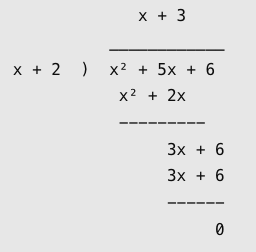

Long Division with a Remainder
Worked Example
Divide:
(x² + 4x + 7) ÷ (x + 2)
Step 1: Divide the Leading Terms
x² ÷ x = x
Step 2: Multiply
x(x + 2) = x² + 2x
Step 3: Subtract
(x² + 4x + 7) − (x² + 2x)
= 2x + 7
Step 4: Divide Again
2x ÷ x = 2
Step 5: Multiply
2(x + 2) = 2x + 4
Step 6: Subtract
(2x + 7) − (2x + 4)
= 3
The remainder is 3.
Therefore:
Quotient = x + 2
Remainder = 3
The division can be written as:
(x² + 4x + 7)/(x + 2) = x + 2 + 3/(x + 2)
where x ≠ −2.
Verification
(x + 2)(x + 2) + 3
= x² + 4x + 4 + 3
= x² + 4x + 7
Correct.
Dividing Cubic Polynomials
Long division can also be used with higher-degree polynomials.
Worked Example
Divide:
(x³ + 4x² + x − 6) ÷ (x + 2)
Step 1
x³ ÷ x = x²
Multiply:
x²(x + 2) = x³ + 2x²
Subtract:
(x³ + 4x² + x − 6) − (x³ + 2x²)
= 2x² + x − 6
Step 2
2x² ÷ x = 2x
Multiply:
2x(x + 2) = 2x² + 4x
Subtract:
(2x² + x − 6) − (2x² + 4x)
= −3x − 6
Step 3
−3x ÷ x = −3
Multiply:
−3(x + 2) = −3x − 6
Subtract:
(−3x − 6) − (−3x − 6) = 0
Therefore:
Quotient = x² + 2x − 3
Remainder = 0
The factorization is:
x³ + 4x² + x − 6 = (x + 2)(x² + 2x − 3)
Dividing by Quadratic Polynomials
Long division also works when the divisor is quadratic.
Worked Example
Divide:
(x³ + 2x² + 3x + 4) ÷ (x² + x + 1)
Step 1
Divide the leading terms:
x³ ÷ x² = x
Multiply:
x(x² + x + 1) = x³ + x² + x
Subtract:
(x³ + 2x² + 3x + 4) − (x³ + x² + x)
= x² + 2x + 4
Step 2
Divide:
x² ÷ x² = 1
Multiply:
x² + x + 1
Subtract:
(x² + 2x + 4) − (x² + x + 1)
= x + 3
The remainder has degree 1, which is lower than the divisor's degree of 2.
Therefore, stop.
Quotient = x + 1
Remainder = x + 3
The result is:
(x³ + 2x² + 3x + 4)/(x² + x + 1) = x + 1 + (x + 3)/(x² + x + 1)
Missing Terms in Polynomial Long Division
Sometimes a polynomial does not contain every power of x.
Missing terms should be represented using zero coefficients.
Example
Divide:
(x³ + 5x − 6) ÷ (x − 1)
Rewrite the dividend:
x³ + 0x² + 5x − 6
The missing x² term has coefficient zero.
Long Division
Divide x³ by x:
x²
Multiply:
x²(x − 1) = x³ − x²
Subtract:
x² + 5x − 6
Next:
x² ÷ x = x
Multiply:
x(x − 1) = x² − x
Subtract:
6x − 6
Next:
6x ÷ x = 6
Multiply:
6(x − 1) = 6x − 6
Subtract:
0
Therefore:
Quotient = x² + x + 6
Remainder = 0
Important Reminder
Missing terms can easily cause errors in long division.
Writing zero coefficients helps keep powers aligned correctly.
Synthetic Division
Synthetic division is a shortened method of polynomial division that uses only the coefficients of the polynomial.
In its standard form, it is used when dividing by a linear expression:
x − c
where c is a constant.
For example:
-
Dividing by x − 2 uses c = 2.
-
Dividing by x + 3 uses c = −3.
-
Dividing by x − 5 uses c = 5.
Synthetic division is usually faster than long division because it avoids repeatedly writing variables and powers.
The Basic Procedure
-
Write the value of c from the divisor x − c.
-
Write the coefficients of the dividend in descending order.
-
Bring down the first coefficient.
-
Multiply it by c.
-
Add the result to the next coefficient.
-
Repeat multiplication and addition until the last coefficient is reached.
-
Interpret the final number as the remainder.
The remaining numbers give the coefficients of the quotient.
Synthetic Division with No Remainder
Worked Example
Divide:
(x² + 5x + 6) ÷ (x + 2)
Step 1: Identify c
The divisor is:
x + 2 = x − (−2)
Therefore:
c = −2
Step 2: Write the Coefficients
The dividend is:
x² + 5x + 6
Coefficients:
1, 5, 6
Step 3: Perform Synthetic Division
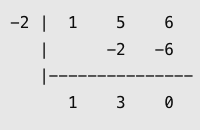
The first coefficient, 1, is brought down.
Multiply:
−2 × 1 = −2
Add:
5 + (−2) = 3
Multiply:
−2 × 3 = −6
Add:
6 + (−6) = 0
Step 4: Interpret the Result
The original dividend has degree 2.
The quotient has degree 1.
The quotient coefficients are:
1, 3
Therefore:
Quotient = x + 3
Remainder = 0
The result agrees with long division.
Synthetic Division with a Remainder
Worked Example
Divide:
(2x³ + 3x² − 5x + 7) ÷ (x − 2)
Step 1: Identify c
c = 2
Step 2: Write the Coefficients
2, 3, −5, 7
Step 3: Perform Synthetic Division
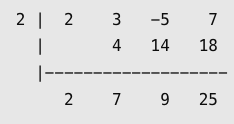
Follow the steps:
Bring down 2.
2 × 2 = 4
3 + 4 = 7
7 × 2 = 14
−5 + 14 = 9
9 × 2 = 18
7 + 18 = 25
Step 4: Interpret
The quotient coefficients are:
2, 7, 9
The quotient is:
Q(x) = 2x² + 7x + 9
The remainder is:
R = 25
Therefore:
(2x³ + 3x² − 5x + 7)/(x − 2) = 2x² + 7x + 9 + 25/(x − 2)
for x ≠ 2.
Verification
Multiply the divisor and quotient:
(x − 2)(2x² + 7x + 9)
= 2x³ + 7x² + 9x − 4x² − 14x − 18
= 2x³ + 3x² − 5x − 18
Add the remainder:
2x³ + 3x² − 5x − 18 + 25
= 2x³ + 3x² − 5x + 7
The original dividend is recovered.
Synthetic Division with Missing Terms
Missing terms must be represented by zero coefficients.
Worked Example
Divide:
(x⁴ − 3x² + 2x − 8) ÷ (x + 2)
The dividend has no x³ term.
Rewrite:
x⁴ + 0x³ − 3x² + 2x − 8
The divisor is x + 2, so:
c = −2
Set up:
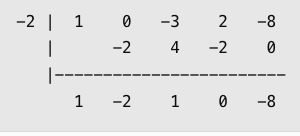
The quotient coefficients are:
1, −2, 1, 0
Therefore:
Q(x) = x³ − 2x² + x
The remainder is:
R = −8
Final Result
(x⁴ − 3x² + 2x − 8)/(x + 2) = x³ − 2x² + x − 8/(x + 2)
where x ≠ −2.
Important Reminder
If a power is missing, include a zero in its position.
Otherwise, every coefficient after the missing term may be interpreted incorrectly.
Comparing Long Division and Synthetic Division
|
Feature |
Long division |
Synthetic division |
|---|---|---|
|
Uses polynomial terms |
Yes |
Usually coefficients only |
|
Works with linear divisors |
Yes |
Yes, in standard form x − c |
|
Works with quadratic divisors |
Yes |
Not with the basic method |
|
Handles missing terms |
Yes |
Yes, using zero coefficients |
|
Produces a quotient |
Yes |
Yes |
|
Produces a remainder |
Yes |
Yes |
|
Often faster for x − c |
No |
Yes |
When Should You Use Each Method?
Use long division when:
-
The divisor has degree 2 or higher.
-
You want a general method that works with any polynomial divisor.
-
You need to see the subtraction and multiplication steps explicitly.
Use synthetic division when:
-
The divisor is x − c.
-
You want a quicker calculation.
-
You need to test whether x − c is a factor.
For divisors such as 2x − 3, the standard synthetic method requires an adjustment. Long division is a reliable choice.
Dividing by a Linear Expression with a Leading Coefficient
Consider:
(2x² + 7x + 3) ÷ (2x + 1)
We can use long division.
Step 1
2x² ÷ 2x = x
Multiply:
x(2x + 1) = 2x² + x
Subtract:
(2x² + 7x + 3) − (2x² + x)
= 6x + 3
Step 2
6x ÷ 2x = 3
Multiply:
3(2x + 1) = 6x + 3
Subtract:
0
Therefore:
Quotient = x + 3
Remainder = 0
Using a Modified Synthetic Approach
The divisor can also be written as:
2x + 1 = 2(x + 1/2)
We can synthetically divide by x + 1/2, using c = −1/2.
This produces:
2x + 6
Because the original divisor is twice x + 1/2, divide this quotient by 2:
(2x + 6)/2 = x + 3
The remainder remains zero.
This method works, but the adjustment must not be forgotten.
The Remainder Theorem
The Remainder Theorem connects polynomial division with function evaluation.
It states:
When a polynomial P(x) is divided by x − c, the remainder is:
R = P(c)
This means we can find the remainder without performing long division.
Worked Example
Find the remainder when:
P(x) = x³ − 4x + 7
is divided by:
x − 2
The divisor has c = 2.
Evaluate:
P(2) = 2³ − 4(2) + 7
= 8 − 8 + 7
Remainder = 7
Another Example
Find the remainder when:
P(x) = 2x³ + 5x² − x + 4
is divided by:
x + 1
Here:
c = −1
Evaluate:
P(−1) = 2(−1)³ + 5(−1)² − (−1) + 4
= −2 + 5 + 1 + 4
Remainder = 8
Why Does This Work?
Polynomial division gives:
P(x) = (x − c)Q(x) + R
Substitute x = c:
P(c) = (c − c)Q(c) + R
P(c) = 0 + R
Therefore:
P(c) = R
The Factor Theorem
The Factor Theorem is closely related to the Remainder Theorem.
It states:
x − c is a factor of P(x) if and only if P(c) = 0.
If the remainder is zero, the division is exact.
Worked Example
Determine whether x − 3 is a factor of:
P(x) = x² − 5x + 6
Evaluate:
P(3) = 3² − 5(3) + 6
= 9 − 15 + 6
= 0
Because the remainder is zero:
x − 3 is a factor.
We can verify by factoring:
x² − 5x + 6 = (x − 2)(x − 3)
Another Example
Is x + 2 a factor of:
P(x) = x³ + 3x² − 4x + 5?
Evaluate P(−2):
P(−2) = (−2)³ + 3(−2)² − 4(−2) + 5
= −8 + 12 + 8 + 5
= 17
Because P(−2) ≠ 0:
x + 2 is not a factor.
Using Synthetic Division to Factor Polynomials
Synthetic division can help factor higher-degree polynomials after one factor has been identified.
Worked Example
Factor:
P(x) = x³ − 6x² + 11x − 6
Test x = 1:
P(1) = 1 − 6 + 11 − 6 = 0
Therefore, x − 1 is a factor.
Use synthetic division:
The quotient is:
x² − 5x + 6
Factor the quotient:
x² − 5x + 6 = (x − 2)(x − 3)
Therefore:
P(x) = (x − 1)(x − 2)(x − 3)
Interpretation
The polynomial has three zeros:
x = 1
x = 2
x = 3
Synthetic division helps us move from a cubic polynomial to a simpler quadratic polynomial.

Interpreting Quotients and Remainders
The quotient tells us how many times the divisor fits into the dividend in an algebraic sense.
The remainder describes the part left over after the polynomial quotient has been removed.
For example:
x² + 5x + 7 = (x + 2)(x + 3) + 1
This tells us:
-
Dividend: x² + 5x + 7
-
Divisor: x + 2
-
Quotient: x + 3
-
Remainder: 1
The quotient is not the complete rational expression when the remainder is nonzero.
We must write:
(x² + 5x + 7)/(x + 2) = x + 3 + 1/(x + 2)
Degree of the Remainder
The remainder must have a degree lower than the divisor.
Examples:
-
Dividing by a linear polynomial produces a constant remainder or zero.
-
Dividing by a quadratic polynomial can produce a linear remainder, a constant remainder, or zero.
-
Dividing by a cubic polynomial can produce a quadratic remainder or one of lower degree.
This condition tells us when polynomial division is complete.
Polynomial Division and Rational Expressions
Polynomial division is especially useful when the numerator of a rational expression has degree greater than or equal to the denominator.
Consider:
(x² + 3x + 5)/(x + 1)
Long division gives:
Quotient = x + 2
Remainder = 3
Therefore:
(x² + 3x + 5)/(x + 1) = x + 2 + 3/(x + 1)
where x ≠ −1.
This form separates the polynomial part from the remaining fraction.
It is useful in advanced algebra, calculus, and the study of rational functions.
Understanding Polynomial Division Through Area
Multiplication and division are inverse operations.
For example, if a rectangle has area:
A = x² + 5x + 6
and one side has length:
x + 2
we can determine the other side by division:
(x² + 5x + 6) ÷ (x + 2)
The quotient is:
x + 3
Therefore, the rectangle's dimensions are:
x + 2
and:
x + 3
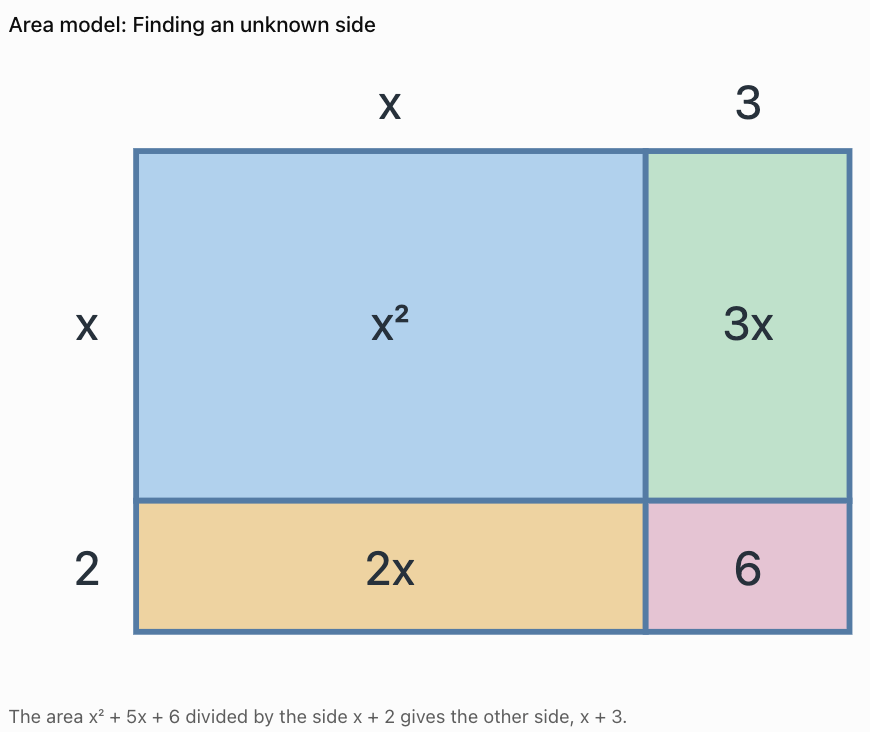
Polynomial division can therefore be understood as finding an unknown factor in a product.
Verifying Polynomial Division
Every polynomial division result can be checked using:
Dividend = Divisor × Quotient + Remainder
This is called the division algorithm for polynomials.
Worked Example
Verify the division:
(2x³ + 5x² − x + 4) ÷ (x + 3)
Suppose the quotient is:
Q(x) = 2x² − x + 2
and the remainder is:
R = −2
Check by multiplying:
(x + 3)(2x² − x + 2)
Distribute x:
2x³ − x² + 2x
Distribute 3:
6x² − 3x + 6
Combine:
2x³ + 5x² − x + 6
Add the remainder:
2x³ + 5x² − x + 6 − 2
= 2x³ + 5x² − x + 4
The original dividend is recovered.
The division is correct.
A Second Check Using the Remainder Theorem
Because the divisor is x + 3, evaluate the dividend at x = −3.
P(−3) = 2(−3)³ + 5(−3)² − (−3) + 4
= −54 + 45 + 3 + 4
= −2
This agrees with the remainder.
Using both checks can help detect calculation errors.
Real-World Application: Finding an Unknown Dimension
Suppose a rectangular storage area has an area of:
A = 2x² + 9x + 10
One side has length:
x + 2
Find the other side.
Use polynomial division:
(2x² + 9x + 10) ÷ (x + 2)
Step 1
2x² ÷ x = 2x
Multiply:
2x(x + 2) = 2x² + 4x
Subtract:
5x + 10
Step 2
5x ÷ x = 5
Multiply:
5(x + 2) = 5x + 10
Subtract:
0
Therefore:
Other side = 2x + 5
Verification
(x + 2)(2x + 5)
= 2x² + 9x + 10
The area expression is recovered.
If x = 3 metres:
First side = 5 m
Second side = 11 m
Area = 5 × 11
Area = 55 m²
Real-World Application: Production and Packaging
Suppose a manufacturer models the total material required for a production process using:
M(x) = 3x² + 14x + 8
The material required per package is represented by:
D(x) = x + 4
To find the polynomial quotient, divide:
(3x² + 14x + 8) ÷ (x + 4)
Long Division
3x² ÷ x = 3x
Multiply:
3x(x + 4) = 3x² + 12x
Subtract:
2x + 8
Divide:
2x ÷ x = 2
Multiply:
2(x + 4) = 2x + 8
Subtract:
0
Therefore:
Q(x) = 3x + 2
Interpretation
Within this algebraic model, the total material expression is exactly the product:
M(x) = (x + 4)(3x + 2)
The quotient represents the corresponding number of packages algebraically, provided the model's units and assumptions support that interpretation.
Common Mistakes
Subtracting exponents incorrectly
Incorrect:
x⁶ ÷ x² = x³
Correct:
x⁶ ÷ x² = x⁴
Dividing only the first term by a monomial
Incorrect:
(6x² + 9x)/3x = 2x + 9x
Correct:
(6x² + 9x)/3x = 2x + 3
Forgetting missing terms
For synthetic division of x³ + 4x − 7, use coefficients:
1, 0, 4, −7
Using the wrong sign in synthetic division
For x + 3, use c = −3, not 3.
Forgetting to subtract the entire polynomial during long division
Every term in the polynomial being subtracted must change sign.
Stopping long division too early
Continue until the remainder has a lower degree than the divisor.
Treating the remainder as part of the quotient
If the quotient is x + 2 and the remainder is 3, the rational expression is:
x + 2 + 3/(x + 1)
not x + 5.
Ignoring the remainder
A nonzero remainder must be included in the final division result.
Forgetting domain restrictions
The divisor cannot equal zero.
For example:
(x² − 4)/(x − 2) = x + 2
only when x ≠ 2.
Using basic synthetic division with an unsuitable divisor
The standard shortcut is designed for x − c. For other divisors, use long division or an appropriately modified method.
Failing to verify
Always check:
Divisor × Quotient + Remainder = Dividend
Key Terms
-
Polynomial Division: Process of dividing one polynomial by another.
-
Dividend: Polynomial being divided.
-
Divisor: Polynomial by which another polynomial is divided.
-
Quotient: Polynomial result of the division algorithm.
-
Remainder: Polynomial left after division, with degree lower than the divisor.
-
Monomial: Polynomial containing one term.
-
Leading Term: Term with the highest power in a polynomial.
-
Leading Coefficient: Coefficient of the leading term.
-
Degree: Highest exponent in a nonzero polynomial in one variable.
-
Quotient of Powers Rule: Rule for subtracting exponents when dividing powers with the same nonzero base.
-
Long Division: Systematic polynomial division using repeated multiplication and subtraction.
-
Synthetic Division: Shortcut using coefficients when dividing by a suitable linear polynomial.
-
Zero Coefficient: Coefficient used to represent a missing power.
-
Division Algorithm: Relationship P(x) = D(x)Q(x) + R(x).
-
Remainder Theorem: When dividing P(x) by x − c, the remainder equals P(c).
-
Factor Theorem: x − c is a factor of P(x) exactly when P(c) = 0.
-
Exact Division: Division producing a zero remainder.
-
Rational Expression: Quotient of two polynomials with a nonzero denominator.
-
Domain Restriction: Value excluded because it makes the original denominator zero.
-
Verification: Checking a division result using multiplication and addition.
-
Zero of a Polynomial: Value of x that makes the polynomial equal zero.
Key Takeaways
-
Polynomial division extends ordinary numerical division.
-
When dividing powers with the same base, subtract their exponents.
-
Dividing a polynomial by a monomial requires dividing every term.
-
Polynomial division produces a quotient and a remainder.
-
The degree of a nonzero remainder must be lower than the degree of the divisor.
-
Long division works with any nonzero polynomial divisor.
-
Synthetic division is a shortcut for divisors of the form x − c.
-
Missing powers must be represented by zero coefficients.
-
For a divisor x + a, synthetic division uses c = −a.
-
The Remainder Theorem allows us to calculate remainders by substitution.
-
The Factor Theorem helps identify factors of polynomials.
-
A zero remainder means the divisor is a factor of the dividend.
-
Polynomial division can help factor higher-degree polynomials.
-
A nonzero remainder must be included in the final rational expression.
-
Every division result can be verified using the division algorithm.
Check Your Understanding
Dividing by Monomials
Simplify each expression.
-
12x⁴ ÷ 3x²
-
−20a⁵ ÷ 5a²
-
(15x³ + 10x²)/5x
-
(18x⁴ − 12x³ + 6x²)/6x²
Polynomial Long Division
Find the quotient and remainder.
-
(x² + 7x + 12) ÷ (x + 3)
-
(x² + 5x + 9) ÷ (x + 2)
-
(2x² + 9x + 7) ÷ (x + 1)
-
(x³ + 3x² + 2x) ÷ (x + 1)
-
(x³ + 2x² + 5x + 4) ÷ (x² + 1)
-
(2x³ + 5x² + 4x + 3) ÷ (x² + 2x + 1)
Synthetic Division
Use synthetic division to find the quotient and remainder.
-
(x² − 5x + 6) ÷ (x − 2)
-
(x³ − 4x² + x + 6) ÷ (x − 3)
-
(2x³ + 3x² − 5x + 7) ÷ (x + 1)
-
(x⁴ − 5x² + 4) ÷ (x − 2)
-
(3x³ − 2x² + 5x − 1) ÷ (x + 2)
Remainders and Verification
-
Find the remainder when x² + 4x + 7 is divided by x − 2.
-
Determine whether x − 3 is a factor of x² − 7x + 12.
-
Determine whether x + 2 is a factor of x³ + 2x² − 4x − 8.
-
Explain how to verify a polynomial division result.
-
Explain why the remainder must have a lower degree than the divisor.
Answer Key
|
Question |
Answer |
|---|---|
|
1 |
4x² |
|
2 |
−4a³ |
|
3 |
3x² + 2x |
|
4 |
3x² − 2x + 1 |
|
5 |
Q = x + 4, R = 0 |
|
6 |
Q = x + 3, R = 3 |
|
7 |
Q = 2x + 7, R = 0 |
|
8 |
Q = x² + 2x, R = 0 |
|
9 |
Q = x + 2, R = 4x + 2 |
|
10 |
Q = 2x + 1, R = 2 |
|
11 |
Q = x − 3, R = 0 |
|
12 |
Q = x² − x − 2, R = 0 |
|
13 |
Q = 2x² + x − 6, R = 13 |
|
14 |
Q = x³ + 2x² − x − 2, R = 0 |
|
15 |
Q = 3x² − 8x + 21, R = −43 |
|
16 |
19 |
|
17 |
Yes; P(3) = 0 |
|
18 |
Yes; P(−2) = 0 |
|
19 |
Check that divisor × quotient + remainder equals the dividend |
|
20 |
Otherwise, division can continue by cancelling another leading term |
For Questions 1–4, retain the domain restrictions imposed by the original divisors.
Extended Challenge
Dividing by Monomials
-
(24x⁶ − 18x⁴ + 12x²)/6x²
-
(30a⁵b³ − 20a³b² + 10a²b)/5a²b
-
(−16x⁵ + 24x³ − 8x²)/(−8x²)
-
(12x⁴ + 9x² + 3)/3x
-
Explain why dividing a polynomial by a monomial does not always produce another polynomial.
Polynomial Long Division
Find the quotient and remainder.
-
(x³ + 5x² + 8x + 4) ÷ (x + 1)
-
(2x³ − 3x² + 4x − 5) ÷ (x − 2)
-
(x⁴ − 3x² + 2x − 8) ÷ (x + 2)
-
(3x⁴ + 2x³ − 5x² + x + 7) ÷ (x² + 1)
-
(2x⁴ − x³ + 3x² − 4x + 5) ÷ (x² − x + 2)
Synthetic Division
-
(x³ − 7x + 6) ÷ (x − 1)
-
(2x⁴ − 3x³ + 5x − 8) ÷ (x + 2)
-
(3x³ + 4x² − 7x + 2) ÷ (x − 1)
-
(x⁵ − 4x³ + 3x² − 2) ÷ (x + 1)
-
(4x⁴ − 5x³ + 2x² − 7x + 9) ÷ (x − 3)
Remainder and Factor Theorems
-
Find the remainder when 2x³ − 5x² + 4x − 7 is divided by x − 2.
-
Determine whether x + 3 is a factor of x³ + 2x² − 5x + 6.
-
Determine whether x − 4 is a factor of x³ − 6x² + 8x.
-
Find a value of k so that x − 2 is a factor of x³ + kx² − 4x + 8.
-
Explain how synthetic division and the Factor Theorem can work together to factor a cubic polynomial.
Advanced Applications
-
Divide x⁴ − 1 by x² − 1.
-
Divide 2x⁵ + 3x³ − x + 4 by x² + x + 1.
-
Find the quotient and remainder when x⁵ − 3x⁴ + 2x² − 7 is divided by x − 3.
-
Use synthetic division to factor x³ − 4x² + x + 6 completely.
-
Construct a cubic polynomial that gives quotient x² + 2x − 3 and remainder 5 when divided by x + 2.
Final Challenge: Investigating Polynomial Division
A polynomial is defined by:
P(x) = x³ − 4x² − x + 4
Complete the investigation.
-
Identify the degree of P(x).
-
Evaluate P(1).
-
Use the Remainder Theorem to determine the remainder when P(x) is divided by x − 1.
-
Determine whether x − 1 is a factor.
-
Divide P(x) by x − 1 using long division.
-
Repeat the division using synthetic division.
-
Compare the quotients obtained by both methods.
-
Verify the division using multiplication.
-
Factor the resulting quadratic quotient.
-
Write P(x) as a product of linear factors.
-
Identify all zeros of P(x).
-
Explain how these zeros relate to the x-intercepts of its graph.
-
Determine the remainder when P(x) is divided by x + 2.
-
Verify that remainder using substitution.
-
Explain why synthetic division is efficient for linear divisors.
-
Describe a situation in which long division would be preferable.
-
Explain the meaning of a zero remainder.
-
Explain why a nonzero remainder prevents the divisor from being a factor.
-
Write a general statement describing the relationship between polynomial division and factoring.
-
Summarise how long division, synthetic division, and the Remainder Theorem are connected.
Further Investigation: Creating Your Own Polynomial
Choose three different integer values for a, b, and c.
Construct:
P(x) = (x − a)(x − b)(x − c)
Expand the expression to obtain a cubic polynomial.
Then:
-
Divide P(x) by x − a using synthetic division.
-
Divide P(x) by x − b using long division.
-
Use the Remainder Theorem to determine the remainder when dividing by x − c.
-
Verify each result.
-
Explain why all three divisions produce a zero remainder.
-
Change one coefficient of your expanded polynomial and investigate how the remainders change.
This investigation demonstrates how polynomial multiplication, factoring, and division are closely related operations.
5. The Remainder and Factor Theorems
Learning outcomes
- I can apply the Remainder Theorem.
- I can apply the Factor Theorem.
- I can determine whether a binomial is a factor.
- I can evaluate polynomials efficiently.
- I can solve problems using these theorems.
The Remainder and Factor Theorems
Introduction
The Remainder Theorem and Factor Theorem are powerful algebraic tools that connect polynomial division, substitution, factoring, and solving equations.
These theorems allow us to answer important questions without performing lengthy polynomial division.
For example, suppose we have:
P(x) = x³ − 4x² + x + 6
We might want to know:
-
What is the remainder when P(x) is divided by x − 2?
-
Is x − 3 a factor of P(x)?
-
Can we find the zeros of the polynomial?
-
How can we evaluate a polynomial efficiently?
-
How are polynomial factors connected to its graph?
The Remainder and Factor Theorems provide efficient methods for answering these questions.
They are especially useful when working with quadratic, cubic, and higher-degree polynomials.


Review: Polynomial Division
When one polynomial is divided by another, the result can be expressed using a quotient and remainder.
The general relationship is:
P(x) = D(x)Q(x) + R(x)
Where:
-
P(x) is the dividend.
-
D(x) is the divisor.
-
Q(x) is the quotient.
-
R(x) is the remainder.
The remainder must have a degree lower than the divisor, unless the remainder is zero.
Example
Suppose:
P(x) = x² + 5x + 7
Divide by:
D(x) = x + 2
The quotient is:
Q(x) = x + 3
The remainder is:
R = 1
Therefore:
x² + 5x + 7 = (x + 2)(x + 3) + 1
This relationship is the foundation of the Remainder Theorem.
The Remainder Theorem
The Remainder Theorem states:
When a polynomial P(x) is divided by x − a, the remainder is equal to P(a).
In symbols:
Remainder = P(a)
This means we can calculate the remainder simply by substituting a value into the polynomial.
We do not need to perform polynomial long division.
Important Sign Rule
|
Divisor |
Value to substitute |
|---|---|
|
x − 2 |
x = 2 |
|
x + 3 |
x = −3 |
|
x − 5 |
x = 5 |
|
x + 7 |
x = −7 |
|
x − 1/2 |
x = 1/2 |
The value used is the number that makes the divisor equal to zero.
Applying the Remainder Theorem
Worked Example
Find the remainder when:
P(x) = x² + 3x + 5
is divided by:
x − 2
Step 1: Identify the Value
The divisor is x − 2.
Therefore:
a = 2
Step 2: Evaluate the Polynomial
P(2) = 2² + 3(2) + 5
= 4 + 6 + 5
= 15
Final Answer
The remainder is 15.
No long division was necessary.
Remainder Theorem with a Negative Value
Worked Example
Find the remainder when:
P(x) = 2x³ + 5x² − 3x + 4
is divided by:
x + 2
Step 1: Identify the Value
x + 2 = x − (−2)
Therefore:
a = −2
Step 2: Substitute
P(−2) = 2(−2)³ + 5(−2)² − 3(−2) + 4
Step 3: Evaluate Powers
(−2)³ = −8
(−2)² = 4
Therefore:
P(−2) = 2(−8) + 5(4) + 6 + 4
= −16 + 20 + 6 + 4
= 14
Final Answer
The remainder is 14.
Important Reminder
Negative values must be substituted carefully.
For example:
(−2)² = 4
but:
−2² = −4
Parentheses make the intended operation clear.
Why Does the Remainder Theorem Work?
The theorem follows directly from the polynomial division algorithm.
Suppose P(x) is divided by x − a.
We can write:
P(x) = (x − a)Q(x) + R
Because the divisor is linear, the remainder must be a constant.
Now substitute:
x = a
Then:
P(a) = (a − a)Q(a) + R
Since:
a − a = 0
we obtain:
P(a) = 0 × Q(a) + R
Therefore:
P(a) = R
This proves the Remainder Theorem.
The key idea is that substituting x = a makes the divisor zero, leaving only the remainder.
Evaluating Polynomials Efficiently
Direct substitution is useful, but higher-degree polynomials can involve many calculations.
An efficient method called Horner's method reduces the number of operations.
Horner's method is closely related to synthetic division.
Worked Example
Evaluate:
P(x) = 2x³ − 3x² + 4x − 5
at x = 2.
Direct Substitution
P(2) = 2(2³) − 3(2²) + 4(2) − 5
= 16 − 12 + 8 − 5
= 7
Horner's Method
Rewrite the polynomial:
P(x) = ((2x − 3)x + 4)x − 5
Substitute x = 2:
First:
2(2) − 3 = 1
Next:
1(2) + 4 = 6
Finally:
6(2) − 5 = 7
Therefore:
P(2) = 7
Horner's method avoids calculating each power separately.
Synthetic Division and Polynomial Evaluation
Synthetic division can be used to evaluate polynomials efficiently.
Consider:
P(x) = 2x³ − 3x² + 4x − 5
We want to calculate P(2).
Write the coefficients:
2, −3, 4, −5
Use synthetic division with a = 2.
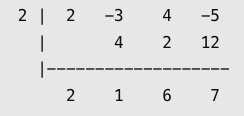
The final number is 7.
Therefore:
P(2) = 7
The final number in synthetic division is both:
-
The remainder when dividing by x − 2.
-
The value of the polynomial at x = 2.
This connection is one of the most useful consequences of the Remainder Theorem.
Evaluating Polynomials with Missing Terms
Some polynomials do not contain every power of x.
When using synthetic division or Horner's method, missing powers must be represented by zero coefficients.
Worked Example
Evaluate:
P(x) = x⁴ − 3x² + 5
at x = 2.
Rewrite:
P(x) = x⁴ + 0x³ − 3x² + 0x + 5
Coefficients:
1, 0, −3, 0, 5
Use synthetic division:
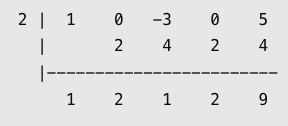
Therefore:
P(2) = 9
Check by direct substitution:
P(2) = 2⁴ − 3(2²) + 5
= 16 − 12 + 5
= 9
Both methods agree.
Interactive Polynomial Evaluation
Use the controls below to explore how polynomial values and remainders are connected.
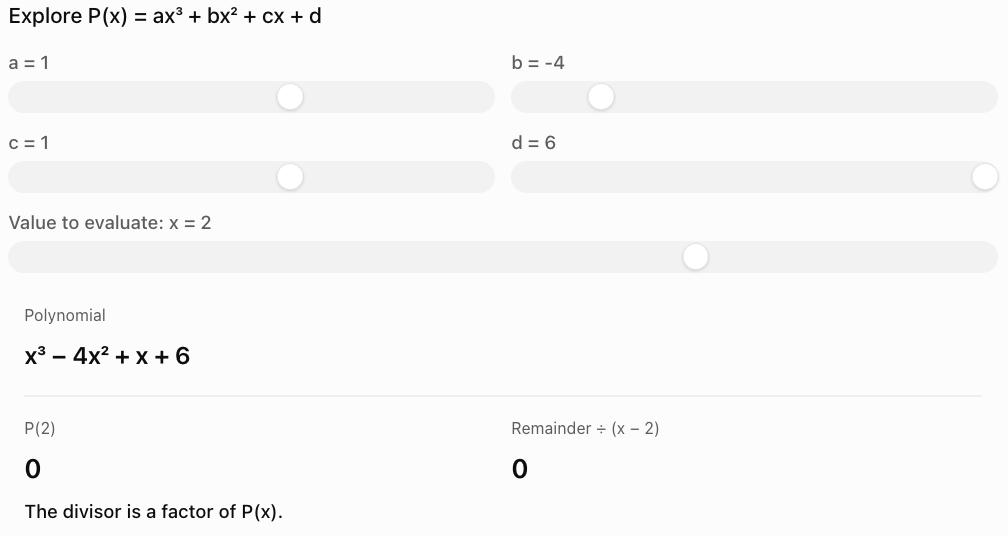
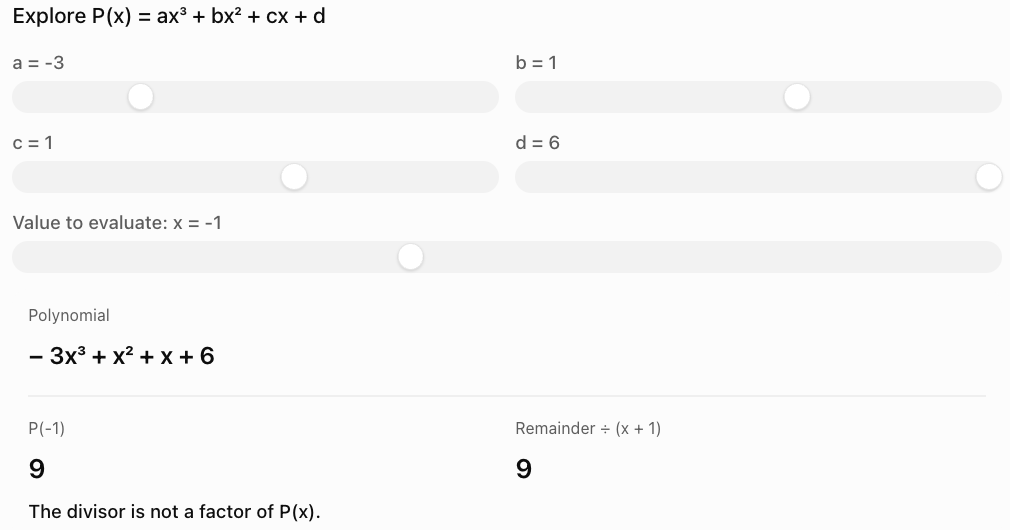
The Factor Theorem
The Factor Theorem is closely related to the Remainder Theorem.
It states:
x − a is a factor of P(x) if and only if P(a) = 0.
This means that when a polynomial evaluates to zero at x = a, the expression x − a divides the polynomial exactly.
Two Important Conclusions
If:
P(a) = 0
then:
x − a is a factor of P(x).
If:
P(a) ≠ 0
then:
x − a is not a factor of P(x).
This allows us to test possible factors without performing polynomial division.
Applying the Factor Theorem
Worked Example
Determine whether:
x − 3
is a factor of:
P(x) = x² − 5x + 6
Step 1: Identify a
The divisor is x − 3.
Therefore:
a = 3
Step 2: Evaluate
P(3) = 3² − 5(3) + 6
= 9 − 15 + 6
= 0
Step 3: Interpret
Because P(3) = 0:
x − 3 is a factor of P(x).
Verification
Factor the polynomial:
x² − 5x + 6 = (x − 2)(x − 3)
The factor x − 3 appears in the product.
Testing a Binomial That Is Not a Factor
Worked Example
Determine whether:
x + 2
is a factor of:
P(x) = x³ + 2x² − 3x + 5
Step 1
The divisor is x + 2.
Therefore:
a = −2
Step 2
Evaluate:
P(−2) = (−2)³ + 2(−2)² − 3(−2) + 5
= −8 + 8 + 6 + 5
= 11
Step 3
Because:
P(−2) = 11 ≠ 0
x + 2 is not a factor of P(x).
The remainder when dividing by x + 2 is 11.
Understanding the Connection Between Factors and Zeros
Consider:
P(x) = (x − 2)(x + 3)
If x = 2:
P(2) = (2 − 2)(2 + 3)
= 0 × 5
= 0
If x = −3:
P(−3) = (−3 − 2)(−3 + 3)
= −5 × 0
= 0
Therefore, the polynomial has zeros at:
x = 2 and x = −3
The factors correspond directly to the zeros.
|
Factor |
Zero |
|---|---|
|
x − 2 |
x = 2 |
|
x + 3 |
x = −3 |
|
x − 5 |
x = 5 |
|
x + 7 |
x = −7 |
This is why the Factor Theorem is useful for solving polynomial equations.
The Factor Theorem and Polynomial Graphs
A zero of a polynomial is an x-value where the function equals zero.
On a graph, these values correspond to x-intercepts.
Consider:
P(x) = x² − x − 6
Factor:
P(x) = (x − 3)(x + 2)
The zeros are:
x = 3
x = −2
Therefore, the graph crosses the x-axis at:
(3, 0) and (−2, 0)

Important Connection
If P(a) = 0, then:
-
a is a zero of the polynomial.
-
x − a is a factor.
-
(a, 0) is an x-intercept of the graph.
These are three different ways of describing the same algebraic relationship.
Using the Factor Theorem to Factor Cubic Polynomials
The Factor Theorem becomes especially useful for polynomials of degree 3 or higher.
Worked Example
Factor completely:
P(x) = x³ − 6x² + 11x − 6
Step 1: Test a Possible Zero
Try x = 1:
P(1) = 1 − 6 + 11 − 6
= 0
Therefore:
x − 1 is a factor.
Step 2: Use Synthetic Division
Divide by x − 1.
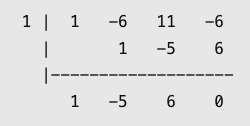
The quotient is:
x² − 5x + 6
Step 3: Factor the Quadratic
x² − 5x + 6 = (x − 2)(x − 3)
Final Answer
P(x) = (x − 1)(x − 2)(x − 3)
The zeros are:
x = 1, 2, and 3

Finding Possible Rational Zeros
When a polynomial has integer coefficients, the Rational Root Theorem can help identify possible rational zeros.
For a polynomial:
P(x) = aₙxⁿ + ... + a₁x + a₀
any rational zero p/q in lowest terms must satisfy:
-
p is a factor of the constant term a₀.
-
q is a factor of the leading coefficient aₙ.
Example
Consider:
P(x) = 2x³ − 3x² − 8x + 12
The constant term is 12.
The leading coefficient is 2.
Possible rational zeros include:
±1/2, ±1, ±3/2, ±2, ±3, ±4, ±6, ±12
This list contains candidates, not guaranteed zeros.
Test x = 2
P(2) = 2(8) − 3(4) − 8(2) + 12
= 16 − 12 − 16 + 12
= 0
Therefore:
x − 2 is a factor.
Synthetic Division
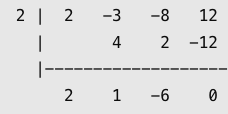
The quotient is:
2x² + x − 6
Factor:
2x² + x − 6 = (2x − 3)(x + 2)
Therefore:
P(x) = (x − 2)(2x − 3)(x + 2)
The zeros are:
x = 2, 3/2, and −2
Finding Unknown Coefficients Using the Remainder Theorem
The Remainder Theorem can help determine unknown coefficients in polynomial expressions.
Worked Example
A polynomial is defined by:
P(x) = x³ + kx² − 4x + 6
When divided by x − 2, the remainder is 10.
Find k.
Step 1: Apply the Remainder Theorem
Because the divisor is x − 2:
P(2) = 10
Step 2: Substitute
2³ + k(2²) − 4(2) + 6 = 10
Simplify:
8 + 4k − 8 + 6 = 10
4k + 6 = 10
Step 3: Solve
4k = 4
k = 1
Verification
Substitute k = 1:
P(x) = x³ + x² − 4x + 6
Evaluate:
P(2) = 8 + 4 − 8 + 6
= 10
Correct.
Finding Unknown Coefficients Using the Factor Theorem
Worked Example
Find k if x + 3 is a factor of:
P(x) = x³ + kx² − 5x + 3
Step 1: Apply the Factor Theorem
Because x + 3 is a factor:
P(−3) = 0
Step 2: Substitute
(−3)³ + k(−3)² − 5(−3) + 3 = 0
Simplify:
−27 + 9k + 15 + 3 = 0
9k − 9 = 0
Step 3: Solve
9k = 9
k = 1
Verification
P(x) = x³ + x² − 5x + 3
P(−3) = −27 + 9 + 15 + 3
= 0
Therefore, x + 3 is a factor.
Finding Two Unknown Coefficients
Sometimes a polynomial contains two unknown coefficients.
If two factors are known, we can form two equations and solve them simultaneously.
Worked Example
Suppose:
P(x) = x³ + ax² + bx + 6
Both x − 1 and x + 2 are factors.
Find a and b.
Step 1: Apply the Factor Theorem
Because x − 1 is a factor:
P(1) = 0
Because x + 2 is a factor:
P(−2) = 0
Step 2: Substitute x = 1
1 + a + b + 6 = 0
Therefore:
a + b = −7
Step 3: Substitute x = −2
−8 + 4a − 2b + 6 = 0
Simplify:
4a − 2b = 2
Divide by 2:
2a − b = 1
Step 4: Solve Simultaneously
We have:
a + b = −7
2a − b = 1
Add the equations:
3a = −6
Therefore:
a = −2
Substitute into the first equation:
−2 + b = −7
b = −5
Final Answer
a = −2 and b = −5
The polynomial is:
P(x) = x³ − 2x² − 5x + 6
Verification
P(1) = 1 − 2 − 5 + 6 = 0
P(−2) = −8 − 8 + 10 + 6 = 0
Both factors are confirmed.
Applying the Theorems to Non-Monic Linear Divisors
The standard Remainder Theorem is often stated for x − a.
However, it can also be applied to a divisor of the form:
mx + n
where m ≠ 0.
Set the divisor equal to zero:
mx + n = 0
x = −n/m
The remainder is:
R = P(−n/m)
Worked Example
Find the remainder when:
P(x) = 2x² + 3x + 5
is divided by:
2x − 1
Set the divisor equal to zero:
2x − 1 = 0
x = 1/2
Evaluate:
P(1/2) = 2(1/2)² + 3(1/2) + 5
= 2(1/4) + 3/2 + 5
= 1/2 + 3/2 + 5
= 7
Therefore:
The remainder is 7.
Generalised Factor Theorem
For m ≠ 0:
mx + n is a factor of P(x) if and only if P(−n/m) = 0.
Recognising Repeated Factors
The Factor Theorem identifies zeros, but a zero may occur more than once.
Consider:
P(x) = (x − 2)²(x + 1)
The zeros are:
x = 2
x = −1
However, x = 2 is a repeated zero because the factor x − 2 appears twice.
We say that x = 2 has multiplicity 2.
Graphical Interpretation
For a polynomial with real coefficients:
-
A zero of odd multiplicity generally corresponds to the graph crossing the x-axis.
-
A zero of even multiplicity generally corresponds to the graph touching the x-axis and turning around.

Worked Example
Factor:
P(x) = x³ − 3x² + 4
Test x = 2:
P(2) = 8 − 12 + 4 = 0
Therefore, x − 2 is a factor.
Synthetic division gives:
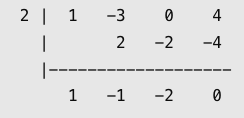
The quotient is:
x² − x − 2
Factor:
x² − x − 2 = (x − 2)(x + 1)
Therefore:
P(x) = (x − 2)²(x + 1)
The zeros are:
x = 2, with multiplicity 2.
x = −1, with multiplicity 1.
Real-World Application: Projectile Motion
Suppose the height of an object above the ground is modelled by:
h(t) = −5t² + 20t
where t is time in seconds and h is height in metres.
We want to determine when the object reaches the ground.
At ground level:
h(t) = 0
Factor:
−5t² + 20t = −5t(t − 4)
Therefore:
−5t(t − 4) = 0
Using the zero product property:
t = 0
or:
t = 4
Interpretation
At t = 0, the object is launched.
At t = 4 seconds, it returns to the ground.
The flight lasts 4 seconds.
The Factor Theorem confirms that t and t − 4 are factors of the height polynomial because h(0) = 0 and h(4) = 0.

Real-World Application: Designing a Container
Suppose the volume of a rectangular container is:
V(x) = x³ + 6x² + 11x + 6
A designer suspects that x + 1 represents one dimension.
We can test this using the Factor Theorem.
Step 1: Test the Factor
If x + 1 is a factor:
V(−1) should equal zero.
Evaluate:
V(−1) = (−1)³ + 6(−1)² + 11(−1) + 6
= −1 + 6 − 11 + 6
= 0
Therefore:
x + 1 is a factor.
Step 2: Divide
Using synthetic division with −1:
The quotient is:
x² + 5x + 6
Step 3: Factor the Quotient
x² + 5x + 6 = (x + 2)(x + 3)
Therefore:
V(x) = (x + 1)(x + 2)(x + 3)
Possible container dimensions are:
x + 1
x + 2
x + 3
For a physical container, choose x so that all three dimensions are positive.
Common Mistakes
Using the wrong substitution value
Incorrect:
For x + 4, substitute x = 4.
Correct:
For x + 4, substitute x = −4.
Confusing a nonzero remainder with a factor
If P(a) ≠ 0, then x − a is not a factor.
Forgetting missing coefficients in synthetic division
For:
x³ + 5x − 2
use coefficients:
1, 0, 5, −2
Making sign errors with negative inputs
Always use parentheses when evaluating negative values.
For example:
(−3)² = 9
Assuming a zero remainder identifies every factor
Finding one factor does not necessarily completely factor the polynomial.
Confusing zeros and factors
If x = 5 is a zero, then x − 5 is a factor.
The factor is not x + 5.
Assuming all zeros are integers
Some polynomial zeros are fractions, irrational numbers, or complex numbers.
Failing to verify unknown coefficients
After solving for an unknown coefficient, substitute it back into the original polynomial.
Using the Remainder Theorem directly with quadratic divisors
The simple evaluation rule P(a) applies to linear divisors. A quadratic divisor generally produces a remainder of degree at most 1, requiring a different approach.
Key Terms
-
Polynomial: Algebraic expression containing terms with nonnegative integer exponents.
-
Polynomial Function: Function defined by a polynomial expression.
-
Dividend: Polynomial being divided.
-
Divisor: Polynomial used to divide another polynomial.
-
Quotient: Resulting polynomial in the division algorithm.
-
Remainder: Expression left after polynomial division.
-
Remainder Theorem: The remainder when P(x) is divided by x − a equals P(a).
-
Factor Theorem: x − a is a factor of P(x) exactly when P(a) = 0.
-
Factor: Expression that divides another polynomial without a remainder.
-
Zero or Root: Value of x that makes a polynomial equal zero.
-
x-Intercept: Point where a function's graph meets the x-axis.
-
Synthetic Division: Efficient method for dividing by suitable linear expressions.
-
Horner's Method: Efficient procedure for evaluating polynomials using nested multiplication.
-
Coefficient: Numerical multiplier of a variable term.
-
Leading Coefficient: Coefficient of the highest-degree term.
-
Rational Root Theorem: Theorem that identifies possible rational zeros of polynomials with integer coefficients.
-
Multiplicity: Number of times a factor occurs in the factored form of a polynomial.
-
Exact Division: Division producing a zero remainder.
-
Substitution: Replacing a variable with a value.
-
Verification: Checking that a result satisfies the original expression or condition.
Key Takeaways
-
The Remainder Theorem states that dividing P(x) by x − a gives remainder P(a).
-
The Factor Theorem states that x − a is a factor exactly when P(a) = 0.
-
To test x + a, substitute x = −a.
-
Polynomial evaluation can replace lengthy division when only the remainder is needed.
-
Horner's method provides an efficient way to evaluate polynomials.
-
Synthetic division calculates both the quotient and the remainder.
-
A zero remainder confirms that the divisor is a factor.
-
Factors correspond to zeros of polynomial functions.
-
Zeros correspond to x-intercepts on polynomial graphs.
-
The Factor Theorem can help factor cubic and higher-degree polynomials.
-
The Rational Root Theorem provides candidates for rational zeros.
-
Unknown coefficients can be determined using given remainders or factors.
-
Repeated factors correspond to zeros with multiplicity greater than one.
-
These theorems are useful in algebra, geometry, physics, and mathematical modelling.
Check Your Understanding
Remainder Theorem
Find the remainder without using long division.
-
P(x) = x² + 5x + 7, divided by x − 2.
-
P(x) = x³ − 3x + 4, divided by x + 1.
-
P(x) = 2x³ + x² − 5x + 6, divided by x − 3.
-
P(x) = x⁴ − 4x² + 2, divided by x + 2.
Factor Theorem
Determine whether the given binomial is a factor.
-
P(x) = x² − 7x + 12; x − 3.
-
P(x) = x³ + 2x² − 5x − 6; x + 1.
-
P(x) = 2x³ − 3x² − 8x + 12; x − 2.
-
P(x) = x³ − 4x + 5; x + 2.
Polynomial Evaluation
-
Evaluate P(3) if P(x) = 2x³ − x² + 4x − 7.
-
Evaluate P(−2) if P(x) = x⁴ − 3x² + 2x + 1.
-
Use Horner's method to evaluate P(2) for P(x) = x³ − 5x² + 6x − 4.
-
Explain why synthetic division can be used to evaluate a polynomial.
Unknown Coefficients
-
Find k if the remainder when x² + kx + 5 is divided by x − 2 is 11.
-
Find k if x + 1 is a factor of x³ + kx² − 4x + 2.
-
Find k if x − 3 is a factor of 2x³ + kx² − 5x + 6.
Applications
-
Factor x³ − 6x² + 11x − 6 using the Factor Theorem.
-
Find the zeros of x² − 5x + 6.
-
Explain the connection between a zero, a factor, and an x-intercept.
-
Determine the remainder when P(x) = 2x² + 3x + 5 is divided by 2x − 1.
-
Explain how the Remainder and Factor Theorems are related.
Answer Key
|
Question |
Answer |
|---|---|
|
1 |
21 |
|
2 |
6 |
|
3 |
54 |
|
4 |
2 |
|
5 |
Yes; P(3) = 0 |
|
6 |
Yes; P(−1) = 0 |
|
7 |
Yes; P(2) = 0 |
|
8 |
No; P(−2) = 5 |
|
9 |
50 |
|
10 |
1 |
|
11 |
−4 |
|
12 |
The final synthetic division value equals P(a), the remainder |
|
13 |
k = 1 |
|
14 |
k = −5 |
|
15 |
k = −7/3 |
|
16 |
(x − 1)(x − 2)(x − 3) |
|
17 |
x = 2 and x = 3 |
|
18 |
P(a) = 0 means x − a is a factor and (a, 0) is an x-intercept |
|
19 |
7 |
|
20 |
The Factor Theorem is the zero-remainder case of the Remainder Theorem |
Extended Challenge
Remainder Calculations
-
Find the remainder when 3x³ − 5x² + 7x − 4 is divided by x − 2.
-
Find the remainder when x⁴ − 2x³ + 5x − 8 is divided by x + 3.
-
Find the remainder when 2x⁵ − 3x³ + x − 7 is divided by x − 1.
-
Find the remainder when 4x³ + 2x² − 5x + 9 is divided by 2x + 1.
-
Explain how the Remainder Theorem follows from the polynomial division algorithm.
Testing Factors
-
Determine whether x − 4 is a factor of x³ − 6x² + 8x.
-
Determine whether x + 2 is a factor of 2x³ + 5x² − 4x − 12.
-
Determine whether 3x − 2 is a factor of 9x³ − 6x² − 4x + 8.
-
Find all integer zeros of x³ − 2x² − 5x + 6.
-
Factor x³ + 2x² − 9x − 18 completely.
Unknown Coefficients
-
Find k if x − 2 is a factor of x³ + kx² − 5x + 6.
-
Find k if the remainder when 2x³ + kx² − 3x + 4 is divided by x + 1 is 7.
-
Find a and b if x − 1 and x + 3 are factors of x³ + ax² + bx + 9.
-
Find a and b if P(2) = 0 and P(−1) = 0 for P(x) = 2x³ + ax² + bx − 4.
-
Construct a cubic polynomial that has zeros at x = −2, 1, and 4.
Advanced Applications
-
Use synthetic division to factor x³ − 7x + 6 completely.
-
Determine all rational zeros of 2x³ − 5x² − 4x + 3.
-
Explain why a polynomial with a repeated factor may touch the x-axis rather than cross it.
-
Show that the remainder when P(x) is divided by ax + b is P(−b/a), where a ≠ 0.
-
Construct a polynomial P(x) for which P(2) = 5 and P(−1) = −4.
Final Challenge: Polynomial Investigation
Consider the polynomial:
P(x) = x³ − 4x² − x + 4
Complete the investigation.
-
Identify the degree and leading coefficient.
-
Calculate P(1).
-
Determine whether x − 1 is a factor.
-
Calculate P(−1).
-
Determine whether x + 1 is a factor.
-
Calculate P(4).
-
Determine whether x − 4 is a factor.
-
Use synthetic division to divide P(x) by x − 1.
-
Write the resulting quotient.
-
Factor the quotient completely.
-
Write P(x) in completely factored form.
-
Identify all zeros.
-
Determine the x-intercepts of the graph.
-
Sketch the general shape of the polynomial.
-
Explain how the degree affects its end behaviour.
-
Verify the factorization by expansion.
-
Use the Remainder Theorem to calculate the remainder when dividing by x − 2.
-
Check the remainder using synthetic division.
-
Explain why x − 2 is or is not a factor.
-
Describe how the Remainder Theorem, Factor Theorem, and synthetic division work together.
Further Investigation: Creating a Polynomial with Known Remainders
Construct a polynomial of degree 3:
P(x) = ax³ + bx² + cx + d
Choose values for its coefficients so that:
-
P(1) = 0
-
P(−2) = 0
-
P(3) = 12
Then:
-
Verify each condition using direct substitution.
-
Identify two factors of the polynomial.
-
Use synthetic division to find the remaining factor.
-
Write the polynomial in factored form.
-
Expand the factors to verify your result.
-
Explain why the polynomial is not uniquely determined by only these three conditions.
-
Investigate what additional condition would determine a unique cubic polynomial.