Understanding Polynomial Functions
3. Zeros and Multiplicity
Learning outcomes
- I can identify the zeros of a polynomial.
- I can explain the relationship between zeros and x-intercepts.
- I can determine the multiplicity of a root.
- I can predict how multiplicity affects the graph.
- I can sketch graphs using zeros and multiplicities.
Zeros and Multiplicity
The zeros of a polynomial are the values of x that make the polynomial equal to zero.
For example:
f(x) = (x − 2)(x + 3)
To find the zeros, set:
f(x) = 0
So:
(x − 2)(x + 3) = 0
This gives:
x = 2
and:
x = −3
These zeros are closely connected to the places where the graph meets the x-axis.


Learning Targets
- I can identify the zeros of a polynomial.
- I can explain the relationship between zeros and x-intercepts.
- I can determine the multiplicity of a root.
- I can predict how multiplicity affects the graph.
- I can sketch graphs using zeros and multiplicities.
What Is a Zero?
A zero of a polynomial is a value of x for which:
f(x) = 0
Consider:
f(x) = x − 5
Set the function equal to zero:
x − 5 = 0
Therefore:
x = 5
So 5 is a zero of the function.
Other names commonly used for zeros include:
- Roots
- Solutions of f(x) = 0
- X-values of x-intercepts, when the roots are real
Zeros and X-Intercepts
On the x-axis:
y = 0
Therefore, if:
f(a) = 0
the point:
(a, 0)
lies on the graph.
For example, if:
x = 3
is a zero, then:
(3, 0)
is an x-intercept.


This gives us the important relationship:
Zero: x = a
X-intercept: (a, 0)
The zero is an x-value, while the x-intercept is a point on the graph.
Finding Zeros from Factored Form
Zeros are particularly easy to identify when a polynomial is written in factored form.
Consider:
f(x) = (x − 4)(x + 2)
Set:
f(x) = 0
Then:
(x − 4)(x + 2) = 0
For the product to equal zero, at least one factor must equal zero.
So:
x − 4 = 0
giving:
x = 4
or:
x + 2 = 0
giving:
x = −2
Therefore, the zeros are:
x = −2 and x = 4
The Zero Product Property
The previous method works because of the zero product property.
If:
ab = 0
then:
a = 0
or:
b = 0
For example:
(x − 5)(x + 1) = 0
means:
x − 5 = 0
or:
x + 1 = 0
Therefore:
x = 5
or:
x = −1
This property is fundamental when finding polynomial zeros.
Worked Example — Finding Several Zeros
Find the zeros of:
f(x) = (x + 4)(x − 1)(x − 6)
Set each factor equal to zero.
First:
x + 4 = 0
so:
x = −4
Second:
x − 1 = 0
so:
x = 1
Third:
x − 6 = 0
so:
x = 6
Therefore, the zeros are:
−4, 1, and 6
The corresponding x-intercepts are:
(−4, 0), (1, 0), and (6, 0)

What Is Multiplicity?
Sometimes the same factor appears more than once in a polynomial.
Consider:
f(x) = (x − 2)²(x + 3)
The factor:
(x − 2)
appears twice.
Therefore:
x = 2
is a zero with multiplicity 2.
The factor:
(x + 3)
appears once.
Therefore:
x = −3
has multiplicity 1.
Multiplicity tells us how many times a particular factor occurs.
Reading Multiplicity from Factors
If a polynomial contains:
(x − a)ⁿ
then:
x = a
is a zero with multiplicity:
n
For example:
(x − 4)³
gives:
Zero: x = 4
Multiplicity: 3
Similarly:
(x + 2)⁴
can be written conceptually as:
(x − (−2))⁴
so:
Zero: x = −2
Multiplicity: 4
Worked Example — Identifying Multiplicities
Consider:
f(x) = (x + 1)²(x − 3)³(x − 5)
For:
(x + 1)²
the zero is:
x = −1
with multiplicity:
2
For:
(x − 3)³
the zero is:
x = 3
with multiplicity:
3
For:
(x − 5)
the zero is:
x = 5
with multiplicity:
1
The sum of the multiplicities is:
2 + 3 + 1 = 6
Therefore, this polynomial has degree 6.
Multiplicity Affects the Graph
Multiplicity does more than tell us how often a factor appears.
It also affects how the graph behaves at the corresponding x-intercept.
The most important pattern is:
Odd multiplicity → graph crosses the x-axis
Even multiplicity → graph touches the x-axis and turns around

This is extremely useful when sketching polynomial graphs.
Multiplicity 1
Consider:
f(x) = x − 2
The zero is:
x = 2
with multiplicity:
1
Since 1 is odd, the graph crosses the x-axis at:
(2, 0)
Multiplicity 1 usually produces a straightforward crossing.
Multiplicity 2
Consider:
f(x) = (x − 2)²
The zero is:
x = 2
with multiplicity:
2
Since 2 is even, the graph touches the x-axis and turns around.
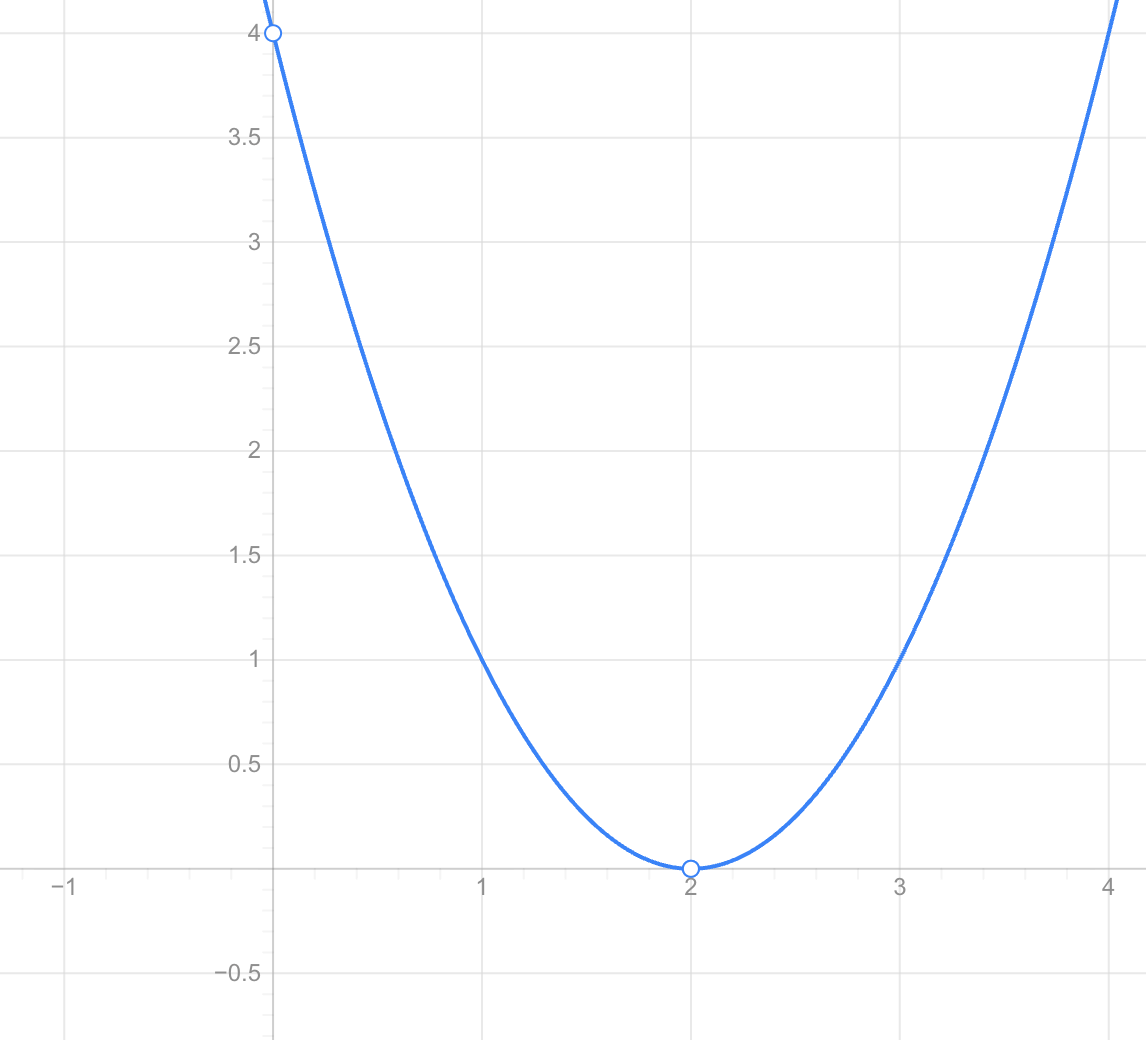
The graph reaches the x-axis but does not pass through it.
This behaviour is sometimes described as bouncing off the x-axis.
Multiplicity 3
Consider:
f(x) = (x − 2)³
The zero is:
x = 2
with multiplicity:
3
Because 3 is odd, the graph crosses the x-axis.
However, the graph becomes flatter near the root than it would for multiplicity 1.
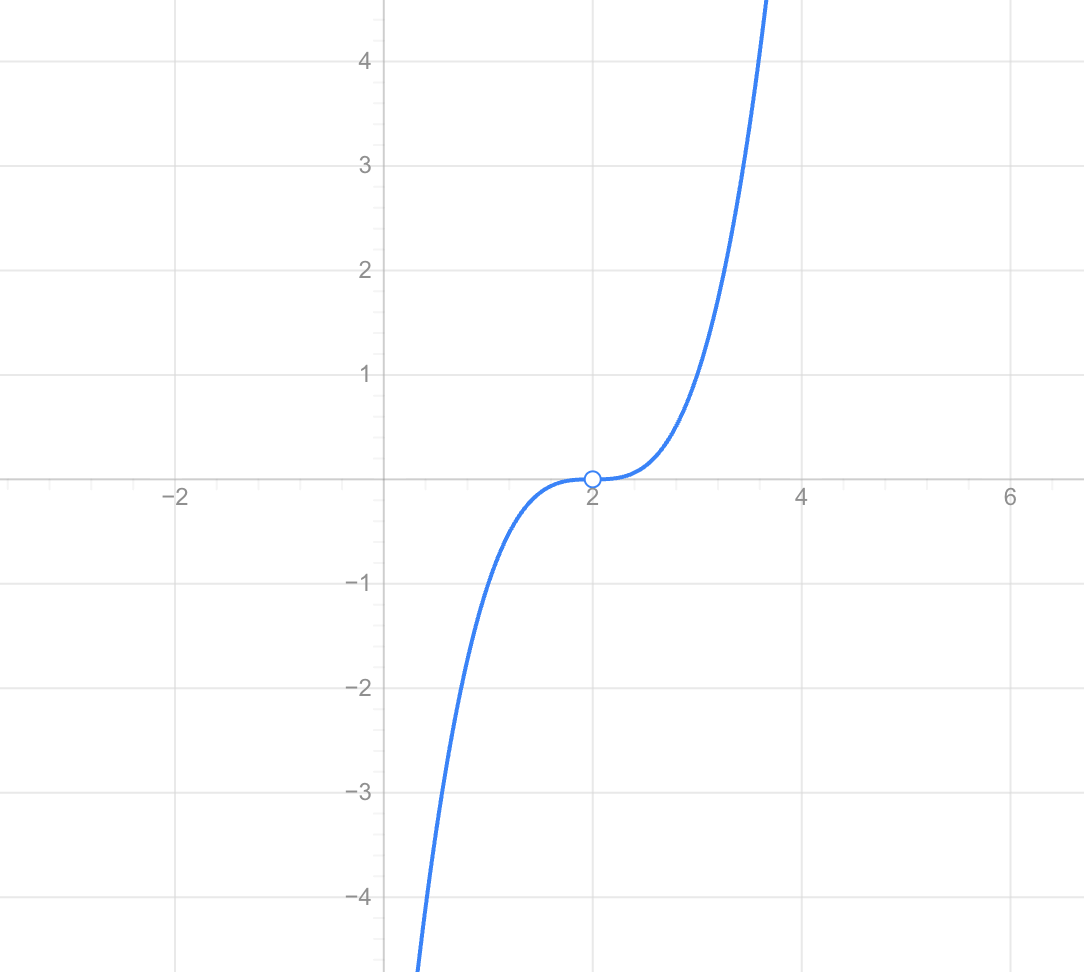
The graph still crosses, but it tends to flatten as it passes through the intercept.
Multiplicity 4
Consider:
f(x) = (x − 2)⁴
The zero is:
x = 2
with multiplicity:
4
Because 4 is even, the graph touches the x-axis and turns around.
Higher multiplicity also causes the graph to become flatter near the root.
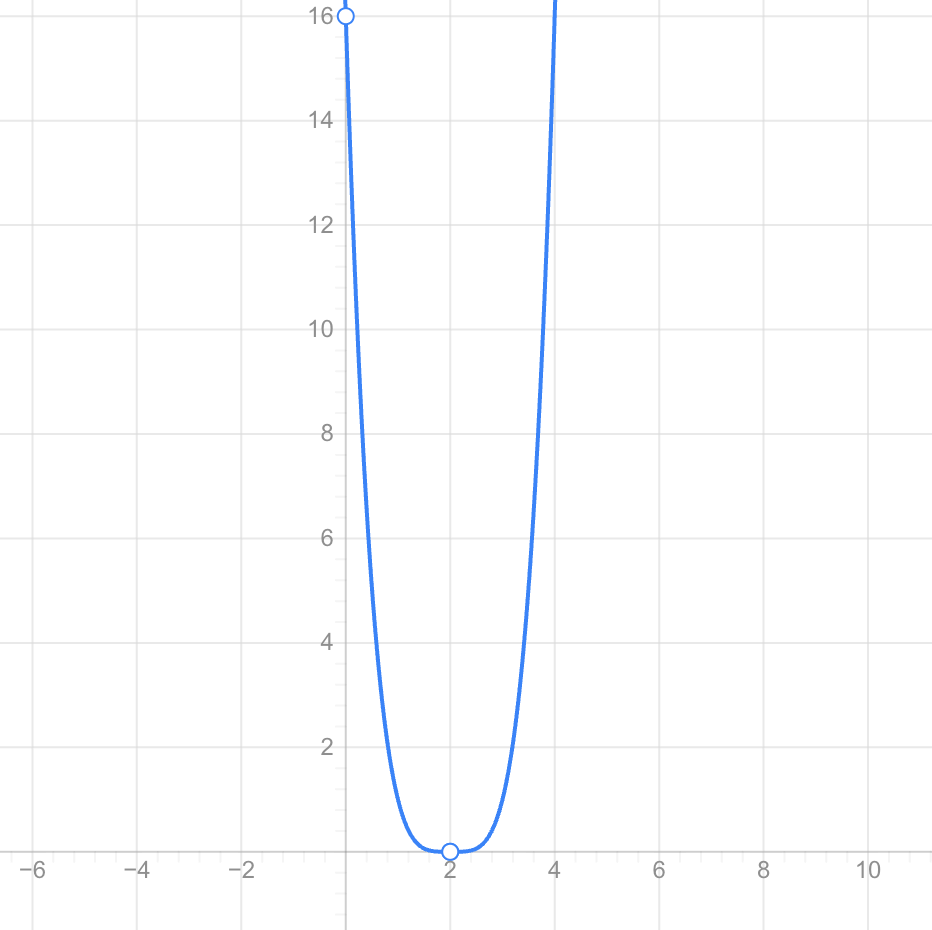
So multiplicity 4 behaves like multiplicity 2 in terms of crossing versus touching, but the graph is flatter near the zero.
Odd Multiplicity
Zeros with odd multiplicity cause the graph to cross the x-axis.
Examples include multiplicities:
1, 3, 5, 7, ...
The function changes sign as it passes through the root.
For example, it might change from:
negative → positive
or:
positive → negative


Even Multiplicity
Zeros with even multiplicity cause the graph to touch the x-axis and turn around.
Examples include:
2, 4, 6, 8, ...
The function does not change sign at the root.
If the graph approaches the x-axis from above, it touches the axis and returns upward.
If it approaches from below, it touches the axis and returns downward.
A Useful Multiplicity Pattern
When sketching, remember:
Multiplicity 1 → crosses
Multiplicity 2 → touches and turns
Multiplicity 3 → crosses and flattens
Multiplicity 4 → touches, turns, and flattens
For higher multiplicities, the same odd/even pattern continues.
The larger the multiplicity, the flatter the graph tends to become near the root.


Worked Example — Predicting Graph Behaviour
Consider:
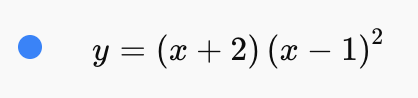
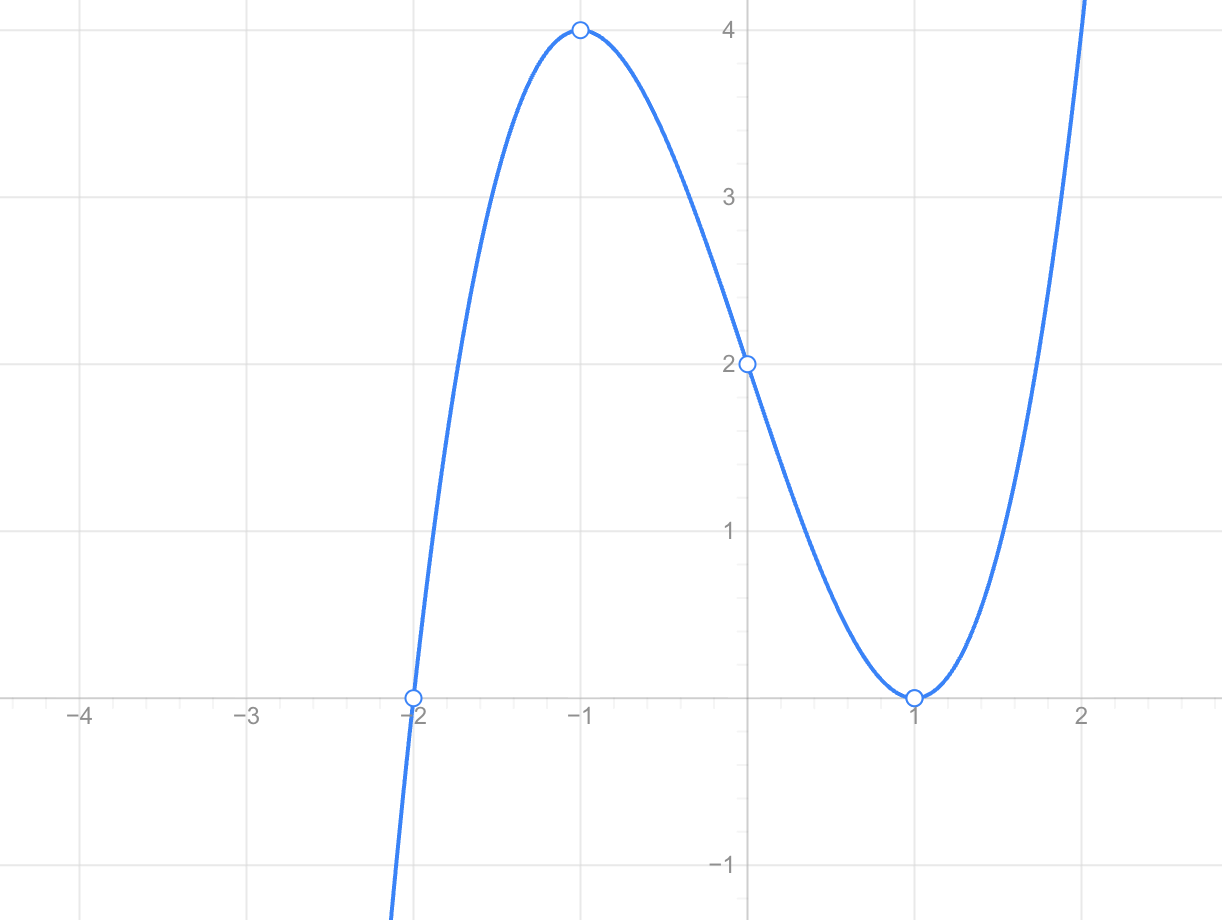
f(x) = (x + 2)(x − 1)²
The zeros are:
x = −2
with multiplicity:
1
and:
x = 1
with multiplicity:
2
Therefore:
At:
x = −2
the graph crosses the x-axis.
At:
x = 1
the graph touches the x-axis and turns around.
This information already tells us a great deal about the shape of the graph.
Degree from Multiplicity
When a polynomial is completely factored, the multiplicities can help identify its degree.
Consider:
f(x) = (x + 3)²(x − 1)³
The first factor contributes degree:
2
The second contributes degree:
3
Therefore:
Degree = 2 + 3 = 5
This is a fifth-degree polynomial.
The sum of the multiplicities is:
5
Multiplicity and End Behaviour Together
To sketch a polynomial successfully, we can combine information about:
- Zeros
- Multiplicities
- Degree
- Leading coefficient
- End behaviour
Consider:
f(x) = (x + 2)(x − 1)²
The degree is:
1 + 2 = 3
So the polynomial has odd degree.
Its leading coefficient is positive.
Therefore:
Left end → down
Right end → up
At:
x = −2
the graph crosses.
At:
x = 1
the graph touches and turns.
Together, these facts give us the basic shape.
Sketching from Zeros and Multiplicity
A useful process is:
- Write down all zeros.
- Identify the multiplicity of each zero.
- Plot each zero on the x-axis.
- Determine whether the graph crosses or touches at each zero.
- Determine the degree.
- Determine the sign of the leading coefficient.
- Predict the end behaviour.
- Find the y-intercept if useful.
- Connect the features with a smooth curve.
Polynomial graphs should be drawn smoothly, without sharp corners.
Worked Example — Sketching a Cubic
Sketch the general graph of:
f(x) = (x + 2)(x − 1)²
Zeros:
x = −2, multiplicity 1
x = 1, multiplicity 2
Degree:
3
Leading coefficient:
positive
End behaviour:
Left end → down
Right end → up
At:
x = −2
the graph crosses the x-axis.
At:
x = 1
the graph touches the x-axis and turns.