Solving Quadratic Equations
2. Solving by Completing the Square
Learning outcomes
- I can complete the square for simple quadratics.
- I can rewrite equations in vertex form.
- I can solve quadratic equations using completing the square.
- I can explain why the method works.
- I can verify my solutions.
Solving by Completing the Square
What Is Completing the Square?
Completing the square is an algebraic method used to rewrite a quadratic expression so that part of it becomes a perfect square.
For example:
x² + 6x + 9
can be written as:
(x + 3)²
because:
(x + 3)² = (x + 3)(x + 3)
= x² + 6x + 9
Completing the square allows us to turn expressions such as:
x² + 6x
into a perfect-square expression by adding the correct number.
This method is useful for:
- converting standard form to vertex form
- finding the vertex of a parabola
- solving quadratic equations
- understanding how the quadratic formula is developed
Perfect-Square Trinomials
A perfect-square trinomial has one of these patterns:
x² + 2px + p² = (x + p)²
or:
x² − 2px + p² = (x − p)²
For example:
x² + 8x + 16 = (x + 4)²
because:
2(4) = 8
and:
4² = 16
Similarly:
x² − 10x + 25 = (x − 5)²
because:
2(−5) = −10
and:
(−5)² = 25
Recognizing this pattern is the foundation of completing the square.
Finding the Number That Completes the Square
Consider:
x² + 6x
To turn this into a perfect square:
Take half the coefficient of x
6 ÷ 2 = 3
Square the result
3² = 9
Therefore:
x² + 6x + 9 = (x + 3)²
The number needed to complete the square is:
9
The General Pattern
For:
x² + bx
take half of b:
b/2
and square it:
(b/2)²
Therefore:
x² + bx + (b/2)² = (x + b/2)²
This is the central pattern behind completing the square.
More Examples
For:
x² + 10x
Half of 10 is 5.
Square 5:
25
Therefore:
x² + 10x + 25 = (x + 5)²
For:
x² − 8x
Half of −8 is −4.
Square −4:
16
Therefore:
x² − 8x + 16 = (x − 4)²
For:
x² + 14x
Half of 14 is 7.
Square 7:
49
Therefore:
x² + 14x + 49 = (x + 7)²
Why We Must Keep an Equation Balanced
Suppose:
x² + 6x = 7
If we add 9 to the left side:
x² + 6x + 9
we have changed the value of that side.
To keep the equation balanced, we must also add 9 to the right side:
x² + 6x + 9 = 7 + 9
This gives:
(x + 3)² = 16
The idea is exactly like a balanced scale: whatever is done to one side of an equation must also be done to the other.
Solving by Completing the Square
Solve:
x² + 6x = 7
Half the coefficient of x:
6 ÷ 2 = 3
Square it:
3² = 9
Add 9 to both sides:
x² + 6x + 9 = 7 + 9
Factor the perfect square:
(x + 3)² = 16
Take the square root of both sides:
x + 3 = ±4
The ± symbol is important because both:
4² = 16
and:
(−4)² = 16
Now solve:
x + 3 = 4
x = 1
or:
x + 3 = −4
x = −7
Therefore:
x = 1 or x = −7
Why We Need ±
Suppose:
x² = 25
There are two numbers whose square equals 25:
5² = 25
and:
(−5)² = 25
Therefore:
x = ±5
Similarly, if:
(x − 2)² = 36
then:
x − 2 = ±6
giving:
x = 8
or:
x = −4
Forgetting ± is one of the most common mistakes when solving quadratics by completing the square.
A Reliable Solving Method
For a simple equation such as:
x² + bx + c = 0
use this process:
Move the constant
Write the x² and x terms on one side.
Find the completing number
Calculate:
(b/2)²
Add it to both sides
Keep the equation balanced.
Factor the perfect-square trinomial
Rewrite it as a squared binomial.
Take square roots
Remember:
±
Solve for x
Isolate x.
Verify
Substitute each solution into the original equation.
Example: Solve x² + 8x + 7 = 0
Move the constant:
x² + 8x = −7
Take half of 8:
4
Square it:
16
Add 16 to both sides:
x² + 8x + 16 = −7 + 16
Factor:
(x + 4)² = 9
Take square roots:
x + 4 = ±3
Therefore:
x + 4 = 3
x = −1
or:
x + 4 = −3
x = −7
Solutions:
x = −1, −7
Example with a Negative Middle Term
Solve:
x² − 10x + 9 = 0
Move the constant:
x² − 10x = −9
Take half of −10:
−5
Square it:
25
Add 25 to both sides:
x² − 10x + 25 = 16
Factor:
(x − 5)² = 16
Take square roots:
x − 5 = ±4
Therefore:
x = 9
or:
x = 1
Solutions:
x = 1, 9
Completing the Square with Fractions
Completing the square also works when the coefficient of x is odd.
Consider:
x² + 5x
Half of 5 is:
5/2
Square it:
25/4
Therefore:
x² + 5x + 25/4 = (x + 5/2)²
Fractions can make the calculations less convenient, but the method is exactly the same.
Example with an Odd Coefficient
Solve:
x² + 5x + 4 = 0
Move the constant:
x² + 5x = −4
Complete the square:
x² + 5x + 25/4 = −4 + 25/4
Since:
−4 = −16/4
we get:
(x + 5/2)² = 9/4
Take square roots:
x + 5/2 = ±3/2
Therefore:
x = −5/2 + 3/2 = −1
or:
x = −5/2 − 3/2 = −4
So:
x = −1, −4
Factoring would have been faster for this particular equation, but completing the square still works.
Rewriting Standard Form as Vertex Form
Completing the square is also useful when the equation is a function rather than an equation set equal to zero.
Consider:
y = x² + 6x + 2
We want vertex form:
y = a(x − h)² + k
Start with:
y = x² + 6x + 2
Complete the square using the x-terms.
Half of 6 is 3.
Square it:
9
Add and subtract 9:
y = x² + 6x + 9 − 9 + 2
Factor:
y = (x + 3)² − 9 + 2
Therefore:
y = (x + 3)² − 7
The vertex is:
(−3, −7)
Why We Add and Subtract in a Function
When solving an equation, we can add the same number to both sides.
But when rewriting:
y = x² + 6x + 2
we want the expression itself to remain unchanged.
So we add and subtract the same number:
+9 − 9
Since:
9 − 9 = 0
the value of the expression has not changed.
This allows us to create a perfect square without changing the function.
Another Standard-to-Vertex Example
Convert:
y = x² − 8x + 10
Half of −8 is:
−4
Square it:
16
Add and subtract 16:
y = x² − 8x + 16 − 16 + 10
Factor:
y = (x − 4)² − 6
Therefore:
y = (x − 4)² − 6
Vertex:
(4, −6)
Axis of symmetry:
x = 4
Seeing the Same Parabola
The equations:
y = x² − 8x + 10
and:
y = (x − 4)² − 6
are equivalent.
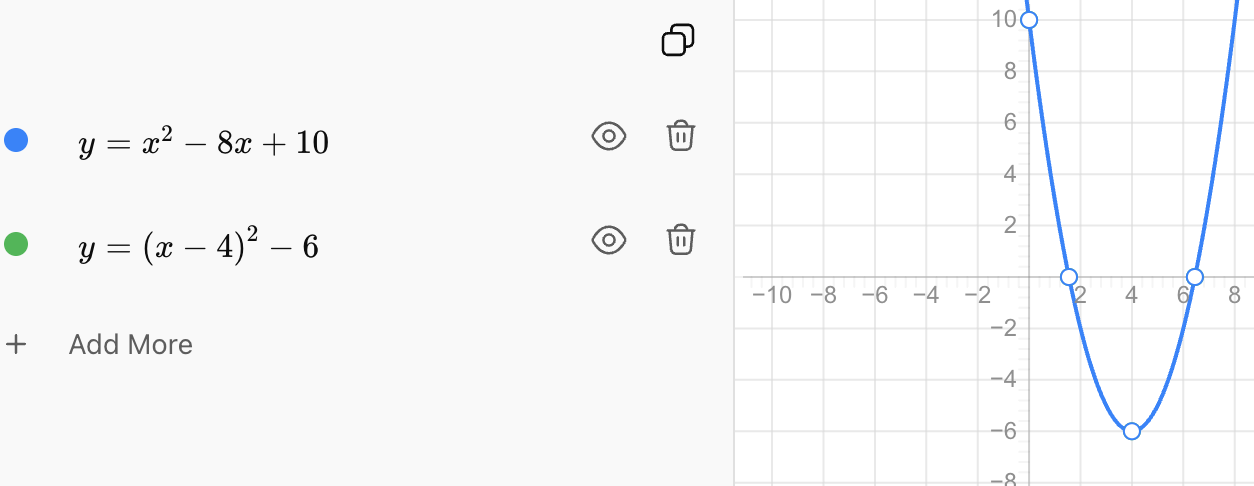
The two graphs overlap exactly because completing the square changes the form of the equation, not the function itself.
When the Leading Coefficient Is Not 1
Consider:
y = 2x² − 8x + 3
Before completing the square, factor 2 from the x² and x terms:
y = 2(x² − 4x) + 3
Now complete the square inside the brackets.
Half of −4 is:
−2
Square it:
4
Write:
y = 2(x² − 4x + 4 − 4) + 3
Group the perfect square:
y = 2[(x − 2)² − 4] + 3
Distribute:
y = 2(x − 2)² − 8 + 3
Therefore:
y = 2(x − 2)² − 5
Vertex:
(2, −5)
Why Factoring Out a Matters
Consider:
2x² − 8x
The coefficient of x² is 2.
We should first write:
2(x² − 4x)
Then complete the square using:
x² − 4x
If we simply treated −8 as the middle coefficient without accounting for the 2, we would complete the square incorrectly.
Solving When a Is Not 1
Solve:
2x² − 8x − 10 = 0
Divide the entire equation by 2:
x² − 4x − 5 = 0
Move the constant:
x² − 4x = 5
Half of −4 is −2.
Square it:
4
Add 4 to both sides:
x² − 4x + 4 = 9
Factor:
(x − 2)² = 9
Take square roots:
x − 2 = ±3
Therefore:
x = 5
or:
x = −1
When Dividing First Is Helpful
If every term is divisible by the coefficient of x², dividing first can make completing the square easier.
For example:
3x² + 12x − 15 = 0
Divide by 3:
x² + 4x − 5 = 0
Now complete the square:
x² + 4x = 5
x² + 4x + 4 = 9
(x + 2)² = 9
x + 2 = ±3
Therefore:
x = 1 or x = −5
Solutions That Are Irrational
One advantage of completing the square is that it works even when a quadratic does not factor neatly using integers.
Solve:
x² + 4x − 2 = 0
Move the constant:
x² + 4x = 2
Complete the square:
x² + 4x + 4 = 6
So:
(x + 2)² = 6
Take square roots:
x + 2 = ±√6
Therefore:
x = −2 ± √6
These are exact solutions.
Factoring with integers would not have worked conveniently here.
Exact and Approximate Solutions
For:
x = −2 ± √6
the exact answers are:
x = −2 + √6
and:
x = −2 − √6
Since:
√6 ≈ 2.45
the approximate solutions are:
x ≈ 0.45
and:
x ≈ −4.45
Unless a decimal answer is requested, it is often better to keep irrational solutions in exact radical form.
What If the Square Equals Zero?
Solve:
x² − 6x + 9 = 0
The left side is already a perfect square:
(x − 3)² = 0
Take the square root:
x − 3 = 0
Therefore:
x = 3
This is a repeated root.
Graphically, the parabola touches the x-axis at its vertex.
What If the Square Equals a Negative Number?
Consider:
x² + 4x + 8 = 0
Move the constant:
x² + 4x = −8
Complete the square:
x² + 4x + 4 = −4
Therefore:
(x + 2)² = −4
No real number squared can equal −4.
Therefore:
there are no real solutions.
In a course that includes complex numbers, the equation can be solved further using i, but over the real numbers there are no solutions.
Completing the Square and the Graph
Consider:
y = x² − 6x + 5
Complete the square:
y = x² − 6x + 9 − 9 + 5
y = (x − 3)² − 4
Vertex form immediately reveals:
vertex = (3, −4)
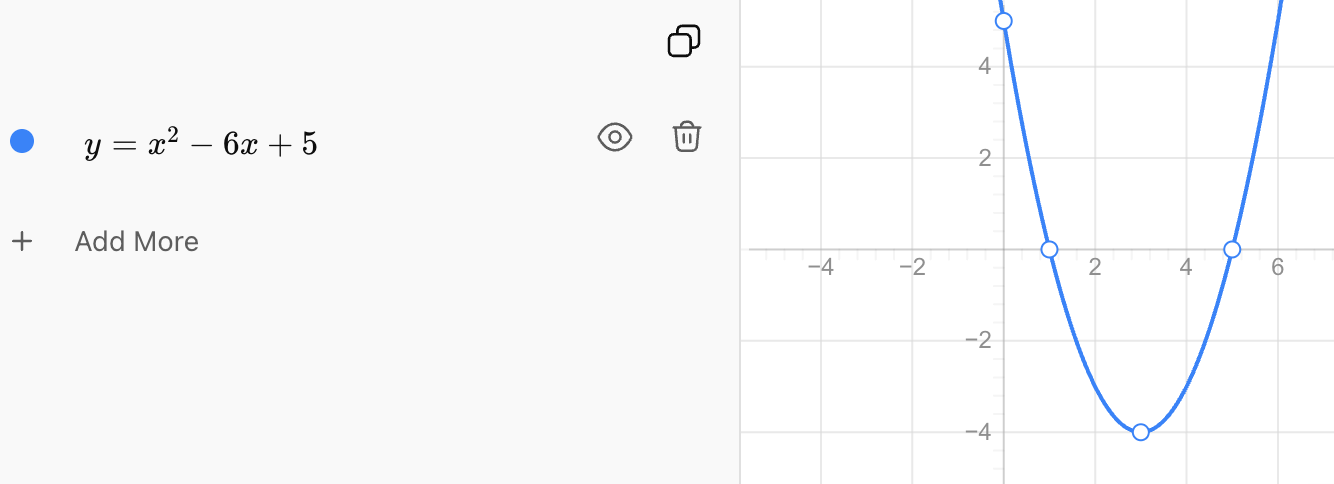
Because the vertex lies below the x-axis and the parabola opens upward, the graph has two real x-intercepts.
Solving:
(x − 3)² − 4 = 0
gives:
(x − 3)² = 4
x − 3 = ±2
Therefore:
x = 1 or x = 5
Completing the Square Reveals the Vertex
Starting with:
y = x² + bx + c
completing the square gives:
y = (x + b/2)² + c − (b/2)²
This shows why completing the square reveals the vertex.
For example:
y = x² + 8x + 11
becomes:
y = (x + 4)² − 5
So the vertex is:
(−4, −5)
Why Completing the Square Works
The method works because of the identity:
(x + p)² = x² + 2px + p²
Suppose we start with:
x² + bx
We want:
2p = b
Therefore:
p = b/2
To create the perfect square, we need:
p² = (b/2)²
So:
x² + bx + (b/2)² = (x + b/2)²
Completing the square is therefore not a trick. It follows directly from expanding a squared binomial.
Completing the Square and Symmetry
Vertex form:
y = a(x − h)² + k
reveals the axis of symmetry:
x = h
This explains another important result.
For:
y = ax² + bx + c
the axis of symmetry is:
x = −b/(2a)
This result can be derived by completing the square.
So completing the square connects the algebraic form of a quadratic with the geometry of its graph.
When Is Completing the Square Useful?
Completing the square is particularly useful when:
- a quadratic does not factor easily
- you need to convert standard form to vertex form
- you need to find the vertex
- you need the maximum or minimum value
- you want exact solutions involving square roots
- you want to understand the structure of a quadratic
- you are deriving the quadratic formula
Factoring may be faster when simple factors are obvious, but completing the square is a more general method.
Factoring vs Completing the Square
Consider:
x² − 7x + 12 = 0
This factors easily:
(x − 3)(x − 4) = 0
So factoring is probably faster.
Now consider:
x² − 6x + 2 = 0
This does not factor conveniently using integers.
Completing the square gives:
x² − 6x = −2
x² − 6x + 9 = 7
(x − 3)² = 7
Therefore:
x = 3 ± √7
Here, completing the square is much more useful.
Verifying Solutions
Consider:
x² − 6x + 2 = 0
We found:
x = 3 ± √7
Take:
x = 3 + √7
Substituting into the original equation:
(3 + √7)² − 6(3 + √7) + 2
= 9 + 6√7 + 7 − 18 − 6√7 + 2
= 18 − 18
= 0
So the solution works.
The same process can be used to verify:
x = 3 − √7
Numerical Verification
When answers contain awkward radicals, a calculator can also provide a useful numerical check.
For:
x = 3 ± √7
√7 ≈ 2.646
So:
x ≈ 5.646
or:
x ≈ 0.354
Substituting these approximate values into the original equation should produce a result close to zero.
Small differences may occur because of rounding.
Worked Example: Complete Process
Solve:
x² + 4x − 12 = 0
Move the constant:
x² + 4x = 12
Take half of 4:
2
Square:
4
Add to both sides:
x² + 4x + 4 = 16
Factor:
(x + 2)² = 16
Take square roots:
x + 2 = ±4
Solve:
x = −2 + 4 = 2
or:
x = −2 − 4 = −6
Therefore:
x = 2 or x = −6
Verify x = 2:
2² + 4(2) − 12
= 4 + 8 − 12
= 0
Verify x = −6:
(−6)² + 4(−6) − 12
= 36 − 24 − 12
= 0
Both solutions are correct.
Worked Example: Irrational Solutions
Solve:
x² − 8x + 5 = 0
Move the constant:
x² − 8x = −5
Half of −8:
−4
Square:
16
Add 16:
x² − 8x + 16 = 11
Factor:
(x − 4)² = 11
Take square roots:
x − 4 = ±√11
Therefore:
x = 4 ± √11
These are the exact solutions.
Worked Example: Convert to Vertex Form
Rewrite:
y = 3x² + 12x + 7
Factor 3 from the x-terms:
y = 3(x² + 4x) + 7
Complete the square:
y = 3(x² + 4x + 4 − 4) + 7
Factor:
y = 3[(x + 2)² − 4] + 7
Distribute:
y = 3(x + 2)² − 12 + 7
Therefore:
y = 3(x + 2)² − 5
The vertex is:
(−2, −5)
The axis of symmetry is:
x = −2
The minimum value is:
−5
Common Mistakes
Mistake: Using b² instead of (b/2)².
For x² + 8x, use:
(8/2)² = 16
not 64.
Mistake: Forgetting to add the completing number to both sides.
When solving an equation, both sides must remain balanced.
Mistake: Adding but not subtracting when rewriting a function.
For a function, add and subtract the same value so the expression remains equivalent.
Mistake: Forgetting ± when taking square roots.
If x² = 25, then x = ±5.
Mistake: Completing the square before dealing correctly with a ≠ 1.
Factor the leading coefficient from the x² and x terms, or divide the equation when appropriate.
Mistake: Thinking completing the square changes the parabola.
Correct algebra changes only the form of the equation, not the function.
Mistake: Converting exact radicals to decimals too early.
Keep answers such as 3 ± √7 exact unless decimal approximations are required.
Mistake: Not checking solutions.
Substitution into the original equation provides a reliable verification.
Key Terms
Completing the square — rewriting a quadratic so that part of it becomes a perfect-square expression.
Perfect-square trinomial — trinomial that can be written as the square of a binomial.
Standard form — quadratic form y = ax² + bx + c.
Vertex form — quadratic form y = a(x − h)² + k.
Vertex — maximum or minimum point of a parabola.
Axis of symmetry — vertical line passing through the vertex.
Square root — value that produces a given number when multiplied by itself.
± symbol — indicates both the positive and negative square roots.
Radical — expression containing a root symbol, such as √7.
Exact solution — solution written without rounding, such as 3 + √7.
Approximate solution — rounded numerical value of an exact solution.
Repeated root — solution that occurs twice.
Equivalent equations — equations representing the same relationship after valid algebraic operations.
Verification — checking that a solution satisfies the original equation.
Key Takeaways
- Completing the square creates a perfect-square trinomial.
- For x² + bx, the completing number is (b/2)².
- The pattern comes from (x + p)² = x² + 2px + p².
- When solving an equation, the completing number must be added to both sides.
- When rewriting a function, the completing number can be added and subtracted within the expression.
- Completing the square can convert standard form into vertex form.
- Vertex form reveals the vertex, axis of symmetry and maximum or minimum.
- After creating a squared binomial, solve by taking square roots.
- Remember ± when taking the square root of a positive number.
- Completing the square works even when a quadratic does not factor neatly using integers.
- Solutions may be integers, fractions or irrational numbers.
- If the squared expression equals zero, there is a repeated real root.
- If a squared real expression must equal a negative number, there are no real solutions.
- When a ≠ 1, deal with the leading coefficient before completing the square.
- Completing the square does not change the function when the algebra is performed correctly.
- Solutions can be verified by substitution into the original equation.
Check Your Understanding
- What number completes the square for x² + 10x?
- What number completes the square for x² − 12x?
- Rewrite x² + 8x + 16 as a squared binomial.
- Rewrite x² − 14x + 49 as a squared binomial.
- Solve x² + 6x = 7 by completing the square.
- Solve x² + 8x + 12 = 0 by completing the square.
- Solve x² − 10x + 16 = 0 by completing the square.
- Solve x² + 4x − 3 = 0 and leave your answers in exact form.
- Solve x² − 6x + 1 = 0 and leave your answers in exact form.
- Rewrite y = x² + 10x + 7 in vertex form.
- Rewrite y = x² − 12x + 20 in vertex form.
- Rewrite y = 2x² − 8x + 7 in vertex form.
- Rewrite y = 3x² + 18x + 20 in vertex form.
- Determine the vertex of y = x² + 6x − 2 by completing the square.
- Explain why the number added to x² + bx is (b/2)².
- Explain why ± must be used when taking the square root during the solving process.
- Solve x² − 8x + 20 = 0 over the real numbers. What happens when you complete the square?
- Verify the solutions of x² − 6x + 2 = 0 by substitution.
- Explain one situation in which completing the square would be more useful than factoring.
- Explain how completing the square connects standard form with vertex form.