Solving Quadratic Equations
| Website: | Young Education |
| Kurs: | Quadratic Functions |
| Buch: | Solving Quadratic Equations |
| Gedruckt von: | Guest user |
| Datum: | Montag, 9. November 2026, 16:36 |
1. Solving by Factoring
Learning outcomes
- I can factor simple quadratic expressions.
- I can apply the Zero Product Property.
- I can solve quadratic equations by factoring.
- I can verify my solutions.
- I can recognise when factoring is appropriate.
Solving by Factoring
What Does It Mean to Solve a Quadratic Equation?
A quadratic equation is an equation that can be written in the form:
ax² + bx + c = 0
where a ≠ 0.
To solve a quadratic equation means to find the value or values of x that make the equation true.
For example:
x² − 5x + 6 = 0
has two solutions:
x = 2
and:
x = 3
One of the most efficient ways to find these solutions is factoring.
Expressions vs Equations
It is important to distinguish between a quadratic expression and a quadratic equation.
An expression:
x² − 5x + 6
can be factored.
An equation:
x² − 5x + 6 = 0
can be solved.
Factoring the expression gives:
(x − 2)(x − 3)
Solving the equation gives:
x = 2 or x = 3
Factoring is therefore often a step used to solve a quadratic equation.
Factoring Simple Quadratics
Consider:
x² + 7x + 12
To factor this expression, find two numbers that:
- multiply to 12
- add to 7
The numbers are:
3 and 4
Therefore:
x² + 7x + 12 = (x + 3)(x + 4)
The Sum-and-Product Method
For a quadratic:
x² + bx + c
look for two numbers that:
multiply to c
and:
add to b
For example:
x² + 9x + 20
We need two numbers that:
multiply to 20
and add to 9.
The numbers are:
4 and 5
Therefore:
x² + 9x + 20 = (x + 4)(x + 5)
Factoring with Negative Numbers
Consider:
x² − 7x + 12
We need two numbers that:
multiply to +12
and add to −7.
The numbers are:
−3 and −4
Therefore:
x² − 7x + 12 = (x − 3)(x − 4)
When the Constant Is Negative
Consider:
x² + 2x − 15
We need two numbers that:
multiply to −15
and add to 2.
The numbers are:
5 and −3
Therefore:
x² + 2x − 15 = (x + 5)(x − 3)
When the constant is negative, the two factors will have opposite signs.
Sign Patterns
For:
x² + bx + c
some useful patterns are:
| Sign of c | Sign of b | Likely Factor Signs |
|---|---|---|
| positive | positive | both positive |
| positive | negative | both negative |
| negative | positive or negative | opposite signs |
For example:
x² + 8x + 15
becomes:
(x + 3)(x + 5)
while:
x² − 8x + 15
becomes:
(x − 3)(x − 5)
Checking Your Factoring
Always check factoring by expanding.
Suppose:
x² − 7x + 12 = (x − 3)(x − 4)
Expand the right side:
(x − 3)(x − 4)
= x² − 4x − 3x + 12
= x² − 7x + 12
The expressions match, so the factorization is correct.
Factoring Out a Common Factor
Before factoring a trinomial, always check whether all terms have a common factor.
Consider:
2x² − 10x + 12
All terms are divisible by 2.
Factor out 2:
2(x² − 5x + 6)
Now factor the quadratic:
2(x − 2)(x − 3)
Factoring out the greatest common factor first usually makes the remaining expression easier to work with.
Factoring When There Is a Common Variable
Consider:
x² − 6x
Both terms contain x.
Factor out x:
x(x − 6)
If the equation is:
x² − 6x = 0
then:
x(x − 6) = 0
This can now be solved using the Zero Product Property.
The Zero Product Property
The key idea behind solving by factoring is the Zero Product Property.
If:
A × B = 0
then:
A = 0
or:
B = 0
Why?
A product can equal zero only if at least one of its factors equals zero.
For example:
7 × 0 = 0
and:
0 × 12 = 0
But two nonzero numbers cannot multiply to give zero.
Applying the Zero Product Property
Suppose:
(x − 2)(x − 5) = 0
The Zero Product Property tells us:
x − 2 = 0
or:
x − 5 = 0
Solve each equation:
x = 2
or:
x = 5
Therefore, the quadratic equation has two solutions:
x = 2, 5
Solving a Quadratic by Factoring
Consider:
x² − 7x + 12 = 0
Factor:
(x − 3)(x − 4) = 0
Apply the Zero Product Property:
x − 3 = 0
or:
x − 4 = 0
Therefore:
x = 3
or:
x = 4
Solutions:
x = 3, 4
A Reliable Solving Strategy
When solving a quadratic by factoring:
Put the equation equal to zero
Write it in the form:
ax² + bx + c = 0
Factor completely
Rewrite the quadratic as a product.
Apply the Zero Product Property
Set each factor equal to zero.
Solve each equation
Find the possible values of x.
Verify
Substitute the solutions into the original equation.
This process works because factoring turns one quadratic equation into simpler linear equations.
Why the Equation Must Equal Zero
The Zero Product Property works when the product equals zero.
Consider:
(x − 2)(x − 5) = 12
You cannot say:
x − 2 = 12
or:
x − 5 = 12
The Zero Product Property does not apply.
Instead, the equation should first be rearranged into a form equal to zero before factoring.
This is one of the most important rules when solving by factoring.
Example: Rearranging First
Solve:
x² + 3x = 10
The equation is not equal to zero.
Move 10 to the left:
x² + 3x − 10 = 0
Factor:
(x + 5)(x − 2) = 0
Apply the Zero Product Property:
x + 5 = 0
or:
x − 2 = 0
Therefore:
x = −5
or:
x = 2
Another Rearranging Example
Solve:
x² = 7x − 10
Move everything to one side:
x² − 7x + 10 = 0
Factor:
(x − 2)(x − 5) = 0
Therefore:
x = 2 or x = 5
Solving When There Is a Common Factor
Solve:
3x² − 12x = 0
Factor out the greatest common factor:
3x(x − 4) = 0
The constant factor 3 cannot equal zero, so:
x = 0
or:
x − 4 = 0
Therefore:
x = 0 or x = 4
Do Not Lose the x = 0 Solution
Consider:
x² − 5x = 0
A common mistake is to divide both sides by x:
x − 5 = 0
This gives:
x = 5
But this loses another solution.
Instead, factor:
x(x − 5) = 0
Therefore:
x = 0
or:
x = 5
So the correct solutions are:
x = 0, 5
Dividing by a variable can accidentally remove a valid solution when that variable might equal zero.
Solving When a Is Not 1
Consider:
2x² + 7x + 3 = 0
Factor:
(2x + 1)(x + 3) = 0
Apply the Zero Product Property:
2x + 1 = 0
or:
x + 3 = 0
Solve:
2x = −1
x = −1/2
and:
x = −3
Therefore:
x = −1/2, −3
Another Example with a Leading Coefficient
Solve:
3x² − 11x − 4 = 0
Factor:
(3x + 1)(x − 4) = 0
Check:
3x² − 12x + x − 4
= 3x² − 11x − 4
Now solve:
3x + 1 = 0
x = −1/3
or:
x − 4 = 0
x = 4
Solutions:
x = −1/3, 4
Difference of Squares
Some quadratics have a special factoring pattern.
a² − b² = (a − b)(a + b)
For example:
x² − 25
is:
x² − 5²
Therefore:
x² − 25 = (x − 5)(x + 5)
If:
x² − 25 = 0
then:
(x − 5)(x + 5) = 0
So:
x = 5 or x = −5
Another Difference-of-Squares Example
Solve:
4x² − 49 = 0
Recognize:
4x² = (2x)²
49 = 7²
Therefore:
(2x − 7)(2x + 7) = 0
So:
2x − 7 = 0
or:
2x + 7 = 0
Therefore:
x = 7/2
or:
x = −7/2
Perfect-Square Trinomials
Some quadratics factor into two identical factors.
For example:
x² − 6x + 9
factors as:
(x − 3)(x − 3)
or:
(x − 3)²
If:
(x − 3)² = 0
then:
x = 3
There is only one distinct solution.
This is called a repeated root or double root.
Two Roots, One Root, or No Easy Factors
A quadratic equation can have:
- two distinct real solutions
- one repeated real solution
- no real solutions
Factoring is especially convenient when the factors can be found easily.
For example:
x² − 5x + 6 = 0
factors easily.
But:
x² + x − 1 = 0
does not factor neatly using integers.
Another solving method may therefore be more efficient.
When Is Factoring Appropriate?
Factoring is a good choice when:
- the quadratic is already in factored form
- there is an obvious common factor
- the trinomial factors using simple integers
- the expression is a difference of squares
- the expression is a perfect-square trinomial
- the problem asks specifically for factoring
- exact roots can be obtained easily from the factors
When Might Another Method Be Better?
Factoring may not be the most efficient method when:
- factors are difficult to identify
- roots are irrational
- the quadratic does not factor over the real numbers
- coefficients make factoring complicated
Other methods include:
- graphing
- completing the square
- using the quadratic formula
Choosing an appropriate method is part of solving quadratic equations efficiently.
Factoring and Graphs
Consider:
y = (x − 2)(x − 6)
The roots are:
x = 2 and x = 6
These solutions correspond to the x-intercepts:
(2, 0) and (6, 0)
So solving:
x² − 8x + 12 = 0
is equivalent to asking:
Where does the graph of y = x² − 8x + 12 cross the x-axis?
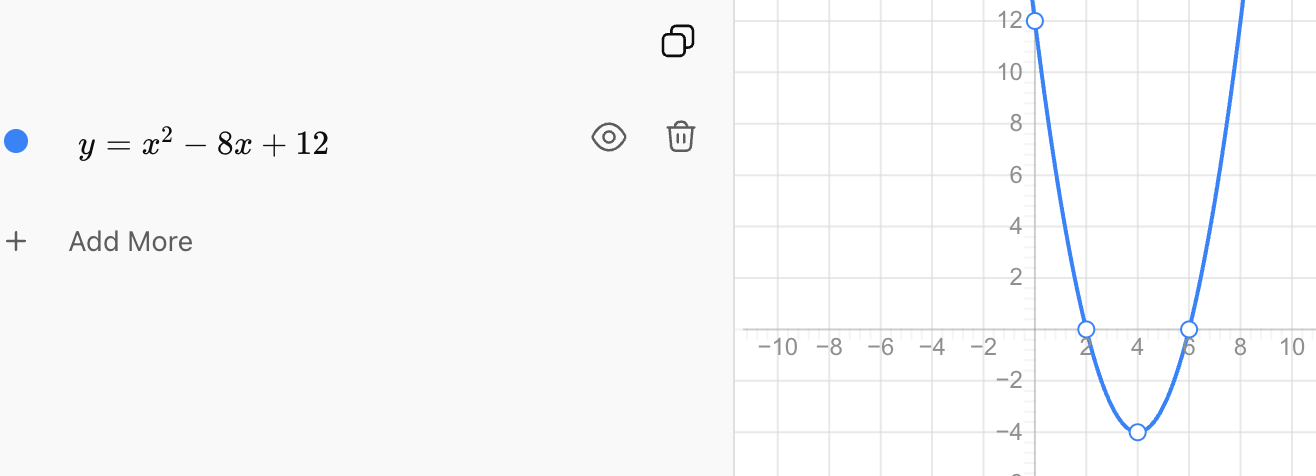
Factoring connects algebraic solutions directly to graphical features.
Repeated Roots on a Graph
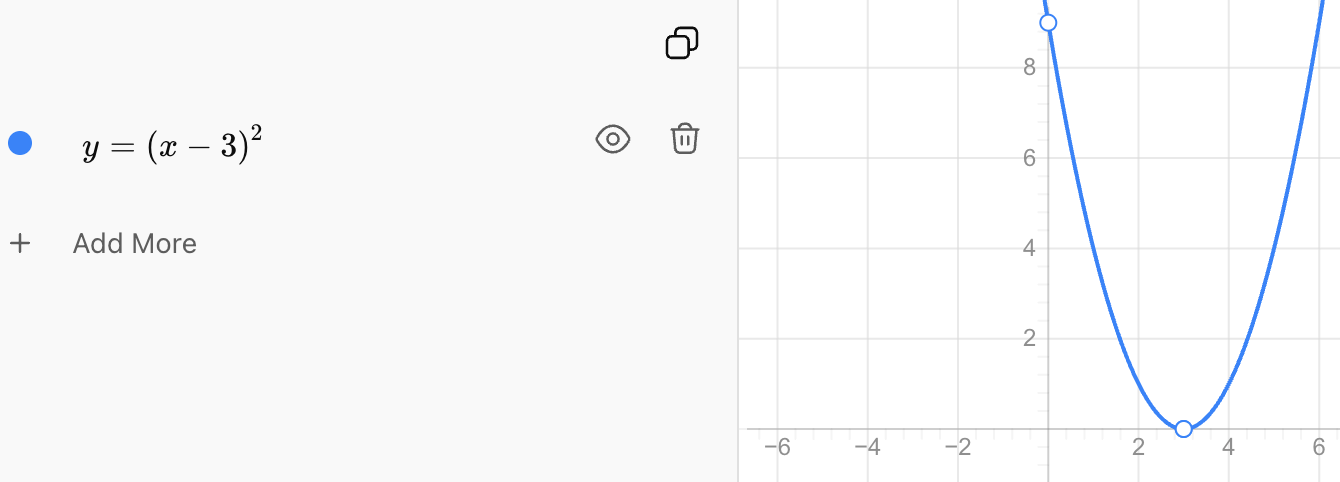
Consider:
x² − 6x + 9 = 0
Factor:
(x − 3)² = 0
Solution:
x = 3
The corresponding function is:
y = (x − 3)²
2. Solving by Completing the Square
Learning outcomes
- I can complete the square for simple quadratics.
- I can rewrite equations in vertex form.
- I can solve quadratic equations using completing the square.
- I can explain why the method works.
- I can verify my solutions.
Solving by Completing the Square
What Is Completing the Square?
Completing the square is an algebraic method used to rewrite a quadratic expression so that part of it becomes a perfect square.
For example:
x² + 6x + 9
can be written as:
(x + 3)²
because:
(x + 3)² = (x + 3)(x + 3)
= x² + 6x + 9
Completing the square allows us to turn expressions such as:
x² + 6x
into a perfect-square expression by adding the correct number.
This method is useful for:
- converting standard form to vertex form
- finding the vertex of a parabola
- solving quadratic equations
- understanding how the quadratic formula is developed
Perfect-Square Trinomials
A perfect-square trinomial has one of these patterns:
x² + 2px + p² = (x + p)²
or:
x² − 2px + p² = (x − p)²
For example:
x² + 8x + 16 = (x + 4)²
because:
2(4) = 8
and:
4² = 16
Similarly:
x² − 10x + 25 = (x − 5)²
because:
2(−5) = −10
and:
(−5)² = 25
Recognizing this pattern is the foundation of completing the square.
Finding the Number That Completes the Square
Consider:
x² + 6x
To turn this into a perfect square:
Take half the coefficient of x
6 ÷ 2 = 3
Square the result
3² = 9
Therefore:
x² + 6x + 9 = (x + 3)²
The number needed to complete the square is:
9
The General Pattern
For:
x² + bx
take half of b:
b/2
and square it:
(b/2)²
Therefore:
x² + bx + (b/2)² = (x + b/2)²
This is the central pattern behind completing the square.
More Examples
For:
x² + 10x
Half of 10 is 5.
Square 5:
25
Therefore:
x² + 10x + 25 = (x + 5)²
For:
x² − 8x
Half of −8 is −4.
Square −4:
16
Therefore:
x² − 8x + 16 = (x − 4)²
For:
x² + 14x
Half of 14 is 7.
Square 7:
49
Therefore:
x² + 14x + 49 = (x + 7)²
Why We Must Keep an Equation Balanced
Suppose:
x² + 6x = 7
If we add 9 to the left side:
x² + 6x + 9
we have changed the value of that side.
To keep the equation balanced, we must also add 9 to the right side:
x² + 6x + 9 = 7 + 9
This gives:
(x + 3)² = 16
The idea is exactly like a balanced scale: whatever is done to one side of an equation must also be done to the other.
Solving by Completing the Square
Solve:
x² + 6x = 7
Half the coefficient of x:
6 ÷ 2 = 3
Square it:
3² = 9
Add 9 to both sides:
x² + 6x + 9 = 7 + 9
Factor the perfect square:
(x + 3)² = 16
Take the square root of both sides:
x + 3 = ±4
The ± symbol is important because both:
4² = 16
and:
(−4)² = 16
Now solve:
x + 3 = 4
x = 1
or:
x + 3 = −4
x = −7
Therefore:
x = 1 or x = −7
Why We Need ±
Suppose:
x² = 25
There are two numbers whose square equals 25:
5² = 25
and:
(−5)² = 25
Therefore:
x = ±5
Similarly, if:
(x − 2)² = 36
then:
x − 2 = ±6
giving:
x = 8
or:
x = −4
Forgetting ± is one of the most common mistakes when solving quadratics by completing the square.
A Reliable Solving Method
For a simple equation such as:
x² + bx + c = 0
use this process:
Move the constant
Write the x² and x terms on one side.
Find the completing number
Calculate:
(b/2)²
Add it to both sides
Keep the equation balanced.
Factor the perfect-square trinomial
Rewrite it as a squared binomial.
Take square roots
Remember:
±
Solve for x
Isolate x.
Verify
Substitute each solution into the original equation.
Example: Solve x² + 8x + 7 = 0
Move the constant:
x² + 8x = −7
Take half of 8:
4
Square it:
16
Add 16 to both sides:
x² + 8x + 16 = −7 + 16
Factor:
(x + 4)² = 9
Take square roots:
x + 4 = ±3
Therefore:
x + 4 = 3
x = −1
or:
x + 4 = −3
x = −7
Solutions:
x = −1, −7
Example with a Negative Middle Term
Solve:
x² − 10x + 9 = 0
Move the constant:
x² − 10x = −9
Take half of −10:
−5
Square it:
25
Add 25 to both sides:
x² − 10x + 25 = 16
Factor:
(x − 5)² = 16
Take square roots:
x − 5 = ±4
Therefore:
x = 9
or:
x = 1
Solutions:
x = 1, 9
Completing the Square with Fractions
Completing the square also works when the coefficient of x is odd.
Consider:
x² + 5x
Half of 5 is:
5/2
Square it:
25/4
Therefore:
x² + 5x + 25/4 = (x + 5/2)²
Fractions can make the calculations less convenient, but the method is exactly the same.
Example with an Odd Coefficient
Solve:
x² + 5x + 4 = 0
Move the constant:
x² + 5x = −4
Complete the square:
x² + 5x + 25/4 = −4 + 25/4
Since:
−4 = −16/4
we get:
(x + 5/2)² = 9/4
Take square roots:
x + 5/2 = ±3/2
Therefore:
x = −5/2 + 3/2 = −1
or:
x = −5/2 − 3/2 = −4
So:
x = −1, −4
Factoring would have been faster for this particular equation, but completing the square still works.
Rewriting Standard Form as Vertex Form
Completing the square is also useful when the equation is a function rather than an equation set equal to zero.
Consider:
y = x² + 6x + 2
We want vertex form:
y = a(x − h)² + k
Start with:
y = x² + 6x + 2
Complete the square using the x-terms.
Half of 6 is 3.
Square it:
9
Add and subtract 9:
y = x² + 6x + 9 − 9 + 2
Factor:
y = (x + 3)² − 9 + 2
Therefore:
y = (x + 3)² − 7
The vertex is:
(−3, −7)
Why We Add and Subtract in a Function
When solving an equation, we can add the same number to both sides.
But when rewriting:
y = x² + 6x + 2
we want the expression itself to remain unchanged.
So we add and subtract the same number:
+9 − 9
Since:
9 − 9 = 0
the value of the expression has not changed.
This allows us to create a perfect square without changing the function.
Another Standard-to-Vertex Example
Convert:
y = x² − 8x + 10
Half of −8 is:
−4
Square it:
16
Add and subtract 16:
y = x² − 8x + 16 − 16 + 10
Factor:
y = (x − 4)² − 6
Therefore:
y = (x − 4)² − 6
Vertex:
(4, −6)
Axis of symmetry:
x = 4
Seeing the Same Parabola
The equations:
y = x² − 8x + 10
and:
y = (x − 4)² − 6
are equivalent.
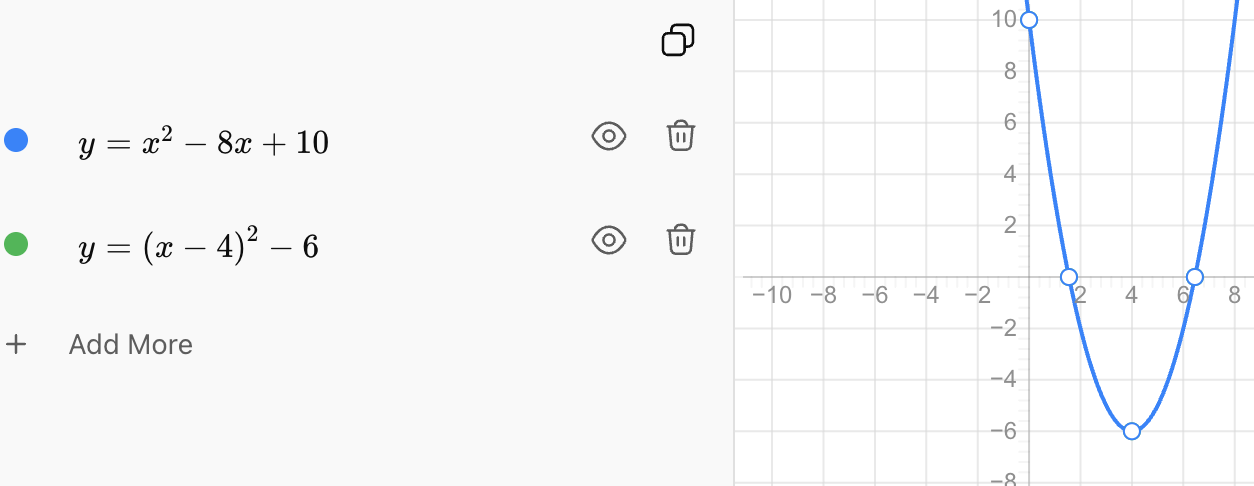
The two graphs overlap exactly because completing the square changes the form of the equation, not the function itself.
When the Leading Coefficient Is Not 1
Consider:
y = 2x² − 8x + 3
Before completing the square, factor 2 from the x² and x terms:
y = 2(x² − 4x) + 3
Now complete the square inside the brackets.
Half of −4 is:
−2
Square it:
4
Write:
y = 2(x² − 4x + 4 − 4) + 3
Group the perfect square:
y = 2[(x − 2)² − 4] + 3
Distribute:
y = 2(x − 2)² − 8 + 3
Therefore:
y = 2(x − 2)² − 5
Vertex:
(2, −5)
Why Factoring Out a Matters
Consider:
2x² − 8x
The coefficient of x² is 2.
We should first write:
2(x² − 4x)
Then complete the square using:
x² − 4x
If we simply treated −8 as the middle coefficient without accounting for the 2, we would complete the square incorrectly.
Solving When a Is Not 1
Solve:
2x² − 8x − 10 = 0
Divide the entire equation by 2:
x² − 4x − 5 = 0
Move the constant:
x² − 4x = 5
Half of −4 is −2.
Square it:
4
Add 4 to both sides:
x² − 4x + 4 = 9
Factor:
(x − 2)² = 9
Take square roots:
x − 2 = ±3
Therefore:
x = 5
or:
x = −1
When Dividing First Is Helpful
If every term is divisible by the coefficient of x², dividing first can make completing the square easier.
For example:
3x² + 12x − 15 = 0
Divide by 3:
x² + 4x − 5 = 0
Now complete the square:
x² + 4x = 5
x² + 4x + 4 = 9
(x + 2)² = 9
x + 2 = ±3
Therefore:
x = 1 or x = −5
Solutions That Are Irrational
One advantage of completing the square is that it works even when a quadratic does not factor neatly using integers.
Solve:
x² + 4x − 2 = 0
Move the constant:
x² + 4x = 2
Complete the square:
x² + 4x + 4 = 6
So:
(x + 2)² = 6
Take square roots:
x + 2 = ±√6
Therefore:
x = −2 ± √6
These are exact solutions.
Factoring with integers would not have worked conveniently here.
Exact and Approximate Solutions
For:
x = −2 ± √6
the exact answers are:
x = −2 + √6
and:
x = −2 − √6
Since:
√6 ≈ 2.45
the approximate solutions are:
x ≈ 0.45
and:
x ≈ −4.45
Unless a decimal answer is requested, it is often better to keep irrational solutions in exact radical form.
What If the Square Equals Zero?
Solve:
x² − 6x + 9 = 0
The left side is already a perfect square:
(x − 3)² = 0
Take the square root:
x − 3 = 0
Therefore:
x = 3
This is a repeated root.
Graphically, the parabola touches the x-axis at its vertex.
What If the Square Equals a Negative Number?
Consider:
x² + 4x + 8 = 0
Move the constant:
x² + 4x = −8
Complete the square:
x² + 4x + 4 = −4
Therefore:
(x + 2)² = −4
No real number squared can equal −4.
Therefore:
there are no real solutions.
In a course that includes complex numbers, the equation can be solved further using i, but over the real numbers there are no solutions.
Completing the Square and the Graph
Consider:
y = x² − 6x + 5
Complete the square:
y = x² − 6x + 9 − 9 + 5
y = (x − 3)² − 4
Vertex form immediately reveals:
vertex = (3, −4)
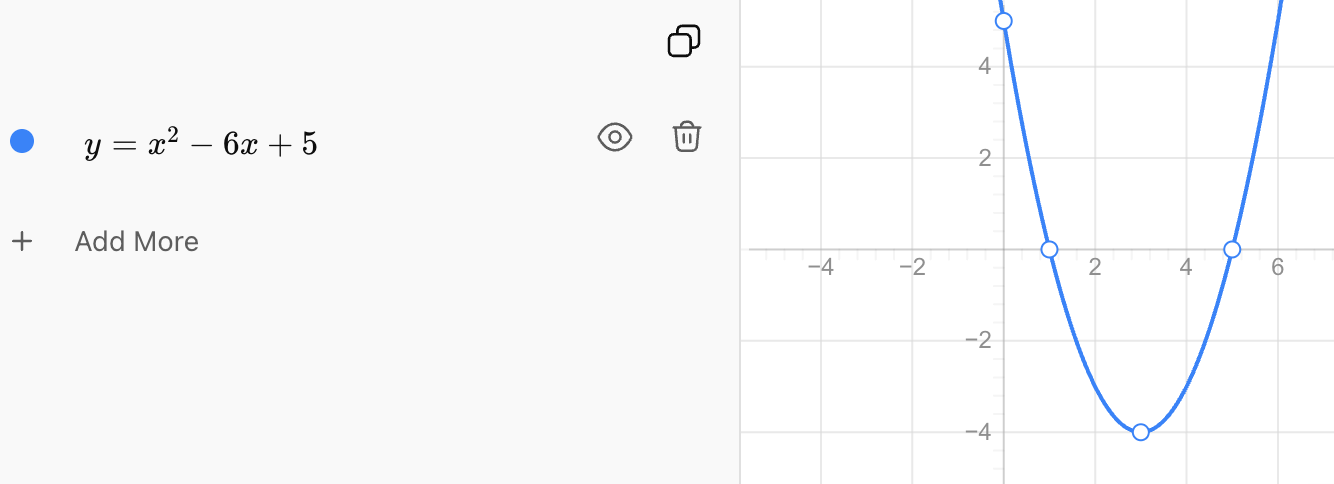
Because the vertex lies below the x-axis and the parabola opens upward, the graph has two real x-intercepts.
Solving:
(x − 3)² − 4 = 0
gives:
(x − 3)² = 4
x − 3 = ±2
Therefore:
x = 1 or x = 5
Completing the Square Reveals the Vertex
Starting with:
y = x² + bx + c
completing the square gives:
y = (x + b/2)² + c − (b/2)²
This shows why completing the square reveals the vertex.
For example:
y = x² + 8x + 11
becomes:
y = (x + 4)² − 5
So the vertex is:
(−4, −5)
Why Completing the Square Works
The method works because of the identity:
(x + p)² = x² + 2px + p²
Suppose we start with:
x² + bx
We want:
2p = b
Therefore:
p = b/2
To create the perfect square, we need:
p² = (b/2)²
So:
x² + bx + (b/2)² = (x + b/2)²
Completing the square is therefore not a trick. It follows directly from expanding a squared binomial.
Completing the Square and Symmetry
Vertex form:
y = a(x − h)² + k
reveals the axis of symmetry:
x = h
This explains another important result.
For:
y = ax² + bx + c
the axis of symmetry is:
x = −b/(2a)
This result can be derived by completing the square.
So completing the square connects the algebraic form of a quadratic with the geometry of its graph.
When Is Completing the Square Useful?
Completing the square is particularly useful when:
- a quadratic does not factor easily
- you need to convert standard form to vertex form
- you need to find the vertex
- you need the maximum or minimum value
- you want exact solutions involving square roots
- you want to understand the structure of a quadratic
- you are deriving the quadratic formula
Factoring may be faster when simple factors are obvious, but completing the square is a more general method.
Factoring vs Completing the Square
Consider:
x² − 7x + 12 = 0
This factors easily:
(x − 3)(x − 4) = 0
So factoring is probably faster.
Now consider:
x² − 6x + 2 = 0
This does not factor conveniently using integers.
Completing the square gives:
x² − 6x = −2
x² − 6x + 9 = 7
(x − 3)² = 7
Therefore:
x = 3 ± √7
Here, completing the square is much more useful.
Verifying Solutions
Consider:
x² − 6x + 2 = 0
We found:
x = 3 ± √7
Take:
x = 3 + √7
Substituting into the original equation:
(3 + √7)² − 6(3 + √7) + 2
= 9 + 6√7 + 7 − 18 − 6√7 + 2
= 18 − 18
= 0
So the solution works.
The same process can be used to verify:
x = 3 − √7
Numerical Verification
When answers contain awkward radicals, a calculator can also provide a useful numerical check.
For:
x = 3 ± √7
√7 ≈ 2.646
So:
x ≈ 5.646
or:
x ≈ 0.354
Substituting these approximate values into the original equation should produce a result close to zero.
Small differences may occur because of rounding.
Worked Example: Complete Process
Solve:
x² + 4x − 12 = 0
Move the constant:
x² + 4x = 12
Take half of 4:
2
Square:
4
Add to both sides:
x² + 4x + 4 = 16
Factor:
(x + 2)² = 16
Take square roots:
x + 2 = ±4
Solve:
x = −2 + 4 = 2
or:
x = −2 − 4 = −6
Therefore:
x = 2 or x = −6
Verify x = 2:
2² + 4(2) − 12
= 4 + 8 − 12
= 0
Verify x = −6:
(−6)² + 4(−6) − 12
= 36 − 24 − 12
= 0
Both solutions are correct.
Worked Example: Irrational Solutions
Solve:
x² − 8x + 5 = 0
Move the constant:
x² − 8x = −5
Half of −8:
−4
Square:
16
Add 16:
x² − 8x + 16 = 11
Factor:
(x − 4)² = 11
Take square roots:
x − 4 = ±√11
Therefore:
x = 4 ± √11
These are the exact solutions.
Worked Example: Convert to Vertex Form
Rewrite:
y = 3x² + 12x + 7
Factor 3 from the x-terms:
y = 3(x² + 4x) + 7
Complete the square:
y = 3(x² + 4x + 4 − 4) + 7
Factor:
y = 3[(x + 2)² − 4] + 7
Distribute:
y = 3(x + 2)² − 12 + 7
Therefore:
y = 3(x + 2)² − 5
The vertex is:
(−2, −5)
The axis of symmetry is:
x = −2
The minimum value is:
−5
Common Mistakes
Mistake: Using b² instead of (b/2)².
For x² + 8x, use:
(8/2)² = 16
not 64.
Mistake: Forgetting to add the completing number to both sides.
When solving an equation, both sides must remain balanced.
Mistake: Adding but not subtracting when rewriting a function.
For a function, add and subtract the same value so the expression remains equivalent.
Mistake: Forgetting ± when taking square roots.
If x² = 25, then x = ±5.
Mistake: Completing the square before dealing correctly with a ≠ 1.
Factor the leading coefficient from the x² and x terms, or divide the equation when appropriate.
Mistake: Thinking completing the square changes the parabola.
Correct algebra changes only the form of the equation, not the function.
Mistake: Converting exact radicals to decimals too early.
Keep answers such as 3 ± √7 exact unless decimal approximations are required.
Mistake: Not checking solutions.
Substitution into the original equation provides a reliable verification.
Key Terms
Completing the square — rewriting a quadratic so that part of it becomes a perfect-square expression.
Perfect-square trinomial — trinomial that can be written as the square of a binomial.
Standard form — quadratic form y = ax² + bx + c.
Vertex form — quadratic form y = a(x − h)² + k.
Vertex — maximum or minimum point of a parabola.
Axis of symmetry — vertical line passing through the vertex.
Square root — value that produces a given number when multiplied by itself.
± symbol — indicates both the positive and negative square roots.
Radical — expression containing a root symbol, such as √7.
Exact solution — solution written without rounding, such as 3 + √7.
Approximate solution — rounded numerical value of an exact solution.
Repeated root — solution that occurs twice.
Equivalent equations — equations representing the same relationship after valid algebraic operations.
Verification — checking that a solution satisfies the original equation.
Key Takeaways
- Completing the square creates a perfect-square trinomial.
- For x² + bx, the completing number is (b/2)².
- The pattern comes from (x + p)² = x² + 2px + p².
- When solving an equation, the completing number must be added to both sides.
- When rewriting a function, the completing number can be added and subtracted within the expression.
- Completing the square can convert standard form into vertex form.
- Vertex form reveals the vertex, axis of symmetry and maximum or minimum.
- After creating a squared binomial, solve by taking square roots.
- Remember ± when taking the square root of a positive number.
- Completing the square works even when a quadratic does not factor neatly using integers.
- Solutions may be integers, fractions or irrational numbers.
- If the squared expression equals zero, there is a repeated real root.
- If a squared real expression must equal a negative number, there are no real solutions.
- When a ≠ 1, deal with the leading coefficient before completing the square.
- Completing the square does not change the function when the algebra is performed correctly.
- Solutions can be verified by substitution into the original equation.
Check Your Understanding
- What number completes the square for x² + 10x?
- What number completes the square for x² − 12x?
- Rewrite x² + 8x + 16 as a squared binomial.
- Rewrite x² − 14x + 49 as a squared binomial.
- Solve x² + 6x = 7 by completing the square.
- Solve x² + 8x + 12 = 0 by completing the square.
- Solve x² − 10x + 16 = 0 by completing the square.
- Solve x² + 4x − 3 = 0 and leave your answers in exact form.
- Solve x² − 6x + 1 = 0 and leave your answers in exact form.
- Rewrite y = x² + 10x + 7 in vertex form.
- Rewrite y = x² − 12x + 20 in vertex form.
- Rewrite y = 2x² − 8x + 7 in vertex form.
- Rewrite y = 3x² + 18x + 20 in vertex form.
- Determine the vertex of y = x² + 6x − 2 by completing the square.
- Explain why the number added to x² + bx is (b/2)².
- Explain why ± must be used when taking the square root during the solving process.
- Solve x² − 8x + 20 = 0 over the real numbers. What happens when you complete the square?
- Verify the solutions of x² − 6x + 2 = 0 by substitution.
- Explain one situation in which completing the square would be more useful than factoring.
- Explain how completing the square connects standard form with vertex form.
3. Solving Using the Quadratic Formula
Learning outcomes
- I can identify the coefficients in a quadratic equation.
- I can substitute correctly into the quadratic formula.
- I can solve quadratic equations accurately.
- I can simplify exact solutions.
- I can verify solutions by substitution.
4. The Discriminant
Learning outcomes
- I can calculate the discriminant.
- I can predict the number of real solutions.
- I can distinguish between repeated and distinct roots.
- I can explain what the discriminant represents graphically.
- I can relate the discriminant to x-intercepts.
The Discriminant
What Is the Discriminant?
A quadratic equation can be written in standard form:
ax² + bx + c = 0
The discriminant is the expression:
D = b² − 4ac
The discriminant is part of the quadratic formula:
x = [−b ± √(b² − 4ac)] / (2a)
The value of the discriminant tells us important information about the solutions before we actually solve the quadratic.
It can tell us whether the equation has:
- two distinct real solutions
- one repeated real solution
- no real solutions
These solutions correspond directly to the x-intercepts of the parabola.
Identifying a, b and c
Before calculating the discriminant, write the quadratic in standard form:
ax² + bx + c = 0
Then identify:
- a = coefficient of x²
- b = coefficient of x
- c = constant
For example:
2x² − 7x + 3 = 0
gives:
a = 2
b = −7
c = 3
The negative sign is part of the coefficient.
Calculating the Discriminant
For:
2x² − 7x + 3 = 0
use:
D = b² − 4ac
Substitute:
D = (−7)² − 4(2)(3)
D = 49 − 24
D = 25
Because the discriminant is positive, this quadratic has two distinct real solutions.
We did not need to solve the equation to determine this.
The Three Possible Cases
The sign of the discriminant determines the number of real roots.
| Discriminant | Roots | x-Intercepts |
|---|---|---|
| D > 0 | Two distinct real roots | Two |
| D = 0 | One repeated real root | One |
| D < 0 | No real roots | None |
This relationship is one of the most useful features of the discriminant.
Positive Discriminant
If:
D > 0
then the quadratic has:
two distinct real roots
The word distinct means that the roots have different values.
For example:
x² − 5x + 6 = 0
Identify:
a = 1
b = −5
c = 6
Calculate:
D = (−5)² − 4(1)(6)
D = 25 − 24
D = 1
Since:
D > 0
there are two distinct real roots.
In fact:
x² − 5x + 6 = (x − 2)(x − 3)
so the roots are:
x = 2 and x = 3
Positive Discriminant and the Graph
For the function:
y = x² − 5x + 6
the graph crosses the x-axis at:
(2, 0)
and:
(3, 0)
So a positive discriminant means that the parabola has two different x-intercepts.
The roots are the x-values of those intercepts.
Zero Discriminant
If:
D = 0
the quadratic has:
one repeated real root
Consider:
x² − 6x + 9 = 0
Here:
a = 1
b = −6
c = 9
Calculate:
D = (−6)² − 4(1)(9)
D = 36 − 36
D = 0
Therefore, the equation has one repeated root.
Factor:
(x − 3)² = 0
So:
x = 3
What Is a Repeated Root?
A repeated root is sometimes called a:
- double root
- repeated solution
- equal root
For:
(x − 3)² = 0
we could write:
(x − 3)(x − 3) = 0
Both factors produce the same solution:
x = 3
Therefore, there is only one distinct real solution, even though the root occurs twice algebraically.
Zero Discriminant and the Graph
When:
D = 0
the parabola touches the x-axis at exactly one point.
That point is also the vertex.
For:
y = (x − 3)²
the vertex is:
(3, 0)
The graph touches the x-axis but does not pass through it.
This is why a repeated root corresponds to exactly one x-intercept.
Negative Discriminant
If:
D < 0
there are:
no real roots
Consider:
x² + 2x + 5 = 0
Here:
a = 1
b = 2
c = 5
Calculate:
D = 2² − 4(1)(5)
D = 4 − 20
D = −16
Since:
D < 0
the equation has:
no real solutions
Why a Negative Discriminant Gives No Real Roots
The quadratic formula contains:
√D
If D is negative, we would need to calculate the square root of a negative number.
For example:
√(−16)
There is no real number whose square is −16.
Therefore, there are no real solutions.
If complex numbers are being used, the equation can still be solved using the imaginary unit i.
Negative Discriminant and the Graph
If a quadratic has no real roots, its graph never reaches the x-axis.
For example:
y = x² + 2x + 5
can be rewritten:
y = (x + 1)² + 4
Its vertex is:
(−1, 4)
Since the parabola opens upward and its minimum y-value is 4, it remains completely above the x-axis.
Therefore:
- no real roots
- no x-intercepts
- negative discriminant
These are three ways of describing the same situation.
Roots and x-Intercepts
For a quadratic function:
y = ax² + bx + c
the x-intercepts occur when:
y = 0
Therefore, we solve:
ax² + bx + c = 0
The solutions are the roots.
So:
roots ↔ x-intercepts
This explains why the discriminant tells us about both algebraic solutions and graphical intersections.
Comparing the Three Cases
Imagine three upward-opening parabolas.
Two x-intercepts
The parabola crosses the x-axis twice.
D > 0
There are two distinct real roots.
One x-intercept
The vertex lies exactly on the x-axis.
D = 0
There is one repeated real root.
No x-intercepts
The entire parabola remains above the x-axis.
D < 0
There are no real roots.
The same relationships also apply to downward-opening parabolas.
Distinct Roots
Distinct roots simply means that the solutions have different values.
For example:
x = −2 and x = 5
are distinct roots.
A quadratic with distinct real roots has:
D > 0
and its graph has:
two different x-intercepts
Repeated Roots
A repeated root occurs when both solutions have the same value.
For example:
x = 4
might occur twice:
(x − 4)(x − 4) = 0
or:
(x − 4)² = 0
This occurs when:
D = 0
Graphically, the vertex lies exactly on the x-axis.
Example: Predict Without Solving
Consider:
3x² + 4x − 2 = 0
Calculate:
D = 4² − 4(3)(−2)
D = 16 + 24
D = 40
Since:
40 > 0
we know immediately:
- two distinct real roots
- two x-intercepts
We do not need to calculate the actual roots unless the question asks for them.
Another Prediction
Consider:
4x² − 12x + 9 = 0
Calculate:
D = (−12)² − 4(4)(9)
D = 144 − 144
D = 0
Therefore:
- one repeated real root
- one x-intercept
- the vertex lies on the x-axis
Another Prediction
Consider:
2x² + 3x + 7 = 0
Calculate:
D = 3² − 4(2)(7)
D = 9 − 56
D = −47
Therefore:
- no real roots
- no x-intercepts
- the parabola does not cross or touch the x-axis
Perfect-Square Discriminants
A positive discriminant tells us there are two real roots, but it can tell us even more.
Suppose:
D = 25
Then:
√D = 5
Since 25 is a perfect square, the quadratic formula will usually produce rational roots.
For example:
2x² − 7x + 3 = 0
has:
D = 25
and roots:
x = 3 and x = 1/2
Both are rational.
Positive but Not a Perfect Square
Suppose:
D = 20
Then:
√20 = 2√5
The roots are real, but they usually contain radicals.
For example:
x² − 4x − 1 = 0
has:
D = (−4)² − 4(1)(−1)
D = 16 + 4
D = 20
Therefore, there are two distinct real roots.
Using the quadratic formula gives:
x = 2 ± √5
These roots are irrational.
What the Size of the Discriminant Does Not Tell Us Directly
It is tempting to think that a larger discriminant always means the graph has x-intercepts that are farther apart.
The relationship is more precise.
From the quadratic formula:
x₁ = [−b + √D]/(2a)
x₂ = [−b − √D]/(2a)
The distance between the roots is:
|x₁ − x₂| = √D/|a|
So the separation depends on both:
- the discriminant
- the coefficient a
The sign of D determines the number and type of real roots, while other coefficients also affect their locations.
The Discriminant and the Vertex
The discriminant can also tell us how the vertex relates to the x-axis.
For:
y = ax² + bx + c
the vertex occurs at:
x = −b/(2a)
Its y-coordinate can be written as:
y_vertex = −D/(4a)
This creates an interesting connection between the discriminant and the graph.
If the Parabola Opens Upward
When:
a > 0
the parabola opens upward.
If D > 0:
y_vertex < 0
so the vertex lies below the x-axis and the parabola crosses the axis twice.
If D = 0:
y_vertex = 0
so the vertex lies on the x-axis.
If D < 0:
y_vertex > 0
so the vertex lies above the x-axis and there are no x-intercepts.
If the Parabola Opens Downward
When:
a < 0
the parabola opens downward.
The same discriminant rules still apply:
D > 0 → two x-intercepts
D = 0 → one x-intercept
D < 0 → no x-intercepts
The parabola's orientation changes, but the discriminant rules do not.
The Discriminant in Factored Form
Suppose a quadratic can be written:
y = a(x − r₁)(x − r₂)
If:
r₁ ≠ r₂
there are two distinct roots.
Therefore:
D > 0
If:
r₁ = r₂
there is a repeated root.
Therefore:
D = 0
If there are no real values for r₁ and r₂, then:
D < 0
So the discriminant connects standard form with what we see in factored form.
The Discriminant and the Quadratic Formula
The quadratic formula is:
x = [−b ± √D]/(2a)
This makes the importance of the discriminant clear.
If D > 0
√D is a positive real number.
The + and − produce different answers.
Two distinct real roots.
If D = 0
√D = 0.
The + and − produce the same answer.
One repeated real root.
If D < 0
√D is not a real number.
No real roots.
This is exactly why the discriminant works.
Worked Example: Two Distinct Roots
Determine the nature of the roots of:
2x² − 5x − 3 = 0
Identify:
a = 2
b = −5
c = −3
Calculate:
D = (−5)² − 4(2)(−3)
D = 25 + 24
D = 49
Since:
D > 0
there are:
two distinct real roots
Since 49 is also a perfect square, the roots will be rational.
Worked Example: Repeated Root
Determine the nature of the roots of:
9x² + 12x + 4 = 0
Identify:
a = 9
b = 12
c = 4
Calculate:
D = 12² − 4(9)(4)
D = 144 − 144
D = 0
Therefore:
one repeated real root
In fact:
9x² + 12x + 4 = (3x + 2)²
So:
x = −2/3
Worked Example: No Real Roots
Determine the nature of the roots of:
3x² − 2x + 5 = 0
Identify:
a = 3
b = −2
c = 5
Calculate:
D = (−2)² − 4(3)(5)
D = 4 − 60
D = −56
Therefore:
no real roots
and:
no x-intercepts
Worked Example: Missing Term
Consider:
x² − 16 = 0
There is no x-term, so:
b = 0
Identify:
a = 1
b = 0
c = −16
Calculate:
D = 0² − 4(1)(−16)
D = 64
Since:
D > 0
there are two distinct real roots.
In fact:
x = ±4
Rearrange Before Calculating
Consider:
x² + 6 = 5x
Do not calculate the discriminant yet.
First rearrange:
x² − 5x + 6 = 0
Now:
a = 1
b = −5
c = 6
Calculate:
D = 25 − 24
D = 1
Therefore, there are two distinct real roots.
Using the Discriminant to Find Unknown Values
The discriminant can also help determine when a quadratic has a certain number of solutions.
Consider:
x² + kx + 9 = 0
Suppose we want the equation to have one repeated real root.
For a repeated root:
D = 0
So:
k² − 4(1)(9) = 0
k² − 36 = 0
k² = 36
Therefore:
k = ±6
So either:
x² + 6x + 9 = 0
or:
x² − 6x + 9 = 0
has a repeated root.
Discriminant Conditions
For:
ax² + bx + c = 0
we can use inequalities.
For two distinct real roots:
b² − 4ac > 0
For one repeated real root:
b² − 4ac = 0
For no real roots:
b² − 4ac < 0
This makes the discriminant useful not only for solving equations but also for analyzing entire families of quadratic equations.
Graphical Interpretation
The discriminant answers a very specific graphical question:
How many times does the parabola meet the x-axis?
If:
D > 0
the parabola crosses the x-axis at two different points.
If:
D = 0
the parabola touches the x-axis at its vertex.
If:
D < 0
the parabola never reaches the x-axis.
This connection makes the discriminant both an algebraic tool and a graphical tool.
Why the Discriminant Is Useful
Without the discriminant, we might have to:
- factor the quadratic
- complete the square
- use the entire quadratic formula
- graph the function
just to determine how many real roots exist.
The discriminant lets us answer that question quickly.
For example:
7x² − 3x + 12 = 0
D = (−3)² − 4(7)(12)
D = 9 − 336
D = −327
We immediately know:
no real solutions
There is no need to continue solving if the question only asks about the number of real roots.
Common Mistakes
Mistake: Using D = b² + 4ac.
The correct formula is:
D = b² − 4ac
Mistake: Losing the sign of b.
If b = −5, calculate:
(−5)² = 25
Mistake: Forgetting that c can be negative.
For c = −3:
−4ac may become positive.
Mistake: Calculating the discriminant before rearranging into standard form.
First write:
ax² + bx + c = 0
Mistake: Saying D > 0 means exactly two solutions of every type.
It means two distinct real solutions.
Mistake: Saying D = 0 means no solutions.
It means one repeated real root.
Mistake: Saying D < 0 means the equation has no solutions at all.
It has no real solutions. Complex solutions may exist.
Mistake: Confusing roots with points.
A root might be x = 3, while the corresponding x-intercept is (3, 0).
Key Terms
Discriminant — expression D = b² − 4ac that determines the nature of the roots of a quadratic.
Quadratic equation — equation that can be written as ax² + bx + c = 0.
Coefficient — number multiplying a variable or power of a variable.
Root — x-value that makes a quadratic equal to zero.
Solution — value that satisfies an equation.
Real root — root belonging to the real number system.
Distinct roots — roots with different values.
Repeated root — root occurring twice in a quadratic equation.
Double root — another name for a repeated root.
x-intercept — point where a graph meets the x-axis.
Perfect square — number such as 1, 4, 9, 16, 25 or 36 that is the square of an integer.
Irrational root — real root that cannot be written as a ratio of integers.
Quadratic formula — general formula for finding the roots of a quadratic equation.
Key Takeaways
- The discriminant is D = b² − 4ac.
- Calculate it using the coefficients from ax² + bx + c = 0.
- Always rearrange the quadratic into standard form first.
- If D > 0, there are two distinct real roots.
- If D = 0, there is one repeated real root.
- If D < 0, there are no real roots.
- Roots correspond to the x-intercepts of a quadratic graph.
- A positive discriminant means the parabola has two x-intercepts.
- A zero discriminant means the parabola touches the x-axis at one point.
- A negative discriminant means the parabola has no x-intercepts.
- A repeated root occurs at the vertex of a parabola.
- If D is a positive perfect square, the roots are typically rational.
- If D is positive but not a perfect square, the roots are typically irrational.
- The discriminant allows us to predict the nature of the roots without fully solving the equation.
- The discriminant appears under the square-root sign in the quadratic formula.
- Its sign determines whether that square root produces two real values, zero, or no real value.
- The discriminant connects algebraic solutions directly with the graph of a quadratic.
Check Your Understanding
- State the formula for the discriminant.
- Calculate the discriminant of x² − 7x + 10 = 0.
- Calculate the discriminant of x² − 8x + 16 = 0.
- Calculate the discriminant of x² + 4x + 10 = 0.
- Determine the number of real roots of 2x² − 5x − 3 = 0.
- Determine the number of real roots of 3x² + 6x + 3 = 0.
- Determine the number of real roots of 4x² + 2x + 7 = 0.
- Explain what D > 0 tells you about the graph.
- Explain what D = 0 tells you about the graph.
- Explain what D < 0 tells you about the graph.
- What is the difference between a distinct root and a repeated root?
- Explain the relationship between roots and x-intercepts.
- A quadratic has D = 36. How many real roots does it have? What else can you predict about the roots?
- A quadratic has D = 7. What can you predict about its roots?
- A quadratic has D = −12. What can you predict about its graph?
- Determine the discriminant of x² + 8 = 6x after first writing the equation in standard form.
- Find the value or values of k that make x² + kx + 16 = 0 have one repeated real root.
- Explain why a negative discriminant produces no real x-intercepts.
- Explain why the ± part of the quadratic formula produces only one distinct root when D = 0.
- Describe how you could use the discriminant to predict the appearance of a parabola before graphing it.
5. Choosing an Appropriate Method
Learning outcomes
- I can decide whether factoring is appropriate.
- I can recognise when completing the square is useful.
- I can determine when the quadratic formula is most efficient.
- I can compare different solution methods.
- I can justify my choice of method.
Choosing an Appropriate Method for Solving Quadratic Equations
Introduction
Quadratic equations can be solved using several different methods. Although these methods can produce the same solutions, some are much faster or easier than others for a particular equation.
For example, consider these three equations:
-
x² − 5x + 6 = 0
-
x² + 6x + 2 = 0
-
3x² + 4x − 2 = 0
All three are quadratic equations, but their structures suggest different approaches.
The first can be factored easily. The second is well suited to completing the square. The third may be solved most efficiently using the quadratic formula.
Choosing an appropriate method involves examining the equation, recognising useful patterns, considering the type of answer required, and selecting a strategy that minimises unnecessary calculations.
This is an important mathematical skill because solving a problem efficiently requires understanding its structure, not simply memorising procedures.


Recognising a Quadratic Equation
A quadratic equation is an equation in which the highest power of the variable is two.
The standard form is:
ax² + bx + c = 0
where:
-
a, b, and c are constants.
-
a ≠ 0.
-
x is the unknown variable.
Examples include:
x² − 7x + 12 = 0
2x² + 5x − 3 = 0
x² + 4x + 1 = 0
3x² − 12 = 0
A quadratic equation may have two distinct real solutions, one repeated real solution, or two non-real complex solutions.
The Main Solution Methods
The most common algebraic methods are:
-
Factoring.
-
Completing the square.
-
Using the quadratic formula.
-
Using square roots directly when the equation has a suitable structure.
Graphing is also useful for estimating solutions and interpreting them visually.
The best method depends on the equation.
Examining an Equation Before Solving
Before beginning calculations, inspect the structure of the quadratic equation.
Ask yourself:
-
Is there a common factor?
-
Can the expression be factored easily?
-
Is the equation a difference of two squares?
-
Is it already written as a perfect square?
-
Is it in vertex form?
-
Is the coefficient of x² equal to 1?
-
Will completing the square produce a simple expression?
-
Does the discriminant suggest irrational or complex solutions?
-
Is an exact answer or a decimal approximation required?
These questions can prevent unnecessary work.
Example
Consider:
x² − 16 = 0
It would be possible to use the quadratic formula, but the equation has a much simpler structure.
x² = 16
x = ±4
Solutions: x = 4 or x = −4
Recognising the difference-of-squares structure or using square roots makes the solution much faster.
When Is Factoring Appropriate?
Factoring is often the fastest method when a quadratic expression can be written as a product of simple factors.
For example:
(x − 3)(x − 4) = 0
The zero-product property states:
If A × B = 0, then A = 0 or B = 0.
Therefore:
x − 3 = 0 or x − 4 = 0
x = 3 or x = 4
When to Choose Factoring
Factoring is particularly useful when:
-
The coefficients are small integers.
-
Two numbers have an obvious product and sum.
-
The expression contains a common factor.
-
The expression is a difference of squares.
-
The quadratic is a perfect-square trinomial.
-
The solutions are simple rational numbers.
Worked Example: Factoring a Simple Quadratic
Solve:
x² − 7x + 12 = 0
Step 1: Find Two Numbers
We need two numbers that:
Multiply to give +12.
Add to give −7.
The numbers are −3 and −4.
Step 2: Factor
x² − 7x + 12 = (x − 3)(x − 4)
Therefore:
(x − 3)(x − 4) = 0
Step 3: Apply the Zero-Product Property
x − 3 = 0
or
x − 4 = 0
Final Answer
x = 3 or x = 4
Why Was Factoring Appropriate?
The coefficients were small, and the expression factored easily into two linear factors.
The solution required only a few algebraic steps.

Factoring with a Leading Coefficient Greater Than One
Consider:
2x² + 7x + 3 = 0
Step 1: Factor the Expression
2x² + 7x + 3 = (2x + 1)(x + 3)
Step 2: Apply the Zero-Product Property
2x + 1 = 0
or
x + 3 = 0
Step 3: Solve
2x = −1
x = −1/2
and
x = −3
Final Answer
x = −1/2 or x = −3
Why Choose Factoring?
Although the leading coefficient is not 1, the quadratic still factors into simple expressions.
Factoring remains efficient.
Special Factoring Patterns
Some quadratic equations contain recognisable patterns that make factoring especially useful.
Difference of Squares
a² − b² = (a − b)(a + b)
Example:
x² − 49 = 0
(x − 7)(x + 7) = 0
x = 7 or x = −7
Perfect-Square Trinomial
a² + 2ab + b² = (a + b)²
Example:
x² + 10x + 25 = 0
(x + 5)² = 0
x = −5
This equation has one repeated real solution.
Common Factor
Example:
3x² − 12x = 0
3x(x − 4) = 0
x = 0 or x = 4
Important Observation
Always check for a common factor before attempting more complicated methods.
When Is Completing the Square Appropriate?
Completing the square rewrites a quadratic expression as a squared binomial plus or minus a constant.
It is particularly useful when:
-
The quadratic does not factor easily.
-
The coefficient of x² is 1 or can easily be made 1.
-
The equation contains an even coefficient of x.
-
The vertex of the parabola is needed.
-
The equation must be converted into vertex form.
-
We want to understand how the quadratic formula is derived.
The Basic Idea
Consider:
x² + 6x
Take half the coefficient of x:
6/2 = 3
Square it:
3² = 9
Then:
x² + 6x + 9 = (x + 3)²
This process creates a perfect-square trinomial.
Worked Example: Completing the Square
Solve:
x² + 6x + 2 = 0
Step 1: Move the Constant
x² + 6x = −2
Step 2: Take Half the Coefficient of x
6/2 = 3
Step 3: Square the Result
3² = 9
Step 4: Add 9 to Both Sides
x² + 6x + 9 = −2 + 9
x² + 6x + 9 = 7
Step 5: Factor the Perfect Square
(x + 3)² = 7
Step 6: Take Square Roots
x + 3 = ±√7
Step 7: Solve
x = −3 ± √7
Approximate Solutions
√7 ≈ 2.646
x ≈ −0.354
or
x ≈ −5.646
Why Was Completing the Square Appropriate?
The quadratic did not factor conveniently over the integers.
Completing the square produced exact solutions using a relatively simple sequence of steps.
Completing the Square to Find the Vertex
Completing the square is especially valuable when analysing quadratic functions.
Consider:
y = x² − 8x + 5
Step 1: Group the Variable Terms
y = (x² − 8x) + 5
Step 2: Complete the Square
Half of −8 is −4.
Square −4:
(−4)² = 16
Add and subtract 16:
y = x² − 8x + 16 − 16 + 5
Step 3: Rewrite
y = (x − 4)² − 11
Vertex Form
y = (x − 4)² − 11
The vertex is:
(4, −11)
The axis of symmetry is:
x = 4
Why Was Completing the Square Appropriate?
The objective was to determine the vertex and understand the graph.
Completing the square directly reveals this information.

When Is the Quadratic Formula Most Efficient?
The quadratic formula is a general method that can solve any quadratic equation with a ≠ 0.
For:
ax² + bx + c = 0
the solutions are:
x = [−b ± √(b² − 4ac)]/(2a)
When to Choose the Quadratic Formula
It is especially useful when:
-
The quadratic does not factor easily.
-
The coefficients are awkward.
-
The solutions are irrational.
-
The solutions may be complex.
-
An exact algebraic answer is required.
-
A reliable general method is preferred.
Important Advantage
The quadratic formula works for every quadratic equation.
However, it may require more calculations than factoring or using square roots when a simpler structure is available.
Worked Example: Using the Quadratic Formula
Solve:
3x² + 4x − 2 = 0
Step 1: Identify the Coefficients
a = 3
b = 4
c = −2
Step 2: Substitute
x = [−4 ± √(4² − 4(3)(−2))]/[2(3)]
Step 3: Simplify the Discriminant
4² − 4(3)(−2)
= 16 + 24
= 40
Step 4: Simplify
x = [−4 ± √40]/6
√40 = 2√10
x = [−4 ± 2√10]/6
Step 5: Reduce
x = (−2 ± √10)/3
Approximate Solutions
x ≈ 0.387
or
x ≈ −1.721
Why Was the Quadratic Formula Appropriate?
The expression does not factor into simple rational linear factors.
The quadratic formula gives the exact irrational solutions directly.
Understanding the Discriminant
The discriminant is the expression inside the square root of the quadratic formula.
D = b² − 4ac
It tells us the nature of the solutions before we calculate them.
|
Discriminant |
Type of solutions |
|---|---|
|
D > 0 |
Two distinct real solutions |
|
D = 0 |
One repeated real solution |
|
D < 0 |
Two non-real complex conjugate solutions |
For quadratics with integer coefficients, a positive perfect-square discriminant indicates rational solutions, making factoring over rational numbers possible.
A positive discriminant that is not a perfect square indicates irrational solutions.
Example
Consider:
x² + 4x + 8 = 0
a = 1
b = 4
c = 8
D = 4² − 4(1)(8)
D = 16 − 32
D = −16
Since the discriminant is negative, there are no real solutions.
Using the quadratic formula gives:
x = [−4 ± √(−16)]/2
x = −2 ± 2i
where i² = −1.
Comparing the Three Main Methods
|
Method |
Main advantage |
Main limitation |
Best used when |
|---|---|---|---|
|
Factoring |
Usually quick and simple |
Not every quadratic factors conveniently |
Simple rational roots or recognisable factors |
|
Completing the square |
Reveals vertex form and exact solutions |
Can involve fractions or radicals |
Finding vertices or converting forms |
|
Quadratic formula |
Works for every quadratic |
May involve lengthy substitution and simplification |
Awkward coefficients or irrational roots |
Important Observation
The most efficient method is not necessarily the one with the fewest written lines.
A method is efficient when it is accurate, appropriate for the structure, and easy to apply reliably.
Solving the Same Equation Using Different Methods
Consider:
x² − 6x + 8 = 0
We can solve this equation using all three methods.
Method A: Factoring
x² − 6x + 8 = 0
(x − 2)(x − 4) = 0
x = 2 or x = 4
Method B: Completing the Square
x² − 6x = −8
x² − 6x + 9 = 1
(x − 3)² = 1
x − 3 = ±1
x = 2 or x = 4
Method C: Quadratic Formula
a = 1
b = −6
c = 8
x = [6 ± √(36 − 32)]/2
x = (6 ± 2)/2
x = 2 or x = 4
Comparing the Methods
All three methods produce the same solutions.
However, factoring is clearly the quickest in this example.
Completing the square provides additional information about the vertex.
The quadratic formula is reliable but requires more substitution.
Conclusion
Factoring is the most efficient choice for this particular equation.
Using Square Roots Directly
Some quadratic equations can be solved more efficiently without using any of the three main methods.
Consider:
(x − 5)² = 16
Take square roots:
x − 5 = ±4
Therefore:
x = 9 or x = 1
Another Example
2x² = 50
x² = 25
x = ±5
When Is This Method Useful?
Use square roots directly when:
-
The variable is squared without a linear term.
-
The equation is already in the form (x − h)² = k.
-
The squared expression can easily be isolated.
This method is often faster than expanding and then factoring.
A Practical Method-Selection Guide
Choosing a solution strategy
Examine the quadratic equation
Already a squared expression or no linear term?
Try square roots directly.
Simple factors or a recognisable pattern?
Try factoring.
Need the vertex or vertex form?
Use completing the square.
No convenient factorisation or an exact general solution needed?
Use the quadratic formula.
Using Graphs to Understand the Solutions
Quadratic equations can also be interpreted graphically.
For a quadratic function:
y = ax² + bx + c
the solutions of:
ax² + bx + c = 0
are the x-coordinates where the graph intersects the x-axis.
Two Real Solutions
The parabola crosses the x-axis at two different points.
One Repeated Real Solution
The parabola touches the x-axis at its vertex.
No Real Solutions
The parabola does not intersect the x-axis.

Example
Consider:
y = x² − 5x + 6
Factoring gives:
y = (x − 2)(x − 3)
The graph crosses the x-axis at:
x = 2
and
x = 3
The algebraic solutions correspond to the graphical x-intercepts.
Important Observation
Graphs are excellent for visual interpretation and checking approximate solutions.
However, algebraic methods are generally preferable when exact answers are required.
Choosing a Method Based on the Required Information
Sometimes the question itself suggests the best method.
Finding x-Intercepts
Factoring may be most efficient if the quadratic factors easily.
Finding the Vertex
Completing the square is especially useful because it produces vertex form.
Finding Exact Irrational Solutions
The quadratic formula or completing the square may be appropriate.
Finding the Number of Real Solutions
Calculate the discriminant.
Solving a Quadratic Already in Vertex Form
Use square roots directly.
Checking Solutions
Substitute solutions into the original equation or compare them with the graph.
Real-World Application: Projectile Motion
Quadratic equations are often used to model the motion of objects.

Example
The height of a ball above the ground is modelled by:
h(t) = −5t² + 20t
where:
-
h = height in metres.
-
t = time in seconds.
Find when the ball reaches the ground.
Step 1: Set Height Equal to Zero
−5t² + 20t = 0
Step 2: Choose a Method
Both terms contain a common factor.
Factoring is the simplest method.
Step 3: Factor
−5t(t − 4) = 0
Step 4: Solve
t = 0
or
t = 4
Interpretation
The ball is at ground level when it is launched and again four seconds later.
Why Was Factoring Appropriate?
The equation had a common factor, allowing it to be solved immediately.
Using the quadratic formula would have added unnecessary steps.
Real-World Application: Maximising Area
Quadratic functions can model optimisation problems.

Example
A gardener has 40 metres of fencing to construct a rectangular garden.
Let x represent the width.
The length is:
20 − x
The area is:
A = x(20 − x)
A = −x² + 20x
Find the maximum possible area.
Step 1: Choose a Method
We need the maximum value of a quadratic function.
Completing the square is especially useful.
Step 2: Rewrite
A = −(x² − 20x)
A = −(x² − 20x + 100) + 100
A = −(x − 10)² + 100
Step 3: Identify the Maximum
Because the squared expression is always nonnegative, its negative is at most zero.
The maximum area occurs when:
x − 10 = 0
x = 10
Final Answer
Maximum area = 100 m²
The garden should be 10 metres by 10 metres.
Why Was Completing the Square Appropriate?
The question required the maximum value, not the roots.
Vertex form directly revealed the maximum area.
Real-World Application: Finding Break-Even Points
Businesses sometimes use quadratic models for profit.
Example
A company's profit is modelled by:
P(x) = −x² + 9x − 14
where x represents the number of units in a simplified model.
Find the break-even points.
Step 1: Set Profit Equal to Zero
−x² + 9x − 14 = 0
Multiply by −1:
x² − 9x + 14 = 0
Step 2: Choose a Method
The expression has simple integer factors.
Factoring is appropriate.
Step 3: Factor
(x − 2)(x − 7) = 0
Step 4: Solve
x = 2 or x = 7
Interpretation
The model predicts break-even points at 2 and 7 units.
Profit is positive between these values.
Why Was Factoring Appropriate?
The quadratic factored easily, and the question asked for the values where profit equals zero.
Justifying a Choice of Method
Mathematical reasoning involves explaining why a particular method is appropriate.
A good justification should refer to the structure of the equation or the information required.
Example: Factoring
"I chose factoring because the quadratic has small integer coefficients and can be written as a product of two simple linear factors."
Example: Completing the Square
"I chose completing the square because the problem requires the vertex of the parabola, which can be identified directly from vertex form."
Example: Quadratic Formula
"I chose the quadratic formula because the equation does not factor conveniently over the rational numbers, and the formula provides exact solutions."
Example: Square Roots
"I chose square roots because the squared expression was already isolated, so expanding the equation would create unnecessary work."
Important Observation
A justification should explain the mathematical reason for the choice, not simply state that the method is familiar.
Common Mistakes
Trying to factor every quadratic
Some quadratics do not factor conveniently over the integers or rational numbers.
Using the quadratic formula automatically
The formula always works, but simpler methods may be faster.
Forgetting to set the equation equal to zero before factoring
The zero-product property applies when a product equals zero.
Dividing by x and losing a solution
For example, dividing x² − 4x = 0 by x would remove the solution x = 0.
Factor instead:
x(x − 4) = 0
Forgetting the ± symbol
When solving x² = 25:
x = ±5
Both solutions must be considered.
Completing the square incorrectly
The value added to complete the square must be balanced on both sides of an equation.
Forgetting to divide by the leading coefficient
When completing the square with a ≠ 1, first factor out or divide by the leading coefficient appropriately.
Using incorrect signs in the quadratic formula
Carefully identify a, b, and c, including negative signs.
Confusing the discriminant with the solutions
The discriminant indicates the nature of the solutions but is not itself a root.
Choosing a method that does not match the question
Finding the vertex may require a different approach from finding the x-intercepts.
Failing to check solutions
Substitution can reveal arithmetic or algebraic errors.
Key Terms
-
Quadratic Equation: Equation whose highest variable power is two.
-
Standard Form: Quadratic written as ax² + bx + c = 0.
-
Coefficient: Numerical factor multiplying a variable term.
-
Root: Value of the variable that satisfies an equation.
-
Solution: Value that makes an equation true.
-
Factoring: Rewriting an expression as a product of factors.
-
Zero-Product Property: If a product equals zero, at least one factor must equal zero.
-
Difference of Squares: Expression of the form a² − b².
-
Perfect-Square Trinomial: Trinomial that factors into the square of a binomial.
-
Completing the Square: Rewriting a quadratic expression using a perfect square.
-
Vertex Form: Quadratic function written as y = a(x − h)² + k.
-
Vertex: Maximum or minimum point of a parabola.
-
Axis of Symmetry: Vertical line passing through the vertex of a parabola.
-
Quadratic Formula: General formula for solving quadratic equations.
-
Discriminant: Expression b² − 4ac used to determine the nature of quadratic solutions.
-
Repeated Root: Real solution occurring twice algebraically.
-
Irrational Root: Root that cannot be expressed as a ratio of integers.
-
Complex Root: Root involving the imaginary unit i.
-
Parabola: Graph of a quadratic function.
-
x-Intercept: Point where a graph crosses or touches the x-axis.
-
Exact Solution: Answer expressed without rounding.
-
Approximate Solution: Answer expressed using a rounded numerical value.
-
Optimisation: Process of finding a maximum or minimum value.
-
Mathematical Justification: Explanation supporting a mathematical decision.
-
Efficiency: Solving a problem using an appropriate and effective strategy.
Key Takeaways
-
Quadratic equations can be solved using several methods.
-
The structure of the equation helps determine the most appropriate method.
-
Factoring is usually efficient when simple factors are available.
-
Special patterns such as common factors and differences of squares should be recognised.
-
Completing the square is useful for finding exact solutions and converting to vertex form.
-
The quadratic formula can solve any quadratic equation.
-
The discriminant helps identify the number and type of real solutions.
-
Square roots can be used directly when a squared expression is isolated.
-
Different methods should produce equivalent solutions.
-
Graphs can help interpret and check algebraic solutions.
-
The best method depends on the equation and the information required.
-
Mathematical justifications should explain why a method is appropriate.
-
Efficient problem-solving involves recognising patterns and avoiding unnecessary steps.
Check Your Understanding
Recognising Appropriate Methods
-
Which method is most efficient for x² − 9 = 0?
-
Which method is most efficient for x² − 5x + 6 = 0?
-
Which method is especially useful for finding the vertex of y = x² + 8x + 3?
-
Which method always works for a quadratic equation?
-
Why might the quadratic formula be preferable when a quadratic does not factor conveniently?
Factoring
-
Solve x² − 7x + 10 = 0.
-
Solve x² − 25 = 0.
-
Solve 2x² − 8x = 0.
-
Solve x² + 10x + 25 = 0.
-
Explain why factoring is appropriate for x² − 6x + 8 = 0.
Completing the Square
-
Complete the square for x² + 6x + 5.
-
Solve x² + 4x − 1 = 0.
-
Rewrite y = x² − 8x + 3 in vertex form.
-
Find the vertex of y = x² + 2x − 7.
-
Explain why completing the square is useful for optimisation.
Quadratic Formula and Method Selection
-
Solve 2x² + 3x − 2 = 0.
-
Calculate the discriminant of x² + 4x + 8 = 0.
-
Determine the number of real solutions of x² − 6x + 9 = 0.
-
Explain why x² + x − 1 = 0 is well suited to the quadratic formula.
-
Describe how you would justify your choice of method when solving a quadratic equation.
Answer Key
|
Question |
Answer |
|---|---|
|
1 |
Square roots or difference of squares |
|
2 |
Factoring |
|
3 |
Completing the square |
|
4 |
Quadratic formula |
|
5 |
It provides exact solutions without requiring convenient factors |
|
6 |
x = 2 or 5 |
|
7 |
x = ±5 |
|
8 |
x = 0 or 4 |
|
9 |
x = −5 |
|
10 |
It factors easily into (x − 2)(x − 4) |
|
11 |
(x + 3)² − 4 |
|
12 |
x = −2 ± √5 |
|
13 |
y = (x − 4)² − 13 |
|
14 |
(−1, −8) |
|
15 |
It reveals the vertex and maximum or minimum value |
|
16 |
x = 1/2 or −2 |
|
17 |
−16 |
|
18 |
One repeated real solution |
|
19 |
Its discriminant is 5, giving irrational roots |
|
20 |
Refer to the structure of the equation and the required result |
Extended Challenge
Choosing a Method
For each equation, select the most efficient method and justify your choice.
-
x² − 16 = 0
-
x² − 9x + 20 = 0
-
x² + 8x + 3 = 0
-
3x² + 5x − 1 = 0
-
(x − 4)² = 25
Comparing Methods
-
Solve x² − 5x + 6 = 0 by factoring.
-
Solve the same equation by completing the square.
-
Solve the same equation using the quadratic formula.
-
Compare the number and complexity of steps required.
-
Explain which method is most efficient and why.
Completing the Square
-
Rewrite y = x² − 10x + 7 in vertex form.
-
Find the vertex.
-
Determine the minimum value.
-
Solve x² − 10x + 7 = 0.
-
Explain how completing the square provides both graphical and algebraic information.
Quadratic Formula
-
Solve 2x² + 5x + 1 = 0.
-
Solve 3x² − 4x − 2 = 0.
-
Determine the nature of the roots of 4x² + 4x + 1 = 0.
-
Determine the nature of the roots of 2x² + 3x + 5 = 0.
-
Explain why the quadratic formula is a useful general method even when other methods are faster.
Final Investigation: Selecting and Defending a Solution Strategy
A mathematics teacher presents the following quadratic equations:
Equation A: x² − 11x + 30 = 0
Equation B: x² + 8x + 5 = 0
Equation C: 2x² + 3x − 4 = 0
Equation D: (x − 6)² = 49
Equation E: x² − 14x + 49 = 0
Complete the investigation.
-
Identify which equations can be solved efficiently by factoring.
-
Identify which equation is already suitable for square roots.
-
Identify which equations are well suited to completing the square.
-
Identify which equations may be most efficiently solved using the quadratic formula.
-
Solve Equation A using your chosen method.
-
Explain why your method was appropriate.
-
Solve Equation B using completing the square.
-
Solve Equation B using the quadratic formula.
-
Compare the two methods for Equation B.
-
Solve Equation C using the quadratic formula.
-
Calculate the discriminant of Equation C.
-
Explain what the discriminant reveals.
-
Solve Equation D using square roots.
-
Explain why expanding Equation D would be unnecessary.
-
Solve Equation E by factoring.
-
Explain why Equation E has a repeated root.
-
Sketch the graphs of Equations A, C, and E as quadratic functions.
-
Explain how the graphs relate to the number of real solutions.
-
Create a method-selection guide for students learning quadratic equations.
-
Write a conclusion explaining why choosing an appropriate method is an important mathematical skill.