2. Binding Energy

Learning outcomes
  • I can define nuclear binding energy.
  • I can explain why energy is required to separate a nucleus.
  • I can describe how binding energy relates to nuclear stability.
  • I can interpret binding energy per nucleon graphs.
  • I can compare the stability of different nuclei.

What Holds a Nucleus Together?

An atomic nucleus contains protons and neutrons, collectively called nucleons.

This creates an interesting problem.

Every proton has a positive electric charge. Because like charges repel, the protons inside a nucleus experience electromagnetic repulsion.

Yet many nuclei remain stable.

This happens because nucleons also experience the strong nuclear interaction. At the very short distances found inside nuclei, the attractive nuclear interaction can overcome the electrical repulsion between nearby protons.

As a result, energy is required to pull a stable nucleus apart.

That energy is called its nuclear binding energy.

https://images.openai.com/static-rsc-4/UHocwsT3Jh2v-9qXC021IDb2fYjpdfsbdbE08L_8HEt5uKlXjJZaYlKgt5Fab5G-MTUk9E5au_DYdUfzZ6mi24RFfKfR9PfIa4OyHiGvC23kyYVu278vw1bfkSDcU228qgzVXHvNCVkcxgQtOgfNROmMlJN3q_RSKdCDvhMbCENIkBxZXNLxcJGLdwB1jT1u?purpose=fullsize
 
https://images.openai.com/static-rsc-4/mhFDjVl6QIbuoN7duNxD9OfetjR701QDdGw0m33hwkXZdlqCnlEZ-fT7pboLaOnmAUlwn17_E-hbkmYcqT7tcn-AoxKH-RJu_Y6PyAYuGwweO2gp7ckfgELmk100D06iP9GidTcIeco9TbCdyPrLipCgIVq070GdRrVO0zHqindcN1NuC2XNH1Z9LcerOVIK?purpose=fullsize
 
https://images.openai.com/static-rsc-4/D5NxTu64c2Z8z8Bp7qVhmLnUpA1HifER2q1hV3YHEGgH9s7zlKfEiVi1FsAOgorunnlMxKHz_IXLgfo5cJROEAgInszJTLhQKZ15UJbuNtjuT_7NYpMbewM_APTnpYGPom-8lSqGP3UsM9fqa1fdHbtSaeviG1D4InhVBYiY0Wt7mxlpt4-gEfNUPP79hyvT?purpose=fullsize
 
5

What Is Nuclear Binding Energy?

Nuclear binding energy is the minimum energy required to completely separate a nucleus into its individual protons and neutrons.

We can also think about the process in reverse.

When individual protons and neutrons combine to form a nucleus, energy is released.

Therefore:

Separate nucleus → energy must be supplied

Form nucleus → energy is released

The more strongly the nucleons are bound together, the more energy is generally required to separate them.


A Simple Analogy

Imagine several objects sitting at the bottom of a deep valley.

To remove them from the valley, you must supply energy to move them upward.

A nucleus can be thought of in a similar way.

When nucleons form a bound nucleus, the system reaches a lower-energy state than the separated nucleons.

To separate the nucleus again, energy must be supplied.

The deeper the energy difference, the more tightly bound the nucleus is.

This is why binding energy provides useful information about nuclear stability.


Where Does Binding Energy Come From?

When protons and neutrons combine to form a nucleus, the mass of the resulting nucleus is slightly less than the total mass of the individual free nucleons.

This difference is called the mass defect.

Mass defect = mass of separate nucleons − mass of nucleus

The "missing" mass has not simply disappeared.

It corresponds to energy released when the nucleus formed.

Einstein's mass-energy relationship connects the two:

E = mc²

For nuclear binding energy:

Eᵦ = Δmc²

where:

Eᵦ = binding energy

Δm = mass defect

c = speed of light

Because c² is extremely large, even a tiny difference in mass corresponds to a substantial amount of energy.

https://images.openai.com/static-rsc-4/kmr6rsWxFqXDZMZCFY523KF6E7AOB-nNDCYmm_PPCCr2bcUwOucOBK-1eBzH-axGRH-axo-CBvp-XsJU49mYkhtPHRoNY5JTP4bh22zwcu-vzIhhCgdNyv_kws2umXPDc7dlhkvqbL1jXg1zxetED_MuJD5o6NVl3rsfILUJdo3Ogn8jUoz0wZ1EuBFLCNj3?purpose=fullsize
 
https://images.openai.com/static-rsc-4/eu1OLBe2onsmPsP_DTbL7jlO8jLQeC_eqRAzX7XYo9OPKBYhdX95QLKan6mkUDTa27IAwzuaMSIzwxcXrj2dYGnqQOUgTZ8PAtDPBB5jfBv3dYvrm4apUzmx9SEfRlQWlNoDmFOPGyK3ctnPG4qaKRg_HTPkHDKmZtoAAJWvxM6f4HWl0cw3Rx3yPcyP4rik?purpose=fullsize
 
https://images.openai.com/static-rsc-4/GasstSTjMjb_8ye6xxY0oko5yCRneQWRV1PueYuIHRnPpVrIZJ-NeqEwauFUANHxOMKsEsXRyfOxR0ezQpJuxLG3MaYrpqdgXNZMwisLXDoUtvMGNsbKdQMwL3liL5qg-7Uz08KgxdQq8pOHGELRZ-v_5i70ccof1QkKwsIrpJ_LE0Dpqxar617j96L70Cz9?purpose=fullsize
 
6

Example: Forming a Nucleus

Imagine that separate protons and neutrons have a total mass of:

4.0320 u

After they combine, suppose the nucleus has a mass of:

4.0015 u

The mass defect is:

Δm = 4.0320 − 4.0015

Δm = 0.0305 u

This mass difference corresponds to energy that was released when the nucleus formed.

To completely separate that nucleus back into its individual nucleons, the same amount of energy would have to be supplied.


Converting Mass into Binding Energy

Nuclear masses are often measured in atomic mass units (u).

A useful conversion is:

1 u ≈ 931.5 MeV/c²

Therefore, if the mass defect is measured in atomic mass units:

Binding energy (MeV) ≈ Δm × 931.5

Using our previous example:

Δm = 0.0305 u

Therefore:

Eᵦ ≈ 0.0305 × 931.5

Eᵦ ≈ 28.4 MeV

The nucleus has a total binding energy of approximately:

28.4 MeV


Total Binding Energy

The total binding energy tells us the energy required to completely separate the entire nucleus into free protons and neutrons.

However, total binding energy alone is not always useful for comparing nuclei.

A large nucleus naturally contains many more nucleons than a small nucleus.

For example, a nucleus containing 200 nucleons might have a much larger total binding energy than a nucleus containing 20 nucleons simply because it contains more particles.

To compare nuclear stability more meaningfully, physicists use:

binding energy per nucleon.


Binding Energy per Nucleon

The binding energy per nucleon is the average binding energy associated with each proton or neutron in the nucleus.

It is calculated using:

Binding energy per nucleon = total binding energy ÷ number of nucleons

Since the number of nucleons is the mass number A:

Binding energy per nucleon = Eᵦ / A

The unit is usually:

MeV/nucleon


Example

Suppose a nucleus has:

Total binding energy = 240 MeV

and:

A = 30

Then:

Binding energy per nucleon = 240 ÷ 30

= 8.0 MeV/nucleon

This means that, on average, each nucleon contributes about 8.0 MeV to the nuclear binding.


Binding Energy and Nuclear Stability

In general:

Higher binding energy per nucleon → more tightly bound nucleus

A nucleus with a high binding energy per nucleon is relatively difficult to break apart.

A nucleus with a lower binding energy per nucleon may be able to move toward a more tightly bound configuration through nuclear reactions.

This is why binding energy per nucleon is one of the most useful measures for comparing nuclear stability.

However, it is not the only factor controlling whether a particular nuclide is radioactive. Proton-to-neutron ratio, available decay pathways, shell effects, and other nuclear properties also matter.


The Binding Energy per Nucleon Curve

If we graph binding energy per nucleon against mass number, a characteristic curve appears.

Binding energy per nucleon
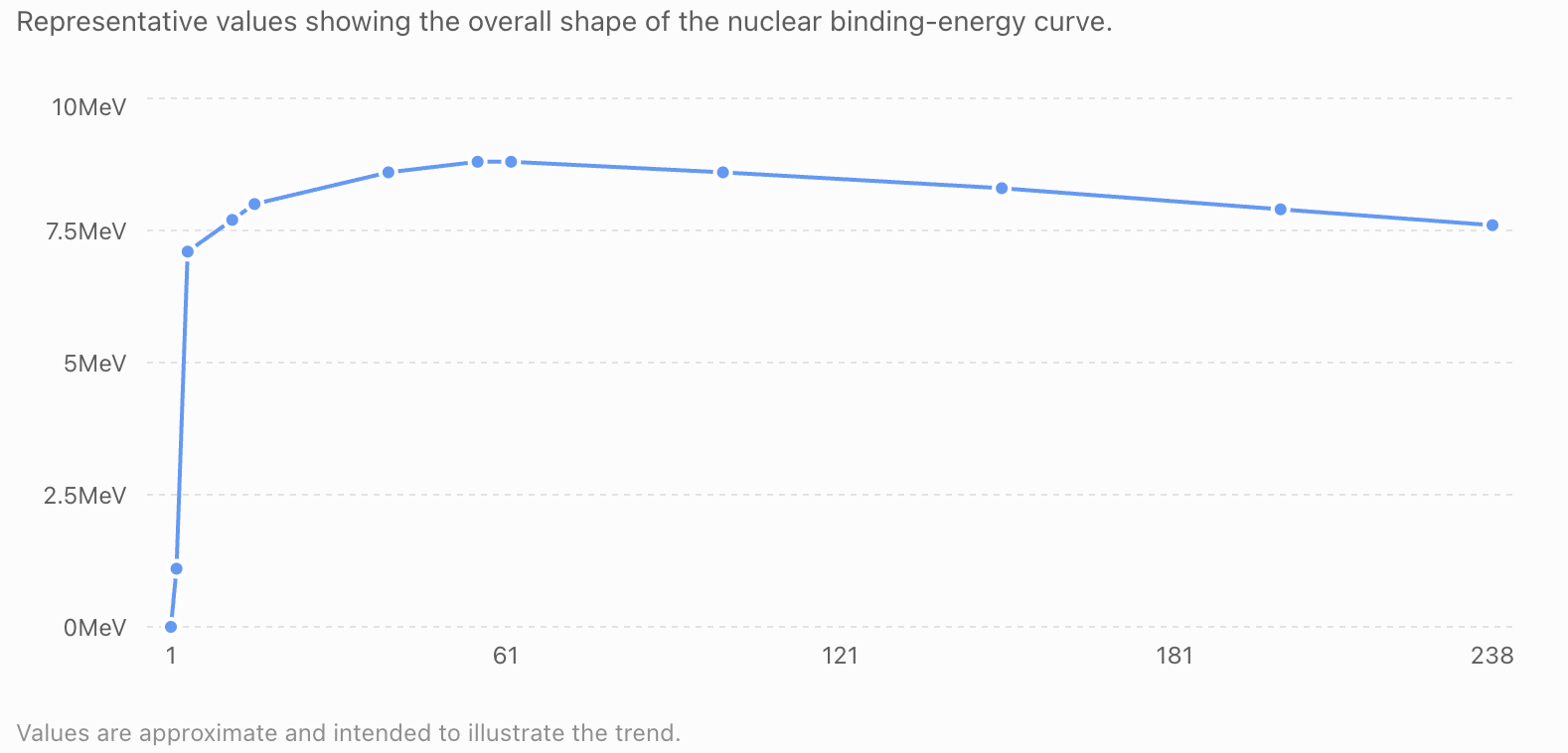
The graph has three important regions:

Light nuclei → binding energy per nucleon rises rapidly

Medium-mass nuclei → highest binding energies per nucleon

Very heavy nuclei → binding energy per nucleon gradually decreases

This shape explains some of the most important processes in nuclear physics.


The Most Tightly Bound Nuclei

The binding-energy curve reaches its highest region around nuclei with mass numbers near iron and nickel.

Nuclei in this region have binding energies of roughly:

8.7–8.8 MeV per nucleon

They are among the most tightly bound nuclei.

Iron-56 is often used as a convenient reference when discussing the peak, although nickel-62 has a slightly higher binding energy per nucleon.

The important idea is:

Medium-mass nuclei around iron and nickel are extremely tightly bound.

https://images.openai.com/static-rsc-4/QAd54f_r4JPbF7AVCQHh5FmWQWlsaR2StbK7rSjY8MrA1O30bJVqGjRi7k5mrXUjkU9p21OxarUBLQ8DS9WM9lmrAyICn00F-oFJYIPu9kiriIk8MKTR6_aatqwt9lxh1T6nBwEQUVO7sN_bz09juTbywhFnz35qN_OCJgH44-0gZJs0oZoZRM3OyZmsBJzt?purpose=fullsize
 
https://images.openai.com/static-rsc-4/Yrbrgc8L5KR82vtKx467W2Nr-etIahYxzyNyTZRkI3RV5UtZIa3Oj_efIa8oSeo-CKkqeUUeGwLO2bcIzzLJ7ryx_DU0mZyPQ-ecb9-UfptR1EK9q4jj6JxY-hr2xzZieG6Lnh9qbIKGM5iLr76vJr-N_T0Bv39AZMpfPzrP6-5nhGG8ALfiOaG9I9ySyle3?purpose=fullsize
 
https://images.openai.com/static-rsc-4/yCYTSYNdeG7kc6GCQfU4PCGjT2en44eda9RSExkGfvEztcZ7kSeztt4ACTmN3vdcufT7rxYU6wA5SHa1gFpJ2M-YIIPaCxGeQDjQyPzQQ09lDQs4J12mzxK-MJTnZ16vQf7B1cTVGcrhogtK6OhX0IuS0PH8OM_NB9vLSvwOS7-bAZnkh3NB38FtDjGfot7i?purpose=fullsize
 
5

Why Does the Binding Energy Curve Matter?

The binding-energy curve explains why both nuclear fusion and nuclear fission can release energy.

In both cases, nuclei move toward configurations with higher binding energy per nucleon.

When this happens, the final system has lower total mass-energy than the starting system.

The difference is released as energy.


Fusion of Light Nuclei

Very light nuclei have relatively low binding energies per nucleon.

If two light nuclei combine to form a heavier nucleus, the resulting nucleus can have a higher binding energy per nucleon.

For example:

light nuclei → fusion → heavier, more tightly bound nucleus + energy

This is the basic reason nuclear fusion can release energy.

Fusion powers stars such as the Sun.

https://images.openai.com/static-rsc-4/Bpwbp5u7Yp7TLUusKjRIx_teWrXe_IA0ROduWWoaB8FYFGtYdYqxgCSKcBZLuLY-YN7zzjN74dQamP_HadANGfBZGo10GndxT3e48s6a7Tish8mgJgjK5lCCUz_rAJc_IUGxsjbRH9MZZyP_VbZxCN2gjLDkFVgPU9IY8UQ2ClqmMvfB5vw4JwHtji7yYsF1?purpose=fullsize
 
https://images.openai.com/static-rsc-4/YVujYujuj8z_YsvV4ntbOa1Tq1x1iWOU_DSSTv9BgebukRbonKYwwxsOd_noo1KQdI6rQd4wkuVDFzK-GbzxTM4TmeAlzTQwPmSDT8ztnUqH4YOL07jwS7L06mWGMlifO-LYZTPullEF-vgoBXQJVVqIciWuTwdZraF0xzelgN8pdJzKsT_3JlVewZCEhHss?purpose=fullsize
 
https://images.openai.com/static-rsc-4/o9utxl4F2rtBbnplBD79z2nK3ldeWQ2IWgk-LqSrM138MSAcrdEE37r2IcPgTC8dqYYeB0VLjfAbhwhRpKLnnDhlboDQxrwFA_t9yXfi8jFQSBQYot_EErbttJZ6j2oGEhizfe6QVMs4qoAAcstSGfQRVog5lE2mZR4llu7CO1nZbq91xJ_boaRTc2KwjG9R?purpose=fullsize
 
6

As light nuclei move toward the iron/nickel region of the binding-energy curve, energy can be released.


Fission of Heavy Nuclei

Very heavy nuclei also have lower binding energies per nucleon than medium-mass nuclei.

A heavy nucleus can sometimes split into two smaller nuclei.

This process is called nuclear fission.

For example:

heavy nucleus → smaller nuclei + energy

The fission products generally have higher binding energies per nucleon than the original very heavy nucleus.

The difference in mass-energy is released.

https://images.openai.com/static-rsc-4/zvhLWfc0iZChVpZO0nLllY40q9PGn4JxHP8a8bi8RlniRRjPwFafN4ZDkxjPFZA8xCH5pP8WVaJrSHF5PFW8PeLmQh-fsC_7cz_Zz4kpq74OiNC3mqM7x3eBAQxLV87E480N8Plbu17Zi6PQkh-WnzpwA_4RXrdBYcPPbRcklUV_VFrA5FawjmTqBCZtcqXF?purpose=fullsize
 
https://images.openai.com/static-rsc-4/pD-zYD0bpD7IGpSYW9at19_qPVVnOV-YO3yETN6FyaWz57ett71Hz58hhTNNSrCjUNn78aHpDke8ZmjjM460jN96PgFZMB8Uiqc5xvw_-McBlZaZU_3s4Q-0668BkcrVTsvcWju4OTzbho7U77lkpDQzFplUd06b2j0xhLEzh_H96AHC5Xav1lSfUFmfIK1n?purpose=fullsize
 
https://images.openai.com/static-rsc-4/wxCT3Qje1jOBi0Kjm54cr6xMbX-tUNp2Nkr0wEaFMIOCL27rQ7pymkQyBMdbrXRW-4ZVPCVc5hpDNRDgyM4BGzcgUe5QdE_X63ytvOWtCnskQdHYX9Xv8bPgbUT1HMXAqh9cJ29-CRZdG7-Xry42FQl9DEjNapCUdwTmBaYaq66ZbFhiZuzj11_ZiYkQ_aQj?purpose=fullsize
 
5

Fusion and Fission on the Same Graph

The binding-energy curve gives us a powerful way to understand both processes.

Light nuclei

Can release energy by moving up the curve through fusion.

Heavy nuclei

Can release energy by moving up the curve through fission.

Medium-mass nuclei

Nuclei near iron and nickel are already close to the maximum binding energy per nucleon.

Therefore, there is much less energy available from either fusion or fission that would move them toward more tightly bound nuclei.

This is one reason the iron region is so important in nuclear physics and astrophysics.


Comparing Nuclear Stability

Suppose we have three hypothetical nuclei:

Nucleus Binding Energy per Nucleon
A 5.2 MeV/nucleon
B 7.4 MeV/nucleon
C 8.7 MeV/nucleon

Based only on binding energy per nucleon:

C is the most tightly bound.

Then:

B

and finally:

A

So:

C > B > A

in average binding strength per nucleon.


How to Read a Binding Energy Graph

When given a graph of binding energy per nucleon against mass number, follow these steps.

Step 1: Check the axes.

Horizontal axis:

Mass number, A

Vertical axis:

Binding energy per nucleon

Step 2: Locate the nucleus.

Find its approximate mass number on the horizontal axis.

Step 3: Read the binding energy per nucleon.

Move upward to the curve and then across to the vertical axis.

Step 4: Compare nuclei.

A nucleus higher on the graph generally has nucleons that are more tightly bound.

Step 5: Look for possible energy-releasing changes.

Movement toward the peak of the curve can release energy.


Binding Energy Is Not the Same as Activation Energy

It is important not to confuse nuclear binding energy with the activation energy used in chemistry.

Nuclear binding energy relates to the energy associated with binding protons and neutrons in a nucleus.

Chemical activation energy relates mainly to rearrangements of electrons and chemical bonds.

Nuclear energy scales are generally much larger than chemical energy scales.

This is one reason nuclear reactions can release vastly more energy per reaction than ordinary chemical reactions.


Did You Know?

A nucleus can have a mass of less than the combined masses of all of its separate nucleons.

At first this may seem to violate conservation of mass.

It does not.

Modern physics uses conservation of mass-energy.

When the nucleus forms, some of the original mass-energy is released into the surroundings.

Because:

E = mc²

mass and energy are two forms of the same conserved physical quantity.


Connecting the Ideas

The complete process can be summarized:

Separate protons and neutrons

↓

Strong nuclear attraction brings nucleons into a bound system

↓

A nucleus forms

↓

Energy is released

↓

The nucleus has less mass than the separated nucleons

↓

This difference is the mass defect

↓

Δm corresponds to binding energy through E = Δmc²

The reverse process requires energy:

Nucleus + binding energy → separated nucleons


Key Terms

Nuclear binding energy – The minimum energy required to completely separate a nucleus into its individual protons and neutrons.

Mass defect – The difference between the total mass of separate nucleons and the mass of the bound nucleus.

Binding energy per nucleon – The average binding energy associated with each nucleon in a nucleus.

Nucleon – A proton or neutron.

MeV – Mega-electronvolt, a unit of energy commonly used in nuclear and particle physics.

Nuclear stability – The tendency of a nucleus to remain in its existing state rather than undergo radioactive transformation.

Fusion – The joining of light nuclei to form heavier nuclei.

Fission – The splitting of a heavy nucleus into smaller nuclei.


Key Takeaways

  • Nuclear binding energy is the energy required to completely separate a nucleus into its protons and neutrons.
  • Energy is released when nucleons combine to form a bound nucleus.
  • The bound nucleus has slightly less mass than the separated nucleons.
  • This difference is called the mass defect.
  • Mass defect and binding energy are related by E = Δmc².
  • Binding energy per nucleon is useful for comparing how tightly different nuclei are bound.
  • Higher binding energy per nucleon generally indicates a more tightly bound nucleus.
  • The binding-energy curve reaches its highest region near iron and nickel.
  • Light nuclei can release energy through fusion as they move toward higher binding energy per nucleon.
  • Heavy nuclei can release energy through fission for the same general reason.
  • The binding-energy curve provides one of the most important links between nuclear structure, stability, fusion, and fission.