Nuclear Structure and Stability
| 站点: | Young Education |
| 课程: | Nuclear and Particle Physics |
| 图书: | Nuclear Structure and Stability |
| 打印: | Gast |
| 日期: | 2026年09月25日 星期五 02:38 |
1. Nuclear Composition
Learning outcomes
- I can determine the number of protons and neutrons in a nucleus.
- I can interpret nuclear notation.
- I can calculate atomic and mass numbers.
- I can distinguish between isotopes and ions.
- I can identify nuclides using nuclear symbols.
What Is Inside a Nucleus?
At the centre of every atom is a tiny, dense nucleus.
The nucleus contains two types of particles:
- Protons
- Neutrons
Together, protons and neutrons are called nucleons.
The number and combination of these nucleons determine the identity and nuclear properties of an atom.
Nucleus = protons + neutrons
Electrons are located outside the nucleus and therefore are not nucleons.


Atomic Number
The atomic number tells us the number of protons in the nucleus.
It is represented by the symbol:
Z
Therefore:
Z = number of protons
The number of protons determines which element an atom is.
For example:
| Element | Atomic Number | Protons |
|---|---|---|
| Hydrogen | 1 | 1 |
| Carbon | 6 | 6 |
| Oxygen | 8 | 8 |
| Sodium | 11 | 11 |
| Iron | 26 | 26 |
| Uranium | 92 | 92 |
Every carbon nucleus contains 6 protons.
If the number of protons changes, the element changes.
Mass Number
The mass number is the total number of protons and neutrons in the nucleus.
It is represented by:
A
Therefore:
A = protons + neutrons
Since the number of protons is the atomic number:
A = Z + N
where:
A = mass number
Z = atomic number
N = number of neutrons
Calculating the Number of Neutrons
We can rearrange:
A = Z + N
to give:
N = A − Z
Therefore:
Number of neutrons = mass number − atomic number
Example 1: Carbon-12
Carbon-12 has:
A = 12
Z = 6
Therefore:
N = 12 − 6
N = 6
Carbon-12 contains:
- 6 protons
- 6 neutrons
Example 2: Sodium-23
Sodium has atomic number 11.
For sodium-23:
A = 23
Z = 11
Therefore:
N = 23 − 11
N = 12
Sodium-23 contains:
- 11 protons
- 12 neutrons
Example 3: Uranium-238
Uranium has atomic number 92.
A = 238
Z = 92
Therefore:
N = 238 − 92
N = 146
Uranium-238 contains:
- 92 protons
- 146 neutrons
Nuclear Notation
Scientists use nuclear notation to show the composition of a nucleus.
The general form is:
ᴬZX
where:
X = chemical symbol
A = mass number
Z = atomic number
For example, carbon-14 can be written as:
¹⁴₆C
This tells us:
A = 14
Z = 6
Therefore:
Protons = 6
Neutrons = 14 − 6 = 8


Reading a Nuclear Symbol
Consider:
²³₁₁Na
We can read this systematically.
Step 1: Identify the element
Na = sodium
Step 2: Find the atomic number
Z = 11
Therefore:
Protons = 11
Step 3: Find the mass number
A = 23
Step 4: Calculate neutrons
N = A − Z
N = 23 − 11
N = 12
Therefore, the sodium-23 nucleus contains:
11 protons and 12 neutrons
What Is a Nuclide?
A nuclide is a particular type of nucleus defined by its specific numbers of protons and neutrons.
Examples include:
¹²₆C
¹⁴₆C
²³₁₁Na
²³⁵₉₂U
²³⁸₉₂U
Each represents a particular nuclide.
The term nuclide is especially useful in nuclear physics because nuclear behaviour depends on both the number of protons and the number of neutrons.
Naming Nuclides
Nuclides can also be written using the element name followed by the mass number.
For example:
¹²₆C = carbon-12
¹⁴₆C = carbon-14
²³₁₁Na = sodium-23
²³⁵₉₂U = uranium-235
²³⁸₉₂U = uranium-238
Notice that the atomic number is normally not included in the written name because the element already tells us the number of protons.
If we know something is uranium, we already know:
Z = 92
What Are Isotopes?
Isotopes are atoms of the same element that contain the same number of protons but different numbers of neutrons.
Because they belong to the same element:
same Z
But because they have different numbers of neutrons:
different A
For example:
| Isotope | Protons | Neutrons | Mass Number |
|---|---|---|---|
| Carbon-12 | 6 | 6 | 12 |
| Carbon-13 | 6 | 7 | 13 |
| Carbon-14 | 6 | 8 | 14 |
All three are carbon because they all contain:
6 protons
However, they contain different numbers of neutrons.


Isotopes and Nuclear Stability
Different isotopes of the same element can have different nuclear properties.
Some isotopes are stable.
Others are unstable, meaning their nuclei can undergo radioactive decay.
For example:
Carbon-12 → stable
Carbon-14 → radioactive
Both are carbon atoms because they contain 6 protons, but their different numbers of neutrons affect the stability of their nuclei.
This relationship between proton number, neutron number, and nuclear stability will become extremely important later in this unit.
What Is an Ion?
An ion is an atom or group of atoms that has gained or lost electrons.
This changes the particle's electric charge.
For example, a neutral sodium atom has:
11 protons
11 electrons
If it loses one electron:
11 protons
10 electrons
it becomes:
Na⁺
The nucleus has not changed.
It still contains 11 protons.
Isotopes vs Ions
Isotopes and ions are very different concepts.
Isotopes
Differ in the number of neutrons.
The nucleus is different.
Example:
¹²₆C and ¹⁴₆C
Ions
Differ in the number of electrons.
The nucleus does not need to change.
Example:
Na and Na⁺
A useful rule is:
Change neutrons → isotope
Change electrons → ion
Change protons → different element
Comparing the Three Changes
| What Changes? | Result |
|---|---|
| Number of protons | Different element |
| Number of neutrons | Different isotope |
| Number of electrons | Different ion/charge state |
This is one of the most useful relationships to remember when interpreting atomic and nuclear notation.
Nuclear Notation for Ions
An ionic charge can also be added to nuclear notation.
For example:
²³₁₁Na⁺
The nuclear information tells us:
A = 23
Z = 11
Therefore:
Protons = 11
Neutrons = 23 − 11 = 12
The +1 charge tells us that the atom has lost one electron.
Therefore:
Electrons = 10
Notice that the charge does not change the number of protons or neutrons.
Worked Example: Magnesium Ion
Consider:
²⁴₁₂Mg²⁺
Step 1: Find the protons
Z = 12
Therefore:
12 protons
Step 2: Find the neutrons
N = A − Z
N = 24 − 12
N = 12
Step 3: Find the electrons
The charge is +2, meaning two electrons have been lost.
Electrons = 12 − 2 = 10
Therefore:
²⁴₁₂Mg²⁺ contains 12 protons, 12 neutrons, and 10 electrons.
Worked Example: Chloride Ion
Consider:
³⁷₁₇Cl⁻
Protons
17
Neutrons
37 − 17 = 20
Electrons
A −1 charge means the atom has gained one electron.
17 + 1 = 18 electrons
Therefore:
³⁷₁₇Cl⁻ contains 17 protons, 20 neutrons, and 18 electrons.
Finding a Missing Mass Number
Sometimes you may be given the numbers of protons and neutrons.
For example:
A nucleus contains:
17 protons
20 neutrons
Find its nuclear symbol.
Step 1: Identify the element
17 protons means:
Z = 17
Element 17 is chlorine:
Cl
Step 2: Calculate the mass number
A = Z + N
A = 17 + 20
A = 37
Step 3: Write the nuclear symbol
³⁷₁₇Cl
The nuclide is chlorine-37.
Finding a Missing Atomic Number
Suppose a nucleus has:
A = 27
N = 14
We know:
A = Z + N
Therefore:
Z = A − N
Z = 27 − 14
Z = 13
Atomic number 13 is aluminium.
Therefore the nuclide is:
²⁷₁₃Al
or:
aluminium-27
A Reliable Method for Nuclear Problems
When solving nuclear composition questions, use the following relationships:
Z = number of protons
A = protons + neutrons
N = A − Z
Then ask:
What is changing?
If the number of protons changes → element changes
If the number of neutrons changes → isotope changes
If the number of electrons changes → ion changes
This method can solve most introductory nuclear notation problems.
Nuclear Composition at a Glance
Consider these particles:
| Particle | Protons | Neutrons | Electrons | Classification |
|---|---|---|---|---|
| ¹²₆C | 6 | 6 | 6 | Neutral atom |
| ¹⁴₆C | 6 | 8 | 6 | Isotope of carbon |
| ²³₁₁Na | 11 | 12 | 11 | Neutral atom |
| ²³₁₁Na⁺ | 11 | 12 | 10 | Positive ion |
| ³⁷₁₇Cl⁻ | 17 | 20 | 18 | Negative ion |
| ²³⁸₉₂U | 92 | 146 | 92 | Uranium-238 nuclide |
Did You Know?
The word nuclide is broader than the word isotope.
A nuclide identifies one particular combination of protons and neutrons.
An isotope describes a relationship between nuclides of the same element.
For example:
carbon-12 is a nuclide
carbon-14 is a nuclide
and:
carbon-12 and carbon-14 are isotopes of carbon
This distinction becomes useful when studying large numbers of radioactive nuclei.


Key Terms
Nucleus – The dense central region of an atom containing protons and neutrons.
Nucleon – A proton or neutron.
Atomic number (Z) – The number of protons in a nucleus.
Mass number (A) – The total number of protons and neutrons in a nucleus.
Neutron number (N) – The number of neutrons in a nucleus.
Nuclear notation – A symbolic system showing the element, atomic number, and mass number of a nuclide.
Nuclide – A specific type of nucleus defined by its numbers of protons and neutrons.
Isotope – One of two or more forms of the same element containing different numbers of neutrons.
Ion – An atom or group of atoms with an overall electric charge because electrons have been gained or lost.
Key Takeaways
- The nucleus contains protons and neutrons, collectively called nucleons.
- The atomic number Z equals the number of protons.
- The mass number A equals the total number of protons and neutrons.
- The neutron number can be calculated using N = A − Z.
- Nuclear notation can be written in the form ᴬZX.
- The number of protons determines the element.
- Nuclides are specific combinations of protons and neutrons.
- Isotopes have the same number of protons but different numbers of neutrons.
- Ions form when the number of electrons changes.
- Changing the number of neutrons changes the isotope; changing the number of electrons changes the ion; changing the number of protons changes the element.
- Nuclear symbols can be used to determine the numbers of protons, neutrons, and, when charge is shown, electrons.
2. Binding Energy
Learning outcomes
- I can define nuclear binding energy.
- I can explain why energy is required to separate a nucleus.
- I can describe how binding energy relates to nuclear stability.
- I can interpret binding energy per nucleon graphs.
- I can compare the stability of different nuclei.
What Holds a Nucleus Together?
An atomic nucleus contains protons and neutrons, collectively called nucleons.
This creates an interesting problem.
Every proton has a positive electric charge. Because like charges repel, the protons inside a nucleus experience electromagnetic repulsion.
Yet many nuclei remain stable.
This happens because nucleons also experience the strong nuclear interaction. At the very short distances found inside nuclei, the attractive nuclear interaction can overcome the electrical repulsion between nearby protons.
As a result, energy is required to pull a stable nucleus apart.
That energy is called its nuclear binding energy.


What Is Nuclear Binding Energy?
Nuclear binding energy is the minimum energy required to completely separate a nucleus into its individual protons and neutrons.
We can also think about the process in reverse.
When individual protons and neutrons combine to form a nucleus, energy is released.
Therefore:
Separate nucleus → energy must be supplied
Form nucleus → energy is released
The more strongly the nucleons are bound together, the more energy is generally required to separate them.
A Simple Analogy
Imagine several objects sitting at the bottom of a deep valley.
To remove them from the valley, you must supply energy to move them upward.
A nucleus can be thought of in a similar way.
When nucleons form a bound nucleus, the system reaches a lower-energy state than the separated nucleons.
To separate the nucleus again, energy must be supplied.
The deeper the energy difference, the more tightly bound the nucleus is.
This is why binding energy provides useful information about nuclear stability.
Where Does Binding Energy Come From?
When protons and neutrons combine to form a nucleus, the mass of the resulting nucleus is slightly less than the total mass of the individual free nucleons.
This difference is called the mass defect.
Mass defect = mass of separate nucleons − mass of nucleus
The "missing" mass has not simply disappeared.
It corresponds to energy released when the nucleus formed.
Einstein's mass-energy relationship connects the two:
E = mc²
For nuclear binding energy:
Eᵦ = Δmc²
where:
Eᵦ = binding energy
Δm = mass defect
c = speed of light
Because c² is extremely large, even a tiny difference in mass corresponds to a substantial amount of energy.


Example: Forming a Nucleus
Imagine that separate protons and neutrons have a total mass of:
4.0320 u
After they combine, suppose the nucleus has a mass of:
4.0015 u
The mass defect is:
Δm = 4.0320 − 4.0015
Δm = 0.0305 u
This mass difference corresponds to energy that was released when the nucleus formed.
To completely separate that nucleus back into its individual nucleons, the same amount of energy would have to be supplied.
Converting Mass into Binding Energy
Nuclear masses are often measured in atomic mass units (u).
A useful conversion is:
1 u ≈ 931.5 MeV/c²
Therefore, if the mass defect is measured in atomic mass units:
Binding energy (MeV) ≈ Δm × 931.5
Using our previous example:
Δm = 0.0305 u
Therefore:
Eᵦ ≈ 0.0305 × 931.5
Eᵦ ≈ 28.4 MeV
The nucleus has a total binding energy of approximately:
28.4 MeV
Total Binding Energy
The total binding energy tells us the energy required to completely separate the entire nucleus into free protons and neutrons.
However, total binding energy alone is not always useful for comparing nuclei.
A large nucleus naturally contains many more nucleons than a small nucleus.
For example, a nucleus containing 200 nucleons might have a much larger total binding energy than a nucleus containing 20 nucleons simply because it contains more particles.
To compare nuclear stability more meaningfully, physicists use:
binding energy per nucleon.
Binding Energy per Nucleon
The binding energy per nucleon is the average binding energy associated with each proton or neutron in the nucleus.
It is calculated using:
Binding energy per nucleon = total binding energy ÷ number of nucleons
Since the number of nucleons is the mass number A:
Binding energy per nucleon = Eᵦ / A
The unit is usually:
MeV/nucleon
Example
Suppose a nucleus has:
Total binding energy = 240 MeV
and:
A = 30
Then:
Binding energy per nucleon = 240 ÷ 30
= 8.0 MeV/nucleon
This means that, on average, each nucleon contributes about 8.0 MeV to the nuclear binding.
Binding Energy and Nuclear Stability
In general:
Higher binding energy per nucleon → more tightly bound nucleus
A nucleus with a high binding energy per nucleon is relatively difficult to break apart.
A nucleus with a lower binding energy per nucleon may be able to move toward a more tightly bound configuration through nuclear reactions.
This is why binding energy per nucleon is one of the most useful measures for comparing nuclear stability.
However, it is not the only factor controlling whether a particular nuclide is radioactive. Proton-to-neutron ratio, available decay pathways, shell effects, and other nuclear properties also matter.
The Binding Energy per Nucleon Curve
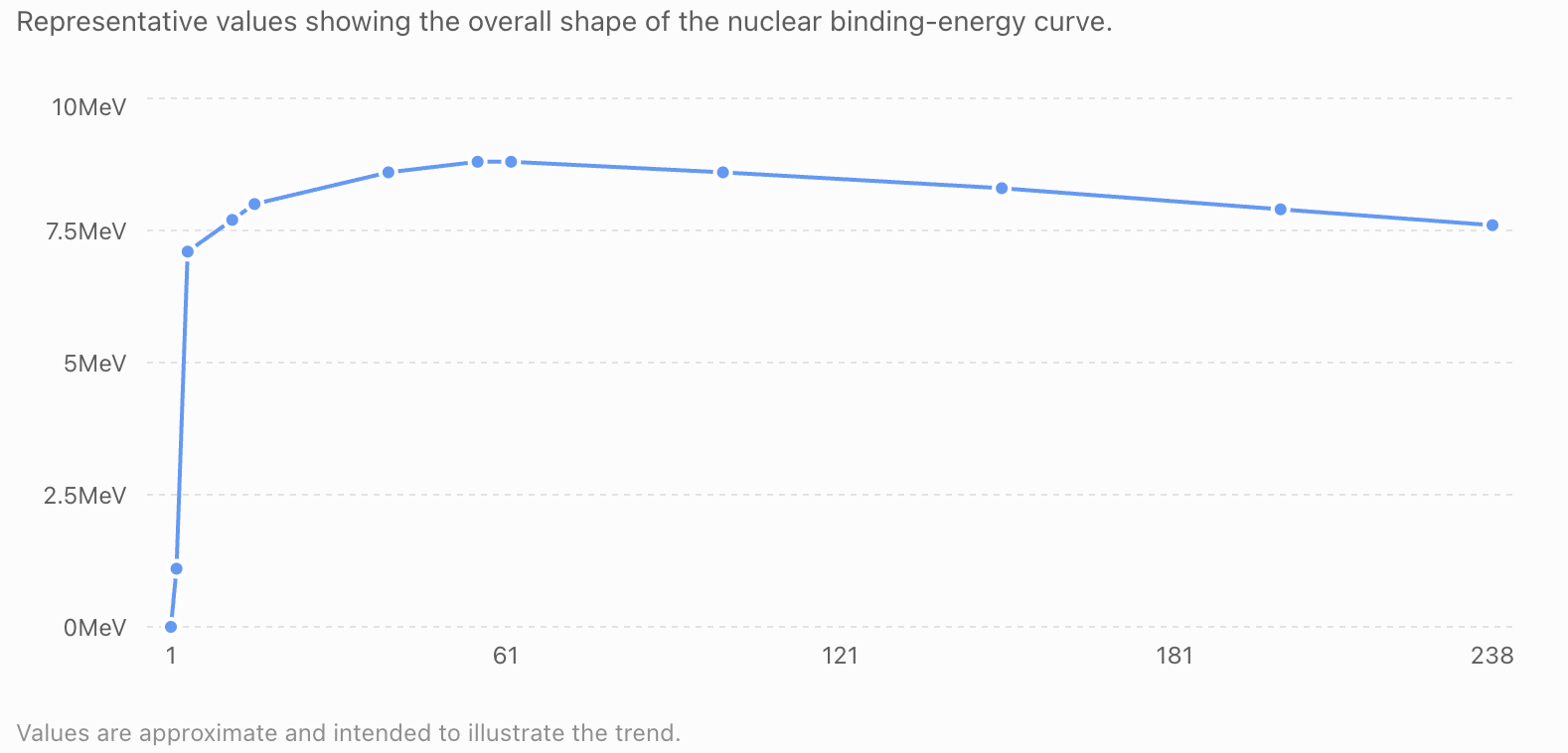
If we graph binding energy per nucleon against mass number, a characteristic curve appears.
Binding energy per nucleon


3. Mass Defect
Learning outcomes
- I can define mass defect.
- I can explain why nuclear mass differs from the sum of its particles.
- I can calculate mass defect.
- I can relate mass defect to binding energy.
- I can interpret simple mass defect calculations.
What Is Mass Defect?
If we measure the mass of a nucleus, we discover something surprising:
The mass of the nucleus is slightly less than the total mass of the individual protons and neutrons that make it.
The difference between these two masses is called the mass defect.
Mass defect = mass of separate nucleons − mass of nucleus
Using symbols:
Δm = (Zmp + Nmn) − mnucleus
where:
Δm = mass defect
Z = number of protons
N = number of neutrons
mp = mass of one proton
mn = mass of one neutron
mnucleus = measured mass of the nucleus
The mass defect is closely connected to nuclear binding energy.


Why Is There a Mass Difference?
Imagine starting with separate protons and neutrons.
When these nucleons come together to form a nucleus, the strong nuclear interaction creates a bound system.
As the nucleus forms, energy is released.
Because mass and energy are related, the loss of energy from the system corresponds to a decrease in its mass.
Einstein's equation describes this relationship:
E = mc²
Therefore, the final bound nucleus has less mass-energy than the original separated nucleons.
The difference in mass is the mass defect.
Has the Mass Disappeared?
No.
The word "defect" can make it sound as though some mass has mysteriously vanished.
Instead, some of the original mass-energy has been released from the system as energy when the nucleus formed.
So:
separate nucleons → nucleus + released energy
The nucleus has a lower total mass-energy than the separated nucleons.
To completely separate the nucleus again, this energy must be supplied back to the system.
That required energy is the nuclear binding energy.
Mass Defect and Binding Energy
Mass defect and binding energy describe the same change from two different perspectives.
Mass defect → difference in mass
Binding energy → corresponding difference in energy
They are connected by:
Eᵦ = Δmc²
where:
Eᵦ = nuclear binding energy
Δm = mass defect
c = speed of light
A larger mass defect generally corresponds to a larger total binding energy.
Calculating Mass Defect
To calculate mass defect, we compare:
total mass of separate nucleons
with:
measured mass of the nucleus
The general method is:
Step 1: Determine the number of protons
Protons = Z
Step 2: Determine the number of neutrons
N = A − Z
Step 3: Calculate the mass of the separate nucleons
Mass of nucleons = (Z × mp) + (N × mn)
Step 4: Subtract the nuclear mass
Δm = mass of separate nucleons − mass of nucleus
Example 1: A Simple Nucleus
Suppose a nucleus contains:
2 protons
2 neutrons
For this simplified example, use:
mass of proton = 1.0073 u
mass of neutron = 1.0087 u
Measured nuclear mass:
4.0015 u
Step 1: Calculate the mass of the protons
2 × 1.0073 = 2.0146 u
Step 2: Calculate the mass of the neutrons
2 × 1.0087 = 2.0174 u
Step 3: Calculate the total mass of the separate nucleons
2.0146 + 2.0174 = 4.0320 u
Step 4: Calculate the mass defect
Δm = 4.0320 − 4.0015
Δm = 0.0305 u
Therefore:
Mass defect = 0.0305 u
The bound nucleus has 0.0305 u less mass than the equivalent separated nucleons.
Converting Mass Defect to Binding Energy
The atomic mass unit can be converted into energy using:
1 u ≈ 931.5 MeV/c²
Therefore:
Binding energy (MeV) = mass defect (u) × 931.5
For our previous example:
Δm = 0.0305 u
Therefore:
Eᵦ = 0.0305 × 931.5
Eᵦ ≈ 28.4 MeV
So the nucleus has a binding energy of approximately:
28.4 MeV
What Does 28.4 MeV Mean?
A binding energy of 28.4 MeV means approximately 28.4 MeV of energy would have to be supplied to completely separate the nucleus into its individual protons and neutrons.
The reverse is also true.
Approximately 28.4 MeV would be released when the separated nucleons form that nucleus.
Therefore:
nucleus + 28.4 MeV → separate nucleons
or:
separate nucleons → nucleus + 28.4 MeV


Example 2: Carbon-12
Consider a carbon-12 nucleus:
¹²₆C
From the nuclear notation:
A = 12
Z = 6
Therefore:
Protons = 6
Neutrons = 12 − 6 = 6
Suppose we use:
mp = 1.0073 u
mn = 1.0087 u
and the nuclear mass is approximately:
11.9967 u
Mass of separate protons
6 × 1.0073 = 6.0438 u
Mass of separate neutrons
6 × 1.0087 = 6.0522 u
Total mass of separate nucleons
6.0438 + 6.0522 = 12.0960 u
Mass defect
Δm = 12.0960 − 11.9967
Δm = 0.0993 u
The corresponding binding energy is:
Eᵦ = 0.0993 × 931.5
Eᵦ ≈ 92.5 MeV
So the carbon-12 nucleus has a total binding energy of approximately:
92.5 MeV
Binding Energy per Nucleon
We can go one step further.
Carbon-12 contains 12 nucleons.
Therefore:
Binding energy per nucleon = total binding energy ÷ A
= 92.5 ÷ 12
≈ 7.71 MeV/nucleon
This value tells us the average binding energy associated with each nucleon.
Binding energy per nucleon is particularly useful when comparing the relative stability of different nuclei.
Example 3: Finding the Missing Nuclear Mass
Mass defect calculations can also be reversed.
Suppose a nucleus contains:
3 protons
4 neutrons
The separate nucleons have a combined mass of:
7.0567 u
The mass defect is:
0.0421 u
Find the mass of the nucleus.
We know:
Δm = mass of separate nucleons − mass of nucleus
Rearrange:
mass of nucleus = mass of separate nucleons − Δm
Therefore:
mass of nucleus = 7.0567 − 0.0421
mass of nucleus = 7.0146 u
Example 4: Finding Binding Energy from Mass Defect
Suppose:
Δm = 0.0850 u
Calculate the binding energy.
Use:
Eᵦ = Δm × 931.5
Therefore:
Eᵦ = 0.0850 × 931.5
Eᵦ ≈ 79.2 MeV
So:
Binding energy ≈ 79.2 MeV
Using Kilograms Instead of Atomic Mass Units
Mass defect can also be expressed in kilograms.
In that case, use Einstein's equation directly:
E = Δmc²
where:
c = 3.00 × 10⁸ m/s
For example, suppose:
Δm = 5.00 × 10⁻²⁹ kg
Then:
E = (5.00 × 10⁻²⁹)(3.00 × 10⁸)²
First:
(3.00 × 10⁸)² = 9.00 × 10¹⁶
Therefore:
E = (5.00 × 10⁻²⁹)(9.00 × 10¹⁶)
E = 4.50 × 10⁻¹² J
Even an extremely small mass difference can therefore correspond to a measurable amount of nuclear energy.
Why Is c² So Important?
The speed of light is:
c ≈ 3.00 × 10⁸ m/s
Therefore:
c² ≈ 9.00 × 10¹⁶ m²/s²
This is an enormous number.
As a result:
tiny mass change × enormous c² = significant energy change
This is why very small changes in nuclear mass can correspond to large energy releases.
Atomic Mass or Nuclear Mass?
There is an important detail when solving mass-defect problems.
Tables may provide either:
- nuclear masses, or
- atomic masses
An atomic mass includes the electrons surrounding the nucleus.
A nuclear mass does not.
Therefore, you must use masses consistently.
If a problem provides the mass of the nucleus, compare it with the masses of separate protons and neutrons.
If a problem provides neutral atomic masses, calculations are often arranged using the mass of a hydrogen atom instead of a bare proton so that electron masses cancel correctly.
For introductory problems, always follow the mass values provided in the question.
A Reliable Calculation Method
For a nuclide:
ᴬZX
use this sequence:
1. Protons = Z
2. Neutrons = A − Z
3. Calculate mass of separate nucleons
4. Subtract measured nuclear mass
5. The result is Δm
6. Convert Δm to energy if required
If Δm is in atomic mass units:
Eᵦ(MeV) = Δm(u) × 931.5
If Δm is in kilograms:
Eᵦ(J) = Δm(kg)c²
Interpreting a Mass Defect Calculation
Suppose two nuclei have these mass defects:
| Nucleus | Mass Defect |
|---|---|
| A | 0.025 u |
| B | 0.080 u |
Nucleus B has the larger total mass defect.
Therefore, nucleus B also has the larger total binding energy, because:
Eᵦ = Δmc²
However, we cannot automatically conclude that nucleus B is more stable.
Why?
Because nucleus B may contain many more nucleons.
To compare how tightly different nuclei are bound, we usually calculate:
binding energy per nucleon
This distinction is important:
Mass defect → connected to total binding energy
Binding energy per nucleon → better for comparing how tightly nuclei of different sizes are bound
Connecting Mass Defect to Nuclear Reactions
Mass defect is also central to understanding why nuclear reactions can release energy.
Suppose a nuclear reaction begins with particles having a total mass:
minitial
and ends with products having total mass:
mfinal
If:
minitial > mfinal
then the difference in mass has been released as energy.
ΔE = Δmc²
This principle explains the enormous energy available from processes such as:
- nuclear fusion
- nuclear fission
- radioactive decay


Mass Defect and Fusion
When light nuclei undergo fusion, the resulting nucleus can be more tightly bound.
The final system can have less mass than the original nuclei.
The mass difference appears as released energy.
This is one of the reasons stars can produce enormous amounts of energy.
Mass Defect and Fission
During nuclear fission, a heavy nucleus splits into smaller nuclei.
The resulting nuclei can have a greater binding energy per nucleon.
Again, the total mass of the products is slightly less than the original mass.
That mass difference is converted into released energy.
Did You Know?
The mass defect of a nucleus is usually only a small fraction of its total mass.
However, because of the enormous conversion factor in:
E = mc²
that tiny mass difference can represent a very large amount of energy.
This is why nuclear reactions can release far more energy per reaction than ordinary chemical reactions.
Chemical reactions mainly rearrange electrons.
Nuclear reactions change the structure and energy of the nucleus itself.
Key Terms
Mass defect – The difference between the total mass of separate nucleons and the mass of the bound nucleus.
Nuclear binding energy – The energy required to completely separate a nucleus into its individual nucleons.
Nucleon – A proton or neutron.
Atomic mass unit (u) – A unit commonly used for atomic and nuclear masses.
MeV – Mega-electronvolt, a unit of energy commonly used in nuclear physics.
Mass-energy equivalence – The relationship between mass and energy described by E = mc².
Binding energy per nucleon – The average binding energy associated with each nucleon in a nucleus.
Key Takeaways
- The mass of a bound nucleus is less than the combined masses of its separate protons and neutrons.
- This difference is called the mass defect.
- Mass is not simply lost; the difference corresponds to energy released when the nucleus forms.
- Mass defect can be calculated using Δm = mass of separate nucleons − mass of nucleus.
- Mass defect and binding energy are connected by Eᵦ = Δmc².
- When mass defect is measured in atomic mass units, 1 u corresponds to approximately 931.5 MeV/c².
- A larger mass defect means a larger total binding energy.
- Binding energy per nucleon is more useful than total mass defect when comparing nuclei of different sizes.
- Mass defect helps explain the energy released during fusion, fission, and other nuclear processes.
- Mass and energy are conserved together as mass-energy.
4. Mass-Energy Equivalence
Learning outcomes
- I can state Einstein's mass-energy relationship.
- I can explain how mass can be converted into energy.
- I can calculate energy released from mass changes.
- I can relate mass-energy equivalence to nuclear reactions.
- I can solve simple mass-energy problems.
Mass and Energy Are Connected
Before the development of modern physics, mass and energy were often treated as completely separate quantities.
Albert Einstein showed that they are fundamentally connected.
His famous mass-energy relationship is:
E = mc²
where:
E = energy, measured in joules (J)
m = mass, measured in kilograms (kg)
c = speed of light = 3.00 × 10⁸ m/s
This equation tells us that mass is a form of energy.
Because the speed of light squared is an enormous number, even a very small amount of mass corresponds to a very large amount of energy.


Understanding E = mc²
The speed of light is approximately:
c = 3.00 × 10⁸ m/s
Squaring this gives:
c² = 9.00 × 10¹⁶ m²/s²
Therefore:
E = m × 9.00 × 10¹⁶
This enormous conversion factor means that a tiny change in mass can correspond to a substantial amount of energy.
For example, a mass of only:
0.001 kg
has a mass-energy equivalent of:
E = (0.001)(3.00 × 10⁸)²
E = 9.00 × 10¹³ J
That is:
90 trillion joules
This does not mean that ordinary objects spontaneously release all their rest energy. It shows the enormous amount of energy associated with mass.
Mass Changes in Nuclear Physics
In nuclear physics, we are usually interested in a change in mass, rather than converting the entire mass of an object.
For this reason, the equation is often written:
ΔE = Δmc²
where:
ΔE = change in energy
Δm = change in mass
If the products of a nuclear process have slightly less mass than the starting particles, the difference in mass appears as other forms of energy.
Therefore:
mass decrease → energy released
The energy may appear as:
- kinetic energy of particles
- electromagnetic radiation such as gamma rays
- energy carried by other emitted particles
Is Mass Really Destroyed?
It is more accurate to say that mass-energy is conserved.
Consider a nuclear reaction:
Initial particles → final particles + released energy
If the final particles have less rest mass than the initial particles, the difference has appeared as other forms of energy.
So we can think of:
rest mass-energy → kinetic energy + radiation + other energy
The total mass-energy of the complete isolated system remains conserved.
Example 1: Energy from a Mass Change
Suppose a nuclear reaction results in a mass decrease of:
2.00 × 10⁻²⁹ kg
Calculate the energy released.
Use:
ΔE = Δmc²
Substitute:
ΔE = (2.00 × 10⁻²⁹)(3.00 × 10⁸)²
First calculate:
(3.00 × 10⁸)² = 9.00 × 10¹⁶
Therefore:
ΔE = (2.00 × 10⁻²⁹)(9.00 × 10¹⁶)
ΔE = 1.80 × 10⁻¹² J
So:
Energy released = 1.80 × 10⁻¹² J
This may appear small, but remember that this is the energy from a change involving only a tiny number of particles. A macroscopic sample contains an enormous number of nuclei.
Example 2: A Larger Mass Change
Suppose:
Δm = 5.00 × 10⁻⁶ kg
Calculate the equivalent energy.
ΔE = Δmc²
ΔE = (5.00 × 10⁻⁶)(3.00 × 10⁸)²
ΔE = (5.00 × 10⁻⁶)(9.00 × 10¹⁶)
ΔE = 4.50 × 10¹¹ J
Even a mass change of only a few millionths of a kilogram corresponds to an enormous amount of energy.
Rearranging the Equation
Sometimes the energy is known and the mass change must be calculated.
Starting with:
ΔE = Δmc²
divide both sides by c²:
Δm = ΔE / c²
This allows us to determine how much mass corresponds to a particular amount of energy.
Example 3: Finding the Mass Change
Suppose a process releases:
1.80 × 10¹⁴ J
Calculate the equivalent mass change.
Use:
Δm = ΔE / c²
Substitute:
Δm = (1.80 × 10¹⁴) / (3.00 × 10⁸)²
Δm = (1.80 × 10¹⁴) / (9.00 × 10¹⁶)
Δm = 2.00 × 10⁻³ kg
Therefore:
Δm = 0.00200 kg
or:
2.00 g
Using Atomic Mass Units
Working in kilograms is not always convenient when dealing with individual nuclei.
Nuclear masses are commonly measured in atomic mass units (u).
A useful relationship is:
1 u = 1.6605 × 10⁻²⁷ kg
Using E = mc², this corresponds to an energy of approximately:
1 u = 931.5 MeV/c²
Therefore, a mass change of:
1 u
corresponds to an energy change of:
931.5 MeV
For nuclear calculations, we can therefore use:
ΔE (MeV) = Δm (u) × 931.5
Example 4: Using Atomic Mass Units
Suppose a nuclear reaction has a mass decrease of:
0.0250 u
Calculate the energy released.
Use:
ΔE = Δm × 931.5
ΔE = 0.0250 × 931.5
ΔE ≈ 23.3 MeV
Therefore:
Energy released ≈ 23.3 MeV
This method is much quicker than first converting atomic mass units into kilograms.
Joules and Electronvolts
Nuclear energies can be expressed in either joules or electronvolts.
An electronvolt (eV) is a very small unit of energy.
Useful units include:
1 keV = 10³ eV
1 MeV = 10⁶ eV
1 GeV = 10⁹ eV
Nuclear reaction energies are commonly measured in MeV.
A useful conversion is:
1 eV ≈ 1.602 × 10⁻¹⁹ J
Therefore:
1 MeV ≈ 1.602 × 10⁻¹³ J
Mass-Energy and Nuclear Binding
Mass-energy equivalence explains the connection between mass defect and nuclear binding energy.
When separate protons and neutrons combine to form a nucleus:
nucleons → bound nucleus + energy
The bound nucleus has slightly less mass than the separated nucleons.
The difference is the mass defect:
Δm = mass of separate nucleons − mass of nucleus
The corresponding energy is the nuclear binding energy:
Eᵦ = Δmc²

Mass-Energy in Nuclear Reactions
Mass-energy equivalence is essential for understanding nuclear reactions.
For any nuclear reaction, we can compare the total rest mass before and after the reaction.
Mass before > mass after
means that energy can be released.
The mass difference corresponds to:
ΔE = Δmc²
The released energy often appears primarily as kinetic energy of the reaction products and radiation.
Nuclear Fusion
In nuclear fusion, light nuclei combine to form heavier nuclei.
For example, stars ultimately convert hydrogen into helium through a sequence of nuclear reactions.
The total rest mass of the final products is slightly less than the total rest mass of the original particles.
That mass difference is released as energy.


The relationship is:
mass of initial particles > mass of final products
Therefore:
mass difference → released energy
This is the fundamental connection between Einstein's equation and the energy produced by stars.
Nuclear Fission
Mass-energy equivalence also explains the energy released during nuclear fission.
In fission, a heavy nucleus splits into smaller nuclei.
For example:
heavy nucleus → smaller nuclei + neutrons + energy
The combined rest mass of the products can be slightly smaller than the initial rest mass.
The mass difference is released as energy.


Why Can Both Fusion and Fission Release Energy?
This can seem confusing.
Fusion joins nuclei together.
Fission splits nuclei apart.
How can both release energy?
The answer comes from nuclear binding energy.
Light nuclei can become more tightly bound by fusion.
Very heavy nuclei can become more tightly bound by fission.
In both cases, the products can have a lower total rest mass-energy than the starting nuclei.
The difference is released as energy.
This connects three major ideas:
Mass defect ↔ Binding energy ↔ E = mc²
The Q-Value of a Nuclear Reaction
The energy released or absorbed in a nuclear reaction is often called the Q-value.
A simple expression is:
Q = (minitial − mfinal)c²
If:
Q > 0
energy is released.
If:
Q < 0
energy must be supplied.
This gives physicists a quick way to determine whether a particular nuclear process releases or requires energy.
Example 5: Energy Released in a Nuclear Reaction
Suppose the total mass before a reaction is:
4.0350 u
and the total mass after the reaction is:
4.0080 u
Step 1: Calculate the mass difference
Δm = 4.0350 − 4.0080
Δm = 0.0270 u
Step 2: Convert mass to energy
ΔE = 0.0270 × 931.5
ΔE ≈ 25.2 MeV
Therefore:
Energy released ≈ 25.2 MeV
Because the final mass is smaller than the initial mass, the reaction releases energy.
A Reliable Problem-Solving Method
For mass-energy problems, use this sequence.
Step 1: Identify what is given.
Is the mass in:
kg
or:
u?
Step 2: Choose the correct relationship.
For kilograms:
ΔE = Δmc²
For atomic mass units:
ΔE(MeV) = Δm(u) × 931.5
Step 3: Substitute carefully.
Pay particular attention to powers of ten.
Step 4: Include units.
Energy should normally be expressed in:
J or MeV
Step 5: Interpret your answer.
Ask whether the process:
releases energy
or:
requires energy.
Common Mistakes
Mistake 1: Forgetting to square c
The equation is:
E = mc²
not:
E = mc
Remember:
(3.00 × 10⁸)² = 9.00 × 10¹⁶
Mistake 2: Using grams instead of kilograms
If you are calculating energy in joules using SI units, mass must be in:
kilograms
For example:
2 g = 0.002 kg
Mistake 3: Using the total mass instead of the mass change
In most nuclear reaction calculations, we need:
Δm
not the entire mass of the nucleus.
Calculate:
Δm = initial mass − final mass
and then use:
ΔE = Δmc²
Mistake 4: Confusing MeV with MeV/c²
Mass can be expressed as:
MeV/c²
Energy is expressed as:
MeV
The conversion:
1 u ≈ 931.5 MeV/c²
means that a mass difference of 1 u corresponds to an energy difference of approximately:
931.5 MeV
Did You Know?
The Sun converts roughly 4 million tonnes of mass into other forms of energy every second.
That sounds enormous, but the Sun itself has an enormous mass, so this represents only a tiny fraction of its total mass.
Einstein's mass-energy relationship explains how such a relatively small mass change can provide the tremendous energy radiated by the Sun.


Connecting the Ideas
Mass-energy equivalence connects several major concepts in nuclear physics:
Nuclear composition
↓
Nucleons bind together
↓
Mass defect occurs
↓
Mass corresponds to binding energy
↓
E = Δmc²
↓
Nuclear reactions rearrange nuclear binding
↓
Differences in mass-energy can be released as kinetic energy and radiation
This relationship is fundamental to understanding radioactivity, nuclear fusion, nuclear fission, stars, and nuclear energy.
Key Terms
Mass-energy equivalence – The principle that mass and energy are different forms of the same physical quantity.
Rest energy – The energy associated with the rest mass of an object, given by E = mc².
Mass defect – The difference between the mass of separated nucleons and the mass of the bound nucleus.
Binding energy – The energy required to completely separate a nucleus into its nucleons.
Atomic mass unit (u) – A unit commonly used for atomic and nuclear masses.
Electronvolt (eV) – A unit of energy commonly used in atomic and particle physics.
Mega-electronvolt (MeV) – One million electronvolts.
Q-value – The net energy released or absorbed during a nuclear reaction.
Key Takeaways
- Einstein's mass-energy relationship is E = mc².
- Mass and energy are fundamentally related.
- In nuclear physics, we often use ΔE = Δmc² to calculate energy associated with a mass change.
- Because c² is extremely large, a tiny mass change can correspond to substantial energy.
- Mass is not simply destroyed; total mass-energy is conserved.
- Nuclear binding energy is related to mass defect through Eᵦ = Δmc².
- When mass is measured in atomic mass units, 1 u corresponds to approximately 931.5 MeV of energy.
- Nuclear fusion releases energy when the products have lower total rest mass-energy than the starting particles.
- Nuclear fission can release energy for the same reason.
- The energy of a nuclear reaction can be calculated using its Q-value.
- Mass-energy equivalence provides the connection between mass defect, binding energy, fusion, fission, and nuclear energy.
5. Nuclear Stability
Learning outcomes
- I can explain factors affecting nuclear stability.
- I can interpret neutron-to-proton ratios.
- I can identify stable and unstable nuclei.
- I can explain why unstable nuclei undergo nuclear transformations.
- I can predict trends in nuclear stability.
What Is Nuclear Stability?
A nucleus contains positively charged protons and electrically neutral neutrons.
Some combinations of protons and neutrons form nuclei that remain essentially unchanged for extremely long periods. These nuclei are described as stable.
Other combinations are unstable. An unstable nucleus can spontaneously transform into another nucleus while releasing particles or electromagnetic radiation.
This process is called radioactive decay.
Whether a nucleus is stable depends on several factors, including:
- the number of protons
- the number of neutrons
- the neutron-to-proton ratio
- the competition between the strong nuclear interaction and electrical repulsion
- nuclear binding energy
- nuclear shell structure


The Competition Inside the Nucleus
Two important interactions influence nuclear stability.
Strong Nuclear Interaction
The strong nuclear interaction provides the short-range attraction that binds nucleons together.
At nuclear distances, it is extremely strong.
Electromagnetic Interaction
Protons are positively charged.
Therefore, every proton electrically repels every other proton.
As the number of protons increases, this electrical repulsion becomes increasingly important.
Nuclear stability therefore involves a competition between:
nuclear attraction
and
proton-proton electrical repulsion
Why Are Neutrons Important?
Neutrons contribute to nuclear binding through the strong interaction but do not add electrical repulsion because they have no electric charge.
This makes neutrons particularly important in larger nuclei.
A neutron can contribute to the attractive nuclear interactions without adding another positively charged proton.
As nuclei become larger, they generally require more neutrons relative to protons to remain stable.
The Neutron-to-Proton Ratio
An important indicator of nuclear stability is the neutron-to-proton ratio, usually written:
N/Z
where:
N = number of neutrons
Z = number of protons
For example, carbon-12 contains:
6 neutrons
6 protons
Therefore:
N/Z = 6/6 = 1.0
Example: Carbon-14
Carbon-14 contains:
Z = 6
A = 14
Therefore:
N = A − Z
N = 14 − 6 = 8
Its neutron-to-proton ratio is:
N/Z = 8/6
N/Z ≈ 1.33
Carbon-14 is radioactive.
Eventually, it undergoes a nuclear transformation that moves the nucleus toward a more stable configuration.
Stable Light Nuclei
For many light stable nuclei:
N ≈ Z
This means they contain approximately equal numbers of neutrons and protons.
Examples include:
| Nuclide | Protons | Neutrons | N/Z |
|---|---|---|---|
| Helium-4 | 2 | 2 | 1.00 |
| Carbon-12 | 6 | 6 | 1.00 |
| Oxygen-16 | 8 | 8 | 1.00 |
| Calcium-40 | 20 | 20 | 1.00 |
However, N = Z is not a universal rule for stability.
As nuclei become heavier, stable nuclei generally contain more neutrons than protons.
Stable Heavy Nuclei
Consider lead-208:
²⁰⁸₈₂Pb
Protons:
Z = 82
Neutrons:
N = 208 − 82 = 126
Therefore:
N/Z = 126/82
N/Z ≈ 1.54
Lead-208 is stable despite having considerably more neutrons than protons.
This illustrates an important trend:
Light stable nuclei → N/Z close to 1
Heavier stable nuclei → N/Z becomes greater than 1


The Band of Stability
If we plot the number of neutrons against the number of protons for known nuclei, stable nuclei occupy a region called the band of stability or valley of stability.
For light nuclei, the band lies close to:
N = Z
As proton number increases, the band gradually moves toward:
N > Z
This happens because larger nuclei require additional neutrons to help maintain nuclear binding without increasing electrical repulsion.
Reading a Stability Graph
A typical nuclear stability graph has:
Horizontal axis → number of protons, Z
Vertical axis → number of neutrons, N
Stable nuclei form a narrow band.
Nuclei outside this band tend to be radioactive.
The position of an unstable nucleus relative to the band can help us predict the type of nuclear transformation it may undergo.
Neutron-Rich Nuclei
A nucleus above the band of stability contains too many neutrons relative to protons.
Such a nucleus may move toward stability through beta-minus decay.
During beta-minus decay, a neutron is effectively transformed into a proton:
n → p + e⁻ + ν̄ₑ
where:
e⁻ = electron
ν̄ₑ = electron antineutrino
The result is:
Neutrons decrease by 1
Protons increase by 1
The mass number stays the same.
Example: Carbon-14
Carbon-14 contains:
6 protons
8 neutrons
It undergoes beta-minus decay:
¹⁴₆C → ¹⁴₇N + e⁻ + ν̄ₑ
After the transformation, nitrogen-14 contains:
7 protons
7 neutrons
Nitrogen-14 is stable.
The transformation has moved the nucleus toward a more stable neutron-to-proton balance.
Proton-Rich Nuclei
A nucleus below the band of stability has too many protons relative to neutrons.
Such nuclei may move toward stability through processes such as:
- beta-plus decay
- electron capture
In beta-plus decay, a proton is effectively transformed into a neutron:
p → n + e⁺ + νₑ
within an energetically allowed nuclear process.
The result is:
Protons decrease by 1
Neutrons increase by 1
Again, the mass number remains unchanged.
Electron Capture
Some proton-rich nuclei undergo electron capture instead.
An inner atomic electron is captured by the nucleus and interacts with a proton:
p + e⁻ → n + νₑ
The proton becomes a neutron.
Therefore:
Z decreases by 1
while:
A remains unchanged
Both beta-plus decay and electron capture can move a proton-rich nucleus toward the band of stability.
Very Heavy Nuclei
For very heavy nuclei, another problem develops.
There are so many protons that the electrical repulsion between them becomes increasingly difficult for the short-range nuclear interaction to counteract.
Very heavy nuclei are therefore generally unstable.
They may undergo processes such as:
- alpha decay
- spontaneous fission
Alpha Decay
An alpha particle contains:
2 protons + 2 neutrons
It is equivalent to a helium-4 nucleus:
⁴₂He
When a heavy nucleus emits an alpha particle:
A decreases by 4
Z decreases by 2
For example:
²³⁸₉₂U → ²³⁴₉₀Th + ⁴₂He
This reduces both the size and charge of the original nucleus.


Why Do Unstable Nuclei Decay?
An unstable nucleus is in a state from which an energetically allowed transformation can produce a more stable configuration.
Through radioactive decay, the nucleus can move toward a state with lower total energy.
The process may change:
- the neutron-to-proton ratio
- the number of protons
- the number of neutrons
- the total size of the nucleus
- the internal energy of the nucleus
Energy can be released as kinetic energy of particles, neutrinos, and electromagnetic radiation.
Binding Energy and Stability
Nuclear stability is also connected to binding energy.
A nucleus with a high binding energy per nucleon is generally more tightly bound than one with a lower binding energy per nucleon.
The binding-energy curve reaches its highest region around medium-mass nuclei near iron and nickel.


However, binding energy per nucleon alone does not determine whether an individual isotope is radioactive.
The neutron-to-proton ratio, nuclear energy levels, shell structure, and possible decay pathways must also be considered.
Nuclear Shells
Protons and neutrons occupy quantum energy levels within the nucleus.
Certain numbers of protons or neutrons produce particularly stable nuclear arrangements.
These are called magic numbers.
Common magic numbers include:
2, 8, 20, 28, 50, 82, 126
For example, lead-208 contains:
82 protons
126 neutrons
Both are magic numbers.
This contributes to the exceptional stability of the lead-208 nucleus.
The nuclear shell model is more advanced, but it helps explain why some nuclei are more stable than a simple neutron-to-proton calculation might suggest.
Even and Odd Numbers of Nucleons
Another trend appears when examining stable nuclei.
Nuclei containing even numbers of protons and even numbers of neutrons are particularly common among stable nuclides.
Nuclei with both an odd proton number and an odd neutron number are much less commonly stable.
This is related to the tendency of nucleons to form energetically favourable pairs inside the nucleus.
Therefore, nuclear stability depends on more than simply counting neutrons and protons.
Predicting Nuclear Stability
We can use several general trends.
Trend 1: Light nuclei
Stable nuclei usually have approximately:
N ≈ Z
Trend 2: Increasing nuclear size
As proton number increases:
N/Z generally increases
Heavy stable nuclei therefore contain more neutrons than protons.
Trend 3: Too many neutrons
A neutron-rich nucleus may undergo:
beta-minus decay
This changes a neutron into a proton.
Trend 4: Too many protons
A proton-rich nucleus may undergo:
beta-plus decay or electron capture
These processes effectively change a proton into a neutron.
Trend 5: Very heavy nuclei
Very heavy nuclei are generally unstable and may undergo:
alpha decay
or sometimes:
spontaneous fission
A Simple Prediction Table
| Nuclear Situation | Likely Behaviour |
|---|---|
| Light nucleus with suitable N/Z | May be stable |
| Neutron-rich nucleus | Often β⁻ decay |
| Proton-rich nucleus | Often β⁺ decay or electron capture |
| Very heavy nucleus | Often α decay; fission may also occur |
| Excited nucleus | May emit γ radiation |
These are general trends, not absolute rules. Actual decay depends on which transformations are energetically and quantum-mechanically allowed.
Gamma Decay and Stability
Sometimes a nucleus has the correct numbers of protons and neutrons but is left in an excited nuclear state.
It can release excess energy by emitting a gamma-ray photon.
excited nucleus → lower-energy nucleus + γ
During gamma emission:
A does not change
and:
Z does not change
The nucleus simply moves from a higher nuclear energy state to a lower one.
Example: Predicting the Trend
Suppose a relatively light nucleus contains:
8 protons
12 neutrons
Its neutron-to-proton ratio is:
N/Z = 12/8 = 1.5
For a light nucleus, this is strongly neutron-rich.
We would therefore expect it to be unstable.
A likely route toward greater stability would be beta-minus decay, because this changes:
one neutron → one proton
After one beta-minus transformation:
Protons = 9
Neutrons = 11
The neutron-to-proton imbalance has been reduced.
Whether that particular daughter nucleus is itself stable requires consideration of the actual nuclides involved.
Example: Comparing Two Nuclei
Consider:
Carbon-12: 6 protons, 6 neutrons
and:
Carbon-16: 6 protons, 10 neutrons
Carbon-12 has:
N/Z = 6/6 = 1.00
Carbon-16 has:
N/Z = 10/6 ≈ 1.67
Carbon-16 is extremely neutron-rich for such a light nucleus.
Therefore, we would predict:
Carbon-12 → stable
Carbon-16 → unstable
Carbon-16 can undergo nuclear transformations that move its products toward more stable neutron-to-proton combinations.
The Chart of Nuclides
Physicists often use a chart of nuclides rather than a conventional periodic table when studying nuclear physics.
A chart of nuclides organizes nuclei according to:
- proton number
- neutron number
- stability
- radioactive decay behaviour
It allows scientists to see the band of stability and identify neutron-rich and proton-rich isotopes.
The periodic table is mainly organized around chemical behaviour.
The chart of nuclides is organized around nuclear composition and behaviour.
Did You Know?
Only a relatively narrow range of proton-neutron combinations produces stable nuclei.
Thousands of other nuclides are known, but most are radioactive.
Some unstable nuclei survive for billions of years, while others exist for only tiny fractions of a second.
So unstable does not necessarily mean that a nucleus decays immediately.
The rate of decay is described using another important concept:
half-life.
Connecting Nuclear Stability
Nuclear stability can be understood as the result of several connected factors:
Number of protons and neutrons
↓
Neutron-to-proton ratio
↓
Strong nuclear attraction vs electrical repulsion
↓
Nuclear shell and pairing effects
↓
Available lower-energy nuclear states
↓
Stable nucleus or radioactive transformation
If a nucleus has an energetically available pathway to a more stable state, it may undergo radioactive decay.
Key Terms
Nuclear stability – The tendency of a nucleus to remain in its existing nuclear state.
Unstable nucleus – A nucleus capable of spontaneously transforming through radioactive decay.
Radioactive decay – A spontaneous nuclear transformation accompanied by the release of particles and/or radiation.
Neutron-to-proton ratio (N/Z) – The number of neutrons divided by the number of protons in a nucleus.
Band of stability – The region on a neutron-versus-proton graph containing stable nuclei.
Beta-minus decay – A radioactive process that effectively changes a neutron into a proton while emitting an electron and an electron antineutrino.
Beta-plus decay – A radioactive process that effectively changes a proton into a neutron while emitting a positron and an electron neutrino.
Electron capture – A process in which the nucleus captures an electron, converting a proton into a neutron and emitting a neutrino.
Alpha decay – The emission of a helium-4 nucleus from an unstable nucleus.
Magic number – A proton or neutron number associated with particularly stable closed nuclear shells.
Key Takeaways
- Nuclear stability depends strongly on the balance between protons and neutrons.
- The strong nuclear interaction helps bind nucleons together, while positively charged protons electrically repel each other.
- Neutrons contribute to nuclear binding without adding electrical repulsion.
- Light stable nuclei often have N/Z close to 1.
- As nuclei become heavier, stable nuclei generally require more neutrons than protons.
- Stable nuclei occupy a region called the band of stability.
- Neutron-rich nuclei often move toward stability through beta-minus decay.
- Proton-rich nuclei often undergo beta-plus decay or electron capture.
- Very heavy nuclei commonly undergo alpha decay, and some can undergo spontaneous fission.
- Gamma emission allows an excited nucleus to lose energy without changing its proton or neutron numbers.
- Nuclear binding energy, proton-neutron balance, nuclear shells, and nucleon pairing all contribute to stability.
- Radioactive transformations allow unstable nuclei to move toward lower-energy, more stable nuclear configurations.