Applications and Mathematical Modelling
3. Geometry Applications
Learning outcomes
- I can solve geometric problems using systems.
- I can model geometric relationships.
- I can interpret coordinate geometry solutions.
- I can apply systems to intersections and dimensions.
- I can verify geometric solutions.
Introduction
Geometry is the study of shapes, sizes, positions, distances, angles, and spatial relationships. Many geometric problems involve two or more unknown quantities connected by mathematical rules.
For example, we might need to determine:
-
The length and width of a rectangle.
-
The angles of a triangle.
-
The coordinates where two lines intersect.
-
The dimensions of a shape from its perimeter and area.
-
The point where a line intersects a circle.
-
The coordinates of the vertices of a geometric figure.
-
The dimensions of a three-dimensional object.
Systems of equations provide a systematic way to solve these problems by combining different geometric relationships.
In coordinate geometry, equations can represent lines, circles, and other curves. Solving a system allows us to identify points shared by two or more geometric objects.
In measurement problems, equations can describe relationships between lengths, widths, heights, perimeters, areas, and volumes.
By constructing appropriate systems, solving them, and interpreting the results geometrically, we can solve problems that would otherwise be difficult to approach.
Why Are Systems Useful in Geometry?
A single geometric condition often does not provide enough information to determine every unknown.
Suppose a rectangle has a perimeter of 40 cm.
Its length and width satisfy:
2l + 2w = 40
or:
l + w = 20
Many rectangles satisfy this condition.
Examples include:
-
Length 12 cm and width 8 cm.
-
Length 15 cm and width 5 cm.
-
Length 11 cm and width 9 cm.
The perimeter alone does not determine a unique rectangle.
However, suppose we also know that the length is 4 cm greater than the width.
Then:
l − w = 4
We now have a system:
l + w = 20
l − w = 4
Solving this system determines the dimensions uniquely.
This illustrates an important idea:
Each independent geometric condition provides information that can help determine unknown quantities.
Constructing Systems from Geometric Relationships
A reliable approach to geometric modelling involves six steps.
-
Identify the unknown lengths, angles, or coordinates.
-
Define variables and include units where appropriate.
-
Identify relevant geometric properties or formulas.
-
Construct equations from the given conditions.
-
Solve the equations and check all possible solutions.
-
Verify that the results satisfy both the equations and the geometric restrictions.
Useful geometric relationships
|
Geometric property |
Equation |
|---|---|
|
Rectangle perimeter |
P = 2l + 2w |
|
Rectangle area |
A = lw |
|
Triangle perimeter |
P = a + b + c |
|
Triangle angle sum |
A + B + C = 180° |
|
Quadrilateral angle sum |
A + B + C + D = 360° |
|
Complementary angles |
A + B = 90° |
|
Supplementary angles |
A + B = 180° |
|
Circle equation |
(x − h)² + (y − k)² = r² |
|
Straight-line equation |
y = mx + b |
|
Pythagorean theorem |
a² + b² = c² |
Some geometric relationships produce linear equations, while others produce nonlinear equations involving squares or products of variables.
Systems of equations can be used in both situations, although the solving methods may differ.
Application: Finding the Dimensions of a Rectangle
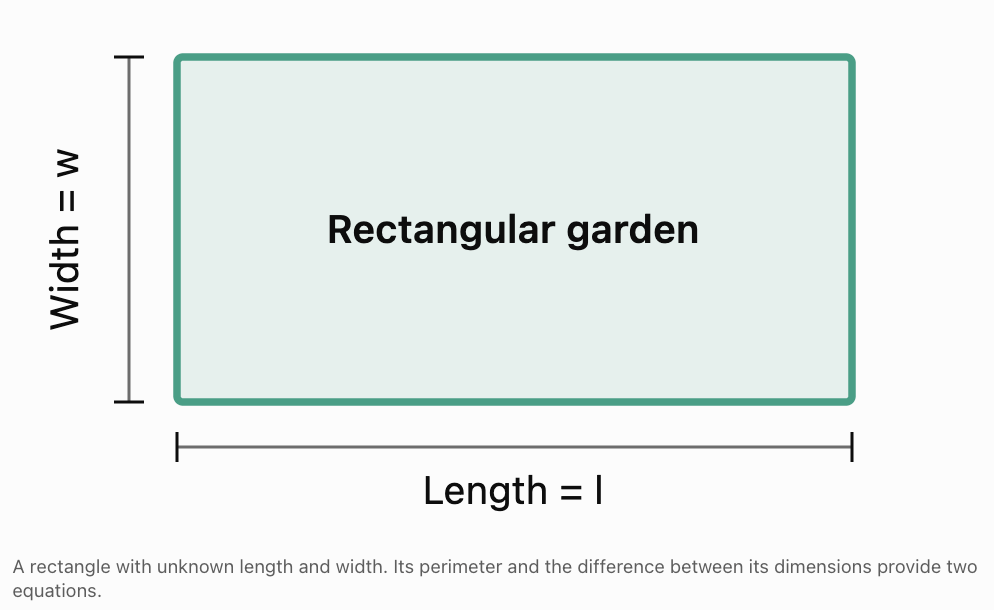
A rectangular garden has a perimeter of 52 m.
Its length is 6 m greater than its width.
Find the dimensions.
Step 1: Define variables
l = length of the garden, in metres
w = width of the garden, in metres
Step 2: Construct the perimeter equation
P = 2l + 2w
52 = 2l + 2w
Divide by 2:
l + w = 26
Step 3: Construct the second equation
The length is 6 m greater than the width.
l − w = 6
Step 4: Solve by elimination
l + w = 26
l − w = 6
Add:
2l = 32
l = 16
Substitute:
16 + w = 26
w = 10
Step 5: Verify
Perimeter:
2(16) + 2(10) = 52 m
Difference:
16 − 10 = 6 m
Both conditions are satisfied.
Answer: The garden is 16 m long and 10 m wide.
Geometric interpretation
The solution determines a unique rectangle satisfying both the perimeter and dimension conditions.
Its area is:
A = lw
A = 16(10)
A = 160 m²
The system provides dimensions that can be used for further calculations involving fencing, landscaping, or construction materials.
Application: Rectangle Dimensions from Area and Perimeter
Not all geometric systems are linear.
Suppose a rectangle has:
-
Perimeter = 34 cm.
-
Area = 60 cm².
Find its dimensions.
Step 1: Define variables
l = length, in cm
w = width, in cm
Step 2: Construct equations
Perimeter:
2l + 2w = 34
Simplify:
l + w = 17
Area:
lw = 60
Step 3: Substitute
From the perimeter equation:
l = 17 − w
Substitute into the area equation:
(17 − w)w = 60
17w − w² = 60
Rearrange:
w² − 17w + 60 = 0
Step 4: Factor
(w − 5)(w − 12) = 0
Therefore:
w = 5 or w = 12
If w = 5:
l = 12
If w = 12:
l = 5
These describe the same rectangle with its dimensions interchanged.
Answer: The rectangle measures 12 cm by 5 cm.
Verify
Perimeter:
2(12) + 2(5) = 34 cm
Area:
12(5) = 60 cm²
Important observation
The system contains a linear equation and a nonlinear equation.
Substitution transforms the system into a quadratic equation.
This demonstrates how systems of equations connect algebra and geometry.
Application: Finding Unknown Angles
Geometric angle relationships can be represented using systems of equations.
Worked Example: Complementary Angles
Two angles are complementary.
The larger angle is 18° greater than the smaller angle.
Find both angles.
Step 1: Define variables
x = larger angle, in degrees
y = smaller angle, in degrees
Step 2: Construct equations
Complementary angles add to 90°.
x + y = 90
The larger angle exceeds the smaller by 18°.
x − y = 18
Step 3: Solve
Add the equations:
2x = 108
x = 54
Then:
y = 90 − 54
y = 36
Step 4: Verify
54° + 36° = 90°
54° − 36° = 18°
Answer: The angles are 54° and 36°.
Application: Angles in a Triangle
The three interior angles of a triangle add to 180°.
Suppose:
-
The second angle is 20° greater than the first.
-
The third angle is twice the first.
Find all three angles.
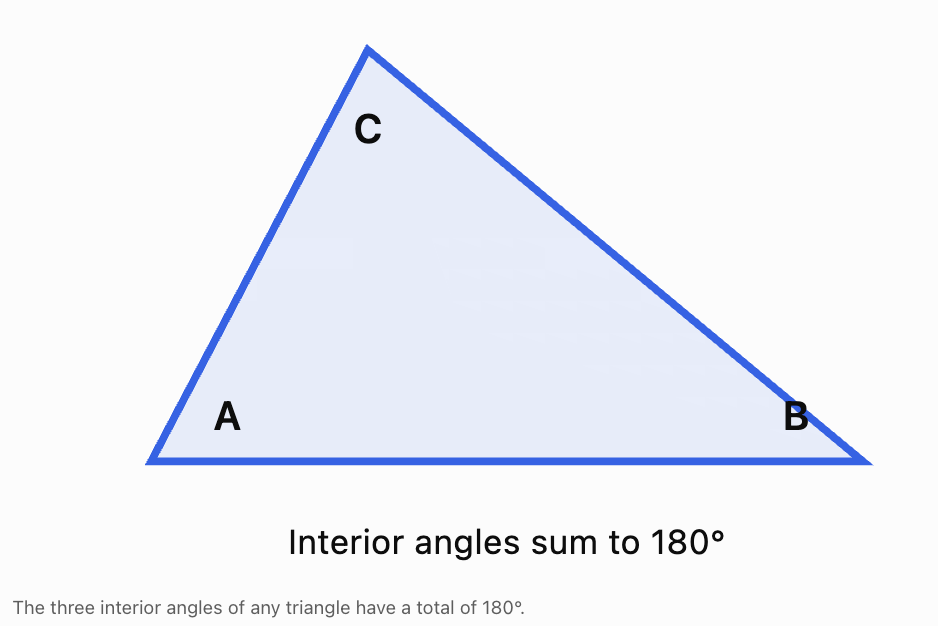
Step 1: Define variables
x = first angle
y = second angle
z = third angle
Step 2: Construct equations
Angle sum:
x + y + z = 180
Second angle relationship:
y = x + 20
Third angle relationship:
z = 2x
Step 3: Substitute
x + (x + 20) + 2x = 180
4x + 20 = 180
4x = 160
x = 40
Then:
y = 40 + 20 = 60
z = 2(40) = 80
Step 4: Verify
40° + 60° + 80° = 180°
60° − 40° = 20°
80° = 2(40°)
Answer: The triangle's angles are 40°, 60°, and 80°.
Geometric interpretation
All three angles are less than 90°, so the triangle is acute.
This example shows how a three-variable system can be solved efficiently using relationships between the variables.
Coordinate Geometry: Intersections of Straight Lines
In coordinate geometry, a straight line can be represented by an equation such as:
y = mx + b
where:
-
m = gradient or slope.
-
b = y-intercept.
-
x and y = coordinates of points on the line.
When two lines intersect, the intersection point satisfies both equations simultaneously.
Therefore, finding the intersection of two lines is equivalent to solving a system of equations.
Worked Example: Two Intersecting Lines
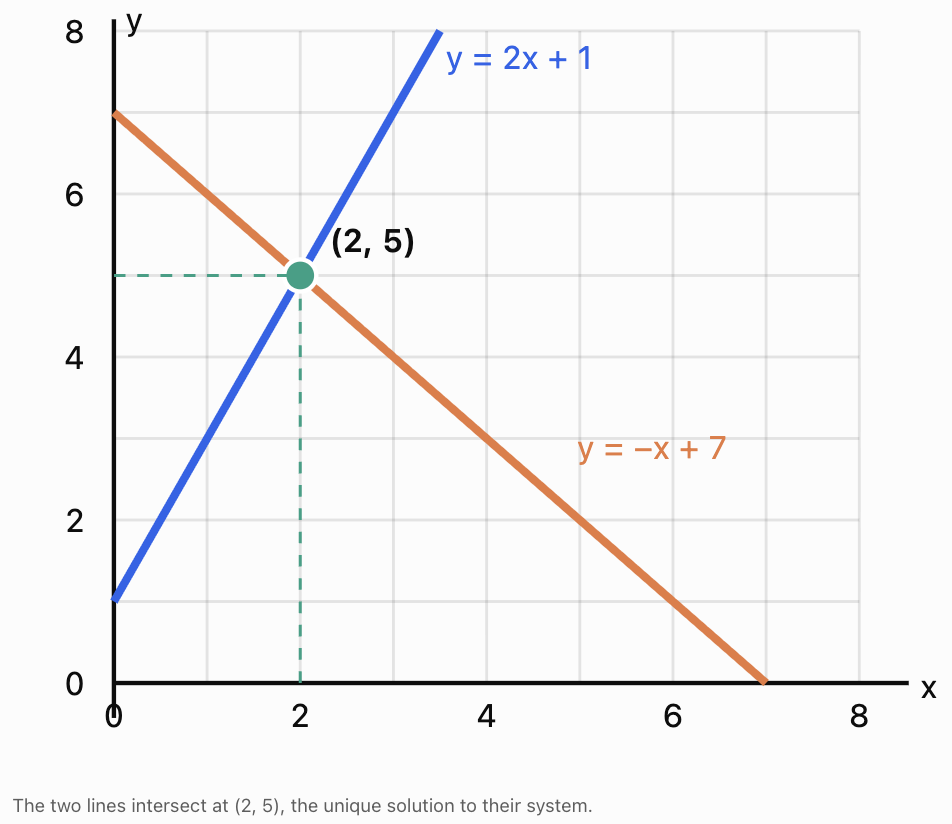
Find the intersection of:
y = 2x + 1
y = −x + 7
Step 1: Set the expressions equal
At the intersection, both equations have the same x-value and y-value.
2x + 1 = −x + 7
Step 2: Solve for x
3x = 6
x = 2
Step 3: Solve for y
y = 2(2) + 1
y = 5
Intersection: (2, 5).
Step 4: Verify
First equation:
5 = 2(2) + 1
Second equation:
5 = −2 + 7
Both are correct.
Geometric interpretation
The ordered pair (2, 5) represents a point that lies on both lines.
The x-coordinate is 2, and the y-coordinate is 5.
Because the lines have different gradients, they intersect at exactly one point.
Parallel and Coincident Lines
Not every pair of lines has one intersection.
Consider three possibilities.
|
Relationship |
Geometric meaning |
Number of solutions |
|---|---|---|
|
Intersecting lines |
Lines cross at one point |
One |
|
Distinct parallel lines |
Lines never meet |
None |
|
Coincident lines |
Both equations represent the same line |
Infinitely many |
Example: Parallel Lines
y = 3x + 2
y = 3x − 4
Setting the expressions equal:
3x + 2 = 3x − 4
2 = −4
This is impossible.
Conclusion: No solution.
Example: Coincident Lines
2x + 4y = 12
x + 2y = 6
Multiplying the second equation by 2 produces the first equation.
The equations represent the same line.
Conclusion: Infinitely many solutions.
Every point on that line satisfies both equations.
Application: Finding the Vertices of a Triangle
A triangle is formed by three lines:
Line A: y = x + 1
Line B: y = −x + 7
Line C: y = 2
Find the three vertices of the triangle.
Step 1: Find the intersection of A and B
x + 1 = −x + 7
2x = 6
x = 3
y = 4
First vertex:
P = (3, 4)
Step 2: Find the intersection of A and C
2 = x + 1
x = 1
Second vertex:
Q = (1, 2)
Step 3: Find the intersection of B and C
2 = −x + 7
x = 5
Third vertex:
R = (5, 2)
Step 4: Interpret geometrically
The vertices are:
P = (3, 4)
Q = (1, 2)
R = (5, 2)
Step 5: Calculate the area
The base QR lies horizontally along y = 2.
Its length is:
5 − 1 = 4 units
The vertical height from P to the base is:
4 − 2 = 2 units
Area of a triangle:
A = ½bh
A = ½(4)(2)
A = 4 square units
Verification
Check each vertex in its two corresponding line equations.
For P = (3, 4):
4 = 3 + 1
4 = −3 + 7
For Q = (1, 2):
2 = 1 + 1
2 = 2
For R = (5, 2):
2 = −5 + 7
2 = 2
All three vertices are correct.
Application: Finding the Intersection of a Line and a Circle
Systems can also contain nonlinear equations.
The equation of a circle with centre (h, k) and radius r is:
(x − h)² + (y − k)² = r²
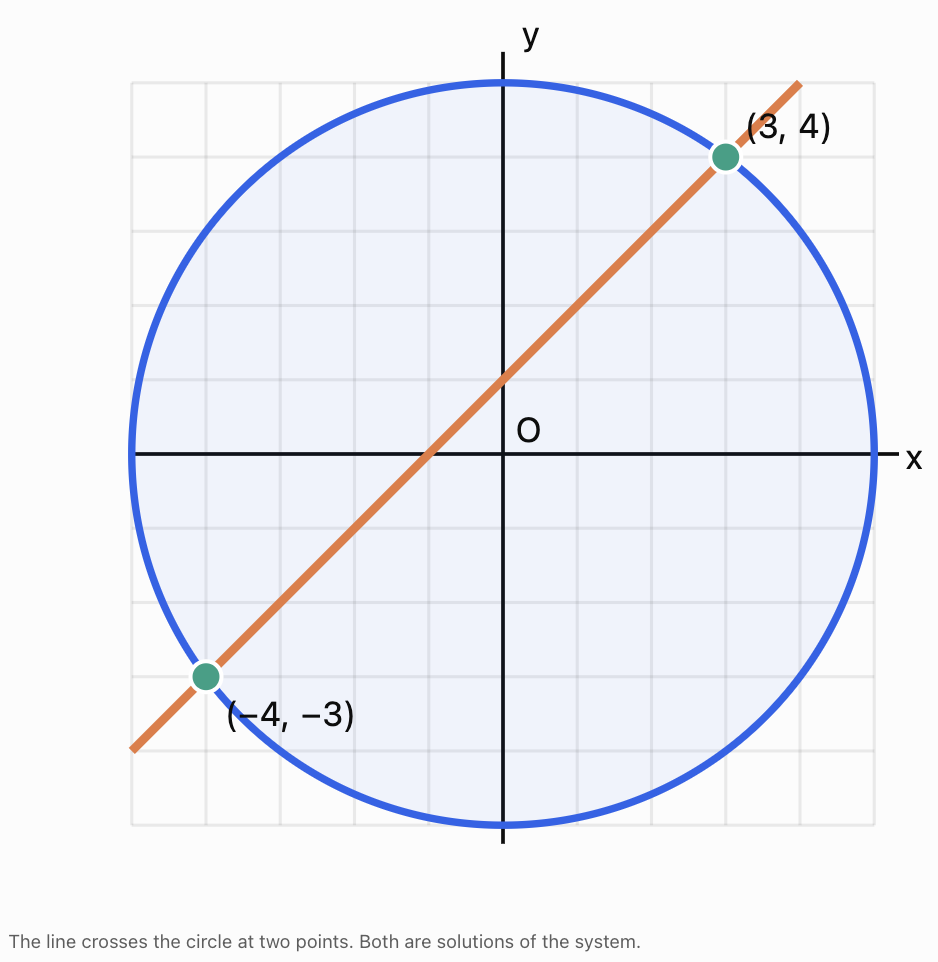
Suppose we want to find where the line:
y = x + 1
intersects the circle:
x² + y² = 25
Step 1: Substitute the line equation
Replace y with x + 1:
x² + (x + 1)² = 25
Step 2: Expand
x² + x² + 2x + 1 = 25
2x² + 2x − 24 = 0
Divide by 2:
x² + x − 12 = 0
Step 3: Factor
(x + 4)(x − 3) = 0
Therefore:
x = −4 or x = 3
Step 4: Find the corresponding y-values
If x = −4:
y = −4 + 1 = −3
If x = 3:
y = 3 + 1 = 4
Intersection points: (−4, −3) and (3, 4).
Step 5: Verify
For (−4, −3):
Circle:
(−4)² + (−3)² = 16 + 9 = 25
Line:
−3 = −4 + 1
For (3, 4):
Circle:
3² + 4² = 9 + 16 = 25
Line:
4 = 3 + 1
Both points satisfy both equations.
How many intersections are possible?
A straight line and a circle can have:
-
Two intersection points.
-
One intersection point, when the line is tangent.
-
No real intersection points.
The number of real solutions of the resulting quadratic equation determines the number of intersections.
Using the discriminant
For:
ax² + bx + c = 0
the discriminant is:
D = b² − 4ac
If:
-
D is positive: two distinct real intersections.
-
D = 0: one tangent intersection.
-
D is negative: no real intersections.
This provides a connection between quadratic equations and coordinate geometry.
Application: Finding an Unknown Point Using the Midpoint
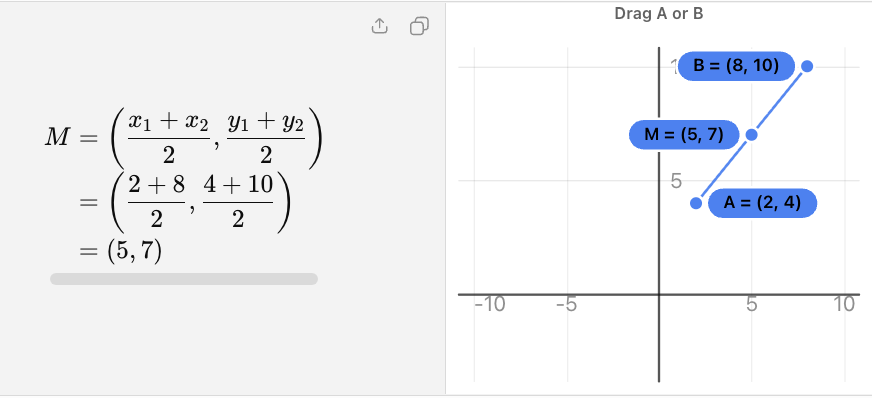
The midpoint of a line segment lies halfway between its endpoints.
For endpoints A(x₁, y₁) and B(x₂, y₂), the midpoint is:
M = ((x₁ + x₂)/2, (y₁ + y₂)/2)
Suppose a line segment has:
A = (2, 4)
M = (5, 7)
Find the coordinates of B.
Step 1: Define the unknown endpoint
B = (x, y)
Step 2: Construct equations
For the x-coordinate:
(2 + x)/2 = 5
For the y-coordinate:
(4 + y)/2 = 7
Step 3: Solve
2 + x = 10
x = 8
4 + y = 14
y = 10
Answer: B = (8, 10).
Verify
Midpoint of (2, 4) and (8, 10):
M = ((2 + 8)/2, (4 + 10)/2)
M = (5, 7)
The calculated endpoint is correct.
Geometric interpretation
The midpoint is exactly halfway between the endpoints in both coordinate directions.
The two coordinate equations can be solved independently because each involves a different unknown.
Application: Perpendicular Lines and Intersection Points
Two nonvertical lines are perpendicular when their gradients multiply to −1.
m₁m₂ = −1
Suppose a line passes through (2, 3) and has gradient 2.
Find the equation of the perpendicular line passing through (4, 1), and determine where the two lines intersect.
Step 1: Find the first line
Using point-slope form:
y − 3 = 2(x − 2)
y = 2x − 1
Step 2: Find the perpendicular gradient
The negative reciprocal of 2 is:
m = −1/2
Step 3: Find the second line
Through (4, 1):
y − 1 = −½(x − 4)
y = −½x + 3
Step 4: Solve the system
2x − 1 = −½x + 3
2.5x = 4
x = 8/5
Step 5: Find y
y = 2(8/5) − 1
y = 16/5 − 5/5
y = 11/5
Intersection: (8/5, 11/5).
Verify
First line:
2(8/5) − 1 = 11/5
Second line:
−½(8/5) + 3 = −4/5 + 15/5 = 11/5
Gradient product:
2(−1/2) = −1
Both the intersection and perpendicularity conditions are satisfied.
Geometric interpretation
The two lines meet at a right angle.
This method is useful when constructing perpendicular paths, locating perpendicular projections, or analysing geometric figures.
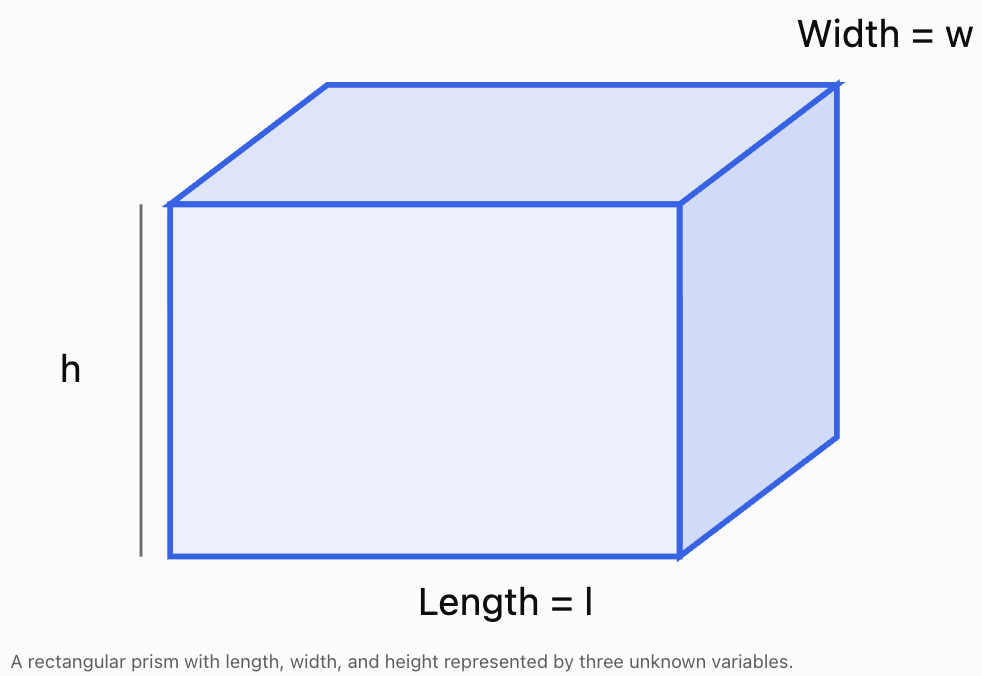
Application: Dimensions of a Rectangular Prism
Three-dimensional geometry can involve three unknown dimensions.
A rectangular storage box has:
-
Length + width + height = 24 cm.
-
Length is twice the width.
-
Height is 3 cm greater than the width.
Find the dimensions and volume.
Step 1: Define variables
l = length, in cm
w = width, in cm
h = height, in cm
Step 2: Construct equations
l + w + h = 24
l = 2w
h = w + 3
Step 3: Substitute
2w + w + (w + 3) = 24
4w + 3 = 24
4w = 21
w = 21/4 = 5.25 cm
Step 4: Find the remaining dimensions
l = 2(5.25) = 10.5 cm
h = 5.25 + 3 = 8.25 cm
Step 5: Verify
10.5 + 5.25 + 8.25 = 24 cm
10.5 = 2(5.25)
8.25 = 5.25 + 3
All conditions are satisfied.
Step 6: Calculate volume
V = lwh
V = 10.5 × 5.25 × 8.25
V = 454.78125 cm³
Interpretation
The box measures:
-
Length: 10.5 cm.
-
Width: 5.25 cm.
-
Height: 8.25 cm.
Its volume is approximately 454.78 cm³.
This type of modelling is useful in packaging, storage design, and construction.
Applications in Design, Architecture, and Engineering
Systems of equations are used extensively when geometric conditions must be satisfied simultaneously.
Architecture
Determine room dimensions, wall intersections, and layouts that satisfy multiple design constraints.
Engineering
Calculate geometric intersections, structural dimensions, and positions of connected components.
Computer-Aided Design
Use equations to locate intersections and construct precise geometric models.
Land Surveying
Determine positions and boundaries from coordinate measurements and geometric relationships.
Example: Locating Two Paths
Two straight paths are modelled by:
Path A: y = 0.5x + 2
Path B: y = −x + 8
Their intersection is found by solving:
0.5x + 2 = −x + 8
1.5x = 6
x = 4
Then:
y = 0.5(4) + 2
y = 4
The paths intersect at (4, 4).
If the coordinates are measured in metres from a defined origin, the intersection is 4 m east and 4 m north of that origin, assuming positive x points east and positive y points north.
In a real design, the coordinate system and measurement units must be clearly defined.
Using Technology to Verify Geometric Solutions
Graphing calculators and mathematical software can help visualise geometric systems.
For example, enter:
y = 2x + 1
y = −x + 7
into Desmos Graphing Calculator.
The graph shows the lines intersecting at (2, 5).
For a line-circle system, enter:
x² + y² = 25
y = x + 1
The graph displays two intersection points.
Benefits of technology
Technology can:
-
Display geometric relationships visually.
-
Estimate intersection coordinates.
-
Check algebraic solutions.
-
Investigate the effect of changing parameters.
-
Help identify the number of intersections.
Limitations
Graphing technology may display approximate values.
A poorly chosen graphing window may hide intersections.
Some intersections may be difficult to identify accurately from the graph alone.
Therefore, algebraic verification remains important.
Evaluating Geometric Solutions
A solution may satisfy an equation but still be inappropriate for the geometric situation.
Positive dimensions
Lengths, widths, heights, radii, and areas cannot be negative in ordinary geometric measurement.
For example, a quadratic equation might produce:
w = 5 or w = −3
If w represents a physical width, the negative solution must be rejected.
Angle restrictions
Interior angles of a nondegenerate triangle must be greater than 0° and less than 180°.
Three proposed angles must also add to 180°.
Coordinate order
The point (3, 5) is different from (5, 3).
Coordinate order must be preserved.
Extraneous solutions
Squaring equations or performing other non-equivalent transformations may introduce solutions that do not satisfy the original system.
Every candidate solution should be checked.
Geometric assumptions
A drawing may not be to scale.
Do not assume two lines are perpendicular or two lengths are equal unless this is given or established mathematically.
Units
Lengths are measured in units such as cm or m.
Areas are measured in square units such as cm² or m².
Volumes are measured in cubic units such as cm³ or m³.
Using incorrect units can make an otherwise correct numerical result incomplete.
Common Mistakes
Using the wrong perimeter formula
For a rectangle:
P = 2l + 2w
not l + w.
Confusing area and perimeter
Area measures the region enclosed by a shape, while perimeter measures the distance around it.
Forgetting angle-sum relationships
Triangle angles add to 180°, while quadrilateral angles add to 360°.
Reversing coordinate values
The point (x, y) must be written in the correct order.
Assuming every system is linear
Area and circle equations often produce nonlinear systems.
Ignoring multiple solutions
A line may intersect a circle at two points.
Both points must be included when valid.
Accepting negative dimensions
Negative lengths or widths are not valid physical dimensions.
Assuming a diagram is drawn to scale
Only use relationships given or justified by geometry.
Misinterpreting parallel lines
Parallel lines with different intercepts have no intersection.
Forgetting to verify intersections
A coordinate must satisfy both equations to be an intersection point.
Using incorrect units
Lengths, areas, and volumes require different types of units.
Relying only on graphing technology
Graphical answers may be approximate or incomplete.
Key Terms
-
System of equations: Two or more equations solved simultaneously.
-
Coordinate geometry: The study of geometric figures using coordinates and equations.
-
Cartesian plane: A coordinate plane with perpendicular x- and y-axes.
-
Ordered pair: A pair of coordinates written as (x, y).
-
Intersection point: A point shared by two or more geometric objects.
-
Gradient: The slope of a straight line.
-
Y-intercept: The point where a line crosses the y-axis.
-
Parallel lines: Coplanar lines that never intersect.
-
Perpendicular lines: Lines that meet at a right angle.
-
Coincident lines: Lines that occupy exactly the same position.
-
Perimeter: The total distance around a shape.
-
Area: The amount of two-dimensional space enclosed by a shape.
-
Volume: The amount of three-dimensional space occupied by an object.
-
Complementary angles: Two angles whose sum is 90°.
-
Supplementary angles: Two angles whose sum is 180°.
-
Midpoint: The point halfway between two endpoints.
-
Circle: The set of points at a fixed distance from a centre.
-
Radius: The distance from the centre of a circle to its boundary.
-
Tangent: A line that touches a circle at exactly one point.
-
Discriminant: The expression b² − 4ac, which helps determine the number of real roots of a quadratic equation.
-
Nonlinear system: A system containing at least one nonlinear equation.
-
Extraneous solution: A solution introduced during algebraic manipulation that does not satisfy the original problem.
-
Geometric constraint: A condition restricting possible dimensions, angles, or positions.
-
Verification: Checking that a solution satisfies the original equations and geometric conditions.
Key Takeaways
-
Systems of equations can model lengths, widths, angles, coordinates, and dimensions.
-
Geometric properties provide relationships that can be expressed as equations.
-
Rectangle problems may involve perimeter, area, and dimension relationships.
-
Angle problems can use triangle angle sums and relationships between angles.
-
The intersection of two lines is a solution common to both line equations.
-
Parallel lines have no intersection, while coincident lines have infinitely many shared points.
-
Triangle vertices can be found by solving pairs of line equations.
-
A line and a circle may have zero, one, or two real intersection points.
-
Midpoint relationships can be used to find unknown coordinates.
-
Three-variable systems can determine the dimensions of three-dimensional objects.
-
Geometric solutions must satisfy relevant restrictions and use correct units.
-
Verification is essential for confirming that calculated values represent valid geometric results.
Check Your Understanding
Recall and Understanding
1. Explain how a system of equations can be used to determine the dimensions of a rectangle.
2. What does the solution to a system of two straight-line equations represent geometrically?
3. Explain the difference between intersecting, parallel, and coincident lines.
4. Why might a line-circle system have two solutions?
5. Why must negative solutions sometimes be rejected in geometric problems?
Rectangle and Angle Problems
6. A rectangle has a perimeter of 48 cm.
Its length is 8 cm greater than its width.
Find its dimensions and area.
7. A rectangle has a perimeter of 30 cm and an area of 54 cm².
Find its dimensions.
8. Two complementary angles differ by 24°.
Find both angles.
9. The second angle of a triangle is 15° greater than the first.
The third angle is twice the first.
Find all three angles.
10. Three angles of a quadrilateral are x, x + 20°, and 2x. The fourth angle is 100°.
Find all four angles.
Coordinate Geometry
11. Find the intersection of:
y = 3x − 2
y = −x + 10
12. Determine the number of solutions:
y = 4x + 3
y = 4x − 7
13. Determine the number of solutions:
2x + 6y = 18
x + 3y = 9
14. Find the vertices of the triangle formed by:
y = x
y = −x + 6
y = 1
15. Find the intersection points of:
x² + y² = 25
y = 3
Applications and Challenge
16. A line segment has endpoint A = (3, 5) and midpoint M = (7, 9).
Find the other endpoint.
17. A line has gradient 3 and passes through (1, 2).
Find the equation of the perpendicular line passing through (4, 5), then determine the intersection of the two lines.
18. A rectangular prism has length, width, and height whose sum is 30 cm.
The length is twice the width.
The height is 6 cm greater than the width.
Find its dimensions and volume.
19. Find the intersection points of:
y = x + 2
x² + y² = 20
20. A rectangular garden has a perimeter of 60 m and an area of 200 m².
Find its dimensions and explain how you verify the result.
Answers to Check Your Understanding
1. Rectangle dimensions
Define variables for length and width.
Use geometric information, such as perimeter and a relationship between the dimensions, to construct two equations.
Solve the system and verify that the dimensions satisfy the original conditions.
2. Intersection of two lines
The solution represents the coordinates of a point lying on both lines.
For example, (3, 5) means both lines pass through x = 3, y = 5.
3. Types of lines
Intersecting lines cross at one point and have one solution.
Distinct parallel lines never meet and have no solution.
Coincident lines represent the same line and have infinitely many solutions.
4. Line-circle intersections
A line can pass through a circle at two different points.
Both intersection points satisfy the line equation and circle equation.
The resulting quadratic equation may therefore have two distinct real solutions.
5. Negative geometric values
Physical dimensions such as lengths, widths, and radii cannot be negative.
Therefore, a negative algebraic solution must be rejected when it represents an invalid dimension.
Negative coordinates, however, can be perfectly valid.
6. Rectangle perimeter
Let:
l = length
w = width
Perimeter:
2l + 2w = 48
l + w = 24
Difference:
l − w = 8
Add:
2l = 32
l = 16
Then:
w = 8
Area:
A = 16(8) = 128 cm²
Answer: Length = 16 cm, width = 8 cm, area = 128 cm².
7. Rectangle area and perimeter
Perimeter:
2l + 2w = 30
l + w = 15
Area:
lw = 54
Substitute l = 15 − w:
(15 − w)w = 54
15w − w² = 54
w² − 15w + 54 = 0
(w − 6)(w − 9) = 0
Therefore:
w = 6 or w = 9
Answer: The rectangle measures 9 cm by 6 cm.
Verification:
2(9) + 2(6) = 30 cm
9(6) = 54 cm²
8. Complementary angles
Let:
x = larger angle
y = smaller angle
Equations:
x + y = 90
x − y = 24
Add:
2x = 114
x = 57
Then:
y = 33
Answer: 57° and 33°.
9. Triangle angles
Let the first angle be x.
Second angle:
x + 15
Third angle:
2x
Angle sum:
x + (x + 15) + 2x = 180
4x + 15 = 180
4x = 165
x = 41.25
Second angle:
56.25°
Third angle:
82.5°
Answer: 41.25°, 56.25°, and 82.5°.
Verification:
41.25 + 56.25 + 82.5 = 180°
10. Quadrilateral angles
Angle sum:
x + (x + 20) + 2x + 100 = 360
4x + 120 = 360
4x = 240
x = 60
Therefore:
First angle = 60°
Second angle = 80°
Third angle = 120°
Fourth angle = 100°
Answer: 60°, 80°, 120°, and 100°.
Verification:
60 + 80 + 120 + 100 = 360°
11. Intersection of two lines
Equations:
y = 3x − 2
y = −x + 10
Set equal:
3x − 2 = −x + 10
4x = 12
x = 3
Then:
y = 3(3) − 2 = 7
Answer: (3, 7).
Verification:
7 = −3 + 10
12. Parallel lines
Equations:
y = 4x + 3
y = 4x − 7
Both lines have gradient 4 but different y-intercepts.
Answer: No solution.
13. Coincident lines
Equations:
2x + 6y = 18
x + 3y = 9
Multiplying the second equation by 2 gives the first.
Answer: Infinitely many solutions.
14. Triangle vertices
Lines:
y = x
y = −x + 6
y = 1
First intersection:
x = −x + 6
2x = 6
x = 3
y = 3
First vertex: (3, 3)
Second intersection:
1 = x
Second vertex: (1, 1)
Third intersection:
1 = −x + 6
x = 5
Third vertex: (5, 1)
Answer: (3, 3), (1, 1), and (5, 1).
15. Line-circle intersections
Circle:
x² + y² = 25
Line:
y = 3
Substitute:
x² + 3² = 25
x² + 9 = 25
x² = 16
x = ±4
Answer: (−4, 3) and (4, 3).
Verification:
16 + 9 = 25 for both points.
16. Unknown endpoint
Given:
A = (3, 5)
M = (7, 9)
Let the other endpoint be B = (x, y).
Midpoint equations:
(3 + x)/2 = 7
(5 + y)/2 = 9
Solve:
3 + x = 14
x = 11
5 + y = 18
y = 13
Answer: B = (11, 13).
17. Perpendicular lines
The first line has gradient 3 and passes through (1, 2).
Using point-slope form:
y − 2 = 3(x − 1)
y = 3x − 1
The perpendicular gradient is:
−1/3
Through (4, 5):
y − 5 = −⅓(x − 4)
y = −x/3 + 19/3
Find the intersection:
3x − 1 = −x/3 + 19/3
Multiply by 3:
9x − 3 = −x + 19
10x = 22
x = 11/5
Substitute:
y = 3(11/5) − 1
y = 28/5
Answer: The perpendicular line is y = −x/3 + 19/3, and the intersection is (11/5, 28/5).
Verification:
3(−1/3) = −1
The gradients confirm that the lines are perpendicular.
18. Rectangular prism
Let:
l = length
w = width
h = height
Equations:
l + w + h = 30
l = 2w
h = w + 6
Substitute:
2w + w + (w + 6) = 30
4w + 6 = 30
4w = 24
w = 6
Then:
l = 12
h = 12
Volume:
V = lwh
V = 12(6)(12)
V = 864 cm³
Answer: Length = 12 cm, width = 6 cm, height = 12 cm, volume = 864 cm³.
19. Line-circle intersections
Given:
y = x + 2
x² + y² = 20
Substitute:
x² + (x + 2)² = 20
Expand:
x² + x² + 4x + 4 = 20
2x² + 4x − 16 = 0
Divide by 2:
x² + 2x − 8 = 0
Factor:
(x + 4)(x − 2) = 0
Therefore:
x = −4 or x = 2
If x = −4:
y = −2
If x = 2:
y = 4
Answer: (−4, −2) and (2, 4).
Verification:
For (−4, −2):
16 + 4 = 20
For (2, 4):
4 + 16 = 20
Both points also satisfy y = x + 2.
20. Rectangular garden
Given:
Perimeter = 60 m
Area = 200 m²
Let:
l = length
w = width
Perimeter:
2l + 2w = 60
l + w = 30
Area:
lw = 200
Substitute:
l = 30 − w
(30 − w)w = 200
30w − w² = 200
w² − 30w + 200 = 0
Factor:
(w − 10)(w − 20) = 0
Therefore:
w = 10 or w = 20
The dimensions are interchangeable.
Answer: The garden measures 20 m by 10 m.
Verification:
Perimeter:
2(20) + 2(10) = 60 m
Area:
20(10) = 200 m²
Both original conditions are satisfied.
Final Summary
Systems of equations provide a powerful connection between algebra and geometry. They allow us to determine unknown dimensions, calculate angles, find intersections, locate vertices, and analyse geometric figures in two and three dimensions.
Some geometric systems are linear, while others involve quadratic equations or additional geometric relationships.
The most important part of solving these problems is constructing equations that accurately represent the geometric conditions.
Once a solution has been obtained, it should be verified using the original equations, relevant geometric properties, and appropriate units.
Successful geometric problem-solving combines algebraic accuracy, visual understanding, and careful interpretation of mathematical results.