Systems with Three Variables
5. Error Analysis
Learning outcomes
- I can identify common mistakes when solving systems.
- I can explain why incorrect methods fail.
- I can correct algebraic errors.
- I can evaluate completed solutions.
- I can improve my problem-solving accuracy.
Error Analysis: Solving Systems of Equations
Introduction
Solving systems of equations requires more than knowing how to use substitution, elimination, or graphing. It also requires the ability to recognise mistakes, explain why they occur, and correct them.
Even a small algebraic error can produce a completely different solution. A missing negative sign, an incorrectly distributed coefficient, or a substitution error may cause an otherwise correct method to fail.
For example, consider the system:
x + y = 10
x − y = 4
The correct solution is:
x = 7
y = 3
However, a student who makes a sign error during elimination might obtain x = 3 and y = 7.
Although these numbers add to 10, they do not satisfy the second equation:
3 − 7 = −4, not 4.
This demonstrates an important principle:
A solution to a system must satisfy every original equation, not just one of them.
Error analysis helps us become more accurate and independent mathematical problem-solvers. By examining incorrect work, we can understand why particular methods fail and develop strategies to prevent similar mistakes.
What Is Error Analysis?
Error analysis is the process of examining mathematical work to identify, explain, and correct mistakes.
It involves four important questions:
-
What was the student trying to do?
-
Where did the first mistake occur?
-
Why is that step incorrect?
-
How can the solution be corrected and verified?
The goal is not simply to identify a wrong answer. It is to understand the reasoning that produced the mistake.
Three Types of Errors
|
Error type |
Description |
Example |
|---|---|---|
|
Conceptual error |
Misunderstanding a mathematical idea |
Believing that a solution only needs to satisfy one equation |
|
Procedural error |
Applying a method incorrectly |
Multiplying only some terms when eliminating |
|
Arithmetic error |
Making a calculation mistake |
Calculating 8 − (−3) as 5 |
Some mistakes involve more than one category.
For example, subtracting a negative incorrectly may be an arithmetic mistake, but repeated errors could indicate a conceptual misunderstanding of negative numbers.
A Systematic Method for Finding Errors
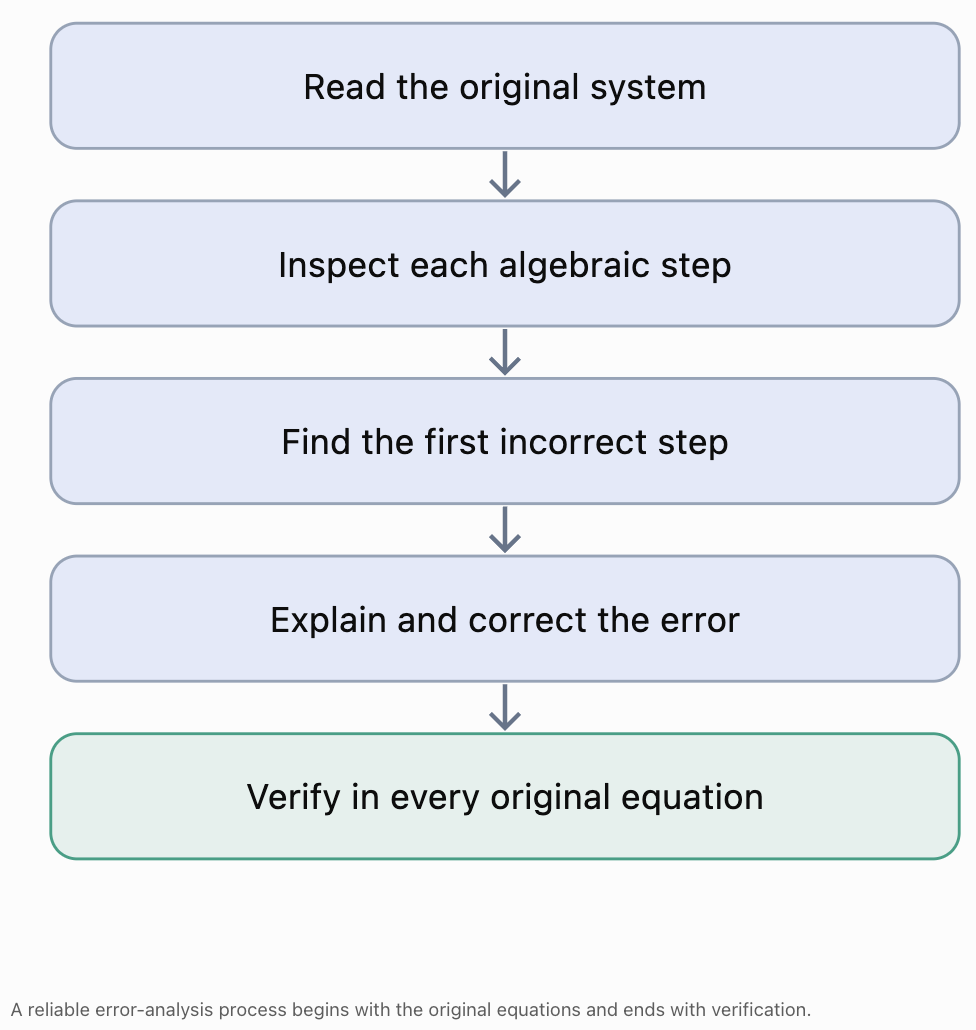
Why identify the first incorrect step?
Later steps may be mathematically correct based on an earlier mistake.
For example:
2x = 10
x = 5
These steps are correct.
But if the equation 2x = 10 was produced by incorrectly subtracting two earlier equations, the final answer may still be wrong.
Therefore, finding the first incorrect step is more useful than simply marking the final answer incorrect.
Error 1: Incorrectly Adding or Subtracting Equations
Consider:
x + y = 12
x − y = 4
A student writes:
(x + y) + (x − y) = 12 + 4
2x = 8
x = 4
Identify the error
The student combined the variables correctly:
(x + y) + (x − y) = 2x
However, the constants were added incorrectly.
12 + 4 = 16, not 8.
Correct solution
Add the equations:
2x = 16
x = 8
Substitute into the first equation:
8 + y = 12
y = 4
Correct answer: (8, 4).
Verify
8 + 4 = 12
8 − 4 = 4
Both equations are satisfied.
Prevention strategy
When adding or subtracting equations, treat the variables and constants as separate columns.
|
x terms |
y terms |
Constants |
|---|---|---|
|
x |
+y |
12 |
|
x |
−y |
4 |
|
2x |
0 |
16 |
This organisation helps prevent arithmetic mistakes.
Error 2: Forgetting to Distribute a Negative Sign
Consider:
3x + 2y = 16
x + 2y = 8
A student subtracts the second equation from the first:
(3x + 2y) − (x + 2y) = 16 − 8
But writes:
3x − x + 2y + 2y = 8
2x + 4y = 8
Identify the error
The negative sign outside the second set of parentheses must apply to every term.
The correct expression is:
3x + 2y − x − 2y = 8
The +2y and −2y cancel.
Correct solution
2x = 8
x = 4
Substitute into:
x + 2y = 8
4 + 2y = 8
2y = 4
y = 2
Correct answer: (4, 2).
Verify
3(4) + 2(2) = 16
4 + 2(2) = 8
Prevention strategy
Rewrite subtraction as addition of the opposite equation.
For example:
3x + 2y = 16
−x − 2y = −8
Add:
2x = 8
This makes the sign changes easier to see.
Error 3: Multiplying Only Part of an Equation
Consider:
2x + 3y = 12
3x − y = 5
A student wants to eliminate y.
They multiply the second equation by 3 but write:
3x − 3y = 15
Identify the error
The student multiplied −y and 5 by 3 but forgot to multiply 3x.
Every term must be multiplied by the same number.
The correct multiplication is:
3(3x − y) = 3(5)
9x − 3y = 15
Correct solution
Original first equation:
2x + 3y = 12
Modified second equation:
9x − 3y = 15
Add:
11x = 27
x = 27/11
Substitute into:
3x − y = 5
3(27/11) − y = 5
81/11 − y = 55/11
y = 26/11
Correct answer: (27/11, 26/11).
Verify
2(27/11) + 3(26/11)
= 54/11 + 78/11
= 132/11 = 12
3(27/11) − 26/11
= 81/11 − 26/11
= 55/11 = 5
Prevention strategy
Write the multiplier outside parentheses before simplifying:
3(3x − y) = 3(5)
This makes it clear that every term must be multiplied.
Error 4: Substituting into the Wrong Expression
Consider:
x + y = 9
2x − y = 6
A student rearranges the first equation:
x = 9 − y
Then substitutes into the second equation:
2(9 − y) − y = 6
However, the student writes:
18 − 2y + y = 6
Identify the error
The expression contains −y outside the parentheses.
It should remain negative.
The correct expansion is:
18 − 2y − y = 6
Correct solution
18 − 3y = 6
−3y = −12
y = 4
Then:
x = 9 − 4
x = 5
Correct answer: (5, 4).
Verify
5 + 4 = 9
2(5) − 4 = 6
Prevention strategy
Use parentheses when substituting expressions, especially those containing negative terms.
Do not remove parentheses until the signs have been handled carefully.
Error 5: Incorrectly Rearranging an Equation
Consider:
3x + 2y = 14
A student attempts to isolate y:
2y = 14 + 3x
y = 7 + 3x/2
Identify the error
To move +3x to the other side, subtract 3x from both sides.
The correct equation is:
2y = 14 − 3x
Therefore:
y = 7 − 3x/2
Why the mistake matters
An incorrect rearrangement changes the relationship represented by the equation.
If the incorrect expression is used in substitution, every later calculation may be wrong.
Prevention strategy
Think in terms of performing the same operation on both sides rather than simply "moving terms."
For example:
3x + 2y = 14
Subtract 3x from both sides:
2y = 14 − 3x
Divide both sides by 2:
y = (14 − 3x)/2
y = 7 − 3x/2
Error 6: Dividing Only One Term
Consider:
4x + 8y = 20
A student divides by 4 and writes:
x + 8y = 5
Identify the error
Every term must be divided by 4.
Correct division:
(4x)/4 + (8y)/4 = 20/4
Therefore:
x + 2y = 5
Prevention strategy
When dividing an equation by a number, show the division for every term.
The same principle applies when simplifying equations with three variables.
For example:
6x + 9y − 3z = 15
Divide every term by 3:
2x + 3y − z = 5
Error 7: Confusing the Order of Coordinates
Suppose a student correctly solves:
x = 3
y = 7
But writes:
(7, 3)
Identify the error
An ordered pair must be written in the order:
(x, y)
Therefore, the correct ordered pair is:
(3, 7)
For three-variable systems, the usual order is:
(x, y, z)
If:
x = 2
y = 5
z = 8
then the ordered triple is:
(2, 5, 8)
Prevention strategy
Write the variable labels immediately before giving the final ordered pair or triple.
Error 8: Assuming a Solution Only Needs to Satisfy One Equation
Consider:
x + y = 10
2x − y = 8
A student proposes:
x = 6
y = 4
Check the first equation
6 + 4 = 10
Correct.
Check the second equation
2(6) − 4 = 8
Correct.
In this case, the proposed solution is valid.
Now consider another proposed answer:
x = 7
y = 3
First equation:
7 + 3 = 10
Correct.
Second equation:
2(7) − 3 = 11
Incorrect.
Therefore, (7, 3) is not a solution.
Important principle
A solution to a system must satisfy all equations simultaneously.
This is one of the most important checks in error analysis.
Error 9: Incorrectly Interpreting Parallel Lines
Consider:
y = 2x + 3
y = 2x − 5
A student says:
"The lines have the same slope, so they have infinitely many solutions."
Identify the error
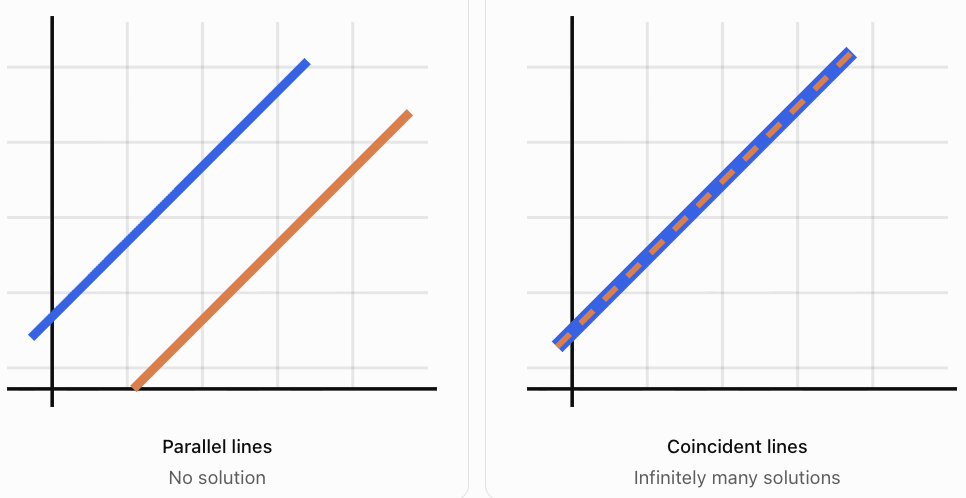
Having the same slope does not automatically mean the lines are identical.
The slopes are equal, but the y-intercepts are different.
Therefore, the lines are parallel and distinct.
They never intersect.
Correct answer: No solution.
Comparing parallel and coincident lines
Prevention strategy
Compare both slopes and intercepts.
-
Same slope, different intercepts: no solution.
-
Same slope, same intercept: infinitely many solutions.
-
Different slopes: one solution.
Error 10: Misinterpreting a Contradiction
Consider:
2x + 3y = 12
4x + 6y = 30
A student multiplies the first equation by 2:
4x + 6y = 24
Then subtracts the second equation:
0 = −6
The student concludes:
"x = 0 and y = −6."
Identify the error
The expression 0 = −6 is not an equation involving x and y.
It is an impossible statement.
This means the original equations contradict each other.
Correct conclusion: The system has no solution.
Prevention strategy
Recognise that:
0 = a nonzero number
indicates an inconsistent system.
Error 11: Misinterpreting an Identity
Consider:
x + 2y = 6
2x + 4y = 12
Multiply the first equation by 2:
2x + 4y = 12
Subtract the second:
0 = 0
A student concludes:
"The answer is x = 0 and y = 0."
Identify the error
The statement 0 = 0 is always true.
It does not mean that the variables equal zero.
It indicates that the two equations represent the same relationship.
The system has infinitely many solutions.
Expressing the solutions
From:
x + 2y = 6
x = 6 − 2y
Let y = t.
Then:
x = 6 − 2t
The solutions are:
(6 − 2t, t)
where t is any real number.
Important distinction
|
Result during elimination |
Meaning |
|---|---|
|
0 = 5 |
Contradiction: no solution |
|
0 = 0 |
Redundant equation; further analysis is needed |
|
x = 4 |
A variable has been determined |
For a two-variable system of two linear equations, an identity after elimination means infinitely many solutions, provided the remaining equation is consistent.
For larger systems, an identity does not automatically guarantee infinitely many solutions because other equations may still impose restrictions or contradictions.
Error 12: Eliminating Different Variables in a Three-Variable System
Consider:
x + y + z = 12
2x − y + z = 7
x + 2y − z = 6
A student eliminates z from the first two equations:
x − 2y = −5
Then eliminates x from the first and third equations:
−y + 2z = 6
The student tries to solve these two equations as a two-variable system.
Identify the error
The first reduced equation contains x and y.
The second reduced equation contains y and z.
Together, they still involve three unknowns.
The elimination process has not reduced the system to two equations in the same two variables.
Correct method
Eliminate z from the first two equations:
(2x − y + z) − (x + y + z) = 7 − 12
x − 2y = −5
Now eliminate z from the first and third equations:
(x + y + z) + (x + 2y − z) = 12 + 6
2x + 3y = 18
Solve:
x − 2y = −5
2x + 3y = 18
Multiply the first equation by 2:
2x − 4y = −10
Subtract:
7y = 28
y = 4
Then:
x − 8 = −5
x = 3
Use the first original equation:
3 + 4 + z = 12
z = 5
Correct answer: (3, 4, 5).
Verify
3 + 4 + 5 = 12
2(3) − 4 + 5 = 7
3 + 2(4) − 5 = 6
Prevention strategy
When solving three-variable systems by elimination, eliminate the same variable from two different pairs of equations.
This produces two equations involving the same two remaining variables.
Error 13: Forgetting a Zero Coefficient
Consider:
2x + 3z = 12
x + y + z = 9
3x − y + 2z = 13
A student enters the first equation into a calculator as:
2x + 3y + 0z = 12
Identify the error
The first equation does not contain y.
Therefore, the coefficient of y is zero.
The correct form is:
2x + 0y + 3z = 12
Correct coefficient table
|
Equation |
x |
y |
z |
Constant |
|---|---|---|---|---|
|
2x + 3z = 12 |
2 |
0 |
3 |
12 |
|
x + y + z = 9 |
1 |
1 |
1 |
9 |
|
3x − y + 2z = 13 |
3 |
−1 |
2 |
13 |
Prevention strategy
Before entering a system into technology, write every equation in the same variable order:
ax + by + cz = d
Include zero coefficients for missing variables.
Error 14: Rounding Too Early
Consider:
3x = 10
A student calculates:
x = 3.33
Then uses this rounded value in another equation:
2x + y = 12
2(3.33) + y = 12
y = 5.34
Identify the error
The exact value of x is:
x = 10/3
Using 3.33 introduces a small rounding error.
Correct solution
2(10/3) + y = 12
20/3 + y = 36/3
y = 16/3
Therefore:
(x, y) = (10/3, 16/3)
Decimal approximations:
x ≈ 3.3333
y ≈ 5.3333
Prevention strategy
Use exact fractions whenever possible.
Round only when presenting the final answer, unless the problem specifically requires an approximate result.
Error 15: Trusting Technology Without Verification
A calculator gives the solution:
x = 2
y = 3
for the system:
2x + y = 7
x + 2y = 9
Check the first equation
2(2) + 3 = 7
Correct.
Check the second equation
2 + 2(3) = 8
But the original equation requires 9.
The calculator output does not satisfy the system.
Correct solution
From the first equation:
y = 7 − 2x
Substitute into the second:
x + 2(7 − 2x) = 9
x + 14 − 4x = 9
−3x = −5
x = 5/3
Then:
y = 7 − 2(5/3)
y = 11/3
Correct answer: (5/3, 11/3).
Verify
2(5/3) + 11/3 = 21/3 = 7
5/3 + 2(11/3) = 27/3 = 9
Why might technology give an incorrect result?
Possible reasons include:
-
An equation was entered incorrectly.
-
A coefficient was omitted.
-
A negative sign was entered incorrectly.
-
The output was copied incorrectly.
-
The student read the wrong coordinate or variable.
Technology is useful, but the user remains responsible for checking the result.
Error 16: Incorrectly Translating Word Problems
A school sells adult and student tickets.
Adult tickets cost $12.
Student tickets cost $8.
A total of 100 tickets are sold.
The total revenue is $960.
A student defines:
a = adult tickets
s = student tickets
Then writes:
a + s = 100
12a + 8s = 100
Identify the error
The first equation correctly represents the total number of tickets.
The second equation should represent total revenue, which is $960, not 100 tickets.
Correct equations
a + s = 100
12a + 8s = 960
Solve
Multiply the first equation by 8:
8a + 8s = 800
Subtract from the revenue equation:
4a = 160
a = 40
Then:
s = 60
Verify
40 + 60 = 100 tickets
12(40) + 8(60)
= 480 + 480
= $960
Correct answer: 40 adult tickets and 60 student tickets.
Prevention strategy
Write the meaning and units beside each equation.
For example:
a + s = 100 tickets
12a + 8s = $960
This helps prevent mixing quantities with monetary values.
Error 17: Accepting an Unrealistic Solution
Suppose a system representing ticket sales produces:
a = 25.5
s = 40
c = 34.5
These values may satisfy the equations algebraically.
However, tickets are counted in whole numbers.
A school cannot sell half of an individual ticket if the variables represent numbers of complete tickets.
Correct interpretation
The system has an algebraic solution, but the solution is not valid under the real-world requirement that ticket counts be nonnegative integers.
This may indicate that the original data or assumptions need to be reviewed.
Prevention strategy
After solving, ask:
-
Are the values positive or nonnegative when required?
-
Must the answers be whole numbers?
-
Are the units correct?
-
Do the values satisfy any maximum or minimum limits?
-
Do the results make sense in context?
Error 18: Incorrectly Reading a Graph
Suppose two lines intersect at:
(4, 7)
A student reads the solution as:
x = 7
y = 4
Identify the error
Coordinates are written in the order:
(x, y)
Therefore:
x = 4
y = 7
Other graphing errors
Students may also:
-
Misread the scale of an axis.
-
Assume every grid square represents one unit.
-
Estimate an intersection inaccurately.
-
Confuse the x-intercept with the solution.
-
Mistake parallel lines for intersecting lines when the graph is zoomed out.
Prevention strategy
Read the axis labels and scales carefully.
Whenever possible, use a graphing tool's intersection feature and verify the coordinates algebraically.
Error 19: Assuming a System Has a Unique Solution
Consider:
x + y = 10
2x + 2y = 20
A student tries to solve for x and y and concludes:
x = 5
y = 5
Identify the error
The ordered pair (5, 5) satisfies both equations, but it is not the only solution.
Other solutions include:
(4, 6)
(3, 7)
(8, 2)
The second equation is twice the first.
Both represent the same line.
Therefore, the system has infinitely many solutions.
Correct answer
From:
x + y = 10
y = 10 − x
The general solution is:
(x, y) = (t, 10 − t)
where t is any real number.
Prevention strategy
Before concluding that a system has one solution, check whether the equations are independent.
Evaluating Completed Solutions
When reviewing another student's work, it is helpful to use a structured checklist.
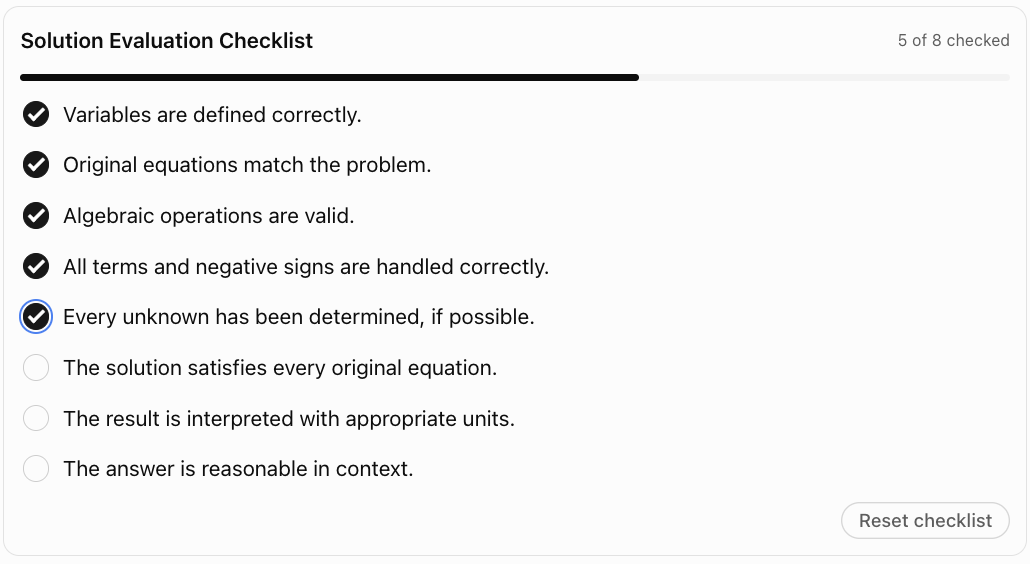
A solution should not be considered complete until these checks have been considered.
Strategies for Improving Accuracy
Work in clearly labelled steps
Label original equations A, B, and C.
Label reduced equations D and E.
This makes multi-step work easier to follow.
Keep equations aligned
Write matching variable terms beneath one another.
For example:
2x + 3y = 12
4x − 3y = 18
Adding gives:
6x = 30
x = 5
Use parentheses carefully
When subtracting equations or substituting expressions, parentheses help preserve signs.
Avoid unnecessary decimals
Fractions often produce more accurate answers than rounded decimals.
Estimate before solving
If a word problem involves positive prices or quantities, consider whether the final answer should be positive.
Check with a second method
If you solve using elimination, verify using substitution or technology.
Always return to the original equations
Checking only the reduced equations may fail to reveal an earlier mistake.
Explain why an error occurred
Understanding the cause of a mistake helps prevent it from happening again.
Common Mistakes Summary
|
Mistake |
Why it fails |
How to prevent it |
|---|---|---|
|
Sign error |
Changes the equation |
Use parentheses and rewrite subtraction carefully |
|
Incorrect distribution |
Changes coefficients |
Multiply every term |
|
Incorrect rearrangement |
Changes the relationship |
Perform the same operation on both sides |
|
Wrong substitution |
Produces an incorrect expression |
Substitute using parentheses |
|
Incorrect elimination |
Fails to remove the intended variable |
Align coefficients before combining |
|
Coordinate reversal |
Assigns values to wrong variables |
Write answers in (x, y) or (x, y, z) order |
|
Misreading a graph |
Gives incorrect coordinates |
Check scales and intersection tools |
|
Misinterpreting 0 = 0 |
Treats an identity as a numerical solution |
Check for dependent equations |
|
Misinterpreting 0 = 5 |
Treats a contradiction as variable values |
Recognise inconsistency |
|
Early rounding |
Introduces numerical error |
Keep exact values |
|
Incorrect model |
Misrepresents the problem |
Define variables and units |
|
No verification |
Allows errors to remain undetected |
Check every original equation |
Key Terms
-
Error analysis: The process of identifying, explaining, and correcting mathematical mistakes.
-
Conceptual error: A mistake caused by misunderstanding a mathematical idea.
-
Procedural error: A mistake caused by applying a method incorrectly.
-
Arithmetic error: A mistake in numerical calculation.
-
Verification: Checking whether a proposed solution satisfies the original equations.
-
Substitution: Replacing a variable with a known value or equivalent expression.
-
Elimination: Combining equations to remove a variable.
-
Distribution: Multiplying every term inside parentheses by an outside factor.
-
Coefficient: A number multiplying a variable.
-
Ordered pair: Two values written in a specified order.
-
Ordered triple: Three values written in a specified order.
-
Consistent system: A system with at least one solution.
-
Inconsistent system: A system with no solution.
-
Dependent equations: Equations that contain redundant information.
-
Contradiction: An impossible statement, such as 0 = 5.
-
Identity: A statement that is always true, such as 0 = 0.
-
Exact solution: A solution expressed without rounding.
-
Approximate solution: A solution expressed using estimated or rounded values.
-
Constraint: A restriction on allowable values.
-
Mathematical model: A mathematical representation of a real-world situation.
Key Takeaways
-
Error analysis helps identify and correct mistakes when solving systems.
-
The first incorrect step is usually the most important one to locate.
-
Sign errors are common during subtraction, elimination, and substitution.
-
Every term must be multiplied or divided when transforming an equation.
-
A solution must satisfy every original equation.
-
A contradiction indicates that a system has no solution.
-
An identity indicates redundant information, but other equations must still be considered.
-
Graphical solutions must be interpreted using the correct coordinate order and scale.
-
Technological outputs should always be checked.
-
Real-world solutions must satisfy contextual restrictions.
-
Organised work and careful verification greatly improve accuracy.
Check Your Understanding
For each question, identify the mistake, explain why it is incorrect, and provide the corrected solution.
Recall and Understanding
1. A student says:
"If two equations have the same slope, their system always has infinitely many solutions."
Explain why this statement is incorrect.
2. A student solves a system and obtains:
0 = 7
They conclude that x = 0 and y = 7.
Explain the error.
3. A student solves a system and obtains:
0 = 0
They conclude that x = 0 and y = 0.
Explain why this conclusion is not justified.
4. A student obtains:
x = 4
y = 6
They write the final solution as (6, 4).
Identify the mistake.
5. Explain why checking only one original equation is insufficient when verifying a solution.
Finding Algebraic Errors
6. A student solves:
x + y = 14
x − y = 6
Their work is:
2x = 8
x = 4
Find the error and solve correctly.
7. A student multiplies:
3x − 2y = 8
by 2 and writes:
6x − 2y = 16
Correct the error.
8. A student rearranges:
4x + 3y = 18
and writes:
3y = 18 + 4x
Find the error and correctly isolate y.
9. A student substitutes x = 5 − y into:
2x − y = 4
and writes:
10 − 2y + y = 4
Identify the error and solve the system.
10. A student divides:
6x + 9y = 15
by 3 and obtains:
2x + 9y = 5
Correct the equation.
Evaluating Completed Solutions
11. A student claims that (3, 4) solves:
x + y = 7
2x − y = 3
Verify the claim and find the correct solution if necessary.
12. A student concludes that:
y = 3x + 2
y = 3x − 5
has infinitely many solutions because both equations have the same slope.
Explain the error and give the correct conclusion.
13. A student solves:
x + y + z = 12
2x + y + z = 16
x + 2y + z = 17
and obtains:
(4, 5, 2)
Evaluate the solution and correct it.
14. A calculator gives:
x = 2.3333
y = 3.6667
for the system:
3x + 3y = 18
3x − 3y = −4
Determine whether the displayed values are accurate approximations. Find the exact solution.
15. A school sells adult tickets for $12 and student tickets for $8. A total of 100 tickets are sold, generating $920.
A student writes:
a + s = 100
12a + 8s = 100
Identify the modelling error, correct the system, and solve it.
Answers to Check Your Understanding
1. Same slope misconception
Two lines with the same slope may be parallel or coincident.
If their y-intercepts are different, the lines are parallel and have no solution.
If their y-intercepts are also the same, the lines coincide and have infinitely many solutions.
Therefore, equal slopes alone do not guarantee infinitely many solutions.
2. Misinterpreting a contradiction
The statement:
0 = 7
is impossible.
It does not assign values to x or y.
Correct conclusion: The system has no solution.
3. Misinterpreting an identity
The statement:
0 = 0
is always true.
It does not mean that x and y equal zero.
It indicates that the elimination step produced redundant information.
For a two-equation, two-variable linear system, this means the equations are dependent and the system has infinitely many solutions, provided the remaining equation is consistent.
4. Reversing coordinates
The correct order is:
(x, y)
Since x = 4 and y = 6:
Correct answer: (4, 6).
5. Incomplete verification
A proposed solution may satisfy one equation but fail another.
A valid solution must satisfy every equation simultaneously.
Therefore, all original equations must be checked.
6. Incorrect addition
Original system:
x + y = 14
x − y = 6
Adding the equations:
2x = 20
x = 10
Substitute into the first equation:
10 + y = 14
y = 4
Correct answer: (10, 4).
The student incorrectly calculated 14 + 6 as 8.
Verification:
10 + 4 = 14
10 − 4 = 6
7. Incorrect multiplication
Original equation:
3x − 2y = 8
Multiply every term by 2:
2(3x) − 2(2y) = 2(8)
Correct equation: 6x − 4y = 16.
The student forgot to multiply the y-term.
8. Incorrect rearrangement
Original equation:
4x + 3y = 18
Subtract 4x from both sides:
3y = 18 − 4x
Divide by 3:
y = 6 − 4x/3
The student's error was changing +4x into +4x on the opposite side instead of −4x.
9. Substitution sign error
The system is:
x = 5 − y
2x − y = 4
Correct substitution:
2(5 − y) − y = 4
10 − 2y − y = 4
10 − 3y = 4
−3y = −6
y = 2
Then:
x = 5 − 2 = 3
Correct answer: (3, 2).
Verification:
3 = 5 − 2
2(3) − 2 = 4
The student incorrectly changed −y into +y.
10. Incorrect division
Original equation:
6x + 9y = 15
Divide every term by 3:
6x/3 + 9y/3 = 15/3
Correct equation: 2x + 3y = 5.
11. Incorrect proposed solution
Original system:
x + y = 7
2x − y = 3
Check (3, 4):
3 + 4 = 7
Correct.
2(3) − 4 = 2
But the second equation requires 3.
Therefore, (3, 4) is incorrect.
Solve by adding the equations:
3x = 10
x = 10/3
Substitute:
10/3 + y = 7
y = 11/3
Correct answer: (10/3, 11/3).
Verification:
10/3 + 11/3 = 7
2(10/3) − 11/3 = 3
12. Incorrect interpretation of slopes
The equations are:
y = 3x + 2
y = 3x − 5
Both lines have slope 3, but their y-intercepts are different.
Therefore, they are distinct parallel lines.
Correct answer: No solution.
13. Incorrect three-variable solution
Original system:
x + y + z = 12
2x + y + z = 16
x + 2y + z = 17
Check the proposed solution (4, 5, 2):
First equation:
4 + 5 + 2 = 11
But the required total is 12.
Therefore, the proposed solution is incorrect.
Subtract the first equation from the second:
x = 4
Subtract the first equation from the third:
y = 5
Substitute into the first equation:
4 + 5 + z = 12
z = 3
Correct answer: (4, 5, 3).
Verification:
4 + 5 + 3 = 12
2(4) + 5 + 3 = 16
4 + 2(5) + 3 = 17
14. Incorrect calculator output
Original system:
3x + 3y = 18
3x − 3y = −4
Add the equations:
6x = 14
x = 7/3
Substitute into the first equation:
3(7/3) + 3y = 18
7 + 3y = 18
3y = 11
y = 11/3
Exact solution: (7/3, 11/3).
Decimal approximations:
x ≈ 2.3333
y ≈ 3.6667
The calculator values are accurate to four decimal places.
However, substituting the rounded decimals may produce small differences from the exact constants.
15. Incorrect mathematical model
Let:
a = adult tickets
s = student tickets
The total ticket equation is:
a + s = 100
The revenue equation should be:
12a + 8s = 920
The student incorrectly used the ticket total of 100 as the revenue.
Multiply the first equation by 8:
8a + 8s = 800
Subtract from the revenue equation:
4a = 120
a = 30
Then:
s = 100 − 30
s = 70
Correct answer: 30 adult tickets and 70 student tickets.
Verification:
30 + 70 = 100 tickets
12(30) + 8(70)
= 360 + 560
= $920
Final Summary
Error analysis is an essential part of solving systems of equations. It develops the ability to recognise incorrect reasoning, correct algebraic mistakes, and evaluate whether a solution is mathematically and contextually valid.
The most effective approach is to examine each step carefully, identify the first error, explain why it occurred, and correct the work before verifying the final result.
A strong mathematical problem-solver does not simply find answers. They understand their methods, recognise mistakes, and can demonstrate why their solutions are correct.