Systems with Three Variables
| Site: | Young Education |
| Course: | Systems of Equations |
| Book: | Systems with Three Variables |
| Printed by: | Guest user |
| Date: | Monday, 9 November 2026, 4:36 PM |
1. Introduction to Three-Variable Systems
Learning outcomes
- I can identify systems containing three variables.
- I can explain what a solution represents.
- I can recognize equations with three unknowns.
- I can organize information effectively.
- I can compare two-variable and three-variable systems.
Introduction
Many mathematical and real-world problems involve more than two unknown quantities.
For example, a school may sell three types of tickets, a business may manufacture three different products, or a scientist may combine three substances to produce a mixture.
In these situations, two variables may not be enough to describe all the unknown information.
A system of three-variable equations allows us to represent relationships involving three unknown quantities and determine values that satisfy all the equations simultaneously.
Three-variable systems extend the ideas already used in two-variable systems. We still define variables, construct equations, and look for values that make every equation true. However, the mathematics becomes more complex because we are working with three unknowns instead of two.
Three-variable systems are an important foundation for algebra, geometry, engineering, economics, chemistry, and more advanced mathematics.
What Is a Three-Variable System?
A three-variable system is a collection of equations involving three unknown quantities.
The variables are commonly represented by:
x, y, and z
For example:
x + y + z = 12
2x + y − z = 7
x − y + 2z = 7
These three equations form a system.
The goal is to find values of x, y, and z that satisfy all three equations at the same time.
A possible solution is written as an ordered triple:
(x, y, z)
For this system, the solution is:
(4, 5, 3)
We can verify this by substituting the values into each equation.
First equation:
4 + 5 + 3 = 12
Second equation:
2(4) + 5 − 3 = 10
This does not equal 7.
Therefore, (4, 5, 3) is not a solution to the system.
This illustrates an important principle: a solution must satisfy every equation, not just one or two of them.
We will return to the correct solution later.
Recognising Equations with Three Unknowns
An equation with three variables contains three different unknown quantities.
Examples include:
x + y + z = 20
2x − 3y + 4z = 15
5x + 2y − z = 8
3x + 6y + 2z = 30
Each equation contains x, y, and z.
However, an equation does not need to display all three variables explicitly to belong to a three-variable system.
For example:
x + y = 10
y + z = 12
x + z = 14
Together, these equations form a three-variable system because the system involves x, y, and z.
We can rewrite the first equation as:
x + y + 0z = 10
The coefficient of z is zero.
Identifying the variables
Consider:
4a + 2b − 3c = 18
The variables are:
-
a
-
b
-
c
The coefficients are:
-
4 for a
-
2 for b
-
−3 for c
The constant on the right side is 18.
Variable names do not have to be x, y, and z. They can represent quantities such as price, distance, time, or mass.
The General Form of a Linear Equation in Three Variables
A linear equation in three variables can be written as:
ax + by + cz = d
where:
-
x, y, and z are variables.
-
a, b, and c are coefficients.
-
d is a constant.
-
At least one of a, b, and c is nonzero.
For example:
2x + 3y − 4z = 12
Here:
a = 2
b = 3
c = −4
d = 12
The equation is linear because each variable appears only to the first power, and the variables are not multiplied together.
Linear and nonlinear equations
|
Equation |
Classification |
|---|---|
|
x + y + z = 10 |
Linear |
|
2x − 3y + z = 7 |
Linear |
|
4x + 0y − 2z = 12 |
Linear |
|
x² + y + z = 10 |
Nonlinear |
|
xy + z = 8 |
Nonlinear |
|
x + yz = 15 |
Nonlinear |
Three-variable systems can contain nonlinear equations, but this topic focuses on linear systems.
What Does a Solution Represent?
A solution to a three-variable system is an ordered triple of values that makes every equation true.
For example, consider:
x + y + z = 9
2x + y + z = 11
x + 2y + z = 12
We can test:
(x, y, z) = (2, 3, 4)
First equation:
2 + 3 + 4 = 9
Correct.
Second equation:
2(2) + 3 + 4 = 11
Correct.
Third equation:
2 + 2(3) + 4 = 12
Correct.
All three equations are satisfied.
Therefore:
(2, 3, 4) is a solution to the system.
The order matters
The ordered triple:
(2, 3, 4)
means:
x = 2
y = 3
z = 4
The triple (4, 3, 2) represents different values and is not necessarily a solution.
Always write the values in the order specified by the variables.
Why One Equation Is Usually Not Enough
Consider:
x + y + z = 12
Many different triples satisfy this equation.
Examples include:
(2, 4, 6)
(3, 5, 4)
(1, 1, 10)
(6, 3, 3)
Each triple adds to 12.
One equation generally does not provide enough information to determine three unknowns uniquely.
Adding a second equation
Suppose we also know:
x − y = 2
We now have:
x + y + z = 12
x − y = 2
There are still infinitely many real-number solutions.
For example:
(5, 3, 4)
(4, 2, 6)
(3, 1, 8)
Each triple satisfies both equations.
Adding a third independent equation
Suppose we also know:
y + z = 7
Our system becomes:
x + y + z = 12
x − y = 2
y + z = 7
The third equation provides additional information.
From:
x + y + z = 12
and:
y + z = 7
we obtain:
x = 5
Then:
5 − y = 2
y = 3
Finally:
3 + z = 7
z = 4
Therefore:
(x, y, z) = (5, 3, 4)
The system now has a unique solution.
Important qualification
Three equations do not automatically guarantee a unique solution.
Some equations may repeat information or contradict one another.
A three-variable system may have:
-
Exactly one solution.
-
No solution.
-
Infinitely many solutions.
The number and independence of the equations determine the possible outcomes.
Comparing Two-Variable and Three-Variable Systems
Two-variable and three-variable systems follow the same general mathematical principles, but they differ in several important ways.
|
Feature |
Two-variable system |
Three-variable system |
|---|---|---|
|
Common variables |
x, y |
x, y, z |
|
Typical equations for a unique solution |
2 independent equations |
3 independent equations |
|
Solution notation |
(x, y) |
(x, y, z) |
|
Graphical representation |
Lines in a plane |
Planes in three-dimensional space |
|
Common solving methods |
Substitution, elimination |
Repeated elimination, substitution |
|
Example |
x + y = 10 |
x + y + z = 10 |
Two-variable example
x + y = 10
x − y = 2
Add the equations:
2x = 12
x = 6
Then:
y = 4
Solution:
(6, 4)
Three-variable example
x + y + z = 12
x − y = 2
y + z = 7
As shown earlier:
x = 5
y = 3
z = 4
Solution:
(5, 3, 4)
The central idea remains the same: find values that satisfy all equations simultaneously.
Graphical Meaning of Three-Variable Equations
A linear equation in two variables generally represents a straight line on a two-dimensional coordinate plane.
A linear equation in three variables represents a plane in three-dimensional space.
For example:
x + y + z = 6
represents a plane containing all points whose coordinates add to 6.
Some points on this plane include:
(6, 0, 0)
(0, 6, 0)
(0, 0, 6)
(2, 2, 2)
What is a plane?
A plane is a flat, two-dimensional surface extending infinitely in three-dimensional space.
A sheet of paper provides a useful physical analogy, although a mathematical plane has no thickness and extends without boundaries.
What happens when three planes intersect?
A system of three linear equations corresponds to three planes.
The solution consists of points that lie on all three planes simultaneously.
Depending on the arrangement, the system may have one solution, no solution, or infinitely many solutions.
A Unique Solution: Three Planes Meeting at One Point
Consider:
x = 2
y = 3
z = 4
Each equation represents a plane.
The plane x = 2 contains all points whose x-coordinate is 2.
The plane y = 3 contains all points whose y-coordinate is 3.
The plane z = 4 contains all points whose z-coordinate is 4.
All three planes share exactly one point:
(2, 3, 4)
This is a system with a unique solution.
Algebraic example
x + y + z = 9
2x + y + z = 11
x + 2y + z = 12
The unique solution is:
(2, 3, 4)
Graphically, the three planes share one common point.
No Solution: Planes with No Common Point
Consider:
x + y + z = 6
x + y + z = 10
The left sides are identical, but the right sides are different.
The same three values cannot add to both 6 and 10.
These equations represent parallel, distinct planes.
Adding a third equation cannot create a common point.
Therefore, the system has no solution.
Important idea
A system has no solution when there is no point that satisfies all its equations.
Not every inconsistent three-variable system consists of parallel planes. Three planes may also intersect pairwise without sharing a single common point.
Infinitely Many Solutions: Planes Sharing a Line
Consider:
x + y + z = 6
2x + 2y + 2z = 12
The second equation is twice the first.
Therefore, both equations represent the same plane.
Now add:
x − y = 0
This equation represents another plane.
The first and third planes intersect along a line.
Every point on that line satisfies all three equations.
For example:
x = y
and:
2x + z = 6
Let x = t.
Then:
y = t
z = 6 − 2t
The solutions have the form:
(t, t, 6 − 2t)
where t can be any real number.
Examples include:
(0, 0, 6)
(1, 1, 4)
(2, 2, 2)
(3, 3, 0)
There are infinitely many solutions.
Organising Information in Three-Variable Systems
One of the most important skills is translating written information into mathematical equations.
When three unknown quantities are involved, careful organisation becomes especially important.
Example: School Supplies
A school shop sells:
-
Notebooks.
-
Pens.
-
Pencils.
A customer purchases:
2 notebooks, 3 pens, and 1 pencil for $15.
Another purchases:
1 notebook, 2 pens, and 4 pencils for $13.
A third purchases:
3 notebooks, 1 pen, and 2 pencils for $18.
We want to determine the price of each item.
Step 1: Define variables
n = price of one notebook in dollars
p = price of one pen in dollars
c = price of one pencil in dollars
Step 2: Organise the information
|
Purchase |
Notebooks |
Pens |
Pencils |
Total cost |
|---|---|---|---|---|
|
First |
2 |
3 |
1 |
$15 |
|
Second |
1 |
2 |
4 |
$13 |
|
Third |
3 |
1 |
2 |
$18 |
Step 3: Construct equations
First purchase:
2n + 3p + c = 15
Second purchase:
n + 2p + 4c = 13
Third purchase:
3n + p + 2c = 18
These equations form a three-variable system.
Step 4: Interpret the meaning
A solution (n, p, c) would give the individual prices of notebooks, pens, and pencils.
The system must satisfy all three purchases simultaneously.
We will solve this system in a later section.
Using Tables to Organise Information
Tables are particularly useful when word problems contain several categories.
For example, suppose a cinema sells adult, student, and child tickets.
Let:
a = number of adult tickets
s = number of student tickets
c = number of child tickets
If 200 tickets are sold:
a + s + c = 200
Suppose the prices are:
Adult: $15
Student: $10
Child: $6
If the total revenue is $2,200:
15a + 10s + 6c = 2200
Suppose 20 more adult tickets than child tickets were sold:
a − c = 20
We now have three equations:
a + s + c = 200
15a + 10s + 6c = 2200
a − c = 20
These equations represent three separate pieces of information.
The first describes the total number of tickets.
The second describes the total revenue.
The third describes the relationship between two ticket categories.
A useful habit is to identify what each equation represents before attempting to solve the system.
Worked Example: Finding Three Unknown Numbers
Three numbers have a sum of 24.
The first number is twice the second.
The third number is 3 greater than the second.
Find the three numbers.
Step 1: Define variables
x = first number
y = second number
z = third number
Step 2: Translate the statements
The sum is 24:
x + y + z = 24
The first is twice the second:
x = 2y
The third is 3 greater than the second:
z = y + 3
Step 3: Substitute
Substitute x = 2y and z = y + 3 into the first equation:
2y + y + (y + 3) = 24
4y + 3 = 24
4y = 21
y = 5.25
Step 4: Find the other values
x = 2(5.25) = 10.5
z = 5.25 + 3 = 8.25
Step 5: Verify
Sum:
10.5 + 5.25 + 8.25 = 24
First is twice the second:
10.5 = 2(5.25)
Third is 3 greater than the second:
8.25 = 5.25 + 3
Answer: The three numbers are 10.5, 5.25, and 8.25.
This example demonstrates that three-variable systems can be solved using substitution when two variables are easily expressed in terms of the third.
Worked Example: Three Types of Tickets
A school sells adult, student, and child tickets for a performance.
The prices are:
-
Adult: $15
-
Student: $10
-
Child: $6
A total of 200 tickets are sold.
The total revenue is $2,200.
There are 20 more adult tickets than child tickets.
Find the number of each ticket type.
Step 1: Define variables
a = adult tickets
s = student tickets
c = child tickets
Step 2: Construct the system
Total tickets:
a + s + c = 200
Total revenue:
15a + 10s + 6c = 2200
Relationship:
a − c = 20
Step 3: Express a in terms of c
a = c + 20
Substitute into the total ticket equation:
(c + 20) + s + c = 200
s = 180 − 2c
Step 4: Substitute into the revenue equation
15(c + 20) + 10(180 − 2c) + 6c = 2200
Expand:
15c + 300 + 1800 − 20c + 6c = 2200
Combine:
c + 2100 = 2200
c = 100
Step 5: Find a and s
a = c + 20
a = 120
s = 180 − 2(100)
s = −20
Step 6: Interpret
The mathematical solution is:
a = 120
s = −20
c = 100
However, a negative number of student tickets is impossible.
Therefore, the conditions do not describe a valid real-world ticket sale.
Answer: There is no physically meaningful solution using nonnegative whole-number ticket quantities.
This is an important reminder that an algebraically consistent system may still produce values that violate contextual restrictions.
Worked Example: Solving a Three-Variable System by Elimination
Consider:
x + y + z = 12
2x − y + z = 7
x + 2y − z = 6
We want to determine x, y, and z.
Step 1: Label the equations
Equation A:
x + y + z = 12
Equation B:
2x − y + z = 7
Equation C:
x + 2y − z = 6
Step 2: Eliminate z from A and B
Subtract A from B:
(2x − y + z) − (x + y + z) = 7 − 12
x − 2y = −5
Call this Equation D.
Step 3: Eliminate z from A and C
Add A and C:
(x + y + z) + (x + 2y − z) = 12 + 6
2x + 3y = 18
Call this Equation E.
Step 4: Solve the two-variable system
We now have:
x − 2y = −5
2x + 3y = 18
Multiply the first equation by 2:
2x − 4y = −10
Subtract:
(2x + 3y) − (2x − 4y) = 18 − (−10)
7y = 28
y = 4
Step 5: Find x
x − 2(4) = −5
x − 8 = −5
x = 3
Step 6: Find z
Substitute into Equation A:
3 + 4 + z = 12
z = 5
Step 7: Verify
Equation A:
3 + 4 + 5 = 12
Equation B:
2(3) − 4 + 5 = 7
Equation C:
3 + 2(4) − 5 = 6
All three equations are satisfied.
Answer: (x, y, z) = (3, 4, 5).
Why elimination works
The original system has three unknowns.
By eliminating z from two pairs of equations, we create a smaller system containing only x and y.
After solving that system, we substitute the values back to find z.
This is the main strategy used for solving many three-variable linear systems.
Revisiting the Opening Example
At the beginning of these notes, we considered:
x + y + z = 12
2x + y − z = 7
x − y + 2z = 7
Let's determine the correct solution.
Step 1: Eliminate z
Add the first and second equations:
3x + 2y = 19
Multiply the first equation by 2:
2x + 2y + 2z = 24
Subtract the third equation:
x + 3y = 17
Step 2: Solve the resulting system
3x + 2y = 19
x + 3y = 17
From the second:
x = 17 − 3y
Substitute:
3(17 − 3y) + 2y = 19
51 − 9y + 2y = 19
−7y = −32
y = 32/7
Then:
x = 17 − 3(32/7)
x = 23/7
Step 3: Find z
x + y + z = 12
23/7 + 32/7 + z = 12
55/7 + z = 84/7
z = 29/7
Step 4: Verify
First equation:
23/7 + 32/7 + 29/7 = 84/7 = 12
Second equation:
2(23/7) + 32/7 − 29/7 = 49/7 = 7
Third equation:
23/7 − 32/7 + 2(29/7) = 49/7 = 7
Correct solution: (23/7, 32/7, 29/7).
Applications of Three-Variable Systems
Business and Economics
Businesses may need to determine the prices or quantities of three products using sales information.
Three-variable systems can also model production costs and financial relationships.
Chemistry
Scientists may use systems to determine the quantities of several substances in a mixture.
They can also use linear equations when balancing chemical reactions or analysing experimental data.
Engineering
Engineers use systems of equations to model forces, electrical circuits, structures, and mechanical systems.
Geometry
Three-variable equations represent planes in three-dimensional space.
Their intersections help describe geometric relationships.
Computer Science
Systems of equations are important in computer graphics, simulations, optimisation, and numerical modelling.
Transport and Logistics
Three-variable systems can describe quantities such as vehicle numbers, delivery costs, and transport capacities.
Common Mistakes
Assuming three variables always require exactly three equations
Three independent equations are typically sufficient for a unique solution, but three equations may be dependent or inconsistent. Some systems may require additional information.
Confusing an equation with a system
An equation is one mathematical relationship. A system contains multiple equations considered together.
Forgetting the order of the solution
The ordered triple (x, y, z) must match the variable definitions.
Checking only one equation
A valid solution must satisfy every equation.
Assuming all three-variable systems have one solution
A system may have one solution, no solution, or infinitely many solutions.
Incorrectly translating word problems
For example, "twice as many adults as children" means a = 2c, not a = c + 2.
Losing negative signs during elimination
When subtracting an equation, every term must be subtracted correctly.
Confusing three-dimensional coordinates with two-dimensional coordinates
A point in three-dimensional space has three coordinates, not two.
Accepting unrealistic contextual values
Negative numbers of tickets or fractional numbers of people may not make sense.
Failing to organise information
Tables, variable definitions, and labelled equations help prevent errors.
Key Terms
-
System of equations: Two or more equations considered simultaneously.
-
Three-variable system: A system involving three unknown quantities.
-
Variable: A symbol representing an unknown quantity.
-
Coefficient: A number multiplying a variable.
-
Constant: A fixed numerical value.
-
Linear equation: An equation in which variables occur only to the first power and are not multiplied together.
-
Solution: Values that satisfy all equations in a system.
-
Ordered triple: Three values written in a specified order, such as (x, y, z).
-
Independent equations: Equations that provide distinct mathematical information.
-
Dependent equations: Equations containing redundant information.
-
Consistent system: A system with at least one solution.
-
Inconsistent system: A system with no solution.
-
Unique solution: Exactly one solution.
-
Infinitely many solutions: A system with an unlimited number of solutions.
-
Plane: A flat, two-dimensional surface in three-dimensional space.
-
Intersection: A point or set of points shared by geometric objects.
-
Substitution: Replacing a variable with an equivalent expression.
-
Elimination: Combining equations to remove a variable.
-
Verification: Checking that proposed values satisfy the original equations.
-
Constraint: A restriction on the possible values of variables.
Key Takeaways
-
Three-variable systems involve three unknown quantities, commonly x, y, and z.
-
A linear equation in three variables has the general form ax + by + cz = d.
-
A solution is an ordered triple that satisfies every equation.
-
One or two equations generally do not determine three unknowns uniquely.
-
Three independent, consistent linear equations can determine a unique solution.
-
A system may have one solution, no solution, or infinitely many solutions.
-
Linear equations in three variables represent planes in three-dimensional space.
-
Tables and clearly defined variables help organise information from word problems.
-
Elimination can reduce a three-variable system to a two-variable system.
-
Every solution should be verified by substitution into the original equations.
-
Contextual restrictions must be considered when interpreting real-world answers.
Check Your Understanding
Recall and Understanding
1. What is a three-variable system?
2. Write the general form of a linear equation in three variables.
3. What does the ordered triple (2, 5, 7) represent?
4. Explain why one linear equation in three variables generally does not determine a unique solution.
5. Describe the graphical difference between two-variable and three-variable linear systems.
Identifying and Organising Systems
6. Identify the variables and coefficients in:
3x − 2y + 5z = 18
7. Determine whether the following equations are linear:
a. x + 2y − z = 9
b. x² + y + z = 10
c. 3x + 4y = 12
d. xy + z = 7
8. A shop sells three types of stationery. Two notebooks, one pen, and three pencils cost $14. One notebook, three pens, and two pencils cost $13. Three notebooks, two pens, and one pencil cost $19. Define variables and construct the system.
9. Explain the difference between a consistent and an inconsistent system.
10. Can three linear equations in three variables have infinitely many solutions? Explain.
Application
11. Determine whether (2, 3, 4) satisfies:
x + y + z = 9
2x + y − z = 3
x − y + 2z = 7
12. Solve:
x + y + z = 15
x − y = 3
y + z = 9
13. Solve:
x + y + z = 10
2x + y + z = 13
x + 2y + z = 14
14. Determine whether the system has a solution:
x + y + z = 8
2x + 2y + 2z = 20
x − y = 3
15. A school sells adult, student, and child tickets. A total of 100 tickets are sold. Adult tickets cost $12, student tickets cost $8, and child tickets cost $5. The total revenue is $850. There are 10 more adult tickets than child tickets. Construct the system and determine the number of each ticket type.
Answers to Check Your Understanding
1. A three-variable system is a collection of equations involving three unknown quantities that must be satisfied simultaneously.
2.
ax + by + cz = d
At least one of a, b, and c must be nonzero.
3.
x = 2
y = 5
z = 7
The order of the values matters.
4. One equation usually allows infinitely many combinations of three values. Additional independent relationships are needed to determine a unique solution.
5. A linear equation in two variables represents a line in two-dimensional space. A linear equation in three variables represents a plane in three-dimensional space.
6.
Variables:
x, y, z
Coefficients:
3, −2, 5
Constant:
18
7.
a. Linear
b. Nonlinear, because x is squared.
c. Linear; the coefficient of z is zero.
d. Nonlinear, because x and y are multiplied.
8.
Let:
n = price of one notebook
p = price of one pen
c = price of one pencil
The system is:
2n + p + 3c = 14
n + 3p + 2c = 13
3n + 2p + c = 19
9. A consistent system has at least one solution. An inconsistent system has no solution.
10. Yes. If the equations are dependent or share a common line or plane, infinitely many solutions may exist.
11.
Test (2, 3, 4).
First equation:
2 + 3 + 4 = 9
Correct.
Second equation:
2(2) + 3 − 4 = 3
Correct.
Third equation:
2 − 3 + 2(4) = 7
Correct.
Answer: Yes, (2, 3, 4) satisfies the system.
12.
x + y + z = 15
x − y = 3
y + z = 9
Subtract the third equation from the first:
x = 6
Then:
6 − y = 3
y = 3
Finally:
3 + z = 9
z = 6
Answer: (6, 3, 6).
Verification:
6 + 3 + 6 = 15
6 − 3 = 3
3 + 6 = 9
13.
x + y + z = 10
2x + y + z = 13
x + 2y + z = 14
Subtract the first equation from the second:
x = 3
Subtract the first equation from the third:
y = 4
Substitute:
3 + 4 + z = 10
z = 3
Answer: (3, 4, 3).
14.
First equation:
x + y + z = 8
Multiply by 2:
2x + 2y + 2z = 16
However, the second equation states:
2x + 2y + 2z = 20
This is a contradiction.
Answer: The system has no solution.
15.
Let:
a = adult tickets
s = student tickets
c = child tickets
The equations are:
a + s + c = 100
12a + 8s + 5c = 850
a − c = 10
From the third equation:
a = c + 10
Substitute into the first:
c + 10 + s + c = 100
s = 90 − 2c
Substitute into the revenue equation:
12(c + 10) + 8(90 − 2c) + 5c = 850
12c + 120 + 720 − 16c + 5c = 850
c + 840 = 850
c = 10
Then:
a = 20
s = 90 − 20 = 70
Verification:
20 + 70 + 10 = 100
12(20) + 8(70) + 5(10)
= 240 + 560 + 50
= $850
Adult tickets exceed child tickets by:
20 − 10 = 10
Answer: 20 adult tickets, 70 student tickets, and 10 child tickets.
Final Summary
Three-variable systems extend the principles of simultaneous equations to situations involving three unknown quantities.
These systems can be represented algebraically using equations such as ax + by + cz = d, and graphically using planes in three-dimensional space.
A solution is an ordered triple that satisfies every equation. Depending on the relationships between the equations, a system may have one solution, no solution, or infinitely many solutions.
The central idea is that each equation provides information about the unknown quantities, and a valid solution must satisfy all the information simultaneously.
2. Solving Three-Variable Systems
Learning outcomes
- I can solve systems using elimination.
- I can eliminate variables systematically.
- I can organize multi-step solutions.
- I can solve for all three variables.
- I can verify my answers.
Introduction
Many mathematical and real-world problems involve three unknown quantities connected by several relationships. These problems can be represented using systems of three linear equations.
For example, a school might need to determine the prices of three different products, a business might calculate the quantities of three items sold, or an engineer might determine three unknown forces acting on a structure.
To solve these problems, we need to find values for all three variables that satisfy every equation in the system.
One of the most effective methods is elimination.
Elimination allows us to simplify a complicated system by removing one variable at a time. We begin with three equations containing three unknowns, reduce them to two equations containing two unknowns, and then solve the resulting system.
Once two variables have been found, we substitute their values into one of the original equations to determine the third variable.
The key to success is working systematically, organising each step clearly, and verifying the final solution.
Reviewing Three-Variable Systems
A linear equation in three variables has the general form:
ax + by + cz = d
where:
-
x, y, and z are variables.
-
a, b, and c are coefficients.
-
d is a constant.
-
At least one of a, b, and c is nonzero.
A system of three linear equations may be written as:
a₁x + b₁y + c₁z = d₁
a₂x + b₂y + c₂z = d₂
a₃x + b₃y + c₃z = d₃
The goal is to determine an ordered triple:
(x, y, z)
that satisfies all three equations simultaneously.
Example
Consider:
x + y + z = 12
2x − y + z = 7
x + 2y − z = 6
The solution is:
(x, y, z) = (3, 4, 5)
Verification:
First equation:
3 + 4 + 5 = 12
Second equation:
2(3) − 4 + 5 = 7
Third equation:
3 + 2(4) − 5 = 6
All three equations are satisfied.
Why Elimination Works
Elimination uses the addition or subtraction of equations to remove a variable.
The principle is the same as in two-variable systems.
For example:
x + y = 10
x − y = 4
Adding the equations eliminates y:
2x = 14
x = 7
Then:
y = 3
In a three-variable system, we use the same idea, but we must eliminate a variable from two different pairs of equations.
This produces two equations containing only two unknowns.
We then solve that smaller system.
The elimination process
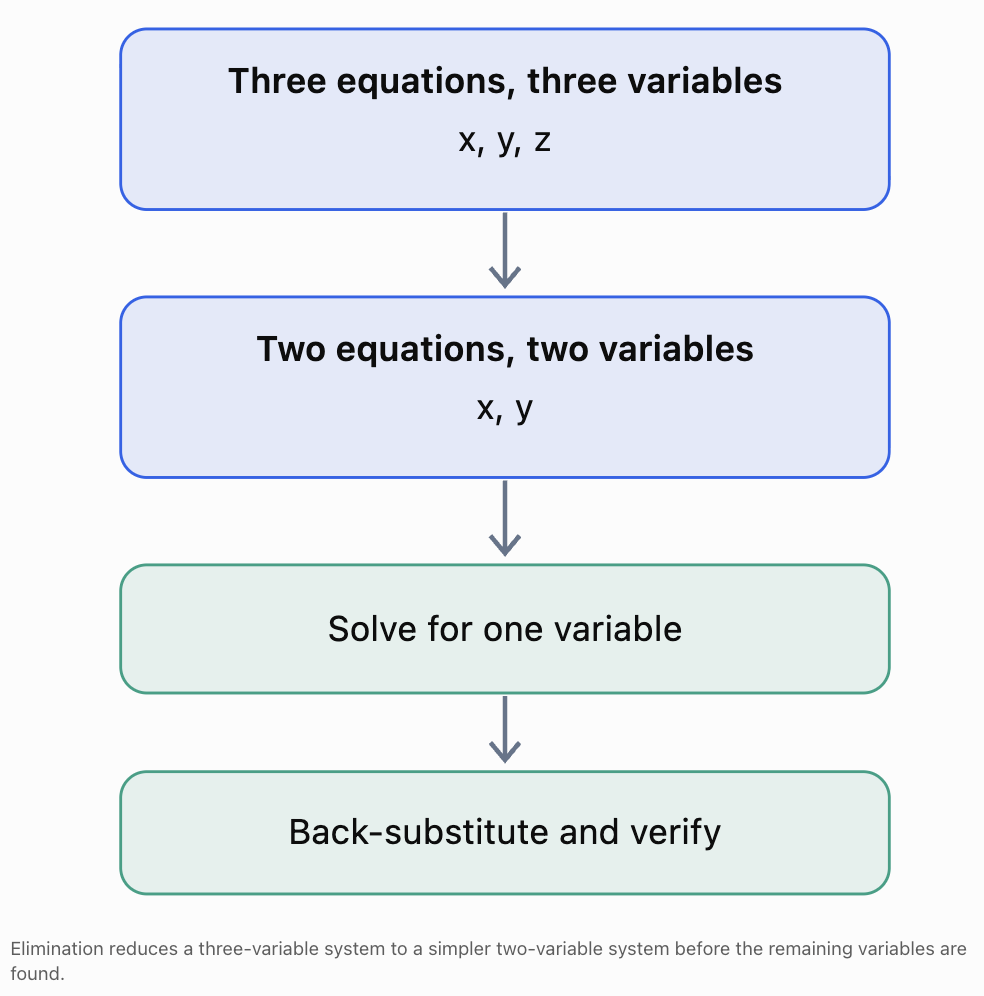
The process is sometimes called successive elimination because variables are removed in stages.
The General Elimination Method
To solve a system of three linear equations:
-
Label the original equations A, B, and C.
-
Choose one variable to eliminate first.
-
Eliminate that variable using two of the equations.
-
Eliminate the same variable using another pair of equations.
-
Solve the resulting two-variable system.
-
Substitute the known values into an original equation to find the third variable.
-
Check the ordered triple in all three original equations.
Important rule
When eliminating the first variable, use the same variable in both pairs.
For example, if you eliminate z from Equations A and B, you should also eliminate z from another pair, such as A and C.
Otherwise, the two resulting equations may contain different sets of variables and will not form the intended two-variable system.
Worked Example: Elimination Without Multiplication
Solve:
x + y + z = 12
2x − y + z = 7
x + 2y − z = 6
Step 1: Label the equations
A: x + y + z = 12
B: 2x − y + z = 7
C: x + 2y − z = 6
Step 2: Eliminate z from A and B
Both equations contain +z.
Subtract A from B:
(2x − y + z) − (x + y + z) = 7 − 12
Simplify:
x − 2y = −5
Call this Equation D.
Step 3: Eliminate z from A and C
Equation A contains +z.
Equation C contains −z.
Add the equations:
(x + y + z) + (x + 2y − z) = 12 + 6
Simplify:
2x + 3y = 18
Call this Equation E.
Step 4: Solve the two-variable system
We now have:
D: x − 2y = −5
E: 2x + 3y = 18
Multiply D by 2:
2x − 4y = −10
Subtract this from E:
(2x + 3y) − (2x − 4y) = 18 − (−10)
7y = 28
y = 4
Step 5: Find x
Substitute y = 4 into D:
x − 2(4) = −5
x − 8 = −5
x = 3
Step 6: Find z
Substitute x = 3 and y = 4 into A:
3 + 4 + z = 12
z = 5
Step 7: Verify
A:
3 + 4 + 5 = 12
B:
2(3) − 4 + 5 = 7
C:
3 + 2(4) − 5 = 6
All three equations are satisfied.
Final answer: (3, 4, 5).
Organising Elimination Work
Three-variable systems often involve many algebraic steps.
A clear layout reduces errors.
For example:
|
Stage |
Equations used |
Result |
|---|---|---|
|
Original system |
A, B, C |
Three equations in x, y, z |
|
First elimination |
B − A |
D: x − 2y = −5 |
|
Second elimination |
A + C |
E: 2x + 3y = 18 |
|
Solve smaller system |
D and E |
y = 4, x = 3 |
|
Back-substitution |
A |
z = 5 |
|
Verification |
A, B, C |
All satisfied |
Labelling equations is particularly helpful when coefficients are large or fractions are involved.
Worked Example: Multiplying Equations Before Elimination
Sometimes the coefficients of the variable we want to eliminate are not equal or opposite.
In these situations, we must multiply one or both equations by suitable constants.
Solve:
2x + 3y + z = 13
3x − 2y + 2z = 9
x + y − z = 1
Step 1: Label the equations
A: 2x + 3y + z = 13
B: 3x − 2y + 2z = 9
C: x + y − z = 1
We will eliminate z first.
Step 2: Eliminate z from A and B
Equation A contains +z.
Equation B contains +2z.
Multiply A by 2:
4x + 6y + 2z = 26
Subtract B:
(4x + 6y + 2z) − (3x − 2y + 2z) = 26 − 9
Simplify:
x + 8y = 17
Call this Equation D.
Step 3: Eliminate z from A and C
Equation A contains +z.
Equation C contains −z.
Add A and C:
(2x + 3y + z) + (x + y − z) = 13 + 1
Simplify:
3x + 4y = 14
Call this Equation E.
Step 4: Solve D and E
D: x + 8y = 17
E: 3x + 4y = 14
Multiply D by 3:
3x + 24y = 51
Subtract E:
20y = 37
y = 37/20
Step 5: Find x
Substitute into D:
x + 8(37/20) = 17
x + 74/5 = 17
x = 11/5
Step 6: Find z
Substitute into C:
x + y − z = 1
11/5 + 37/20 − z = 1
44/20 + 37/20 − z = 20/20
81/20 − z = 20/20
z = 61/20
Step 7: Verify
A:
2(11/5) + 3(37/20) + 61/20
= 88/20 + 111/20 + 61/20
= 260/20 = 13
B:
3(11/5) − 2(37/20) + 2(61/20)
= 132/20 − 74/20 + 122/20
= 180/20 = 9
C:
11/5 + 37/20 − 61/20
= 44/20 + 37/20 − 61/20
= 20/20 = 1
Final answer: (11/5, 37/20, 61/20).
This example demonstrates why fractions should be kept exact during multi-step algebra.
Rounding too early can produce inaccurate results.
Choosing Which Variable to Eliminate
Any variable can be eliminated first, but some choices make the calculation easier.
Consider:
x + 2y + z = 11
2x − y + z = 7
3x + y − z = 8
The coefficients of z are:
+1, +1, −1
These are convenient because z can be eliminated by simple addition or subtraction.
In contrast, eliminating x would require working with coefficients 1, 2, and 3.
Useful strategies
Choose a variable that:
-
Has equal coefficients in two equations.
-
Has opposite coefficients in two equations.
-
Has coefficients of 1 or −1.
-
Can be eliminated using small multipliers.
The goal is to reduce unnecessary arithmetic.
Worked Example: Choosing the Efficient Variable
Solve:
x + 2y + z = 11
2x − y + z = 7
3x + y − z = 8
Step 1: Eliminate z from the first two equations
Subtract the first equation from the second:
(2x − y + z) − (x + 2y + z) = 7 − 11
x − 3y = −4
Call this D.
Step 2: Eliminate z from the first and third equations
Add the equations:
(x + 2y + z) + (3x + y − z) = 11 + 8
4x + 3y = 19
Call this E.
Step 3: Solve D and E
D: x − 3y = −4
E: 4x + 3y = 19
Add:
5x = 15
x = 3
Substitute into D:
3 − 3y = −4
−3y = −7
y = 7/3
Step 4: Find z
Substitute into the first equation:
3 + 2(7/3) + z = 11
3 + 14/3 + z = 11
9/3 + 14/3 + z = 33/3
z = 10/3
Step 5: Verify
First equation:
3 + 14/3 + 10/3 = 11
Second equation:
2(3) − 7/3 + 10/3 = 7
Third equation:
3(3) + 7/3 − 10/3 = 8
Final answer: (3, 7/3, 10/3).
Worked Example: Eliminating x Instead of z
Elimination does not always have to begin with z.
Solve:
x + y + z = 9
x + 2y + 3z = 17
x − y + 2z = 7
Step 1: Label equations
A: x + y + z = 9
B: x + 2y + 3z = 17
C: x − y + 2z = 7
All three equations have a coefficient of 1 for x.
Therefore, eliminating x is convenient.
Step 2: Eliminate x from A and B
Subtract A from B:
y + 2z = 8
Call this D.
Step 3: Eliminate x from A and C
Subtract A from C:
−2y + z = −2
Call this E.
Step 4: Solve D and E
D: y + 2z = 8
E: −2y + z = −2
Multiply D by 2:
2y + 4z = 16
Add E:
5z = 14
z = 14/5
Step 5: Find y
y + 2(14/5) = 8
y + 28/5 = 40/5
y = 12/5
Step 6: Find x
x + 12/5 + 14/5 = 9
x + 26/5 = 45/5
x = 19/5
Step 7: Verify
A:
19/5 + 12/5 + 14/5 = 45/5 = 9
B:
19/5 + 24/5 + 42/5 = 85/5 = 17
C:
19/5 − 12/5 + 28/5 = 35/5 = 7
Final answer: (19/5, 12/5, 14/5).
Elimination with Negative Coefficients
Negative coefficients require careful attention.
Consider:
2x − 3y + z = 4
−x + 2y − z = 1
3x + y + 2z = 14
We can eliminate z by adding the first two equations.
Step 1: Add the first two equations
(2x − 3y + z) + (−x + 2y − z) = 4 + 1
x − y = 5
Call this D.
Step 2: Eliminate z from the first and third equations
Multiply the first equation by 2:
4x − 6y + 2z = 8
Subtract this from the third equation:
(3x + y + 2z) − (4x − 6y + 2z) = 14 − 8
−x + 7y = 6
Call this E.
Step 3: Solve D and E
D: x − y = 5
E: −x + 7y = 6
Add:
6y = 11
y = 11/6
Then:
x = 5 + 11/6
x = 41/6
Step 4: Find z
Use the first equation:
2(41/6) − 3(11/6) + z = 4
82/6 − 33/6 + z = 24/6
49/6 + z = 24/6
z = −25/6
Step 5: Verify
First equation:
2(41/6) − 3(11/6) − 25/6
= 82/6 − 33/6 − 25/6
= 24/6 = 4
Second equation:
−41/6 + 2(11/6) − (−25/6)
= −41/6 + 22/6 + 25/6
= 6/6 = 1
Third equation:
3(41/6) + 11/6 + 2(−25/6)
= 123/6 + 11/6 − 50/6
= 84/6 = 14
Final answer: (41/6, 11/6, −25/6).
Notice that a negative value for z is perfectly acceptable in an abstract algebraic system.
Whether negative values are reasonable in a real-world problem depends on what the variables represent.
Organising Multi-Step Solutions
Three-variable elimination can become difficult when equations are written without a clear structure.
A useful method is to label each equation and keep the reduced system separate from the original system.
Recommended layout
Original equations:
A: 2x + y − z = 8
B: x − y + 2z = 3
C: 3x + 2y + z = 14
First elimination:
D: Equation obtained from A and B
E: Equation obtained from A and C
Reduced system:
D: Equation in two variables
E: Equation in two variables
Solve:
Find the first variable.
Find the second variable.
Back-substitute:
Find the third variable.
Verification:
Check A, B, and C.
This approach makes it easier to identify where a calculation error occurred.
Worked Example: Solving a System with Larger Coefficients
Solve:
2x + 3y + 4z = 25
3x − 2y + z = 10
x + 4y − 2z = 5
Step 1: Label equations
A: 2x + 3y + 4z = 25
B: 3x − 2y + z = 10
C: x + 4y − 2z = 5
We will eliminate z.
Step 2: Eliminate z from A and B
Multiply B by 4:
12x − 8y + 4z = 40
Subtract A:
10x − 11y = 15
Call this D.
Step 3: Eliminate z from A and C
Multiply C by 2:
2x + 8y − 4z = 10
Add A:
4x + 11y = 35
Call this E.
Step 4: Solve D and E
D: 10x − 11y = 15
E: 4x + 11y = 35
Add:
14x = 50
x = 25/7
Step 5: Find y
Substitute into E:
4(25/7) + 11y = 35
100/7 + 11y = 245/7
11y = 145/7
y = 145/77
Step 6: Find z
Use B:
3x − 2y + z = 10
3(25/7) − 2(145/77) + z = 10
825/77 − 290/77 + z = 770/77
535/77 + z = 770/77
z = 235/77
Step 7: Verify
A:
2(25/7) + 3(145/77) + 4(235/77)
= 550/77 + 435/77 + 940/77
= 1925/77 = 25
B:
3(25/7) − 2(145/77) + 235/77
= 825/77 − 290/77 + 235/77
= 770/77 = 10
C:
25/7 + 4(145/77) − 2(235/77)
= 275/77 + 580/77 − 470/77
= 385/77 = 5
Final answer: (25/7, 145/77, 235/77).
This example shows that elimination remains effective even when the solution contains fractions.
Using Elimination in Word Problems
Three-variable systems are useful when a situation contains three unknown quantities and enough independent information to determine them.
Worked Example: Prices of Three Products
A school shop sells notebooks, pens, and pencils.
Two notebooks, one pen, and one pencil cost $13.
One notebook, two pens, and three pencils cost $14.
Three notebooks, one pen, and two pencils cost $20.
Find the price of each item.
Step 1: Define variables
n = price of one notebook
p = price of one pen
c = price of one pencil
Step 2: Construct equations
A: 2n + p + c = 13
B: n + 2p + 3c = 14
C: 3n + p + 2c = 20
Step 3: Eliminate p from A and C
Subtract A from C:
n + c = 7
Call this D.
Step 4: Eliminate p from A and B
Multiply A by 2:
4n + 2p + 2c = 26
Subtract B:
3n − c = 12
Call this E.
Step 5: Solve D and E
D: n + c = 7
E: 3n − c = 12
Add:
4n = 19
n = 4.75
Then:
c = 7 − 4.75
c = 2.25
Step 6: Find p
Use A:
2(4.75) + p + 2.25 = 13
9.50 + p + 2.25 = 13
p = 1.25
Step 7: Verify
A:
2(4.75) + 1.25 + 2.25 = 13
B:
4.75 + 2(1.25) + 3(2.25)
= 4.75 + 2.50 + 6.75
= 14
C:
3(4.75) + 1.25 + 2(2.25)
= 14.25 + 1.25 + 4.50
= 20
Answer: Notebook = $4.75; pen = $1.25; pencil = $2.25.
Worked Example: Three Types of Tickets
A theatre sells adult, student, and child tickets.
Adult tickets cost $15.
Student tickets cost $10.
Child tickets cost $5.
A total of 100 tickets are sold.
The total revenue is $1,050.
There are twice as many student tickets as child tickets.
Find the number of each type of ticket.
Step 1: Define variables
a = adult tickets
s = student tickets
c = child tickets
Step 2: Construct equations
Total tickets:
a + s + c = 100
Total revenue:
15a + 10s + 5c = 1050
Relationship:
s = 2c
Step 3: Eliminate a
Multiply the total ticket equation by 15:
15a + 15s + 15c = 1500
Subtract the revenue equation:
5s + 10c = 450
Divide by 5:
s + 2c = 90
Call this D.
Step 4: Use the third equation
We also know:
s = 2c
Substitute into D:
2c + 2c = 90
4c = 90
c = 22.5
Then:
s = 45
And:
a = 100 − 45 − 22.5
a = 32.5
Step 5: Interpret
The algebraic solution is:
a = 32.5
s = 45
c = 22.5
However, tickets must be counted in whole numbers.
Therefore, the original conditions have no valid whole-number solution.
This is a useful reminder that solving a system algebraically does not guarantee that its solution is realistic.
Recognising Special Cases
Three-variable systems do not always have exactly one solution.
During elimination, we may encounter an equation that reveals something important about the system.
No solution
Consider:
x + y + z = 10
2x + 2y + 2z = 25
x − y + z = 4
Multiply the first equation by 2:
2x + 2y + 2z = 20
But the second equation states:
2x + 2y + 2z = 25
Subtracting gives:
0 = 5
This is impossible.
Therefore, the system is inconsistent.
Answer: No solution.
Infinitely many solutions
Consider:
x + y + z = 10
2x + 2y + 2z = 20
x − y = 2
The second equation is twice the first.
It provides no new independent information.
From:
x − y = 2
we obtain:
x = y + 2
Substitute into the first equation:
(y + 2) + y + z = 10
2y + z = 8
z = 8 − 2y
Let y = t.
Then:
x = t + 2
y = t
z = 8 − 2t
The solution set is:
(t + 2, t, 8 − 2t)
where t is any real number.
There are infinitely many solutions.
Unique solution
If elimination produces enough independent equations to determine one value for each variable, the system has a unique solution.
Verifying Solutions
Verification is essential because three-variable systems involve several calculations and opportunities for errors.
Suppose we obtain:
x = 2
y = 3
z = 4
for the system:
x + y + z = 9
2x + y − z = 3
x − y + 2z = 7
Check the first equation:
2 + 3 + 4 = 9
Correct.
Check the second equation:
2(2) + 3 − 4 = 3
Correct.
Check the third equation:
2 − 3 + 2(4) = 7
Correct.
Since all three equations are satisfied, the solution is verified.
Why checking one equation is insufficient
A proposed triple may satisfy one or two equations but fail the third.
For example:
(3, 2, 4)
satisfies:
x + y + z = 9
because:
3 + 2 + 4 = 9
However, it does not satisfy:
2x + y − z = 3
because:
2(3) + 2 − 4 = 4
Therefore, it is not a solution to the complete system.
Checking Answers in Context
When solving real-world problems, verification involves more than substitution.
We must also consider whether the values make sense.
For example:
-
Prices should generally be nonnegative.
-
Numbers of people should be whole numbers.
-
Distances should use appropriate units.
-
Masses and volumes should not be negative.
-
Quantities should satisfy any limits stated in the problem.
A system may have a mathematically correct solution that is invalid in the original context.
Common Mistakes
Eliminating different variables from different pairs
When reducing a three-variable system, eliminate the same variable from two different pairs to obtain two equations in the same remaining variables.
Forgetting to multiply every term
If an equation is multiplied by 3, every coefficient and the constant must be multiplied by 3.
Incorrect subtraction of negative terms
For example:
5y − (−2y) = 7y
not 3y.
Losing track of equations
Label equations A, B, C, D, and E to keep the work organised.
Stopping after finding two variables
A complete solution must include all three variables.
Substituting into a reduced equation that no longer contains the third variable
To find the eliminated variable, return to an original equation containing it.
Rounding too early
Keep fractions exact until the final answer when possible.
Assuming every system has a unique solution
Some systems have no solution or infinitely many solutions.
Not verifying the result
Substitute the final ordered triple into all three original equations.
Ignoring contextual restrictions
A mathematically valid result may not make sense in a word problem.
Key Terms
-
System of equations: Two or more equations solved simultaneously.
-
Three-variable system: A system involving three unknown quantities.
-
Linear equation: An equation in which variables appear only to the first power and are not multiplied together.
-
Elimination: A method of removing variables by combining equations.
-
Successive elimination: Eliminating variables in stages to simplify a system.
-
Substitution: Replacing a variable with an equivalent expression or known value.
-
Back-substitution: Using previously calculated values to find remaining unknowns.
-
Coefficient: A number multiplying a variable.
-
Constant: A fixed numerical value.
-
Ordered triple: Three values written in a specified order, such as (x, y, z).
-
Unique solution: Exactly one set of values satisfies the system.
-
Consistent system: A system with at least one solution.
-
Inconsistent system: A system with no solution.
-
Dependent equations: Equations that provide redundant information.
-
Contradiction: An impossible statement such as 0 = 5.
-
Identity: A statement true for all relevant values, such as 0 = 0.
-
Verification: Checking that a proposed solution satisfies the original equations.
-
Constraint: A restriction on the possible values of variables.
Key Takeaways
-
Elimination is an effective method for solving three-variable systems.
-
The goal is to reduce three equations in three variables to two equations in two variables.
-
The same variable should be eliminated from two different pairs of equations.
-
Multiplication may be required to create matching or opposite coefficients.
-
Labelling equations helps organise multi-step solutions.
-
After solving the reduced system, back-substitution determines the third variable.
-
Every solution should be written as an ordered triple.
-
A system may have one solution, no solution, or infinitely many solutions.
-
Contradictions indicate inconsistency.
-
Redundant equations may lead to infinitely many solutions when the system remains consistent.
-
Verification requires substituting the final values into all original equations.
-
Contextual restrictions must be considered in real-world applications.
Check Your Understanding
Recall and Understanding
1. Explain why elimination is useful for solving systems of three linear equations.
2. Why should the same variable be eliminated from two different pairs of equations?
3. What is back-substitution, and why is it necessary?
4. What does the equation 0 = 8 indicate when it appears during elimination?
5. Explain why a solution must be checked in all three original equations.
Basic Elimination
6. Solve:
x + y + z = 12
x + y − z = 4
x − y + z = 6
7. Solve:
x + y + z = 15
2x + y + z = 19
x + 2y + z = 20
8. Solve:
2x + y + z = 13
x + y − z = 2
x − y + z = 4
9. Solve:
x + 2y + z = 14
2x − y + z = 8
x + y − z = 2
10. Solve:
2x + 3y − z = 7
x − y + z = 5
3x + 2y + z = 16
Application and Challenge
11. Solve:
2x + y + 3z = 17
x − 2y + z = 1
3x + y − z = 4
12. Determine whether the following system has a solution:
x + y + z = 9
2x + 2y + 2z = 20
x − y + z = 3
13. Determine whether the following system has one solution or infinitely many solutions:
x + y + z = 8
2x + 2y + 2z = 16
x − y = 2
14. A school shop sells notebooks, pens, and pencils.
-
Two notebooks, one pen, and one pencil cost $14.
-
One notebook, two pens, and three pencils cost $15.
-
Three notebooks, two pens, and one pencil cost $23.
Find the price of each item.
15. A theatre sells adult, student, and child tickets for $15, $10, and $5 respectively. A total of 100 tickets are sold, generating $1,050. There are twice as many child tickets as adult tickets.
Construct and solve a three-variable system to determine how many of each ticket type were sold.
Answers to Check Your Understanding
1. Elimination simplifies a three-variable system by removing one variable from two pairs of equations. This produces a two-variable system that can be solved using familiar methods.
2. Eliminating the same variable produces two equations involving the same two remaining unknowns. These can then be solved simultaneously.
3. Back-substitution involves substituting known variable values into an earlier equation to find an unknown variable. It is necessary to recover variables that were eliminated.
4. The statement 0 = 8 is a contradiction. It indicates that the system is inconsistent and has no solution.
5. A proposed ordered triple must satisfy every equation simultaneously. Checking only one or two equations does not establish that it is a solution to the complete system.
6.
A: x + y + z = 12
B: x + y − z = 4
C: x − y + z = 6
Subtract B from A:
2z = 8
z = 4
Subtract C from A:
2y = 6
y = 3
Substitute into A:
x + 3 + 4 = 12
x = 5
Answer: (5, 3, 4).
Verification:
5 + 3 + 4 = 12
5 + 3 − 4 = 4
5 − 3 + 4 = 6
7.
A: x + y + z = 15
B: 2x + y + z = 19
C: x + 2y + z = 20
Subtract A from B:
x = 4
Subtract A from C:
y = 5
Substitute into A:
4 + 5 + z = 15
z = 6
Answer: (4, 5, 6).
Verification:
4 + 5 + 6 = 15
2(4) + 5 + 6 = 19
4 + 2(5) + 6 = 20
8.
A: 2x + y + z = 13
B: x + y − z = 2
C: x − y + z = 4
Add B and C:
2x = 6
x = 3
Add A and B:
3x + 2y = 15
Substitute x = 3:
9 + 2y = 15
y = 3
Use B:
3 + 3 − z = 2
z = 4
Answer: (3, 3, 4).
Verification:
2(3) + 3 + 4 = 13
3 + 3 − 4 = 2
3 − 3 + 4 = 4
9.
A: x + 2y + z = 14
B: 2x − y + z = 8
C: x + y − z = 2
Subtract B from A:
−x + 3y = 6
Add A and C:
2x + 3y = 16
Subtract the first reduced equation from the second:
3x = 10
x = 10/3
Substitute into:
−x + 3y = 6
−10/3 + 3y = 6
3y = 28/3
y = 28/9
Use C:
10/3 + 28/9 − z = 2
z = 40/9
Answer: (10/3, 28/9, 40/9).
Verification:
A: 10/3 + 2(28/9) + 40/9 = 14
B: 2(10/3) − 28/9 + 40/9 = 8
C: 10/3 + 28/9 − 40/9 = 2
10.
A: 2x + 3y − z = 7
B: x − y + z = 5
C: 3x + 2y + z = 16
Add A and B:
3x + 2y = 12
Subtract B from C:
2x + 3y = 11
Multiply the first reduced equation by 3:
9x + 6y = 36
Multiply the second by 2:
4x + 6y = 22
Subtract:
5x = 14
x = 14/5
Substitute into:
3x + 2y = 12
42/5 + 2y = 12
2y = 18/5
y = 9/5
Use B:
14/5 − 9/5 + z = 5
z = 4
Answer: (14/5, 9/5, 4).
Verification:
A: 28/5 + 27/5 − 4 = 7
B: 14/5 − 9/5 + 4 = 5
C: 42/5 + 18/5 + 4 = 16
11.
A: 2x + y + 3z = 17
B: x − 2y + z = 1
C: 3x + y − z = 4
Eliminate y.
Subtract A from C:
x − 4z = −13
Call this D.
Multiply A by 2:
4x + 2y + 6z = 34
Add B:
5x + 7z = 35
Call this E.
From D:
x = 4z − 13
Substitute into E:
5(4z − 13) + 7z = 35
20z − 65 + 7z = 35
27z = 100
z = 100/27
Then:
x = 4(100/27) − 13
x = 49/27
Use B:
49/27 − 2y + 100/27 = 1
149/27 − 2y = 27/27
2y = 122/27
y = 61/27
Answer: (49/27, 61/27, 100/27).
Verification:
A: (98 + 61 + 300)/27 = 459/27 = 17
B: (49 − 122 + 100)/27 = 27/27 = 1
C: (147 + 61 − 100)/27 = 108/27 = 4
12.
First equation:
x + y + z = 9
Multiply by 2:
2x + 2y + 2z = 18
But the second equation states:
2x + 2y + 2z = 20
Subtracting gives:
0 = 2
This is impossible.
Answer: No solution. The system is inconsistent.
13.
The system is:
x + y + z = 8
2x + 2y + 2z = 16
x − y = 2
The second equation is twice the first, so it provides no new information.
From:
x − y = 2
x = y + 2
Substitute into the first equation:
(y + 2) + y + z = 8
2y + z = 6
z = 6 − 2y
Let y = t.
Then:
x = t + 2
y = t
z = 6 − 2t
Answer: Infinitely many solutions, given by (t + 2, t, 6 − 2t), for any real number t.
14.
Let:
n = notebook price
p = pen price
c = pencil price
The equations are:
A: 2n + p + c = 14
B: n + 2p + 3c = 15
C: 3n + 2p + c = 23
Subtract A from C:
n + p = 9
Therefore:
p = 9 − n
Substitute into A:
2n + (9 − n) + c = 14
n + c = 5
Therefore:
c = 5 − n
Substitute both expressions into B:
n + 2(9 − n) + 3(5 − n) = 15
n + 18 − 2n + 15 − 3n = 15
33 − 4n = 15
4n = 18
n = 4.50
Then:
p = 9 − 4.50 = 4.50
c = 5 − 4.50 = 0.50
Answer: Notebook = $4.50; pen = $4.50; pencil = $0.50.
Verification:
2(4.50) + 4.50 + 0.50 = 14
4.50 + 2(4.50) + 3(0.50) = 15
3(4.50) + 2(4.50) + 0.50 = 23
15.
Let:
a = adult tickets
s = student tickets
c = child tickets
Construct the equations.
Total tickets:
a + s + c = 100
Total revenue:
15a + 10s + 5c = 1050
Twice as many child tickets as adult tickets:
c = 2a
Substitute c = 2a into the total ticket equation:
3a + s = 100
Therefore:
s = 100 − 3a
Substitute into the revenue equation:
15a + 10(100 − 3a) + 5(2a) = 1050
15a + 1000 − 30a + 10a = 1050
−5a = 50
a = −10
Then:
c = −20
s = 100 − 3(−10) = 130
The algebraic solution is:
a = −10
s = 130
c = −20
Verification:
−10 + 130 − 20 = 100
15(−10) + 10(130) + 5(−20)
= −150 + 1300 − 100
= 1050
And:
−20 = 2(−10)
The values satisfy the equations, but negative ticket quantities are impossible.
Answer: The system has a unique algebraic solution but no valid real-world solution using nonnegative ticket quantities.
Final Summary
Elimination provides a systematic method for solving three-variable systems of linear equations.
By combining equations to eliminate the same variable twice, we reduce the original system to two equations in two unknowns. We can then solve the smaller system and use back-substitution to determine the remaining variable.
Clear organisation, careful handling of signs and coefficients, and verification are essential for avoiding errors.
The most important principle is to simplify the system one variable at a time while preserving the relationships represented by the original equations.
3. Applications of Three Variables
Learning outcomes
- I can model real-world situations using three variables.
- I can write systems from practical problems.
- I can solve application problems.
- I can interpret solutions.
- I can explain my reasoning.
Introduction
Many real-world problems involve three unknown quantities that are connected by several relationships. These problems appear in shopping, business, transport, science, engineering, agriculture, and everyday decision-making.
For example, a school might sell three types of tickets, a business might manufacture three different products, or a scientist might combine three substances to create a mixture.
When three unknown quantities must be determined simultaneously, we can often represent the situation using a system of three linear equations.
By solving the system, we can determine values that satisfy all the conditions of the problem.
However, solving the equations is only part of the process. We must also interpret the answers, include appropriate units, and check that the results make sense in the original situation.
Why Three Variables Are Useful
Consider a school shop that sells notebooks, pens, and pencils.
Suppose we want to determine the price of each item.
We have three unknown prices:
-
Price of one notebook.
-
Price of one pen.
-
Price of one pencil.
We can represent these using:
n = notebook price
p = pen price
c = pencil price
If customers purchase different combinations of these items, each purchase can provide an equation.
With three suitable independent equations, we can often determine all three prices.
A simple example
Suppose:
-
One notebook, one pen, and one pencil cost $9.
-
Two notebooks, one pen, and one pencil cost $13.
-
One notebook, two pens, and one pencil cost $12.
The equations are:
n + p + c = 9
2n + p + c = 13
n + 2p + c = 12
Subtract the first equation from the second:
n = 4
Subtract the first equation from the third:
p = 3
Substitute into the first equation:
4 + 3 + c = 9
c = 2
Therefore:
Notebook = $4, pen = $3, pencil = $2.
Verification:
4 + 3 + 2 = 9
2(4) + 3 + 2 = 13
4 + 2(3) + 2 = 12
All three purchases are represented correctly.
This demonstrates how information from several situations can be combined to determine unknown values.
The Mathematical Structure of Three-Variable Applications
A linear equation in three variables has the general form:
ax + by + cz = d
where:
-
x, y, and z represent unknown quantities.
-
a, b, and c are coefficients.
-
d is a constant.
A three-variable system contains several equations involving the same unknowns.
For example:
2x + 3y + z = 20
x + 2y + 4z = 19
3x + y + 2z = 23
The equations may represent quantities, costs, distances, masses, or other relationships.
A solution is an ordered triple:
(x, y, z)
that satisfies every equation.
Conditions for a meaningful solution
A successful application solution must satisfy two requirements.
Mathematical correctness: The values satisfy all the equations.
Contextual correctness: The values make sense in the real-world situation.
For example, a negative number of tickets is mathematically possible as an algebraic result, but it cannot represent an actual ticket sale.
Similarly, 12.5 students is not a valid count of individual students.
Translating Word Problems into Equations
The most important part of an application problem is often constructing the equations correctly.
Consider these common phrases:
|
Written information |
Mathematical representation |
|---|---|
|
The total is 100 |
x + y + z = 100 |
|
The combined cost is $250 |
ax + by + cz = 250 |
|
There are twice as many A as B |
x = 2y |
|
There are 10 more A than C |
x = z + 10 |
|
A and B together equal C |
x + y = z |
|
The total mass is 500 g |
x + y + z = 500 |
|
The total time is 6 hours |
x + y + z = 6 |
|
The average is 20 |
(x + y + z)/3 = 20 |
Notice that some relationships involve only two variables. They can still form part of a three-variable system.
A General Strategy for Application Problems
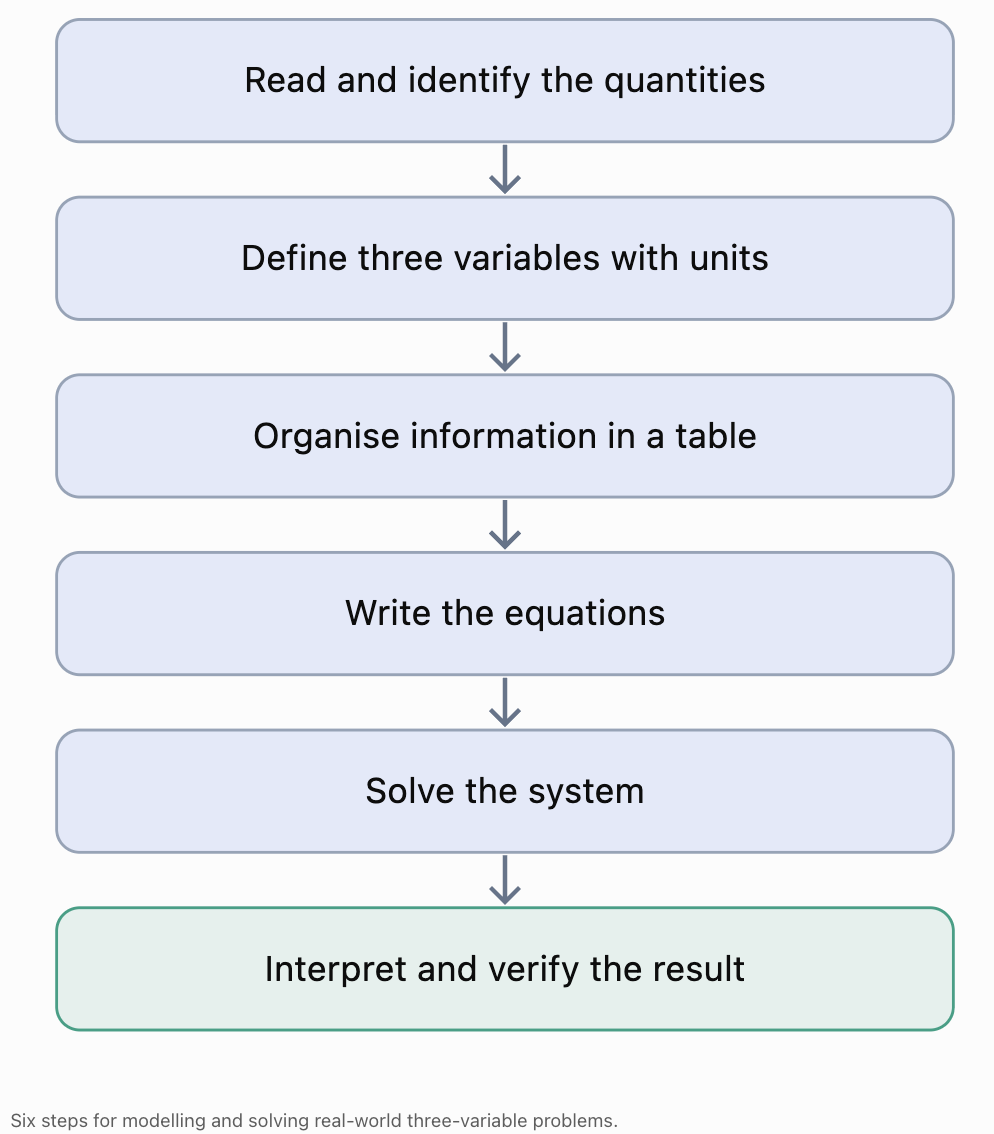
Step 1: Identify the unknown quantities
Determine exactly what must be calculated.
Step 2: Define variables
Use clear definitions and include units.
For example:
x = number of adult tickets
y = number of student tickets
z = number of child tickets
Step 3: Organise the information
Use a table when several categories or measurements are involved.
Step 4: Construct equations
Translate each independent piece of information into an equation.
Step 5: Solve the system
Use elimination, substitution, or a combination of both.
Step 6: Interpret and verify
Explain the answer in words, check the original equations, and evaluate whether the values are realistic.
Application: Finding the Prices of Three Products
A school stationery shop sells notebooks, pens, and pencils.
Three customers make the following purchases:
-
Customer A buys 2 notebooks, 1 pen, and 3 pencils for $16.
-
Customer B buys 1 notebook, 3 pens, and 2 pencils for $15.
-
Customer C buys 3 notebooks, 2 pens, and 1 pencil for $23.
Find the price of each item.
Step 1: Define variables
n = price of one notebook in dollars
p = price of one pen in dollars
c = price of one pencil in dollars
Step 2: Organise the information
|
Customer |
Notebooks |
Pens |
Pencils |
Total |
|---|---|---|---|---|
|
A |
2 |
1 |
3 |
$16 |
|
B |
1 |
3 |
2 |
$15 |
|
C |
3 |
2 |
1 |
$23 |
Step 3: Construct equations
A: 2n + p + 3c = 16
B: n + 3p + 2c = 15
C: 3n + 2p + c = 23
Step 4: Eliminate n
Multiply B by 2:
2n + 6p + 4c = 30
Subtract A:
5p + c = 14
Call this D.
Multiply B by 3:
3n + 9p + 6c = 45
Subtract C:
7p + 5c = 22
Call this E.
Step 5: Solve D and E
D: 5p + c = 14
E: 7p + 5c = 22
From D:
c = 14 − 5p
Substitute into E:
7p + 5(14 − 5p) = 22
7p + 70 − 25p = 22
−18p = −48
p = 8/3
Then:
c = 14 − 5(8/3)
c = 2/3
Step 6: Find n
Use B:
n + 3p + 2c = 15
n + 3(8/3) + 2(2/3) = 15
n + 8 + 4/3 = 15
n = 17/3
Step 7: Interpret
Notebook price = $17/3, approximately $5.67
Pen price = $8/3, approximately $2.67
Pencil price = $2/3, approximately $0.67
These are exact mathematical prices; the rounded amounts should not be substituted back as if they were exact cent-based prices.
Step 8: Verify using exact values
A:
2(17/3) + 8/3 + 3(2/3)
= 34/3 + 8/3 + 6/3
= 48/3 = 16
B:
17/3 + 3(8/3) + 2(2/3)
= 17/3 + 24/3 + 4/3
= 45/3 = 15
C:
3(17/3) + 2(8/3) + 2/3
= 51/3 + 16/3 + 2/3
= 69/3 = 23
Answer: Notebook = $17/3, pen = $8/3, pencil = $2/3.
The mathematical solution is valid, although a real shop pricing items to the nearest cent would need additional pricing constraints.
Application: Ticket Sales at a School Event
A school sells three types of tickets for a concert.
-
Adult tickets cost $15.
-
Student tickets cost $10.
-
Child tickets cost $5.
A total of 150 tickets are sold, generating $1,500 in revenue.
The number of student tickets is twice the number of child tickets.
Find how many tickets of each type were sold.
Step 1: Define variables
a = number of adult tickets
s = number of student tickets
c = number of child tickets
Step 2: Construct equations
Total tickets:
a + s + c = 150
Total revenue:
15a + 10s + 5c = 1500
Relationship between student and child tickets:
s = 2c
Step 3: Substitute the relationship
Substitute s = 2c into the first equation:
a + 2c + c = 150
a + 3c = 150
Therefore:
a = 150 − 3c
Step 4: Substitute into the revenue equation
15(150 − 3c) + 10(2c) + 5c = 1500
2250 − 45c + 20c + 5c = 1500
2250 − 20c = 1500
−20c = −750
c = 37.5
Then:
s = 75
a = 37.5
Step 5: Interpret
The system has a unique algebraic solution:
a = 37.5
s = 75
c = 37.5
However, ticket quantities must be whole numbers.
Therefore, the information does not produce a valid real-world solution.
This is an important distinction between solving an equation and solving a practical problem.
Adjusting the information
Suppose the total revenue had been $1,450 instead.
Then:
2250 − 20c = 1450
20c = 800
c = 40
s = 80
a = 150 − 120 = 30
Verification:
30 + 80 + 40 = 150 tickets
15(30) + 10(80) + 5(40)
= 450 + 800 + 200
= $1450
With the revised revenue, the school sold 30 adult tickets, 80 student tickets, and 40 child tickets.
Application: Mixing Three Solutions
Systems of three variables are especially useful in chemistry and manufacturing.
Suppose a laboratory needs to prepare 100 litres of a solution with a concentration of 30%.
Three available solutions have concentrations of:
-
10%
-
30%
-
50%
The laboratory must use twice as much 10% solution as 50% solution.
How many litres of each solution should be used?
Step 1: Define variables
x = volume of 10% solution, in litres
y = volume of 30% solution, in litres
z = volume of 50% solution, in litres
Step 2: Construct the volume equation
The total volume is 100 litres.
x + y + z = 100
Step 3: Construct the concentration equation
The amount of dissolved substance in each solution is:
10% solution: 0.10x
30% solution: 0.30y
50% solution: 0.50z
The final mixture contains:
0.30 × 100 = 30 litres of dissolved substance
Therefore:
0.10x + 0.30y + 0.50z = 30
This model assumes volumes are additive.
Step 4: Construct the relationship equation
The volume of 10% solution is twice the volume of 50% solution:
x = 2z
Step 5: Simplify the concentration equation
Multiply by 10:
x + 3y + 5z = 300
Subtract the total volume equation:
(x + 3y + 5z) − (x + y + z) = 300 − 100
2y + 4z = 200
Divide by 2:
y + 2z = 100
Step 6: Use the relationship equation
Substitute x = 2z into the volume equation:
2z + y + z = 100
y + 3z = 100
We now have:
y + 2z = 100
y + 3z = 100
Subtract:
z = 0
Then:
x = 0
y = 100
Step 7: Interpret
The mathematical solution is:
-
10% solution: 0 litres
-
30% solution: 100 litres
-
50% solution: 0 litres
This is mathematically valid, but it does not involve combining all three solutions.
If the laboratory must use a positive amount of every solution, the conditions are impossible.
Why does this happen?
The final concentration is 30%, which is exactly the concentration of the middle solution.
To balance 10% and 50% solutions around 30%, equal volumes of the two would be needed.
However, the problem requires twice as much 10% solution as 50% solution.
These conditions can only be satisfied when neither of those two solutions is used.
This demonstrates how algebra can reveal limitations in a proposed scientific procedure.
Application: A Three-Ingredient Mixture
A food manufacturer produces a 100 kg mixture using three ingredients.
Ingredient A costs $2 per kilogram.
Ingredient B costs $4 per kilogram.
Ingredient C costs $6 per kilogram.
The mixture costs $380 in total.
The manufacturer uses 10 kg more of Ingredient A than Ingredient C.
Determine the mass of each ingredient.
Step 1: Define variables
x = mass of Ingredient A, in kg
y = mass of Ingredient B, in kg
z = mass of Ingredient C, in kg
Step 2: Construct equations
Total mass:
x + y + z = 100
Total cost:
2x + 4y + 6z = 380
Relationship:
x − z = 10
Step 3: Simplify the cost equation
Divide by 2:
x + 2y + 3z = 190
Subtract the mass equation:
y + 2z = 90
Step 4: Use the relationship equation
x = z + 10
Substitute into the mass equation:
(z + 10) + y + z = 100
y + 2z = 90
This is the same equation obtained from the cost information.
Step 5: Interpret the result
We have:
x = z + 10
y = 90 − 2z
The solutions are:
(x, y, z) = (z + 10, 90 − 2z, z)
For nonnegative ingredient masses:
0 ≤ z ≤ 45
Therefore, there are infinitely many possible mixtures.
For example:
|
Ingredient A |
Ingredient B |
Ingredient C |
|---|---|---|
|
10 kg |
90 kg |
0 kg |
|
30 kg |
50 kg |
20 kg |
|
50 kg |
10 kg |
40 kg |
All three mixtures have a mass of 100 kg and cost $380.
What does this teach us?
Three equations do not necessarily provide three independent pieces of information.
In this example, one equation is redundant.
An additional independent condition is needed to determine a unique mixture.
Application: Three Vehicles and Travel Distances
A delivery company uses three vehicles.
Vehicle A travels at 40 km/h.
Vehicle B travels at 60 km/h.
Vehicle C travels at 80 km/h.
Each vehicle travels for a different amount of time.
Together, they travel for 12 hours and cover 720 km.
Vehicle A travels for twice as long as Vehicle C.
Determine how long each vehicle travels.
Step 1: Define variables
x = travel time of Vehicle A, in hours
y = travel time of Vehicle B, in hours
z = travel time of Vehicle C, in hours
Step 2: Construct equations
Total travel time:
x + y + z = 12
Total distance:
40x + 60y + 80z = 720
Relationship:
x = 2z
Step 3: Simplify the distance equation
Divide by 20:
2x + 3y + 4z = 36
Multiply the time equation by 2:
2x + 2y + 2z = 24
Subtract:
y + 2z = 12
Step 4: Substitute the relationship
From x = 2z:
2z + y + z = 12
y + 3z = 12
Subtract the reduced equations:
z = 0
Then:
x = 0
y = 12
Step 5: Interpret
The only nonnegative solution is:
Vehicle A: 0 hours
Vehicle B: 12 hours
Vehicle C: 0 hours
This result satisfies the algebra but is unsuitable if all three vehicles were required to operate.
It also makes sense physically: the required average speed is 720/12 = 60 km/h. The stated relationship between the slower and faster vehicles prevents their contributions from balancing unless both are zero.
Improving the model
If the company instead specifies that Vehicle A travels for the same amount of time as Vehicle C:
x = z
Then:
x + y + z = 12
2x + 3y + 4z = 36
x = z
Substitute x = z:
2z + y = 12
6z + 3y = 36
Dividing the second equation by 3 gives the same relationship.
This modified system also has infinitely many solutions.
The important lesson is that the equations must provide independent information to determine a unique result.
Application: Production Planning in a Factory
A factory manufactures three types of products: A, B, and C.
During one production period:
-
The factory manufactures 200 products in total.
-
Product A requires 2 machine-hours, Product B requires 3 machine-hours, and Product C requires 5 machine-hours.
-
The total machine time used is 650 hours.
-
The factory manufactures 20 more units of Product A than Product C.
Find the number of each product manufactured.
Step 1: Define variables
x = number of Product A units
y = number of Product B units
z = number of Product C units
Step 2: Construct equations
Total products:
x + y + z = 200
Total machine-hours:
2x + 3y + 5z = 650
Quantity relationship:
x − z = 20
Step 3: Eliminate x
Multiply the first equation by 2:
2x + 2y + 2z = 400
Subtract from the machine-hours equation:
y + 3z = 250
Step 4: Use the third equation
x = z + 20
Substitute into the total products equation:
z + 20 + y + z = 200
y + 2z = 180
Step 5: Solve
Subtract:
(y + 3z) − (y + 2z) = 250 − 180
z = 70
Then:
y + 2(70) = 180
y = 40
And:
x = 70 + 20
x = 90
Step 6: Verify
Total products:
90 + 40 + 70 = 200
Machine-hours:
2(90) + 3(40) + 5(70)
= 180 + 120 + 350
= 650
Quantity difference:
90 − 70 = 20
Answer: The factory manufactures 90 units of A, 40 units of B, and 70 units of C.
This is a practical example of using three variables to make production and resource-planning decisions.
Application: Three Types of Transport Tickets
A transport company sells single, day, and weekly passes.
-
A single ticket costs $3.
-
A day pass costs $8.
-
A weekly pass costs $20.
During a sales period, the company sells 100 passes and tickets, earning $800.
It sells 20 more single tickets than day passes.
Determine how many of each type are sold.
Step 1: Define variables
x = number of single tickets
y = number of day passes
z = number of weekly passes
Step 2: Construct equations
Total sales:
x + y + z = 100
Total revenue:
3x + 8y + 20z = 800
Relationship:
x − y = 20
Step 3: Substitute
x = y + 20
From the total sales equation:
(y + 20) + y + z = 100
z = 80 − 2y
Step 4: Solve
Substitute into the revenue equation:
3(y + 20) + 8y + 20(80 − 2y) = 800
3y + 60 + 8y + 1600 − 40y = 800
1660 − 29y = 800
29y = 860
y = 860/29
Then:
x = 1440/29
z = 600/29
Step 5: Interpret
These values are not whole numbers.
Since tickets and passes are sold as complete items, the model does not produce a valid solution for actual sales.
A business could use this finding to identify inconsistent records or incorrect assumptions.
Application: A Three-Subject Examination
A student completes three assessments in mathematics, science, and English.
The total of the three scores is 240 points.
The mathematics score is 10 points higher than the science score.
The English score is 20 points lower than the mathematics score.
Find the student's score in each subject.
Step 1: Define variables
m = mathematics score
s = science score
e = English score
Step 2: Construct equations
Total:
m + s + e = 240
Mathematics compared with science:
m − s = 10
English compared with mathematics:
m − e = 20
Step 3: Express variables in terms of m
s = m − 10
e = m − 20
Step 4: Substitute
m + (m − 10) + (m − 20) = 240
3m − 30 = 240
3m = 270
m = 90
Then:
s = 80
e = 70
Step 5: Verify
90 + 80 + 70 = 240
90 − 80 = 10
90 − 70 = 20
Answer: Mathematics = 90 points, Science = 80 points, English = 70 points.
This example demonstrates that not every three-variable application requires complicated elimination. Substitution may be more efficient when two relationships already express variables in terms of another.
Application: Agricultural Planning
A farmer plants three crops: corn, wheat, and vegetables.
The farmer has 50 hectares available.
-
Corn requires 4 labour-hours per hectare.
-
Wheat requires 2 labour-hours per hectare.
-
Vegetables require 6 labour-hours per hectare.
The farmer has 190 labour-hours available.
The area planted with corn is 5 hectares greater than the area planted with vegetables.
Determine the area used for each crop.
Step 1: Define variables
c = hectares planted with corn
w = hectares planted with wheat
v = hectares planted with vegetables
Step 2: Construct equations
Total land:
c + w + v = 50
Total labour:
4c + 2w + 6v = 190
Relationship:
c − v = 5
Step 3: Eliminate w
Multiply the land equation by 2:
2c + 2w + 2v = 100
Subtract from the labour equation:
2c + 4v = 90
Divide by 2:
c + 2v = 45
Step 4: Use the relationship equation
c = v + 5
Substitute:
(v + 5) + 2v = 45
3v + 5 = 45
3v = 40
v = 40/3
Step 5: Find the other variables
c = 40/3 + 5
c = 55/3
Then:
w = 50 − 55/3 − 40/3
w = 55/3
Step 6: Interpret
Corn: 55/3 hectares, approximately 18.33 ha
Wheat: 55/3 hectares, approximately 18.33 ha
Vegetables: 40/3 hectares, approximately 13.33 ha
Step 7: Verify
Total land:
55/3 + 55/3 + 40/3 = 150/3 = 50 ha
Total labour:
4(55/3) + 2(55/3) + 6(40/3)
= 220/3 + 110/3 + 240/3
= 570/3 = 190 hours
Difference:
55/3 − 40/3 = 15/3 = 5 ha
Answer: Corn = 55/3 ha, wheat = 55/3 ha, vegetables = 40/3 ha.
Unlike counts of people or tickets, fractional hectares are reasonable because land area is a continuous quantity.
How to Explain Mathematical Reasoning
A complete solution should communicate the reasoning behind the equations, not just the calculations.
Consider a school that sells three types of meals.
A complete explanation should identify:
What the variables represent
For example:
x = number of vegetarian meals
y = number of chicken meals
z = number of fish meals
Why each equation is appropriate
If 120 meals were sold:
x + y + z = 120
If the meals cost $6, $8, and $10 respectively, and total revenue is $920:
6x + 8y + 10z = 920
If 10 more vegetarian meals than fish meals were sold:
x − z = 10
How the system is solved
Explain whether elimination or substitution is being used, and show the important intermediate steps.
What the solution means
Write the number of each type of meal in words.
Why the solution is reasonable
Check that the quantities are nonnegative whole numbers and that the totals match the original information.
This approach makes mathematical work easier to follow and evaluate.
Comparing Different Application Types
|
Application |
Typical variables |
Important relationships |
|---|---|---|
|
Shopping |
Prices of three items |
Total cost |
|
Ticket sales |
Quantities of three ticket types |
Total tickets and revenue |
|
Mixtures |
Amounts of three ingredients |
Total mass and concentration |
|
Manufacturing |
Quantities of three products |
Total production and resource use |
|
Transport |
Numbers of tickets or vehicles |
Total quantity and cost |
|
Assessment scores |
Three subject scores |
Total and score differences |
|
Agriculture |
Areas planted with three crops |
Total land and resource use |
The same algebraic methods can be applied across many different contexts.
Recognising When a Model Is Incomplete
Sometimes a problem does not contain enough independent information to determine all three unknowns.
For example:
x + y + z = 100
2x + 2y + 2z = 200
x − y = 10
The second equation is twice the first.
It does not provide any new information.
Therefore, the system has infinitely many real-number solutions.
Why this matters in real life
If a business uses incomplete information, it may be unable to determine exact quantities.
If a scientist has insufficient experimental measurements, several combinations of substances may fit the data.
If a school has incomplete sales records, it may be impossible to determine the number of each ticket type sold.
Mathematics helps identify when additional information is needed.
Recognising Inconsistent Information
Consider:
x + y + z = 100
x + y + z = 120
The equations contradict each other.
The same three quantities cannot have two different totals at the same time.
Therefore, no solution exists.
In a real-world situation, this might indicate:
-
A recording error.
-
An incorrect assumption.
-
Inconsistent measurements.
-
Missing or inaccurate information.
Recognising inconsistencies is an important practical application of systems of equations.
Common Mistakes
Defining variables unclearly
Always explain what each variable represents and include units where appropriate.
Constructing the wrong equation
Read statements carefully. "Twice as many" means multiplication, while "two more" means addition.
Confusing quantity and cost
The number of items and their prices are different quantities.
Ignoring units
Mass, volume, distance, time, and money must be handled consistently.
Assuming three equations always produce one solution
Dependent or inconsistent equations may prevent a unique solution.
Stopping after finding two variables
A three-variable problem requires values for all three unknowns unless the system has no unique solution.
Accepting impossible values
Negative quantities of products or fractional numbers of people may be invalid.
Rounding too early
Keep exact fractions during calculations, especially when verifying answers.
Failing to explain the meaning of the result
A final answer should state what each value represents.
Not checking the original conditions
Substitute values into all original equations and verify contextual restrictions.
Key Terms
-
Mathematical model: A representation of a real-world situation using mathematical relationships.
-
Three-variable system: A system of equations involving three unknown quantities.
-
Variable: A symbol representing an unknown quantity.
-
Coefficient: A number multiplying a variable.
-
Linear equation: An equation in which variables occur only to the first power and are not multiplied together.
-
System of equations: Two or more equations solved simultaneously.
-
Ordered triple: Three values written in a specified order.
-
Elimination: Removing a variable by combining equations.
-
Substitution: Replacing a variable with an equivalent expression or known value.
-
Independent equations: Equations providing distinct mathematical information.
-
Dependent equations: Equations containing redundant information.
-
Consistent system: A system with at least one solution.
-
Inconsistent system: A system with no solution.
-
Constraint: A restriction on allowable values.
-
Revenue: Money received from sales.
-
Unit price: The cost of one unit of a product.
-
Concentration: The amount of a substance relative to the amount of solution.
-
Resource allocation: Distributing available resources among different uses.
-
Verification: Checking that a solution satisfies the original conditions.
-
Interpretation: Explaining what a mathematical result means in context.
Key Takeaways
-
Three-variable systems can represent many practical situations involving three unknown quantities.
-
Variables must be defined clearly before equations are constructed.
-
Tables help organise complex information.
-
Each equation should represent a specific relationship from the problem.
-
Elimination and substitution can be used to solve three-variable systems.
-
A unique solution requires sufficient independent information.
-
Some systems have no solution or infinitely many solutions.
-
Mathematical solutions must be interpreted using appropriate units.
-
Contextual restrictions may exclude algebraically valid answers.
-
Verification requires checking every original condition.
-
Clear explanations connect mathematical calculations to real-world meaning.
Check Your Understanding
Recall and Understanding
1. Why are three variables useful in real-world mathematical problems?
2. Explain why variables should be defined before constructing equations.
3. What is the difference between a mathematically correct solution and a contextually valid solution?
4. Why might a system of three equations fail to produce a unique solution?
5. Explain how tables can help when constructing equations from word problems.
Application
6. A shop sells notebooks, pens, and pencils.
-
One notebook, one pen, and one pencil cost $10.
-
Two notebooks, one pen, and one pencil cost $15.
-
One notebook, two pens, and one pencil cost $13.
Find the price of each item.
7. A theatre sells adult tickets for $15, student tickets for $10, and child tickets for $5.
A total of 100 tickets are sold, generating $1,000.
There are twice as many student tickets as child tickets.
Find the number of each ticket type.
8. A company manufactures three products.
Product A requires 2 machine-hours per unit.
Product B requires 3 machine-hours per unit.
Product C requires 4 machine-hours per unit.
The company manufactures 100 units using 280 machine-hours.
It produces 10 more units of A than C.
Determine the number of each product.
9. Three numbers add to 90.
The first number is twice the second.
The third number is 15 greater than the second.
Find the numbers.
10. A student scores a total of 255 points across three tests.
The mathematics score is 10 points higher than the science score.
The English score is 5 points lower than the science score.
Find the three scores.
Analysis and Challenge
11. A laboratory combines three solutions with concentrations of 10%, 20%, and 40%.
The total volume is 100 litres, and the final concentration is 25%.
The laboratory uses equal volumes of the 10% and 40% solutions.
Find the volume of each solution.
12. A farmer plants corn, wheat, and vegetables across 60 hectares.
Corn requires 4 labour-hours per hectare, wheat requires 2, and vegetables require 6.
The total labour requirement is 240 hours.
The corn area is twice the wheat area.
Determine the area of each crop.
13. A school sells three types of lunch.
Vegetarian meals cost $6, chicken meals cost $8, and fish meals cost $10.
A total of 120 meals are sold, generating $960.
The number of vegetarian meals equals the number of fish meals.
Determine whether the system has a unique solution.
14. A company records:
x + y + z = 150
2x + 2y + 2z = 320
x − y = 10
Explain why the system has no solution.
15. A transport company sells single tickets for $3, day passes for $8, and weekly passes for $20.
A total of 100 tickets and passes are sold, generating $800.
There are 20 more single tickets than day passes.
Construct the system, solve it algebraically, and explain whether the solution is valid in context.
Answers to Check Your Understanding
1. Three variables allow us to represent three unknown quantities simultaneously, such as three prices, three product quantities, or three ingredient amounts.
2. Defining variables ensures that each equation represents the correct quantities and allows the final answer to be interpreted clearly.
3. A mathematically correct solution satisfies the equations. A contextually valid solution also satisfies real-world restrictions such as nonnegative quantities, whole-number counts, and appropriate units.
4. The equations may be dependent or inconsistent. Three equations do not guarantee three independent pieces of information.
5. Tables organise quantities, coefficients, and totals, making it easier to translate information accurately into equations.
6.
Let n = notebook price, p = pen price, and c = pencil price.
n + p + c = 10
2n + p + c = 15
n + 2p + c = 13
Subtract the first equation from the second:
n = 5
Subtract the first from the third:
p = 3
Substitute:
5 + 3 + c = 10
c = 2
Answer: Notebook = $5, pen = $3, pencil = $2.
Verification:
5 + 3 + 2 = 10
2(5) + 3 + 2 = 15
5 + 2(3) + 2 = 13
7.
Let a = adult tickets, s = student tickets, and c = child tickets.
a + s + c = 100
15a + 10s + 5c = 1000
s = 2c
Substitute s = 2c:
a + 3c = 100
a = 100 − 3c
Substitute into revenue:
15(100 − 3c) + 10(2c) + 5c = 1000
1500 − 45c + 20c + 5c = 1000
1500 − 20c = 1000
c = 25
Then:
s = 50
a = 25
Answer: 25 adult tickets, 50 student tickets, and 25 child tickets.
Verification:
25 + 50 + 25 = 100
15(25) + 10(50) + 5(25) = 1000
8.
Let x = Product A, y = Product B, and z = Product C.
x + y + z = 100
2x + 3y + 4z = 280
x − z = 10
Multiply the first equation by 2 and subtract:
y + 2z = 80
From the third equation:
x = z + 10
Substitute into the total quantity equation:
y + 2z = 90
The reduced equations contradict each other:
y + 2z = 80
y + 2z = 90
Answer: No solution. The production information is inconsistent.
9.
Let x, y, and z represent the three numbers.
x + y + z = 90
x = 2y
z = y + 15
Substitute:
2y + y + y + 15 = 90
4y = 75
y = 18.75
Then:
x = 37.5
z = 33.75
Answer: 37.5, 18.75, and 33.75.
Verification:
37.5 + 18.75 + 33.75 = 90
10.
Let m = mathematics, s = science, and e = English.
m + s + e = 255
m = s + 10
e = s − 5
Substitute:
(s + 10) + s + (s − 5) = 255
3s + 5 = 255
3s = 250
s = 250/3
Then:
m = 280/3
e = 235/3
Answer: Mathematics = 93⅓ points, Science = 83⅓ points, English = 78⅓ points.
These satisfy the equations. If the tests award only whole points, the given conditions would not have a valid whole-number solution.
11.
Let x, y, and z be the volumes of 10%, 20%, and 40% solutions.
x + y + z = 100
0.10x + 0.20y + 0.40z = 25
x = z
Substitute x = z into the volume equation:
y + 2z = 100
Therefore:
y = 100 − 2z
Substitute into the concentration equation:
0.10z + 0.20(100 − 2z) + 0.40z = 25
0.10z + 20 − 0.40z + 0.40z = 25
0.10z = 5
z = 50
Then:
x = 50
y = 0
Answer: 50 L of 10% solution, 0 L of 20% solution, and 50 L of 40% solution.
Verification:
Total volume = 100 L
Dissolved substance = 5 + 20 = 25 L
Concentration = 25%
12.
Let c = corn area, w = wheat area, and v = vegetable area.
c + w + v = 60
4c + 2w + 6v = 240
c = 2w
Substitute:
2w + w + v = 60
v = 60 − 3w
Into the labour equation:
4(2w) + 2w + 6(60 − 3w) = 240
8w + 2w + 360 − 18w = 240
−8w = −120
w = 15
Then:
c = 30
v = 15
Answer: Corn = 30 ha, wheat = 15 ha, vegetables = 15 ha.
Verification:
30 + 15 + 15 = 60
4(30) + 2(15) + 6(15) = 240
13.
Let v = vegetarian meals, c = chicken meals, and f = fish meals.
v + c + f = 120
6v + 8c + 10f = 960
v = f
Substitute f = v:
2v + c = 120
The revenue equation becomes:
16v + 8c = 960
Divide by 8:
2v + c = 120
Both equations provide the same information.
Therefore, the system does not have a unique solution.
Let v = t.
Then:
f = t
c = 120 − 2t
Answer: Infinitely many nonnegative real solutions, with 0 ≤ t ≤ 60. For whole meal counts, t must be an integer, giving 61 possible combinations.
14.
The first equation states:
x + y + z = 150
Multiplying by 2 gives:
2x + 2y + 2z = 300
But the second equation states:
2x + 2y + 2z = 320
This is a contradiction.
Answer: No solution. The information is inconsistent.
15.
Let x = single tickets, y = day passes, and z = weekly passes.
x + y + z = 100
3x + 8y + 20z = 800
x − y = 20
From the third equation:
x = y + 20
Substitute into the total quantity equation:
z = 80 − 2y
Substitute into revenue:
3(y + 20) + 8y + 20(80 − 2y) = 800
3y + 60 + 8y + 1600 − 40y = 800
−29y = −860
y = 860/29
Then:
x = 1440/29
z = 600/29
The exact algebraic solution is:
x = 1440/29
y = 860/29
z = 600/29
These values are not integers.
Answer: The system has a unique algebraic solution but no valid whole-number ticket solution.
Final Summary
Three-variable systems are powerful tools for representing real-world situations involving three unknown quantities.
They can be applied to prices, ticket sales, mixtures, manufacturing, transport, assessment scores, agriculture, and many other practical problems.
The essential process is to identify the unknown quantities, construct accurate equations, solve the system, and interpret the results using the original context.
Not every practical problem produces a unique or realistic solution. Sometimes the information is incomplete, inconsistent, or incompatible with real-world restrictions.
A successful mathematical model must do more than satisfy equations. It must also provide an explanation that makes sense in the situation being studied.
4. Technology for Solving Systems
Learning outcomes
- I can solve systems using graphing technology.
- I can use calculators or software to verify solutions.
- I can interpret technological outputs.
- I can compare manual and technological methods.
- I can recognize when technology is useful.
Introduction
Systems of equations are used to solve problems involving several unknown quantities. They appear in mathematics, science, engineering, economics, business, and many other fields.
We have already learned how to solve systems using algebraic methods such as substitution and elimination. We have also explored how systems can be represented graphically, with solutions appearing where lines or planes intersect.
Although these manual methods are important, some systems become difficult to solve because they involve complicated coefficients, fractions, decimals, or several variables.
This is where technology becomes especially useful.
Graphing calculators, online graphing tools, spreadsheets, and computer algebra systems can help us:
-
Graph equations and identify intersection points.
-
Solve systems of two or more variables.
-
Check answers obtained using manual methods.
-
Investigate systems with no solution or infinitely many solutions.
-
Interpret mathematical results in real-world situations.
-
Explore how changing an equation affects its solution.
However, technology does not replace mathematical understanding. A calculator may produce an answer, but we still need to understand what the answer represents, whether it is accurate, and whether it makes sense.
Why Use Technology to Solve Systems?
Consider the system:
2x + 3y = 12
x − y = 1
This system can be solved easily by substitution or elimination.
However, consider:
17x + 23y = 146
31x − 19y = 52
The second system is more time-consuming to solve manually.
Technology can help determine the solution quickly and reduce arithmetic errors.
Advantages of technology
Speed: Complex calculations can be completed quickly.
Accuracy: Software can reduce arithmetic mistakes, provided equations are entered correctly.
Visualisation: Graphs help us understand how equations relate to one another.
Verification: We can check manually calculated solutions.
Exploration: We can change coefficients and observe how solutions change.
Larger systems: Computers can solve systems involving many unknowns.
Limitations of technology
Technology also has limitations.
-
Incorrectly entered equations produce incorrect results.
-
Graphical solutions may be approximate.
-
Some systems cannot be solved uniquely.
-
Numerical methods may introduce rounding errors.
-
Software may display results without explaining the reasoning.
-
A mathematically correct answer may be unrealistic in context.
The best approach is to combine mathematical reasoning with technological tools.
Graphing Systems of Two Linear Equations
A system of two linear equations can be represented by two lines on the same coordinate plane.
For example:
y = 2x + 1
y = −x + 7
The solution is the point where the lines intersect.
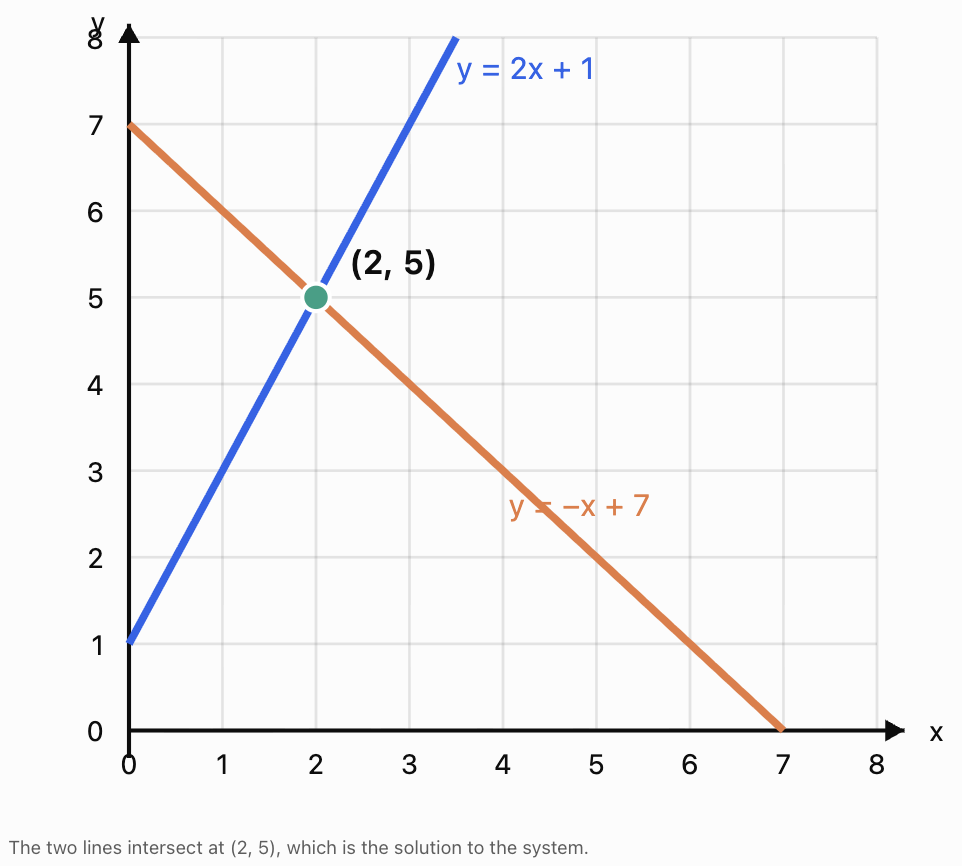
Step 1: Enter the equations
In a graphing calculator or graphing application, enter:
y = 2x + 1
y = −x + 7
Step 2: Display both graphs
The software draws both lines on the same coordinate plane.
Step 3: Locate the intersection
Use the graphing tool's intersection feature, or zoom in and inspect the crossing point.
The intersection is:
(2, 5)
Step 4: Interpret
The x-coordinate is 2.
The y-coordinate is 5.
Therefore:
x = 2
y = 5
Step 5: Verify algebraically
First equation:
5 = 2(2) + 1
5 = 5
Second equation:
5 = −2 + 7
5 = 5
Both equations are satisfied.
Final answer: (2, 5).
Using Desmos to Solve Systems
Desmos Graphing Calculator is a widely used graphing tool that allows users to enter equations and explore their graphs.
You can access it at Desmos Graphing Calculator.
Example
Solve:
3x + 2y = 12
x − y = 1
Step 1: Enter both equations
In Desmos, type:
3x + 2y = 12
x − y = 1
Desmos can graph equations written in standard form, so rearranging them into y = mx + b is not always necessary.
Step 2: Identify the intersection
The lines intersect at:
(2.8, 1.8)
Step 3: Verify
First equation:
3(2.8) + 2(1.8)
= 8.4 + 3.6
= 12
Second equation:
2.8 − 1.8 = 1
Answer: x = 2.8 and y = 1.8.
Why graphing is useful
The graph shows that the two lines cross at exactly one point.
This helps us understand that the system has a unique solution.
Graphing is particularly useful for visualising systems and checking answers.
Understanding Graphing Windows
A graphing window determines which part of the coordinate plane is visible.
For example, suppose:
y = 2x + 100
y = −x + 400
The intersection occurs at:
2x + 100 = −x + 400
3x = 300
x = 100
y = 300
The solution is:
(100, 300)
If the graphing window only displays x-values between −10 and 10 and y-values between −10 and 10, the intersection will not be visible.
This does not mean the system has no solution.
It means the graphing window is too small.
Improving the graph
Adjust the axes to include the expected solution.
For example:
x-axis: 0 to 150
y-axis: 0 to 450
The intersection will then be visible.
Important lesson
A missing intersection on the screen does not necessarily mean that the system has no solution.
Always consider the scale and viewing window.
Using GeoGebra to Solve Systems
GeoGebra is another useful tool for exploring equations and their solutions.
GeoGebra can graph equations, identify intersections, and explore how changing coefficients affects a system.
Worked Example: Two Lines
Solve:
2x + y = 11
x − y = 1
Enter both equations into the graphing calculator.
The two lines intersect at:
(4, 3)
Verification:
2(4) + 3 = 11
4 − 3 = 1
Both equations are satisfied.
Comparing graphing tools
|
Feature |
Desmos |
GeoGebra |
|---|---|---|
|
Graph two-variable equations |
Yes |
Yes |
|
Identify intersections |
Yes |
Yes |
|
Explore changing coefficients |
Yes |
Yes |
|
Work with three-dimensional objects |
Not in the standard 2D calculator |
Yes, using its 3D calculator |
|
Visualise three-variable linear systems |
Requires a suitable 3D tool |
Yes, using its 3D calculator |
For three-variable systems, use GeoGebra 3D Calculator rather than the ordinary two-dimensional graphing view.
Graphing Systems with No Solution
Consider:
y = 2x + 1
y = 2x − 4
Both equations have the same slope:
m = 2
However, they have different y-intercepts:
1 and −4
Therefore, the lines are parallel.
They never intersect.
A graphing calculator will display two distinct parallel lines.
Answer: No solution.
Verifying algebraically
Set the expressions equal:
2x + 1 = 2x − 4
Subtract 2x:
1 = −4
This is impossible.
The system is inconsistent.
Graphing Systems with Infinitely Many Solutions
Consider:
y = 3x + 2
2y = 6x + 4
Simplify the second equation:
y = 3x + 2
Both equations represent exactly the same line.
The graphs overlap completely.
Every point on the line satisfies both equations.
Answer: Infinitely many solutions.
Interpreting overlapping graphs
Graphing software may display what appears to be only one line.
This does not necessarily mean that one equation failed to graph.
It may mean that both equations represent the same line.
To confirm, simplify both equations algebraically.
Comparing the Three Types of Systems
|
Type of system |
Graphical appearance |
Number of solutions |
|---|---|---|
|
Independent, consistent |
Two lines intersect once |
One |
|
Inconsistent |
Two distinct parallel lines |
None |
|
Dependent, consistent |
Two lines coincide |
Infinitely many |
This classification is particularly useful when interpreting technological outputs.
Solving Three-Variable Systems with Technology
Two-variable systems can be represented by lines in a coordinate plane.
Three-variable linear systems are different.
Each equation generally represents a plane in three-dimensional space.
For example:
x + y + z = 9
2x + y + z = 11
x + 2y + z = 12
Each equation represents a plane.
The solution is the point shared by all three planes.
Worked Example: Three-Variable System
Solve:
x + y + z = 9
2x + y + z = 11
x + 2y + z = 12
Using graphing technology
Enter the equations into a suitable three-dimensional graphing application.
The software displays three planes.
If the planes share exactly one point, the system has a unique solution.
For this system, the common point is:
(2, 3, 4)
Verify manually
First equation:
2 + 3 + 4 = 9
Second equation:
2(2) + 3 + 4 = 11
Third equation:
2 + 2(3) + 4 = 12
All three equations are satisfied.
Confirm using elimination
Subtract the first equation from the second:
x = 2
Subtract the first equation from the third:
y = 3
Substitute into the first:
2 + 3 + z = 9
z = 4
Answer: (2, 3, 4).
The graphical and algebraic methods produce the same solution.
Interpreting Three-Dimensional Graphs
Three-dimensional graphs require careful interpretation because the planes may overlap or intersect in different ways.
One solution
Three planes share exactly one point.
The solution is one ordered triple.
No solution
The three planes have no common point.
For example, two of the planes may be parallel and distinct.
Infinitely many solutions
The planes may share a line or coincide.
In these situations, infinitely many points satisfy the equations.
Important limitation
A three-dimensional picture can be misleading because of perspective, overlapping surfaces, or the selected viewing angle.
A graph may suggest a particular intersection, but algebraic verification is needed to confirm the result.
Using Scientific Calculators
Many scientific calculators contain a simultaneous-equation solver.
For example, some models from Casio and Texas Instruments support solving linear systems.
The exact procedure depends on the calculator model.
A typical workflow is:
-
Select the equation or simultaneous-equation mode.
-
Choose the number of unknowns.
-
Enter the coefficients and constants.
-
Execute the calculation.
-
Read the values of the variables.
-
Substitute the results into the original equations.
Worked Example
Solve:
2x + y − z = 8
x + 2y + z = 7
3x − y + 2z = 7
The coefficients can be organised as follows:
|
Equation |
x coefficient |
y coefficient |
z coefficient |
Constant |
|---|---|---|---|---|
|
1 |
2 |
1 |
−1 |
8 |
|
2 |
1 |
2 |
1 |
7 |
|
3 |
3 |
−1 |
2 |
7 |
A calculator's simultaneous-equation mode can use these values to solve the system.
The solution is:
x = 3, y = 2, z = 0
Verification:
2(3) + 2 − 0 = 8
3 + 2(2) + 0 = 7
3(3) − 2 + 2(0) = 7
All three equations are satisfied.
Why coefficient tables are useful
Coefficient tables help prevent mistakes when entering equations into a calculator.
They are particularly important when an equation is missing a variable.
For example:
2x + 3z = 10
must be entered as:
2x + 0y + 3z = 10
The coefficient of y is zero.
Forgetting this zero may cause the remaining values to be entered in the wrong positions.
Solving Systems with Spreadsheets
Spreadsheet software such as Microsoft Excel or Google Sheets can also be used to solve systems.
Spreadsheets are especially useful when working with larger sets of equations, repeated calculations, or real-world data.
Representing a system using a matrix
Consider:
2x + y + z = 9
x + 3y + 2z = 13
3x + 2y + z = 11
The coefficients form the matrix:
|
x |
y |
z |
|---|---|---|
|
2 |
1 |
1 |
|
1 |
3 |
2 |
|
3 |
2 |
1 |
The constants form another column:
|
Constant |
|---|
|
9 |
|
13 |
|
11 |
We can represent the system using:
AX = B
where:
A = coefficient matrix
X = column of unknown variables
B = column of constants
Solving with matrix operations
When A is invertible:
X = A⁻¹B
Spreadsheet software can calculate the inverse matrix and multiply it by the constants.
In Excel or Google Sheets, a typical approach is to enter the coefficients in cells A1:C3 and the constants in E1:E3.
Then use:
=MMULT(MINVERSE(A1:C3),E1:E3)
In current spreadsheet versions that support dynamic arrays, the three results can spill into adjacent cells. Older spreadsheet versions may require array-formula entry.
For the example above, the solution is:
x = 2
y = 1
z = 4
Verification:
2(2) + 1 + 4 = 9
2 + 3(1) + 2(4) = 13
3(2) + 2(1) + 4 = 12
The third equation does not equal 11.
Therefore, the proposed values are not the solution.
The correct spreadsheet result is:
x = 3/2, y = −1/2, z = 13/2
Check:
2(3/2) − 1/2 + 13/2 = 9
3/2 + 3(−1/2) + 2(13/2) = 13
3(3/2) + 2(−1/2) + 13/2 = 10
This also fails the third equation.
We therefore need to solve the system carefully rather than accepting an unverified result.
Using elimination:
From the first equation:
z = 9 − 2x − y
Substitute into the second:
x + 3y + 2(9 − 2x − y) = 13
−3x + y = −5
y = 3x − 5
Substitute into the third:
3x + 2y + 9 − 2x − y = 11
x + y = 2
Substitute y = 3x − 5:
x + 3x − 5 = 2
4x = 7
x = 7/4
Then:
y = 3(7/4) − 5
y = 1/4
And:
z = 9 − 2(7/4) − 1/4
z = 21/4
Verification:
2(7/4) + 1/4 + 21/4 = 9
7/4 + 3(1/4) + 2(21/4) = 13
3(7/4) + 2(1/4) + 21/4 = 11
Correct solution: (7/4, 1/4, 21/4).
This example illustrates why verification remains essential, even when technology is involved.
When matrix methods cannot be used directly
The inverse-matrix formula requires an invertible square coefficient matrix.
If the matrix is singular, the inverse does not exist.
This may happen when the equations are dependent or when the system does not have a unique solution.
A calculator or spreadsheet may display an error rather than three numerical values.
That error does not automatically tell us whether the system has no solution or infinitely many solutions.
Further analysis is required.
Comparing Manual and Technological Methods
Different methods have different strengths.
|
Method |
Advantages |
Limitations |
Best used for |
|---|---|---|---|
|
Graphing |
Visual and intuitive |
Intersections may be approximate |
Understanding two-variable systems |
|
Substitution |
Shows algebraic reasoning clearly |
Can become complicated |
Systems with an easily isolated variable |
|
Elimination |
Systematic and exact |
Can involve lengthy arithmetic |
Two- and three-variable systems |
|
Scientific calculator |
Fast numerical answers |
May not show the reasoning |
Checking solutions |
|
Spreadsheet matrices |
Handles repeated or larger calculations |
Requires correct setup and an invertible matrix for the inverse method |
Data and numerical applications |
|
Computer algebra system |
Can produce exact symbolic solutions |
Outputs still require interpretation |
Complex algebraic systems |
When should technology be used?
Technology is particularly helpful when:
-
Coefficients are large or contain fractions.
-
A system has three or more unknowns.
-
Many similar systems must be solved.
-
A graph would improve understanding.
-
Manual calculations need checking.
-
The effects of changing coefficients are being investigated.
Manual methods are especially useful when the purpose is to understand how the equations work or to explain why a solution exists.
Technology is most effective when it supports mathematical reasoning rather than replacing it.
Worked Example: Comparing Manual and Calculator Solutions
Solve:
4x + 3y = 19
2x − 5y = −13
Manual method
Multiply the second equation by 2:
4x − 10y = −26
Subtract from the first equation:
13y = 45
y = 45/13
Substitute into the first equation:
4x + 3(45/13) = 19
4x = 247/13 − 135/13
4x = 112/13
x = 28/13
Exact solution: (28/13, 45/13).
Calculator method
A calculator may display:
x ≈ 2.153846
y ≈ 3.461538
These are decimal approximations of the same solution.
Comparing the outputs
The manual method gives exact fractions.
The calculator provides convenient decimal values.
Both are useful, but exact fractions are preferable when further algebraic calculations are required.
Technology and Rounding Errors
Computers and calculators often represent numbers using a limited number of decimal places.
Suppose a calculator displays:
x = 1.333333
The exact value might be:
x = 4/3
If we substitute the rounded decimal into an equation, the result may be slightly different from the expected constant.
For example:
3(1.333333) = 3.999999
rather than exactly 4.
This small difference is caused by rounding.
Good practice
Keep exact values when possible.
If decimal approximations are required, retain sufficient precision during calculations and round only the final result.
A very small numerical difference may be acceptable, but a large discrepancy usually indicates an error.
Technology in Real-World Applications
Business and Economics
A business can use spreadsheets to solve systems involving product quantities, prices, revenue, and production costs.
Engineering
Engineers use computer software to solve systems describing forces, electrical circuits, and structural behaviour.
Science
Scientists use systems of equations to analyse experimental data, mixtures, and physical relationships.
Transport
Transport planners can use mathematical models to analyse vehicle movement, scheduling, and resource allocation.
Computer Graphics
Three-dimensional computer graphics use systems of equations and matrix calculations to represent and transform objects.
Common Mistakes
Entering equations incorrectly
A missing negative sign or coefficient can completely change the answer.
Using an inappropriate graphing window
An intersection may exist outside the visible region.
Assuming two lines do not intersect because they appear parallel
Lines with very similar slopes may intersect far away.
Treating approximate values as exact
Graphical and numerical solutions may be rounded.
Confusing the coordinates
The solution (3, 5) means x = 3 and y = 5, not the reverse.
Assuming every calculator error means no solution
Some errors indicate a singular matrix or unsupported calculation rather than an inconsistent system.
Using a two-dimensional graphing tool for three-dimensional equations
Three-variable systems generally require a three-dimensional graphing application or another solving method.
Accepting a technological output without checking it
Always substitute the proposed values into the original equations.
Ignoring real-world restrictions
Negative quantities or fractional counts may be mathematically possible but contextually invalid.
Key Terms
-
Graphing calculator: A device or application that displays mathematical graphs.
-
Graphing software: Computer software used to represent equations visually.
-
Intersection point: A point shared by two or more graphs.
-
Simultaneous equations: Equations solved together to determine common variable values.
-
Numerical solution: A solution expressed using numerical values, often approximations.
-
Exact solution: A solution expressed without rounding.
-
Approximation: A value close to, but not necessarily equal to, an exact value.
-
Graphing window: The range of coordinates displayed on a graph.
-
Matrix: A rectangular arrangement of numbers.
-
Coefficient matrix: A matrix containing the coefficients of a system.
-
Inverse matrix: A matrix that reverses the effect of multiplication by an invertible matrix.
-
Singular matrix: A square matrix that does not have an inverse.
-
Computer algebra system: Software capable of performing symbolic mathematical operations.
-
Verification: Checking that a proposed solution satisfies the original equations.
-
Consistent system: A system with at least one solution.
-
Inconsistent system: A system with no solution.
-
Dependent equations: Equations that contain redundant information.
-
Rounding error: A small numerical difference caused by using approximate values.
Key Takeaways
-
Technology can help solve and visualise systems of equations.
-
Graphing software identifies solutions as intersection points.
-
Two-variable linear systems are represented by lines.
-
Three-variable linear systems are represented by planes.
-
Scientific calculators can solve systems using coefficients and constants.
-
Spreadsheets can use matrices to solve linear systems.
-
Exact algebraic solutions and approximate numerical solutions should be distinguished.
-
Graphing windows must be chosen carefully.
-
Technology can reveal whether systems have one, no, or infinitely many solutions, although further analysis may be needed.
-
Manual methods remain important for understanding and explaining mathematical relationships.
-
Every technological solution should be verified using the original equations.
Check Your Understanding
Recall and Understanding
1. Explain two advantages of using technology to solve systems of equations.
2. What does the intersection of two lines represent?
3. Why might a graphing calculator fail to display an intersection even when one exists?
4. Explain the difference between an exact solution and an approximate solution.
5. Why is verification necessary when using technology?
Application
6. Use a graphing calculator or algebraic method to solve:
y = 2x + 3
y = −x + 12
7. Solve and verify:
3x + 2y = 16
x − y = 2
8. Determine the number of solutions:
y = 4x + 1
y = 4x − 3
9. Determine the number of solutions:
2x + 4y = 12
x + 2y = 6
10. Solve the three-variable system:
x + y + z = 12
2x + y + z = 15
x + 2y + z = 16
Analysis and Challenge
11. A graphing calculator displays the intersection (2.6667, 3.3333). Explain why these coordinates may not be exact.
12. A student enters the system:
2x + 3y = 12
x − y = 1
The calculator gives x = 3 and y = 2. Verify whether this is correct.
13. Explain why a system with dependent equations may cause a matrix-inverse calculation to fail.
14. A calculator produces x = −5, y = 20, z = 15 for a ticket-sales problem. Explain what should be checked before accepting the result.
15. Solve using a calculator, spreadsheet, or elimination:
2x + y + z = 9
x + 3y + 2z = 13
3x + 2y + z = 11
Answers to Check Your Understanding
1. Technology can perform complicated calculations quickly and display graphs that help us understand the relationships between equations.
2. The intersection represents the ordered pair that satisfies both equations simultaneously.
3. The intersection may lie outside the selected graphing window.
4. An exact solution is not rounded, such as 4/3. An approximate solution is a numerical estimate, such as 1.3333.
5. Equations may have been entered incorrectly, numerical results may be rounded, or the output may not make sense in the original context.
6.
Set the equations equal:
2x + 3 = −x + 12
3x = 9
x = 3
Then:
y = 2(3) + 3 = 9
Answer: (3, 9).
7.
3x + 2y = 16
x − y = 2
From the second equation:
x = y + 2
Substitute:
3(y + 2) + 2y = 16
5y + 6 = 16
y = 2
x = 4
Verification:
3(4) + 2(2) = 16
4 − 2 = 2
Answer: (4, 2).
8. No solution. The lines have the same slope but different y-intercepts.
9. Infinitely many solutions. The second equation multiplied by 2 gives the first equation, so both represent the same line.
10.
x + y + z = 12
2x + y + z = 15
x + 2y + z = 16
Subtract the first equation from the second:
x = 3
Subtract the first equation from the third:
y = 4
Substitute:
3 + 4 + z = 12
z = 5
Answer: (3, 4, 5).
11. The calculator may have rounded the coordinates. The exact values could be fractions such as 8/3 and 10/3.
12.
Check the first equation:
2(3) + 3(2) = 12
Correct.
Check the second:
3 − 2 = 1
Correct.
Answer: (3, 2) is a valid solution.
13. Dependent equations can produce a singular coefficient matrix. A singular matrix has no inverse, so the inverse-matrix method cannot be applied directly.
14. The values should be substituted into the original equations. Since x = −5, the result is invalid if x represents a number of tickets. Ticket quantities must be nonnegative whole numbers.
15.
The system is:
2x + y + z = 9
x + 3y + 2z = 13
3x + 2y + z = 11
From the first equation:
z = 9 − 2x − y
Substitute into the second:
x + 3y + 2(9 − 2x − y) = 13
−3x + y = −5
y = 3x − 5
Substitute into the third:
3x + 2y + 9 − 2x − y = 11
x + y = 2
Substitute y = 3x − 5:
4x − 5 = 2
x = 7/4
Then:
y = 3(7/4) − 5 = 1/4
And:
z = 9 − 2(7/4) − 1/4 = 21/4
Verification:
2(7/4) + 1/4 + 21/4 = 9
7/4 + 3(1/4) + 2(21/4) = 13
3(7/4) + 2(1/4) + 21/4 = 11
Answer: (7/4, 1/4, 21/4).
Final Summary
Graphing calculators, mathematical software, and spreadsheets provide powerful ways to solve systems of equations and investigate their properties.
Technology is particularly valuable for complex calculations, visualising intersections, and checking answers. However, understanding substitution, elimination, and the meaning of solutions remains essential.
The most effective mathematical problem-solving combines the efficiency of technology with the accuracy, interpretation, and reasoning provided by algebraic methods.
5. Error Analysis
Learning outcomes
- I can identify common mistakes when solving systems.
- I can explain why incorrect methods fail.
- I can correct algebraic errors.
- I can evaluate completed solutions.
- I can improve my problem-solving accuracy.
Error Analysis: Solving Systems of Equations
Introduction
Solving systems of equations requires more than knowing how to use substitution, elimination, or graphing. It also requires the ability to recognise mistakes, explain why they occur, and correct them.
Even a small algebraic error can produce a completely different solution. A missing negative sign, an incorrectly distributed coefficient, or a substitution error may cause an otherwise correct method to fail.
For example, consider the system:
x + y = 10
x − y = 4
The correct solution is:
x = 7
y = 3
However, a student who makes a sign error during elimination might obtain x = 3 and y = 7.
Although these numbers add to 10, they do not satisfy the second equation:
3 − 7 = −4, not 4.
This demonstrates an important principle:
A solution to a system must satisfy every original equation, not just one of them.
Error analysis helps us become more accurate and independent mathematical problem-solvers. By examining incorrect work, we can understand why particular methods fail and develop strategies to prevent similar mistakes.
What Is Error Analysis?
Error analysis is the process of examining mathematical work to identify, explain, and correct mistakes.
It involves four important questions:
-
What was the student trying to do?
-
Where did the first mistake occur?
-
Why is that step incorrect?
-
How can the solution be corrected and verified?
The goal is not simply to identify a wrong answer. It is to understand the reasoning that produced the mistake.
Three Types of Errors
|
Error type |
Description |
Example |
|---|---|---|
|
Conceptual error |
Misunderstanding a mathematical idea |
Believing that a solution only needs to satisfy one equation |
|
Procedural error |
Applying a method incorrectly |
Multiplying only some terms when eliminating |
|
Arithmetic error |
Making a calculation mistake |
Calculating 8 − (−3) as 5 |
Some mistakes involve more than one category.
For example, subtracting a negative incorrectly may be an arithmetic mistake, but repeated errors could indicate a conceptual misunderstanding of negative numbers.
A Systematic Method for Finding Errors
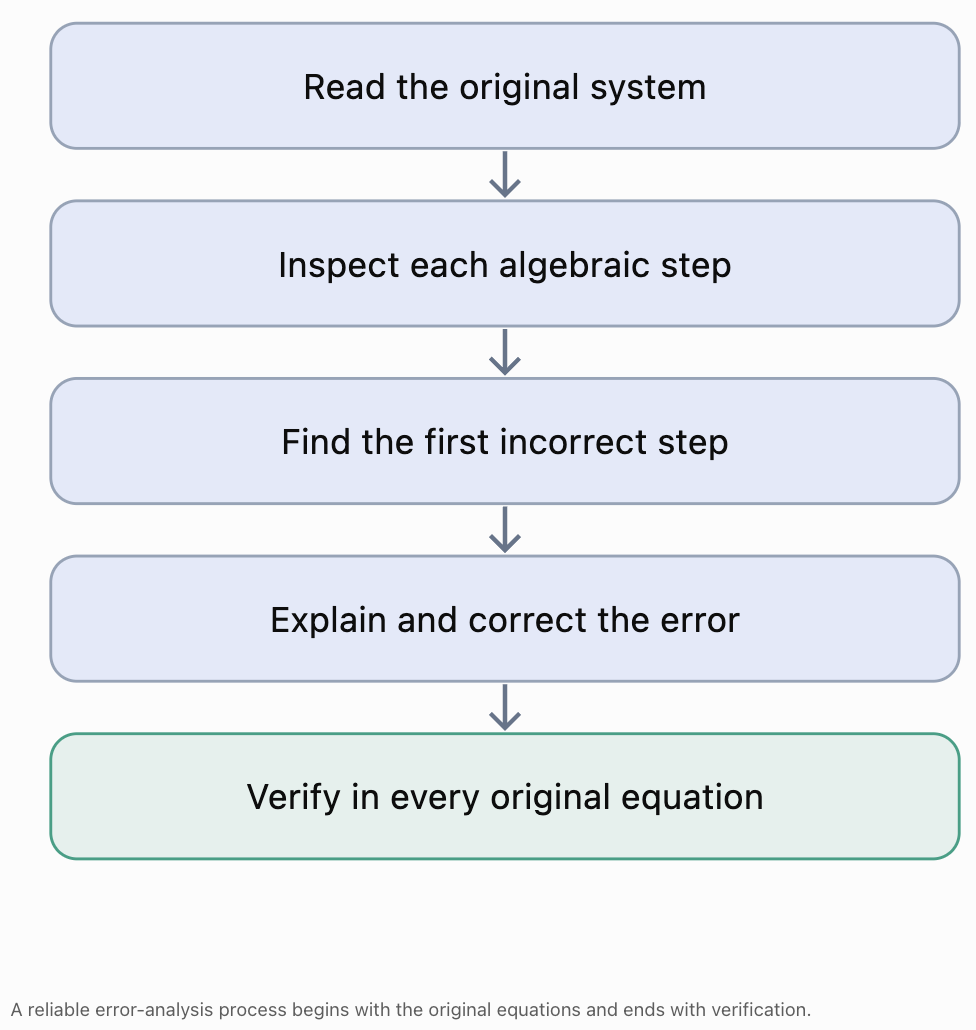
Why identify the first incorrect step?
Later steps may be mathematically correct based on an earlier mistake.
For example:
2x = 10
x = 5
These steps are correct.
But if the equation 2x = 10 was produced by incorrectly subtracting two earlier equations, the final answer may still be wrong.
Therefore, finding the first incorrect step is more useful than simply marking the final answer incorrect.
Error 1: Incorrectly Adding or Subtracting Equations
Consider:
x + y = 12
x − y = 4
A student writes:
(x + y) + (x − y) = 12 + 4
2x = 8
x = 4
Identify the error
The student combined the variables correctly:
(x + y) + (x − y) = 2x
However, the constants were added incorrectly.
12 + 4 = 16, not 8.
Correct solution
Add the equations:
2x = 16
x = 8
Substitute into the first equation:
8 + y = 12
y = 4
Correct answer: (8, 4).
Verify
8 + 4 = 12
8 − 4 = 4
Both equations are satisfied.
Prevention strategy
When adding or subtracting equations, treat the variables and constants as separate columns.
|
x terms |
y terms |
Constants |
|---|---|---|
|
x |
+y |
12 |
|
x |
−y |
4 |
|
2x |
0 |
16 |
This organisation helps prevent arithmetic mistakes.
Error 2: Forgetting to Distribute a Negative Sign
Consider:
3x + 2y = 16
x + 2y = 8
A student subtracts the second equation from the first:
(3x + 2y) − (x + 2y) = 16 − 8
But writes:
3x − x + 2y + 2y = 8
2x + 4y = 8
Identify the error
The negative sign outside the second set of parentheses must apply to every term.
The correct expression is:
3x + 2y − x − 2y = 8
The +2y and −2y cancel.
Correct solution
2x = 8
x = 4
Substitute into:
x + 2y = 8
4 + 2y = 8
2y = 4
y = 2
Correct answer: (4, 2).
Verify
3(4) + 2(2) = 16
4 + 2(2) = 8
Prevention strategy
Rewrite subtraction as addition of the opposite equation.
For example:
3x + 2y = 16
−x − 2y = −8
Add:
2x = 8
This makes the sign changes easier to see.
Error 3: Multiplying Only Part of an Equation
Consider:
2x + 3y = 12
3x − y = 5
A student wants to eliminate y.
They multiply the second equation by 3 but write:
3x − 3y = 15
Identify the error
The student multiplied −y and 5 by 3 but forgot to multiply 3x.
Every term must be multiplied by the same number.
The correct multiplication is:
3(3x − y) = 3(5)
9x − 3y = 15
Correct solution
Original first equation:
2x + 3y = 12
Modified second equation:
9x − 3y = 15
Add:
11x = 27
x = 27/11
Substitute into:
3x − y = 5
3(27/11) − y = 5
81/11 − y = 55/11
y = 26/11
Correct answer: (27/11, 26/11).
Verify
2(27/11) + 3(26/11)
= 54/11 + 78/11
= 132/11 = 12
3(27/11) − 26/11
= 81/11 − 26/11
= 55/11 = 5
Prevention strategy
Write the multiplier outside parentheses before simplifying:
3(3x − y) = 3(5)
This makes it clear that every term must be multiplied.
Error 4: Substituting into the Wrong Expression
Consider:
x + y = 9
2x − y = 6
A student rearranges the first equation:
x = 9 − y
Then substitutes into the second equation:
2(9 − y) − y = 6
However, the student writes:
18 − 2y + y = 6
Identify the error
The expression contains −y outside the parentheses.
It should remain negative.
The correct expansion is:
18 − 2y − y = 6
Correct solution
18 − 3y = 6
−3y = −12
y = 4
Then:
x = 9 − 4
x = 5
Correct answer: (5, 4).
Verify
5 + 4 = 9
2(5) − 4 = 6
Prevention strategy
Use parentheses when substituting expressions, especially those containing negative terms.
Do not remove parentheses until the signs have been handled carefully.
Error 5: Incorrectly Rearranging an Equation
Consider:
3x + 2y = 14
A student attempts to isolate y:
2y = 14 + 3x
y = 7 + 3x/2
Identify the error
To move +3x to the other side, subtract 3x from both sides.
The correct equation is:
2y = 14 − 3x
Therefore:
y = 7 − 3x/2
Why the mistake matters
An incorrect rearrangement changes the relationship represented by the equation.
If the incorrect expression is used in substitution, every later calculation may be wrong.
Prevention strategy
Think in terms of performing the same operation on both sides rather than simply "moving terms."
For example:
3x + 2y = 14
Subtract 3x from both sides:
2y = 14 − 3x
Divide both sides by 2:
y = (14 − 3x)/2
y = 7 − 3x/2
Error 6: Dividing Only One Term
Consider:
4x + 8y = 20
A student divides by 4 and writes:
x + 8y = 5
Identify the error
Every term must be divided by 4.
Correct division:
(4x)/4 + (8y)/4 = 20/4
Therefore:
x + 2y = 5
Prevention strategy
When dividing an equation by a number, show the division for every term.
The same principle applies when simplifying equations with three variables.
For example:
6x + 9y − 3z = 15
Divide every term by 3:
2x + 3y − z = 5
Error 7: Confusing the Order of Coordinates
Suppose a student correctly solves:
x = 3
y = 7
But writes:
(7, 3)
Identify the error
An ordered pair must be written in the order:
(x, y)
Therefore, the correct ordered pair is:
(3, 7)
For three-variable systems, the usual order is:
(x, y, z)
If:
x = 2
y = 5
z = 8
then the ordered triple is:
(2, 5, 8)
Prevention strategy
Write the variable labels immediately before giving the final ordered pair or triple.
Error 8: Assuming a Solution Only Needs to Satisfy One Equation
Consider:
x + y = 10
2x − y = 8
A student proposes:
x = 6
y = 4
Check the first equation
6 + 4 = 10
Correct.
Check the second equation
2(6) − 4 = 8
Correct.
In this case, the proposed solution is valid.
Now consider another proposed answer:
x = 7
y = 3
First equation:
7 + 3 = 10
Correct.
Second equation:
2(7) − 3 = 11
Incorrect.
Therefore, (7, 3) is not a solution.
Important principle
A solution to a system must satisfy all equations simultaneously.
This is one of the most important checks in error analysis.
Error 9: Incorrectly Interpreting Parallel Lines
Consider:
y = 2x + 3
y = 2x − 5
A student says:
"The lines have the same slope, so they have infinitely many solutions."
Identify the error
Having the same slope does not automatically mean the lines are identical.
The slopes are equal, but the y-intercepts are different.
Therefore, the lines are parallel and distinct.
They never intersect.
Correct answer: No solution.
Comparing parallel and coincident lines
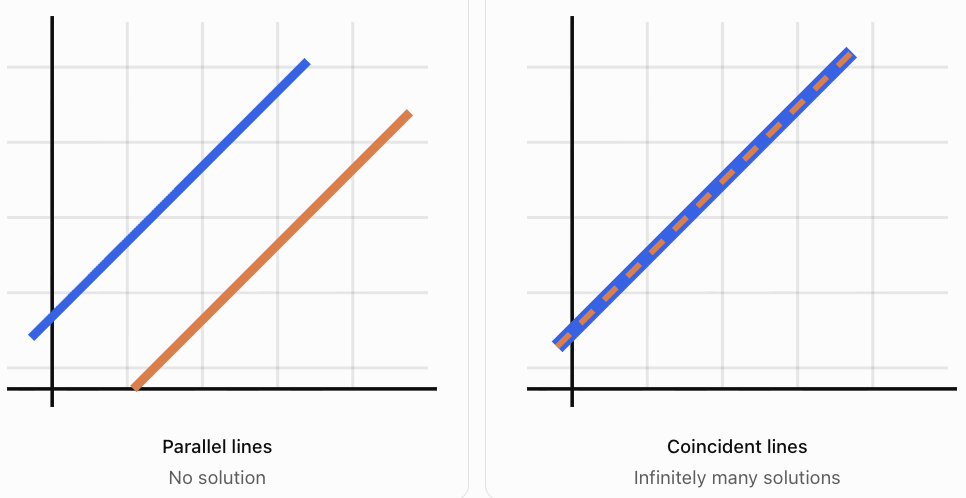
Prevention strategy
Compare both slopes and intercepts.
-
Same slope, different intercepts: no solution.
-
Same slope, same intercept: infinitely many solutions.
-
Different slopes: one solution.
Error 10: Misinterpreting a Contradiction
Consider:
2x + 3y = 12
4x + 6y = 30
A student multiplies the first equation by 2:
4x + 6y = 24
Then subtracts the second equation:
0 = −6
The student concludes:
"x = 0 and y = −6."
Identify the error
The expression 0 = −6 is not an equation involving x and y.
It is an impossible statement.
This means the original equations contradict each other.
Correct conclusion: The system has no solution.
Prevention strategy
Recognise that:
0 = a nonzero number
indicates an inconsistent system.
Error 11: Misinterpreting an Identity
Consider:
x + 2y = 6
2x + 4y = 12
Multiply the first equation by 2:
2x + 4y = 12
Subtract the second:
0 = 0
A student concludes:
"The answer is x = 0 and y = 0."
Identify the error
The statement 0 = 0 is always true.
It does not mean that the variables equal zero.
It indicates that the two equations represent the same relationship.
The system has infinitely many solutions.
Expressing the solutions
From:
x + 2y = 6
x = 6 − 2y
Let y = t.
Then:
x = 6 − 2t
The solutions are:
(6 − 2t, t)
where t is any real number.
Important distinction
|
Result during elimination |
Meaning |
|---|---|
|
0 = 5 |
Contradiction: no solution |
|
0 = 0 |
Redundant equation; further analysis is needed |
|
x = 4 |
A variable has been determined |
For a two-variable system of two linear equations, an identity after elimination means infinitely many solutions, provided the remaining equation is consistent.
For larger systems, an identity does not automatically guarantee infinitely many solutions because other equations may still impose restrictions or contradictions.
Error 12: Eliminating Different Variables in a Three-Variable System
Consider:
x + y + z = 12
2x − y + z = 7
x + 2y − z = 6
A student eliminates z from the first two equations:
x − 2y = −5
Then eliminates x from the first and third equations:
−y + 2z = 6
The student tries to solve these two equations as a two-variable system.
Identify the error
The first reduced equation contains x and y.
The second reduced equation contains y and z.
Together, they still involve three unknowns.
The elimination process has not reduced the system to two equations in the same two variables.
Correct method
Eliminate z from the first two equations:
(2x − y + z) − (x + y + z) = 7 − 12
x − 2y = −5
Now eliminate z from the first and third equations:
(x + y + z) + (x + 2y − z) = 12 + 6
2x + 3y = 18
Solve:
x − 2y = −5
2x + 3y = 18
Multiply the first equation by 2:
2x − 4y = −10
Subtract:
7y = 28
y = 4
Then:
x − 8 = −5
x = 3
Use the first original equation:
3 + 4 + z = 12
z = 5
Correct answer: (3, 4, 5).
Verify
3 + 4 + 5 = 12
2(3) − 4 + 5 = 7
3 + 2(4) − 5 = 6
Prevention strategy
When solving three-variable systems by elimination, eliminate the same variable from two different pairs of equations.
This produces two equations involving the same two remaining variables.
Error 13: Forgetting a Zero Coefficient
Consider:
2x + 3z = 12
x + y + z = 9
3x − y + 2z = 13
A student enters the first equation into a calculator as:
2x + 3y + 0z = 12
Identify the error
The first equation does not contain y.
Therefore, the coefficient of y is zero.
The correct form is:
2x + 0y + 3z = 12
Correct coefficient table
|
Equation |
x |
y |
z |
Constant |
|---|---|---|---|---|
|
2x + 3z = 12 |
2 |
0 |
3 |
12 |
|
x + y + z = 9 |
1 |
1 |
1 |
9 |
|
3x − y + 2z = 13 |
3 |
−1 |
2 |
13 |
Prevention strategy
Before entering a system into technology, write every equation in the same variable order:
ax + by + cz = d
Include zero coefficients for missing variables.
Error 14: Rounding Too Early
Consider:
3x = 10
A student calculates:
x = 3.33
Then uses this rounded value in another equation:
2x + y = 12
2(3.33) + y = 12
y = 5.34
Identify the error
The exact value of x is:
x = 10/3
Using 3.33 introduces a small rounding error.
Correct solution
2(10/3) + y = 12
20/3 + y = 36/3
y = 16/3
Therefore:
(x, y) = (10/3, 16/3)
Decimal approximations:
x ≈ 3.3333
y ≈ 5.3333
Prevention strategy
Use exact fractions whenever possible.
Round only when presenting the final answer, unless the problem specifically requires an approximate result.
Error 15: Trusting Technology Without Verification
A calculator gives the solution:
x = 2
y = 3
for the system:
2x + y = 7
x + 2y = 9
Check the first equation
2(2) + 3 = 7
Correct.
Check the second equation
2 + 2(3) = 8
But the original equation requires 9.
The calculator output does not satisfy the system.
Correct solution
From the first equation:
y = 7 − 2x
Substitute into the second:
x + 2(7 − 2x) = 9
x + 14 − 4x = 9
−3x = −5
x = 5/3
Then:
y = 7 − 2(5/3)
y = 11/3
Correct answer: (5/3, 11/3).
Verify
2(5/3) + 11/3 = 21/3 = 7
5/3 + 2(11/3) = 27/3 = 9
Why might technology give an incorrect result?
Possible reasons include:
-
An equation was entered incorrectly.
-
A coefficient was omitted.
-
A negative sign was entered incorrectly.
-
The output was copied incorrectly.
-
The student read the wrong coordinate or variable.
Technology is useful, but the user remains responsible for checking the result.
Error 16: Incorrectly Translating Word Problems
A school sells adult and student tickets.
Adult tickets cost $12.
Student tickets cost $8.
A total of 100 tickets are sold.
The total revenue is $960.
A student defines:
a = adult tickets
s = student tickets
Then writes:
a + s = 100
12a + 8s = 100
Identify the error
The first equation correctly represents the total number of tickets.
The second equation should represent total revenue, which is $960, not 100 tickets.
Correct equations
a + s = 100
12a + 8s = 960
Solve
Multiply the first equation by 8:
8a + 8s = 800
Subtract from the revenue equation:
4a = 160
a = 40
Then:
s = 60
Verify
40 + 60 = 100 tickets
12(40) + 8(60)
= 480 + 480
= $960
Correct answer: 40 adult tickets and 60 student tickets.
Prevention strategy
Write the meaning and units beside each equation.
For example:
a + s = 100 tickets
12a + 8s = $960
This helps prevent mixing quantities with monetary values.
Error 17: Accepting an Unrealistic Solution
Suppose a system representing ticket sales produces:
a = 25.5
s = 40
c = 34.5
These values may satisfy the equations algebraically.
However, tickets are counted in whole numbers.
A school cannot sell half of an individual ticket if the variables represent numbers of complete tickets.
Correct interpretation
The system has an algebraic solution, but the solution is not valid under the real-world requirement that ticket counts be nonnegative integers.
This may indicate that the original data or assumptions need to be reviewed.
Prevention strategy
After solving, ask:
-
Are the values positive or nonnegative when required?
-
Must the answers be whole numbers?
-
Are the units correct?
-
Do the values satisfy any maximum or minimum limits?
-
Do the results make sense in context?
Error 18: Incorrectly Reading a Graph
Suppose two lines intersect at:
(4, 7)
A student reads the solution as:
x = 7
y = 4
Identify the error
Coordinates are written in the order:
(x, y)
Therefore:
x = 4
y = 7
Other graphing errors
Students may also:
-
Misread the scale of an axis.
-
Assume every grid square represents one unit.
-
Estimate an intersection inaccurately.
-
Confuse the x-intercept with the solution.
-
Mistake parallel lines for intersecting lines when the graph is zoomed out.
Prevention strategy
Read the axis labels and scales carefully.
Whenever possible, use a graphing tool's intersection feature and verify the coordinates algebraically.
Error 19: Assuming a System Has a Unique Solution
Consider:
x + y = 10
2x + 2y = 20
A student tries to solve for x and y and concludes:
x = 5
y = 5
Identify the error
The ordered pair (5, 5) satisfies both equations, but it is not the only solution.
Other solutions include:
(4, 6)
(3, 7)
(8, 2)
The second equation is twice the first.
Both represent the same line.
Therefore, the system has infinitely many solutions.
Correct answer
From:
x + y = 10
y = 10 − x
The general solution is:
(x, y) = (t, 10 − t)
where t is any real number.
Prevention strategy
Before concluding that a system has one solution, check whether the equations are independent.
Evaluating Completed Solutions
When reviewing another student's work, it is helpful to use a structured checklist.
A solution should not be considered complete until these checks have been considered.
Strategies for Improving Accuracy
Work in clearly labelled steps
Label original equations A, B, and C.
Label reduced equations D and E.
This makes multi-step work easier to follow.
Keep equations aligned
Write matching variable terms beneath one another.
For example:
2x + 3y = 12
4x − 3y = 18
Adding gives:
6x = 30
x = 5
Use parentheses carefully
When subtracting equations or substituting expressions, parentheses help preserve signs.
Avoid unnecessary decimals
Fractions often produce more accurate answers than rounded decimals.
Estimate before solving
If a word problem involves positive prices or quantities, consider whether the final answer should be positive.
Check with a second method
If you solve using elimination, verify using substitution or technology.
Always return to the original equations
Checking only the reduced equations may fail to reveal an earlier mistake.
Explain why an error occurred
Understanding the cause of a mistake helps prevent it from happening again.
Common Mistakes Summary
|
Mistake |
Why it fails |
How to prevent it |
|---|---|---|
|
Sign error |
Changes the equation |
Use parentheses and rewrite subtraction carefully |
|
Incorrect distribution |
Changes coefficients |
Multiply every term |
|
Incorrect rearrangement |
Changes the relationship |
Perform the same operation on both sides |
|
Wrong substitution |
Produces an incorrect expression |
Substitute using parentheses |
|
Incorrect elimination |
Fails to remove the intended variable |
Align coefficients before combining |
|
Coordinate reversal |
Assigns values to wrong variables |
Write answers in (x, y) or (x, y, z) order |
|
Misreading a graph |
Gives incorrect coordinates |
Check scales and intersection tools |
|
Misinterpreting 0 = 0 |
Treats an identity as a numerical solution |
Check for dependent equations |
|
Misinterpreting 0 = 5 |
Treats a contradiction as variable values |
Recognise inconsistency |
|
Early rounding |
Introduces numerical error |
Keep exact values |
|
Incorrect model |
Misrepresents the problem |
Define variables and units |
|
No verification |
Allows errors to remain undetected |
Check every original equation |
Key Terms
-
Error analysis: The process of identifying, explaining, and correcting mathematical mistakes.
-
Conceptual error: A mistake caused by misunderstanding a mathematical idea.
-
Procedural error: A mistake caused by applying a method incorrectly.
-
Arithmetic error: A mistake in numerical calculation.
-
Verification: Checking whether a proposed solution satisfies the original equations.
-
Substitution: Replacing a variable with a known value or equivalent expression.
-
Elimination: Combining equations to remove a variable.
-
Distribution: Multiplying every term inside parentheses by an outside factor.
-
Coefficient: A number multiplying a variable.
-
Ordered pair: Two values written in a specified order.
-
Ordered triple: Three values written in a specified order.
-
Consistent system: A system with at least one solution.
-
Inconsistent system: A system with no solution.
-
Dependent equations: Equations that contain redundant information.
-
Contradiction: An impossible statement, such as 0 = 5.
-
Identity: A statement that is always true, such as 0 = 0.
-
Exact solution: A solution expressed without rounding.
-
Approximate solution: A solution expressed using estimated or rounded values.
-
Constraint: A restriction on allowable values.
-
Mathematical model: A mathematical representation of a real-world situation.
Key Takeaways
-
Error analysis helps identify and correct mistakes when solving systems.
-
The first incorrect step is usually the most important one to locate.
-
Sign errors are common during subtraction, elimination, and substitution.
-
Every term must be multiplied or divided when transforming an equation.
-
A solution must satisfy every original equation.
-
A contradiction indicates that a system has no solution.
-
An identity indicates redundant information, but other equations must still be considered.
-
Graphical solutions must be interpreted using the correct coordinate order and scale.
-
Technological outputs should always be checked.
-
Real-world solutions must satisfy contextual restrictions.
-
Organised work and careful verification greatly improve accuracy.
Check Your Understanding
For each question, identify the mistake, explain why it is incorrect, and provide the corrected solution.
Recall and Understanding
1. A student says:
"If two equations have the same slope, their system always has infinitely many solutions."
Explain why this statement is incorrect.
2. A student solves a system and obtains:
0 = 7
They conclude that x = 0 and y = 7.
Explain the error.
3. A student solves a system and obtains:
0 = 0
They conclude that x = 0 and y = 0.
Explain why this conclusion is not justified.
4. A student obtains:
x = 4
y = 6
They write the final solution as (6, 4).
Identify the mistake.
5. Explain why checking only one original equation is insufficient when verifying a solution.
Finding Algebraic Errors
6. A student solves:
x + y = 14
x − y = 6
Their work is:
2x = 8
x = 4
Find the error and solve correctly.
7. A student multiplies:
3x − 2y = 8
by 2 and writes:
6x − 2y = 16
Correct the error.
8. A student rearranges:
4x + 3y = 18
and writes:
3y = 18 + 4x
Find the error and correctly isolate y.
9. A student substitutes x = 5 − y into:
2x − y = 4
and writes:
10 − 2y + y = 4
Identify the error and solve the system.
10. A student divides:
6x + 9y = 15
by 3 and obtains:
2x + 9y = 5
Correct the equation.
Evaluating Completed Solutions
11. A student claims that (3, 4) solves:
x + y = 7
2x − y = 3
Verify the claim and find the correct solution if necessary.
12. A student concludes that:
y = 3x + 2
y = 3x − 5
has infinitely many solutions because both equations have the same slope.
Explain the error and give the correct conclusion.
13. A student solves:
x + y + z = 12
2x + y + z = 16
x + 2y + z = 17
and obtains:
(4, 5, 2)
Evaluate the solution and correct it.
14. A calculator gives:
x = 2.3333
y = 3.6667
for the system:
3x + 3y = 18
3x − 3y = −4
Determine whether the displayed values are accurate approximations. Find the exact solution.
15. A school sells adult tickets for $12 and student tickets for $8. A total of 100 tickets are sold, generating $920.
A student writes:
a + s = 100
12a + 8s = 100
Identify the modelling error, correct the system, and solve it.
Answers to Check Your Understanding
1. Same slope misconception
Two lines with the same slope may be parallel or coincident.
If their y-intercepts are different, the lines are parallel and have no solution.
If their y-intercepts are also the same, the lines coincide and have infinitely many solutions.
Therefore, equal slopes alone do not guarantee infinitely many solutions.
2. Misinterpreting a contradiction
The statement:
0 = 7
is impossible.
It does not assign values to x or y.
Correct conclusion: The system has no solution.
3. Misinterpreting an identity
The statement:
0 = 0
is always true.
It does not mean that x and y equal zero.
It indicates that the elimination step produced redundant information.
For a two-equation, two-variable linear system, this means the equations are dependent and the system has infinitely many solutions, provided the remaining equation is consistent.
4. Reversing coordinates
The correct order is:
(x, y)
Since x = 4 and y = 6:
Correct answer: (4, 6).
5. Incomplete verification
A proposed solution may satisfy one equation but fail another.
A valid solution must satisfy every equation simultaneously.
Therefore, all original equations must be checked.
6. Incorrect addition
Original system:
x + y = 14
x − y = 6
Adding the equations:
2x = 20
x = 10
Substitute into the first equation:
10 + y = 14
y = 4
Correct answer: (10, 4).
The student incorrectly calculated 14 + 6 as 8.
Verification:
10 + 4 = 14
10 − 4 = 6
7. Incorrect multiplication
Original equation:
3x − 2y = 8
Multiply every term by 2:
2(3x) − 2(2y) = 2(8)
Correct equation: 6x − 4y = 16.
The student forgot to multiply the y-term.
8. Incorrect rearrangement
Original equation:
4x + 3y = 18
Subtract 4x from both sides:
3y = 18 − 4x
Divide by 3:
y = 6 − 4x/3
The student's error was changing +4x into +4x on the opposite side instead of −4x.
9. Substitution sign error
The system is:
x = 5 − y
2x − y = 4
Correct substitution:
2(5 − y) − y = 4
10 − 2y − y = 4
10 − 3y = 4
−3y = −6
y = 2
Then:
x = 5 − 2 = 3
Correct answer: (3, 2).
Verification:
3 = 5 − 2
2(3) − 2 = 4
The student incorrectly changed −y into +y.
10. Incorrect division
Original equation:
6x + 9y = 15
Divide every term by 3:
6x/3 + 9y/3 = 15/3
Correct equation: 2x + 3y = 5.
11. Incorrect proposed solution
Original system:
x + y = 7
2x − y = 3
Check (3, 4):
3 + 4 = 7
Correct.
2(3) − 4 = 2
But the second equation requires 3.
Therefore, (3, 4) is incorrect.
Solve by adding the equations:
3x = 10
x = 10/3
Substitute:
10/3 + y = 7
y = 11/3
Correct answer: (10/3, 11/3).
Verification:
10/3 + 11/3 = 7
2(10/3) − 11/3 = 3
12. Incorrect interpretation of slopes
The equations are:
y = 3x + 2
y = 3x − 5
Both lines have slope 3, but their y-intercepts are different.
Therefore, they are distinct parallel lines.
Correct answer: No solution.
13. Incorrect three-variable solution
Original system:
x + y + z = 12
2x + y + z = 16
x + 2y + z = 17
Check the proposed solution (4, 5, 2):
First equation:
4 + 5 + 2 = 11
But the required total is 12.
Therefore, the proposed solution is incorrect.
Subtract the first equation from the second:
x = 4
Subtract the first equation from the third:
y = 5
Substitute into the first equation:
4 + 5 + z = 12
z = 3
Correct answer: (4, 5, 3).
Verification:
4 + 5 + 3 = 12
2(4) + 5 + 3 = 16
4 + 2(5) + 3 = 17
14. Incorrect calculator output
Original system:
3x + 3y = 18
3x − 3y = −4
Add the equations:
6x = 14
x = 7/3
Substitute into the first equation:
3(7/3) + 3y = 18
7 + 3y = 18
3y = 11
y = 11/3
Exact solution: (7/3, 11/3).
Decimal approximations:
x ≈ 2.3333
y ≈ 3.6667
The calculator values are accurate to four decimal places.
However, substituting the rounded decimals may produce small differences from the exact constants.
15. Incorrect mathematical model
Let:
a = adult tickets
s = student tickets
The total ticket equation is:
a + s = 100
The revenue equation should be:
12a + 8s = 920
The student incorrectly used the ticket total of 100 as the revenue.
Multiply the first equation by 8:
8a + 8s = 800
Subtract from the revenue equation:
4a = 120
a = 30
Then:
s = 100 − 30
s = 70
Correct answer: 30 adult tickets and 70 student tickets.
Verification:
30 + 70 = 100 tickets
12(30) + 8(70)
= 360 + 560
= $920
Final Summary
Error analysis is an essential part of solving systems of equations. It develops the ability to recognise incorrect reasoning, correct algebraic mistakes, and evaluate whether a solution is mathematically and contextually valid.
The most effective approach is to examine each step carefully, identify the first error, explain why it occurred, and correct the work before verifying the final result.
A strong mathematical problem-solver does not simply find answers. They understand their methods, recognise mistakes, and can demonstrate why their solutions are correct.